
PART 1: THE GILDED CAGE
When the red carpet shines beneath a thousand powerful spotlights, the distance between absolute pride and complete disaster can sometimes be measured in a single heartbeat. For me, that distance disappeared in one afternoon inside a crowded hall.
My name is Alistair Prescott.
If you read the financial newspapers or attend charity galas among Boston’s wealthiest families, you probably know my face and the story people tell about me. I am known as the self-made titan of high-stakes investment funds—the man who supposedly transformed a modest inheritance into an empire filled with glass towers, investment portfolios, and offshore accounts.
But behind the custom-made suits and carefully controlled public image was a very different story.
My personal life was completely bankrupt.
It was a Tuesday afternoon, and the air inside the Symphony Center in downtown Boston was heavy with expensive perfume, cologne, and nervous ambition. Large banners carrying the crest of the National Scholastic Excellence Tournament hung from the vaulted ceilings, glowing beneath the warm stage lights.
Soft instrumental music floated from hidden speakers, but it struggled to compete with the rustle of designer gowns and the sharp sound of expensive leather shoes striking the polished marble floor.
For the wealthy families gathered inside, this was much more than an academic competition.
It was a bloodless battlefield.
We had come to compare social status, display our children like prized racehorses, and chase the kind of approval that could later be turned into influence and connections.
I stood near the VIP partition with a crystal glass of sparkling water in my right hand. My left hand rested inside the pocket of a suit that had cost more than many families earned in an entire year.
I was in my mid-forties, and the world liked to tell me that age had been kind to me. I had the confident, untouchable presence of a man who controlled enormous corporate power and had millions of dollars within easy reach.
The heavy platinum watch around my wrist caught the surrounding light and reflected cold flashes against the velvet curtains.
Beside me, Genevieve was engaged in a furious, whispered battle with a jacket.
She was my wife, a woman whose beauty was maintained with the strict discipline of a military operation. She wore a skin-tight scarlet dress, while her face was covered by a flawless layer of cosmetic work designed to hide the anxiety slowly appearing in her eyes.
Her manicured fingers aggressively smoothed the collar of the blazer worn by Benedict, her twelve-year-old son from a previous marriage.
“You better get this right today, Benedict,” Genevieve whispered sharply as she leaned toward him. “Do you hear me?”
The boy physically pulled away from her breath and stared down at his polished black shoes.
“Alistair canceled a huge board meeting with our top investors today just to sit here with you,” Genevieve continued. Her fingers tightened around his shoulder. “The private tutors we hired are some of the best university professors money can buy. They cost tens of thousands of dollars every month. If you do not bring home a major award today, how am I supposed to face everyone in our circle?”
I watched the boy carefully as he shrank beneath her stare.
His face was pale and slightly soft from a childhood without physical hardship. Yet he looked exhausted, and that exhaustion did not belong on the face of a twelve-year-old.
Benedict had grown up surrounded by luxury, but he had also grown accustomed to being treated like an expensive decoration for his mother’s social image.
I gave him the faint, practiced smile I used when closing a hostile corporate takeover.
Then I stepped closer and placed a hand on his trembling shoulder.
“Be confident out there, Benedict,” I said in a low, authoritative voice. “You are part of this family now, so you need to walk onto that stage with your head held high. I made sure you had the best study materials, the finest tutors, and every advantage possible. Your only responsibility today is to go up there and bring that title home.”
To an outsider, my words might have sounded encouraging.
Perhaps even fatherly.
But I knew they contained no real warmth.
Benedict could feel that too.
Genevieve, however, immediately relaxed when she heard my voice. A victorious smile spread across her painted lips. She leaned against my arm while her eyes moved over the nearby groups of parents.
It was a silent announcement.
The most powerful corporate man in the room belonged to her.
And her son’s future was paved with my money.
As Genevieve’s expensive perfume filled my lungs, a sudden chill moved through my body.
For a moment, it felt as if all the oxygen had disappeared from the room.
It had been thirteen years since I had traded my integrity for a place at this table.
Thirteen years since I had entered the ruthless world of multimillion-dollar hedge funds, luxury real estate deals, and parties that lasted until sunrise.
I had deliberately destroyed my old life so I could build myself a gilded throne.
I had everything the elite world promised.
Status.
Fearful respect from competitors.
A beautiful woman on my arm who constantly fed my ego.
Yet as the ice in my glass made a soft clinking sound, I found myself wondering why my chest felt like an empty cavern.
The truth was simple.
Money could buy obedience, but it could not buy one second of genuine peace.
My life had become a carefully rehearsed performance.
Genevieve loved being the wife of a billionaire almost as much as she loved the endless credit limits.
Benedict called me by my first name with the nervous respect of a child who was afraid of disappointing me.
And beneath all the luxury, the foundation of my life had already rotted away.
Then a memory I had spent a fortune trying to bury suddenly returned.
Thirteen years earlier, I had not been Alistair Prescott, the powerful investment titan.
I had been Rick.
A broke, ambitious, bitter man trapped beneath the weight of poverty.
And during those dark years, there had been one woman who had been my anchor.
She saved every dollar from her tiny paycheck. She cooked warm meals on a broken stove during freezing winters. She looked at me as though I were the center of her entire universe.
Her name was Beatrice Montgomery.
When I closed my eyes against the glare of the chandeliers, I no longer saw Genevieve’s bright scarlet dress.
I saw Beatrice.
Her clear, steady eyes.
Her dark hair tied back with a simple elastic band.
Her hands slightly rough from the daily struggle of survival.
“Alistair, what are you staring at?” Genevieve asked suddenly.
Her sharp voice broke through my memory as she gently shook my arm for the cameras nearby.
“You look like you are a million miles away from this room.”
I blinked and swallowed the dryness in my throat.
“It is nothing,” I lied smoothly. “I was just thinking about a corporate acquisition.”
“Forget the corporate acquisitions until tomorrow morning,” Genevieve purred.
She leaned her head against my shoulder so the nearby photographer could capture the perfect angle.
“The ushers are moving everyone into the main auditorium now. I have already messaged several journalist friends so we get proper media coverage tomorrow. We need to remind everyone what real class looks like.”
“Then let us go inside,” I replied, mechanically adjusting the silk cuffs of my shirt.
We moved through the velvet ropes toward our assigned seats.
Whispers followed us like ghosts.
People murmured my name. They pointed at my suit. They whispered about the enormous fortune behind our family.
Once, those whispers had been like a drug.
They had fueled my ambition.
Today, they sounded like meaningless noise coming from a sinking ship.
I took my seat in the center of the VIP section, where the plush chair seemed to mold itself perfectly around me.
Genevieve immediately pulled out a compact mirror and began correcting a tiny flaw in her eyeliner.
Benedict slouched in his seat and secretly tapped at his smartphone beneath his jacket.
I leaned back and stared at the enormous red curtains covering the stage.
I took a slow breath, trying to steady my uneven heartbeat.
I told myself I was still the master of my universe.
I told myself I was still the author of my own destiny.
I had no idea that less than fifty feet away from me sat the person who would completely destroy the life I had spent thirteen years building.
She was waiting quietly for the curtain to rise.
PART 2: THE GHOSTS OF THE PAST
The auditorium lights slowly began to fade, plunging the enormous room into an expectant twilight.
A single circle of bright white light appeared in the darkness, illuminating the center of the stage.
Then the host walked out.
His voice had been trained to carry all the way to the back of the hall, and when he began speaking, applause exploded through the room like a physical wave.
But to me, the sound seemed distant.
Muffled.
As though I were listening from beneath deep water.
My body remained anchored to the velvet seat, but my mind had already been dragged thirteen years into the past.
Back to an autumn afternoon that had changed the rest of my life.
Our tiny rented apartment in an old neighborhood always smelled of damp rain.
Moisture seeped through the porous brick walls and mixed with the earthy smell of herbal tea Beatrice drank whenever her stomach bothered her.
I had been twenty-nine years old.
I was drowning in the catastrophic failure of my first technology company. Every dollar of capital I had managed to scrape together had disappeared.
The people who had once happily accepted my drinks and promised to support me had stopped answering my calls.
I was trapped.
Humiliated.
Buried under debt.
And then Genevieve appeared.
She was an investor five years older than me, with the confidence of someone who had never been told no.
More importantly, she had access to a family trust that could erase my debts with one signature.
She saw my desperation.
And I saw her usefulness.
Our business meetings slowly became something else.
Something quiet.
Something transactional.
Genevieve had been completely honest about what she wanted. She needed a competent man who could manage her complicated inherited estate.
I needed a ladder out of the financial grave I had dug for myself.
Her offer came with one strict condition.
I had to be completely free of my past.
I made my decision without hesitation.
Even now, I remembered the day I packed my duffel bag.
Beatrice sat at our tiny kitchen table, her knuckles white as she gripped the edge while fighting through another wave of morning sickness.
Between us, on the scratched wooden surface, lay a sonogram printout.
Two tiny shadows were visible.
Two babies.
I had rehearsed what I would say for days.
I expected anger.
I expected screaming.
I expected her to throw dishes, collapse in tears, or beg me not to leave.
I had prepared myself to play the practical realist.
I would tell her that a drowning man could not save two babies and a struggling partner.
But Beatrice did not scream.
She did not cry.
She simply sat there in a silence so heavy that I could hear the steady drip of the leaking bathroom faucet.
Finally, she lifted her head.
There were no tears in her eyes.
Her expression was cold and distant.
She no longer looked at me like a partner.
She looked at me like a stranger.
She placed one hand over her stomach, nodded once, and spoke calmly.
“You can leave now,” Beatrice said softly. “From this moment forward, you go your way and I will go mine. These children belong to me. They have nothing to do with your life.”
I walked out of that building feeling relieved.
I convinced myself I had made the practical choice.
I told myself that eventually Beatrice would understand how impossible her financial situation was and would come looking for me.
I imagined that my absence would teach her a lesson about reality.
Instead, Beatrice disappeared.
For thirteen years, I heard nothing.
She never demanded child support.
She never left angry messages.
She never filed legal claims against me.
Nothing.
Her complete silence became a daily reminder that someone in this world considered my entire empire of money completely worthless.
“Look at Benedict,” Genevieve whispered sharply, dragging me back into the present.
She pointed toward her son, who was openly yawning through the opening speeches.
“He stayed up all week doing mock exams for this event. If he does not win a top prize today, I will personally complain to the directors. We paid fifty thousand dollars to his academy!”
I looked at Benedict and felt a quiet wave of frustration.
I remembered him throwing a glass onto the floor because staff had brought the wrong brand of water.
I remembered signing enormous checks for private schools simply to make his poor grades disappear.
He had become an empty container filled with the entitlement his mother had poured into him.
Then another thought struck me.
What had happened to my own children?
What had become of those two tiny shadows on that old sonogram?
Had they grown up struggling?
Were they angry teenagers who hated the father who abandoned them?
For years, I had buried those questions beneath stock portfolios and business deals.
But sitting there, the empty space inside my chest seemed to grow wider.
“We now ask the audience to welcome our competitor delegations to the main stage,” the host announced through the sound system.
Music filled the auditorium.
Bright spotlights swept across the crowd.
I straightened my jacket and forced myself to regain control.
I refused to let old memories destroy me in public.
I glanced toward Genevieve.
She had placed her phone on a small tripod and was livestreaming herself while whispering about success to her online followers.
The display disgusted me.
I looked away and reached for my glass.
Then my eyes moved across the enormous auditorium toward the opposite VIP section.
My hand stopped in midair.
Five rows above the main floor, sitting quietly in her seat, was a woman wearing a simple, tailored dark green dress.
She wore no flashy jewelry.
Only a plain silver pin held her dark hair back.
Surrounded by people desperately trying to display their wealth and importance, she possessed a calmness that seemed completely untouchable.
My heart stopped.
The crystal glass almost slipped from my fingers.
It was Beatrice.
She had not been destroyed.
She had not surrendered to her circumstances.
She was sitting in the VIP section of one of the most exclusive academic events in the region.
And as I watched her calmly looking toward the stage, I knew with absolute certainty that my past had just walked back into my life.
PART 3: THE UNBROKEN BOND
“Alistair, why are your hands shaking?” Genevieve asked.
Her voice cut through my thoughts.
I quickly placed my glass on the small table beside me and pressed both hands against my knees to hide the trembling.
“It is nothing,” I answered quietly. “The air conditioning is cold over here.”
Genevieve did not continue questioning me.
Her eyes had already followed mine across the auditorium toward the woman in the green dress.
Her lips curled immediately with disdain.
“Look at that woman over there,” Genevieve whispered, loudly enough for several nearby guests to hear. “She looks like someone who won a door prize just to get into this section.”
She glanced at Beatrice’s dress.
“That dress is completely ordinary. The organizers are letting anyone into the VIP tier these days. It completely destroys the prestige.”
Her words grated against me.
I looked at Genevieve.
I looked at her heavy makeup, her endless need for attention, and the way she measured every person by appearance.
For the first time, I felt nothing but exhaustion.
I ignored her and picked up the glossy event program from my lap.
My fingers were still cold as I flipped through the thick pages.
I searched the list of honored guests, sponsors, and directors, trying to understand why Beatrice was there.
Perhaps she worked for one of the schools.
Perhaps she was assisting one of the executives.
Then I found a small paragraph near the back.
Special Guest Assessor and Founder of the Vanguard Educational Trust: Beatrice Montgomery.
The program slipped from my fingers and landed softly on the carpet.
Beatrice was not a struggling guest.
She was not an assistant.
She was an honored director.
She had built a respected institution through her own intelligence, work, and determination, completely independent of my wealth.
The realization destroyed whatever pride I had left.
For thirteen years, I had believed I had won our silent separation.
I had believed I had escaped the past and built something better.
Now I understood.
I had been completely wrong.
“Honored guests and students,” the host announced, his voice filling the room. “We will now begin the formal awards presentation for the National Scholastic Excellence Tournament.”
Genevieve immediately straightened.
She tapped Benedict firmly on the arm.
“Put that phone away right now and pay attention,” she ordered.
Benedict reluctantly shoved the device into his pocket.
The announcer began revealing the lower placements.
Third place.
Second place.
Minor commendations.
Every time another name was called and Benedict’s name did not follow, Genevieve’s fingers dug deeper into her leather handbag.
Her impatience slowly became anger.
“Why have they not called his name yet?” she whispered to me. “It has to be the top honor. The academy guaranteed us a placement.”
I had no answer.
My eyes remained fixed on Beatrice.
She sat calmly across the aisle, clapping politely for every student who walked onto the stage.
There was no nervousness in her expression.
No desperation.
She looked completely comfortable in her surroundings.
Suddenly, the stage lights dimmed.
Two brilliant white beams swept across the audience and stopped on a row in the student section.
“And now,” the host announced with excitement, “for the highest honor of the afternoon. The Gold Trophy and individual medals for the highest overall score go to two students who achieved a perfect mark—a result never before recorded in the history of this competition.”
The entire room became silent.
Genevieve leaned forward, ready to stand.
Then the host spoke.
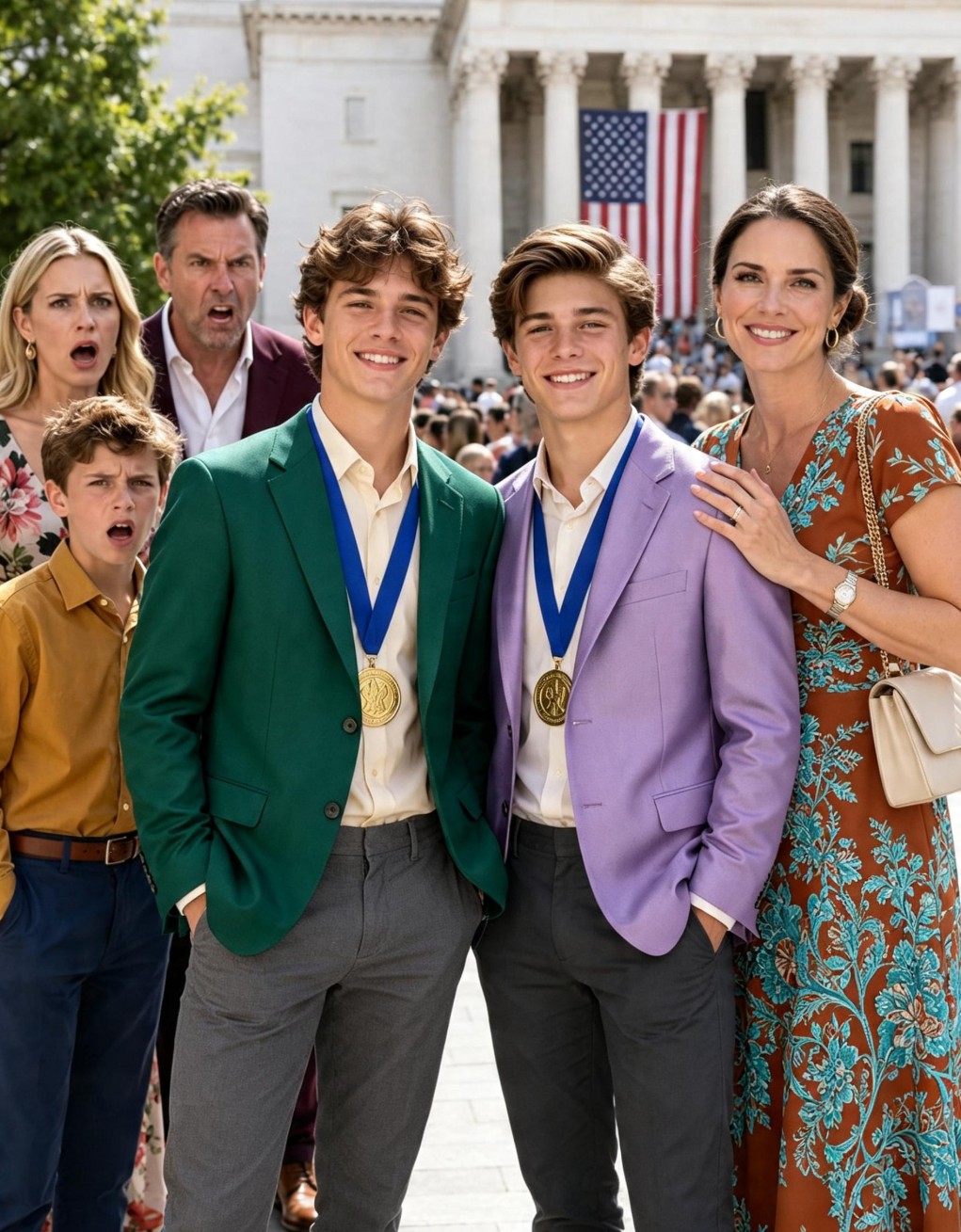
“Congratulations to the twin brothers, Bennett Montgomery and Caleb Montgomery!”
The auditorium exploded into applause.
But I barely heard it.
Two young men stood from the illuminated row.
They wore matching dark suits and white shirts.
They were tall and broad-shouldered.
As they walked toward the aisle, the giant digital screens beside the stage displayed their faces.
I stopped breathing.
I was staring at myself.
Twice.
They had my sharp jawline.
My high nose bridge.
My structured brow.
They looked exactly like I had looked at their age.
But their eyes were different.
Their dark, focused eyes carried a calm strength that clearly came from Beatrice.
There was none of my arrogance.
None of my entitlement.
“Montgomery,” the host repeated.
The family name struck me like a blow.
It was Beatrice’s name.
“What is happening?” Genevieve suddenly shouted.
She jumped to her feet.
“This has to be an error! Where is Benedict’s name?”
I did not even look at her.
I watched my sons climb the carpeted steps toward the center of the stage.
Their confidence was natural.
No amount of private tutoring could have bought it.
The head of the judging committee stepped forward.
“The analytical project submitted by Bennett and Caleb demonstrated an exceptional level of insight and practical understanding that exceeded our highest expectations,” he announced.
Heavy gold medals were placed around their necks.
Bennett took the main trophy in both hands.
They did not look toward the cameras.
They did not look toward the wealthy sponsors.
Instead, both boys turned toward the VIP section.
Toward Beatrice.
Beatrice slowly stood.
She did not shout.
She did not wave.
She simply placed one hand over her heart and smiled at them.
Her expression was filled with quiet pride.
The connection between that mother and her sons was visible even from across the room.
It was a bond my money could never buy.
Then the electronic scoreboard changed.
Benedict’s name appeared near the bottom.
His score was mediocre.
“This entire competition is improperly managed!” Genevieve screamed.
Her polished public image disappeared completely as she struck the velvet railing in front of her.
“We contributed significant funding to this event! How can my son be placed below these unknown students?”
Benedict sank lower in his seat.
He covered his face with both hands, trying to hide from the people around him.
I slowly turned toward Genevieve.
Then I looked back at the stage.
My biological sons stood there calmly.
The full weight of what I had thrown away pressed against my chest.
I had traded genuine strength for hollow appearances.
I had exchanged love and family for money, status, and constant demands.
“Alistair, say something to the committee!” Genevieve demanded.
She grabbed my jacket sleeve.
“You are one of the most important people here! Demand that they review the scores!”
I firmly grabbed her wrist and pulled her hand away from my suit.
Then I leaned toward her.
My voice was low and cold.
“Be quiet, Genevieve,” I said. “Do not say another word in this room.”
She froze.
Her eyes widened in shock.
She had never heard that tone from me before.
I stood.
Suddenly, the expensive suit felt like a burden.
I could not stay in that section for another minute.
I needed to see my sons.
I needed to get closer to the family I had abandoned.
Leaving Genevieve behind in complete confusion, I stepped into the aisle and began walking toward the backstage exit.
PART 4: THE MEETING IN THE CORRIDOR
The corridor behind the main auditorium was lined with white marble walls and bright overhead lights.
The noise from the crowd and the music in the main hall had faded into a distant hum.
I walked slowly down the corridor.
I had no plan.
No prepared speech.
No words capable of repairing thirteen years of absence and terrible choices.
There was only one powerful need driving me forward.
I wanted to see my sons face to face.
I turned a corner and stopped near a doorway.
At the far end of the bright hallway stood Beatrice with Bennett and Caleb.
She was gently adjusting the ribbon of Caleb’s medal around his collar.
Her hands were steady.
Tender.
Bennett held the trophy while placing a folder of documents into a plain canvas bag resting on a bench.
“Mom, this award is surprisingly heavy,” Caleb said, his voice echoing softly against the stone walls. “It feels like it weighs ten pounds.”
Beatrice laughed softly.
It was a genuine laugh.
The sound immediately reminded me of our old life.
She patted Bennett’s shoulder.
“You earned it through your own hard work,” she said. “So you can carry it home.”
“That is fair enough,” Bennett replied with a small smile.
I stood about thirty feet away.
I leaned my shoulder against the wall because I suddenly needed something to support me.
Seeing them this close made their existence feel real in a way the stage had not.
They had a natural confidence that was completely different from the artificial world I lived in.
A deep wave of grief filled my chest.
I wanted to walk toward them.
I wanted to ask for forgiveness.
I wanted to hear them call me their father.
But I knew the truth.
I had surrendered that right the moment I walked away from their mother.
Bennett seemed unusually observant.
He suddenly stopped organizing his bag and looked up.
His dark eyes moved across the hallway.
Then they landed directly on me.
There was no shock.
No anger.
No confusion.
He did not look at me like a missing father.
He simply studied me calmly, analyzing my presence without emotion.
Caleb noticed where his brother was looking and turned as well.
Four eyes with the same shape and color as mine focused directly on me.
Under their quiet examination, my money meant nothing.
My corporate title meant nothing.
My social status meant nothing.
I was simply a man standing in a hallway, facing the consequences of his own decisions.
Beatrice followed their gaze.
Slowly, she turned around.
Our eyes met.
The silence between us seemed to stretch across thirteen years.
Two separate lives had suddenly collided in a single hallway.
I took one hesitant step forward.
My throat tightened as I tried to say her name.
Every persuasive word I had ever used in business negotiations disappeared from my mind.
“Beatrice…”
She looked at me calmly.
I searched her face for anger.
Resentment.
Pain.
Anything.
Because anger would have meant she still cared enough to be hurt by me.
Instead, I found quiet indifference.
She looked at me the way someone looks at a stranger passing through a hallway.
That hurt more than anger ever could.
It told me exactly how little space I occupied in her life now.
“Mom, the transportation van for our trust leaves in ten minutes,” Bennett said quietly.
His voice broke the silence.
“Let us head outside, then,” Beatrice replied.
She did not rush.
She did not look uncomfortable.
She simply took Caleb’s arm while Bennett picked up his bag and trophy.
They turned toward the glass doors leading outside.
“Beatrice,” I called.
My voice sounded strained.
I took two steps forward and raised one hand slightly.
Caleb stopped near the doors.
He turned his head and looked back at me one final time.
There was no anger in his face.
No hostility.
He simply shook his head once.
Then he turned back toward his mother and brother.
That tiny gesture carried absolute finality.
It was a quiet message.
The door to their lives was closed.
I stood motionless as the automatic doors opened.
Beatrice and my sons stepped outside into the cool evening air.
A light breeze moved through the doorway.
Then they disappeared.
I remained alone in the hallway, surrounded by distant applause meant for other people.
Eventually, I left through a side entrance.
My driver was waiting near the vehicle.
But instead of waiting for him to open the door, I opened it myself and climbed inside.
The cabin was silent.
A minute later, Genevieve opened the opposite door and slid inside.
Her face was tight with anger.
Benedict climbed into the back seat without saying anything and immediately placed his headphones over his ears.
“Tell the driver to take us back to the residence immediately,” Genevieve demanded as the vehicle began moving.
The car merged into city traffic.
Silence filled the cabin.
I pressed my shoulder against the window and watched the streetlights slide past.
Caleb’s final look remained trapped inside my mind.
“I cannot understand your behavior today,” Genevieve finally said.
Her voice was sharp.
“You embarrassed our family in front of everyone in our section. Then you refused to challenge the committee when Benedict was overlooked. My son was humiliated, and you simply walked away.”
“Please be quiet, Genevieve,” I said without looking at her.
“Excuse me?”
Her voice rose.
“I am trying to protect our family’s reputation! Are you going to defend those two unknown students who won the main award? Who are they supposed to be anyway?”
Her question forced the truth into the open.
I slowly turned my head.
I looked directly at her.
My voice remained calm.
“They are my biological sons.”
The words hung heavily inside the vehicle.
The driver adjusted his mirror.
Benedict pulled his headphones down and stared at me from the back seat.
Genevieve froze.
The color drained from her face.
She remembered Beatrice sitting in the VIP section.
She remembered the two identical faces on the stage.
Suddenly, everything she valued—her influence, her position, her carefully arranged family life—began collapsing beneath the weight of the truth.
PART 5: THE SHATTERED HOUSEHOLD
Our enormous residence in Weston had been designed as a private monument to success.
That night, it felt cold and completely empty.
I did not even wait for the vehicle to park properly before stepping out.
I walked through the front entrance, ignored the household staff, and went directly to my private study.
I closed the double doors behind me.
Then I locked them.
I walked to the cabinet, poured myself a small glass of spirits, and drank slowly.
It did nothing to ease the cold inside my chest.
I sat at my desk and opened a small compartment hidden behind the wall paneling.
Inside was a plain leather folder I had kept hidden for years.
There were only a few old photographs.
One showed Beatrice at twenty-four, laughing in a public park on a winter morning.
Another showed her sitting on the small sofa in our old rented apartment.
A third showed her holding an early medical report, her expression quiet and hopeful.
I touched the photograph with my thumb.
Back then, I had made promises.
I had told her I would build a secure life for us.
I had promised to protect her.
But when faced with a real test, I had chosen the easy road.
Genevieve’s family wealth had offered me a shortcut.
And I had taken it.
I had thrown away my promises so I could advance myself.
Now the result was impossible to ignore.
My money had helped create an entitled, dependent stepson.
Beatrice’s independence, hard work, and dedication had raised two intelligent, capable young men.
Outside my study, arguments echoed through the hallway.
I heard Genevieve shouting at the staff.
Then something broke against the tiled floor.
Benedict answered her defensively.
Those sounds represented the household I had spent thirteen years creating.
I walked to the large window overlooking the landscaped grounds.
I took my phone from my pocket.
My fingers hovered over the screen.
I thought about trying to find Beatrice’s number.
I thought about asking for a conversation.
But I realized I had no right to disturb her peace.
She had removed me from her life years ago.
That night, I stayed at my desk without sleeping.
By early morning, I called a trusted investigator and asked him to find Beatrice’s current address.
By eight o’clock, as the sun rose over the trees, I had it.
A modest apartment building in a quiet, working-class neighborhood in nearby Cambridge.
I did not change clothes.
I did not pack anything.
I simply left my study.
Genevieve was sitting in the main living room, watching a financial report on television.
Her face was dark and tired.
The reporter’s voice filled the room.
“…Reports suggest unexpected leadership changes at Prescott Investments following personal developments over the weekend…”
Genevieve looked up.
“My family’s trust is meeting this morning to discuss withdrawing their investments from your fund,” she said coldly. “You are destroying everything we built for a past that no longer exists.”
I looked at her without anger.
Without fear.
“You should do whatever you believe is necessary, Genevieve,” I replied calmly. “Manage the accounts however you want.”
I walked past her.
I left the house.
For the first time in years, I drove my own vehicle through the main gate.
The drive to Cambridge was quiet.
My mind was filled with questions.
What was I trying to accomplish?
I knew I had no moral right to suddenly appear in their lives.
Yet something stronger than reason continued pushing me forward.
Blood.
Regret.
And the desperate need to face the past I had spent thirteen years avoiding.
I parked on a plain street lined with older brick buildings.
Small potted plants decorated the balconies.
Bicycles were secured near the entrance.
The neighborhood felt real.
Lived-in.
Human.
Nothing like the carefully designed world I had created.
I entered the building and took the elevator to the fourth floor.
Then I walked down the quiet hallway until I found apartment 402.
My hand remained suspended near the door for several seconds.
My heart was beating rapidly.
Finally, I knocked three times.
Footsteps approached.
The lock turned.
The door opened.
Beatrice stood in front of me.
She wore simple clothes, and her hair was tied neatly behind her head.
She looked at my wrinkled suit and tired face.
There was no surprise.
No distress.
The same calmness from the auditorium remained in her expression.
“Beatrice,” I said quietly.
My voice sounded rough.
“Could we talk for a few minutes?”
She leaned against the doorframe and studied me.
She could see the pain on my face.
Yet she did not mock me.
She did not dismiss me.
“You may come inside,” she said softly.
Then she turned and walked into the apartment.
She left the door open behind her.
I took a deep breath.
Then I stepped across the threshold.
For the first time in thirteen years, I was entering the world I had abandoned.
PART 6: THE ACCOUNTABILITY OF TIME
The apartment was modest but filled with natural sunlight.
The air carried the comforting smell of fresh tea and old paper.
It felt warm.
Peaceful.
Genuinely lived-in.
On the small dining table in the center of the room sat the gold trophy, with the two award boxes beside it.
Near the window, Bennett and Caleb were working together at a shared desk covered with books, notebooks, and study papers.
When I entered, both boys stood calmly.
Their backs were straight.
Their expressions remained reserved.
They looked at me with polite curiosity, as though I were simply an unexpected visitor.
“Sit down, please,” Beatrice said.
She pointed toward a simple wooden chair.
Then she looked at the boys.
“Bennett, Caleb, please give us a few minutes in your room while I speak with our guest.”
“Yes, Mom,” they answered together.
They gathered their notebooks.
Before closing the bedroom door, Bennett glanced back at me.
There was no anger in his expression.
Only quiet assessment.
Then the door closed.
I sat heavily in the wooden chair.
Beatrice sat opposite me and placed a cup of tea on the table between us.
“I assume you did not drive here simply to look at the apartment,” she said quietly.
“Beatrice, I want to apologize.”
The words came out quickly.
“Thirteen years ago, I made a terrible decision. I was selfish, afraid, and completely wrong.”
She listened without interrupting.
A faint, thoughtful smile appeared on her face.
“You do not need to give me a speech, Alistair,” she replied calmly. “When you left our apartment thirteen years ago, you made your decision very clearly. You chose your ambitions. You used Genevieve’s family connections to build your corporate career, and you achieved the wealth you wanted.”
“I sacrificed everything that actually mattered,” I said.
I pressed both hands against the table.
“I saw our sons yesterday. I saw the way they respect you. I realized my entire life is empty despite all the money and titles.”
“That emptiness did not happen by accident,” Beatrice said firmly. “It is the natural result of the choices you made over time.”
She lifted her tea.
“I chose to raise our sons alone. I faced the difficulties, and I received two remarkable young men. You chose power and position, and you received isolation.”
She looked directly at me.
“Life balances itself, Alistair. You cannot spend your entire life chasing status and then expect genuine warmth in return.”
I lowered my head.
Her words felt heavier than any business loss I had ever experienced.
“I want to support them now,” I said quietly. “I have enormous resources. I can pay their university tuition. I can fund your educational programs. I can provide whatever financial security you need.”
Beatrice placed her cup down.
The sound was clear.
Her calm voice became sharper.
“Financial support?”
She stared directly at me.
“Do you still believe you can solve every problem with money, Alistair? Do you really think a financial fund makes up for all the years I worked extra hours to support two children? Do you think writing a check replaces the moments when they wondered why they did not have a father like the other children?”
I could not answer.
I could not meet her eyes.
“They lack nothing important,” she continued more softly. “They are loved. They are capable. They have strong values. None of those things came from the superficial world you live in.”
She paused.
“They do not need your money.”
“What can I do, then?” I asked.
I looked up at her.
“How could I ever earn their respect? How could I have a place in their lives?”
Beatrice turned toward the window.
“You cannot purchase relationships, Alistair.”
She looked back at me.
“I never taught our sons to hate you. I simply told them the truth about our past. If you want any meaningful relationship with them, you have to stop thinking like an investor looking for a transaction.”
Her voice softened.
“You have to become a person who is willing to prove that he has changed.”
The bedroom door opened.
Bennett stepped out to get a glass of water.
He moved quietly toward the kitchen.
Then he stopped near my chair and placed the glass on the table in front of me.
I looked up at him.
My heart beat faster.
“Drink some water, sir,” Bennett said politely. “You look tired.”
The word sir was polite.
But it created a boundary.
There was no anger behind it.
Still, I could feel the distance between us.
“Mom,” Bennett said, turning toward Beatrice, “Caleb and I are going to the public library down the street to finish our project. Is that okay?”
“Of course,” Beatrice said with a warm smile. “Be back before lunchtime.”
Caleb walked out carrying his bag.
The two brothers headed toward the front door.
They did not hurry.
They did not avoid looking at me.
They simply treated me like a guest in their home.
The door closed.
I slowly stood.
I felt stripped of the confidence I had carried for decades.
“I understand,” I said quietly.
I turned toward the doorway.
“I know I have no right to expect anything. But I am willing to take whatever small steps are necessary.”
Beatrice gave me a quiet nod.
She made no promises.
I left the apartment and walked down the hallway.
When I reached the street, my phone began ringing repeatedly.
It was my senior fund manager.
“Alistair, we have serious problems here,” he said in a panicked voice. “Genevieve’s family has announced that they are withdrawing their capital immediately. The financial news is reporting everything about your personal situation, and the firm’s stock is dropping rapidly. We need you back at the Boston office right now!”
I looked up at the fourth-floor window.
I could see the small potted plants resting on the balcony in the sunlight.
“Let the firm handle it without me,” I replied.
“What do you mean?” he asked in disbelief. “We are talking about millions of dollars!”
“I am stepping down.”
I ended the call.
Then I switched the phone off.
For the first time in years, I felt relief when my phone went dark.
I was ready to walk away from the empire I had built.
My priority had finally changed.
I wanted to rebuild my character.
But before I could begin a new life, I still had to settle the affairs of the old one.
PART 7: THE ROAD TO REDEMPTION
My return to the Weston residence was calm and deliberate.
I walked through the front doors with a quiet determination.
I was ready to deal with everything that remained from the life I had built.
The foyer was filled with packed suitcases and storage boxes.
Genevieve stood near the staircase, speaking loudly on the phone with her lawyers.
When she saw me, she ended the call immediately.
“My attorneys have finalized the separation papers!” she announced sharply.
Her face was tense with anger.
“My family is pulling every asset, and I will claim my share of whatever remains of the estate!”
I walked past her without arguing.
Then I stopped near the bottom of the stairs.
“Benedict,” I called clearly toward the upper floor.
There was a short pause.
Then Benedict appeared at the top of the staircase.
He looked anxious.
He was holding his gaming console tightly against his chest.
“Benedict, please come down here for a moment,” I said gently.
He hesitated.
He looked at his mother.
Then he slowly walked down the stairs.
When he reached the bottom, I knelt so we were at eye level.
Genevieve stepped forward as if she wanted to interrupt.
I raised one hand firmly, telling her to stay back.
“Benedict, listen to me carefully,” I said.
I looked directly into his eyes.
“For years, I failed to guide you properly. I allowed your mother to put you under constant pressure, and I supported that pressure because it fit the image we wanted people to see.”
I paused.
“I gave you tutors and elite schools instead of giving you my time and attention.”
His eyes widened slightly.
“Starting today, that artificial pressure is over,” I continued. “You do not have to win trophies or get perfect grades just to prove that you are worth something.”
I placed a hand gently on his shoulder.
“If you want ordinary interests, follow them. If you want to grow at your own pace, do that. Do not let anyone turn your life into a performance for other people.”
Benedict’s expression slowly softened.
His eyes filled with tears.
He placed his gaming console on the step.
Then he suddenly stepped forward and wrapped his arms around my neck.
He began crying quietly.
It was not an angry outburst.
It was the relief of a young boy who had finally been released from expectations that had been crushing him.
I held him tightly.
For the first time, I gave him the genuine comfort I should have offered years earlier.
I could only hope that he would now have the chance to grow into a healthier, happier person.
Months passed.
The public fascination with my resignation from Prescott Investments, my separation from Genevieve, and the restructuring of my assets eventually disappeared from the news.
I gave up the Weston estate.
I sold the additional properties.
I kept only enough money to live comfortably and simply.
I also placed a secure, independent fund into a trust for Benedict’s future education.
The enormous corporate network I had spent years building was largely dissolved or transferred.
By late autumn, I returned to the Cambridge area.
The air was crisp.
Leaves had turned bright yellow and red along the sidewalks.
I parked my modest sedan one block away from the Vanguard Foundation’s community center.
I was wearing plain trousers and a wool sweater.
The expensive watches and tailored suits belonged to another life.
I walked toward the open courtyard near the entrance, carrying a heavy cardboard box.
Inside the courtyard, volunteers were preparing tables for a local book donation drive.
Beatrice stood near the center, speaking warmly with a group of students while handing out information sheets.
I did not interrupt her.
Instead, I stood quietly near the perimeter fence beneath a large tree and watched.
Several minutes later, Bennett and Caleb came out of the main building carrying stacks of supplies.
Caleb noticed me first.
He stopped.
Then he tapped his brother on the shoulder and pointed in my direction.
Bennett looked over.
His expression was different now.
He was no longer cold.
No longer distant.
There was still careful thought in his eyes, but he was looking at a man who had willingly set aside his pride and wealth.
Bennett handed his supplies to Caleb.
Then he walked across the courtyard toward me.
His eyes dropped to the heavy cardboard box in my arms.
“Did you bring books for the drive, sir?” he asked.
His voice was calm and clear in the cool autumn air.
He still called me sir.
There was still distance between us.
But the coldness was gone.
“I did,” I replied with a small, genuine smile.
“These are advanced mathematics and logic books from my early university years. I thought the students here might find them useful.”
Bennett examined the neatly packed box.
Then he looked at me.
He noticed the gray hair appearing at my temples.
He noticed my plain clothes.
He noticed that I was no longer standing like a powerful executive who expected everyone to make room for him.
“You can put them on that table near the sorting area,” he said, pointing toward a nearby table.
I nodded.
I carried the box over and carefully placed it on the table.
When I turned around, Bennett was still standing there.
“If you are free this Saturday, sir,” he said, “the foundation is holding a public seminar about logic and problem-solving. Anyone from the community can attend if they are interested.”
The invitation was simple.
But to me, it meant everything.
It was not forgiveness.
It was not a complete reconciliation.
It was not a promise that we would suddenly become a family.
It was simply a door left slightly open.
A small chance offered by a young man who possessed more character than I had shown at his age.
“Thank you, Bennett,” I said.
I had to work to keep my voice steady.
“I will certainly attend.”
Bennett gave a small nod.
A faint smile appeared on his face.
Then he turned and walked back toward his brother and mother.
Beatrice looked up from her table.
Our eyes met across the courtyard.
She did not wave.
But her quiet expression carried something I understood.
She recognized that rebuilding thirteen years of damage would take time.
She also recognized that, for the first time, I was finally taking the right steps.
I turned and walked toward my car.
Fallen leaves rustled beneath my shoes.
The past could not be rewritten.
Lost years could not be purchased with money.
Sudden regret could not magically restore the childhood I had missed or erase the pain I had caused.
But I had finally learned something that money had never been able to teach me.
If a person is willing to abandon false pride, accept full responsibility for his choices, and approach others with genuine humility, he can begin rebuilding a meaningful life.
I could never recover the years I had thrown away.
But I could decide what I would do with the years that remained.
For the first time in many years, I was no longer running away from my past.
I was finally walking in the right direction.
THE END.
