
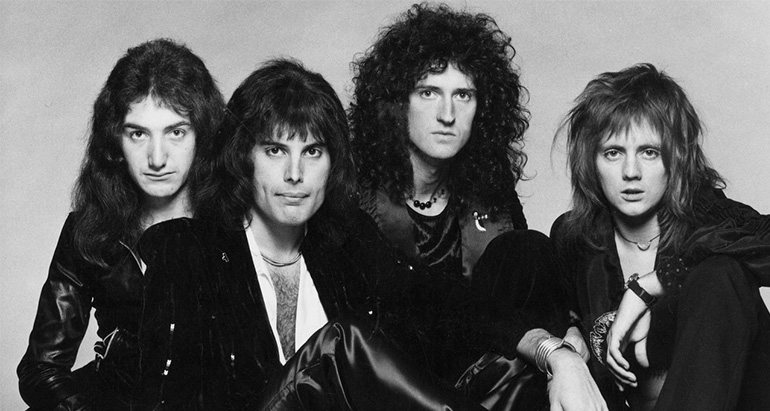
Queen is a British rock band formed in 1970. Their lineup with Freddie Mercury, Brian May, Roger Taylor, and John Deacon remained unchanged for more than two decades.
The band’s music is characterized by great stylistic diversity, and all band members were significantly involved in the songwriting. Some of Queen’s best-known songs include Freddie Mercury’s “We Are the Champions,” Brian May’s “We Will Rock You,” John Deacon’s “Another One Bites the Dust,” and Roger Taylor’s “Radio Ga Ga.” The Mercury composition Bohemian Rhapsody topped the British singles charts for many weeks in both 1975 and 1991. For this title, which combines ballad and operetta-style exaggerated vocal pyrotechnics with hard rock in one song, the band produced one of the earliest and most stylistically influential music videos.
Queen was continuously successful internationally: All studio albums released after their breakthrough in 1974 reached number one on the charts. With around 200 million albums sold, Queen is one of the most commercially successful bands in the world. In their home country of Great Britain, their first greatest hits album alone sold more than five million copies, which is unmatched there to this day. With more than 31 million copies sold, it is also one of the best-selling albums worldwide. With sales of over seven million units, Another One Bites the Dust is the band’s best-selling single. Queen played more than 700 concerts in 16 years.
History
Prehistory
In August 1963, Brian May, together with his father, began building his first electric guitar, the “Red Special.” It later shaped the typical, unmistakable guitar sound of Queen. In 1966, Tim Staffell and Farrokh Bulsara – who was then called Freddie Bulsara and later, in the early seventies, Freddie Mercury – became friends, both studying at the Ealing College of Art at the time.
In 1968, May (guitar, vocals), Staffell (lead vocals, bass), and Roger Taylor (drums, vocals) formed the group Smile. Meanwhile, Mercury joined the Liverpool band Ibex as a singer. Thru his friend Tim Staffell, he got to know Smile and became a fan of the band.
In February 1969, Smile participated in a festival at the Royal Albert Hall. They played, among other things, the later Queen title “See What a Fool I’ve Been.” With producer John Anthony, who later co-produced Queen’s debut album, the band recorded the tracks Doin’ Alright, Earth, and Step on Me at Trident Studios. The single with the latter two tracks was released in August on Mercury Records in the US. The label enabled further recordings in the De Lane Lea Studios in London. Here, among other things, the piece “Blag” was created, featuring a precursor to May’s later “Brighton Rock” guitar solo.
1970–1974: Early Years
While May was in Tenerife for studies, Staffell left the band Smile and joined Colin Petersen’s Humpy Bong. Subsequently, May, Taylor, and Freddie Mercury joined together to form the band Queen.
With Mike Grose on bass, this formation, still under the name “Smile” due to prior advertising, made their live debut in Truro on June 27, 1970. His successor, Barry Mitchell, played a few gigs as the bassist for “Smile” starting in August, but left the group at the beginning of the following year. This was followed by a brief stint by Doug Bogie until February 1971. After a long search for a bassist, John Deacon finally completed the lineup of Queen, which did not change for 20 years until Mercury’s death. Still in the same year, the group recorded the first demo recordings with five tracks at the De Lane Lea Studios, which later appeared on their first album.
In February 1973, she recorded her first BBC session for John Peel’s radio show Sounds of the ’70s (which was released in 1989 on the album At the Beeb). In the following years, there were numerous other BBC sessions by Queen. On April 9, 1973, the press launch of the band Queen took place at the Marquee Club in London.
The Trident producer Robin Cable invited the band to the studio, allowing the sound engineers to experiment with ways of imitating the Phil Spector sound. This resulted in a cover version of the Beach Boys hit I Can Hear Music, which, along with the Dusty Springfield song Goin’ Back, was released as a single (without John Deacon). Since the style of the recordings was completely different from that of the band, they were released three weeks before Queen’s debut album under the pseudonym Larry Lurex, a humorous allusion to Gary Glitter.
On July 6, 1973, the single “Keep Yourself Alive” was released as a preview of the first album, but it did not chart. A week later, the first album, Queen, was released, representing Queen’s music from the past three years. The following month, recording began for the second album. In the fall, Queen toured the UK as the opening act for Mott the Hoople.
The second single, “Seven Seas of Rhye,” released in February 1974, reached number ten in the UK charts and was Queen’s first hit. In March, the band undertook their first major headlining tour thru the UK. In the same month, the second album, Queen II, was released. The band presented a concept album with a wide range of different types of music: from pieces in the style of the British music hall to heavy metal tracks and ballads. The album reached number five in the UK charts. In September 1974, the band received their first silver disk for more than 100,000 copies sold of Queen II.
With the pre-released third single “Killer Queen,” in which the theatrical British variety merges with Brian May’s guitar sound, the band achieved international success for the first time. The record reached number twelve in the US Billboard charts. In Great Britain, the single reached number two, just missing the top of the charts. In November 1974, the third album, Sheer Heart Attack, was released, which also reached number two in the British charts.
1975–1979: Number one
The pre-released single “Bohemian Rhapsody,” released in October 1975, became the Christmas number one hit of the year and topped the UK charts for nine weeks; thus, it matched Paul Anka’s 1957 record with “Diana.” The song, written by Freddie Mercury, was different from other singles of the time in its unusual musical structure and its length of 5:55 minutes. Bohemian Rhapsody is also considered the beginning of the era of music videos. Since the band didn’t have time for a live performance at the BBC, a short film was made instead, in which the band is mirrored multiple times to represent a large choir for the Rhapsody. Released in November 1975, A Nite at the Opera was the first Queen album to reach the top of the British charts. In the United States, it received triple platinum and brought Queen commercial success.
The two albums A Nite at the Opera and A Day at the Races, which was released in December 1976 and also reached number one in the UK charts, can be considered sister works. Both titles refer to film titles of the Marx Brothers, the design of the two album covers is complementary: the first is white, the second is black, and both feature the Queen logo as the title image. There are also parallels in the selection of musical styles. The singles released were the gospel-influenced Somebody to Love and the hard rock song Tie Your Mother Down.
On a pre-release single of the next album, the anthem We Are the Champions, one of Queen’s most famous songs today, was released; on the B-side was We Will Rock You. In October 1977, the sixth album, News of the World, which was musically rougher than its predecessors, was released. The album cover was designed by Frank Kelly Freas.
The recordings for the next album took place for the first time outside of Great Britain – in Montreux and Nice. The double A-side Fat Bottomed Girls and the Tour de France-inspired Bicycle Race were released as a single. In November 1978, the album Jazz followed. This album included a poster with naked women on racing bikes; the photo was taken during the video shoot for Bicycle Race at Wimbledon Stadium. The second single, “Don’t Stop Me Now,” was released. During the Jazz tour, the recordings for Queen’s first live LP were made: The double album Live Killers, released in June 1979, includes excerpts from various concerts in Europe.
Also in June, for the first time, recordings for the next album began with Reinhold Mack as sound engineer and co-producer at the Musicland Studios in Munich. Mack was supposed to give Queen’s music a new direction. In October 1979, one of Queen’s most successful singles was released: With “Crazy Little Thing Called Love,” Queen made their first leap to the top of the US singles charts the following year. In this rockabilly-style song, Mercury is heard as a rhythm guitarist for the first and only time. The song later appeared on the album The Game. The “Crazy Tour” thru the UK ended on December 26, 1979, in London with a charity concert for the needy population in Cambodia.
1980–1984: New Paths
After the two additional advance singles Save Me and Play the Game, the album The Game was released in June 1980. It is Queen’s only album to reach number one on the charts in the USA. The band had changed radically not only in sound but also in appearance: The long hair was cut short, except for Brian May, who has not given up his long curls to this day, and the flamboyant costumes were replaced with leather clothing. Freddie Mercury also grew a mustache. For the first time, a synthesizer could also be heard on an album. In August 1980, during the North American tour, the fourth single, Another One Bites the Dust, was released. This funk rock song, based on the bass line of Good Times, remained at number one on the US charts for several weeks and is Queen’s best-selling single in the United States.
The film producer Dino De Laurentiis asked the band to write the film music for his movie Flash Gordon. In December 1980, the album Flash Gordon – Original Soundtrack Music was released, featuring predominantly instrumental pieces.
In 1981, Roger Taylor was the first band member to release his solo album Fun in Space. In the same year, the band played in large football stadiums in Argentina, Brazil, Venezuela, and Mexico for the first time. Toward the end of the tour, Queen set a new attendance record: on March 20, 1981, the band played in front of 131,000 spectators at the Morumbi Stadium in São Paulo.
Another outstanding event of the year was the release of the single “Under Pressure” in October 1981. The idea of a collaboration between Queen and David Bowie came about during a chance meeting at the studios in Montreux. Under Pressure reached number one in the UK charts as the second Queen single; the song was later released on the album Hot Space. In November, the first “Greatest Hits” album was released with the most successful Queen singles to date: Greatest Hits, which remained in the charts for over ten years, is by far the best-selling album in the UK. This compilation is Queen’s best-selling album worldwide.
In November 1981, the band gave two concerts in Montreal, which served for the recording of the concert film We Will Rock You, which premiered two years later. In 2007, this recording of Queen’s last live performances as a quartet was released on CD and DVD under the title Queen Rock Montreal.
In April 1982, the Hot Space Tour began, during which Morgan Fisher accompanied the band on keyboards for the first time. The concert at the Milton Keynes Bowl was released in 2004 under the title Queen on Fire – Live at the Bowl. In May 1982, the album Hot Space was released. The song “Life Is Real” is dedicated to John Lennon († December 8, 1980). The overwhelming commercial success of Another One Bites the Dust was one of the reasons why the band decided to produce significant portions of the album in disko and funk style. Due to this stylistic change, Hot Space is one of the most polarizing Queen albums. While music critics expressed themselves quite positively, parts of the band’s traditional rock sound fanbase were disappointed by the album’s unusual direction. The sales figures were overall worse than those of previous albums.
After the conclusion of the Hot Space World Tour in November, Queen took their longest break to date – lasting nine months. Brian May released the mini-album Star Fleet Project in 1983, among others with Edward Van Halen.
At the beginning of 1984, the advance single “Radio Ga Ga” was released, one of Queen’s most internationally successful singles. The video for the song features the band in scenes from Fritz Lang’s science fiction silent film Metropolis. The short film for the second single, I Want to Break Free, in which the band members dressed as women, is also one of Queen’s most famous music videos. In February 1984, the album The Works was released. The sound of the album is shaped by synthesizers programmed, among others, by Fred Mandel. With the album, Queen built a bridge between hard rock (Hammer to Fall) and pop (I Want to Break Free).
Spike Edney was hired as the live keyboardist, who would from then on be present at all subsequent Queen concerts and also participated in numerous solo projects. The band faced some fierce criticism for their performances in Sun City, when apartheid was still prevalent in South Africa, due to their breaking of the boycott. In November, the single “Thank God It’s Christmas,” which was not included on any Queen studio album, was released.
1985–1989: Live Aid and Final Tour
In January 1985, Queen played two concerts at the first edition of “Rock in Rio” in front of over 250,000 spectators. In April, Freddie Mercury released his first solo album, Mr. Bad Guy.
On July 13, 1985, at 6:41 PM, Queen performed at Bob Geldof’s charity concert Live Aid at London’s Wembley Stadium. They played some of their biggest hits: the first part of Bohemian Rhapsody, Radio Ga Ga (75,000 fans clapped in time to the chorus), Hammer to Fall, Crazy Little Thing Called Love, We Will Rock You and, to finish, We Are the Champions. With their 20-minute performance, Queen stole the show from all the other acts in the eyes of the fans and the event’s organizer Bob Geldof. Later, Mercury sang with May Is This the World We Created?
Inspired by the Live Aid experience, the band members collaboratively wrote the song “One Vision,” which was released as a single in November 1985. The fast, guitar-driven song was unusual for this period of Queen’s output; it was the opener for both the subsequent album and the Magic Tour. The song was also used in the soundtrack of the film Iron Eagle. In March 1986, the advance single “A Kind of Magic” was released, whose original version comes from the simultaneously released film “Highlander” by Russell Mulcahy. Shortly before the European tour, the album A Kind of Magic was released in early June 1986. Queen had written six tracks for Highlander, which were included in the album in modified form. As film music, these pieces sometimes feature lush orchestration. As a result, numerous other artists were involved in this album. Mulcahy also directed the two videos A Kind of Magic and Princes of the Universe, in which the main actor Christopher Lambert participated.
The sold-out Magic Tour ran thru Europe from June to August. The two performances at London’s Wembley Stadium on 11 and 12 July were released as a compilation in 1992 under the title Live at Wembley ’86 as a CD and later as a DVD. On 27 July, one of the first concerts by a major Western band in the Eastern Bloc took place at the Népstadion in Budapest. On 9 August, more than 120,000 fans (unofficial estimates put the figure at 200,000, a record for Queen in England) saw the final concert of the tour at Knebworth Park, unaware that they were witnessing the last performance of the full band. In December 1986, the album Live Magic was released, featuring recordings from these performances.
In the following period, the individual band members engaged in solo projects. Roger Taylor founded the band The Cross in the autumn of 1987 to go on tour again, and produced their debut album Shove It, which was released the following year. The title Heaven for Everyone was sung by Freddie Mercury. In 1988, Mercury’s second solo album, Barcelona, was released, which he had recorded together with the Spanish opera singer Montserrat Caballé, a synthesis of pop and opera singing.
Three years after Queen’s last studio album, the advance single “I Want It All” and the album “The Miracle” were released in May 1989. A sign of the bond between the band members was that Queen was listed as the author for all the tracks. David Richards was the sole co-producer for the first time. Musically, the album is a continuation of A Kind of Magic, which is evident in the contemporary pop-rock sound of the hits The Invisible Man, The Miracle, and Breakthru. Particularly due to the (initially kept secret) AIDS illness of Freddie Mercury, there were no live performances for the first time upon the release of a new Queen studio album. In December, the album “At the Beeb” was released, featuring BBC recordings from 1973.
1990–1994: Freddie Mercury’s Death and “Tribute Concert”
In February 1990, Queen was honored with the BRIT Award for their outstanding achievements. Mercury’s sickly appearance at the event sparked further speculation about his health.
In January 1991, the six-and-a-half-minute title track from the upcoming album, “Innuendo,” was released as a pre-single. It reached number one in the UK charts – as the third song by Queen. In February, the album “Innuendo” was released, which also reached number one on the British charts. The title (Innuendo) is a program for the songs on the album, which only became clear after Mercury’s death: I’m Going Slightly Mad, These Are the Days of Our Lives and above all The Show Must Go On. That Freddie Mercury had not lost his sense of humor despite everything is evident both in his song Delilah (a love song to one of his cats) and in the video to I’m Going Slightly Mad.
Brian May produced the charity single “The Stonk” by Hale and Pace, with the involvement of Roger Taylor, which reached number 1 on the UK charts. On October 28, 1991, the commercially successful Queen compilation Greatest Hits II was released.
This year, rumors intensified that Freddie Mercury was seriously ill and suffering from the immune deficiency disease AIDS, which was reported by tabloids around the world. Mercury himself did not comment on these rumors and had them denied by a spokesperson. On November 23, he informed the public in a prepared statement that he had AIDS. A few hours after this announcement, Freddie Mercury passed away on November 24, 1991, at the age of 45, in his home at 1 Logan Place, Kensington, London, surrounded by close family, from pneumonia.
In December 1991, as a legacy from Mercury, the single “Bohemian Rhapsody” was released with the double A-side “These Are the Days of Our Lives”; it once again topped the British charts for weeks. The proceeds were donated to an AIDS foundation. Only in North America, the compilation album Classic Queen (instead of Greatest Hits II) was released in March 1992. It reached fourth place in the US charts, marking the best placement of a Queen album there in over a decade.
Among the outstanding musical events of the year was the Freddie Mercury Tribute Concert, organized by the remaining members of Queen on April 20, 1992, which took place at London’s Wembley Stadium. Brian May, Roger Taylor, and John Deacon performed together with guest singers and musicians, including George Michael, Robert Plant, Axl Rose, Annie Lennox, David Bowie, Roger Daltrey, Paul Young, James Hetfield, Elton John, and Liza Minnelli. At the end of May, the double album Live at Wembley ’86 was released, a digitally remastered compilation of both concerts at Wembley Stadium from 1986.
2000–2004: Musical and Other Projects
The planetarium in the Forum of Technology of the German Museum produced a multimedia laser show together with Brian May, which premiered in Munich on December 13, 2001. The show features laser effects and 5.1 surround sound, incorporating the starry sky projected onto the planetarium dome. Wrapped in light, artificial fog, the audience experienced music and videos of remixed Queen hits. The show was on display from 2002 at the Zeiss Planetarium in Jena, from 2005 at the Nicolaus Copernicus Planetarium in Nuremberg, and from 2006 at the Vienna Planetarium.
Together with Ben Elton, Queen wrote their own jukebox musical called “We Will Rock You,” which premiered in London in 2002. See also We Will Rock You (musical).
On June 3, 2002, Brian May and Roger Taylor performed on the occasion of the celebrations for Queen Elizabeth II’s Golden Jubilee. The BBC broadcast the Party at the Palace live from the grounds of Buckingham Palace. At the beginning, May played his extended version of God Save the Queen, standing on the roof of the palace with Roger Taylor on the drums. Phil Collins was on drums for the Taylor-sung title Radio Ga Ga. The ensemble from the Queen musical then took to the stage and sang a Queen medley with the band. This time, the middle part of Bohemian Rhapsody was not played from a recording, but was performed by the choir of the musical ensemble.
Under the supervision of May and Taylor, numerous digital restorations took place, significantly extending Queen’s audio and video catalog. Since 2002, several concert recordings (including Live at Wembley Stadium and Live at the Bowl) and compilations of video clips have been released on DVD. They were also remixed in 5.1 and DTS surround sound, as were two of Queen’s most successful albums, A Nite at the Opera and The Game, which were released as DVD-Audio albums.
On November 6, 2002, the Queen Symphony by Tolga Kashif was premiered with the Royal Philharmonic Orchestra at the Royal Festival Hall. The performance was televised, with Brian May, Roger Taylor and Mercury’s mother Jer Bulsara in attendance. Kashif had been inspired by the band’s melodies. Queen Symphony was nominated for the Classical BRIT Awards as “Album of the Year 2003.”
In 2003, Queen was seen in connection with a charitable music event in South Africa: The band performed in Cape Town at the 46664 concert, which they co-organized, initiated by Nelson Mandela as a charity project to combat AIDS. In December 2004, Brian May and Roger Taylor announced that they would be going on tour together again with Paul Rodgers as the singer after 19 years. Not involved was bassist John Deacon, who had completely retired from his work as an active musician in the late nineties. The name of the new project was “Queen + Paul Rodgers.”
2004–2009: Queen + Paul Rodgers
The basis for the collaboration between Brian May and Roger Taylor with Paul Rodgers was a meeting of May and Rodgers at the Fender Strat Pack concert in 2004, when the guitarist accompanied the singer on the Free song “All Right Now.” Subsequently, May asked Rodgers to accompany Queen at their induction into the British Music Hall of Fame, where they performed We Will Rock You, We Are the Champions, and All Right Now together.
In 2004, it was announced that they would go on tour together. In March 2005, Queen and Rodgers performed at the reissue of the 46664 concert. In the same month, an extensive European tour began under the name “Queen + Paul Rodgers”; this was followed by performances in the USA and Japan, among other places. The six-member line-up included, in addition to Spike Edney, the former keyboard player at Queen concerts, the accompanying musicians Jamie Moses on guitar and Danny Miranda on bass. In addition to the Queen songs, the program included pieces by Free and Bad Company, the former bands of Paul Rodgers. In the song Bohemian Rhapsody, Freddie Mercury and Rodgers shared the vocals via video. The concert in Sheffield was recorded and released under the title Return of the Champions. In 2006, “Queen + Paul Rodgers” undertook an extensive tour of North America. In the same year, a live recording of a concert held there the previous year was released exclusively in Japan as a DVD (Super Live in Japan).
In December 2006, Brian May confirmed that work on a film about the band’s history had begun. May and Roger Taylor are overseeing the project. The film is being produced by Robert De Niro’s company Tribeca Production, which is also involved in the musical We Will Rock You.
On the occasion of World AIDS Day in 2007, Queen + Paul Rodgers released the song “Say It’s Not True” as a free download. A few weeks later, the song was also released as a single, with the proceeds going to the 46664 project. In September 2008, their album The Cosmos Rocks was released, the first joint studio album by Brian May and Roger Taylor in 13 years. At the same time, a tour of Europe and South America began. The opening concert of the tour at Peace Square in Kharkiv was later released on DVD as Live in Ukraine.
In May 2009, Rodgers announced that the collaboration had ended. He explained that his involvement with Queen was similar to that of Jimmy Page with The Firm, in that they never thot of it as a long-term thing. Rodgers added that he considered the collaboration a success, having produced two world tours, some live releases and, not least, the first full new Queen album since the early 1990s. Rodgers did not rule out future performances with May and Taylor, specifically for charity.
Since 2010: Change of record label and film project
On November 8, 2010, it was announced that Queen would end their 37-year collaboration with their record label EMI and would be signed to Island Records starting in January 2011. From this new record company, the back catalog of Queen will be re-released from 2011 with extensive bonus material.
Furthermore, a film project was also announced. In this film, Freddie Mercury was to be portrayed by Sacha Baron Cohen. The project was delayed and eventually came out in 2018 under the title Bohemian Rhapsody. Mercury is played by Rami Malek in this film.
At the end of 2011, they cast their own cover band via the Internet, which then went on a big tour, because they were annoyed by the large number of bad cover bands. In January 2012, the cover band, called The Queen Extravaganza and consisting of 7 people, was confirmed.
In October 2011, the music magazine NME reported that there were considerations to go on tour with Lady Gaga as a replacement for Paul Rodgers, who had left in 2009. Lady Gaga subsequently stated that she would be open to doing something with Queen.
In December 2011, the music magazine Billboard reported that it was also possible to go on tour with Adam Lambert. A joint performance was planned for July 7, 2012, at the Sonisphere Festival in Knebworth. However, the festival was canceled at the end of March 2012. Shortly afterward, two performances at the Hammersmith Apollo were announced. Both concerts sold out within 24 hours. On 30 June 2012, Queen and Lambert were scheduled to perform at the Luzhniki Olympic Stadium in Moscow. A performance at the Miejski Stadium in Wrocław was scheduled for 7 July 2012.
On August 12, 2012, Brian May and Roger Taylor performed “We Will Rock You” with Jessie J as a guest singer at the closing ceremony of the 2012 Summer Olympics.
In December 2013, Brian May announced that he had found unreleased material by Freddie Mercury in the band’s archive. He is trying to arrange these tracks with producer William Orbit into new songs. However, he said he was not sure whether it would be enough for a new Queen album. Among other things, there are tracks from studio sessions with Michael Jackson, David Bowie, Andy Gibb and Rod Stewart. At the same time, the band announced during an exhibition in Montreux that they had also signed a new contract with Universal Music Group.
2012–present: Successor project Queen + Adam Lambert
As Queen + Adam Lambert, Queen gave six concerts in Eastern Europe, Russia, and three in London in 2012 together with singer Adam Lambert. Since 2014, Queen + Adam Lambert have been on a world tour. Only old hits were played. They were accompanied, among others, by Rufus Taylor, the son of Roger Taylor. In 2014, they traveled thru North America, Japan and Korea, Australia and New Zealand, and in 2015/16/17 in Europe, Asia, and America.
Characteristics of the music
Authors of the Queen songs
Although Freddie Mercury was sometimes considered the head of the band in the media due to the dominant role he played during live performances, all band members were equal in the studio when it came to developing the songs, and each contributed several hits.
Of the total 180 published original compositions, Freddie Mercury wrote 51, Brian May 46, Roger Taylor 22, and John Deacon 14. From the collaboration of two band members each, 8 titles were created; for 35 titles, the official author credit is “Queen.”
Four additional songs were co-written by external authors:
- Doing All Right on the first Queen album (1973) dates back to the time of Brian May’s collaboration with Tim Staffell in their joint band Smile.
- Under Pressure was co-written by Queen and David Bowie and recorded at Queen’s own Mountain Studios in Montreux. The single reached the top of the British charts in 1981; the piece is included on the 1982 album Hot Space.
- Brian May wrote “Too Much Love Will Kill You” with Frank Musker and Elizabeth Lamers. Freddie Mercury recorded the vocals during the Miracle sessions in the late 1980s. The song premiered in 1992 at the Freddie Mercury Tribute Concert at Wembley Stadium. In May’s solo album Back to the Light (1992) there is a version sung by him. Later, the title was included in a completely revised version with Mercury’s voice in the album Made in Heaven (1995).
- On All God’s People on the album Innuendo (1991), Mike Moran was a co-author. Moran had also co-written the songs for the album Barcelona (1988) with Mercury, a solo project by Freddie Mercury with the opera singer Montserrat Caballé.
In 1989, the band agreed to credit “Queen” as the authors instead of individual members. The group first implemented this plan with their album The Miracle. Among other things, the contributions of the individual band members cannot be determined for the following titles: Soul Brother (released in 1981 on the single Under Pressure), Under Pressure, One Vision (on A Kind of Magic), and Stealin’ (on the single Breakthru).
On their studio albums, the band also released two instrumental cover versions arranged by Brian May: the traditional “God Save the Queen” and “The Wedding March” from Richard Wagner’s opera Lohengrin. In live performances, the band often covered songs from the 1950s and 1960s, such as Elvis Presley’s hit “Jailhouse Rock” and “Big Spender” from the musical “Sweet Charity,” as well as during the 1986 tour, among others, Ricky Nelson’s single “Hello Mary Lou,” Little Richard’s “Tutti Frutti,” and occasionally “Gimme Some Lovin'” by the Spencer Davis Group.
On the album The Cosmos Rocks by Queen + Paul Rodgers (2008), all three band members are credited as authors.
Details about the compositions can be found in the articles on the individual albums or band members.
Guest singers after 1991
After Mercury’s death, the remaining Queen members May, Taylor, and Deacon performed at the Freddie Mercury Tribute Concert in 1992 together with a multitude of guest singers, including Roger Daltrey, James Hetfield, Robert Plant, Seal, David Bowie, Annie Lennox, George Michael, Lisa Stansfield, Elton John, Axl Rose, and Liza Minnelli. The second and final performance as a trio was in 1997 at the premiere of Maurice Béjart’s ballet in Paris, with Elton John again taking lead vocals on The Show Must Go On, the only song performed at the time. This live version was released in 1999 on the album Greatest Hits III.
In the following years, Brian May and Roger Taylor (without the involvement of John Deacon) undertook various smaller live and studio projects under the name “Queen+”: May and Taylor shared lead vocals with changing guest singers. At short appearances, among others, Dave Grohl from the Foo Fighters (2001 in New York at Queen’s induction into the Rock and Roll Hall of Fame), Patti Russo (2002 in Amsterdam), Zucchero and Luciano Pavarotti (2003 in Modena), as well as Anastacia (2003 in Cape Town at the 46664 benefit concert) were heard. In the studio, there were new recordings of Queen titles, including with Five (We Will Rock You, 2000), Robbie Williams (We Are the Champions, 2001), and John Farnham (We Will Rock You, 2003).
From the end of 2004, there was a permanent collaboration with Paul Rodgers. With him, extensive tours thru Europe, Japan, and North America took place in 2005, 2006, and 2008 under the name “Queen + Paul Rodgers.” The project ended in 2009 with Paul Rodgers’ departure.
Remixes
In addition to the aforementioned studio re-recordings and live interpretations, numerous remixes have also been created since the early nineties, which were officially released on Queen records. As remixers, for example, Rick Rubin, Trent Reznor, Vanguard (Flash), and the rapper Wyclef Jean, who was also involved in Pras Michel’s version of “Another One Bites the Dust,” were active.
The “Theatrical”
“Theatrical” Some critics said that Queen’s music often had a somewhat theatrical and pompous quality to it.
Some critics said that Queen’s music often had a theatrical and pompous quality to it. This is mainly due to the lush guitar and vocal harmonies, the wide range and expressiveness of Mercury’s voice, and Roger Taylor’s special mastery of high vocal ranges (e.g., in ’39). This is most clearly expressed in Bohemian Rhapsody, but also in Don’t Try So Hard, Innuendo, The Miracle, and Was It All Worth It. Another reason for the theatrical impression is the harmonic variety of the pieces. Queen does not content itself, like many a hit or pop song, with tonic and dominant, but enriches the harmony with further distant keys, cadences, suspensions, that is, with the means of “classical” music.
Guitar sound
Until 1980, Brian May used his self-built “Red Special” to create all the sound effects that other groups used synthesizers, string orchestras, or brass instruments for. This was partly possible because his guitar has structural features such as resonance chambers that, independent of all electrical changes, produce a distinctive sound. In addition, May recorded more than one guitar track for many pieces. For example, the score of Somebody to Love features five electric guitar parts. In the purely instrumental pieces (Procession, The Wedding March, and God Save the Queen), but also in songs like Keep Yourself Alive, Dreamer’s Ball, or The Millionaire Waltz, this “orchestral” guitar sound is particularly pronounced. May achieved another increase in these guitar effects in Good Company (“jazz band”), The Loser in the End (“rock organ”), All Dead, All Dead, and Lily of the Valley (“string orchestra”). In some tracks, the guitar sound acquires a flexibility similar to that of a choir or a singing voice, making the transition between vocals and instrument almost imperceptible, as in the pieces with Roger Taylor’s extremely high “screams” (Seven Seas of Rhye, The March of the Black Queen, The Fairy Feller’s Master-Stroke, Ogre Battle, Father to Son).
This typical Queen approach of treating vocals and guitar equally is also evident in the “canon” pieces: Here, the delay technique allows musicians to sing or play in harmony with themselves live. Examples of this are May’s three-part guitar playing in Brighton Rock and White Man, as well as Mercury’s singing in Now I’m Here (live) and The Prophet’s Song.
Brian May does not use a plectrum when playing the guitar, but a British sixpence coin. When they were taken out of circulation, he had coins made with his likeness, which have since become highly sought-after collector’s items.
Queen as a Live Band
Queen played over 700 concerts in 16 years; the band was one of the most successful live bands of the 1970s and 1980s.
In the 1960s, before Queen, live performances were more reminiscent of transferring the conditions of a recording or television studio to a small stage: The clothing was conventional, the band members hardly moved from their spots (which was also due to the restrictive technical conditions), and the musicians had little contact with the audience. The pieces were musically in line with the recordings, but it was evident that the technology and studio recording conditions could not be transferred to the stage.
For Queen, on the other hand, the perfect show and entertaining the audience were always the top priorities. They used new techniques to improve acoustics and lighting and employed correspondingly large sound and lighting systems. Special effects such as fog, lighting changes, and pyrotechnics were used purposefully and with a sense for the right, dramatic moment. Extravagant hairstyles and costumes played a significant role on stage until 1980. Freddie Mercury, as the lead singer, was anything but static. He fascinated his audience with his dance-like, powerful movements, synchronized with the music and inspired by it. A special role was played by his microphone stand, from which the feet had been removed. It was an integral part of his stage presence, used as a drumstick, guitar, balancing device, and phallic symbol. Mercury needed a large stage for his type of performance, which extended into the third dimension thru stairs and ramps. Thus, each concert also became a theatrical total work of art.
Queen could not and did not want to bring the complex titles of the records to the stage 1:1. Each piece was adapted for live performances, and thanks to the improvisational skills of Mercury and May, the interpretation varied from performance to performance.
Basically, the group was of the opinion that nothing should come off the assembly line. But there were a few exceptions: While the a cappella middle section of Bohemian Rhapsody was played from a tape, the band disappeared from the stage, which was dominated only by light effects and fog. The transition to the final part was a real explosion of light and fireworks, from which the band reappeared as if from a theatrical trapdoor. The second piece that came from the tape was played at the end of the concert every time (except in Ireland): during the God Save the Queen, arranged by Brian May, the four musicians said goodbye to their audience. On the Magic Tour, Freddie Mercury appeared in a coronation robe and crown, which he removed as a gesture of respect to the audience. As the opening of each concert of the Magic Tour, the intro of One Vision played from a tape, just as the intro of Flash did on the Hot Space Tour.
Also on the Magic Tour, Mercury appeared during the encore of We Will Rock You with a Union Jack. He wore the flag like a cape. After strutting around the stage with it for a while, he quickly flipped it over and presented the respective national flag on the other side, much to the audience’s delight.
The selection of songs was generally based on the current album, although many older hits remained in the program. However, the standard repertoire included some songs that were played at most concerts: Most frequently played was “Now I’m Here,” a piece in which Mercury used the delay technique to improvise a canon with himself. Keep Yourself Alive and Killer Queen were played almost as often as Bohemian Rhapsody, which was a highlight at more than 500 concerts. Since 1977, the twin pair We Will Rock You and We Are the Champions have never been missing. The program could change from concert to concert on a tour for individual pieces.
With the album News of the World, the band wrote songs that were tailored for audience participation at concerts. We Will Rock You is especially worth mentioning, with its characteristic basic rhythm that gets the audience to join in. This also includes Radio Ga Ga, which encourages the audience to clap along rhythmically, influenced by the music video.
Queen also placed great importance on the structure of their concerts. Thus, the band played mainly fast, rock songs in the first part of the concert to captivate the audience. In the middle part of the concert, quieter pieces were played with a smaller ensemble or solo improvisations. This allowed individual band members to take short breaks, while at the same time creating a dramatic arc from tension to relaxation to the final climax. Here, acoustic interpretations such as “Love of My Life” often rang out, with Brian May on guitar and Mercury letting the audience sing alone over long passages. Also in the middle of the concert, May’s long guitar improvisations, such as Brighton Rock, could be heard. A special feature was the songs that the band performed especially for the country they were in: in Japan, Teo Torriatte, or in Budapest, the Hungarian folk song Tavaszi szél vizet áraszt (“The spring winds bring the water”).
Queen gave most of their concerts in the USA (almost 250) and in the UK (200). Then follow Germany with 55 and Japan with 51 tour performances. The largest audience Queen had was on January 12, 1985, in Rio de Janeiro (250,000), the smallest (6) on January 28, 1972, at Bedford College in London. From 1973 to 1986, Queen went on at least one major tour each year. Exceptions are the year 1981 with three shorter concert tours and 1983, in which Queen did not perform live.
Band name
In an interview, Freddie Mercury commented on the band name: Es war dann, dass ich über den Namen Queen nachdachte. You know, at that time, the name conjured up a lot of things, a lot of theater, very grand, very pompous, all of those kinds of connotations. It meant so much, you know, it was nice. C’était pas une étiquette précise, ça pouvait vouloir dire beaucoup de choses.
With this unspoken ambivalence of expression, especially Freddie Mercury played during his live performances: He knew how to use humor and ironic distance, thru ballet steps, hairstyles, and costumes on the one hand, and thru deliberately masculine gestures and playing with the microphone stand on the other, to prevent the audience’s prejudices from leaning in one direction or the other. Although some costumes were very extravagant, for example, skin-tight with sequins and a deep neckline. However, Mercury never wore dresses typical of a drag queen. In an interview, Mercury once said: “I like to ridicule myself.” Ich nehme es nicht zu ernst. No me pondría esta ropa si fuera seria. The one thing that keeps me going is that I like to laugh at myself.”
Even with possibly “suspicious” sounding song titles by Mercury, such as The March of the Black Queen or My Fairy King (“fairy” has the same connotation as “queen”), it is up to each individual to decide which interpretation they prefer. The songwriter himself usually did not comment on his lyrics.
Freddie Mercury did not lay out his private life in public. For the audience, it usually didn’t matter what preferences he had. Music and stage presence were the only decisive factors. At the latest, when it was officially announced that he was suffering from AIDS, many began to suspect that the man Farrokh Bulsara was more than just the “official” image of a “rock diva.” George Michael stated in his short speech at the Freddie Mercury Tribute Concert: “I think a lot of people (…) are probably taking some small comfort in the fact that although Freddie died of AIDS he was publicly bisexual.”
Emblem
The Queen emblem designed by Freddie Mercury, most prominently featured on the cover of the LP A Day at the Races, is inspired by the full coat of arms of the British royal family. A Q forms an oval shield that contains the stylized British crown and is surrounded by allegorical figures. Two rising, crowned lions serve as supporters. The left (heraldically right) lion has yellow fur, while the right (heraldically left) is gray and winged. On the upper edge of the shield, a red crab balances, with flames rising behind it. In heraldry, it occupies the position of the helmet. As a helmet crest, a white phoenix rises from the flames, spreading its wings over the group. In front of the lions, two female, winged fairies or elves (English: fairies) flank the shield. The motto ribbon usually found in full coats of arms is replaced by the curved underline of the Q. The background features the rays of the rising sun.
Meaning of the characters:
- In Egyptian mythology, the phoenix embodies the sun: Just as it dies in the evening to be reborn in the morning, the phoenix burns itself every 500 years to then rise rejuvenated from the ashes. After the death of Freddie Mercury, the Phoenix became the namesake of the AIDS foundation Mercury Phoenix Trust. The symbol for the tours of Queen + Paul Rodgers was the crowned phoenix.
- The two lions symbolize the zodiac sign for Roger Taylor (born July 26, 1949) and John Deacon (born August 19, 1951). In astrology, Leo is considered a fire sign and is ruled by the sun.
- Cancer is the zodiac sign for Brian May (born on July 19, 1947). At the summer solstice, the sun is in the constellation of Cancer.
- The two fairies represent the zodiac sign Virgo of Freddie Mercury (born on September 5, 1946). Usually, this zodiac sign is represented by a girl with a sheaf of grain.
Queen’s coat of arms in its original form is depicted, among other things, on the back cover of the debut album Queen. Various versions of this emblem appear on the album covers of A Nite at the Opera, Greatest Hits II, and Queen Rocks.
Influence on other musicians
Musicians and bands from very different styles – from alternative rock, hard rock, heavy metal, and progressive rock to, among others, industrial rock and pop – have been influenced by Queen’s music and stage performances, such as Judas Priest, Def Leppard, Steve Vai, Culture Club, George Michael, Pulp, Frankie Goes to Hollywood, The Melvins, Manowar, Guns N’ Roses, Blind Guardian, Trent Reznor, Extreme, Ween, The Smashing Pumpkins, Radiohead, Robbie Williams, Ben Folds Five, Muse, The Darkness, Alex Kapranos, and Mika.
Dave Grohl and Taylor Hawkins repeatedly emphasized their appreciation for Queen. The two members of the Foo Fighters also gave the speech for Queen’s induction into the Rock and Roll Hall of Fame in 2001. Their band performed live several times with Roger Taylor and Brian May; in addition, the Foo Fighters recorded some tracks in the studio with May.
Dave Grohl (Nirvana; Foo Fighters; Queens of the Stone Age):
“Freddie Mercury has to be one of the greatest frontmen of all time.” – “Making thousands and thousands of people connect with your music – it’s not easy.” Queen can do it (…). About Live Aid: “Queen smoked on it.” They just took everybody. They walked away being the greatest band you’d ever seen in your life.”
Henry Rollins (Black Flag; Rollins Band):
“When you see that footage of Wembley, here is the band kicking it.” And what made it for me was Brian May’s guitar sound. He is an amazing guitar player.”
Billy Corgan (The Smashing Pumpkins):
“(…) had made me so sick during the Eighties that I just couldn’t listen to them anymore. I worked at this record store (…) and I found ‘Queen II,’ probably their least popular album. C’est tellement exagéré, avec tant de pistes vocales et de guitares superposées – une surcharge totale de Queen. I loved it. Me encantaron las canciones geniales, raras y ambiguas sobre la sexualidad de Freddie y la forma en que pasa de lo pesado a hermosas baladas. So I liked Queen again and I realized it was okay to do an over-the-top album.”
Queen’s songs were covered many times. The band Metallica received a Grammy in 1991 for their version of Stone Cold Crazy, released a year earlier, in the category “Best Metal Performance.” Other artists who have recorded studio versions of Queen’s compositions include Weird Al Yankovic (e.g. Another One Bites the Dust), Laibach (One Vision), Nine Inch Nails (Get Down, Make Love), Lemmy Kilmister (Tie Your Mother Down), Dwight Yoakam (Crazy Little Thing Called Love), Travis (Killer Queen) and The Flaming Lips (Bohemian Rhapsody). In addition, since 2002, there has been a Queen tribute band called Gary Mullen and The Works, which tries to replicate Queen’s music and stage performances as authentically as possible.
Numerous artists have used samples from Queen’s songs in their works. This includes, among others, the American hip-hop musicians Grandmaster Flash (in: The Adventures of Grandmaster Flash on the Wheels of Steel), Public Enemy (in: Terminator X to the Edge of Panic), Vanilla Ice (in: Ice Ice Baby), Ice Cube (in: When Will They Shoot?), and Eminem (in: Till I Collapse and Puke).
