
Part 1:
“I can’t sit down, teacher… It hurts.”
Six-year-old Sofía Hernández spoke so quietly that, at first, Diego Ramírez thought he had misunderstood her.
It was Monday morning at Benito Juárez Elementary, a small school in a quiet neighborhood in Puebla, Mexico, where nearly everyone knew everyone else.
Mothers sold tamales outside the school gates. Grandparents greeted teachers by name. Children ran toward their classrooms, laughing and carrying backpacks almost as big as their little bodies.
But that morning, Sofía didn’t run.
She didn’t hang up her pink backpack.
She didn’t take out her crayons.
And she didn’t sit beside Mariana, her best friend.
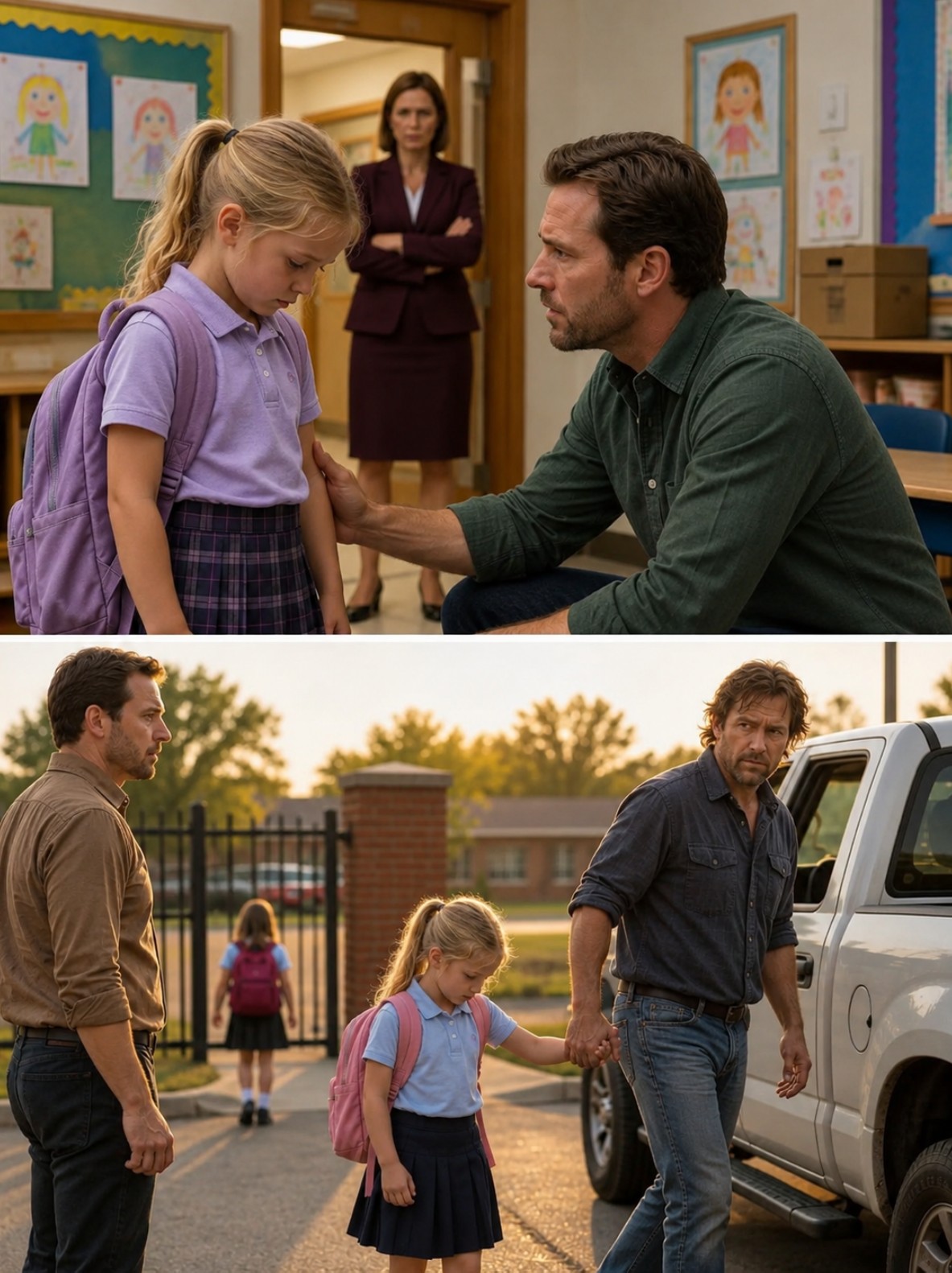
Instead, she stood near the classroom door, looking pale and frightened. Her eyes stayed fixed on the floor while her tiny fingers twisted the hem of her uniform skirt.
Diego set his notebooks on his desk and walked toward her.
He had been teaching young children for years, and he knew the difference between a child who was simply having a difficult morning and one who was genuinely afraid.
He knelt in front of Sofía so she wouldn’t have to look up at him.
“Did you fall, Sofi?” he asked gently.
She shook her head.
“Does your tummy hurt?”
Sofía hesitated. Her little fingers tightened around her skirt.
Then she leaned closer and whispered, “It hurts down there… but my mom told me not to say anything.”
For a moment, Diego felt as though the air had disappeared from the room.
The classroom was still full of noise. Children were talking, sharpening pencils, and arguing over who had taken whose eraser. But all those ordinary sounds suddenly seemed far away.
A terrible feeling settled in his chest.
He knew he had to remain calm. Sofía was already frightened, and the last thing she needed was an adult reacting in a way that might scare her even more.
“You don’t have to sit down if you don’t want to,” he told her softly. “You can stand by the reading corner. That’s perfectly fine.”
Sofía slowly lifted her eyes toward him.
“You won’t get mad at me?”
Diego swallowed hard.
“No, sweetheart. Nobody is going to get mad at you for telling me you’re hurting. You haven’t done anything wrong.”
She didn’t answer, but her shoulders relaxed a little.
Diego gave her some space and watched her carefully without pressing her for more information. He didn’t want to ask leading questions or make her repeat something that was clearly difficult for her to say.
Five minutes later, he called the principal’s office.
Principal Patricia Salgado arrived with her sharp heels clicking against the hallway floor. Her strong perfume filled the classroom, and she wore the same stiff smile she always used when important parents were nearby.
“What is this about, Mr. Ramírez?” she asked quietly.
Diego explained what Sofía had told him.
Patricia listened, then glanced toward the hallway to make sure no one else was paying attention.
“Let’s not overreact,” she said under her breath. “Children sometimes make things up. Maybe she simply wants attention.”
Diego stared at her, struggling to believe what he had just heard.
“A six-year-old child has told me she can’t sit down because she’s in pain,” he replied. “Shouldn’t we take that seriously?”
Patricia’s smile disappeared.
“That is exactly why we need to handle this carefully,” she said. “This school has a reputation to protect.”
Diego felt anger rising in his throat.
“And what about Sofía?”
The principal didn’t answer.
She simply adjusted her jacket and looked toward the door.
That silence disturbed him more than any argument could have.
When the school social worker arrived, Sofía became even quieter.
She sat on a soft chair with her feet dangling above the floor. When the social worker asked how she was feeling, Sofía said she felt better now.
But she didn’t sound relieved.
She sounded scared.
Diego knew that a frightened child might take back what she had said, especially if she believed she could get into trouble for speaking.
He decided not to push her.
That afternoon, he gave the class a drawing activity.
“Today, I want everyone to draw a place where you feel safe,” he explained. “It can be your home, your bedroom, a park, or anywhere you feel happy and protected.”
The children immediately began drawing.
Some drew their houses. Others drew their beds, their grandparents, their favorite parks, or their pets.
Mariana drew a garden filled with butterflies.
One boy drew himself playing soccer with his father.
Another drew his grandmother’s kitchen, complete with a table covered in food.
Sofía, however, drew something very different.
In the middle of her page, she drew a single chair.
There was nothing around it.
No table. No room. No people.
Then she covered the space around the chair with angry red lines, pressing her crayon so hard that the paper nearly tore.
Diego noticed the drawing while walking between the desks.
He stopped beside her and knelt down.
“That’s a lot of red, Sofi,” he said gently. “Would you like to tell me about your picture?”
She pressed her lips together.
For several seconds, she said nothing.
Then, without looking at him, she whispered, “It’s the chair where I’m bad.”
Diego felt a chill run down his spine.
He wanted to ask what she meant, but he reminded himself that his job was to listen, not to investigate. He didn’t want to put words into her mouth or make her feel as though she had to explain everything immediately.
“Thank you for telling me,” he said. “You can always talk to a safe adult when something worries you.”
Sofía returned to her drawing.
Diego quietly made a note of what she had said, determined to report his concerns through the proper child-protection channels.
At dismissal, he watched the children leave their classrooms.
Parents waited outside the gate, calling their children’s names and helping them with their backpacks.
Then Diego noticed Sofía stop near the entrance.
On the other side of the gate stood a tall man wearing a mechanic’s shirt. His arms were crossed, and his expression was hard and impatient. A white pickup truck was parked behind him.
“Move it!” the man shouted. “I don’t have all day!”
Sofía flinched.
Her whole body seemed to shrink at the sound of his voice.
Diego walked toward the gate.
“Are you Sofía’s father?” he asked.
The man turned toward him and gave him a humorless smile.
“Stepfather,” he replied. “And who do you think you are?”
“I’m her teacher, Mr. Ramírez. I’m concerned about her.”
The man’s expression hardened.
He stepped closer to Diego.
“You teach her letters, teacher. Stay out of my house.”
Before Diego could respond, the man grabbed Sofía by the arm. His grip looked far too rough for such a small child.
He pulled her toward the truck.
Sofía didn’t scream.
She didn’t cry.
She didn’t even look back at her teacher.
And somehow, that frightened Diego more than anything else he had seen that day.
That evening, he sat alone at his kitchen table, staring at the drawing he had carefully preserved.
The lonely chair. The angry red lines. Sofía’s quiet voice.
He kept remembering the way she had looked at him when she asked whether he would get mad at her.
He understood that she might be asking for help in the only way she knew how.
She was six years old. She didn’t have the words to explain everything that might be happening to her. She might not even understand why she felt so frightened.
But she had tried to tell someone.
And the adults responsible for protecting her couldn’t afford to ignore that.
The school seemed more concerned about its reputation than about the little girl standing in its classroom.
Diego couldn’t accept that.
He picked up his phone and looked for the number he had been trained to call if he suspected a child was being harmed.
He knew that reporting his concerns could create problems for him at work. Patricia might accuse him of breaking school protocol. Other teachers might turn against him. His job could even be at risk.
But the thought of doing nothing was worse.
He took a deep breath and dialed.
Because the next morning, someone was going to listen to Sofía.
Even if he had to stand against the principal.
Even if the school tried to bury the truth.
And even if everyone told him to stay quiet.
What Diego didn’t yet know was how far the consequences of that single phone call would reach.
Part 2:
That night, Diego sat at his kitchen table with Sofía’s drawing spread out in front of him.
The red scratches around the lonely chair looked less like crayon marks now and more like warning signals he could no longer ignore.
He kept hearing her tiny voice inside his head.
“My mom told me not to say anything.”
He already knew what Principal Patricia Salgado would say the next morning.
She would tell him to calm down. She would remind him to document the situation internally. She would insist that the school needed time to handle the matter properly.
She would tell him to wait.
But Diego had begun to understand something that frightened him.
Sometimes, waiting was how children disappeared in plain sight.
He unlocked his phone and called the number he had been trained to use but had always hoped he would never need.
His hand shook as the line rang.
Finally, a woman answered.
“Child protection services. How can I help you?”
“My name is Diego Ramírez,” he said. “I’m a teacher at Benito Juárez Elementary in Puebla. I’m calling to report concerns about one of my students. She’s six years old, and I’m worried she may be in danger.”
The woman’s voice immediately became more serious.
“Tell me what happened, Mr. Ramírez. Please describe only what you observed and what the child told you.”
Diego took a breath and began explaining.
He described Sofía standing beside the classroom door, refusing to sit down because she was in pain. He repeated her words about her mother telling her not to speak.
He explained how she had become frightened when the school social worker arrived.
Then he described the drawing of the lonely chair surrounded by angry red lines.
Finally, he told the woman about the man who had identified himself as Sofía’s stepfather and had grabbed the little girl by the arm at the school gate.
The woman listened without interrupting.
When he finished, she asked several important questions.
“Did the child directly tell you that someone had hurt her?”
“She told me she was in pain, but she didn’t explain what had caused it.”
“Did she say someone had told her not to speak?”
“Yes. She said her mother had told her not to say anything.”
“Did you observe that she appeared afraid of a caregiver?”
Diego closed his eyes.
He remembered Sofía flinching when her stepfather shouted at her. He remembered the man’s rough grip and the way the little girl had gone completely silent.
“Yes,” he answered. “I did.”
The woman explained that he had done the right thing by reporting his concerns.
She also gave him clear instructions.
He was not to investigate the situation himself, question Sofía repeatedly, or confront the family again. He needed to preserve his notes and any relevant information, follow the instructions of the child-protection professionals, and make sure the school did not suppress the report.
She gave him a case reference number.
Diego wrote it down carefully, then wrote it a second time to make sure he hadn’t made a mistake.
He pressed so hard that his pen nearly tore through the paper.
Before ending the call, he asked the question that had been troubling him most.
“What happens now? Is someone going to check whether she’s safe?”
“The report will be assessed,” the woman replied. “A caseworker will determine the appropriate next steps. If we believe the child faces immediate danger, we will act accordingly.”
Diego thanked her and ended the call.
His apartment suddenly felt unbearably quiet.
He looked down at the drawing again.
He had done what he could. Now he had to trust the people trained to handle the situation.
But he couldn’t stop worrying about what might happen to Sofía before anyone could help her.
He barely slept that night.
By morning, he was exhausted, but his decision had not changed.
He arrived at school before the janitor had unlocked the second gate.
The schoolyard was still covered in the gray light of dawn. The painted murals looked faded in the early morning mist, and the empty playground seemed strangely peaceful.
Diego stood outside his classroom and took a deep breath.
He felt like a man preparing to walk straight into a storm.
At 7:15 a.m., Principal Patricia Salgado arrived with a cup of coffee in one hand and her phone in the other.
She stopped when she saw him waiting in the hallway.
“Maestro Diego,” she said, already sounding annoyed. “You look dramatic. What’s wrong with you?”
“I filed a report last night.”
Her expression changed immediately.
There was no concern in her eyes.
Only fury.
“You did what?”
“I filed a child-protection report concerning Sofía Hernández.”
Patricia glanced toward the empty hallway before stepping closer. Her strong perfume reached him before her next words did.
“You had no authority to do that without notifying me first.”
Diego held her gaze.
“I’m her teacher. I have a responsibility to report concerns about a child’s safety.”
“You had a responsibility to follow school protocol.”
“I followed the law.”
For a brief moment, Patricia’s carefully maintained mask slipped.
She was no longer the friendly principal who greeted parents at school meetings or smiled for photographs in the school’s brochures.
Instead, she looked like someone desperately calculating how much damage one report could cause.
“Do you understand what you’ve done?” she whispered. “We have enrollment interviews this week. Donors are visiting. The mayor’s niece is in third grade. If this becomes public, this school will be dragged through the mud.”
Diego stared at her in disbelief.
She was talking about enrollment, donors, and the school’s reputation.
Not about Sofía’s pain.
Not about the possibility that a six-year-old child might be unsafe at home.
“And Sofía?” he asked.
Patricia said nothing.
Once again, her silence told him more than her words ever could.
By the time the students began arriving, Diego felt as though the entire building was watching him.
Patricia’s secretary kept peeking into his classroom. Two experienced teachers stopped talking the moment he entered the copy room.
Word had spread.
Some people seemed to think he had acted recklessly. Others avoided him altogether, perhaps because they feared becoming involved.
Diego tried to concentrate on preparing his lessons, but his thoughts kept returning to the same question.
Would Sofía be safe today?
Then, just as the first children were settling into their seats, she walked through the classroom door.
She was wearing her pink backpack again, but she moved carefully, as though every step caused discomfort.
Her hair was tied into two uneven ponytails. One was higher than the other, and a loose strand hung across her forehead.
Her eyes scanned the room before she entered fully, as though she were searching for something—or someone—she feared.
Diego approached her without making a scene.
He knelt near the doorway and spoke in the same gentle voice he used every morning.
“Good morning, Sofi.”
She looked at him as though she were trying to decide whether yesterday had really happened.
“Good morning, maestro.”
“You can use the reading corner again today if sitting feels uncomfortable,” he told her. “You don’t have to explain anything to me.”
Her lips parted slightly.
Then she nodded.
Diego didn’t ask her more questions.
He didn’t touch her or insist that she prove she was in pain. He didn’t demand that she repeat what she had said the previous day.
He simply made space for her.
Sometimes, he was beginning to understand, that was the first thing a frightened child needed from an adult.
A place where she could exist without being forced to explain herself.
At 9:40 a.m., two visitors arrived at the school.
One was Irene Morales, a child-protection caseworker assigned to the report. The other was a pediatric psychologist working with the child-protection team.
Patricia greeted them at the entrance with a smile so polished it looked painful.
From his classroom window, Diego watched her gesture enthusiastically, laugh too brightly, and attempt to lead them toward her office.
But Irene didn’t return her smile.
“We need to speak with the reporting teacher,” she said.
Patricia’s mouth tightened.
“Of course,” she replied. “I’m sure we can arrange that.”
Ten minutes later, Diego was called into the principal’s office.
Patricia sat behind her desk like a judge preparing to deliver a sentence. Irene sat beside the psychologist, an open folder resting in front of her.
Patricia spoke before anyone had asked her a question.
“Maestro Diego is a very dedicated teacher,” she began. “But sometimes he becomes emotionally involved. He’s inexperienced when it comes to delicate family matters.”
Diego sat down slowly.
He wanted to defend himself, but he knew that this was not the time for an argument.
Irene turned toward him.
“Mr. Ramírez, please tell us what happened from the beginning.”
So he did.
He described Sofía standing by the classroom door. He repeated her words about being in pain and her mother’s warning not to say anything.
He explained how frightened she had seemed when the school social worker arrived.
Then he described the drawing of the chair and the strange sentence Sofía had whispered to him.
Finally, he explained what had happened at dismissal, including the stepfather’s threatening words and the way he had grabbed the little girl by the arm.
Diego kept his voice calm and factual, even though anger burned beneath his ribs.
Patricia interrupted twice.
“Children exaggerate,” she said.
Then, when Diego mentioned the drawing, she added, “That picture could mean anything.”
Irene turned toward her.
“Directora Salgado, please allow him to finish.”
Patricia’s face flushed red.
For the first time, someone had openly told her to stop.
Diego continued.
When he described the stepfather’s grip on Sofía’s arm, the psychologist began writing notes more quickly.
When he repeated the little girl’s words—“the chair where I’m bad”—Irene’s expression became serious.
“Do you still have the drawing?” she asked.
“Yes,” Diego replied. “I preserved it with my notes.”
He opened his folder and carefully placed the drawing on the desk.
Patricia’s eyes widened.
“You removed student work from the classroom?”
“I preserved something that may be relevant to a child-protection report,” Diego answered.
Her nostrils flared, but Irene was already examining the paper.
She studied the isolated chair, the heavy red marks, and the empty space around it.
She didn’t claim to know exactly what the picture meant. A drawing alone could not establish what had happened to a child.
But in the context of Sofía’s words and behavior, it was worth taking seriously.
After a moment, Irene looked up.
“Has the school contacted Sofía’s mother?”
Patricia answered too quickly.
“Not yet. We intended to handle everything carefully.”
“Good,” Irene said. “Do not contact the family before we do. We need to coordinate the next steps and make sure the child is safe.”
Patricia stiffened.
“With all due respect, parents have rights.”
Irene met her gaze.
“So do children.”
The room fell silent.
For the first time since Diego had known her, Patricia seemed to realize that she might no longer control what happened next.
The investigation was no longer something she could quietly manage behind her office door.
People outside the school were now asking questions.
And they weren’t asking how to protect the school’s reputation.
They were asking how to protect Sofía.
Part 3:
At recess, Sofía wasn’t publicly removed from the classroom or surrounded by adults asking questions.
The pediatric psychologist entered Diego’s room quietly and explained that she would be conducting a general emotional-wellness activity with the children.
She sat with several students and asked them to draw their feelings as different kinds of weather.
“What does happiness look like?” she asked.
One child drew a bright yellow sun.
Another drew a rainbow stretching across the sky.
A little boy drew a storm with enormous black clouds because he said he sometimes felt angry when other children took his toys.
The psychologist listened to their explanations without judging them.
When it was Sofía’s turn, she drew a house.
But the house had no windows.
She didn’t explain much about it, and the psychologist didn’t force her to.
Diego noticed the drawing from across the room, but he quickly looked away before Sofía could catch him watching.
He kept reminding himself that he wasn’t a detective.
He wasn’t a police officer.
And he wasn’t a hero in a movie who could solve everything by confronting the villain.
He was a teacher.
His responsibility was to notice when something was wrong, report his concerns, preserve relevant information, and provide a safe environment while trained professionals did their work.
That didn’t mean he could stop worrying.
As dismissal approached, every muscle in his body tightened.
The white pickup truck was back.
It stood near the school gate, its familiar shape immediately catching Diego’s attention.
Sofía’s stepfather was waiting beside it. He wore sunglasses and stood with his arms crossed, his jaw clenched.
The moment Sofía saw him, she stopped moving.
It was as though her body had forgotten how to take another step.
Diego noticed her frozen expression and moved closer, careful not to crowd her.
Irene was waiting near the school office, coordinating the next steps with the school staff.
Patricia noticed the man too.
She hurried toward the gate, apparently hoping to take control of the situation before the other parents began paying attention.
Diego stepped out of his classroom anyway.
He knew Patricia would be furious with him for doing so, but he couldn’t ignore what was happening in front of him.
The stepfather spotted Diego almost immediately.
A smile spread across his face.
It wasn’t a friendly smile.
“Teacher!” he called. “Still sticking your nose where it doesn’t belong?”
Several parents turned to look.
Patricia hurried forward.
“Señor Víctor,” she said, forcing a pleasant tone into her voice. “Please, let’s speak inside.”
Inside.
Away from the parents.
Away from the other teachers.
Away from anyone who might hear too much.
But Irene stepped forward before Patricia could lead the man away.
“Señor, my name is Irene Morales. I’m a child-protection caseworker. I need to speak with Sofía’s mother before the child leaves campus today.”
Víctor’s smile disappeared.
“Her mother is working,” he replied.
“Then we’ll need to arrange contact with her.”
“She’s leaving with me.”
Irene remained calm.
“We need to complete the safety procedures before she leaves. Please cooperate with us while we establish the appropriate arrangements.”
Víctor stepped closer.
His voice grew louder.
“You people think you can tell me what to do with my family?”
Behind Diego, Sofía stood half-hidden in the classroom doorway.
Her face had gone frighteningly blank.
It was the kind of expression that had begun to worry Diego more than tears would have. She seemed to be shutting down, withdrawing into herself as the adults argued around her.
Irene didn’t raise her voice.
“No one is accusing you of anything here at the gate,” she explained. “We are following up on a child-protection report. We need to speak with her legal guardian and complete the required safety procedures before making arrangements for her departure.”
Patricia leaned toward Irene and whispered urgently.
“Please, not in front of everyone.”
Irene ignored the request.
Sofía’s safety mattered more than keeping an uncomfortable conversation out of public view.
Víctor suddenly pointed at Diego.
“This is because of him!”
Diego didn’t answer.
He knew that arguing with the man would not help Sofía. He also knew he needed to avoid doing anything that might escalate the confrontation.
His silence seemed to make Víctor even angrier.
The man turned toward the gate as if he intended to force his way through.
The elderly school guard, Don Lupe, had been standing nearby, watching the confrontation with growing concern.
Now he moved forward.
His hands trembled, but he placed himself between Víctor and the entrance.
“Señor,” he said nervously, “please don’t do that.”
For a long moment, nobody moved.
The parents stood watching. Some held their children close. Others whispered among themselves.
Patricia looked as though she wished the ground would swallow her.
Irene remained composed, while Don Lupe stood his ground despite his obvious fear.
Then a police vehicle turned onto the street.
The sound of the approaching vehicle caught everyone’s attention.
Víctor saw it, and his expression changed instantly.
The anger remained, but something else appeared beneath it.
Surprise.
Diego suddenly understood something important.
The man had behaved as though nobody would challenge him. He had expected the school to step aside, the teacher to remain silent, and the child to follow his orders without question.
For once, that wasn’t happening.
Víctor spat onto the sidewalk, turned around, and marched toward his truck.
Before climbing inside, he looked directly at Diego.
“You don’t know what you’ve started,” he warned.
Then he got into the white pickup and drove away.
Only after the truck disappeared around the corner did Diego realize how badly his hands were shaking.
He had been holding himself together for Sofía’s sake, but now the fear and tension of the past two days were catching up with him.
He looked toward the classroom doorway.
Sofía was still standing there.
She hadn’t moved.
Diego wanted to reassure her, but he didn’t want to make promises he couldn’t guarantee.
Instead, he stayed nearby while Irene and the other staff members continued addressing the situation.
The next steps would need to be handled by the professionals responsible for her safety.
Patricia, however, had other concerns.
The moment the truck disappeared, she turned on Diego.
“Are you satisfied now?” she hissed. “You’ve created a spectacle!”
Diego stared at her.
He looked toward the parents who were still whispering outside the gate.
Then he looked at Sofía, who remained frozen in the doorway.
“No,” he answered quietly. “I’ll be satisfied when she’s safe.”
For once, Patricia had no immediate reply.
That evening, Diego stayed at school longer than usual.
The corridors had emptied, and the familiar sounds of the building had returned: the distant hum of the janitor’s vacuum, rain tapping against the windows, and the faint metallic groan of old pipes settling behind the walls.
He sat alone at his desk beneath the warm glow of a lamp.
Stacks of spelling quizzes waited beside him, untouched.
He couldn’t bring himself to grade them.
His mind kept returning to the day’s events.
The white truck.
The stepfather’s threatening words.
The way Sofía had stopped moving when she saw him.
And the drawing of the chair.
Diego had reported his concerns, and child-protection professionals had begun responding. But he knew that making a report was only the beginning.
There would be questions to answer, procedures to follow, and decisions that would have to be made carefully.
He hoped that Sofía would finally have the chance to tell her story to someone who could help her.
As the rain grew heavier, Diego looked toward the reading corner.
A framed drawing hung on the wall.
It showed a blue chair beneath a simple sentence written in a child’s handwriting.
Mi escuela me escucha.
My school listens to me.
He stared at it for a long time.
The blue chair looked almost real under the classroom lights.
And as he sat there in the quiet school, he wondered whether Sofía would ever be able to look at a chair without remembering the fear that had followed her into the classroom.
He hoped she would.
More than anything, he hoped she would.
Part 4:
Several years later, Diego would remember those first days of the investigation as the beginning of a long journey toward safety and healing.
The process had not been simple.
There had been difficult conversations, professional assessments, and painful moments when the adults involved had to confront things they would rather not have known.
Sofía’s mother, Elena, eventually became part of the process, and Sofía received support from professionals trained to help children recover from frightening experiences.
The details of what happened were not something Diego could simply explain to everyone who asked. Some matters needed to remain private, especially when they involved a child.
What mattered most was that Sofía was no longer expected to carry her fear alone.
Recovery took time.
There were appointments, difficult memories, and days when progress seemed almost impossible to measure.
But there were also ordinary moments.
Moments that might have seemed unimportant to anyone else.
A day when Sofía laughed without looking over her shoulder.
An afternoon when she played with her friends without constantly checking the adults around her.
A morning when she walked into a room and chose where to sit without fear.
Little by little, her world began to grow.
And Diego continued teaching.
He welcomed new students into Room 12, helped children learn their letters, settled arguments over crayons, and reminded his class that mistakes were part of learning.
He also kept the blue chair in the reading corner.
It became a familiar place where children could sit quietly, look at books, or take a moment when the classroom felt overwhelming.
Above it hung the framed drawing.
My school listens to me.
Diego never wanted to forget why those words mattered.
One rainy evening, long after the school day had ended, he sat alone at his desk again.
The building was quiet.
The classroom smelled faintly of paper, crayons, and the cleaning products the janitor had used on the floors.
Outside, rain slid down the windows in crooked silver lines.
Diego had been grading papers when his phone buzzed.
An unknown number appeared on the screen.
He almost ignored it.
Almost.
But something made him answer.
“Hello?”
At first, there was only silence.
Then he heard breathing.
Uneven, nervous breathing.
Finally, a small voice spoke.
“Maestro Diego?”
His chest tightened instantly.
“Sofía?”
“Yes.”
Diego glanced at the clock.
It was 8:42 p.m.
He sat up straighter.
“Sofi, is everything okay?”
There was a pause.
Then the little girl said something he hadn’t expected.
“I lost my tooth.”
Diego blinked.
“What?”
A tiny laugh escaped her.
“My front tooth!” she whispered proudly. “It finally came out!”
For one terrifying second, his mind had raced toward the worst possible explanation.
After everything that had happened, fear had become instinct. An unexpected phone call from Sofía could still make him imagine danger before he had time to think.
But now he understood.
She was calling to share something exciting.
Something ordinary.
Something that mattered to a little girl growing up.
Relief flooded through him so quickly that it almost hurt.
“That’s amazing!” he said, smiling despite himself. “Congratulations, Sofi! You’ve been waiting for that tooth to come out, haven’t you?”
“Yes!” she answered, sounding delighted. “It was wiggly for a really long time.”
“Well, I guess it finally decided it was time to go.”
She giggled.
Diego leaned back in his chair.
For a moment, he simply listened to her laugh.
Then Sofía said something that made his smile fade.
“I wanted to tell you because… because last year I thought I was never gonna grow up.”
The words struck him harder than any courtroom testimony ever could.
Children sometimes said devastating things in the simplest possible way.
He thought about the little girl who had once stood by his classroom door, afraid to sit down.
He remembered the frightened eyes, the twisted uniform skirt, and the question she had asked him.
“You won’t get mad at me?”
Now she was calling him to celebrate losing a tooth.
A small, ordinary milestone.
Proof that she was still growing, still learning, and still finding reasons to be excited about the world.
Diego leaned back slowly in his chair.
“Well,” he said gently, “you were wrong about that, weren’t you?”
Another little laugh came through the phone.
“Yes.”
He could hear Elena in the background asking Sofía whether she had brushed her teeth.
Normal sounds.
Safe sounds.
The kind of sounds many people never realize are miracles.
“Mom says I can come visit the school tomorrow after my appointment,” Sofía said. “Can I see the blue chair?”
Diego smiled.
“Of course you can. You never have to ask permission to visit the reading corner when your mother and the school have arranged it.”
“Okay!”
He could almost picture her nodding enthusiastically on the other end of the line.
For a few seconds, neither of them spoke.
Then Sofía’s voice became quieter.
“Maestro?”
“Yes, Sofi?”
“Do you think kids remember scary things forever?”
Diego looked toward the dark classroom windows.
Rainwater slid down the glass, reflecting the soft light from his desk lamp.
He wanted to give her an answer that would make all her worries disappear.
But he knew that healing didn’t work that way.
He also knew that she deserved honesty.
“I think some memories stay with us for a long time,” he said carefully. “Sometimes, something reminds us of a scary moment, even when we’re somewhere safe. But I also think we can make new memories around those old ones.”
Sofía remained quiet.
So he continued.
“Imagine planting a tree beside a broken wall. The wall is still there, but the tree grows taller every year. Eventually, people may notice the tree before they even notice the wall.”
He paused.
“Your memories don’t have to disappear for you to have a happy life, Sofi. You can keep growing. You can laugh, make friends, learn new things, and discover places where you feel safe.”
He heard her thinking about what he had said.
Then she replied, “My therapist says something kinda like that.”
Diego smiled.
“Then she sounds very smart.”
“She is.”
Another pause followed.
Then Sofía asked the question that mattered most.
“Do you think I’m normal?”
Diego felt his throat tighten.
Not weird.
Not broken.
Not damaged beyond repair.
Just a little girl asking whether she still belonged in the world after experiencing things no child should have to face.
He looked around the classroom.
The alphabet posters were still on the walls. The crayons were scattered across a shelf. Tiny desks bore scratches left by generations of restless children.
Everything looked ordinary.
But Diego knew that ordinary places could hold extraordinary moments.
He took a breath and answered with complete sincerity.
“I think you’re a wonderful girl, Sofi. And I think you’re brave.”
He paused to make sure she was listening.
“Brave people sometimes get hurt. They sometimes feel afraid, confused, or sad. But that doesn’t make them less normal. It makes them human.”
The line fell silent.
Then Diego heard a small sniffle.
It wasn’t the frightened silence he remembered from that first morning.
This time, something about it sounded different.
It sounded like relief.
“Okay,” she whispered.
From somewhere in the background, Elena called, “Sofía, it’s bedtime!”
“I gotta go,” Sofía said.
“Alright, sweetheart. Get some rest.”
“Goodnight, Maestro Diego.”
“Goodnight, Sofi. And congratulations again on your tooth!”
She giggled one last time.
Then the call ended.
Diego sat there for a long time, holding the silent phone in his hand.
Outside, the rain slowly began to ease.
He thought about the journey Sofía had made since the day she first stood in his classroom, unable to sit down without pain.
He knew that one happy phone call didn’t mean every difficult memory had disappeared.
It didn’t mean that the past no longer hurt.
But it meant that she had reasons to call someone and share good news.
She had people she trusted.
She had a therapist who helped her understand her feelings.
And she had a mother who was involved in her care.
Those things mattered.
More than he could explain.
Eventually, Diego stood and walked toward the reading corner.
The little blue chair was already perfectly aligned with the shelf, but he straightened it anyway.
He ran his hand along its back and looked at the framed drawing above it.
That chair had become something much larger than a piece of classroom furniture.
It was a reminder that safety could exist.
That fear did not have to control an entire life.
And that one adult choosing to listen could help change the direction of a child’s future.
Diego turned off the classroom lamp and stepped into the hallway.
The motion sensors flickered on one by one, illuminating the corridor in soft golden sections.
Years earlier, he might have walked through the school thinking that schools were made of concrete, schedules, paperwork, and rules.
Now he understood that a school was much more than that.
A school was made of moments.
A teacher kneeling beside a frightened child.
A staff member deciding whether to speak up or remain silent.
A school guard stepping between a threatening adult and the gate.
A mother finally taking part in the process of protecting her daughter.
And a little girl who had once drawn a red chair surrounded by angry lines, eventually finding comfort in a blue one.
Those were the moments that made a place safe.
Not its reputation.
Not its slogans.
Not the polished brochures hanging in administrative offices.
People made a place safe.
People willing to notice when something was wrong.
People willing to act when a child needed help.
People willing to risk their own comfort rather than leave a frightened child to face the world alone.
As Diego reached the exit doors, he looked back one last time down the empty hallway.
It was quiet.
Warm.
Safe.
And somewhere inside Room 12, beneath the framed drawing on the wall, the little blue chair waited patiently for the next school morning.
For another child with a question.
Another child with a whisper.
Another child hoping someone would listen.
This time, someone would.
The End.
