
Part 1:
“If your daughter actually thought she was going to shine brighter than my girls, someone simply had to bring her back down to earth.”
Those were the words my sister, Pamela, said with a cold, twisted grin while standing in my parents’ living room.
My daughter, Maya, stood trembling beside me. Her knuckles were white as she tightly clutched the skirt of her outfit, tears filling her eyes.
I stared at my sister, barely able to believe what I was hearing.
My name is Jasper. I am forty-two years old, and I have been raising my daughter on my own for the past six years.
Maya’s mother, Josephine, packed a bag six years ago and moved to a small coastal town in Maine to “find herself.” She left behind broken promises and a little girl who desperately needed stability.
At first, Josephine called every Sunday.
Then the calls became monthly.
Eventually, even those stopped.
All Maya received were birthday cards and occasional messages.
She learned very young that depending on other people was a gamble.
But I made myself a promise.
Whatever happened, Maya would never feel like a burden in my home.
She was sixteen now. She was quiet, thoughtful, and observant in a way that often surprised me. During our late-night conversations, she sometimes noticed things about people that I had completely missed.
She loved drawing detailed dress designs and playing the cello in her high school orchestra. She rarely asked me for anything.
Most of the time, all she wanted was another set of art pencils.
So when she burst through our front door one afternoon with the news that she had been nominated for the school’s prom court, I felt a kind of pride I had not experienced in years.
“Are you sure it was me, Dad?” she asked.
There was disbelief in her voice, as if she were waiting for someone to tell her there had been a mistake.
I smiled and gently pushed a strand of hair away from her face.
“The real mistake would have been if they had managed to overlook you in the first place.”
Her eyes lit up.
That weekend, we drove to a boutique in a quiet suburb outside Providence to find her the perfect dress.
Maya walked slowly between the racks until she saw it.
A soft, powder-blue gown.
The neckline was modest, the fabric fell beautifully around her body, and when the light touched it, the material shimmered like moonlight on water.
She immediately stopped.
“Dad…”
“I see it,” I said.
She smiled.
When she finally stepped out of the fitting room wearing it, she stood completely still in front of the mirror.
For several seconds, she said nothing.
It was almost as if she were meeting a version of herself she had only imagined before.
Then she looked at me.
“Is this too much for a school dance?”
“It is exactly what you deserve, Maya.”
She looked down at the dress.
“Really?”
“Really.”
I handed my card to the clerk without another thought.
I would have paid ten times that amount just to see the brief, radiant happiness on my daughter’s face.
Unfortunately, that happiness did not last long.
A few days later, my sister Pamela called and begged me to let her twin daughters, Chloe and Zoey, stay at our house for a long weekend while she attended a business seminar.
The girls were seventeen.
They were popular, attractive, and used to getting what they wanted.
They also carried themselves with a sense of entitlement that could cut deeper than any insult.
I knew they could be difficult, but they were family.
So I agreed.
They arrived with heavy suitcases, perfect makeup, expensive-looking clothes, and loud laughter that somehow felt more like a weapon than genuine happiness.
The moment Chloe saw Maya in the hallway, she smiled.
“Oh, Maya. How sweet that you are actually going to the dance.”
Maya gave a small smile.
Zoey checked her reflection in the hallway mirror.
“Are you going with the orchestra kids, or is it a solo mission this year?”
Maya said nothing.
She simply picked up her dress bag and headed toward her bedroom.
I noticed the way her shoulders tightened.
But I told myself they were just being typical teenagers.
That evening, Chloe and Zoey asked to see Maya’s dress.
Maya hesitated.
I should have noticed that hesitation.
Instead, I foolishly believed showing them the gown might help the cousins become closer.
Maya slowly opened the garment bag.
The twins stared at the dress.
For several seconds, neither said anything.
Then Zoey tilted her head.
“It is nice.”
She paused.
“Very… simple and quiet.”
Chloe gave a little laugh.
“It fits your personality perfectly.”
Maya’s face fell.
I wanted to say something, but the girls were already walking away.
Later that night, I heard them whispering in the hallway.
I stayed in my study.
I convinced myself that teenage drama was simply part of growing up.
I was completely wrong.
Friday afternoon, the day before the dance, I came home carrying takeout containers and feeling excited about spending the evening with Maya.
“Maya?” I called.
There was no answer.
I walked toward her bedroom.
“Maya, I brought dinner.”
Still nothing.
I pushed open her door.
And stopped.
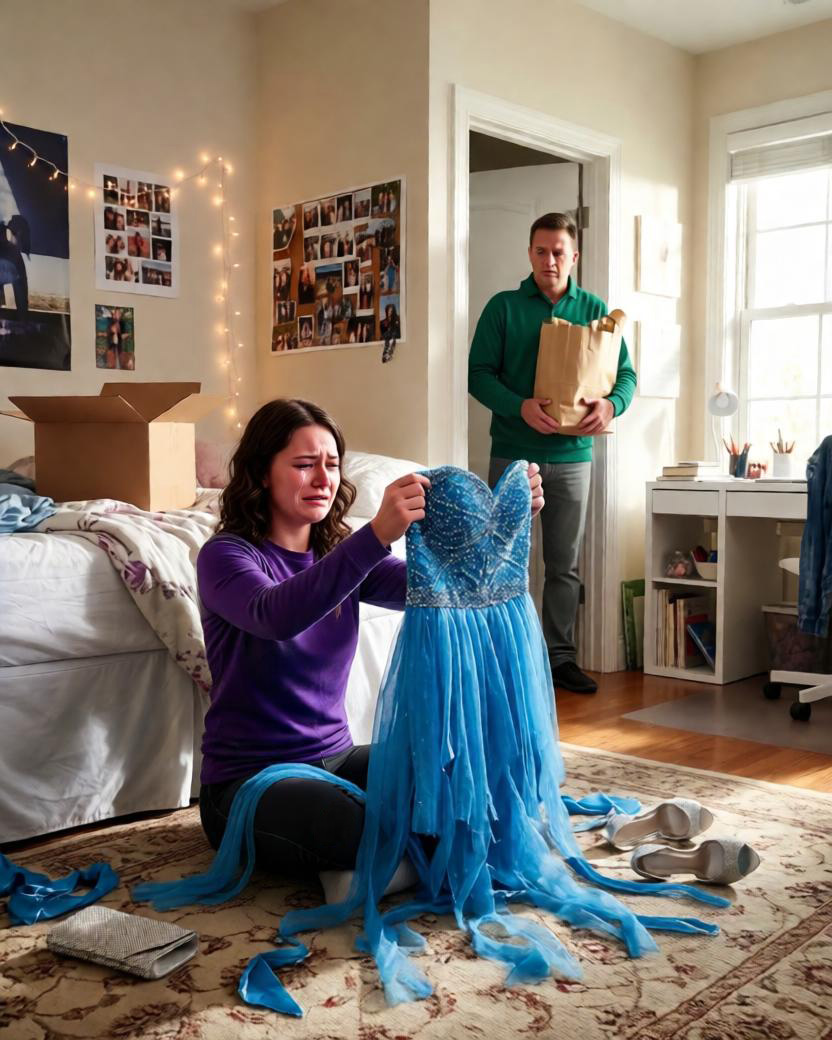
My daughter was sitting on the floor.
She was completely silent.
The blue dress lay across her lap.
Except it was no longer really a dress.
The straps had been cut.
The bodice had been ripped apart.
Large sections of the fabric had been shredded, with jagged edges hanging from the remains.
Someone had destroyed it with deliberate, brutal care.
For several seconds, I could not breathe.
“Maya…”
She looked up.
There were no tears running down her face.
That somehow made it worse.
“I walked in and found it like this,” she whispered.
Her voice was almost empty.
“I think I should just stay home tomorrow, Dad.”
I knelt beside her.
A cold rage spread through me.
“Did you see who was in your room today?”
Maya shook her head.
Then she remembered something.
“Grandma offered to hem the bottom of the dress. She said she wanted to look at the stitching.”
My stomach tightened.
“She let Chloe and Zoey take it to her house for a quick look.”
She swallowed.
“They brought it back about an hour ago.”
I looked at the ruined dress.
I already knew.
I helped Maya stand, put the shredded gown into a large garment bag, and drove straight to my parents’ house.
I knew Pamela and the girls were there for a family gathering before dinner.
When I walked into the living room, everyone looked at me.
I held up the bag.
“What exactly did you two think you were doing to Maya’s dress?”
Chloe looked up from her phone.
She shrugged.
“It was just a harmless prank, Uncle Jasper.”
Zoey crossed her arms.
“We honestly did not expect her to get so incredibly dramatic over a piece of fabric.”
My mother sat silently on the sofa.
Pamela sighed.
“Jasper, please. You are making a huge fuss over a torn dress.”
I stared at her.
Then Chloe looked directly at me.
“It really wasn’t fair for her to try to look prettier than us at the dance.”
The room went silent.
My mother’s mouth opened in shock.
But she said nothing.
Maya stepped forward.
Her voice trembled.
“Why do you hate me so much?”
No one answered.
Not Pamela.
Not Chloe.
Not Zoey.
Not even my mother.
That silence told me more than any confession could have.
Maya had been hurting for a long time, and the adults around her had simply chosen not to see it.
I took my daughter’s hand.
“Come on.”
We turned around and walked out.
My phone rang while we were still on the highway.
It was my mother.
She was crying.
“Please, son,” she begged. “Do not report this to the school principal. It could ruin their standing. The girls could lose their positions on the prom court.”
I glanced at Maya.
She was staring out the window at the passing city lights.
Her face was completely expressionless.
I tightened my grip on the steering wheel.
“If you are so desperate to protect someone, you should start by protecting the girl you allowed them to destroy.”
Then I ended the call.
Part 2:
Saturday morning arrived with a heavy, unnatural silence.
It was the day of the dance.
Maya should have been in the kitchen getting her hair done. She should have been laughing with friends, taking photographs, and getting excited about the night ahead.
Instead, she sat on her bed wearing sweatpants.
She spent most of the morning scrolling through social media and watching everyone else live the evening she had once been looking forward to.
She stopped on a video of several girls from school posing in their dresses.
“They look so happy, don’t they?” she asked.
I sat beside her.
“I am sorry you are missing this, Maya. None of this is your fault.”
She kept staring at the screen.
“It does not matter anymore.”
Her voice sounded much older than sixteen.
“I just wanted to feel like I belonged somewhere for once.”
There was nothing I could say that would magically fix what had happened.
So I stayed beside her.
I did not give her a speech.
I did not tell her everything would be fine.
I simply stayed.
Eventually, she put her phone on the nightstand and leaned against my shoulder.
The following week was the hardest period we had ever faced.
Maya stopped sketching.
She barely touched her food.
She stopped playing her cello.
She even began spending her free time hiding in her bedroom.
My family, meanwhile, seemed more concerned about keeping everything quiet than about what had happened to Maya.
Messages started arriving on my phone.
Pamela insisted that I was exaggerating.
She claimed I was trying to embarrass her daughters.
At one point, she even wrote that my daughter needed to “learn to handle herself.”
She still seemed unwilling to understand that Maya was the victim.
I knew I had to do something.
Not to punish the girls.
Not to get revenge.
I needed to help my daughter.
So I went to her high school and asked to speak with Ms. Gable, the guidance counselor.
I explained everything.
She listened carefully.
Then she looked at me with genuine sadness.
“Maya is a brilliant, gifted girl,” she said. “But she has started hiding in the hallways.”
I looked down.
“What do you mean?”
“It is almost as if she is waiting for permission just to exist.”
Those words hit me hard.
Because I knew exactly where that feeling had come from.
Ms. Gable mentioned an upcoming end-of-year art exhibition.
“Maybe giving her a way to express what she is feeling could help,” she suggested.
That evening, I brought it up over dinner.
Maya barely touched her food.
“I have nothing left to say,” she told me.
“Perhaps you do,” I replied. “You just haven’t found the right way to say it yet.”
She did not answer.
Two days later, I walked past her bedroom.
The door was slightly open.
I looked inside.
Maya was sitting at her desk.
She was drawing.
But she was not drawing beautiful dresses anymore.
She was drawing broken mannequins.
Silhouettes with jagged edges.
Torn fabric.
Figures that looked damaged at first glance, but whose shredded clothing slowly transformed into wings.
I stood quietly in the doorway.
Maya noticed me.
“I think I know what I want to make.”
“What?”
She looked down at the drawing.
“What I Would Have Worn.”
It became the name of the series.
For the first time since the dress had been destroyed, I saw my daughter completely focused on something again.
She also agreed to speak with a therapist.
After her second session, she came home looking a little lighter.
She still had difficult days.
But she was beginning to talk again.
Then Brooke came to our house.
Brooke was one of Maya’s classmates.
She looked nervous when she stepped through the door.
“I need to tell you something,” she said.
Maya looked at her.
Brooke swallowed.
“I saw what they did to your dress.”
Maya’s expression changed.
“Where?”
“On a video call.”
Brooke’s hands were shaking.
“They were laughing about it. I was there, and I didn’t say anything.”
She looked ashamed.
“I was scared of them.”
Then Brooke pulled out her phone.
She showed us screenshots.
There were messages in which Chloe and Zoey bragged about destroying Maya’s dress.
There were comments calling it a joke.
There were messages making fun of Maya for being upset.
And there was enough evidence to show that the destruction had been deliberate.
I did not take the evidence to the school.
Brooke did.
She went to the administration herself.
The school began a private investigation.
They interviewed students, reviewed the screenshots, and examined the timeline of what had happened to the dress.
When my mother learned about the investigation, she came to our house in tears.
“Jasper, please,” she begged. “Pamela is falling apart.”
I said nothing.
She continued.
“The girls could lose their leadership positions. Their scholarships could be affected if they receive a disciplinary record.”
Maya had been standing in the hallway.
She heard every word.
Then she stepped forward.
“And what about my emotional record, Grandma?”
My mother froze.
“What?”
Maya looked directly at her.
“What happens to the part of me that has to remember this every time I see a blue dress?”
My mother looked down.
“I never meant to hurt you, dear.”
Maya’s voice remained calm.
“You did not want to see it.”
She took a breath.
“That is almost the same as hurting me.”
My mother had no answer.
That evening, Ms. Gable called.
The school wanted a formal statement from Maya.
I asked her if she wanted to do it.
She thought about it.
“I don’t want revenge,” she said.
“What do you want?”
She looked at me.
“I want them to understand that I am a person.”
Her eyes filled with tears.
“And what they did really mattered.”
Maya spent three nights writing her statement.
Sometimes she cried silently into her pillow.
Sometimes she crossed out entire paragraphs.
But she refused to stop.
When she finally read the first paragraph aloud to me, I had to walk into the kitchen because I did not want her to see me crying.
The art exhibition opened the following Tuesday.
Maya stood beside her artwork wearing a simple black shirt and jeans.
There was nothing flashy about her.
She was not trying to impress anyone.
She was simply standing there.
Present.
Visible.
A teacher approached her display and spent several minutes studying the broken mannequins.
Finally, he nodded.
“This is a powerful form of protest, young lady.”
Maya looked at him.
For the first time in months, she gave a genuine smile.
“It is.”
The next day, the principal called Maya into his office.
I went with her.
And I knew the truth was finally about to come out.
Part 3:
The principal’s office was quiet.
Ms. Gable sat beside him.
A thick file rested on the desk.
Inside were photographs of Maya’s ruined dress, screenshots of the conversations, Brooke’s statement, and the other information the school had gathered.
Maya sat beside me.
She looked nervous, but she was no longer shrinking into herself.
The principal opened the file.
“Maya, first, I want you to know that you are not in trouble.”
He paused.
“We have confirmed that what happened to your dress was a deliberate and targeted act.”
Maya stared at the folder.
The principal continued.
“We also know that you did not initiate this complaint. You are the primary victim here.”
He folded his hands.
“So we want to know what you would like to happen next.”
Maya took a deep breath.
“I don’t want them expelled.”
The principal looked surprised.
“I don’t?”
Maya shook her head.
“I don’t believe destroying their future will fix mine.”
She looked at me for a moment before continuing.
“But I want them to understand that I am not going to be treated like an invisible target anymore.”
The principal leaned forward.
“Then tell us what you would like to do.”
Maya thought carefully.
She did not ask for money.
She did not ask for public humiliation.
She did not ask for revenge.
Instead, she asked for something much harder.
“I want to read a statement at the closing assembly.”
My heart tightened.
She continued.
“I want to talk about what happens when people destroy someone’s trust and then call it a game.”
When we left the office, I turned to her.
“Are you absolutely sure about this?”
“Yes, Dad.”
Her answer came without hesitation.
“They might have taken my night away.”
She looked directly into my eyes.
“But I am not going to give them my voice.”
The assembly was held several days later.
The auditorium was packed.
Parents filled the back rows.
Teachers stood along the walls.
Students filled almost every seat.
I looked across the room.
I saw Pamela sitting with Chloe and Zoey.
I saw my mother sitting alone in the very back.
She looked smaller than I had ever seen her.
Then Maya walked toward the microphone.
Her hands were steady as she held her pages.
For one brief moment, I remembered the girl I had found sitting on her bedroom floor with her ruined dress across her lap.
That girl was still part of my daughter.
But she was no longer allowing fear to control her.
Maya looked at the audience.
Then she began.
“They say high school is a place where you discover who you are.”
Her voice carried clearly through the auditorium.
“But nobody ever warns you about the people who try to convince you that you do not deserve to be seen.”
The room became completely silent.
“This year, I was honored to be nominated for the prom court. Not because I thought I was better than anyone else, but because, for the first time, I felt like I was finally being recognized.”
She paused.
“Three days before the dance, my dress was destroyed by people who knew exactly how much it meant to me.”
I watched Chloe lower her head.
Zoey stared at the floor.
Maya continued.
“The worst part was not losing the dress.”
Her voice became stronger.
“The worst part was that, for a few minutes, I believed they were right.”
She looked toward the audience.
“I thought maybe I was too happy.”
She took a breath.
“Maybe I was too visible.”
Another pause.
“Maybe I did not deserve to be there.”
My heart ached.
But I stayed in my seat.
This was her moment.
She had earned it.
Then Maya raised her chin.
“Then I realized something.”
Her voice was calm.
“The people who try to dim your light are often afraid of someone who shines without asking for permission.”
The auditorium remained silent.
“They can cut the fabric.”
She glanced toward Chloe and Zoey.
“They can break the straps.”
Her voice grew stronger.
“They can laugh at me.”
She took one final breath.
“But they cannot decide who I am.”
For one second, nobody moved.
Then Brooke began clapping.
One teacher joined.
Then another.
Within seconds, the entire auditorium erupted into applause.
Maya did not smile like someone in a movie.
She simply closed her eyes for a moment and breathed.
She had finally said everything she needed to say.
The consequences came quickly.
The school suspended Chloe and Zoey for one week.
They were also removed from their leadership positions because the administration determined that their actions had violated the school’s conduct standards.
Pamela called me the following morning.
She was furious.
“Are you happy now?” she demanded. “You have ruined their entire year!”
I stayed calm.
“I did not ruin their year.”
“You know exactly what you did!”
“No,” I replied. “They ruined their own reputations when they decided they could hurt someone and face no consequences.”
Pamela was silent for a moment.
Then she returned to the same accusation she had used for years.
“You have always been jealous of me.”
I closed my eyes.
“Pamela…”
“Mom always loved me more.”
I took a slow breath.
“No, Pamela.”
My voice was steady.
“I never wanted your place.”
I paused.
“I just got tired of watching my family treat my daughter like she was less than human.”
There was silence on the other end.
Then I ended the call.
For the first time in years, I realized something.
I was free.
I had spent so long trying to keep peace inside my family that I had forgotten peace was supposed to include Maya, too.
Two days later, a letter arrived from my mother.
It was an apology.
She admitted that she had spent years favoring Pamela.
She admitted that she had ignored things she should have confronted.
And she admitted that staying silent when Maya was hurt had been wrong.
I handed the letter to Maya.
She read it quietly.
Then she looked at me.
“It is a bit late.”
She folded the letter.
“But I guess it is better than nothing.”
Then she returned to her sketchbook.
The summer that followed was quiet.
There were therapy sessions.
There were long conversations between Maya and me.
There were peaceful evenings at home.
Most importantly, there was healing.
Maya also earned an internship with a local design firm.
The first day she came home from the internship, she was practically glowing.
She had spent hours watching designers work.
She had been allowed to sit in on a meeting.
And someone had even asked for her opinion about a fabric choice.
It was a small thing.
But I knew how important it was.
She was no longer asking permission to exist.
She was learning that her voice had value.
One evening, while I was driving us home, Maya rested her head against the car window.
For several minutes, neither of us spoke.
Then she sighed.
“They tried to rob me of my joy, didn’t they, Dad?”
I kept my eyes on the road.
“They did, my love.”
She watched the lights pass outside the window.
Then she smiled.
“But I ended up finding my voice instead.”
She looked over at me.
“That is worth much more than any crown.”
I smiled.
She was right.
The dress was gone.
The dance had come and gone.
The crown she once dreamed about no longer mattered.
What mattered was that my daughter had learned something far more valuable.
People could tear apart fabric.
They could destroy things she had worked hard for.
They could make her question herself.
But they could not decide her worth.
Justice had not arrived in the way I once imagined.
There had been no dramatic punishment.
No perfect revenge.
No magical moment that erased the pain.
Instead, justice came quietly.
It came when Maya stood in front of an entire auditorium and refused to be ashamed.
It came when she found her voice.
It came when she stopped hiding.
And it came when she finally understood that she never needed anyone’s permission to shine.
The people who tried to break her had taken one night from her.
But in the end, they had helped her discover something far more powerful.
She had found herself.
And this time, she was never going to let anyone make her disappear again.
THE END.
