
Part 1:
“If you truly want me gone, then bury me right beside my boy. But first, you have to open this coffin for me.”
Mrs. Joyce’s voice echoed through the funeral parlor and shattered the heavy silence that had settled over the room.
She was sixty-eight years old. Her gray hair was pulled into a hurried bun, her worn sandals were still covered with dust from her long journey, and her eyes were red and swollen from crying.
She had traveled halfway across the country with only one thing on her mind: saying one final goodbye to Oliver, her only child.
Nobody in the room dared to move.
Nobody even seemed to know what to say.
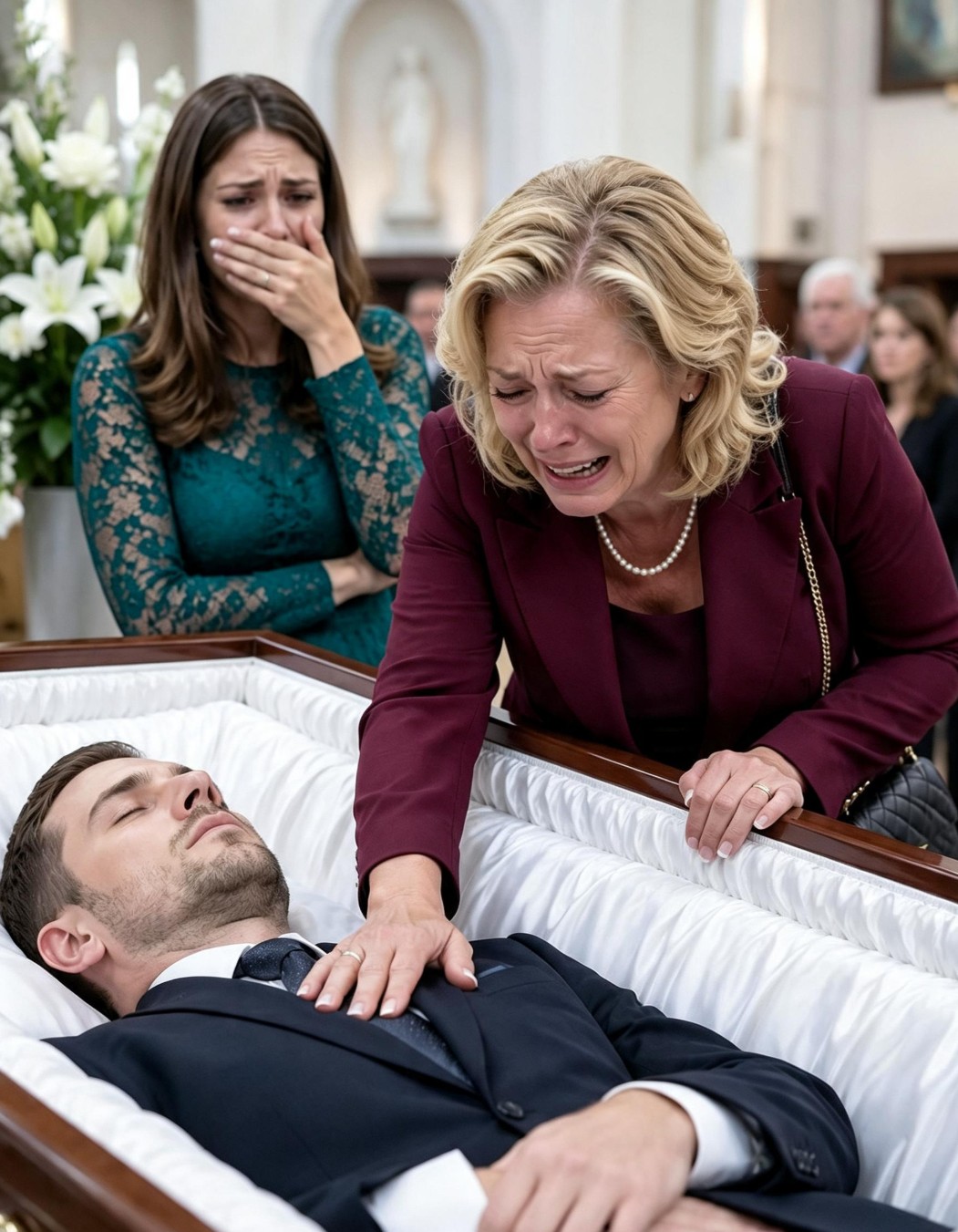
In front of Mrs. Joyce stood a closed mahogany coffin. Around it were expensive arrangements of white lilies, tall candles that flickered softly, and quiet funeral music that seemed almost too perfect, as if someone had carefully chosen every detail to create the appearance of grief.
Standing beside the coffin was Samantha, Oliver’s wife.
She wore a sleek black designer dress. Her hair was perfectly arranged, and her face looked almost flawless. Yet her lips were pressed tightly together, and there was a nervous tension in her eyes.
“Please don’t make a scene here, Mrs. Joyce,” Samantha said in a low, controlled voice. “Oliver is finally at peace now. He deserves to rest quietly.”
Mrs. Joyce slowly turned toward her daughter-in-law.
“At peace?” she repeated.
Her voice was filled with disbelief.
“And who exactly gave you the right to decide how I should say goodbye to my own son?”
An uncomfortable murmur passed through the small group of mourners.
There were not many people at the funeral.
A few were junior employees from Oliver’s company. Two were former college roommates. There was also a stiff-looking lawyer standing near the wall, repeatedly checking his wristwatch as though he had somewhere far more important to be.
None of them seemed to understand why Oliver’s mother had suddenly appeared late, alone, and clearly without being invited.
But Mrs. Joyce understood perfectly.
Nobody had bothered to tell her.
She had learned that Oliver was dead from a short and painfully impersonal text message.
It had come from a neighbor in the old suburb where Oliver had grown up.
“Mrs. Joyce, I’m so incredibly sorry. I had no idea they were holding the funeral today.”
Mrs. Joyce had read those words while standing in her tiny kitchen outside Kansas City.
She had been warming tortillas on the stove.
For several seconds, she simply stared at the phone.
Then she convinced herself it had to be a mistake.
It had to be.
Oliver could not be dead.
She called his cell phone.
Once.
Twice.
Three times.
Seven times.
Every call went directly to voicemail.
She called Samantha.
There was no answer.
She called Oliver’s old classmates. She contacted distant acquaintances. She reached out to people she had not spoken to in years.
Finally, one of them answered.
His voice was clearly breaking as he spoke.
“Mrs. Joyce, everyone is saying Oliver died in his sleep. Samantha insisted on making all the arrangements very quickly. They said the funeral would be held early tomorrow morning.”
The phone nearly slipped from Mrs. Joyce’s hand.
Then the coffee mug she had been holding fell from her fingers.
It struck the kitchen floor and shattered across the linoleum.
Oliver was dead?
No.
It could not be true.
Her son would have called her.
Even if he only wanted to ask how to make chicken soup properly, he would have called.
He would never leave this world without hearing his mother’s voice one last time.
Mrs. Joyce did not stop to think.
She packed what she could, grabbed an old photograph of Oliver, and began the long journey.
Throughout the bus ride, she held that photograph tightly against her chest.
It showed Oliver at six years old.
He was wearing an oversized school uniform and smiling proudly after winning his very first elementary school math competition.
As the landscape moved past the bus window, Mrs. Joyce remembered everything.
Every sacrifice.
Every difficult night.
Every meal she had skipped.
Every bill she had struggled to pay.
Every time she had wondered whether she could give her son the future he deserved.
She had spent her entire life making sure Oliver was healthy, fed, educated, and given opportunities she had never received herself.
She remembered Richard.
The man who had stolen her heart when she was only twenty-one.
He had been charming.
He had a beautiful smile.
And he had possessed an endless supply of promises.
Richard told her that he would take her out of poverty.
He promised that one day they would own a beautiful house with a large yard.
He promised their child would grow up surrounded by security, comfort, and love.
Mrs. Joyce had believed him.
Until the day she told him she was pregnant.
Everything changed.
Richard’s face became cold.
His voice lost all warmth.
They were sitting in a downtown diner when he finally said what he really thought.
“That was never part of my plans,” he told her. “You need to decide right now. Either you fix this problem, or I’m leaving you today.”
He placed a few crumpled bills on the table.
He pushed them toward her as though the life growing inside her was nothing more than an inconvenience that could be paid away.
Mrs. Joyce stared at the money.
She did not touch it.
She pushed it back.
That night, she cried for hours.
She was terrified.
She had no savings.
She had no secure future.
She had no idea how she would raise a child alone.
But she made her choice.
She would keep her baby.
And from the day Oliver was born, she made herself a promise.
No man in this world would ever abandon him as long as she still had breath in her body.
That promise was still alive inside her now.
It was the reason she could not simply stand quietly beside Oliver’s coffin.
So when she saw Samantha blocking her path, something deep inside her suddenly caught fire.
“Open it,” Mrs. Joyce ordered.
Samantha stared at her.
“No.”
“You heard me.”
“I said no,” Samantha repeated. “Oliver specifically requested that nobody see him like that.”
Mrs. Joyce’s eyes narrowed.
“My son would call me if he needed to know how to make chicken soup. So don’t you dare stand there and tell me what he wanted for his funeral.”
Samantha took a step toward her.
“You and Oliver had been completely estranged for months. Please don’t come here now pretending you were the perfect, loving mother.”
The words struck Mrs. Joyce deeply.
Because there was some truth in them.
She and Oliver had been apart for months.
Their relationship had started falling apart when Oliver announced that he was going to marry Samantha.
Samantha was a partner at a rapidly growing technology company. She was intelligent, ambitious, confident, and always thinking about the next business opportunity.
But something about her had always bothered Mrs. Joyce.
It was difficult to explain.
There was something unsettling about the way Samantha smiled.
Her mouth would smile, but her eyes often remained cold.
She also had a habit of speaking for Oliver before he could finish his own sentences.
And whenever Oliver tried to disagree with her, Samantha would gently but firmly place her hand on his arm.
It looked affectionate to other people.
To Mrs. Joyce, it looked like control.
One afternoon, she finally told her son what she thought.
“That young woman doesn’t see you as a husband, Oliver,” she said. “She sees you as an investment.”
Oliver had become furious.
“You always do this, Mother!” he shouted. “You just love distrusting people who actually care about me!”
“I’m trying to protect you.”
“I don’t need you protecting me from my own wife!”
“You may understand business, Oliver, but that doesn’t mean you understand people.”
He stared at her angrily.
“You don’t trust anyone.”
Then he stormed out.
The front door slammed so hard that the picture frames on the wall shook.
Weeks later, Mrs. Joyce discovered through social media that Oliver and Samantha had quietly married in another city.
She had not been invited.
She had not even received a phone call.
From that moment, everything changed.
The phone calls became fewer.
The messages became colder.
The distance between mother and son became an open wound.
But pride was one thing.
Death was something else entirely.
Mrs. Joyce stepped toward the coffin again.
“Open it.”
Samantha shook her head.
“No.”
“Open it, or I swear I will open it myself.”
Samantha looked toward the lawyer.
“Do something. Stop her.”
The lawyer swallowed and stepped forward.
“Mrs. Joyce, legally speaking, I cannot allow you to interfere with the funeral proceedings.”
Mrs. Joyce did not even let him finish.
She pushed Samantha aside with surprising force.
Two funeral home employees immediately moved toward her.
“Ma’am, please!”
“Step away from the coffin!”
But Mrs. Joyce was no longer thinking about manners.
She was no longer thinking about what anyone thought of her.
She was a mother who believed she had been robbed of the chance to say goodbye to her child.
She pushed past the employees and reached the coffin.
Her hands were shaking violently.
She grabbed the lid.
“Mrs. Joyce, please stop!”
She pulled.
The lid opened.
The entire funeral parlor fell silent.
Oliver was lying inside.
His skin was extremely pale.
His body was completely still.
His lips had an unnatural purple color.
Mrs. Joyce let out a low, broken moan.
It sounded as though the pain had been ripped directly from her chest.
She leaned over him.
“My boy…”
She kissed his forehead.
She was about to pull away when something caught her attention.
She froze.
His eyelid had moved.
Just slightly.
Almost too little to notice.
Mrs. Joyce stared at him.
She knew her son.
She knew every expression on his face.
Every movement.
Every breath.
And she had seen something.
Then she noticed his chest.
It rose.
Barely.
Then it fell.
Mrs. Joyce stopped breathing herself.
His chest rose again.
A shallow breath.
Weak.
Almost invisible.
But real.
Her eyes widened.
“He’s alive,” she whispered.
Nobody responded.
Mrs. Joyce leaned closer.
“He’s alive!”
The people around her stared at Oliver.
Some looked confused.
Others looked horrified.
Samantha suddenly took a step backward.
“That’s impossible.”
Mrs. Joyce turned toward her.
“My son is alive!”
She pointed toward the coffin.
“Can’t you see him? He’s still breathing!”
Samantha’s face went completely white.
“That cannot be,” she whispered.
Mrs. Joyce stared at her.
Then she looked at everyone else in the room.
“Call an ambulance!”
Nobody moved for a second.
Then Marcus, one of Oliver’s old friends, suddenly snapped out of his shock.
“I’m calling!”
He pulled out his phone and dialed emergency services.
Mrs. Joyce remained beside Oliver.
She held his face gently between her hands.
She did not care what anyone thought.
Her son was alive.
And now she would not let anyone take him away from her again.
Part 2:
“Call an ambulance immediately!”
Mrs. Joyce grabbed Oliver’s cold hand.
“Don’t just stand there staring at us like you’re watching some cheap television drama!” she shouted. “Get help now!”
Marcus was already speaking to the emergency operator.
“He’s alive,” he said quickly. “He was declared dead, but he’s breathing. We need an ambulance immediately.”
The funeral parlor suddenly filled with movement.
Some of the younger employees began crying.
Others whispered prayers.
One man stood with his hands clasped together, unable to take his eyes off the open coffin.
Samantha remained pressed against the wall.
Her eyes were locked on Oliver.
She looked terrified.
Mrs. Joyce turned toward her.
“You knew,” she said.
Samantha blinked.
“What?”
“You knew he wasn’t actually dead.”
“Don’t say ridiculous things.”
“I’m asking you a question.”
“I simply followed the instructions given to me by the medical staff.”
“Whose instructions?”
Samantha opened her mouth.
Nothing came out.
Mrs. Joyce stared at her.
“Whose instructions, Samantha?”
Again, there was no answer.
Only silence.
A few minutes later, the paramedics rushed through the doors.
To Mrs. Joyce, those few minutes had felt like an eternity.
The paramedics immediately examined Oliver.
They checked his pulse.
They checked his breathing.
They measured his vital signs.
They placed oxygen over his face and began working to stabilize him.
One of them looked at his partner.
“He’s alive.”
The words shocked everyone all over again.
“But he’s in critical condition,” the paramedic continued. “His heart rate is extremely low. He appears to have been heavily sedated.”
“Can you save him?” Mrs. Joyce asked.
“We’re going to do everything we can.”
They quickly placed Oliver on a stretcher.
“We have to get him to the hospital immediately.”
Mrs. Joyce climbed into the ambulance without asking permission.
Nobody tried to stop her.
She took Oliver’s hand.
It was cold and heavy in hers.
She leaned close to his ear.
“I’m right here, my boy,” she whispered. “You just hold on to me.”
She remembered saying almost the same words when Oliver was a little boy and had been burning with fever.
She stroked his hand.
“You promised me we would finally have dinner together when you got some rest from all that work.”
Her voice broke.
“You can’t leave me with the table set for two and nobody there to eat with me.”
The ambulance sped through the city.
Mrs. Joyce watched her son lying motionless beneath the medical equipment.
And as she watched him, the memories of their entire life together returned.
She had raised Oliver alone.
First, she cleaned large suburban houses.
Then she began selling homemade food outside the local high school.
Later, she worked exhausting twelve-hour shifts at a convenience store.
She counted every nickel.
Every dime.
She saved wherever she could.
She bought Oliver’s school supplies even when it meant going without something herself.
She repaired his old uniforms.
And many nights, she pretended she wasn’t hungry so she could give him the last piece of chicken.
Oliver knew they were poor.
But he never doubted that he was loved.
From an early age, it was clear that he was unusually intelligent.
When he was eight, he managed to repair a broken kitchen blender after watching an instructional video online.
At twelve, he was already helping classmates understand advanced mathematics.
By seventeen, he had earned a full academic scholarship to study computer engineering at a prestigious university three states away.
The day he received the acceptance, he came running into the house holding a printed email.
“Mother!”
Mrs. Joyce looked up.
“I got accepted!”
He was shaking with excitement.
“It’s a full scholarship. Everything is covered. Tuition, housing, everything!”
Mrs. Joyce cried as though she had just won the lottery.
“You go, my son,” she told him. “You go and don’t look back.”
She hugged him.
“The world was never meant for you to stay small and limited like I was.”
The day he left remained one of the sweetest and most painful memories she had ever carried.
At the bus station, Oliver hugged her tightly.
“I’m going to make you proud.”
“You already have.”
“No, Mother. One day I’m going to take care of you.”
Mrs. Joyce smiled through her tears.
“Just promise me you’ll remember where you came from.”
“I promise.”
Then the bus pulled away.
For years, Oliver kept his promise to her.
Every Sunday, without fail, he called.
He told her about his classes.
He talked about his strange university projects.
He complained about the terrible tacos sold near the library.
He told her about long nights studying.
And he told her about his dreams.
When he graduated with top honors, Mrs. Joyce traveled to the ceremony.
She wore a royal blue dress she had purchased through a layaway plan because she could not afford to pay for it all at once.
When Oliver’s name was called, she applauded so loudly that several people around her turned to look.
She didn’t care.
That was her son.
She wanted the entire world to know how proud she was.
After graduation came a high-pressure job at a major software company.
Oliver worked harder than ever.
He moved quickly through the industry.
Eventually, he met Samantha.
At first, he spoke about her with genuine admiration.
“She’s brilliant, Mother,” he told Mrs. Joyce. “She has a bold vision for the future. She isn’t afraid of taking big risks.”
Mrs. Joyce listened.
But something inside her remained uneasy.
Samantha seemed unusually interested in corporate investments.
She was always talking about contracts.
Expansion.
Profits.
Global growth.
When Oliver eventually told his mother that he and Samantha were planning to launch their own startup company, Mrs. Joyce felt a cold shiver run through her.
“Just be very careful about what you sign, my son.”
Oliver laughed.
“Mother, please. Not everyone in the world is trying to hurt me.”
Mrs. Joyce looked at him.
“I hope you’re right.”
But she had not been wrong.
At the hospital, doctors worked for hours to reverse the effects of the sedative in Oliver’s system.
Mrs. Joyce paced through the sterile waiting room.
Her hands were wrapped around an old wooden rosary she had carried since she was young.
Marcus stayed beside her.
Then Detective Leo arrived.
Leo had been a close friend of Oliver’s during university.
Over the years, he had become a state police detective.
He approached Mrs. Joyce with a serious expression.
“Mrs. Joyce.”
She turned.
“This is now a formal criminal investigation.”
“I know.”
Leo glanced toward the ICU.
“Nobody ends up inside a coffin while still breathing by accident.”
Mrs. Joyce looked at him.
“And I think you already know who wanted him there.”
Leo followed her gaze.
Samantha was sitting at the far end of the hallway with an expensive lawyer.
She was no longer crying.
She wasn’t acting like a devastated widow.
Instead, she kept looking at the clock.
Leo watched her for several seconds.
“I’m going to make sure she doesn’t leave the city,” he said. “I also need to examine everything. Company records, legal documents, medical certificates, security footage, financial transfers, and every digital record we can find.”
Mrs. Joyce nodded.
“Find the truth.”
“We will.”
Hours later, investigators found the first major piece of evidence.
Oliver’s death certificate had been filed with forged signatures.
The doctor whose name appeared on the document later denied ever treating Oliver.
Then the funeral home admitted something else.
They had received an urgent request for a closed-casket funeral.
Samantha herself had paid a large amount of cash.
She had also insisted that everything happen immediately.
But the most disturbing discovery came from Oliver’s company.
Exactly forty-eight hours before his supposed death, the company’s legal power-of-attorney documents had been changed.
If Oliver died, Samantha would become the sole administrator of the entire multimillion-dollar corporation.
Mrs. Joyce stared at Leo.
“So it was never about love.”
Leo looked at her.
“It appears it was about money and control.”
Mrs. Joyce lowered her eyes.
“I knew something was wrong with that woman.”
But there was still one piece of the puzzle missing.
That night, Marcus remembered something.
He pulled out his phone.
“Detective Leo, there’s something you need to see.”
He showed him a message Oliver had sent three days earlier.
The message said:
“I’m checking for suspicious internal activity. Samantha doesn’t know I already found unauthorized transfers. If anything ever happens to me, make sure she isn’t the one who handles my affairs. Contact my mother immediately.”
Mrs. Joyce read the message.
The air seemed to leave her lungs.
“My son was scared.”
She sat down.
“He reached out to me when he was scared.”
Tears began running down her cheeks.
“And I wasn’t there to hear him.”
Leo crouched in front of her.
“No, Mrs. Joyce.”
She looked at him.
“You were there exactly when he needed you most.”
He pointed toward the ICU.
“You are the reason he is alive.”
The following morning, Samantha was taken into custody for intensive questioning.
At first, she denied everything.
She claimed Oliver had been suffering from extreme mental stress.
She said he had fainted.
She claimed a private doctor had confirmed his death.
“I was simply following the instructions he left behind,” she insisted.
But Detective Leo placed the evidence in front of her.
The forged documents.
The security footage.
The bank transfers.
The funeral records.
And Oliver’s final message.
Samantha stared at the evidence.
She stopped blinking.
Her face became pale.
She realized that the story she had created was falling apart.
“He was going to ruin everything I worked for,” she finally said.
Leo watched her.
“By exposing your fraud?”
Samantha clenched her jaw.
“He didn’t understand what it takes to build a real company.”
Her voice remained cold.
“Oliver was weak. He was too sentimental. He was always worrying about his mother, his employees, and doing what was right.”
She leaned back.
“That is not how you build an empire.”
Leo’s expression hardened.
“What exactly did you give him?”
Samantha refused to answer.
“What did you give him?”
She finally looked at him.
“A heavy sedative.”
Leo stared at her.
“Why?”
“I only needed him to appear dead for a few hours. That gave me enough time to finish transferring control.”
Leo’s voice became hard.
“You were going to let them bury him.”
Samantha lowered her gaze.
“I never imagined that old woman would have the audacity to force her way into the funeral and open the coffin.”
When Leo left the interrogation room, Mrs. Joyce was waiting at the end of the hallway.
He walked toward her.
“She confessed.”
Mrs. Joyce closed her eyes.
A long, shaking breath escaped her.
Then the ICU doors opened.
A doctor stepped into the hallway.
“Mrs. Joyce?”
She immediately looked up.
“Your son has finally woken up.”
For a moment, Mrs. Joyce could not move.
Oliver was alive.
Her son was alive.
But now she would have to hear the truth from him.
And the truth he was about to reveal would change everything she thought she knew about the final days before his supposed death.
Part 3:
When Mrs. Joyce finally entered the quiet hospital room, Oliver was lying beneath a thin blanket.
Wires covered his chest.
An IV was attached to his arm.
Monitors beside the bed beeped steadily.
His face was ghostly pale.
His lips were cracked and dry.
There was a dark bruise near his throat where he had struggled before losing consciousness.
But his eyes were open.
And they were fixed on the door.
Mrs. Joyce stopped when she saw him.
Those were the same eyes she had first seen decades earlier in a small clinic during a freezing winter.
The nurse had placed her newborn son into her arms, even though everyone around her had told her that having a baby would ruin her future.
Now that same little boy was lying in a hospital bed after nearly being buried alive.
“Mother,” Oliver whispered.
His voice was weak and rough.
Mrs. Joyce covered her mouth.
She walked slowly to the bed.
She desperately wanted to remain strong for him.
But the moment she took his hand, her heart broke.
She kissed his knuckles again and again, as though she could somehow put the warmth that had been stolen from him back into his body.
“I’m right here, my boy,” she whispered. “I’m not going anywhere.”
Oliver tried to speak again.
Nothing came out.
Mrs. Joyce gently stroked his hair.
“Don’t try to talk yet. You’re alive. That is all that matters right now.”
But Oliver began to cry.
He did not cry like the successful businessman he had become.
He did not cry like the man who had spent years leading meetings with investors and executives.
He did not cry like the brilliant young man everyone admired.
He cried like the little boy who used to hide behind his mother’s skirt whenever he was frightened by the dark.
“Please forgive me,” he finally managed to say.
Mrs. Joyce shook her head.
“I’m sorry I drifted so far away from you.”
Tears ran down his cheeks.
Mrs. Joyce wiped them away.
“Pride has a way of making fools of all of us,” she told him. “But no argument, no distance, and no amount of time can ever erase the bond between a mother and her child.”
Oliver closed his eyes.
Tears ran toward his temples and dampened his hospital gown.
“You were right,” he whispered.
Mrs. Joyce looked at him.
“About Samantha.”
The room became silent.
Only the steady rhythm of the cardiac monitor could be heard.
The following day, Oliver had regained enough strength to speak for longer periods.
He asked to see Detective Leo.
Mrs. Joyce started to leave the room.
Oliver squeezed her hand.
“Stay, Mother.”
She looked at him.
“I need you to hear this too.”
His voice was still weak.
“I don’t want to hide anything from you ever again.”
Leo turned on his digital recorder.
Oliver took a deep breath.
“I started suspecting something was terribly wrong about two months ago.”
He explained what he had discovered.
Samantha had repeatedly told him that the company needed to move massive amounts of money to attract larger investors.
But the numbers in the company accounts did not make sense.
There were shell companies.
Fake consulting firms.
Huge deposits into accounts that did not belong to legitimate suppliers.
“When I finally questioned her about it,” Oliver said, “she became extremely angry.”
He paused.
“She told me I was too naive to understand what real corporate growth looked like.”
Mrs. Joyce listened carefully.
“Then I found hidden documents where she had forged my legal signature.”
Oliver swallowed.
“She had prepared a power of attorney that would give her complete control of the company if I became incapacitated or died.”
His voice became quieter.
“She had even changed the equity clauses. She was essentially trying to erase me from my own company and from my own life’s work.”
Mrs. Joyce pressed her lips together.
She wanted to remember every word.
Samantha would have to answer for every one of them.
“The night before it happened,” Oliver continued, “we had a massive argument.”
He looked at Detective Leo.
“I told her I was going to report the fraud.”
Then something changed.
“She became completely calm.”
Oliver’s eyes darkened.
“She apologized. She said she was under enormous pressure. She told me she didn’t want to lose me.”
He took another breath.
“She asked me to go home so we could talk.”
Then Samantha made him tea.
Oliver looked down at his hands.
“I felt embarrassed, Mother.”
Mrs. Joyce frowned.
“Embarrassed?”
“Yes.”
His voice cracked.
“When I started feeling dizzy and my lungs felt like they were shutting down, the first thing I wanted to do was call you.”
Mrs. Joyce felt a sharp pain in her chest.
“But I thought you wouldn’t answer because you were still angry with me.”
She reached for his hand.
“Oh, my sweet boy.”
Her voice trembled.
“You should never have been ashamed to call me.”
Oliver closed his eyes.
“After that, I don’t remember much.”
He told them that he had woken up several times.
He remembered strange voices.
He remembered feeling freezing cold.
“I heard Samantha talking,” he said. “She said everything would be finalized by the next morning.”
Then came the memory that still haunted him.
“I woke up in complete darkness.”
His breathing became faster.
“I couldn’t move a single muscle.”
Mrs. Joyce gripped his hand.
“I was awake inside my own body. I wanted to scream for help, but I couldn’t even breathe properly.”
He looked at his mother.
“And then I heard your voice.”
Detective Leo lowered his eyes.
Even he, a man who had spent years dealing with violent crimes, looked deeply shaken.
“Mrs. Joyce literally saved his life,” Leo said.
Oliver looked at his mother.
There was guilt in his eyes.
But there was also love.
“Just like you always have.”
The official investigation moved quickly.
Samantha had believed she was too powerful to be caught.
Her mistake was leaving evidence everywhere.
On her office computer, investigators found altered contracts.
They found emails showing that she had pressured a private doctor to sign false documents.
They found illegal transfers to offshore accounts.
They also found text messages between Samantha and her lawyer.
In those messages, they discussed “resolving the problem” before Oliver had a chance to expose the fraud.
The corrupt doctor was arrested within twenty-four hours.
Eventually, he confessed.
Samantha had paid him a fortune to declare Oliver dead without properly verifying that he was actually dead.
The funeral home was also forced to surrender its security footage.
The footage showed Samantha demanding a closed-casket funeral.
It also showed her insisting that everything happen immediately.
The story soon appeared in newspapers and television reports across the country.
One headline read:
“Local Tech Mogul Almost Buried Alive by His Own Wife.”
Another said:
“Mother Forces Her Way Into Funeral Parlor and Discovers Son Is Still Breathing.”
Another read:
“Samantha M. Accused of Premeditated Attempted Murder and Massive Financial Fraud.”
But Mrs. Joyce did not care about the cameras outside the hospital.
She did not care about the reporters.
She only cared about Oliver getting better.
And the first few weeks were extremely difficult.
Oliver suffered from recurring nightmares.
He would wake up in the middle of the night covered in cold sweat.
Sometimes he would scream that he could not breathe.
Other times he would sit silently and stare at the ceiling for hours.
He begged them to keep the bedroom door open.
A closed room reminded him of the coffin.
Mrs. Joyce stayed close.
She rented a small hotel room nearby so she could be at the hospital every day.
She slept in a chair beside Oliver’s bed.
She brought homemade chicken broth in a thermos.
She adjusted his pillows.
She held his hand.
And she told him stories about when he was a little boy.
One afternoon, she smiled at him.
“Do you remember when you used to sell your handmade crafts at elementary school?”
Oliver looked confused.
“Why?”
“You were trying to buy food for that stray golden retriever we found.”
A weak smile appeared on his face.
“You were furious with me.”
“I was furious because you used your lunch money for the entire week.”
“You still went and bought dog food.”
Mrs. Joyce smiled.
“Of course I did. I bought two big bags of kibble.”
Oliver laughed softly.
Those little memories helped him survive the darkest days.
They reminded him that before Samantha, before the company, before the money, the investors, and the ambition, there had been another life.
A simpler life.
A life where love did not require contracts.
A life where trust did not come with conditions.
A month later, Samantha’s trial officially began.
The courtroom was packed.
Journalists filled the seats.
Employees from Oliver’s company attended.
Former business partners came to watch.
Curious members of the public crowded into the back.
Samantha arrived wearing a stiff gray suit and heavy handcuffs.
She no longer looked like the charming and polished woman Oliver had once introduced to his family.
Without her carefully practiced smile and confident appearance, she looked smaller.
But she did not look sorry.
When she saw Mrs. Joyce, her eyes filled with hatred.
Mrs. Joyce met her gaze.
She refused to look away.
The prosecutor presented the evidence one piece at a time.
Toxicology reports showed that Oliver had been given a massive and dangerous amount of a powerful sedative capable of causing a state that could appear like death under superficial examination.
Financial records proved that millions of dollars had been embezzled.
Digital messages showed the timeline of Samantha’s planning.
The doctor’s testimony destroyed the remaining parts of her defense.
Then the prosecutor called Oliver to the witness stand.
He walked slowly to the podium.
He was still visibly weak.
But his voice was firm.
“I trusted Samantha with my entire life,” he said, looking at the jury.
“I loved her. I gave her access to my work, my dreams, and my identity.”
He took a breath.
“But she didn’t want a life with me.”
He looked toward Samantha.
“She wanted everything I had built.”
Samantha clenched her jaw.
“When she realized I was finally going to uncover the truth,” Oliver continued, “she decided to erase me from existence.”
The prosecutor asked him one final question.
“Is there anything else you would like to say to the court?”
Oliver turned toward his mother.
“Yes.”
He looked directly at her.
“For a long time, I wrongly believed that growing up meant I no longer needed my mother.”
Mrs. Joyce’s eyes filled with tears.
“I was completely wrong.”
Oliver’s voice became stronger.
“Growing up means recognizing who stood beside you when you had absolutely nothing.”
He looked at the jury again.
“My mother tried to warn me, but I foolishly mistook her protective love for control.”
Then he turned back toward Mrs. Joyce.
“If I am alive today, it is only because she refused to be silenced.”
Mrs. Joyce covered her mouth as tears rolled down her cheeks.
Then she was called to the witness stand.
Everyone expected a broken, frightened woman.
Instead, Mrs. Joyce sat up straight.
She adjusted the microphone.
And she began telling the truth.
She spoke about Richard.
She told the court how he had abandoned her and his unborn child.
She spoke about sleepless nights.
She spoke about cleaning houses.
She spoke about selling food.
She spoke about counting pennies.
She spoke about washing Oliver’s uniforms by hand.
She told them about the times she had to choose between paying the electricity bill and buying schoolbooks.
She spoke about the little boy who had promised to take care of her.
And she spoke about the grown man who had worked so hard to build a successful life, only to become vulnerable to someone who confused selfish ambition with greatness.
Then she turned toward Samantha.
“You thought I was just an ignorant old country woman,” Mrs. Joyce said.
Her voice was calm.
“You thought fancy flowers and a closed coffin would silence me.”
She paused.
“But a mother recognizes her own child.”
The courtroom was completely silent.
“I didn’t need a fancy degree. I didn’t need a corporate title. I only needed to see my Oliver take one breath.”
Nobody moved.
Nobody whispered.
Samantha remained expressionless.
She did not cry.
She did not apologize.
When the judge finally gave her the opportunity to speak, she said only:
“I helped build that company just as much as he did. I deserved more than I was given.”
The judge stared at her.
“What you believe you deserve does not give you the right to attempt to take a human life.”
The sentence was severe.
Samantha was sentenced to fifteen years in prison for attempted murder, grand larceny, document forgery, and criminal conspiracy involving the corrupt doctor.
She also lost all rights to the company.
Her personal assets were seized to help provide restitution for the financial damage she had caused.
When Samantha heard the final verdict, she closed her eyes.
For the first time, she understood that the control she had fought so desperately to gain was gone.
Forever.
Outside the courthouse, reporters immediately surrounded Oliver and Mrs. Joyce.
Cameras flashed.
Microphones were pushed toward them.
One reporter called out:
“Mrs. Joyce! What would you say to other mothers who feel like their children are drifting away from them?”
Mrs. Joyce held tightly to Oliver’s arm.
She looked toward the cameras.
“Don’t ever confuse distance with forgetting,” she said.
“Sometimes children get lost while trying to prove to the world that they can do everything by themselves.”
She looked at Oliver.
“But if a mother truly loves her child, she never gives up.”
Then she smiled.
“And she certainly doesn’t stay silent when something feels wrong.”
Oliver lowered his head.
The words touched him deeply.
Another reporter turned toward him.
“And what about you, Oliver? What did you learn from everything that happened?”
Oliver looked at his mother.
“There is no success in this world worth having if you have to let go of the hand of the person who held you when you were nobody.”
The trial was over.
But Oliver’s recovery had only just begun.
Part 4:
The long road to recovery did not end when Samantha was sentenced.
In many ways, it was only beginning.
Oliver still had to rebuild the company she had nearly destroyed.
His employees were frightened and confused.
Some had unknowingly become involved in questionable decisions.
Others were thinking about quitting.
Investors demanded detailed explanations.
Major clients were nervous about continuing their business relationships with the company.
The organization Oliver had built was now sitting on the edge of collapse.
In the past, Oliver would have tried to handle everything himself.
He would have worked until three in the morning.
He would have slept for only a few hours.
He would have ignored calls.
He would have buried his fear under endless meetings, emails, spreadsheets, and business plans.
But he was not the same man anymore.
This time, he made a different decision.
He brought Mrs. Joyce to the office with him every day.
He introduced her to every member of his staff.
Not simply as “my mother.”
Instead, he introduced her as something much more important.
“This is the person who taught me the only thing I truly know about integrity and responsibility.”
Some employees were surprised.
Mrs. Joyce did not look like someone who belonged in a corporate boardroom.
She carried a simple woven tote bag.
She wore ordinary clothes.
She had no experience with software development or computer code.
Yet she sat in the same boardroom where Samantha had once commanded attention and fear.
During one morning meeting, Mrs. Joyce stood in front of the entire team.
“I don’t know anything about software,” she admitted.
Several employees smiled.
“But I know about hard work.”
The room became quiet.
“I know that when you promise something, you keep your word.”
She looked around the room.
“I know that when someone trusts you, you don’t betray them.”
Then she paused.
“And I know that no company built on lies can stand forever. Sooner or later, it will collapse.”
Her words were simple.
But they had an effect that no polished corporate speech could have achieved.
Oliver launched a complete and transparent audit of the company.
He refunded money to every affected client.
He reported the illegal operations to the government.
He knew doing so would cost the company several valuable contracts.
Still, he did it.
He also took a massive cut to his own salary for several months so he could avoid laying off employees.
He rebuilt the company slowly.
Carefully.
Honestly.
For the first time in years, he could look at his work without feeling ashamed.
And every Friday, without fail, Oliver had dinner with his mother.
Sometimes they went to a small, crowded diner in the neighborhood.
Sometimes they stayed home.
They ate simple food.
Beans.
Rice.
Fresh, warm tortillas.
It was never about what was on the table.
It was about who was sitting around it.
One evening, Oliver looked at his mother over a cup of coffee.
“I used to only call you when I had spare time.”
Mrs. Joyce smiled.
“Now I understand something,” he continued. “There really isn’t such a thing as spare time.”
He looked down at his cup.
“You make time for the people who actually matter.”
Mrs. Joyce smiled wider.
“Look at that.”
She shook her head.
“All that expensive schooling, and you finally learned something I already knew.”
Oliver laughed.
Then his mother laughed too.
The sound filled the small room.
It was a simple moment.
But after everything they had survived, it felt priceless.
As the months passed, Oliver slowly regained his strength.
His company became stable again.
But something inside him had changed permanently.
He no longer wanted his company to be nothing more than a machine designed to make money.
He wanted it to mean something.
His own experience had shown him how much talent could be wasted simply because someone did not have enough money or opportunity.
So he created a special educational program for young people from underprivileged families who wanted to study technology.
He called the program Roots.
The name had a special meaning.
Oliver had finally understood that nobody could grow tall if they hated the place where they had started.
The first group of students received full scholarships.
They received new computers.
They received professional mentors.
They received something Oliver had once received himself:
A chance.
At the grand opening ceremony, Oliver invited Mrs. Joyce to cut the ceremonial ribbon.
He handed her the scissors.
“This is yours as much as it is mine, Mother.”
Mrs. Joyce shook her head shyly.
“I didn’t do anything, Oliver.”
He took her hand.
“You did absolutely everything.”
Among the first scholarship recipients was an eighteen-year-old girl named Elena.
Elena was the daughter of a local street vendor.
When she received her new computer, tears immediately filled her eyes.
She turned and hugged Mrs. Joyce.
“My mother keeps saying she doesn’t know if she’ll be able to support me until I finish my degree,” Elena whispered.
Mrs. Joyce gently touched the girl’s cheek.
“Tell your mother not to give up.”
Elena looked at her.
“Sometimes a mother doesn’t have much money,” Mrs. Joyce continued, “but she has something much stronger than money.”
“What?”
“Blessed stubbornness.”
Elena laughed through her tears.
The phrase quickly became popular among the employees.
Whenever a project seemed impossible, someone would smile and say:
“Blessed stubbornness.”
And everyone would understand what it meant.
Keep going.
Don’t quit.
Do your part.
A year later, Oliver returned to the old neighborhood with his mother.
He was no longer there as a grieving visitor.
He was not there as a guilty son.
He was there as a grateful man.
They walked through the busy market where Mrs. Joyce had once sold homemade food.
Several people recognized her.
One neighbor approached them.
“Mrs. Joyce, we saw what you said on the news. You were incredibly brave.”
Mrs. Joyce simply shrugged.
“It wasn’t courage.”
She glanced at Oliver.
“He was my son.”
They bought fresh bread.
They bought flowers.
They bought a small candle.
Then they walked to the tiny apartment where Oliver had grown up.
The place looked smaller than he remembered.
The walls still carried little marks from years of living.
The wooden table still had a dark corner where an old iron had once burned the surface.
And on the bedroom door, barely visible beneath several coats of paint, were the small pencil lines Mrs. Joyce had used to measure Oliver’s height when he was a child.
Oliver ran his fingers across them.
For a moment, he said nothing.
Then he spoke quietly.
“I used to want to get out of here so badly.”
Mrs. Joyce looked at him.
“I promised myself I would never look back.”
She smiled gently.
“And you did get out.”
Oliver nodded.
“That wasn’t the bad part.”
“What was?”
He looked at the old pencil marks.
“The bad part was believing that looking back made me less of a person.”
Mrs. Joyce walked over and placed a hand on his shoulder.
“No, my son.”
She looked at him with love.
“Looking back doesn’t make you less.”
She pointed toward the marks.
“It reminds you exactly how far you’ve come.”
That afternoon, the golden sunlight spread across the rooftops.
Oliver made fresh coffee for the two of them.
They sat beside the window.
For a long time, neither said anything.
They didn’t need to.
After all the fear, pain, betrayal, and anger they had endured, that peaceful silence felt like a miracle.
Then Oliver suddenly spoke.
“Mother.”
She looked at him.
“When I was trapped inside that coffin, I couldn’t move.”
He paused.
“But I heard something.”
Mrs. Joyce waited.
“I don’t know if it was real or if it was only in my head.”
He looked at her.
“But I heard your voice.”
Mrs. Joyce’s eyes widened.
“What were you saying?”
“The story of the hummingbird.”
Mrs. Joyce remembered.
It was a story she had told him many times when he was a little boy.
The story was about a massive forest fire.
All the animals were terrified.
They ran away from the flames.
But one tiny hummingbird refused to leave.
It flew toward a nearby stream.
It picked up one tiny drop of water.
Then it flew back toward the fire.
It dropped the water.
Then it returned for another.
The other animals laughed at the little bird.
They told him his drops were far too small.
They told him he could never stop a forest fire with a few drops of water.
But the hummingbird continued.
Again.
And again.
And again.
“I am doing my part,” the hummingbird said.
Oliver smiled.
“I always loved that story.”
Mrs. Joyce smiled too.
“Because you were just as foolish as that hummingbird.”
Oliver laughed softly.
“You always said I was trying to do everything myself.”
“Yes, you were.”
He looked at her.
“But that’s not why I loved the story.”
Mrs. Joyce waited.
Oliver reached for her hand.
“Because you were the hummingbird.”
Mrs. Joyce could not answer.
Her eyes filled with tears.
Oliver stood and hugged her.
He held her tightly.
“All my life, you carried me forward one drop at a time so I wouldn’t get burned.”
His voice broke.
“And when everyone else thought I was gone for good, you kept doing your part.”
Mrs. Joyce wrapped her arms around him.
She held her son as tightly as she had when he was a little boy.
“And I’m going to keep doing it,” she whispered, “for as long as I have breath.”
The story of Mrs. Joyce and Oliver eventually spread far beyond their own town.
It did not become famous simply because a mother had opened a coffin and discovered that her son was still alive.
It spread because thousands of people saw something painfully familiar in their story.
A truth that could hurt.
And heal.
We sometimes push away the person who loves us most.
We sometimes become so determined to prove that we can succeed alone that we forget who was there before anyone else believed in us.
Oliver had made that mistake.
Samantha had made an even worse one.
She had turned love into a business transaction.
She had turned trust into a weapon.
She had valued money and control above human life.
And in the end, she lost her freedom because of it.
Oliver lost his innocence.
But he gained something far more valuable.
He found his way back to his roots.
He found his way back to the woman who had loved him before he had money, a career, a company, or a name anyone recognized.
And Mrs. Joyce—the woman who had been abandoned while carrying a baby, the woman who cleaned houses, sold food, worked exhausting shifts, counted pennies, swallowed her tears, and sacrificed everything so her son could study—proved something that no amount of money could ever change.
True love does not always speak softly.
It does not always try to make everyone comfortable.
It does not always remain silent.
Sometimes true love arrives late at a funeral parlor.
Sometimes it pushes past everyone standing in its way.
Sometimes it refuses to accept what everyone else has already decided.
Sometimes it opens a coffin even when everyone is telling it not to.
Because a mother can be wrong about many things.
She can make mistakes.
She can worry too much.
She can say things her child does not want to hear.
But when a mother looks at her son and knows that he is still breathing, she will fight with everything she has.
And when everyone else believes the story is already over, she may be the only person willing to look one more time.
Because sometimes love notices the smallest movement.
One tiny breath.
One flicker of an eyelid.
One last sign of life.
And sometimes, that is enough.
Because when a mother knows that her child is still alive, not even death has the final word.
THE END.
