
Part 1:
The commercial jet had been flying over the Atlantic Ocean for almost two hours when the captain’s voice suddenly came over the cabin speakers.
His words made nearly three hundred passengers stop what they were doing.
“If there is a fighter pilot on board, please identify yourself to the flight crew immediately.”
For several seconds, nobody moved.
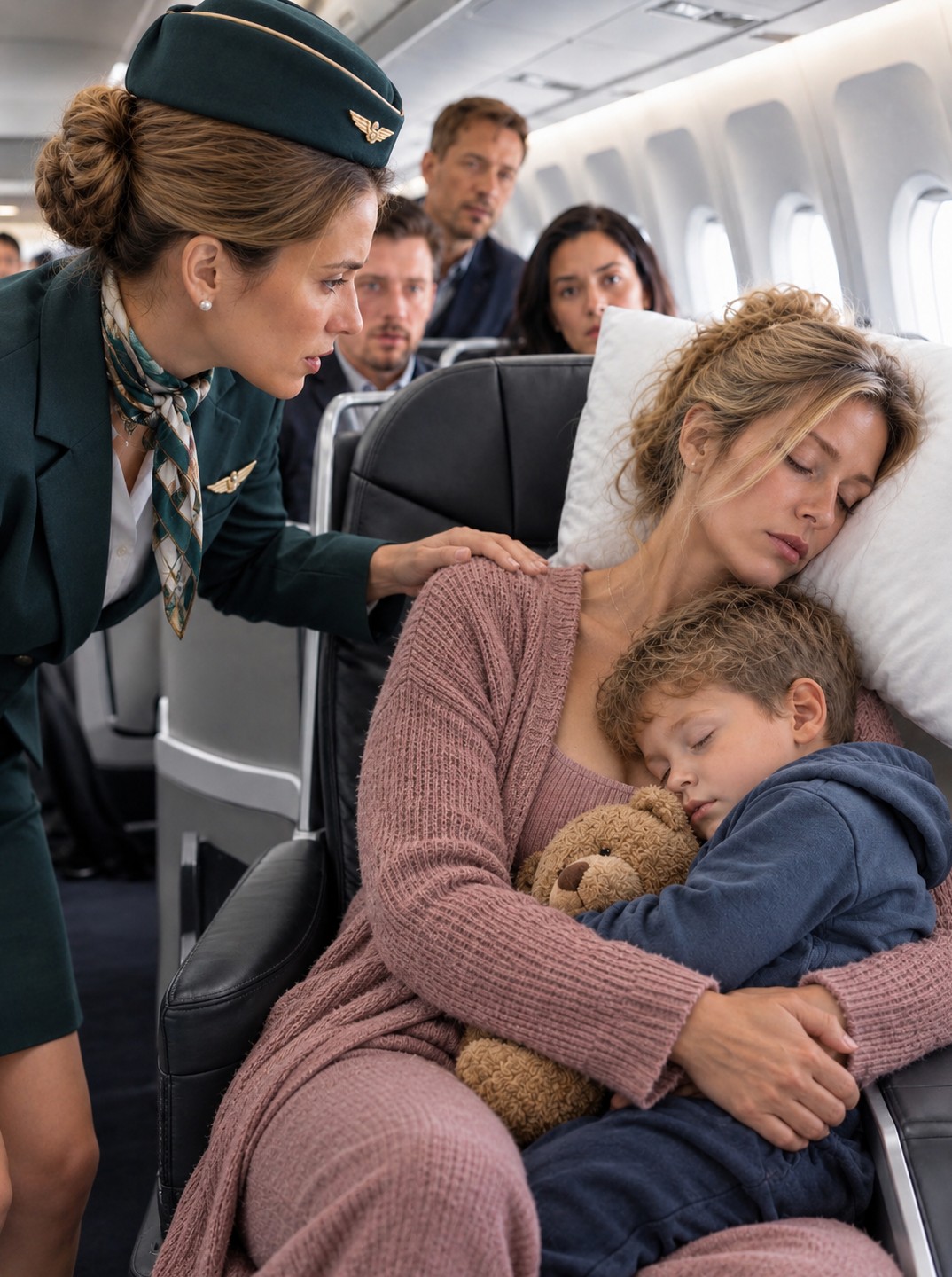
Nobody could imagine that the quiet woman sleeping in seat 8A, with her seven-year-old son resting against her shoulder, would soon become the most important person on the entire airplane.
The flight from New York to Madrid had started like any other overnight trip.
The cabin lights had been dimmed. Some passengers were sleeping with neck pillows around their heads. Others were watching movies with headphones on. A few people were staring silently through the windows at the endless darkness below.
Among them sat Dr. Maya Lin, a thirty-eight-year-old woman wearing a simple green sweater.
A soft blanket covered her legs, and her seven-year-old son, Leo, was sleeping peacefully against her shoulder.
To everyone around her, Maya looked like an ordinary tired mother taking her child on a long-overdue vacation.
She had asked a flight attendant for a cup of water earlier. She had politely declined the dinner service because Leo had finally fallen asleep, and she didn’t want to wake him.
She looked completely ordinary.
But there was something about Maya that nobody on the plane knew.
Years earlier, she had been one of the most decorated fighter pilots in the United States Air Force.
She had flown F-16s during dangerous missions and had spent years making decisions in seconds, knowing that one wrong move could mean the difference between life and death.
She had learned to stay calm while alarms screamed around her.
She had learned to trust her instruments.
She had learned to trust the pilot beside her.
Most importantly, she had learned one rule that had stayed with her long after she left the military:
A pilot never leaves people behind.
But Maya had walked away from that world.
After a devastating tragedy that had destroyed the life she once knew, she had resigned from active military service. She wanted nothing more to do with fighter aircraft, military commands, or the constant pressure of being responsible for other people’s lives.
She had a son now.
Leo was her entire world.
She didn’t want people calling her a hero.
She didn’t want anyone asking about her military past.
She didn’t want to be remembered as a fighter pilot.
She simply wanted to be Maya.
A mother.
A woman who could live a quiet life.
That was exactly why she had chosen seats 8A and 8B for the flight.
Leo could have the window seat.
They could avoid unnecessary conversation.
And because it was an overnight flight, Maya had hoped everyone would simply sleep until they reached Spain.
She had almost succeeded.
Then the captain spoke again.
“Ladies and gentlemen, this is the captain. We are experiencing a technical issue that requires immediate assistance. If anyone on board has experience as a fighter pilot, please identify yourself to a flight attendant immediately.”
This time, the silence inside the cabin was different.
It was heavy.
Fear spread quickly.
A mother pulled her baby closer to her chest.
An elderly man reached across the armrest and grabbed his wife’s hand.
Several passengers looked toward the front of the airplane.
Others looked around the cabin as if a trained fighter pilot might suddenly stand up from one of the seats.
Nobody understood why a commercial airline would need a fighter pilot.
What could possibly be happening inside the cockpit?
Maya slowly opened her eyes.
She immediately recognized the captain’s tone.
She had heard that kind of voice before.
It was the voice of a pilot trying desperately to remain calm while something was going wrong.
The words were controlled.
But underneath them was urgency.
Maya had heard it years earlier inside fighter cockpits while systems failed and warning lights appeared one after another.
She looked toward the front of the plane.
A flight attendant was already moving down the aisle.
The woman’s face was tense.
That told Maya more than the announcement had.
Whatever was happening, it was serious.
Maya looked down at Leo.
His dark hair had fallen across his forehead.
She gently moved it away.
For a moment, she closed her eyes.
No.
She had left that life behind.
She wasn’t a fighter pilot anymore.
She was a mother.
She couldn’t put herself in danger.
Her first responsibility was Leo.
Then the flight attendant stopped beside her row.
“Excuse me, ma’am,” she whispered. “Do you happen to know if anyone near you has military flight experience?”
Maya looked up.
“The captain is urgently looking for a military pilot.”
Maya glanced around the cabin.
She saw children.
Families.
Older passengers.
People who had no control over what was happening thousands of feet above the Atlantic.
Then she looked at Leo.
He was still sleeping.
For several seconds, she said nothing.
If something went seriously wrong with the aircraft, simply remaining in her seat would not protect him.
And suddenly, an old memory returned.
A principle drilled into her during years of military training.
You don’t leave people behind.
Maya gently squeezed Leo’s hand.
She took a slow breath.
Then she looked at the flight attendant.
“I’m a pilot.”
The flight attendant blinked.
“I’m sorry?”
Maya released her seatbelt and sat upright.
Something changed in her posture.
The tired mother seemed to disappear.
Her shoulders straightened.
Her eyes became focused.
And her voice became calm and firm.
“I’m a fighter pilot. Former U.S. Air Force. I flew F-16s for years.”
The passengers sitting nearby stared at her.
A man across the aisle looked at her in disbelief.
“You?”
Maya simply nodded.
She turned toward a middle-aged woman sitting across the aisle.
“My son is asleep,” Maya said quietly. “Could you please keep an eye on him for a few minutes?”
The woman immediately nodded.
“Of course, dear. Go.”
Maya leaned over Leo and carefully pulled the blanket higher around his shoulders.
She kissed his forehead.
“Mommy will be right back, sweetie.”
Then she stood.
The flight attendant looked both relieved and stunned.
“Please follow me. Right now.”
Maya nodded.
As she walked toward the front of the aircraft, the sound of her seatbelt clicking free seemed strangely loud in the quiet cabin.
Every step brought back memories she had spent years trying to bury.
She had thought that part of her life was over.
But now she was walking toward a cockpit again.
And Maya had no idea that the emergency waiting behind that cockpit door was connected to the darkest chapter of her past.
She also didn’t know that someone on that airplane already knew exactly who she was.
Part 2:
Maya reached the front of the aircraft.
The cockpit door opened.
A sharp smell of hot electronics, stale coffee, and tension filled the cramped flight deck.
Captain Mark Davis was sitting in the left seat.
His face was pale, but his eyes were fixed on the flight instruments.
The first officer was still sitting in the right seat.
He was unconscious.
An oxygen mask covered his face.
Mark turned toward Maya.
His eyes quickly moved over her simple travel clothes.
“You have military flight experience?”
“Yes, sir.”
“What aircraft?”
“F-16 Fighting Falcons.”
Mark hesitated.
Then he asked the question that mattered most.
“When was the last time you were actually at the controls?”
Maya paused.
“Eighteen months ago.”
Mark’s expression tightened.
“I need current proficiency, not memories.”
“I understand.”
Before Maya could say anything else, the aircraft suddenly shook.
The vibration wasn’t normal turbulence.
It was rhythmic.
Mechanical.
Something was repeatedly moving or fighting against the aircraft.
Maya’s eyes immediately went to the primary flight display.
“How long has the control system been oscillating?”
“About ten minutes,” Mark answered.
Maya stepped farther into the cockpit.
“Walk me through everything.”
Mark pointed toward the displays.
“The autopilot disconnected without warning. Then the flight-control system started showing contradictory error messages.”
He glanced toward his unconscious first officer.
“Then he complained that his arm was going numb.”
Maya looked at the man.
“Did he eat the same meal as you?”
“No.”
“Anything else?”
“He brought a thermos of coffee from the terminal.”
Maya’s eyes narrowed.
“Has anyone else on the crew experienced numbness, dizziness, or confusion?”
“No. Just him.”
That answer bothered her.
Maya moved closer to the instruments.
She didn’t need to think about her old training.
It simply returned.
Her mind began processing the information automatically.
She watched the flight displays.
She listened to the engines.
She studied the vibration.
The aircraft suddenly began banking slightly to the right.
Mark immediately pulled the control column to correct it.
“Don’t fight it,” Maya said.
“I have to keep us level.”
“You’re fighting a corrupted input signal.”
Mark looked at her.
“The flight-control computer is fighting your manual input.”
“How do you know?”
Maya kept her eyes on the instruments.
“Because I’ve experienced a flight-control override problem before.”
Mark stared at her for a second.
Then he made a decision.
He trusted her.
He isolated one of the secondary control channels.
The airplane jolted.
For one terrifying moment, Maya thought the problem was getting worse.
Then the vibration suddenly became smoother.
The aircraft stopped fighting itself.
Mark looked at Maya.
“You were right.”
Maya didn’t smile.
Her thoughts were already somewhere else.
Row 8.
Leo.
She had to get this airplane safely onto the ground.
Mark checked the weather information.
A powerful storm system was moving across their route toward Spain.
Their fuel margin was becoming tighter.
The first officer was still unconscious.
And now they knew the aircraft had a serious flight-control problem.
A few minutes later, a passenger physician arrived at the cockpit door.
He had been called forward to examine the unconscious first officer.
“Captain,” the doctor said quietly, “I need to tell you something.”
Mark turned.
“What?”
The doctor glanced at the unconscious man.
“I don’t believe this is a normal medical emergency.”
Maya looked at him.
“What do you mean?”
“His symptoms are consistent with acute chemical toxicity.”
Nobody spoke.
Maya slowly looked toward the center console.
The first officer’s thermos had been sitting there earlier.
It was gone.
“Where is his coffee thermos?” she asked.
The lead flight attendant looked confused.
“It was right there a few minutes ago.”
Maya’s stomach tightened.
The problem wasn’t simply mechanical.
Someone had possibly poisoned the first officer.
And someone had removed the evidence.
She looked at Mark.
“Lock the cockpit door.”
Mark immediately reached for the control.
The cockpit door locked.
“You think this was deliberate?” he asked.
Maya’s voice was cold.
“I think someone made sure your first officer couldn’t fly this airplane.”
Mark stared at her.
Before he could respond, the aircraft gave another violent shudder.
Then another warning appeared.
The hydraulic pressure for the right main landing gear was dropping rapidly.
Mark’s face hardened.
“We need to land.”
Maya nodded.
“Agreed.”
They began an emergency descent toward northern Spain.
The cockpit remained tense.
Every instrument mattered.
Every second mattered.
Then the cockpit entry keypad suddenly chimed.
Someone outside was trying to gain access.
Mark looked at the security monitor.
His expression changed.
“It’s Richard Sterling.”
Maya looked at him.
“Who?”
“Our airline’s Director of Flight Operations.”
Mark glanced toward the locked door.
“He was traveling in first class.”
The lead flight attendant’s voice suddenly came through the interphone.
“Captain, please don’t open the door.”
Mark pressed the communication button.
“Why?”
“Mr. Sterling is demanding access. He says he has executive authority.”
Maya stared at the cockpit door.
Something didn’t feel right.
The poisoned first officer.
The strange flight-control failure.
The missing thermos.
The damaged landing gear system.
And now a senior airline executive was demanding access to the cockpit while the aircraft was in an emergency.
The pieces were beginning to fit together.
Then the flight attendant spoke again.
“Captain, the doctor found something.”
“What?”
“A small plastic vial cap under the first officer’s seat.”
Maya looked at Mark.
Mark looked back at her.
Neither of them needed to say what they were thinking.
Someone had brought something onto the plane.
Someone had used it.
And someone was trying to remove the evidence.
Mark looked forward through the windshield.
Through the dark rain clouds, the runway lights of the Spanish airport were becoming visible.
“We have to get this plane on the ground,” he said.
Maya nodded.
“Land the plane first. Handle everything else on the ground.”
She moved into the right seat.
She carefully strapped herself into the first officer’s position.
Mark looked at her.
“You’ve never landed a commercial airliner before.”
“No.”
Maya stared through the windshield.
She thought of Leo.
He was sitting in row 8.
Waiting for his mother.
“I’ve never landed this aircraft before,” she said. “But I have a son sitting back there.”
She tightened her harness.
“And I’m bringing him home.”
The aircraft descended through heavy rain.
Crosswinds pushed against the fuselage.
Mark concentrated on the approach.
Maya monitored the instruments beside him.
They were seconds from touchdown.
Mark selected the landing gear.
Two green lights appeared.
The third light remained dark.
The right main landing gear had not confirmed that it was safely down and locked.
Mark swallowed.
“If that gear collapses when we touch down, we could lose the aircraft.”
Maya kept her hands near the secondary controls.
“I’ll back you up.”
The runway rushed toward them.
The aircraft touched down.
For one terrifying moment, the right side of the airplane dropped.
The damaged landing gear groaned under the enormous weight.
Maya immediately applied the appropriate asymmetric thrust and rudder correction, helping keep the aircraft aligned with the runway while Mark maintained control.
Then—
CLUNK.
The landing gear finally locked into place.
Mark’s eyes widened.
The aircraft stabilized.
The engines went into reverse thrust.
The massive jet slowed.
Rain poured across the windshield.
The airplane finally came to a complete stop.
For several seconds, nobody moved.
Then the cabin erupted.
Passengers screamed with relief.
People cried.
Others clapped.
Some hugged strangers.
Maya barely heard any of it.
She released her harness and immediately left the cockpit.
She ran toward row 8.
Leo was awake.
He was rubbing his eyes while passengers around him were still applauding.
The moment he saw his mother, his face brightened.
“Mommy! Where were you?”
Maya pulled him into her arms.
She hugged him so tightly that he laughed.
“I was right here, sweetie.”
She kissed his hair.
“Everything is okay now.”
But Maya knew it wasn’t over.
The airplane was safely on the ground.
Now they had to find out who had tried to bring it down.
Part 3:
The moment the aircraft reached a secure position away from the active runway, Spanish law enforcement surrounded it.
Emergency vehicles arrived from several directions.
Passengers were evacuated through mobile stairs and escorted away from the aircraft in an orderly manner.
Security officers quickly separated the crew from the passengers.
Richard Sterling was not allowed to leave with the other travelers.
Spanish authorities intercepted him before he could reach the terminal.
As officers placed him in handcuffs, he looked surprisingly calm.
Maya was walking toward the terminal with Leo when Sterling suddenly stopped.
His eyes found her.
A faint smile appeared on his face.
“Dr. Maya Lin,” he said quietly.
Maya stopped.
Sterling tilted his head.
“I never expected to see you sitting in seat 8A.”
Maya’s grip tightened around Leo’s hand.
Captain Mark Davis, walking nearby, looked at Sterling.
“You know her?”
Sterling gave a cold smile.
“I know everything about her.”
Maya felt a chill run through her.
She had never met Richard Sterling personally.
At least, not that she remembered.
Yet he knew her name.
He knew exactly where she had been sitting.
And he had recognized her the moment she stepped off the plane.
That night, investigators began examining the aircraft.
What they discovered over the next forty-eight hours was far worse than anyone had imagined.
Richard Sterling had been involved in a massive corporate fraud scheme.
For years, he had been falsifying aircraft maintenance records.
He had arranged for counterfeit aerospace components to enter the airline’s supply chain.
Those parts had been listed as legitimate components in official records.
The difference in cost had allowed Sterling and his associates to steal millions of dollars.
But the fraud was about to be discovered.
An unexpected audit was approaching.
Investigators were preparing to examine maintenance records and component purchases that could expose the entire operation.
Sterling had panicked.
According to investigators, he had created a plan to destroy the evidence permanently.
He had arranged for a compromised flight-control component to be installed on Flight 412.
He had also poisoned the first officer’s coffee.
His plan was simple and horrifying.
If the aircraft crashed over the Atlantic, investigators might never recover all the evidence.
The deaths of hundreds of passengers would be blamed on a catastrophic technical failure.
The maintenance records could then be altered or destroyed.
The fraud could disappear beneath the wreckage.
But Sterling had made one mistake.
He had underestimated the woman sitting in seat 8A.
There was another reason he had recognized Maya.
And when investigators uncovered it, Maya’s entire understanding of her own past began to collapse.
Years earlier, Richard Sterling had worked as a senior executive for a major defense contractor involved in military logistics.
His company had supplied avionics components to Maya’s squadron.
One of those components had been defective.
Maya knew that defect well.
She had lived with its consequences for eighteen months.
Because it had contributed to the death of her wingman and closest friend, Captain Gabriel Torres.
Gabriel had been flying beside Maya during a military mission when his aircraft suffered a catastrophic flight-control failure.
Maya had tried everything she could.
She had followed emergency procedures.
She had attempted to guide Gabriel toward a safer position.
But his aircraft became uncontrollable.
His ejection system also failed.
Gabriel died.
Maya survived.
But she never truly believed she deserved to.
For eighteen months, she carried the guilt.
She believed she had failed the man flying beside her.
Eventually, she resigned her commission.
She left military aviation.
She took care of Leo.
And she tried to build a quiet life far away from the world that had taken Gabriel from her.
Now investigators were telling her that the accident might never have been her fault.
Maya struggled to believe them.
Then federal investigators arrived from the United States and joined the case.
The evidence recovered from the airline and Sterling’s records was transferred to the appropriate authorities.
Among the recovered material was a classified military file connected to the old accident.
An investigator approached Maya inside a quiet airport briefing room.
“We found something you need to see.”
He handed her a folder.
Maya stared at it.
“What is it?”
“Your wingman’s final transmission.”
Her fingers trembled as she opened the folder.
Inside was a transcript.
A recording had been recovered and preserved from the flight-control communications system.
Maya read the words.
Then she stopped breathing for a moment.
Gabriel’s final recorded message had been transmitted seconds before his ejection system failed.
His voice had been calm.
Even at the end.
The transcript read:
“Tell Maya it wasn’t her fault. The controls locked up. She did everything right.”
Maya stared at the page.
She read the sentence again.
Then again.
Her eyes filled with tears.
For a year and a half, she had believed she had failed him.
She had believed that somewhere in those final seconds, there had been something more she could have done.
Something she had missed.
Something she should have seen.
But Gabriel had known the truth.
He had trusted her.
Until the very end.
Maya covered her mouth as the tears finally fell.
Beside her, Leo was sitting on a sofa.
He had been watching his mother silently.
He reached for a tissue and handed it to her.
“Don’t cry, Mommy.”
Maya looked at him.
Leo smiled.
“You did great.”
Maya laughed softly through her tears.
She pulled him into her arms.
Captain Mark Davis sat nearby, saying nothing.
He understood that some moments did not need words.
For the first time in eighteen months, Maya allowed herself to grieve without blaming herself.
Gabriel had not died because she had failed him.
He had died because the aircraft had been deliberately supplied with compromised equipment.
And the same kind of corruption had nearly killed hundreds of people on Flight 412.
Part 4:
The investigation into Richard Sterling continued for months.
Evidence from Spain was transferred through the proper legal channels, and Sterling was eventually extradited to the United States to face federal charges.
The case against him was overwhelming.
Investigators uncovered financial records, altered maintenance reports, communications with suppliers, and evidence linking him to the use of counterfeit aircraft components.
They also found proof that the emergency on Flight 412 had not been an accident.
Sterling had deliberately arranged for the aircraft’s systems to fail.
He had poisoned the first officer.
He had attempted to remove evidence.
And he had tried to gain access to the cockpit while the aircraft was in crisis.
His goal had been to turn a criminal investigation into an aviation disaster.
Instead, Maya had helped stop him.
Sterling was eventually convicted on multiple federal charges, including sabotage, attempted mass murder, and corporate fraud.
He received a life sentence in federal prison.
But for Maya, the most important part of the entire case wasn’t Sterling’s punishment.
It was what had happened inside the cockpit.
She had spent eighteen months believing that her career had ended because she was not good enough.
Now she understood something different.
She had left because she had been hurting.
She had been carrying guilt that did not belong to her.
And when the moment came, despite eighteen months away from military aviation, her training had still been there.
She had not become the woman she once was.
She had become something stronger.
She was a mother who had been afraid.
She was a woman who had lost someone she loved.
And she was still a pilot.
Maya decided not to return to active military service.
She didn’t want the same life she had before.
She wanted to fly.
She wanted to teach.
And she wanted to be home with Leo every evening.
Several months later, she accepted a position as a senior flight instructor at a major commercial pilot academy in Texas.
It was the perfect balance.
She could remain connected to aviation while having a stable life with her son.
On her first day as an instructor, Maya walked into the classroom carrying her old military flight helmet.
She placed it carefully on the podium.
The young student pilots immediately noticed it.
Everyone knew who she was.
Some had read about Flight 412.
Others had heard the story of the former F-16 pilot who had helped save a commercial airliner.
They were expecting dramatic stories.
They expected stories about combat.
Instead, Maya walked to the whiteboard.
She picked up a marker.
And wrote one sentence.
The aircraft doesn’t care who you used to be.
The room became quiet.
Maya turned toward her students.
“Your past achievements won’t fly the airplane for you when an emergency happens,” she said. “And neither will your pride.”
She pointed toward the cockpit seats.
“All that matters is whether you can understand the situation clearly and trust the person sitting next to you.”
One student raised his hand.
“Ma’am, is that what saved Flight 412?”
Maya thought about it.
“Partly.”
“What was the most important thing?”
Maya looked toward the old flight helmet sitting on the podium.
“Knowing when to listen.”
The student nodded.
Maya continued.
“A good pilot doesn’t have to know everything. A good pilot needs to recognize what is happening, use the information available, and work with the people around them.”
She paused.
“And sometimes, you have to put your fear aside and do the job in front of you.”
At the back of the classroom sat Leo.
He was watching his mother with enormous pride.
He had heard the story many times.
But to him, she wasn’t a famous pilot.
She was simply Mom.
Over the years, thousands of people would hear about the mysterious woman in seat 8A who had helped save Flight 412.
Newspapers would call her a hero.
Passengers would remember her name.
Aviation students would study the emergency.
But Maya never thought of herself as a lone hero.
She believed Captain Mark Davis deserved credit.
The flight attendants deserved credit.
The doctor who recognized the poisoning deserved credit.
The passengers who remained calm deserved credit.
And most importantly, she believed that saving lives had been a team effort.
She had simply done what she had been trained to do.
And she had done it because her son was waiting for her.
Part 5:
Several years passed.
Maya continued teaching.
She flew training missions with students, taught emergency procedures, and helped young pilots learn how to remain calm when everything around them seemed to be going wrong.
At home, she and Leo built an ordinary life.
They cooked dinner together.
They watched movies.
They argued about homework.
They laughed about things that had nothing to do with airplanes.
And sometimes, on weekends, they went to the airfield.
Leo had grown older.
His fascination with aircraft had only increased.
One afternoon, Maya received a letter at the academy.
There was no return address she recognized.
She opened it during her lunch break.
The letter was from a young girl who had been a passenger on Flight 412.
The girl had been sitting in row 6.
Maya began reading.
The letter said:
“I was the girl in row 6. When everyone was scared, you looked at me and my mom and nodded before you went into the cockpit. That made me believe we were going to be okay.”
Maya stopped reading for a moment.
Then she continued.
“I’m taking my first flying lesson today.”
Maya smiled.
She carefully folded the letter.
She took it home that evening and placed it inside a small wooden keepsake box.
Inside that box were three things that meant more to her than any medal she had ever received.
A photograph of Gabriel.
The letter from the girl in row 6.
And a drawing Leo had made years earlier of an airplane.
Maya looked at the three items for a long time.
She understood something now that she hadn’t understood before.
The past never truly disappears.
Loss never completely stops hurting.
Some memories remain painful no matter how many years pass.
But pain doesn’t have to become a prison.
You can remember someone without destroying yourself with guilt.
You can honor the past without living inside it.
And you can move forward without forgetting where you came from.
One afternoon, Maya and Leo stood beside the airfield.
A training jet was preparing for takeoff.
The sky was clear and blue.
The engines grew louder.
Maya held Leo’s hand as the aircraft began moving down the runway.
Seconds later, it lifted into the sky.
Leo watched it climb higher.
Maya watched too.
But for the first time in years, she didn’t see Gabriel’s aircraft falling.
She didn’t see warning lights.
She didn’t hear alarms.
She didn’t relive the moment her best friend disappeared from her life.
She simply saw an aircraft climbing into a clear sky.
She saw the future.
Leo looked up at her.
“Can you teach me to fly one day, Mom?”
Maya looked down at him.
She smiled.
Then she knelt and wrapped her arms around him.
“I’d love to, sweetie.”
Leo hugged her.
Above them, the training jet disappeared into the distance.
Maya held her son a little tighter.
For years, she had believed that returning to aviation meant returning to the pain.
Now she understood that it could also mean something else.
A new beginning.
A second chance.
A future she had once been too afraid to imagine.
Maya kissed Leo’s forehead.
“I’m home.”
And this time, she truly meant it.
The End.
