
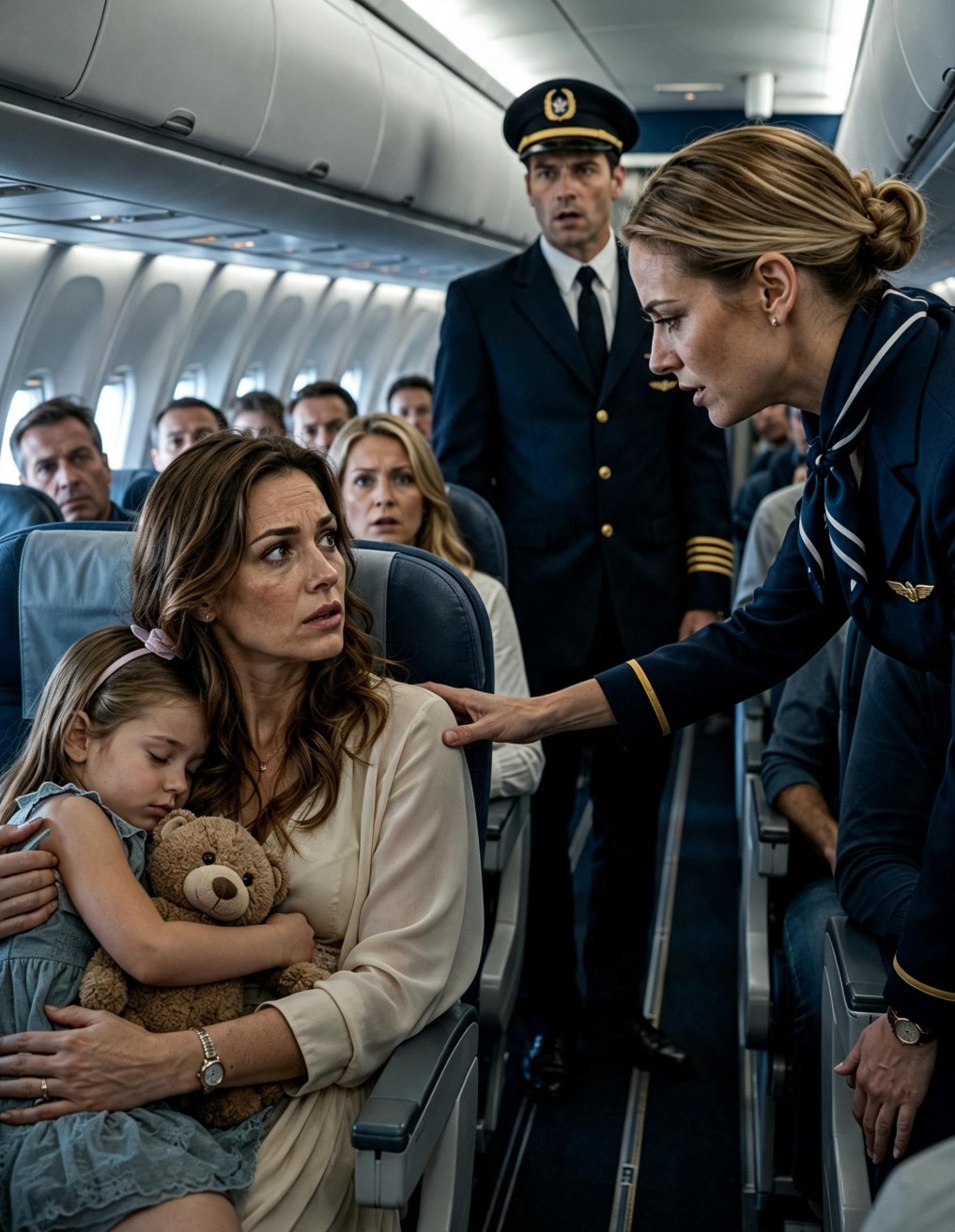
PART 1: THE SHADOW IN THE CABIN
The passenger cabin of Flight 402 was wrapped in a soft twilight glow as the massive twin-engine jet moved smoothly through the black sky over the northern ocean. A quiet vibration traveled through the floor and seats, gently lulling nearly three hundred passengers into deep sleep.
I sat in seat 12A with my temple pressed against the cold, double-paned window. I wore a heavy knitted sweater, and my dark hair was pulled into a messy knot behind my head.
To anyone walking down the aisle, I was simply thirty-eight-year-old Caroline, a widowed corporate consultant traveling to Madrid for a structural engineering summit.
I looked harmless.
Tired.
Completely uninteresting.
I stared through the window at the endless darkness below. Far beneath us, the ocean looked like a sheet of black ink stretching to the horizon. My pale face reflected faintly in the glass, and my fingers were wrapped tightly around a lukewarm paper cup of tea.
No one looking at me would have guessed the truth buried beneath my quiet appearance.
Six years ago, my callsign had been Phoenix.
I was not an engineer.
I had been a Major in the United States Air Force and one of the most decorated F-16 squadron commanders in modern military history. I had led combat missions through dangerous airspace and carried out precision strikes with mathematical accuracy.
But I had buried that woman completely on the day my husband, Ronald, was killed over foreign soil.
Ronald had been my wingman.
He had also been the father of my young son, Christopher.
His fighter jet was destroyed during a classified operation, but the Defense Department publicly dismissed his death as a mechanical accident during a training flight. They covered up what had really happened because revealing the truth could have damaged sensitive international diplomatic negotiations.
The grief did not simply break my heart.
It destroyed the life I had known.
The day after Ronald’s military funeral, I resigned my commission. I gathered my young son, moved us to a quiet neighborhood in Minneapolis, and made myself a promise.
I would never touch a control stick again.
I traded fighter jets for neighborhood carpools, military briefings for grocery lists, and the brutal reality of combat for the quiet illusion of suburban life.
For six years, I believed I had succeeded.
Then the illusion shattered violently at 2:14 in the morning.
A sharp chime suddenly echoed through the cabin speakers.
It cut straight through the low, steady rumble of the engines.
“Ladies and gentlemen,” a voice crackled over the intercom.
It was supposed to be the captain.
But something was terribly wrong.
The voice was breathless, high-pitched, and trembling with barely controlled panic.
“This is Captain Raymond. We are currently experiencing an unexpected operational situation that requires immediate technical support. If there is anyone aboard this aircraft with experience flying military fighter jets, please press your attendant button and notify our crew immediately.”
For a moment, nobody moved.
Then a wave of gasps swept through the cabin.
Passengers suddenly sat upright. Overhead lights flicked on one after another. People looked at each other with frightened expressions as nervous whispers spread through the rows.
I remained frozen in seat 12A.
My pulse exploded.
A cold sweat spread across my back.
Why would a commercial airliner need a fighter pilot?
If an engine had failed or the aircraft had lost hydraulic pressure, an experienced private pilot or off-duty airline pilot could help the crew work through the emergency procedures.
But fighter pilots were trained for something completely different.
We trained for high-G evasive maneuvers.
Air combat.
Extreme physical stress.
Situations where a single mistake could mean death.
I squeezed my eyes shut.
My fingernails dug into my palms hard enough to leave red marks.
Please, I silently begged.
Let there be a retired Navy aviator sitting somewhere in first class.
Anyone.
Someone else.
I wanted to stay hidden.
I wanted to go home to my son.
A flight attendant suddenly rushed past my row.
Her face was completely drained of color.
Her hands trembled as she looked from passenger to passenger.
She wasn’t searching for an off-duty airline employee who could check an instrument panel.
She looked like someone who had just walked into a nightmare.
My instincts spoke louder than my fear.
Because an aviator never abandons people in danger.
I took one slow, controlled breath.
Then I unbuckled my seat belt.
Click.
The metallic sound seemed strangely loud in the silent cabin.
I stood in the aisle.
And in that single movement, the quiet suburban mother disappeared.
The heavy sweater around my body suddenly felt like body armor. My back straightened into the rigid posture I had carried for years in uniform. My breathing slowed into the deliberate rhythm I had used before entering a combat zone.
I stepped toward the flight attendant.
Then I placed one steady hand on her trembling shoulder.
“I am a former Air Force F-16 Squadron Commander,” I told her.
My voice was flat.
Clear.
Certain.
“Take me straight to the cockpit.”
PART 2: BLOOD ON THE CONSOLE
The flight attendant did not question me for even a second.
Something in my voice had bypassed every normal procedure.
She immediately turned around and hurried toward the front of the aircraft.
I followed her past the heavy privacy curtain and into the forward galley.
We stopped in front of the reinforced security door protecting the flight deck.
The attendant’s fingers were shaking so badly that she struggled to enter the access code. She failed once.
Then again.
On the third attempt, the indicator finally flashed green.
The lock released with a soft hiss.
I stepped across the threshold.
I expected chaos.
I expected red warning lights, screaming alarms, and two pilots desperately fighting to keep a failing electrical system under control.
Instead, I walked directly into a crime scene.
The smell hit me first.
Copper.
Blood.
It filled my throat and overwhelmed the dry, recycled air of the cockpit.
The co-pilot was lying unconscious on the metal floor between the seats. His wrists were tightly bound with heavy plastic ties, and dark blood had spread around his temple.
Captain Raymond was strapped into the left seat.
His arms were pinned against the armrests, and blood poured from a deep cut across his forehead, staining the front of his white shirt.
And standing directly behind him was a tall man in a dark, perfectly tailored suit.
He held a suppressed pistol against the base of the captain’s skull.
Two more men stood behind him.
Both wore Kevlar vests.
Both carried compact automatic rifles.
My mind immediately understood what I was seeing.
This wasn’t an equipment failure.
It wasn’t an atmospheric emergency.
It wasn’t a medical crisis.
This was a calculated paramilitary takeover.
My military conditioning took control before fear could fully reach me.
Time seemed to slow.
My eyes moved across the tiny cockpit.
Three armed targets.
Three weapons.
Limited entry points.
The emergency axe was mounted beside the jump seat.
Three feet away.
But reaching for it with three loaded weapons pointed around the cockpit would have been suicide.
I kept my expression calm.
“What is the meaning of this?” I asked.
My voice was cold and firm instead of frightened.
The man in the suit smiled.
It was a dark, calculated smile that never reached his eyes.
He slowly lowered the pistol from the captain’s neck, keeping the weapon pointed toward the floor as he turned to face me.
Then he reached toward the empty flight console.
He picked up a thick red folder.
A classified stamp was printed across its cover.
He tossed it onto the dashboard between the flight instruments.
My eyes locked onto the black logo on the front.
A double-V emblem.
I knew that symbol.
The Apex Syndicate.
An international arms network responsible for selling the experimental missile connected to the operation that had taken my husband’s life six years earlier.
A chill moved through my entire body.
The folder wasn’t there by accident.
None of this was an accident.
“Welcome to the flight deck, Commander Caroline,” the man said.
His voice was smooth, with a cold accent.
Then his smile widened slightly.
“Or perhaps I should address you by your real callsign.”
He paused.
“Valkyrie.”
My stomach tightened.
He knew exactly who I was.
The man pointed his pistol toward the empty right-hand pilot seat.
“Sit down in the pilot seat,” he ordered calmly. “We require a very specific flight path tonight through unmapped airspace.”
He took one step closer.
“We needed a pilot capable of flying low under regional defense radars. And we knew your training would force you to respond to a cabin emergency.”
The truth struck me with crushing force.
This entire emergency had been designed for me.
The Apex Syndicate had planned everything.
They knew about my past.
They knew about Ronald.
They knew I had become a mother living quietly in Minneapolis.
And they had deliberately endangered nearly three hundred innocent passengers because they believed they could use my instincts against me.
They had created a fake emergency because they knew an aviator could never ignore people in danger.
They believed they had trapped a grieving mother inside a metal tube forty thousand feet above the ocean.
They had no idea what they had actually done.
They had just placed the controls of a three-hundred-ton airliner into the hands of an elite combat commander.
PART 3: PREPARING THE TRAP
“Type the new navigation points into the flight computer,” the leader ordered.
The cold muzzle of his pistol pressed against my shoulder blade.
“Turn off the main locator beacon and disconnect the satellite communications line. Right now.”
I kept my eyes on the controls.
“I’m typing them in,” I answered softly.
I deliberately allowed my voice to tremble just enough to sound frightened.
I wanted them to believe I was terrified.
My fingers moved across the terminal.
One coordinate after another appeared on the screen.
The new route pulled the aircraft away from the standard European airways and redirected us south toward the open expanse of the sea.
I hunched my shoulders and kept my eyes fixed on the display panels.
I played the terrified hostage perfectly.
They believed six quiet years had softened me.
They believed suburban life had erased my instincts.
They believed grief had made me weak.
They believed I was predictable.
They were wrong.
A combat pilot does not simply know how to operate an aircraft.
A combat pilot learns how to use everything around her.
The aircraft.
The environment.
The weather.
The enemy’s own mistakes.
As I entered their coordinates, I slowly lowered my left hand toward the lower radio panel hidden behind my torso.
I didn’t attempt a loud voice transmission through the emergency channels.
That would have gotten me killed.
Instead, I used a rapid combination of keys I had memorized during years of combat flights.
I routed a universal high-alert emergency signal through an automated weather transmission.
The signal was directed toward an orbital military satellite.
The distress signal was sent.
But I knew help would not arrive quickly.
It would take at least forty minutes for support to intercept our position.
Forty minutes.
Three armed men.
Three loaded weapons.
And hundreds of innocent passengers behind me.
I couldn’t overpower three armed mercenaries in close quarters with my bare hands.
So I needed something else.
I needed the environment.
I glanced at the weather radar glowing on the primary instrument screen.
And there it was.
Directly along our new route, hidden inside the pitch-black sky, was a massive storm system rising nearly forty thousand feet.
It was a dense tower of wind shear, powerful vertical drafts, and violent changes in atmospheric pressure.
Commercial pilots spent their careers avoiding storms like this.
Severe weather could damage an airframe.
But fighter pilots understood something different.
Weather could also provide cover.
It could hide an aircraft from enemy targeting systems.
I pointed toward a small outer ring of the storm.
“There is severe turbulence directly along this vector,” I said. “I need to turn ten degrees west to keep the ride smooth.”
The leader immediately shook his head.
“You will not turn.”
His voice became sharp.
He pressed the gun harder against my back.
“Fly straight through it. We do not have time for detours.”
I lowered my eyes.
“Understood,” I whispered meekly. “Flying straight ahead.”
Then I moved my hands toward my lap.
I pretended I was adjusting my seat.
Instead, my fingers found the heavy safety harness.
I pulled the straps across my chest.
Click.
I secured them tightly.
Then I pulled the nylon belts as hard as I could, locking myself firmly into the seat.
I glanced toward Captain Raymond.
He was an experienced aviator.
He knew exactly what the radar screen was showing.
Our eyes met.
I tapped my index finger twice against the throttle casing.
It was a military signal.
Prepare for immediate heavy impact.
Captain Raymond understood.
Without saying a word, he tightened his own harness and gripped his armrests until his knuckles turned white.
I wrapped both hands around the heavy control column.
The distance display counted down.
The aircraft moved closer and closer to the storm.
Then the nose entered the outer wall of the massive cell.
PART 4: ATMOSPHERIC EXECUTIONS
The storm hit the aircraft like a solid wall.
The smooth flight disappeared instantly.
Wind shear grabbed the massive airframe and threw it violently sideways. The metal hull groaned under the sudden pressure.
Thick clouds swallowed the cockpit.
Blinding flashes of internal lightning illuminated the darkness around us.
The aircraft suddenly surged upward fifty feet.
Then it dropped violently through a pocket of dead air.
The leader lost his balance.
“Keep this plane level!” he shouted.
For the first time, his calm disappeared.
His polished shoes slipped against the cockpit floor as he desperately reached for the back of my seat.
Behind him, the two mercenaries crashed against the rear bulkhead.
They struggled to remain upright while still trying to hold their heavy rifles.
I kept my eyes on the controls.
“Secure your restraints,” I whispered.
The storm grew stronger.
The aircraft shook harder.
But I wasn’t trying to keep the plane level.
I reached forward.
My hand found the flight computer disengage switch.
Click.
The automated system disengaged.
I took complete manual control of the enormous airliner.
Both hands tightened around the control column.
Then I shoved the controls forward.
Hard.
The three-hundred-ton aircraft dropped into a steep, negative-gravity nose dive toward the dark ocean below.
The effect inside the cockpit was immediate.
Artificial gravity disappeared.
The leader was ripped from the floor.
His body launched upward like a projectile.
He slammed face-first into the hard metal ceiling above my seat.
His suppressed pistol flew from his hand and floated uselessly through the cockpit.
The two mercenaries behind him were thrown violently against the overhead storage panels.
Their rifles slipped from their hands.
For several seconds, their bodies and weapons floated in the air as they desperately tried to regain control.
The cockpit exploded into chaos.
Warning horns screamed across the main panel.
PULL UP.
TERRAIN.
PULL UP.
TERRAIN.
The jet plunged toward the sea at nearly five hundred miles per hour.
The altitude display dropped rapidly.
But I remained locked firmly into the pilot’s seat by my tight harness.
I reached toward the side wall.
My fingers closed around the emergency axe.
I pulled it free from its bracket.
The leader was floating upside down near the ceiling.
Blood ran down his face.
He stared at me with wide, terrified eyes.
And in that moment, he finally understood his mistake.
He understood exactly who was sitting in the pilot’s seat.
He wasn’t looking at a helpless widow.
He was looking at an elite combat aviator.
I didn’t warn him.
I didn’t hesitate.
I swung the heavy steel axe upward.
It struck directly into his chest plate.
The impact drove his body backward across the cramped cockpit and slammed him unconscious against the reinforced exit door.
The remaining two operatives were still helplessly suspended in the air.
Captain Raymond reached out.
His fingers caught the floating pistol.
He grabbed it firmly and pointed the weapon directly at the two mercenaries.
The primary threat was neutralized.
I dropped the axe.
Then I grabbed the control column with both hands.
I pulled back with every ounce of strength in my body.
The nose began to rise.
Positive forces returned instantly.
The sudden pressure pushed me deep into my seat cushions.
The aircraft leveled out at three thousand feet above the dark ocean waves.
One by one, the warning alarms quieted.
The cockpit became still.
Only the steady hum of the engines remained.
I took one deep breath.
Then another.
I engaged the autoflight system on a secure heading toward a military base in western Europe.
Beside me, Captain Raymond secured the remaining two men with their own plastic restraints.
For the first time since entering the cockpit, I allowed myself to breathe normally.
But the night was far from over.
PART 5: UNMASKING THE NETWORK
Three hours later, the heavy landing gear touched the long runway of a secure military airfield in Spain.
The landing was smooth.
There was no civilian terminal waiting for us.
No normal passenger gate.
Instead, a fleet of armored vehicles with flashing lights surrounded the aircraft and escorted it toward an isolated hangar at the far end of the facility.
As soon as the engines shut down, tactical teams moved in.
They breached the cabin doors and secured the entire aircraft.
Soldiers entered the flight deck almost immediately.
They removed the unconscious operatives and took them into custody.
I remained in the cockpit.
Slowly, I unbuckled my chest harness.
The adrenaline that had kept me focused was finally beginning to leave my body.
My hands felt heavier.
My muscles ached.
But there was still one thing I had not forgotten.
The red folder.
The folder I had taken from the console contained a complete operational record of the Apex Syndicate.
It included their logistics networks.
Safehouses.
Funding operations.
Their connections across multiple continents.
When senior intelligence officers arrived, I handed the folder directly to the commanding general.
Then I explained everything inside it.
For the next forty-eight hours, the information in those documents triggered a series of coordinated tactical operations.
The syndicate was attacked from every direction.
Their accounts were frozen.
Their operational bases were cleared.
Their members were identified.
And every person connected to the attack on my husband’s squadron was brought to justice.
The organization that had haunted my life for six years was finally exposed.
The phantom enemy I had spent years trying to forget was gone.
Completely.
Outside the aircraft, the passengers were guided down the steps toward the secure terminal.
By then, word had already spread through the cabin about what had happened in the cockpit.
When I walked down the aisle toward the exit, the passengers erupted into applause.
Some stood.
Others clapped from their seats.
A few people were crying.
Outside the facility perimeter, reporters from international news networks had already gathered.
They wanted a statement from the civilian mother who had landed a hijacked airliner.
They wanted my story.
They wanted my name.
I gave them nothing.
I didn’t stop for the cameras.
I didn’t seek recognition.
I simply walked past the flashing lights with my head held high.
I was still wearing my worn sweater.
My travel bag hung from one hand.
Military escorts guided me into a quiet administrative room inside the station.
A secure video screen waited on the table.
I sat down.
Then I pulled the display closer.
My breath caught as the connection opened.
A familiar face appeared.
My seven-year-old son, Christopher, was sitting in his bedroom in Minneapolis.
He rubbed his sleepy eyes while holding his favorite toy.
My sister sat beside him on the bed.
She gave me a tearful smile.
“Hi, Mom,” Christopher mumbled into the microphone. “Are you in Europe yet?”
My heart tightened.
“I am here, sweetie,” I answered softly.
I placed my hand against the glass screen.
“I made it safely.”
For the first time in years, the heavy anxiety that had followed me everywhere seemed to disappear.
I had spent six years trying to hide from my past.
I had believed my training was nothing more than a painful reminder of Ronald’s death.
But standing inside that cockpit had changed something inside me.
I had used the very skills I once hated to protect hundreds of innocent people.
My past was not a burden.
It was a shield.
A shield that had protected my family.
About an hour later, a senior military commander entered the room.
He walked toward the desk and placed a sealed envelope in front of me.
Then he stepped back.
Inside that envelope was a final choice about my future.
PART 6: THE RETURN TO THE SKY
I looked down at the official crest stamped onto the heavy paper envelope.
It rested on the metallic desk in front of me.
This was not a generic medal notification.
It wasn’t a public relations letter.
I opened the envelope.
Then I carefully read the document inside.
It was an official request signed by defense leadership.
They wanted me to return to active military service.
But they weren’t asking me to return to combat missions.
Instead, they were offering me the position of Senior Tactics Director at an elite flight instruction center at a major training base in Nevada.
They needed someone who understood how to deal with non-standard combat situations.
Someone who could improvise under extreme pressure.
Someone who knew what to do when a situation suddenly went completely wrong.
A year earlier, the idea of wearing a military uniform again would have filled me with doubt.
But now, sitting alone in that quiet office, the offer didn’t feel frightening.
It felt natural.
I picked up a pen.
And without delay, I signed the acceptance line.
Three years later.
I stood on the warm concrete of the flight line at the Nevada instruction facility.
The desert air was hot and dry.
Then two advanced stealth fighters launched into the clear blue sky.
Their engines roared with such force that the sound vibrated through the ground beneath my boots.
I watched them climb.
Three years earlier, I had been wearing a plain sweater because I wanted to disappear into the crowd.
Now, I wore a dark flight suit.
My official military rank insignias were displayed proudly on my uniform.
I was Commander Caroline again.
But this time, I wasn’t preparing young pilots for war by sending them into battle.
I was teaching the next generation of military aviators how to adapt when everything went wrong.
How to think under pressure.
How to remain calm when fear took control of everyone else.
And how to survive situations that could not be found in any ordinary manual.
On the nearby viewing deck, my ten-year-old son watched the fighters climb.
He stood surrounded by supportive friends and mentors, staring proudly at the aircraft disappearing into the cloudless sky.
People often make the mistake of underestimating quiet people.
They see a mother reading a book on a commercial flight.
They see someone running ordinary errands.
They see a woman living a peaceful suburban life.
And they assume she is defenseless.
They believe a calm life means a weak person.
But they don’t understand what can exist beneath that quiet surface.
They don’t know the strength of someone who has survived terrible loss, rebuilt her life from nothing, and learned to keep moving forward.
When someone threatens innocent lives and tries to destroy a peaceful family, they don’t gain control.
They remove every reason for that person to hesitate.
They force that person to take command.
To change the rules.
To face the impossible challenge.
And to overcome it.
I smiled as the two fighters climbed higher into the blue sky.
White vapor trails stretched across the horizon behind them.
Then I turned and walked across the airfield toward the hangar.
For the first time in many years, I felt completely at peace.
I had finally understood something I should have known all along.
A determined mother protecting her family is one of the most formidable forces in the world.
THE END.
