
Part 1:
The first thing I remember is the sound of sirens overlapping, like metal tearing through the wind.
I was driving south on Interstate 15 after finishing a late shift in downtown Salt Lake City. One hand rested on the steering wheel while the other held a paper cup of gas station coffee that had gone cold twenty minutes earlier. The sky was already black, and the highway was still slick with melted snow. Every set of headlights behind me looked stretched and blurry in my rearview mirror.
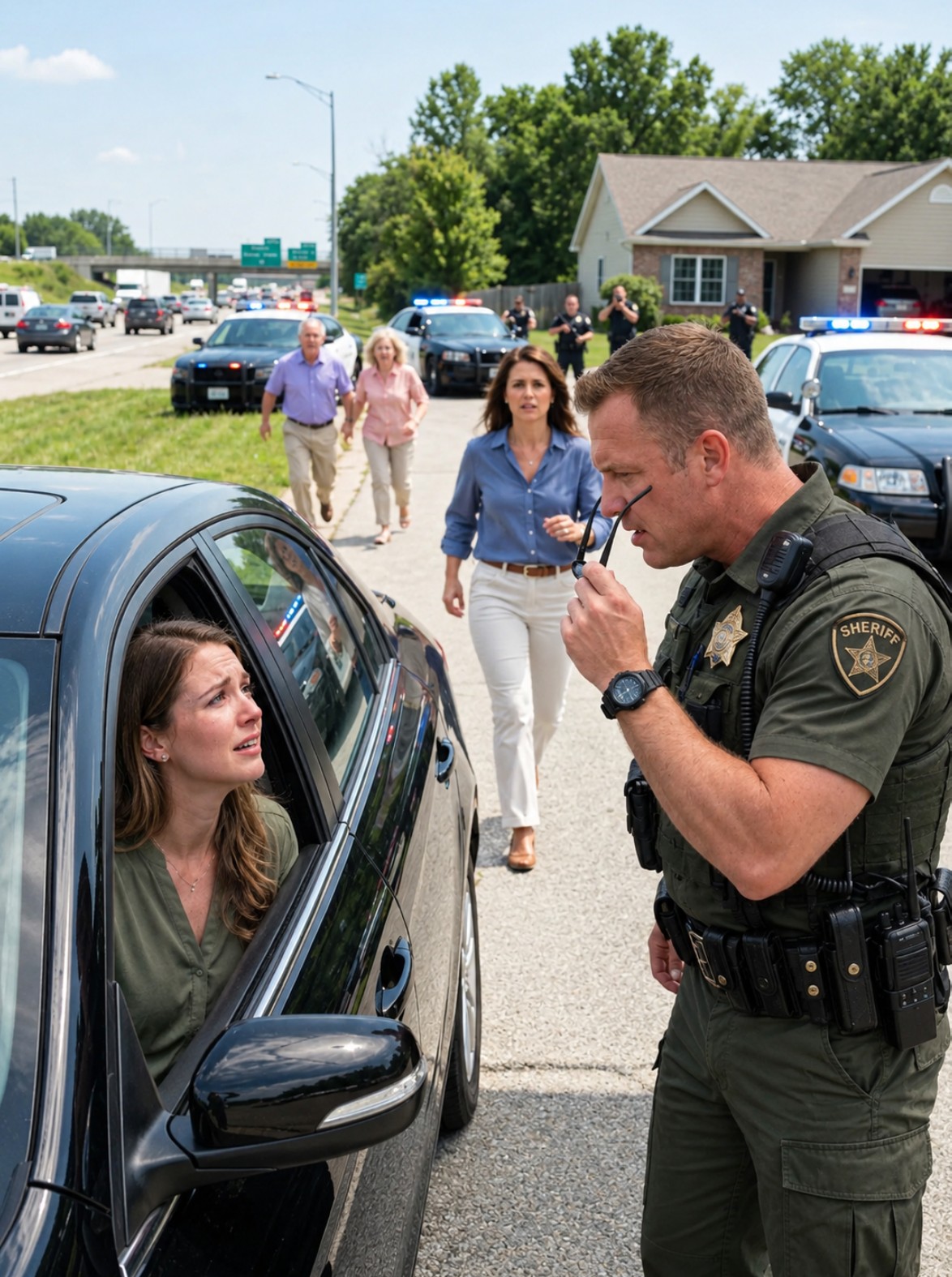
Then three police cruisers suddenly surrounded my car.
One pulled directly in front of my sedan, another moved sharply alongside my passenger door, and the third stopped so close behind me that I could see its heavy bull bar in my mirror. Red and blue lights flashed against the concrete median until the entire world looked like a warning sign.
A voice boomed through a loudspeaker, echoing against my windows.
“Driver, throw your keys out the window and keep both hands visible on the steering wheel!”
For a second, my brain refused to accept that the officer was talking to me.
I was twenty-nine years old and worked as a lead data analyst. I had a clean driving record. I didn’t run red lights, steal makeup from drugstores, or even forget to return my library books on time.
I had never been in serious trouble with the law.
The voice came again, sharper this time.
“Keys out the window! Right now!”
My fingers shook so badly that I scraped the key against the ignition before finally pulling it free. A small silver mountain charm hung from the key ring. A man named Garrett had bought it for me during our first trip to the mountains, back when we were still discovering everything we loved about each other.
The charm clicked against my palm like a nervous tooth.
I lowered the window and dropped the keys onto the wet asphalt.
Cold air slapped my face as I placed my hands at the ten and two positions on the steering wheel. My knuckles turned white while officers stepped out from behind their open doors, their service weapons drawn and their mouths moving into their radios.
The headlights stabbed through my windshield so brightly that I struggled to breathe.
I didn’t know who had done this to me.
I only knew that someone had convinced the police I was dangerous.
Traffic slowed as passing drivers turned their heads to stare. Somewhere to my right, an engine idled heavily while gravel crunched beneath the officers’ boots.
My heartbeat pounded so loudly in my ears that I almost missed the next voice.
“Stand down, everyone!”
The command cut through the sirens like a blade.
“She’s my fiancée, so lower your weapons immediately!”
I blinked against the glare until I recognized the man stepping into the wash of my headlights.
Officer Garrett Woods.
He was still in uniform, his dark jacket zipped to his throat. His badge caught flashes of red and blue light. His face appeared calm from a distance, but I knew him well enough to notice the muscle jumping in his jaw as he holstered his weapon.
He approached my window slowly, as if he were walking toward a wounded animal.
When he leaned down, the smell of cold air and leather from his duty belt drifted into the car.
“Laurel, baby, please look at me,” he said quietly.
My eyes filled with tears.
“I didn’t do anything wrong, Garrett.”
“I know you didn’t,” he whispered.
He reached through the open window and covered my hand with his. His fingers were warm and steady, while mine felt like ice.
“What’s happening to me?” I asked.
He glanced toward another officer before turning back to me.
“Your license plate was flagged ten minutes ago as belonging to a stolen vehicle. The person who reported it also claimed you were hostile and likely to flee.”
The words made no sense.
My car was old but reliable. It was fully paid off, although a minor title issue dating back to my college years had left my father’s name on some of the original paperwork.
“Who reported it stolen?” I asked.
Garrett’s eyes shifted away from mine for a brief moment.
That was when I felt the first real drop in my stomach.
He checked the screen inside his cruiser, then looked back at me with an expression that frightened me more than the guns had.
“Ricardo Sanchez reported it,” he said. “Laurel, your father made the call.”
For a moment, the highway disappeared.
All I could see were my father’s hands.
They were large, square hands belonging to a contractor. They were the same hands that had taught me how to hold a hammer, change a tire, and fix things around the house.
They were also the hands that had taught me how to sign my name neatly when I was eighteen and too trusting to read every document he placed in front of me.
“My dad did this?” I whispered, even though I had heard Garrett perfectly.
The red light on Garrett’s body camera blinked against his chest.
“Laurel, I need you to understand something,” he said. “We have to document everything because filing a false stolen-vehicle report is a serious offense. It puts you and every officer here at risk. Someone could have been hurt.”
The other officers were lowering their weapons. Their expressions had changed from suspicion to confusion and embarrassment.
One retrieved my keys from the road while another radioed to cancel the additional backup.
I remained frozen behind the wheel, my hands still gripping it as the truth slowly settled inside my head.
My father had co-signed paperwork when I bought the car as a sophomore in college. I had made every payment, paid the insurance, and covered every repair and oil change myself.
His name had remained buried in old title records like a loaded gun.
Tonight, he had finally pulled the trigger.
Garrett leaned closer to the window.
“Why would he do something like this to you?”
The heater blew warm air against my ankles, but the rest of my body felt numb.
Forty-eight hours earlier, I had been sitting in my parents’ living room in Provo, surrounded by the smell of slow-roasted pork shoulder and warm tortillas.
My mother, Rosa, had worn her pearls while my older sister, Sofia, cried without ruining her mascara.
My father had asked me for fifteen thousand dollars as casually as if he were asking me to pass the salt.
And I had told him no.
Now, sitting on the shoulder of Interstate 15 while the sirens slowly died away, I understood something that made my hands shake harder than the guns ever had.
My father hadn’t simply lost his temper.
He had made a calculated decision to hurt me.
He had turned my refusal into a dangerous police stop, and I had no idea what he was willing to do next.
Two nights before the highway incident, my mother had texted me while I was finishing a report at work.
“We need to talk, Laurel. Come over at six. It’s about family matters.”
There were no heart emojis, prayer hands, or signs of affection. The message was nothing more than a cold command sitting on my phone screen between a data report and a calendar reminder about wedding cake tastings.
By five thirty, I was driving toward Provo with a tightness beneath my ribs that I couldn’t explain.
My parents lived in a quiet subdivision where every lawn looked perfectly trimmed and every porch light gave off a warm glow that seemed almost too perfect to be real.
The windows were lit when I arrived, and I could see people moving inside.
When I opened the door, the house smelled of cumin and fresh tortillas. Normally, that smell reminded me of birthdays and happy Sunday dinners. That evening, it felt more like bait in a trap.
“Laurel, we’re in here,” my mother called.
Her voice had the soft, careful tone she always used before delivering bad news or trying to manipulate someone.
I found everyone arranged in the living room like a courtroom.
My father sat in his leather recliner, his elbows resting on the armrests and his boots planted firmly on the rug. Ricardo Sanchez had built a contracting business from nothing, and he ran our family the same way he ran a construction site: with strict deadlines, unquestioned authority, and an expectation that everyone would obey.
My mother sat on the sofa, nervously touching the clasp of her pearl necklace.
Across from them were Sofia and her husband, Marcus.
Sofia was beautiful in a polished way that made people assume she was kind, too. Her cashmere sweater matched her lipstick perfectly, and her hair fell in expensive waves around her shoulders.
Marcus looked as though he hadn’t slept properly in a week. He kept his eyes fixed on the rug.
“Sit down,” my father ordered.
I lowered myself into the armchair opposite him. The leather felt cold through my slacks.
“What is going on that requires everyone to be here?” I asked.
My mother sighed as though I were already making things difficult.
“Your sister and Marcus have had a very hard few months, Laurel.”
Sofia lowered her eyes.
“Business has been slow, and we’ve had some unexpected expenses,” she explained. “You know how quickly things can pile up.”
I did know how quickly expenses could pile up. I tracked costs for a living.
I also knew that emergencies always had numbers attached to them, and people tended to avoid discussing those numbers when the truth was uglier than the story they wanted everyone to believe.
“How much money are we talking about?” I asked.
“Fifteen thousand dollars,” my father said firmly.
The room became completely still.
I actually laughed once because I thought I had misunderstood him.
Nobody else laughed.
“You’re asking me for fifteen thousand dollars?” I asked.
“It’s just a loan to help us get through this period,” Sofia said quickly. “We’ll pay you back as soon as we can.”
Marcus shifted in his seat.
“Laurel, you don’t have to do this if you can’t afford it.”
Sofia turned toward him so sharply that he stopped speaking.
That was my first real clue that something wasn’t right.
It wasn’t the amount of money or even Sofia’s tears that bothered me most. It was the way Marcus looked less like a man struggling financially and more like someone trapped inside a crime he didn’t know how to escape.
“I can’t do it,” I said.
My mother’s fingers stopped moving against her pearls.
“What do you mean you can’t help your own sister?” she demanded.
“I mean I’m not giving you fifteen thousand dollars.”
My father leaned forward.
“Don’t lie to me. I know exactly how much you make at that firm.”
Heat rose in my chest.
“Yes, I make good money. But I also pay rent and bills, and Garrett and I are getting married in four months.”
“We’re saving for a down payment on a house,” I continued. “That money has a specific purpose.”
Sofia’s face crumpled as the tears appeared almost on command.
“So your wedding is more important than your own sister’s well-being?” she sobbed.
“It’s not just a party, Sofia.”
“You’d rather spend money on flowers and a dress than help us keep our home?”
The word home sounded strange in the quiet room.
I looked at Marcus again. His jaw tightened, and he seemed desperate to say something without daring to open his mouth.
“Why can’t you get a loan from a bank?” I asked.
My father’s eyes narrowed.
“We handle family matters inside the family.”
“You mean I handle Sofia’s problems inside the family,” I replied.
“Watch your tone with me.”
“No.”
The word came out before I could soften it.
“No, Dad. I’ve helped Sofia before. I helped when she wrecked her car, and I helped when she maxed out her credit cards in college.”
I turned toward my mother.
“I even helped when you said you needed a private loan for a baby shower. But I’m done now.”
Rosa gasped as though I had slapped her.
“After everything we’ve done for you in your life?”
“You raised me, but that doesn’t make me your personal bank.”
Ricardo stood up. His leather chair groaned behind him, and the room seemed to shrink as he towered over me.
“You don’t walk out on this family without facing consequences,” he threatened.
I put on my coat, my fingers trembling despite my efforts to keep them steady.
I still remember the cold brass doorknob against my palm as I walked toward the exit.
I remember my mother whispering my name like a warning.
I remember Sofia watching me with wet eyes that had somehow gone strangely dry around the edges.
But I walked out anyway.
Forty-eight hours later, on the shoulder of Interstate 15, those consequences arrived with flashing lights and drawn weapons.
Garrett drove me home that night in his cruiser while another officer arranged for my car to be returned to my apartment complex.
I sat wrapped in a wool blanket from Garrett’s trunk, shivering so hard that my teeth clicked together.
“What your father did wasn’t just a tantrum,” Garrett said, keeping his eyes on the road. “It was a deliberate escalation of the conflict.”
“But why target my car?”
“Because he had leverage through the old paperwork. The report sounded legitimate enough to get our attention, and it was dangerous enough to frighten you.”
I watched the orange streetlights blur across the window.
“Should I press charges against him?”
Garrett remained silent for a moment.
“Because I responded to the call, I can’t investigate this myself. That would create a conflict of interest.”
He continued, “I’ve uploaded my body-camera footage and documented everything. Tomorrow, I’m handing it over to Detective Dalton in the Financial Crimes Unit.”
“Why Financial Crimes?” I asked.
Garrett looked at me seriously.
“Laurel, this isn’t just a family argument anymore.”
When we reached my apartment, he checked the windows and doors while I stood in the kitchen drinking water that tasted strangely metallic.
Then my phone buzzed on the counter.
A credit-monitoring alert appeared on the screen.
Urgent: New hard inquiry detected.
The lender’s name meant nothing to me, but the loan type made my skin turn cold.
It was a short-term personal loan for exactly fifteen thousand dollars.
Garrett read the notification over my shoulder. The last trace of softness disappeared from his face.
“They didn’t back off after the highway incident,” he said. “They’ve simply changed their approach.”
I stared at the number glowing on my phone. It was the exact amount Sofia had cried over in my parents’ living room.
My father had used the police when I refused to give him money.
Now someone was using my Social Security number.
For the first time that night, I understood that the word family could sound exactly like a threat.
Part 2:
We froze my credit at the kitchen counter beneath the harsh white light above the sink.
I moved between Equifax, Experian, and TransUnion while Garrett stood beside me with his arms crossed and his jaw tight. I entered passwords, answered security questions, and followed instructions while warnings appeared on the screen, making identity theft sound like little more than an inconvenience.
When the final confirmation appeared, I leaned back and stared at the screen.
My apartment was quiet except for the refrigerator humming and a dog barking somewhere downstairs. Everything looked exactly as it had that morning: the gray sofa, the framed hiking photograph, and the little pile of wedding magazines on the coffee table.
But it no longer felt safe.
“They know everything about me,” I said.
Garrett leaned against the counter.
“Parents usually do.”
His words were simple, but they made everything feel worse.
My parents knew my Social Security number because they had handled my childhood tax forms for years. They knew my first address, my first school, and my mother’s maiden name.
All the little pieces of information that were supposed to prove I was who I claimed to be had been handed to them before I could even spell my own name.
Garrett stayed that night, although neither of us slept much.
He lay on the sofa with his phone beside him while I sat in bed refreshing my credit alerts. I watched the sky turn pale blue through the blinds as dawn approached.
By nine the next morning, I was back at work because I needed something normal to hold on to.
My office was a glass-walled analytics firm in downtown Salt Lake City. Everything smelled of espresso and warm electronics.
Numbers usually calmed me. Databases followed rules, and problems could be traced to their source.
At nine fifteen, a calendar alert appeared on my computer.
Mandatory Personnel Check-In.
The attendees were Nicole Nguyen, my manager, and Robert Ross, the director of Human Resources.
My stomach tightened.
Nicole didn’t involve HR in routine meetings. Robert rarely attended anything unless lawyers had already been mentioned or someone thought they might need them.
I walked down the polished concrete corridor, listening to my heels click too loudly against the floor.
The conference room had frosted glass walls. Nicole stood near the window, staring at the skyline instead of the door.
Robert sat at the table with a single printed document in front of him.
“Laurel, please take a seat,” he said.
The chair felt cold beneath me.
Robert slid the paper across the table.
“We received a concerning email this morning. It was sent to our chief information security officer and then escalated to HR.”
I looked down at the document.
At first glance, it resembled an official police incident report. It had a government-style heading and a case number.
But after the previous night’s ordeal, I had become painfully good at noticing small details.
The spacing was too clean, and the badge information was misaligned.
It was fake.
I began reading the allegations, and my mouth went dry.
The report claimed that I had been using my company’s cloud infrastructure to route illegal offshore sports-betting funds.
It contained phrases such as encrypted financial tumbling and unauthorized server access, technical language that sounded frightening enough to make a corporate legal department take notice.
Whoever had written it had clearly searched for complicated terms to make the accusations appear believable.
“This is completely fabricated,” I said.
Nicole finally turned around. Her expression was troubled.
“I believe you’re telling us what you believe, Laurel.”
“No,” I replied. “I’m telling you what I know.”
I explained everything.
“My parents are trying to extort me. Someone attempted to take out a fifteen-thousand-dollar loan in my name last night, and I had to freeze my credit.”
Robert’s expression barely changed.
That frightened me more than anything else.
“We have to protect the company and our clients from potential risks,” he said. “Until we verify the origin of this report and complete a forensic audit, your credentials have been revoked.”
The room seemed to blur around the edges.
“What does that mean for my job?”
“You’re being placed on administrative leave effective immediately.”
I swallowed against the lump in my throat.
“Will I be paid during the investigation?”
Robert looked down at his notes.
“Because the allegation involves financial misconduct, our policy requires unpaid leave during the investigation.”
Unpaid.
It wasn’t just a word to me. It was a knife.
My parents knew exactly where to cut to cause the most damage.
They were attacking the wedding fund, the down payment for our future home, and my ability to pay rent.
My independence had a monthly cost, and they were trying to starve it out.
Security escorted me back to my desk with a flat cardboard box.
My coworkers pretended not to watch as I packed my belongings.
The office, which usually hummed with conversation and the tapping of keyboards, seemed to fall silent around me.
I packed my mug, my notebooks, and a framed photograph of Garrett and me laughing together in the mountains.
When I reached for my corporate laptop, the guard stepped forward.
“Company property stays here,” he said.
Robert appeared behind him.
“Cybersecurity confirmed that her VPN access has already been disabled. She can take the physical hardware because she’ll need it to prepare her formal statement. The audit will use cloud backups.”
So I placed the heavy, slate-gray laptop into my box.
It was a custom machine built for our analytics team, loaded with advanced processing tools.
I had no idea that taking it home would become a mistake my parents never saw coming.
I carried the box to the parking garage and sat in my car without starting the engine.
Twenty-four hours earlier, I had been a lead analyst planning a happy wedding.
Now I was suspended without pay and accused of crimes by my own family.
Then my phone buzzed.
It was a text from Sofia.
“Dad said you’ll have plenty of free time now to rethink your selfishness. Let us know when you’re ready to be a real family again.”
I read it twice.
The grief inside me dried up so quickly that it almost frightened me.
In its place came something cold and clear, like a winter morning.
Sofia knew what was happening.
Perhaps she didn’t know every detail of their plan, but she knew enough to celebrate while my career was falling apart.
I started the car.
The engine growled through the concrete silence of the garage.
My parents had dragged me into a terrifying police stop, tried to steal my credit, and attacked my job.
I was done waiting for the next blow.
If Sofia needed fifteen thousand dollars badly enough to let them destroy me, I was going to find out why.
Sofia lived in Park City in a townhouse that looked as though it had been designed by someone who couldn’t stand ordinary life.
It had cream-colored stucco, black iron railings, and imported tiles on the front steps. A seasonal wreath hung on the door because Sofia believed changing decorations with the calendar was proof of good taste and, somehow, moral superiority.
Two luxury SUVs sat in the driveway. Both were cleaner than my kitchen counters.
I parked across the street beneath a leafless maple tree and watched the house for a full minute.
The neighborhood was quiet in that wealthy way where even the dogs seemed trained to bark politely. Somewhere nearby, a sprinkler ticked across an already perfect lawn.
I walked up the steps and rang the bell.
Sofia opened the door holding an iced latte.
Her eyes moved from my face to my coat, then to the cardboard box imprint still creased into my sleeve.
A flicker of satisfaction crossed her expression before she covered it with concern.
“Laurel, shouldn’t you be home thinking about your choices?” she asked.
I stepped past her into the foyer without waiting for an invitation.
The house smelled of vanilla candles and fresh paint. Sunlight spilled through tall windows onto a rug that probably cost more than my first car.
“Where’s Marcus?” I asked.
Sofia shut the door harder than necessary.
“You can’t just barge in here like this.”
“Where is your husband right now?”
“He’s in his study working, unlike some people,” she snapped.
I turned to face her.
“Mom forged a police report and sent it to my employer this morning.”
Her lips parted, but no words came out.
“Dad reported my car stolen and had me surrounded by armed officers on the highway,” I continued.
“Maybe if you weren’t acting so unstable lately—”
“Someone also tried to take out a payday loan in my name for fifteen thousand dollars.”
That stopped her.
She wasn’t shocked by the news. She was calculating her response.
“Sofia, how much trouble are you actually in?” I asked slowly.
She rolled her eyes, but her fingers tightened around the plastic cup.
“This is exactly what Mom said you’d do. You always have to make yourself the victim.”
“What is the fifteen thousand dollars for?”
Before she could answer, a door opened down the hall.
Marcus stepped into the light.
He looked worse than he had at my parents’ house. His shirt was wrinkled, his hair was uncombed, and the skin beneath his eyes had a gray tint.
He froze when he saw me.
“Laurel,” he said.
Sofia immediately turned on him.
“Go back inside the study.”
“No,” Marcus replied.
It was a quiet word, barely louder than a breath. Yet in that perfect foyer, it sounded like a gunshot.
Sofia’s expression changed from annoyance to panic.
“Marcus, don’t,” she warned.
He looked at me instead of her.
“I didn’t know they were going to contact your employer, Laurel.”
My pulse quickened.
“What exactly did you know?”
He rubbed both hands over his face.
“This has gone way too far.”
Sofia hurried across the foyer and grabbed his arm.
“Stop talking right now!”
He pulled free.
“No. The police stopping her on the highway was one thing, but destroying her career is something else.”
I kept my eyes on Marcus.
“Sofia, what is the money for?”
She laughed too loudly.
“Bills, business expenses, and adult things you wouldn’t understand.”
Marcus closed his eyes.
“It’s the house,” he said.
The entire foyer seemed to hold its breath.
Sofia whispered, “You idiot.”
“What about the house?” I asked.
Marcus looked down at the imported tile.
“We received a notice of default. If we don’t pay fifteen thousand dollars by Friday, the bank will move forward with foreclosure.”
There it was.
Foreclosure.
The word was large enough to swallow Sofia’s candles, luxury cars, and cashmere lies.
“You’ve fallen behind on your mortgage,” I said.
Sofia’s face twisted with anger.
“Congratulations! You’ve solved the mystery. We’re losing our home!”
But something still didn’t make sense.
A million-dollar townhouse wouldn’t necessarily be saved by a single fifteen-thousand-dollar payment. At most, it would buy time. My parents were comfortable, but they weren’t wealthy enough to risk prison just to protect Sofia’s property.
“Why are Mom and Dad so desperate to prevent foreclosure on a house they don’t own?” I asked.
Silence filled the room.
Marcus looked at Sofia. Sofia looked at me.
In that silence, something old and hidden turned over in my mind.
“Get out of here,” Sofia snapped at Marcus.
He stared at her.
“What?”
“Go to your study. Right now!”
He hesitated before retreating down the hall like a man escaping a burning building.
The door clicked shut behind him.
My sister and I stood alone in her perfect foyer.
“Sofia, why would the bank examining your mortgage frighten Mom and Dad?” I asked.
Her iced latte trembled in her hand.
“You’ve always thought you were so smart with your spreadsheets,” she said softly.
“Answer my question.”
She smiled, but there was no humor in it.
“If this house goes into foreclosure, the bank will start looking very closely at the original loan documents.”
My skin went cold.
I thought of the attempted payday loan. I thought of my father’s name on my car title and my mother’s fake police report.
I thought of the exact amount of money they desperately needed.
“What signatures are on those documents?” I whispered.
Sofia didn’t answer.
Instead, she walked to the front door and opened it wide.
“Get out of my house.”
I stood there for one more second, long enough to see the truth flicker behind her eyes.
Then I left.
Outside, the mountain air was cold and bright. A delivery truck hummed at the curb, and a wind chime rang softly in the breeze.
I sat in my car and stared at the townhouse through the windshield.
That house wasn’t just a financial burden to them.
It was evidence.
Suddenly, I knew with terrible certainty whose name I would find buried in those files.
I drove back to Salt Lake City in a silence unlike anything I had experienced before.
The radio was off, and my phone lay face down in the cup holder. Even the traffic seemed muffled, as though the entire city had been wrapped in cotton.
My hands remained locked at the ten and two positions.
I didn’t cry or curse. I simply followed one fact to the next logical conclusion.
When I reached my apartment, I went upstairs and opened my personal laptop without even taking off my coat.
My credit freeze was still active, but I logged into my full credit reports.
Experian loaded first.
There were my student loans and my one credit card. Clean records belonging to a responsible woman.
Then I scrolled down.
And found something that shouldn’t have been there.
An open mortgage account.
The principal balance was three hundred thousand dollars, and the loan had originated ten years earlier.
My mouth went dry as I opened the account details.
The property address appeared on the screen.
It was Sofia’s townhouse in Park City.
For a moment, I forgot how to breathe.
I stared at the screen until the letters blurred.
The imported tiles, seasonal wreaths, and expensive cashmere sweaters were all built on my name.
The primary borrower was listed as Laurel Sanchez.
Below it, the co-signer was listed as Rosa Sanchez.
My mother had sat on that sofa clutching her pearls while calling me selfish. She had helped send fabricated accusations to my employer to destroy my livelihood.
She had once braided my hair before school pictures and told me I was her little angel.
I scrolled back to the origination date.
It was ten years earlier, around my eighteenth birthday.
The memory returned so sharply that I could almost smell the sugar in the air.
Ricardo had taken me to a little ice cream parlor near our old house. He had been unusually cheerful as he tapped his spoon against the table.
After we finished eating, he pulled some papers from his leather briefcase.
“These are college grant forms and state programs,” he told me. “The deadlines are coming up soon.”
I remembered the yellow highlights on the pages and the sticky table beneath my elbows. I remembered feeling grateful that my father had handled the boring paperwork for me.
“You just sign where I’ve marked the pages,” he said.
So I did.
I signed my name again and again while my father watched with a smile.
That hadn’t been help.
It had been the moment he stole my future.
My phone rang.
It was Garrett.
“I found it,” I said before he could speak.
His voice tightened.
“What did you find?”
“The townhouse mortgage is in my name. Three hundred thousand dollars. Mom co-signed, and they forged everything else.”
For a moment, I heard only his heavy breathing.
“I’m coming over right now,” he said.
After we hung up, I opened the county property records and downloaded the deed, mortgage filings, and lien history.
Each PDF landed in a secure folder with a small chime.
Evidence.
Evidence.
Evidence.
Then my phone buzzed again.
A text from my father appeared.
“We need to talk right now. Open your door.”
The apartment seemed to tilt.
Then came the pounding.
It wasn’t a knock.
It was a demand.
“Laurel! Open this door!” my father shouted from the hallway.
My blood ran cold, but the data analyst in me refused to panic.
I uploaded the documents to encrypted cloud storage and copied them to an external drive. Then I slipped the drive into a hollowed-out book on my shelf.
Only after I had secured the files did I approach the door.
Through the peephole, I saw Ricardo’s clenched jaw and Rosa standing behind him.
They hadn’t come to apologize.
They had come to contain the damage.
I opened the door three inches, bracing my foot against it.
“What do you want?”
Ricardo shoved hard.
The door slammed into my shoulder, sending pain down my arm. He stepped inside as though he owned the air in my apartment.
Rosa followed and shut the door, turning the deadbolt behind her.
“Get out of my home,” I said.
“We’re having a family discussion,” Ricardo replied.
He placed a manila envelope on my kitchen island. The slap of paper against stone echoed through the room.
“You forged my signature and put Sofia’s mortgage in my name,” I said.
My mother looked away.
My father didn’t.
“We built your credit profile,” he claimed. “That credit exists because of this family.”
His words were so monstrous that I almost laughed.
He removed a document from the envelope and laid it flat on the counter. Then he produced a pen.
“This is a liability assumption agreement,” he explained. “You acknowledge that you know about the mortgage and agree to take responsibility for the overdue payments.”
He tapped the signature line.
“Once the fifteen thousand dollars is paid, we’ll restructure everything quietly.”
I stared at the paper.
If I signed it, I would turn their crime into my consent.
“No,” I said.
Rosa’s voice sharpened.
“Don’t be dramatic, Laurel.”
“I’m calling the police.”
Ricardo smiled.
“You mean your fiancé? Go ahead and call him.”
The way he said Garrett’s name stopped me.
“If you refuse to sign, I’ll file a formal complaint with Internal Affairs,” my father continued. “I’ll say Officer Woods abused police databases to investigate our family.”
He leaned closer.
“I’ll claim he used his badge to harass us after the traffic stop.”
“That’s a complete lie!”
“It’s an allegation,” Ricardo replied. “And allegations can destroy careers before the truth has a chance to catch up.”
I stood there with my phone in my hand, feeling the trap close around someone I loved.
Rosa softened her voice until it sounded almost maternal.
“Sign the paper, Laurel. Don’t ruin that nice man’s life over a family matter.”
My hands shook.
For one terrible second, I considered surrendering.
Then I pictured the guns on the highway and Sofia standing in her perfect foyer.
“I need to read it first,” I said.
Ricardo’s eyes narrowed.
“If you pressure me any further, I’ll scream until every neighbor calls 911,” I added.
Rosa shifted nervously.
After a long moment, Ricardo slid the document toward me.
“You have twenty-four hours to decide.”
He left the paper on my counter like a ticking bomb.
When the door finally closed behind them, my knees gave out.
I sank to the kitchen floor, shaking so hard that my teeth clicked together.
They had stolen my identity, threatened my safety, and damaged my career.
Now they were holding Garrett’s career against my throat.
And they expected me to thank them for giving me a choice.
Part 3:
Garrett arrived home at six that evening with his badge in his hand.
I heard his key turn in the lock, and my whole body stiffened before I reminded myself that I loved him.
He stepped inside wearing his uniform, but something essential seemed to be missing.
He didn’t kiss me hello.
Instead, he walked straight to the kitchen island, saw the liability agreement, and placed his badge beside it.
The small silver shield struck the quartz with a quiet clink.
“They filed the complaint,” he said.
My stomach dropped.
“With Internal Affairs?”
“At noon today. Ricardo went straight to headquarters and submitted a formal grievance.”
“What did he accuse you of?”
“Database abuse, intimidation, and a conflict of interest.”
I gripped the counter.
“Garrett, I was going to warn you. They broke into my apartment.”
“I know,” he said, his voice flat.
“My captain called me in at two o’clock. Because the allegations involve domestic intimidation, I surrendered my weapon and badge. I’m on desk duty with no fieldwork until the review is finished.”
For a moment, all the fight drained out of me.
I looked at the badge he had always pinned to his uniform with such pride.
Garrett believed in rules and procedure. He believed in the thin line between chaos and safety.
My parents had taken that line and wrapped it around his throat.
“I’ll sign the paper,” I said.
His head snapped up.
“I’ll sign it, and they’ll withdraw the complaint. We can fight the debt later, but I can’t let them ruin you.”
I grabbed the pen and pulled the agreement toward me.
Garrett caught my wrist before the tip touched the paper.
“Don’t you dare sign that.”
My eyes filled with tears.
“But they took your badge!”
“They haven’t taken my judgment,” he replied.
His grip softened, but he didn’t let go of my wrist.
“If you sign this, Ricardo will own you forever. Today it’s the mortgage. Tomorrow it’ll be your savings, your house, or anything else he wants.”
I began crying, the kind of hot, helpless tears that made my nose run and my chest ache.
“I hate them,” I whispered.
Garrett pulled me into his arms and held me tightly.
“I know.”
He didn’t tell me I shouldn’t feel that way. He didn’t remind me that they were still my parents or ask me to forgive them.
He simply held me, as though he understood that sometimes anger is the only thing that protects you from being hurt again.
After a minute, he stepped back and opened a leather bag.
“There’s something else you need to see.”
He removed a manila folder thicker than the one my father had left behind.
Inside were spreadsheets, property records, and old police summaries.
“Detective Dalton started digging after the stolen-car report,” Garrett explained. “When Ricardo filed the Internal Affairs complaint, Dalton had another reason to expand the investigation.”
I wiped my face.
“Expand it into what?”
“Every deed, mortgage, and lien connected to Ricardo and Rosa over the last twenty years.”
He placed a document in front of me. It concerned a property in Provo from fifteen years earlier.
The primary borrower was listed as Lucia Sanchez.
“Aunt Lucia?” I asked.
She was Ricardo’s younger sister, the woman nobody discussed except in lowered voices. When I was growing up, I had been told she made terrible choices and was unstable.
Garrett tapped the co-signer line.
Rosa Sanchez.
“Dalton thinks you weren’t their first target,” he said.
He spread the remaining papers across the counter.
“The pattern is very similar. A younger female relative, paperwork obtained under false pretenses, and a financial obligation she didn’t understand.”
I slowly sat down.
My entire childhood seemed to rearrange itself in my mind.
Every Thanksgiving when Lucia’s name had made the room go quiet came back to me.
My father hadn’t simply been grieving a reckless sister.
He had buried a witness to his crimes.
“We have to find her,” I said.
Garrett nodded.
“Dalton already located her in Ogden. She manages a retail store there.”
I looked at the liability agreement on the island.
I had twenty-four hours to decide whether to sign away my future.
But now the timeline had changed.
My parents thought I was alone, frightened, and cut off from everyone.
They didn’t know they had left one door unlocked fifteen years earlier.
Aunt Lucia opened the door before I could knock twice.
She was smaller than I remembered, but she didn’t look fragile. Her gray hair was pulled back, and she wore a faded denim shirt.
Her apartment smelled of jasmine tea and potting soil.
She looked at me, then at Garrett.
“Laurel, you have your mother’s cheekbones, but thank God you don’t have her eyes,” she said.
I let out a breath I felt as though I had been holding for years.
“You know why I’m here?” I asked.
Lucia stepped aside to let us in.
“I’ve been waiting fifteen years for Ricardo to run out of road.”
Her living room was modest but warm, with books lining one wall. She poured tea into three mugs and sat across from us.
“No small talk,” she said. “Tell me exactly what he did to you.”
So I told her everything: the mortgage, the police stop, the attempted loan, the fake report, and my suspension from work.
Lucia listened without interrupting once.
When I mentioned the ice cream parlor and the papers I had signed on my eighteenth birthday, her mouth tightened into a hard line.
“For me, it was a business loan,” she said.
She wrapped both hands around her mug.
“Ricardo had just started expanding his contracting business. He said he needed a guarantor for some equipment. I was twenty-four, and he was my big brother. I trusted him.”
Her laugh was dry and hollow.
“I signed whatever he put in front of me. Five years later, the bank came after me for a mortgage on a property I’d never even seen.”
“What did you do?” I asked.
“Everything wrong at first. I cried, begged, and tried to explain. Rosa told me that stress could make people remember things incorrectly.”
It was gaslighting, the true language of our family.
“I went to the police,” Lucia continued. “But they saw my real signature on the original loan paperwork and decided it was a family money dispute. Ricardo showed up with folders and a charming smile. I looked hysterical, and he looked responsible.”
She met my eyes.
“That is his gift. He commits crimes while speaking in a tone of voice people associate with authority.”
She stood and opened a filing cabinet, removing a worn envelope.
“I kept everything.”
She spread foreclosure notices and bank letters across the table. There were also threatening letters from Rosa, telling Lucia to stop embarrassing the family.
One signature page contained a badly forged version of Lucia’s name.
The loops were too careful, and the pressure was uneven.
“Paper is how you fight people like Ricardo,” Lucia said. “Not tears, not explanations. Paper.”
Garrett photographed the documents and uploaded them to Detective Dalton’s secure portal.
“Will you testify?” he asked.
Lucia looked almost offended by the question.
“I’ve rehearsed what I’d say in my head for fifteen years.”
For the first time in days, something inside me loosened.
Then my phone buzzed.
It was Marcus.
“Laurel, listen to me. They know,” he whispered when I answered.
Garrett lifted his head.
“Who knows?”
“Ricardo, Rosa, and Sofia know you’ve found the mortgage. Sofia received an alert from the county clerk’s system.”
Cold crept up my spine.
“They’re holding an anniversary dinner tonight at your parents’ house,” Marcus continued. “They’re calling it an intervention.”
Lucia’s eyes hardened.
“They’re going to force you to sign in front of everyone,” Marcus warned. “Ricardo said that if you refuse, he’ll send the report to your CEO and finalize the complaint against Garrett.”
My grip tightened around the phone.
“Where are you right now?”
“At the house. But I’m leaving with the kids. I can’t do this anymore.”
The line crackled.
“Laurel, don’t go there alone,” he said before hanging up.
Garrett was already shaking his head.
“We give Dalton the evidence and stay away.”
But I was staring at Lucia’s old file.
“If I don’t go, Ricardo controls the story,” I said. “He’ll tell everyone I’m unstable and dishonest, just like he did with Lucia.”
Lucia watched me carefully.
“He’ll try to break you in public,” she warned.
“I know.”
“And if you go in there angry, he’ll use that against you.”
“I’m not going in angry,” I replied.
I was angry enough to feel perfectly calm.
Garrett studied my face.
“What are you planning?”
I thought about the corporate laptop sitting in my apartment and its local audio tools. I also remembered the smart-home system I had installed at my parents’ house.
“Ricardo wants an audience,” I said. “So I’m going to give him one.”
On the drive back from Ogden, Ricardo called my phone.
Garrett glanced at the screen.
“Let it go to voicemail.”
I did.
Three minutes later, his message played through the car’s Bluetooth.
“Laurel,” my father began.
His voice sounded thick and almost broken.
“I pushed you too hard, and your mother and I made mistakes. We were trying to keep the family together, but I lost sight of you.”
I stared through the windshield at the highway.
The sun was sinking behind the mountains, turning the sky purple.
For one dangerous second, I wanted to believe him.
“I know you’re angry, but please come tonight,” he continued. “No arguing, no documents. Just family. Let’s make peace.”
The voicemail ended.
I hated that a small part of me still wanted those words to be true.
Garrett broke the silence.
“He’s very good at this.”
“He knows we’ve found the records,” I said.
“Yes.”
“He’s trying to soften me up before the ambush.”
My phone buzzed again.
This time, it was a message from Sofia.
“Laurel, you have to help me. Marcus is leaving!”
Her voice came through in a shaky audio message, with drawers slamming in the background.
“He’s taking the kids and says he can’t be married to a criminal!” she cried.
“A criminal?” I asked quietly when I called her back. “What crime are you talking about, Sofia?”
She cried harder.
“Don’t do this to me!”
“Do what?”
“Act like you don’t know about the mortgage and the signatures,” she whispered.
My thumb moved across the screen to start recording the call.
“What signatures?” I asked.
Sofia inhaled sharply.
“The townhouse,” she whispered. “Mom and Dad took out the mortgage in your name and forged your signature ten years ago.”
There it was.
The confession I had been searching for.
“Did you know?” I asked. “Did you know they stole my identity?”
“Not at first,” she claimed. “I found out three years ago when a statement arrived. But what was I supposed to do?”
“So you let them keep using my name?”
“I didn’t think it would hurt you if we kept making the payments!”
I laughed once, and the sound came out cold.
“And what happened when you stopped paying?”
“That’s why we need the money. Dad has a plan. If you sign the release tonight, everything will be fixed.”
She wasn’t apologizing.
She was negotiating while confessing to a crime.
“I’ll be at dinner,” I said.
Then I ended the call and made sure the recording had uploaded securely.
By the time we reached my apartment, the plan had become clear.
Detective Dalton had the documents, but we needed further evidence of the pressure my father was putting on me. Any recording would need to be collected and handled properly, and Dalton would decide how it could be used in the investigation.
My corporate laptop became the center of my preparations.
I set it on the dining table and opened the audio software. The machine hummed softly while I connected my phone and tested a wireless microphone.
“Are you sure about this?” Garrett asked.
“No,” I admitted.
He almost smiled.
“Honest answer.”
“I’m terrified. But I’m more terrified of spending the rest of my life being afraid of them.”
I opened the smart-home app for my parents’ house.
I still had administrative access because I had configured the system for them.
The dining-room speakers appeared online.
I stared at the little icons on the screen.
Ricardo had built his trap inside a house wired by the daughter he had underestimated.
I wasn’t going to let him control what happened next.
Part 4:
At seven thirty that evening, I parked across the street from my parents’ house in Provo.
Warm light spilled through the windows, and I could hear laughter from inside.
I walked past the dining room without stopping. The den door stood slightly open.
Inside, Ricardo sat behind his desk while Rosa stood near the window holding a wineglass. Sofia sat on the sofa, and a man in an inexpensive suit occupied a chair in the corner with a notary stamp resting on the table beside him.
My father looked nothing like the broken man who had left me that voicemail.
“You came,” he said.
“You invited me.”
He tapped a stack of papers.
“We’re going to end this tonight.”
I stepped inside and closed the door behind me.
The small microphone beneath my collar began capturing the conversation.
The den felt smaller than I remembered from childhood.
Ricardo pushed the documents across the desk.
“Retroactive liability assumption,” he said. “You sign, and the arrears will be paid tomorrow.”
I glanced at the notary.
“Does he know I’m being pressured to sign this?”
The notary swallowed and looked away.
“You’re not being pressured,” Ricardo replied with a smile. “You’re choosing to protect your family.”
Sofia spoke from the sofa.
“Just sign it, Laurel. I can’t lose my kids over this.”
I looked directly at my father.
“What happens if I say no?”
He opened another folder.
The first page contained an email draft addressed to my company’s CEO. Attached to it was another fabricated report.
“I paid someone to build these server logs,” he said. “They show your credentials accessing money-laundering tools.”
My stomach turned.
“You fabricated evidence of federal crimes?”
“I created leverage,” he corrected.
He slid another document toward me.
“And this is the expanded affidavit against Garrett Woods.”
It accused Garrett of stalking, intimidation, and unlawful access to police databases.
“If you don’t sign, this goes to Internal Affairs tomorrow,” Ricardo warned. “Your fiancé will be finished.”
Rosa set down her wineglass.
“Don’t make this harder than it needs to be.”
My father placed a pen beside the signature line and began tapping it against the desk.
Tap.
Tap.
Tap.
“You have two choices,” he said. “Pride or survival.”
I picked up the pen.
Sofia leaned forward, and Rosa let out a relieved breath.
For three seconds, I held the pen above the signature line.
Then I looked up.
“Are you absolutely sure you want to do this on the record?”
Ricardo blinked.
The pen clicked against the desk as I dropped it.
“What does that mean?” Rosa snapped.
I turned and walked out of the den.
“Laurel!” my father barked.
I didn’t stop.
I entered the dining room, where relatives crowded around a long table covered with platters of meat, rice, and vegetables.
Uncle Roberto was standing to give a toast.
“There she is!” he announced. “We were just honoring your parents.”
I stopped in the doorway.
“They’ve been so generous, letting Sofia live in their Park City property,” Roberto continued.
“They don’t own that house,” I said.
The room fell silent.
Roberto frowned.
“What?”
“They stole my identity to buy it.”
Footsteps thundered down the hall behind me.
I pulled out my phone, opened the smart-home controls, and tapped play.
Sofia’s recorded voice poured from the ceiling speakers.
“Mom and Dad took the mortgage out in your name and forged your signature ten years ago.”
Aunt Maria gasped.
The recording continued, shifting to my father’s voice from the den.
“If you don’t sign, this affidavit goes to the Internal Affairs division commander tomorrow. Garrett will be stripped of his badge permanently.”
The room seemed to stop moving.
Every lie hung in the air for everyone to hear.
Ricardo lunged toward me.
“Turn that off right now!”
Rosa stumbled behind him, and her pearl necklace caught on the back of a chair.
The thread snapped.
Pearls scattered across the hardwood floor with a sharp, sudden sound, rolling in every direction like tiny bones.
Then red and blue lights flooded the dining-room windows.
Several police cruisers had arrived.
For the first time in my life, Ricardo Sanchez looked toward the door and realized that consequences could come knocking for him, too.
The front door opened with a heavy thud.
Garrett entered first, dressed in civilian clothes. He looked at me before looking at anyone else.
Detective Dalton walked beside him, carrying a folder. Uniformed deputies followed and spread through the house.
“This man is trespassing!” Ricardo shouted, pointing at Garrett. “He’s conducting an illegal vendetta against my family!”
Dalton stepped between them.
“Officer Woods is here as a civilian witness. I’m leading this operation.”
“This is a private dinner,” Ricardo protested.
“No,” Dalton replied. “This is an active financial-crimes investigation.”
He removed documents from his leather folder.
“I have arrest warrants for Ricardo Sanchez, Rosa Sanchez, and Sofia Martinez.”
Rosa made a small, broken sound as she knelt among her scattered pearls.
Sofia jumped to her feet.
“What? No! I haven’t done anything!”
“The investigation concerns suspected identity theft, mortgage fraud, attempted extortion, and related financial offenses,” Dalton explained.
Ricardo’s expression hardened.
“You have nothing but an illegally recorded conversation.”
“That question will be addressed through the proper legal process,” Dalton replied. “We also have financial records, mortgage documents, and statements from people involved.”
A murmur moved through the room.
Sofia began crying again, but this time nobody rushed to comfort her.
“It was them!” she shouted, pointing at our parents. “They set everything up! I didn’t know!”
“You knew three years ago,” Marcus said as he stepped into the room.
Sofia turned toward him in disbelief.
“I gave Detective Dalton the bank emails and property-tax notices,” Marcus continued. “I also gave a statement and agreed to cooperate with the investigation.”
He looked at his wife with exhausted eyes.
“I couldn’t keep pretending nothing was wrong.”
Sofia’s legs seemed to lose their strength, and she sank into her chair.
“You’re my husband,” she whispered.
“I’m their father first,” he replied.
The deputies moved in.
Sofia’s wrists were secured in handcuffs while she sobbed. Two deputies helped Rosa to her feet, and she stared down at the crushed pearls scattered around her shoes.
Ricardo stood rigid as a deputy turned him around and cuffed his hands behind his back.
When the metal locked into place, his eyes found mine.
“You destroyed your own family,” he said in a low, venomous voice.
I looked at the man who had forged my future for his own comfort.
“No,” I replied. “I stopped cleaning up after your crimes.”
The deputies led them through the front door.
The room remained frozen long after the flashing lights disappeared from the windows.
My relatives avoided my eyes. Uncle Roberto cleared his throat.
“Laurel, I didn’t know.”
“You chose not to know,” I replied.
Garrett came to my side and slipped his arm around my shoulders.
Detective Dalton approached us.
“We’ll need your formal statement tomorrow, but tonight you should go home.”
As we walked out, I didn’t look back at the broken pearls or the spilled wine.
The legal battle wasn’t over. The investigation still had to run its course, and my career would need to be repaired.
But my parents had finally lost the thing they valued most.
Control.
Part 5:
Six months later, I walked back into my office building.
Nicole and Robert were waiting for me in the same conference room where I had been suspended.
“Laurel, thank you for coming in today,” Robert said.
I placed a folder on the table. Inside were copies of the federal indictment and evidence showing that the cybercrime report had been fabricated.
Robert read through the documents in silence while Nicole sat beside him.
“Your account activity showed no evidence of the misconduct alleged in the report,” he finally admitted.
He paused before continuing.
“The company also mishandled aspects of your suspension.”
They offered to reinstate me fully, provide back pay, and compensate me for the harm caused by the situation.
Nicole slid a second folder across the table.
“The executive team reviewed the crisis documentation you prepared during the investigation,” she said. “They would like to promote you to Senior Data Architect.”
I opened the folder.
There it was: my new title, my salary, and the recognition I had thought I might never get back.
“I accept,” I said.
That evening, I logged into my credit-monitoring dashboard at home.
The fraudulent mortgage had been removed from my credit report following the formal correction process. My credit score was back where it belonged.
For the first time in months, the numbers on my screen reflected my real life rather than someone else’s crimes.
Garrett came up behind me and kissed the top of my head.
“Are you okay?”
“I think so,” I replied.
The Park City townhouse entered foreclosure proceedings two weeks later.
Sofia lost the house, and Marcus eventually secured primary custody of the children. He worked hard to give them a stable home away from the chaos that had consumed their parents.
Ricardo and Rosa lost their financial security as investigators froze assets connected to the alleged fraud.
After the legal proceedings, they ended up in a run-down apartment near an industrial road.
I drove past it once.
Ricardo was standing in the parking lot with a GPS monitor attached to his ankle.
I didn’t stop the car.
My peace didn’t require me to forgive people who had never loved me without conditions.
It required distance, locked doors, and legal boundaries.
Garrett and I married at a timber lodge in the mountains.
There was no father to walk me down the aisle because I had finally learned that I didn’t need one to give me away.
I could choose my own future.
Aunt Lucia sat in the front row, crying into a lace handkerchief.
When Garrett took my hands, the mountain wind lifted my veil.
“I choose you because you never stopped rescuing yourself,” he said.
I nearly broke down.
He understood my journey better than anyone.
I hadn’t survived because someone came along and saved me.
I had survived because I finally believed in my own right to say no.
Marriage didn’t erase what had happened to me.
Real peace meant waking up in the home Garrett and I had bought with honest money.
It meant being able to leave my keys on the counter without worrying that someone would use my name against me.
It meant sleeping through the night without expecting another threat.
I began attending therapy every Thursday. I needed to put words to the things I had spent years excusing.
I learned that my childhood had been filled with warning signs about my father’s need for obedience. His anger, his control, and his habit of making love feel like a debt had always been there.
I had simply been too young to understand what they meant.
I also learned that grief could exist without regret.
I grieved the parents I had believed I possessed, but I didn’t owe them another chance to hurt me.
Ricardo sent letters from prison.
I burned them in our firepit.
One evening, Garrett sat beside me as the paper curled into black ash.
“Want to talk about it?” he asked.
“No,” I replied.
He nodded toward the bag of marshmallows.
“Want another one?”
“Yes,” I said with a smile.
Aunt Lucia began visiting us often. She brought plants for our garden and helped me arrange them along the fence.
Sometimes we worked without talking. Other times, she shared memories of the years she had spent trying to recover what Ricardo had taken from her.
“He took years from me, but not everything,” she told me one afternoon.
I carried that sentence with me as I moved forward.
Marcus rebuilt his life, too. We stayed honest with each other for the sake of the children, who deserved adults they could trust.
Sofia sent messages through a cousin, but I blocked them all.
I no longer believed that access to me should be awarded simply because someone shared my blood.
Family was not a free pass to hurt me.
At work, I became known for building systems that could detect fraud early.
During one meeting, I explained a new method for identifying suspicious financial activity.
“Predators always repeat themselves,” I told my manager.
I wasn’t joking.
Every trap has a pattern. Every liar has habits. And people who believe they can control others often make the same mistakes over and over again.
My parents thought my love made me weak.
In reality, that love had taught me to recognize the shape of their lies. It had taken me years to understand that loving someone didn’t mean allowing them to destroy me.
I still remember that highway at night.
Sometimes the fear rises when a police cruiser appears in my rearview mirror. My hands tighten on the steering wheel, and for a moment, I am back beneath those flashing red and blue lights.
Then I breathe slowly and remind myself of what is true.
The car is mine.
My name is mine.
My life is mine.
A clear ending doesn’t mean the pain disappears. It means you stop volunteering to be hurt again.
I refused the kind of holiday-table ending where everyone sits together, smiles for photographs, and pretends nothing ever happened.
The people I kept in my life had proved themselves when everything fell apart.
Garrett and Lucia stood beside me.
Marcus chose to tell the truth when remaining silent would have been easier.
Those were the people who helped me understand what family could mean when it wasn’t built on fear.
On our first wedding anniversary, Garrett and I returned to the mountain lodge where we had married.
We spent the evening listening to the rain against the windows while a fire crackled in the fireplace.
Garrett reached for my hand.
“Still true?” he asked.
I knew what he meant.
I listened to the rain, the fire, and his steady breathing.
“Yes,” I said. “Still true.”
I had named my restitution account Open Doors.
Part of the money went toward therapy, and part was set aside to help other victims of identity theft. I kept the rest untouched because I liked knowing that, for once, I had something that belonged entirely to me.
It wasn’t a fortune, but it was a reminder that I could rebuild what had been taken.
Every December, Garrett and I hosted a dinner filled with laughter, warm food, and honest people.
One evening, Teresa squeezed my hand while we worked together in the kitchen.
“You’ve built a good room, Laurel,” she said.
I looked toward the dining room, where the people I loved were laughing together.
This was my family now.
The people I had chosen, and the people who had chosen me in return.
“I did,” I replied.
My parents had tried to punish me with fear, but all they had done was expose their own empire of fraud.
They lost their money, their reputation, and the control they had spent years protecting.
I lost something, too.
I lost the illusion that my parents would someday become the people I had always hoped they could be.
In the end, it was a fair trade.
I could finally see the road ahead clearly.
And no one else was holding the keys.
THE END.
