
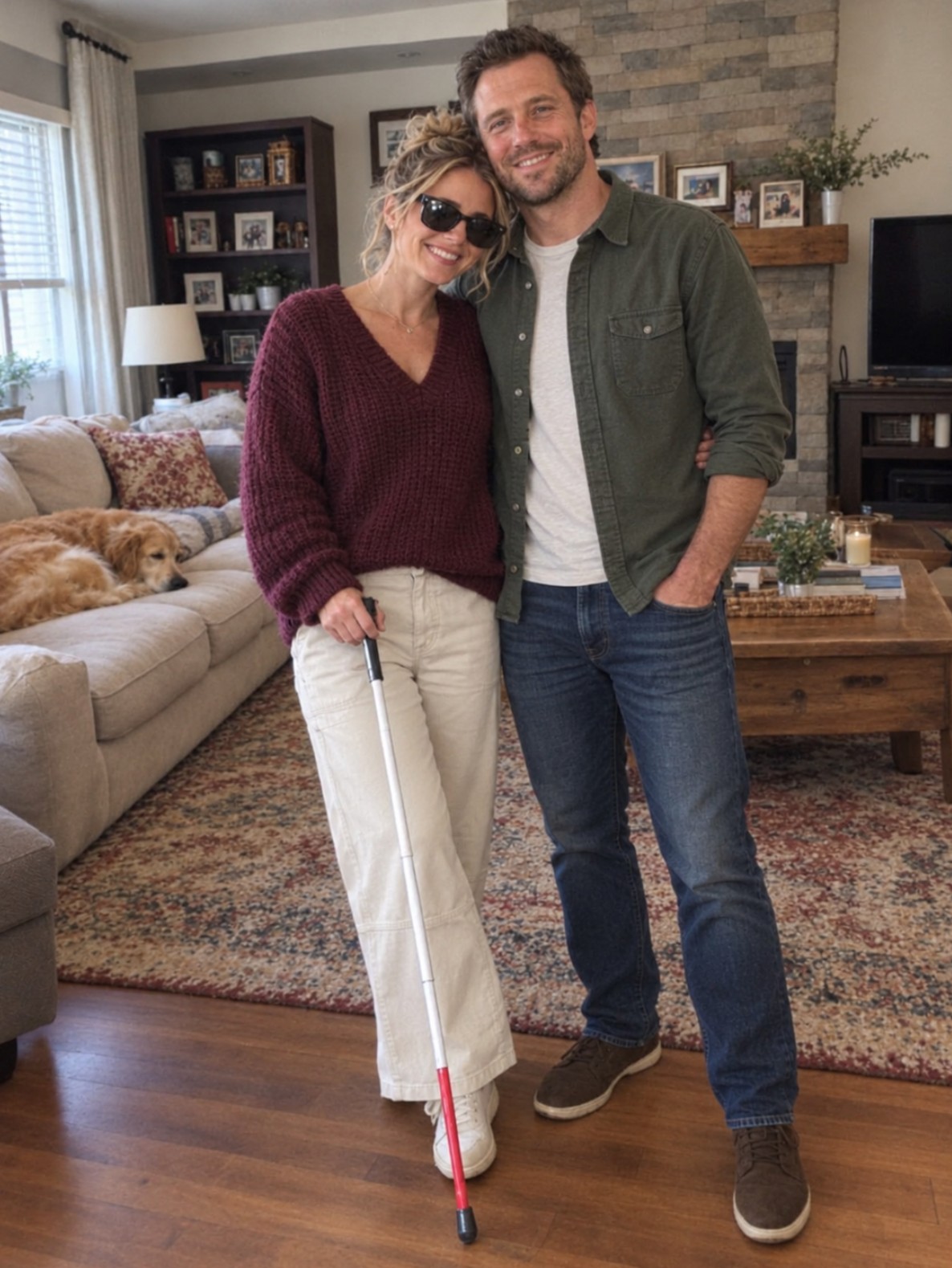
Part 1:
Two years ago, a devastating car accident nearly took my life. I suffered multiple fractures, endured months of painful rehabilitation, and lost my eyesight. The doctors warned me that I might never see again. Although they couldn’t promise that my vision would return, they also couldn’t completely rule out the possibility of recovery.
Those first few months were the hardest period of my life. I had to learn how to live in a world that had suddenly become completely dark. Simple things I had once done without thinking, such as walking from one room to another, getting dressed, or finding something in the kitchen, became enormous challenges.
But through all of it, my husband, Colton, stayed by my side.
He helped me bathe, get dressed, and move safely around our house. He learned how to guide me without making me feel helpless and how to help me with tasks I could no longer manage on my own.
Whenever I felt frightened or frustrated, he tried to comfort me. When I cried because I missed seeing the world, he held me in his arms and reminded me that I wasn’t alone.
I honestly don’t know how I would have survived those first months without him.
Back then, I believed our marriage was strong enough to survive anything. We had promised to stand by each other through good times and bad, and I thought the accident had only made that promise more meaningful.
But as the months passed, something between us slowly began to change.
At first, the changes were small. Colton would sigh when I asked him to help me find something. Sometimes, he answered my questions with a sharpness I had never heard from him before.
If I accidentally knocked something over, he became irritated. If I needed him to repeat something, he sometimes snapped at me.
“Can you please be more careful?” he would say when I dropped a glass or bumped into a chair.
I knew living with someone who had lost her eyesight wasn’t easy. I understood that Colton had responsibilities he had never expected to take on. He still had to work, pay bills, manage household problems, and take care of me.
I tried to be patient with him.
Whenever he lost his temper, I told myself he was tired. When he seemed distant, I assumed he was worried about our future.
But the arguments became more frequent, and his patience seemed to disappear a little more each week.
Sometimes, I lay awake at night wondering whether my blindness had changed the way he saw me.
Did he still look at me and see the woman he had fallen in love with? Or had I become nothing more than another responsibility in his life?
I never asked him those questions directly. I was too afraid of hearing his answers.
Then, a few weeks ago, something extraordinary happened.
I began noticing faint shadows at the edges of my vision.
At first, I thought I was imagining things. I would turn my head toward a window and notice a pale shape, only for it to disappear when I tried to focus on it.
A few days later, I began distinguishing blurry outlines.
I could sometimes tell when someone was standing in front of me. I could make out the difference between a dark piece of furniture and the lighter wall behind it.
I was terrified of getting my hopes up. After two years of darkness, I couldn’t bear the thought of believing I might see again only to discover that nothing was changing.
So I made an appointment with my ophthalmologist without telling Colton.
When I finally sat in the doctor’s office, my hands were trembling.
I explained what I had been experiencing and described the shadows and blurry shapes that had recently appeared.
After examining my eyes and reviewing my condition, the doctor gave me news that nearly brought me to tears.
“My eyesight appears to be recovering,” he explained. “It’s difficult to predict exactly how much vision you’ll regain, but there is a real possibility that it will continue improving over the coming weeks and months.”
I could barely speak.
For the first time in two years, I had a reason to believe that my world might not remain dark forever.
I wanted to rush home and tell Colton everything. I imagined him pulling me into his arms, laughing with relief, and celebrating the miracle we had both been waiting for.
But another thought stopped me.
After everything we had endured together, I wanted to surprise him. I wanted the first time I looked at him again to be a moment neither of us would ever forget.
I wanted to look directly into his eyes and tell him that I could finally see him.
So I kept my recovery a secret.
Over the following weeks, I practiced using my returning vision whenever I had the chance. I didn’t want to push myself too hard, but each day seemed to bring a small improvement.
Then, yesterday morning, I realized just how far I had come.
I could distinguish the furniture around our home. I could recognize movement and make out objects that had previously been nothing more than vague shapes.
Everything was still blurry, and I couldn’t see perfectly. But after two years of darkness, I could finally see the world around me again.
I felt as though I had been given a second chance at life.
That evening, Colton returned from work looking unusually tense.
I heard him come through the front door, put down his keys, and move around the kitchen. Something about his movements suggested that he was upset.
“Is everything all right?” I asked gently when he came into the living room.
“I’m fine,” he replied shortly.
I tried again.
“You sound upset. Did something happen at work?”
“Can we not do this right now, Delaney?”
His harsh tone caught me off guard.
“I was only asking because I’m worried about you.”
“Well, you don’t have to worry about everything!”
The words struck me harder than he probably realized.
I had spent two years trying not to become a burden to him. I had learned to ask for help only when necessary, to apologize whenever I needed something, and to hide my frustration so that he wouldn’t feel responsible for my unhappiness.
Yet somehow, even my concern seemed to irritate him.
We argued for several minutes. Neither of us said anything especially cruel, but every sentence seemed to create more distance between us.
Eventually, I became too exhausted to continue.
“I’m going to lie down,” I told him.
I retreated to our bedroom, hoping we could both calm down before saying something we would regret.
I sat on the edge of the bed, listening to the familiar sounds of our home. I could hear Colton moving around in the other room, and I tried to convince myself that tomorrow would be better.
A few minutes later, I heard the bedroom door open.
Colton walked inside.
At first, I assumed he had come to apologize. Perhaps he had realized how harshly he had spoken to me and wanted to make things right.
I remained quiet, waiting for him to say something.
Instead, I watched him glance in my direction.
Then he turned toward the bed, knelt down, and quickly pushed something underneath it.
My heart began pounding.
Through my still-blurry vision, I could see enough to recognize that he had hidden an object beneath our bed. He moved with such casual confidence that it was obvious he believed I couldn’t possibly see what he was doing.
He had no idea I had been watching him.
I forced myself to remain still and kept my expression neutral. I didn’t want him to suspect that anything had changed.
Colton stood up, glanced around the room, and eventually walked out without saying a word.
I waited until I was certain he had gone before allowing myself to breathe normally again.
Then the questions began.
What had he hidden?
Why had he been so careful?
And why had he chosen to hide it from me?
For the first time since my eyesight began returning, I felt something other than excitement and hope.
I felt afraid.
For two years, I had depended on Colton to help me navigate the world. I had trusted him to tell me what was happening around me, and I had believed that he would never deliberately take advantage of my blindness.
But now I had witnessed him hiding something right in front of me, confident that I would never discover it.
A frightening thought crossed my mind.
How many other things had my husband done during those two years because he believed I couldn’t see him?
I lay awake for most of the night, listening to every sound in the house. Whenever I closed my eyes, I pictured Colton kneeling beside the bed and pushing the mysterious object out of sight.
I wanted to get up immediately and search for it, but I was afraid of making a mistake. My vision was improving, yet I still couldn’t see clearly enough to move around in the darkness with complete confidence.
So I waited.
The following morning, Colton got ready for work as usual.
He kissed my forehead before leaving and told me he would probably be home around six.
I returned his goodbye, pretending everything was normal.
As soon as I heard his car pull away from the driveway, I made my way to our bedroom.
I moved slowly, using the furniture to guide me until I reached the bed. Then I carefully lowered myself to the floor.
My heart was racing.
I reached underneath the bed and began searching with my hands, feeling around until my fingertips brushed against something unfamiliar.
It was larger than I had expected.
I grabbed the edge and slowly dragged it toward me.
The object scraped against the floor before finally emerging from beneath the bed.
I sat back on my heels and stared at it.
It was a suitcase.
My stomach tightened.
Why would Colton hide a suitcase under our bed?
I reached for the zipper and opened it carefully.
Inside were several folded shirts, a few personal belongings, and a collection of papers.
I pulled the papers out first.
The moment I recognized the words printed across the top of the first document, my hands began to shake.
They appeared to be divorce papers.
For several seconds, I couldn’t move.
Then I noticed a handwritten letter tucked between the documents.
It was addressed to a woman named Joanna.
A cold wave of fear swept through me.
Was my husband planning to leave me?
And who was Joanna?
After everything I had survived, had Colton finally decided that he no longer wanted to be married to me?
I stared at the suitcase, the papers, and the unfamiliar name.
Whatever Colton had been hiding, he had never expected his blind wife to find it.
And now that I could finally see again, I was about to discover whether the man I trusted most in the world had been keeping a secret that could destroy our marriage.
Part 2: I Found Divorce Papers Under Our Bed, Then Discovered Who Joanna Really Was
I sat on our bedroom floor for nearly twenty minutes, staring at the letter addressed to Joanna.
My husband had spent two years helping me survive blindness. He had been there when I needed help getting dressed, when I couldn’t find my way around the house, and when I cried because I feared I would never see again.
And now, just as my eyesight was beginning to return, I had discovered what looked like evidence that he was preparing to leave me.
The cruelest part was that Colton still believed I couldn’t read a single word.
He had no idea that I had already begun recovering my vision, and he certainly had no idea that I had seen him hiding the suitcase.
I unfolded the letter again, holding it close and trying to make out the handwriting through my blurry vision.
The first paragraph mentioned our marriage and the growing distance between us. I could recognize enough of the words to understand that Colton had been struggling with his feelings for some time.
But I couldn’t bring myself to read much further.
My mind was racing too quickly.
Who was Joanna?
Was she another woman in my husband’s life? Had he fallen in love with someone else while I was unable to see what was happening around me?
I thought about all the times he had worked late over the past few months. I remembered the phone calls he sometimes took in another room and the occasions when he lowered his voice whenever I entered.
At the time, I had assumed he was dealing with problems at work.
Now, every little detail seemed suspicious.
I remembered something I had overheard the previous week. Colton had been talking on the phone when he thought I was asleep.
“I can’t keep doing this forever,” he had whispered. “Something has to change.”
At the time, I had assumed he was discussing a difficult situation at work.
Now I wondered whether he had been talking about me.
Had he reached the point where he could no longer stand being married to a blind woman?
Had he been pretending everything was fine while secretly preparing to walk away?
I couldn’t keep the questions to myself any longer.
I reached for my phone and called my best friend, Jolene. She had supported me throughout my rehabilitation and had always been someone I could trust.
She answered after a few rings.
“Hey, Delaney! How are you doing this morning?”
I hesitated, unsure where to begin.
“Jolene, I found something, and I don’t know what to do.”
Her voice immediately became serious.
“What happened?”
“Colton has a suitcase hidden under our bed. There are divorce papers inside, and I found a letter addressed to another woman.”
For several seconds, Jolene said nothing.
Then she asked carefully, “Are you sure they’re divorce papers?”
“They look like divorce papers. I haven’t read everything yet, but I saw enough to understand what they are.”
“Have you asked Colton about them?”
I let out a bitter laugh.
“How am I supposed to ask my husband why he’s preparing to abandon his blind wife?”
“Delaney, listen to me,” she said firmly. “You don’t know the whole story yet. You found some papers and a letter. That doesn’t necessarily mean he’s planning to leave you. Please talk to him before you decide what this means.”
I knew Jolene was trying to help me think clearly.
She was right that I didn’t have all the answers.
But I was terrified of hearing something I couldn’t bear.
“What if he admits it?” I whispered. “What if he tells me he’s been waiting for the right moment to leave?”
“Then you’ll deal with the truth when you know it. But don’t torture yourself by deciding what happened before you’ve even spoken to him.”
Her words made sense, but my fear was stronger than my reason.
After we ended the call, I returned my attention to the suitcase.
I needed to know more before Colton came home.
I carefully searched through the folded shirts and personal belongings. Beneath them, I found a small leather notebook.
I opened it and discovered pages filled with dates, appointments, and handwritten observations. Some entries went back several months.
At first, I thought the notebook might contain more evidence of a secret relationship.
Instead, I found something unexpected.
One entry read:
“Lost my temper again after work. Delaney didn’t deserve that.”
I read the sentence twice.
Another entry said:
“I keep trying to protect her, but maybe I’m taking away her independence.”
I frowned.
These weren’t the words of someone celebrating his freedom from a marriage he no longer wanted.
They sounded like the private thoughts of a man who was struggling with himself.
I turned another page.
There were more notes about arguments, difficult evenings, and moments when Colton had felt frustrated with the situation at home.
But there were also signs of guilt.
He repeatedly wrote about regretting the way he had spoken to me and wishing he could find a better way to handle his emotions.
I felt confused.
If he was simply planning to leave me, why would he spend so much time writing about his mistakes?
Then I noticed a small business card tucked between two pages.
I pulled it out and brought it closer to my face.
The name printed on it was clear enough for me to read.
Joanna Pierce. Licensed Marriage and Family Therapist.
I stared at the card.
Joanna wasn’t necessarily another woman in Colton’s life in the way I had feared. She was a professional who helped people deal with relationship problems and emotional struggles.
Perhaps Colton had been seeing her because our marriage was falling apart.
Perhaps he had been asking for help.
But that raised another question.
Why had he hidden the suitcase and the divorce papers from me?
And why had he packed his belongings?
I returned to the letter and forced myself to read more carefully.
As I slowly worked through the blurry handwriting, I discovered that Colton had written about how unhappy he had become with himself.
He admitted that he sometimes dreaded coming home because he was afraid he would lose his patience again. He described feeling guilty whenever he became irritated with me, especially because he knew how much I had already suffered.
He wrote about the pressure of trying to be strong all the time and the shame he felt whenever he failed to live up to the husband he believed I deserved.
Then I reached one sentence that made my chest tighten.
“I’ve started wondering whether Delaney would be happier without me.”
I lowered the paper.
For months, I had believed that Colton was growing tired of caring for me.
I had imagined that he was slowly falling out of love with me because I could no longer do the things I used to do.
But what if the truth was more complicated?
What if he was struggling with feelings he didn’t know how to express?
What if he had become so overwhelmed by the situation that he had begun to believe I would be better off without him?
The thought left me feeling both relieved and devastated.
I didn’t want my husband to suffer. I had never wanted him to feel trapped by our marriage.
But I also couldn’t ignore the fact that he had been keeping important things from me.
He had spoken to a therapist about our relationship without telling me. He had printed divorce papers. He had packed a suitcase and hidden it under our bed.
Whatever his reasons, he had allowed me to believe that our marriage was falling apart without giving me a chance to understand what was happening.
I carefully returned the notebook and papers to the suitcase.
I decided I would wait until Colton came home and ask him directly.
No more guessing.
No more imagining the worst.
I needed to hear the truth from him.
That evening, I sat in the living room and listened for his car.
At six fifteen, I heard the familiar sound of the engine pulling into the driveway.
My stomach twisted.
I had spent the entire day preparing myself for this conversation, but now that the moment had arrived, I wasn’t sure I could handle it.
The front door opened.
“Hey, Delaney!” Colton called from the kitchen. “How was your day?”
I took a deep breath.
“We need to talk.”
There was a brief silence.
Then I heard his footsteps approaching the living room.
When he entered, he stopped abruptly.
I had placed the suitcase on the coffee table, with the papers arranged neatly beside it.
Colton stared at the scene.
His face changed immediately.
“Where did you find that?” he asked.
“Under our bed.”
His shoulders stiffened.
For a moment, neither of us spoke.
Then I picked up the papers and held them toward him.
“Are you planning to leave me, Colton?”
He looked at the documents, then at me.
“Delaney, please let me explain.”
“Then explain. What are these papers? And who is Joanna?”
His expression changed at the name.
“Joanna?”
“Don’t pretend you don’t know her. I found her letter and her business card.”
Colton slowly rubbed his face with both hands.
“She’s my therapist.”
“I figured that out. What I want to know is why you’ve been discussing divorce with her.”
He lowered himself onto the sofa, looking as though the weight of the world had suddenly fallen on his shoulders.
For the first time in a long while, he seemed unable to find the right words.
I waited, my heart pounding.
Whatever he said next would determine whether I could continue trusting the man I had loved for so many years.
And I was finally able to see his face as he prepared to answer.
Part 3: My Husband Finally Revealed the Truth
Colton didn’t answer right away.
He stared at the papers on the coffee table as if they belonged to someone else. His hands were clasped tightly together, and I could see the tension in his shoulders.
I had imagined this moment countless times throughout the day. In some versions, he admitted that he had fallen in love with someone else. In others, he told me that he couldn’t bear the responsibility of caring for me anymore.
But now that he was sitting in front of me, I realized how little I actually knew about what was happening inside his mind.
Finally, he took a deep breath.
“I printed those six weeks ago,” he said quietly. “After a night I’m not proud of.”
I swallowed.
“What happened that night?”
He looked down at his hands.
“Do you remember when you asked me to read you the mail, and I snapped at you in front of your sister?”
I remembered.
I had asked him to read a letter that had arrived that afternoon. He had been tired after work, and when I asked him to repeat a sentence, he had lost his temper.
His sister had been visiting at the time. The moment had been embarrassing, and I had felt humiliated by the way he spoke to me.
I had gone quiet for the rest of the evening.
“I remember,” I replied.
“After that, I went out to the garage and sat in the car for about an hour. I couldn’t stop thinking about how badly I’d treated you. I was angry with myself, but I was also exhausted, and I didn’t know what to do with any of it.”
He paused before continuing.
“I started searching online for information about what happens when someone can no longer care for their spouse. I wanted to understand what my options were if I needed a break. Then I found a divorce template.”
My heart sank again.
“You found a divorce template and printed it?”
He nodded.
“I did. I sat there with those papers in my lap, feeling like the worst husband in the world. I couldn’t believe I’d even searched for them.”
I looked down at the documents.
“Then why didn’t you throw them away?”
“Because I didn’t know what to do with them. I never filled them out, Delaney. Look at them.”
He pushed the papers toward me.
“There’s no name, no date, and no signature. I never made them into anything official. I just kept them.”
I looked closely at the pages.
Through my blurry vision, I could see that the lines were indeed blank.
There were no completed forms, no signatures, and no dates indicating that he had taken any formal steps toward ending our marriage.
It was only a blank template.
That discovery eased some of my fear, but it didn’t answer everything.
“Why keep them for six weeks?”
Colton rubbed the back of his neck.
“Because Joanna asked me to bring the things I was ashamed of to our sessions. She wanted me to stop pretending I was fine when I clearly wasn’t.”
He explained that he had started seeing Joanna about three months earlier.
At first, he had gone because he wanted to learn how to handle his frustration. He had begun to recognize that his temper was getting worse, and he didn’t like the way he was treating me.
He had been afraid to admit how overwhelmed he felt.
He worried that if he told anyone the truth, they would judge him for struggling while his wife was still recovering from a life-changing accident.
“Joanna told me that caregiver burnout is real,” he continued. “She explained that people who spend a long time caring for someone they love can become emotionally exhausted. That doesn’t mean they don’t love the person. It means they need support, too.”
He looked at me.
“She said having frightening or uncomfortable thoughts didn’t automatically make me a monster. What mattered was what I did with those feelings. She wanted me to understand them instead of hiding them.”
I listened without interrupting.
“She also told me that keeping the papers wouldn’t make the thoughts disappear,” he added. “She wanted me to bring them to our next session so we could talk about why I’d printed them in the first place.”
I looked at the suitcase.
“And what about this? Why did you pack your clothes?”
Colton let out a short, humorless laugh.
“That was Wednesday night, after we argued.”
He explained that our argument had left him feeling so frustrated and ashamed that he had considered staying with his brother for a few days.
“I thought I needed some space to calm down. I was afraid I’d say something unforgivable if I stayed in the house while I was that upset.”
“So you packed a suitcase.”
“Yes. I put a few clothes and personal things inside. I thought I might leave the next morning, but then I started thinking about what that would mean.”
He looked at me, his eyes filling with tears.
“I imagined you waking up and discovering I was gone. I imagined you trying to figure out where I’d gone and why I hadn’t told you. I knew you’d be frightened and hurt, and I couldn’t bring myself to do that to you.”
“Then why hide the suitcase under the bed?”
“Because I didn’t want you to find it and think I was leaving you before I’d had a chance to explain. I was ashamed of even considering it.”
I remembered watching him push the suitcase beneath the bed the previous evening.
At the time, I had been certain he was hiding evidence of his plans to abandon me.
Now I was beginning to understand that he had been hiding something else: his own fear and exhaustion.
“Did you leave the bedroom after you hid it?” I asked.
“I did. I went into the living room and sat on the couch for a while. I eventually came back to bed around three in the morning, after you were asleep.”
I remembered hearing the mattress shift during the night.
I had assumed he was simply getting comfortable.
I had no idea that he had spent hours wrestling with a decision he didn’t know how to make.
“And the letter to Joanna?” I asked. “What was that about?”
Colton took another deep breath.
“That was an exercise she gave me. She wanted me to write down everything I was afraid to say to you. She told me to bring it to our session first, so I could work through my feelings and figure out how to talk to you without hurting you.”
He looked down at the letter.
“I wrote about being exhausted. About feeling guilty whenever I lost my temper. About being afraid that I wasn’t giving you the support you needed. And about wondering whether you’d be happier with someone who could do a better job of being your husband.”
His voice cracked.
“I was going to talk to you this weekend. I swear I was. I just didn’t know how to say, ‘I love you and I’m drowning,’ in the same sentence.”
I felt something loosen in my chest.
For weeks, I had believed that Colton was growing tired of me. I had convinced myself that my blindness had slowly destroyed the marriage we had built together.
Now I was learning that he had been struggling with his own emotions, hiding his fear because he didn’t know how to talk about it.
But understanding his pain didn’t erase mine.
“Colton, you should have told me,” I said.
“I know.”
“You should have told me you were struggling. You should have told me you needed help. Instead, you let me sit here wondering whether my own husband still wanted me.”
He closed his eyes.
“You’re right.”
“For two years, I’ve been afraid that I’ve become a burden to you. Every time you snapped at me, I wondered whether you regretted marrying me.”
His eyes filled with tears.
“I never wanted you to feel that way.”
“But I did.”
He nodded slowly.
“I know. And I’m sorry. I let myself believe that I was failing you, and I became so afraid of failing that I stopped being kind to you. You were never the burden, Delaney. The fear was.”
For a moment, neither of us spoke.
I wanted to believe him. I wanted to accept his apology and put the suitcase, the papers, and the letter behind us.
But there was something else I needed to tell him.
Something that would change the way he understood everything that had happened over the past few days.
I took a long breath.
“Colton, I need to tell you something, too.”
He immediately looked up.
“What is it?”
I glanced at the papers on the table before returning my attention to him.
“I’ve been reading these papers. Not by touch. With my eyes.”
He stared at me.
For several seconds, he didn’t seem to understand what I had said.
Then his expression changed.
“What?”
“My eyesight has been coming back for about a month. I started seeing shadows and blurry shapes, so I went to the ophthalmologist. He told me that my vision was recovering, and that it might continue improving.”
Colton opened his mouth, but no words came out.
“It’s still blurry,” I explained. “I can’t see everything clearly yet, but I can recognize objects and make out faces. I can see you.”
He looked at me as though he were afraid to move.
“You can see me?”
I nodded.
“Yes.”
His eyes immediately filled with tears.
“You can actually see me?”
“Not perfectly,” I said softly. “But yes, I can see you.”
He covered his mouth with one hand. His shoulders began to shake, and for a moment, I thought he might be having trouble breathing.
Then I realized he was crying.
“I wanted to surprise you,” I continued. “I wanted to tell you when I could look directly into your eyes again. I imagined coming home from the doctor and seeing your face when I told you the news.”
I swallowed hard.
“Instead, I saw you hiding that suitcase. I spent the next two days believing you were planning to leave me, and I was too afraid to tell you what I had discovered.”
Colton lowered his hand.
“I had no idea,” he whispered.
“I know.”
He leaned forward, looking closely at my face.
“I can’t believe you’ve been seeing again, even a little, and I didn’t know.”
“I didn’t want to tell you too soon. I wanted to be sure it was really happening.”
He nodded, tears running down his cheeks.
Then he asked a question that broke my heart.
“Can you see me right now?”
I reached out slowly and placed my hand against his cheek.
“Yes.”
For the first time in two years, I looked directly at my husband’s face.
I could see the tired lines around his eyes. I could make out the stubble he had missed while shaving that morning. I could see the gray hairs that had appeared near his temples, something I hadn’t known was there.
I studied the face of the man who had helped me survive the darkest period of my life.
“You look exhausted,” I whispered.
Colton let out a cracked, tearful laugh.
Then he pulled me into his arms.
I held him tightly, and we cried together on the living-room sofa.
For the first time in months, neither of us tried to pretend everything was fine.
We were both frightened. We were both exhausted. We had both made mistakes.
But we were finally telling each other the truth.
Part 4: The Conversation That Saved Our Marriage
We stayed on the couch for a long time that night, wrapped in our old afghan and passing a box of tissues back and forth.
There was so much we needed to say that neither of us knew where to begin.
Eventually, I started telling Colton everything about my returning eyesight.
I described the first shadows I had noticed at the edges of my vision. I told him about the day I finally recognized the shape of our kitchen window and the moment I realized that the objects around me were becoming easier to distinguish.
I told him about my appointment with the ophthalmologist and how I had sat in the doctor’s office, barely daring to believe what I was hearing.
Then I explained why I had kept the news to myself.
“I wanted to give you a moment you’d never forget,” I admitted. “I wanted to look at you and tell you that I could see again.”
Colton gently squeezed my hand.
“I wish you’d told me sooner.”
“I know. But I was afraid of getting my hopes up, and I wanted to be certain my eyesight was really improving.”
He nodded.
“I understand that. I just wish we hadn’t spent those days misunderstanding each other.”
“So do I.”
Then it was Colton’s turn to talk.
He told me about the nights he had spent sitting awake in the living room because he couldn’t sleep. He described how he sometimes felt overwhelmed by the responsibility of being my primary caregiver and how ashamed he felt whenever he became irritated with me.
He admitted that there had been moments when he desperately wanted a few hours to himself but didn’t know how to ask for them without making me feel abandoned.
“I kept telling myself that a good husband should be able to handle everything,” he said. “I thought I had to be strong all the time. Whenever I struggled, I felt like I was failing you.”
I listened carefully.
“Why didn’t you tell me that?”
“Because I didn’t want you to think you were making my life miserable. You had already lost so much. I couldn’t bear the thought of making you feel responsible for my problems, too.”
I reached for his hand.
“But keeping everything inside didn’t protect me. It just made me think you were falling out of love with me.”
He nodded sadly.
“I know that now.”
For a while, we sat quietly, thinking about everything we had been through.
Then Colton asked me a question.
“Do you think you can forgive me?”
I looked at him.
“I want to,” I answered honestly. “But I need us to do things differently from now on.”
He nodded immediately.
“Tell me what you need.”
“First, I need you to stop carrying everything alone. If you’re exhausted, tell me. If you need time to yourself, tell me. If something is upsetting you, I want you to feel safe enough to talk to me about it.”
“I can do that.”
“And I need to stop assuming that every bad mood means you’re tired of me. I know I’ve been frightened of losing you, and sometimes that fear has made me jump to conclusions.”
Colton squeezed my hand again.
“We’ve both been afraid.”
“Yes, but we can’t keep letting fear make our decisions for us.”
He looked at me thoughtfully.
“You’re right.”
I took a breath before continuing.
“I also want to come to a session with Joanna. Not instead of your individual therapy, because I think you need a place where you can talk openly about your own feelings. But I want us to work on our marriage together, too.”
Colton didn’t hesitate.
“I’d like that.”
“And one more thing.”
He raised his eyebrows.
“No more secrets. Even good ones.”
A small smile appeared on his face.
“Even good ones?”
“Especially good ones. If something important happens, I want us to be able to share it. I don’t want either of us hiding our feelings until they become too big to handle.”
He leaned forward and kissed my forehead.
“No more secrets,” he promised.
I wanted to believe that promise would be enough to repair everything between us. But I knew that rebuilding trust would take more than one emotional conversation.
We had spent months growing apart. We couldn’t expect to undo all that damage in a single evening.
Still, for the first time in a long while, I felt hopeful.
The following Tuesday, I met Joanna.
Her office was smaller than I had imagined. It was warm and welcoming, with a comfortable sofa, a bookshelf filled with books and small plants, and boxes of tissues placed within easy reach.
Joanna herself was younger than I had expected. She had kind, direct eyes and a calm manner that immediately put me at ease.
When Colton introduced us, she smiled.
“I’m glad you’re here, Delaney.”
I sat beside my husband.
“Thank you for helping him,” I said.
Joanna nodded.
“Colton has talked about you in every session. Mostly about how worried he is that he’s failing you.”
I looked at my husband.
He lowered his eyes, looking embarrassed.
“He’s never failed me,” I said.
Joanna smiled gently.
“I understand that. But he needs to hear it from you more than from me.”
During that first session, we talked about things we had avoided discussing for far too long.
I learned that caregiver burnout was common, even among people who loved the person they were caring for deeply. The constant pressure, lack of rest, and emotional strain could leave someone feeling exhausted and overwhelmed.
That didn’t excuse Colton’s harsh words or mean he had no responsibility for how he treated me.
But it helped me understand that his frustration wasn’t necessarily a sign that he had stopped loving me.
Joanna encouraged him to talk about the feelings he had been hiding.
As he explained what he had experienced over the previous two years, I began to understand how frightened he had been.
He had watched me suffer through painful rehabilitation. He had seen me struggle with losing my independence, and he had wanted desperately to make everything better.
But he couldn’t undo the accident.
He couldn’t restore my eyesight through sheer determination, and he couldn’t protect me from every painful moment.
Over time, his helplessness had turned into frustration. Then the frustration had turned into guilt, because he believed a good husband should never feel resentful while caring for his wife.
The more he tried to hide those feelings, the more difficult they became to manage.
“I thought I had to fix everything,” he admitted during the session. “And when I couldn’t, I started feeling like a failure.”
Joanna listened before responding.
“You were trying to manage an enormous change without giving yourself permission to struggle,” she explained. “You can love someone deeply and still need support. Those two things are not opposites.”
Colton nodded slowly.
For my part, I had to admit something that was difficult to say out loud.
I had become so dependent on Colton’s patience and support that I sometimes expected him to understand what I needed without my having to explain it.
When he became distant, I immediately assumed he no longer loved me.
I had been so frightened of losing him that I rarely told him how afraid I was. Instead, I tried to be as undemanding as possible, hoping that if I needed less, he would have fewer reasons to become frustrated.
Neither of us had been honest about what we were experiencing.
We had both been trying to protect each other, but our silence had only created more distance.
Joanna listened carefully before offering her thoughts.
“The accident changed your marriage,” she said. “Both of you lost something important, and neither of you really had the chance to grieve that loss together.”
Her words stayed with me long after the session ended.
We had spent two years focusing on my physical recovery. We had attended medical appointments, managed daily challenges, and learned new ways to live.
But we had barely talked about how the accident had changed us emotionally.
We hadn’t talked about the life we had imagined before it happened or the things we feared we might never get back.
We hadn’t admitted how lonely we sometimes felt, even when we were sitting in the same room.
That day, we began to grieve those losses together.
We talked about the people we had been before the accident and the people we were becoming afterward.
We talked about our fears, our regrets, and the future we still hoped to build.
For the first time in a long while, I felt that we were truly listening to each other.
And that was only the beginning.
Part 5: The First Time I Saw Our Wedding Photograph Again
Over the following weeks, Colton and I continued working on our marriage.
He kept attending his individual therapy sessions with Joanna, and we began meeting with her together. Those conversations weren’t always easy. Sometimes, we had to discuss painful memories or admit things we wished we had handled differently.
But we were learning how to speak honestly without immediately becoming defensive.
Colton began telling me when he felt overwhelmed instead of pretending he was fine until his frustration boiled over.
If he had a difficult day at work, he would tell me.
If he needed an hour to himself, he would ask for it.
And I learned to stop interpreting every request for space as a sign that he wanted to leave me.
I also started telling him when I felt frightened or insecure instead of keeping those feelings to myself.
Sometimes, all I needed was reassurance.
Other times, I needed him to listen without trying to solve the problem.
We were slowly discovering that we could support each other without pretending to be perfect.
Meanwhile, my eyesight continued to improve.
The changes were gradual, but each one felt extraordinary.
Over the next four months, the blurry shapes around me became clearer. The outlines sharpened, and colors gradually became easier to distinguish.
I began recognizing more objects around our house. I could read larger print, recognize familiar faces, and move through rooms without having to feel for every piece of furniture.
I still needed to be careful, and my vision wasn’t perfect. Some things remained difficult to see, especially when the lighting was poor.
But I was no longer living in the complete darkness I had known for two years.
Every improvement reminded me how much I had once taken for granted.
One afternoon, I was standing in our living room when I noticed a photograph on the mantel.
It was our wedding photograph.
I knew exactly where it was because I had spent countless hours remembering it during the years when I couldn’t see.
I remembered the flowers, the music, the warmth of Colton’s hand around mine, and the happiness I had felt when we promised to spend our lives together.
But I hadn’t been able to see the photograph itself for two years.
Now, I could finally make out the image.
I moved closer.
At first, the details were still blurry. Then, as I focused, the shapes began to become clearer.
I could see my wedding dress.
I could see Colton standing beside me, smiling at the camera.
And I could see the happiness on both our faces.
I started crying.
Colton heard me and hurried into the room.
“Delaney? What’s wrong?”
I pointed toward the mantel.
“Our wedding picture.”
He looked at it, then back at me.
“You can see it?”
I nodded, unable to stop the tears.
“I can see us.”
He wrapped his arms around me, and we stood there together for a long time.
A few weeks later, I experienced another moment I would never forget.
It was a cold morning, and a light layer of snow covered the ground outside our house.
I was standing near the window when I noticed a flash of red on the porch railing.
I moved closer and looked outside.
A cardinal was sitting on the rail.
Its feathers were a brilliant red against the white snow.
For a moment, I simply stared.
I had forgotten how beautiful an ordinary winter morning could be.
I had spent two years imagining the world beyond our windows. I had listened to rain falling on the roof, birds calling from the trees, and the wind moving through the branches.
But hearing those things was different from seeing them.
I called Colton into the room.
“Come here. Look!”
He walked over, and I pointed toward the bird.
“It’s a cardinal,” I whispered.
He smiled.
“Yes, it is.”
I kept watching until the bird finally flew away.
Then I turned to Colton.
“I didn’t realize how much I missed color.”
He gently kissed the top of my head.
“I’m glad you’re getting it back.”
When we returned to the ophthalmologist for another examination, the doctor confirmed that I had regained much of my vision.
He was careful not to promise that I would ever have perfect eyesight, but he was pleased with the progress I had made.
“You’ve regained a significant amount of vision,” he explained. “You’ll still need to be cautious, and we can’t guarantee that every part of your vision will return. But your improvement is encouraging.”
I thanked him, feeling overwhelmed with gratitude.
Colton had accompanied me to the appointment, and he held my hand throughout the examination.
When the doctor finished explaining the results, Colton didn’t let go of my hand until we were sitting in the car.
For a few moments, he stared through the windshield without saying anything.
Then he turned toward me.
“Can I tell you something?” he asked.
“Of course.”
He hesitated before continuing.
“I used to be afraid of the day you’d see me properly again.”
I frowned.
“Why?”
He let out a slow breath.
“Because I thought you’d look at me and see everything I’d done wrong. I thought you’d finally be able to see how impatient I’d become, how often I’d lost my temper, and how many times I’d failed to be the husband I wanted to be.”
I studied his face.
I could see the worry in his eyes and the tension around his mouth.
“What do you think I see?” he asked quietly.
I reached for his hand.
“I see someone who got tired and made mistakes,” I said. “Someone who was frightened and didn’t know how to handle everything that was happening. I see someone who hurt me, but who also recognized that something was wrong and started getting help.”
His eyes filled with tears.
“And I see someone who has been trying to do better,” I continued. “That’s the man I married, Colton. Not someone who never makes mistakes, but someone who is willing to face them.”
He looked down at our joined hands.
“I don’t deserve you.”
I gently shook my head.
“This isn’t about who deserves whom. It’s about whether we’re willing to keep showing up for each other and doing the work our marriage needs.”
He nodded, then leaned across the console and kissed me.
When we pulled apart, I could see the tears resting on his eyelashes.
For the first time in two years, I wasn’t just hearing the emotion in his voice or imagining the expression on his face.
I could see it for myself.
And I realized that seeing again wasn’t only about recovering my eyesight.
It was also about learning to look at the people I loved with honesty, compassion, and a willingness to understand what lay beneath the surface.
Part 6: We Finally Let Go of the Past
That spring, Colton and I decided to do something small but meaningful.
We wanted to let go of the fear and secrecy that had nearly destroyed our marriage.
Joanna suggested that we create a simple ritual to mark the beginning of a new chapter.
She reminded us that throwing away a piece of paper wouldn’t magically erase the problems we had faced. But sometimes, a physical act could help people acknowledge that they were choosing a different path.
So one evening, we took the blank divorce template and the unsent letter to the fireplace.
Colton held the papers for a moment before looking at me.
“Are you sure you want to do this?” he asked.
I nodded.
“Yes. But not because we’re pretending those weeks never happened. I don’t want us to forget what we learned.”
He smiled sadly.
“Neither do I.”
Together, we placed the papers into the fire and watched them burn.
The flames curled around the edges before turning the pages into ash.
It was a small gesture, but it felt like closing a door we had never truly needed to open.
We weren’t destroying the evidence of our problems.
We were acknowledging that we had faced them and were choosing to work toward something better.
The suitcase went back into the closet, empty and forgotten.
For a while, I couldn’t look at it without remembering the fear I had felt when I discovered it beneath our bed.
But eventually, the memory became less painful.
In June, we took the suitcase out again.
This time, we packed it for a long weekend at the lake.
Colton placed several shirts inside while I organized my own things. We argued playfully about how many shoes we needed, and I insisted that he was packing too much.
“Three pairs of shoes for a weekend?” I asked, shaking my head.
He grinned.
“I like to have options.”
“Options? We’re going to a lake, not a fashion show.”
He laughed.
“You never know what might happen.”
I laughed with him, and for a moment, everything felt wonderfully ordinary.
We were simply a married couple preparing for a trip.
There were no hidden papers, no secret plans, and no frightening questions waiting beneath the surface.
We still had challenges to face. My eyesight hadn’t returned perfectly, and Colton still had to be mindful of his stress. We both knew that old habits could return if we stopped communicating.
But we had learned something important.
Love wasn’t enough if we were unwilling to talk about what we were experiencing.
We had to be honest about our fears, even when those fears were uncomfortable.
We had to recognize when we needed help rather than waiting until we reached our breaking points.
And we had to remember that neither of us could read the other’s mind.
Looking back, I still think about that morning when I knelt beside our bed.
I remember reaching underneath it, feeling my fingertips brush against the unfamiliar suitcase, and dragging it into the light.
I remember the papers, the letter, and the terrible certainty that I had discovered the end of my marriage.
At that moment, I thought I knew exactly what I was looking at.
I believed I had found proof that my husband no longer wanted me.
I was convinced that the man who had once promised to love me through everything had finally decided that I was too much for him.
But I had been looking at only one part of the story.
Fear had filled in the gaps before I had the chance to discover the truth.
The suitcase wasn’t proof that Colton had already decided to abandon me. The blank divorce template wasn’t a completed decision to end our marriage. And Joanna wasn’t the other woman I had imagined.
What I had actually discovered was a man who had reached the end of his emotional strength, who was ashamed of his own thoughts, and who desperately needed help.
I had also discovered a marriage that had been struggling under the weight of an accident neither of us had chosen.
For two years, we had focused on surviving.
We had learned how to manage my blindness, how to get through difficult days, and how to keep moving forward when everything felt uncertain.
But somewhere along the way, we had stopped telling each other how we really felt.
Colton had hidden his exhaustion because he didn’t want to hurt me.
I had hidden my fear because I didn’t want him to feel responsible for my unhappiness.
We had both been trying to protect each other, yet our silence had nearly driven us apart.
It took a hidden suitcase, a blank divorce template, and a letter I was never meant to read to force us into the conversation we should have started long before.
Today, I understand that recovering my eyesight was only one part of my healing.
I also needed to learn that asking for help didn’t make me weak, that admitting fear didn’t mean I had lost hope, and that loving someone didn’t mean pretending everything was fine when it wasn’t.
Colton had to learn those lessons, too.
We are still learning.
Some days are easier than others. Sometimes, we misunderstand each other, or one of us becomes frustrated. But now, we try to talk about those moments instead of allowing them to grow into something bigger.
We have learned that we can love each other deeply and still need support.
We can make mistakes and still take responsibility for them.
And we can face painful truths without automatically assuming that those truths mean everything is over.
I once believed that the suitcase beneath our bed represented the end of my marriage.
Instead, it became the beginning of a new chapter in our lives.
Sometimes, the thing hidden under the bed isn’t the end of the story.
Sometimes, it’s the very thing that finally gets you talking.
THE END.
