
Part 1:
My name is Helen Torres, and until that week, I believed the most dangerous thing in my life was getting older.
I was sixty-seven years old, widowed, and living alone in the old colonial house my mother had left me outside a quiet town in Pennsylvania. The property covered eight acres. The porch was beginning to sag, and my kitchen almost always smelled of garlic, fresh coffee, or whatever I happened to be baking. I had never learned how to cook for just one person.
People looked at my house and thought I was lucky.
They didn’t see the empty rooms.
They didn’t hear the silence that settled over the house after dinner.
And they didn’t know that I still kept my daughter Virginia’s school trophies in the hallway cabinet. Some foolish part of me believed that one day she might bring her own children to visit and say, “Look, this is where Grandma kept everything.”
Virginia was my only child.
And that was the weakness she knew how to use better than anyone.
Three weeks before everything happened, she walked into my kitchen without knocking. She wore a cream-colored blazer, coral nail polish, and the kind of smile she always used when she wanted me to agree to something before I understood what she was asking.
“Mom,” she said, looking around as if she were inspecting the place, “we need to talk about your health.”
I was making lasagna.
Her favorite.
I wiped my hands on my apron, trying not to show how happy I was that she had come to see me at all.
“My health?” I asked.
“You’ve been complaining about stomach pain for months. I spoke to Dr. Miller at St. Raphael’s. He can fit you in next week.”
St. Raphael’s was a private hospital that people in our county mentioned with pride. It had a marble lobby, expensive fundraising galas, and doctors with perfect smiles. Wealthy families went there because they believed money could buy them safety.
“Next week?” I asked.
Virginia sighed as if I were already making things difficult.
“Mom, please don’t be stubborn. Do you want me to lose my mother because you refuse to take care of yourself?”
Those words reached the softest place in my heart.
Not because they were gentle, but because they sounded like love.
For years, I had accepted scraps of attention from Virginia and convinced myself they were signs of concern. A quick phone call. A rushed visit. A birthday card that arrived three days late.
I told myself that adult children were busy. I told myself she loved me in her own way.
So when she placed a thick folder on my kitchen table and told me, “These are just standard admission papers,” I signed them.
Page after page.
Wherever she pointed.
“Shouldn’t I read these first?” I asked at one point.
Virginia laughed lightly.
“Mom, it’s medical paperwork. If you read every single line, we’ll be sitting here until Christmas.”
So I trusted her.
A mother should be able to trust her daughter.
That was what I believed back then.
A week later, I woke up after surgery in a private room on the third floor of St. Raphael’s Hospital. My mouth was dry, my abdomen ached, and a pale picture of a lighthouse hung on the wall across from my bed, as if it were trying to guide me somewhere.
Virginia sat beside me, scrolling through her phone.
“How did it go?” I whispered.
“Perfect,” she replied without looking up. “Dr. Miller says you’ll be home soon.”
Home.
I held on to that word as if it were a promise.
For the next two days, nurses came and went. Virginia visited in short bursts, always dressed beautifully and smelling of expensive perfume. She never stayed long enough for me to ask her to sit with me.
Her husband, Michael, came once.
He stood near the door with his hands in his pockets.
“Feeling better, Helen?” he asked.
Then he checked his watch.
I pretended not to notice.
On the third night after my operation, I woke with an urgent need to use the bathroom. I pressed the call button beside my bed.
No one came.
I pressed it again.
Still nothing.
The hallway outside my room was dim and strangely quiet. I told myself I could manage a few steps on my own. After all, I had raised a child alone after her father left, survived the loss of my parents, and kept a house standing through storms and financial struggles.
Surely, I could make it to the bathroom.
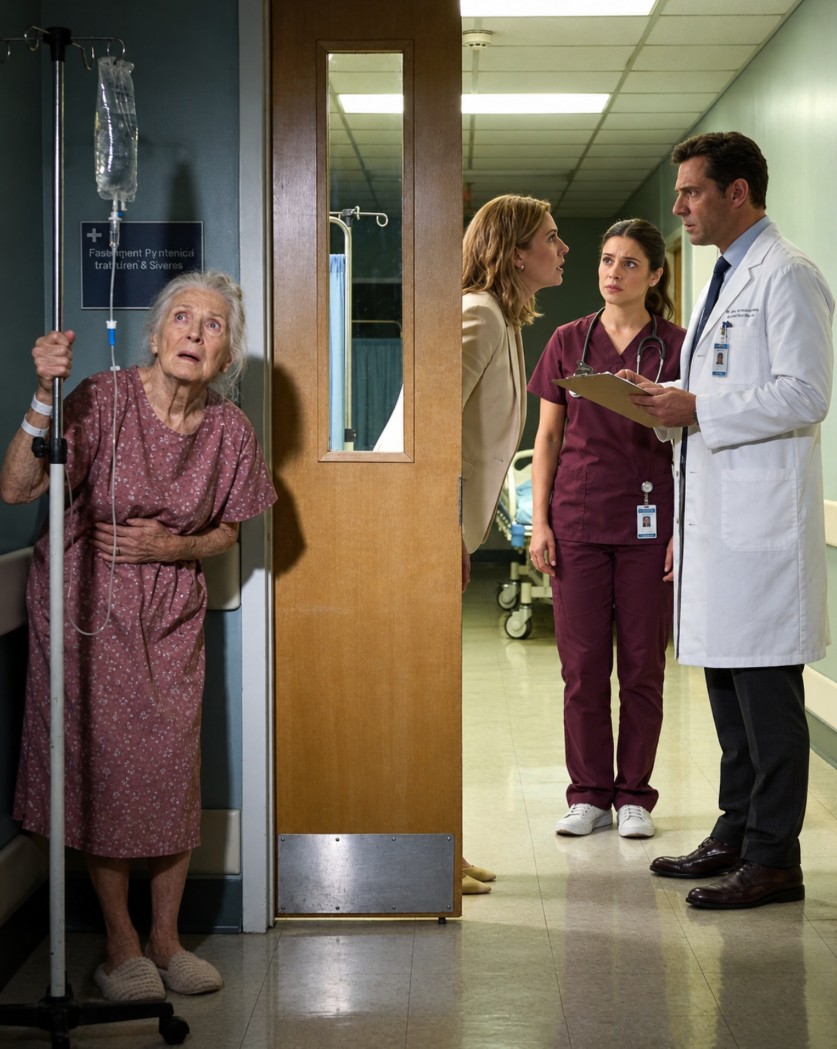
I gripped my IV stand and slowly stepped into the corridor.
The hospital smelled of disinfectant, stale coffee, and fear hidden beneath polished floors.
I moved carefully, keeping one hand close to my side. A television murmured behind a closed door. Somewhere down the hall, a machine beeped at steady intervals.
Then I heard Virginia’s voice.
It wasn’t coming from my room or the waiting area.
It was coming from an office near the surgical wing. The door had been left slightly open, allowing voices to escape into the hallway.
“She signed everything,” Virginia said.
I stopped moving.
My fingers tightened around the IV pole.
Dr. Miller answered in a calm voice, as if they were discussing a lunch reservation.
“Good. Then the property transfer won’t be an issue.”
Property transfer.
At first, the words made no sense.
I leaned closer, my heart beating so hard that I could feel it in my throat.
Virginia lowered her voice, but not enough to keep me from hearing her.
“Tomorrow morning, make sure there are no complications with the paperwork. Twenty-five percent is yours.”
A short silence followed.
Then Dr. Miller said something that turned my blood cold.
“No one asks many questions when an older patient suffers a sudden setback after surgery.”
The hallway seemed to tilt beneath my feet.
For one wild moment, I wondered whether the pain medication was making me imagine things. I told myself I had misunderstood. I told myself that no daughter could sit in a hospital office and calmly discuss her mother’s body and home as if they were items on a shopping list.
Then Virginia spoke again.
“The land alone is worth close to eight hundred thousand dollars. Michael already has buyers interested. Once she’s gone, we’ll close quickly.”
Once she’s gone.
I forgot how to breathe.
That house wasn’t just property to me. It was my mother’s house. My kitchen. My maple trees. The porch where Virginia used to fall asleep in my lap while summer rain tapped against the roof.
And now my daughter had reduced everything to a number.
Dr. Miller asked, “Does your uncle know she’s here?”
“No,” Virginia replied. “I told everyone she needed privacy.”
“Good. The fewer relatives involved, the cleaner this stays.”
Cleaner.
As if I were a mess they needed to wipe away.
Something scraped inside the office. I heard a chair move, followed by footsteps.
They were getting ready to leave.
If they opened the door and found me standing there, I knew I might never get another chance to protect myself.
I turned the IV stand as quietly as I could and forced my aching body back toward my room. Every step hurt. My stitches pulled, and sweat gathered at the base of my neck.
I reached my bed just seconds before footsteps entered the hallway.
I climbed in, closed my eyes, and tried to make my breathing sound natural.
Virginia came into the room.
I knew it was her before she reached my bed because I recognized her perfume. Jasmine and vanilla. It was the same scent I had once bought her for Christmas, back when I still believed gifts could keep love alive.
She stopped beside me.
For several seconds, she said nothing.
She was watching me.
I could feel her eyes on my face, and my heart pounded so loudly that I was sure she could hear it.
Finally, she whispered, “Still sleeping.”
Then she left.
When the door closed, I opened my eyes.
Tears slid into my hair.
They weren’t only tears of fear. They came from a kind of heartbreak that changes a person forever.
I had spent my life giving Virginia reasons to love me. I had worked double shifts when her father left. I had paid for school trips with money meant for groceries. I had stayed awake through fevers, comforted her after heartbreaks, celebrated her graduations, and rushed to help whenever she faced an emergency.
Somewhere along the way, my love had become useful to her.
And now it had become profitable.
The clock on the wall read 2:14 a.m.
I didn’t know how much time I had left.
I only knew that by morning, Dr. Miller would walk into my room with a polite smile. Virginia would stand beside him, pretending to be a devoted daughter, and everyone would expect Helen Torres to disappear quietly inside a hospital that knew exactly how to explain her death.
I looked at the call button.
Then at the door.
Then at the IV line taped to my hand.
For the first time in my life, I understood that being a good mother might not save me.
But telling the truth might.
A soft knock came at my door.
I froze.
A young nurse stepped inside. She had dark hair, tired eyes, and a badge that read Amelia Reyes.
“Mrs. Torres?” she whispered. “Your monitor showed movement. Are you all right?”
I stared at her, searching her face for any sign of danger.
The hallway behind her was empty.
I had one chance. Maybe the last chance I would ever get.
I reached for her wrist with a trembling hand.
Then I whispered, “Close the door. And don’t call Dr. Miller.”
Part 2:
Amelia looked at me for a moment, then quietly closed the door.
After my surgery, I had overheard my daughter discussing my death with Dr. Miller. She had told him I had signed the estate papers and demanded that he make sure I never woke up the next morning. In exchange, he would receive twenty-five percent of the money from the property sale.
I had stood frozen outside their half-open office door, gripping my IV stand and struggling to believe that the woman speaking so calmly was my own child.
But what the doctor had said next made the floor seem to disappear beneath me.
Now I was sitting in my hospital bed, staring at Amelia Reyes.
Her expression had changed.
She didn’t look shocked.
She looked as if she recognized something she had been afraid of seeing again.
I tightened my grip on her wrist.
“You heard them,” I whispered. “My daughter and Dr. Miller. They’re going to kill me in the morning.”
Amelia didn’t pull away.
Instead, she stepped back, checked the hallway through the narrow window in the door, and locked it.
Then she said something I wasn’t prepared to hear.
“I know.”
For a second, I thought my last hope had disappeared.
Perhaps Amelia was involved, too. Perhaps I had just handed myself over to another person who wanted me dead.
But she moved quickly, and not toward me. She went to the wall panel, silenced the monitor alarm, dimmed the lights, and pulled the curtain halfway across the room.
It felt as if she were building a barrier between us and the rest of the hospital.
“You weren’t supposed to hear that,” she said quietly. “They usually keep patients sedated longer.”
My stomach tightened.
“Usually?”
Her jaw clenched.
“This isn’t the first time.”
The room seemed to grow colder.
I felt the truth settle into my bones. This wasn’t simply a terrible betrayal by my daughter. It was something bigger, something planned and repeated. A quiet business operating behind hospital walls, hidden beneath medical language and signed forms.
And somehow, I had walked straight into the middle of it.
“How many?” I asked.
Amelia hesitated before answering.
“Enough that I stopped sleeping.”
For a long moment, neither of us spoke.
The clock ticked on the wall.
2:19 a.m.
Every passing second felt like something precious slipping away.
“I need to get out of here,” I said. “Tonight.”
Amelia nodded, but she didn’t look relieved.
“It’s not that simple.”
“It has to be.”
“No,” she replied firmly. “If you try to walk out right now, they’ll stop you. And if they realize you know what they’re planning…” She let the sentence trail off.
She didn’t need to finish it.
“They’ll do it sooner,” I whispered.
“Yes.”
I closed my eyes.
All my life, I had believed survival meant enduring hardship. Staying strong. Holding on. Being patient when life became unfair.
But this wasn’t the kind of situation that patience could fix.
This was different.
“What do we do?” I asked.
Amelia looked directly at me, studying my face as if she were trying to decide whether I could handle what came next.
Then she said, “We don’t run.”
I stared at her.
“What?”
“We make them believe you’re still exactly where they want you.”
My pulse quickened.
“And then?”
“Then we let them try to carry out their plan while someone is watching.”
It sounded insane. It sounded like a dangerous gamble with my life as the price.
But there was something steady in her voice. She spoke as if she had been preparing for this moment long before I entered her life.
“Why are you helping me?” I asked.
Her expression changed.
For the first time, I saw something beneath her calm manner. Something painful that she had been carrying for a long time.
“My mother died here,” she said.
Her words landed between us like broken glass.
“Two years ago. She was treated by the same doctor. The hospital called it a complication after surgery. At the time, I was still in nursing school. I trusted them, so I never questioned what happened.”
She swallowed hard before continuing.
“Then I started working here. I began noticing things. The same doctor kept appearing in cases involving older patients who suddenly took a turn for the worse. Sometimes their families had recently changed their wills or transferred their property.”
My throat tightened.
“You think your mother was killed?”
“I do,” she said. “And the more I learned, the harder it became to ignore.”
I slowly began to understand.
“You’ve been waiting for a chance to expose them.”
Amelia nodded once.
“For someone who survived long enough for the truth to come out.”
The words frightened me, but they also gave me something I hadn’t felt since hearing Virginia’s voice outside that office.
Hope.
We began putting together a plan in whispers.
According to Amelia, Dr. Miller usually made his morning rounds around six o’clock. He would review the patient’s chart, check their condition, and sometimes adjust their medication or IV.
Around 7:30 a.m., he would administer what she suspected was the final dose.
That was the pattern she had observed.
“But this time,” she said, “someone will be watching.”
“Who?” I asked.
She hesitated, then reached into her pocket and pulled out a small personal phone.
“I reported what I found months ago. First to the state medical board, then to the police.”
My breath caught.
“And they believed you?”
“No. They said there wasn’t enough evidence. They treated everything as a series of medical complications.”
Of course they had.
A hospital like St. Raphael’s didn’t face questions easily. It had wealthy donors, influential patients, and a reputation that people were eager to protect.
“So what has changed?” I asked.
Amelia looked at me.
“You.”
I frowned.
She explained that Virginia had been careless. Instead of discussing only medical treatment, she had openly talked about property, money, and the sale of my land.
“That gives us a possible motive,” Amelia said. “And I recorded the conversation.”
I stared at her.
“You recorded them?”
She nodded.
“Every word I could capture.”
For the first time that night, I felt the balance shift. I was no longer simply a frightened patient who had overheard something terrible.
I could become a witness.
“What about the morning?” I asked.
“My cousin is an investigator. He’s been helping me understand what evidence we need. He’s coming here early, and I’ve told him what happened tonight.”
“You trust him?”
“With my life.”
I looked down at my trembling hands.
“That’s what this is going to take.”
“I know,” she said.
The hours between 2:30 a.m. and sunrise seemed to last forever.
Amelia continued her rounds, making everything appear normal. She checked my IV, reviewed my monitor, and returned to my room at regular intervals.
She made sure no medication was added without proper verification and kept a close watch on anything connected to my treatment.
From the outside, nothing seemed unusual.
Inside my room, everything had changed.
I lay in bed with my eyes closed, listening to every sound.
Footsteps passed my door.
Carts rolled down the corridor.
Doors opened and shut.
Every noise felt like a countdown.
At 5:58 a.m., my door opened.
Dr. Miller walked in.
I kept my breathing slow and steady, pretending to be asleep.
He approached my bed, checked my chart, and examined the equipment beside me.
Then he adjusted something near my IV.
I felt a slight sting.
My heart slammed against my ribs.
Was this it?
Was he already trying to kill me?
“Vitals are stable,” he murmured.
Then he added casually, “Let’s keep her comfortable.”
Comfortable.
I wanted to scream at him. I wanted to sit up and demand to know how a man who had sworn to care for patients could speak so calmly while planning their deaths.
Instead, I remained still.
After a few minutes, he left.
At 6:30 a.m., Virginia arrived.
I recognized her perfume before I heard her voice.
“Is she awake yet?” she asked.
“No,” Amelia answered calmly.
“Good,” Virginia replied.
Good.
That single word echoed inside my head like something breaking.
I had carried her in my arms when she was a baby. I had kissed her forehead when she was sick. I had stayed awake worrying about her when she was late coming home.
And now she was standing beside my hospital bed, waiting for me to die.
I fought to keep my face still.
The minutes crawled by.
At 7:28 a.m., footsteps approached my room again.
There were two people this time.
Dr. Miller entered first, followed by an unfamiliar man.
“Good morning,” the man said.
His voice was calm, but there was something firm about it.
“Routine check?” he added, looking at the doctor.
Dr. Miller frowned.
“Who are you?”
The man didn’t answer immediately.
Instead, he stepped closer to my bed.
“Mrs. Torres, if you can hear me, I need you to open your eyes.”
My heart seemed to stop.
This was it.
I opened my eyes.
Everything happened at once.
Dr. Miller stepped back.
Virginia, who had just entered the room, froze in the doorway.
The unfamiliar man reached into his jacket and pulled out a badge.
“Detective Alvarez,” he announced. “We’re done pretending.”
For a moment, no one spoke.
Then the detective turned toward Dr. Miller.
“We have serious questions about your treatment of this patient, the medication orders, and the conversation recorded last night.”
Dr. Miller tried to recover his composure.
“I don’t know what you’re talking about. Mrs. Torres is under my medical care. There must be some misunderstanding.”
Virginia quickly joined in.
“This is ridiculous. My mother has been ill for months. We arranged for her to receive the best treatment available.”
The detective remained calm.
“Then you shouldn’t have any trouble explaining this.”
Amelia stepped forward and played the recording.
Virginia’s voice filled the room.
“She signed everything…”
Then came the discussion about the property transfer, the eight hundred thousand dollars, and the twenty-five percent payment.
As the recording continued, Dr. Miller’s face lost its color.
Virginia opened her mouth, but the detective raised his hand.
“Don’t say anything else until we’ve spoken to you separately.”
She looked at me for the first time.
I waited for an apology. A sign of regret. Some small indication that the daughter I had raised was still somewhere inside the woman standing before me.
But she said nothing.
The detective and another officer arrived shortly afterward. They questioned Dr. Miller, secured the relevant records, and took Virginia aside for further questioning.
Their denials couldn’t erase the recording or the suspicious circumstances surrounding my treatment.
For the first time since I had entered St. Raphael’s, I felt that I might actually survive.
Not because I had trusted the right people from the beginning.
But because, at the last possible moment, someone had chosen to help me.
Part 3:
Three months later, I stood on my porch.
The same porch.
The same cracked wooden boards.
The same quiet air drifting across the eight acres that had belonged to my family for generations.
But everything felt different.
Not lighter.
Not happier.
Just clearer.
The investigation uncovered more than Amelia and I had expected.
Seven patients had died under suspicious circumstances. All were older adults, and investigators found evidence that several had transferred property or changed estate documents shortly before their deaths.
The authorities began examining the medical records, financial arrangements, and property transactions connected to those cases.
The investigation also revealed that the suspicious dealings extended beyond Dr. Miller and Virginia. Other people had helped arrange paperwork and property sales, although investigators still needed to establish each person’s role.
St. Raphael’s Hospital did not shut down overnight.
But its reputation suffered, its records came under scrutiny, and people who had once trusted it without question began asking difficult questions.
The hospital could no longer rely on its expensive lobby, wealthy donors, and polished public image to keep everyone looking away.
As for Virginia, I stopped asking for updates unless they were necessary for the legal proceedings.
I couldn’t bring myself to chase every detail of what she had done. I had spent too much of my life trying to understand her, excuse her, and find reasons to believe that she loved me.
Some endings don’t need every detail.
Sometimes, accepting the truth is painful enough.
One afternoon, I invited Amelia to my house.
We sat at my kitchen table, the same one where I had signed those papers without reading them. Sunlight streamed through the windows, falling across the wooden surface where Virginia had once done her homework.
I made lasagna.
As always, I made far too much.
Amelia smiled when she took her first bite.
“My mother used to make this,” she said softly.
I looked at her.
“I know.”
For a moment, we sat quietly, remembering the people we had lost and the lives that had been changed by what happened at St. Raphael’s.
Then, just before she left, I handed her a folder.
It wasn’t thick or complicated like the one Virginia had brought me.
Amelia looked at it with a puzzled expression.
“What’s this?”
I smiled.
“Open it and read it.”
She slowly lifted the cover.
Then she went completely still.
Inside was the deed to my house and the eight acres surrounding it.
She looked up at me, her eyes filling with tears.
“No,” she whispered. “Helen, I can’t accept this.”
“You can.”
“But this is your home. Your family’s property. You can’t just give it away.”
I reached across the table and placed my hand over hers.
“I’m not giving it away,” I told her gently. “I’m choosing who I want to leave it to.”
She shook her head, struggling to find the right words.
“Why would you do this for me?”
I looked around the kitchen.
At the old cabinets.
At the familiar table.
At the window where I used to watch Virginia playing in the yard.
Then I looked back at Amelia.
“Because I already learned what happens when you sign things without understanding them. And this time, I know exactly what I’m signing.”
She let out a small, tearful laugh.
“That’s not funny.”
“No,” I agreed. “It isn’t.”
I squeezed her hand.
“But this is different.”
She looked down at the deed again.
“You didn’t have to do any of this for me,” she said.
I shook my head.
“You didn’t take my life. You helped give it back.”
Amelia’s fingers tightened around mine.
“I only told the truth.”
“No,” I said softly. “You did more than that.”
She looked at me.
“You chose to tell the truth, even when it was dangerous. You could have looked away. You could have pretended you hadn’t seen anything. But you didn’t.”
Her eyes filled with tears again.
Neither of us spoke for a while.
Sometimes, there are no words that can properly describe what one person has done for another.
When Amelia finally left, she carried the folder carefully in her hands. We agreed that the property transfer would be completed properly, with independent legal advice and all the necessary documents, so there would be no confusion about my wishes.
After the door closed behind her, I returned to the kitchen.
For years, I had believed that family was something you had to protect at any cost. I had thought that being a good mother meant forgiving everything, accepting disappointment, and continuing to give even when nothing came back.
I had confused love with obligation.
I had mistaken shared blood for a guarantee of loyalty.
And I had allowed my fear of being alone to convince me that I should accept less than I deserved.
But I understood something now.
Love was not measured by how much pain you could endure for another person.
It was measured by the choices people made when doing the right thing became difficult.
That night, after dinner, I washed the dishes and turned off the kitchen lights.
The house was quiet.
But the silence felt different now.
It wasn’t empty.
It wasn’t waiting for someone who might never come.
It was simply peaceful.
I walked through the hallway and paused beside the cabinet where I still kept Virginia’s school trophies.
For a long time, I had been unable to look at them without remembering the little girl she had once been. I had held on to those memories because I wanted to believe that the child who used to fall asleep in my lap was still somewhere inside the woman she had become.
Perhaps some part of her was.
But that didn’t change what she had done.
I could remember the good moments without allowing them to erase the bad ones. I could grieve for the daughter I had loved while accepting that I could no longer trust the woman she had become.
And I could continue living without waiting for her to make everything right.
Later that night, I went to bed.
At 2:14 a.m., I woke up again.
The same time.
The same quiet.
For a moment, I lay still, remembering the hospital corridor, the half-open office door, and Virginia’s voice speaking about my death as if it were nothing more than a business arrangement.
I remembered the terror of those final hours before sunrise.
I remembered Amelia standing beside my bed, choosing to help a frightened stranger even though it meant risking her own safety.
Then I looked toward the window.
Moonlight fell across the floor.
There were no whispers behind doors.
No secrets hiding in the darkness.
No one waiting for me to close my eyes so they could take everything I had.
I was still here.
And I finally understood the truth.
The most dangerous thing in my life had never been getting older.
It had been believing that love, simply because I was willing to give it, would always be returned.
Now I knew better.
I could still love someone without trusting them.
I could forgive myself for being deceived.
I could protect what mattered to me without feeling guilty.
And I could choose who deserved a place in my life, regardless of whether we shared the same blood.
I had spent sixty-seven years believing that being a good mother meant never giving up on my child.
But surviving that week taught me that I also had a responsibility to protect myself.
I had one life.
One home.
And one chance to decide what kind of future I wanted.
For the first time in years, that future belonged entirely to me.
And because I had finally learned to face the truth, I was still here.
The End.
