
Part 1:
I froze in the middle of the entry hall, causing my leather purse to slide down my arm and land with a heavy thump on the hardwood floor.
For a fleeting second, the quiet hum of the silver kettle boiling in the kitchen seemed to disappear from my mind. I could not hear the brass wall clock ticking behind me. I could not hear anything at all.
My eyes were locked on the painting hanging above the fireplace.
I had believed with all my heart that this painting had been destroyed more than two decades ago.
“Bernice?” a gentle, raspy voice called from the hallway.
I slowly turned around and saw my companion walking into the room while balancing two ceramic mugs of hot coffee.
“Where on earth did you get that picture?” I asked, pointing toward the mantel with a trembling finger.
His relaxed smile disappeared.
His expression changed into something guarded and knowing.
And in that exact moment, I realized that this meeting was not a coincidence at all.
For most of my adult life, I had lived for everyone except myself.
I worked as an elementary school secretary for thirty-two consecutive years. I packed lunches, rushed out to pick up sick grandchildren, organized family events, answered endless phone calls, and lent hard-earned money that rarely found its way back into my bank account.
After my beloved husband, Theodore, died twelve years earlier, my family became even more dependent on me.
My children were not cruel people. At least, I never thought of them that way.
They had simply grown used to me always being available.
Whenever my eldest daughter, Brenda, needed someone to babysit her twin boys, she called me.
Whenever my son, Mitchell, was short on his monthly apartment rent in Minneapolis, I became his safety net.
Whenever my middle daughter, Jocelyn, needed help organizing a neighborhood party or needed someone to watch her toddler during an appointment, my phone rang.
And whenever my youngest child, Douglas, needed a ride from the international airport late at night, everyone knew I would be the one sitting behind the wheel.
Yet weeks could pass without any of them calling simply to ask how I was doing.
I kept telling myself that this was normal.
Young families were busy. Children had jobs, bills, marriages, grandchildren, appointments, and endless responsibilities.
Surely they did not mean to take me for granted.
At least, that was what I told myself.
But after Theodore died, I quietly struggled to figure out who I was without him.
For twelve years, I had carried my grief while continuing to take care of everyone else.
Then, one bright Tuesday morning, everything suddenly became clear.
I was standing alone in my kitchen, staring at a giant calendar covered with commitments that belonged almost entirely to other people.
There was a reminder for my grandson’s weekend soccer tournament.
There was a note about Jocelyn’s morning dentist appointment because I had agreed to watch her toddler.
There was another reminder to send money to Mitchell.
There were errands for Brenda.
There was another family obligation for Douglas.
I stared at the calendar for several minutes.
There was not a single square reserved for me.
Not one.
I suddenly realized I was sixty-nine years old.
I had spent decades waiting for something called “someday.”
Theodore and I used to talk about that word all the time.
We had dreamed about traveling after retirement. We talked about Italy, where we would walk through old streets and eat pasta in little restaurants. We talked about Japan, Australia, and France. We imagined sitting together in a charming French café while eating delicate pastries.
We always said, “Someday.”
Then Theodore became ill.
Our someday disappeared almost overnight.
Standing in that kitchen, I finally understood something painful.
If I kept waiting, there might never be a someday for me.
So I made a decision that shocked everyone.
I put my house on the market.
Then I booked an extended trip around the world.
My children reacted as if I had announced that I was selling a national monument.
“You are being completely selfish, Mom!” Brenda shouted during our Sunday dinner.
“What about your grandchildren? They need you here!” Jocelyn added angrily.
Mitchell stared at me as if I had lost my mind.
“Are you seriously going to waste all that family inheritance money on airplane tickets?” he demanded.
Then Douglas lost his temper completely.
“That family house was supposed to stay in our family forever!” he insisted.
I looked directly at him.
“It is my house, Douglas.”
He clearly did not appreciate that answer.
Neither did the others.
When I refused to cancel my plans, Brenda and Mitchell eventually blocked my phone number.
That hurt more deeply than I ever allowed them to see.
But I refused to change my mind.
As long as I could walk through airport terminals, carry my own luggage, climb stairs without my knees protesting, and wake up each morning healthy enough to explore something new, I wanted to see the world.
I desperately wanted to do one meaningful thing for myself before it was too late.
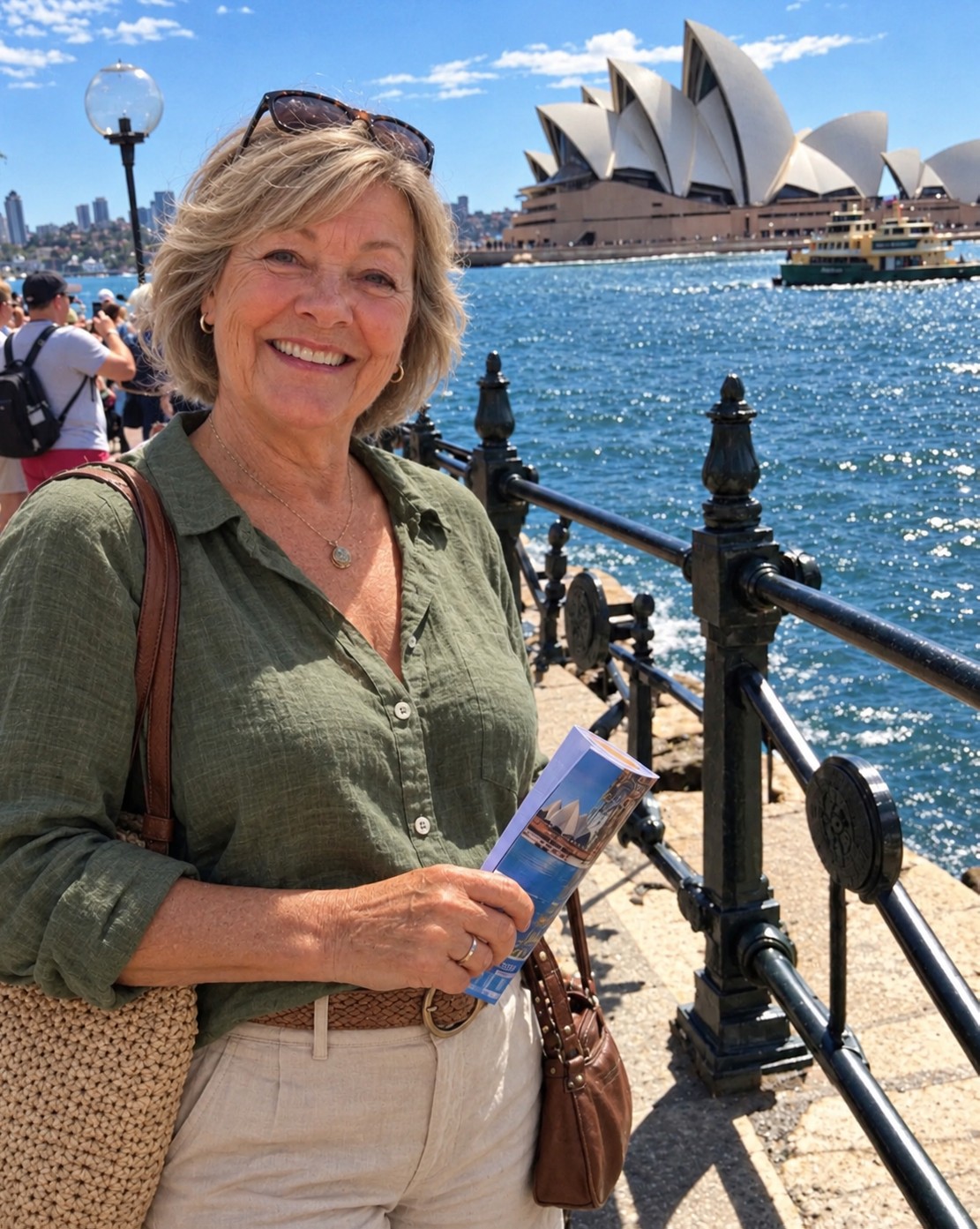
Australia became the fourth major stop on my journey.
And that was where I met a man named Bartholomew.
I had no idea that meeting him would uncover a secret my husband had carried for decades.
Part 2: Unraveling the Secret Past
Bartholomew was seventy-one years old, a widower with a gentle manner and a surprisingly dry sense of humor.
We first crossed paths in a cramped second-hand bookstore in Melbourne.
We both reached for the same mystery novel on the same wooden shelf.
Our hands touched.
“I suppose at our advanced age, physically fighting over a paperback would be entirely undignified,” he said.
I raised an eyebrow.
“At our age?”
He chuckled.
“Fair point. Considering you look barely thirty-five.”
I stared at him.
“Now I know for a fact that you are completely dishonest.”
He laughed.
That was how our friendship began.
We shared our first cup of coffee that afternoon.
Two days later, we met again.
By the end of the week, we were taking a long walk through a public botanical garden, where Bartholomew spent nearly half an hour complaining about the plants.
“Roses are far too needy,” he announced as we passed a large flower bed.
“They are just traditional flowers, Bartholomew.”
“Exactly my point,” he replied. “Imagine being that demanding while contributing nothing toward the rent.”
I laughed.
I realized I had not laughed that freely in years.
Bartholomew and I quickly discovered that we had many things in common.
We both loved smooth jazz and classic movies. We both enjoyed vegetable gardening, although he admitted that his tomato plants had never respected his efforts.
He loved detective stories.
He had been married to his late wife, Christine, for thirty-eight years before she passed away.
And like me, he understood what it meant to lose the person you thought would grow old beside you.
We did not play foolish romantic games.
We did not pretend we were young travelers looking for some dramatic adventure.
Instead, we talked honestly.
We talked about the spouses we had lost.
We talked about our children.
We talked about regrets.
We talked about loneliness.
One afternoon, while we were having lunch, Bartholomew stared thoughtfully into his coffee.
“Nobody warns you that grief eventually gets quieter,” he said. “But it never truly leaves the room.”
I nodded.
“I know exactly what you mean.”
After several pleasant afternoons together, Bartholomew invited me to his home.
“I have a large collection of vintage vinyl records you would love,” he said. “Come over for coffee, and I will show you everything.”
I trusted him, so I accepted.
His home was warm and comfortable.
There were bookshelves everywhere, mismatched armchairs, old photographs, and framed memories lining the hallway.
“I’ll put the kettle on,” he said as we entered. “Make yourself comfortable in the living room.”
I walked inside.
Then I saw the fireplace.
And I froze.
Above it hung a painting of a quiet cottage beside a peaceful lake.
Two tall pine trees leaned toward the water.
A weathered wooden dock stretched out from the shore.
The scene was calm and familiar.
But what made my heart stop were the two tiny initials painted in the lower-right corner.
“T.M.”
Theodore Mercer.
My Theodore.
I knew that painting.
I knew every brushstroke.
I had watched Theodore paint the original scene myself.
For several seconds, I could not move.
“Bernice?”
Bartholomew returned from the kitchen carrying two mugs of coffee.
“Sit down,” he said gently.
“No.”
My voice sounded sharper than I intended.
“I need you to tell me where you got that painting.”
His expression became serious.
“I got it directly from Theodore.”
I stared at him.
“What did you just say?”
“I got the painting directly from Theodore.”
I felt as if the room had tilted.
“Are you telling me you knew my husband?”
Bartholomew slowly nodded.
“I did.”
“When?”
“I was twenty-four,” he explained. “Theodore was about twenty-two. He was living in Australia for nearly a year before you and he met.”
I knew Theodore had traveled overseas when he was young.
But he had rarely spoken about that period of his life.
Bartholomew continued.
“We worked together at a resort hotel outside Melbourne. It was a terrible job. The pay was awful, the hours were worse, and Theodore was probably the worst person I have ever seen at carrying guest luggage.”
Despite everything, I almost smiled.
“That sounds exactly like him.”
Bartholomew smiled.
“We became close friends. On our days off, we traveled around the area together. We listened to records, explored the countryside, and sometimes rented cheap places to stay.”
He pointed toward the painting.
“That painting came from one of those trips.”
He explained that he and Theodore had once rented a rustic cabin near a mountain lake.
“Theodore painted the scene from the porch,” Bartholomew said. “That was the first version.”
“But Theodore painted this exact scene after we were married,” I said.
Bartholomew nodded.
“He painted it again for you.”
I frowned.
“Then what happened?”
“The painting he made for you was eventually lost. Theodore was heartbroken about it. Years later, he recreated the scene a second time from memory and sent that new version to me here in Australia.”
I stared at the canvas.
“So this is not the painting he made for me?”
“No,” Bartholomew said gently. “It is the recreation he painted for me.”
“Why would he send something like this to you?”
Bartholomew did not answer immediately.
Instead, he stood and walked into his study.
A few minutes later, he returned carrying a sturdy wooden storage box.
He placed it carefully on the coffee table.
Then he opened it.
Inside were dozens of handwritten airmail letters.
I recognized the handwriting immediately.
Every single letter had been written by Theodore.
My hands began to tremble.
“How long were you two writing to each other?”
“On and off for several decades,” Bartholomew replied.
I stared at the letters.
“Theodore never told me about any of this.”
Bartholomew studied my face.
“He was not hiding some secret romance, Bernice.”
“I didn’t say that.”
“You were thinking it.”
I gave him an irritated look.
He smiled faintly.
Then his expression became serious again.
“After Theodore returned to the United States and married you, our letters became less frequent. Life got in the way. Families, work, children. You know how it is.”
I nodded.
“But when Theodore became seriously ill, he managed to find me again through a mutual contact,” Bartholomew continued. “After that, we started writing much more often.”
“Why did he keep all this from me?”
Bartholomew looked down at the letters.
“Because most of what he wrote was about you.”
I stopped breathing for a moment.
“What?”
“He worried about your future,” Bartholomew said. “He knew you better than anyone.”
He reached into the box and pulled out a sealed envelope.
Then he handed it to me.
My name was written across the front.
In Theodore’s handwriting.
My fingers immediately began shaking harder.
“Why do you have a sealed letter addressed to me?”
“Because Theodore asked me to keep it for you.”
“For how long?”
“Indefinitely.”
I stared at him.
Bartholomew gave me a bittersweet smile.
“He hoped you would eventually make the trip to Australia you and Theodore had talked about for so many years. He told me about the bookstore where we met. He said he wanted you to see the place someday.”
I looked at him in disbelief.
“You were waiting for me?”
“I visited that bookstore almost every afternoon after I received his final letter,” he said. “I never knew whether you would actually come. But Theodore believed you would.”
Tears filled my eyes.
“He knew you were always giving your time, energy, and money to everyone else,” Bartholomew continued. “He worried that after he was gone, you would spend the rest of your life taking care of everybody and forget that you were allowed to live, too.”
I looked down at the envelope.
For twelve years, I had carried a strange guilt whenever I did something purely for myself.
Even selling my house and traveling had felt wrong.
Part of me had wondered whether I was betraying Theodore by moving forward without him.
Now I held his final words in my hands.
And I finally broke the seal.
Part 3: Living Without Permission
Theodore’s letter was four pages long.
I read every word slowly.
But one section pierced my heart so deeply that I had to stop and wipe the tears from my eyes.
He had written:
“Bernice, if you are reading these words in Australia, then you have finally taken the leap we talked about when we were young. If I am no longer by your side, please do not turn this adventure into a somber memorial for me. Explore new cities simply because you want to see them. Eat unusual foods that I would have disliked. Stay in beautiful places as long as you wish. Spend your money without explaining yourself to anyone.”
I pressed the letter against my chest.
Then I continued reading.
“Our children love you dearly, but do not allow your love for them to become an excuse for never living your own life.”
The tears were running freely now.
I continued to the final paragraph.
“I asked Bartholomew to hold this letter because Australia was the place where I first learned to stand on my own two feet. I hope it offers the same freedom to you. And if old Bartholomew is still kicking around, make sure he buys the coffee, because he still owes me twelve dollars from our youth.”
A laugh escaped me through my tears.
Bartholomew looked up.
“I take it he mentioned the twelve dollars?”
I laughed again.
“He did.”
Bartholomew shook his head.
“Charging interest after forty years seems entirely unreasonable.”
That made me laugh even harder.
For a few minutes, the room was filled with both laughter and tears.
It was one of the strangest combinations of grief and happiness I had ever experienced.
I had spent twelve years believing that moving forward meant leaving Theodore behind.
But his letter made me understand something different.
He had never wanted me to stop living because he had died.
He had wanted me to live more fully.
We sat together until our coffee became completely cold.
Bartholomew told me stories about Theodore that I had never heard.
He told me about the time Theodore fell asleep during an extremely loud jazz performance.
He told me about another occasion when Theodore accidentally dropped a raw fish directly into a campfire.
“That sounds exactly like him,” I said, smiling.
Bartholomew smiled too.
“Your husband talked about you constantly toward the end of his life.”
I looked at him.
Then something suddenly occurred to me.
“Wait. Did you know who I was when we first met at the bookstore?”
“Not immediately,” Bartholomew admitted.
“Why not?”
“Your married surname is common, and I had never seen a recent photograph of you. I only began to suspect who you were during our second outing, when you mentioned your hometown and Theodore’s name.”
“So you knew then.”
“I did.”
“Then why didn’t you tell me?”
Bartholomew gave me a sympathetic look.
“Imagine traveling alone in a foreign country and having a complete stranger approach you in a bookstore and say, ‘Hello. I knew your dead husband decades ago, and I have been keeping his secret letters for more than ten years.’”
I laughed softly.
“That would have been a terrifying introduction.”
“Exactly.”
“So what made you invite me for coffee?”
He smiled.
“I wanted to meet the incredible woman my best friend loved for most of his life.”
The room suddenly felt warmer.
Bartholomew reached across the table and turned his palm upward.
I looked at his hand.
Then I placed mine gently into it.
For the first time in many years, I did not feel as if I was doing something wrong by choosing happiness.
I decided to extend my stay in Australia by another three weeks.
Bartholomew showed me breathtaking coastal places that most tourists never discovered.
We spent quiet evenings listening to classic jazz records.
We drank coffee.
We laughed.
And one day, we drove out to the mountain lake where he and Theodore had stayed decades earlier.
The original cabin was gone.
It had been demolished years ago.
But the lake remained.
The water was clear and peaceful.
The tall trees still stood around the shore.
I walked slowly toward the water and stared across the lake.
“I thought coming here would make me terribly sad,” I admitted.
Bartholomew stood beside me.
“Does it?”
“A little.”
I looked at him.
“But it also makes me very happy.”
He nodded.
“I think Theodore would have liked that.”
When my extended stay in Australia finally ended, I did not abandon the rest of my global journey.
Bartholomew actually traveled with me through two additional European countries before I continued the journey on my own.
For the first time in my life, I was traveling because I wanted to.
Not because someone needed me to organize something.
Not because someone needed money.
Not because someone needed a ride.
Just because I wanted to see the world.
And slowly, my children began reaching out again.
Brenda was the first.
She sent me a long apology message.
Then Jocelyn contacted me and admitted that my absence had forced her to recognize just how dependent her family had become on my constant help.
Mitchell took longer.
Douglas took even longer.
But eventually, he called.
His voice was quieter than I had ever heard it.
“I suppose I just assumed that as long as the old house was standing, you would always be waiting inside it for us,” he confessed.
I smiled sadly.
“I am still your mother, Douglas. I am simply not a piece of permanent living room furniture.”
He laughed softly.
“You’re right, Mom.”
“I know.”
Six months after I first left home, I boarded an airplane and flew back to Australia.
This time, I was not returning because of grief.
I was returning because I genuinely wanted to build a new chapter of my life there.
When I walked through the arrivals terminal, I saw Bartholomew waiting for me.
He was holding a handwritten cardboard sign.
It said:
“BERNICE — COFFEE STILL OWED!”
I burst out laughing.
Today, we divide our time between traveling and living in a comfortable apartment in Melbourne.
Theodore’s recreated cottage painting hangs proudly above our living room mantel.
Beside it sits a small picture frame containing a faded paper receipt from the very first café Bartholomew took me to after I returned to Australia.
The total on the receipt is exactly twelve dollars.
For the longest time, I believed that selling my house meant closing the door on the life I had known.
I was wrong.
I was not closing a door.
I was finally opening one.
For decades, I had postponed my dreams while waiting for the perfect moment.
I kept saying “someday.”
Someday after the children needed me less.
Someday after the grandchildren grew older.
Someday when I had more money.
Someday when I had more time.
Someday when life finally became quiet.
But someday had never been a date on the calendar.
It had only been an excuse to keep waiting.
Theodore’s final letter taught me that loving my family did not mean giving them every remaining piece of myself.
I could love my children and still have boundaries.
I could help people without becoming responsible for their entire lives.
I could remember my husband without refusing to enjoy the life he wanted me to have.
And I could be sixty-nine years old and still discover something completely unexpected.
A new country.
A new friendship.
A new love.
A new beginning.
My promised “someday” was no longer somewhere far away on the horizon.
I was finally standing inside it.
And for the first time in my life, I was not asking anyone for permission to stay.
THE END.
