
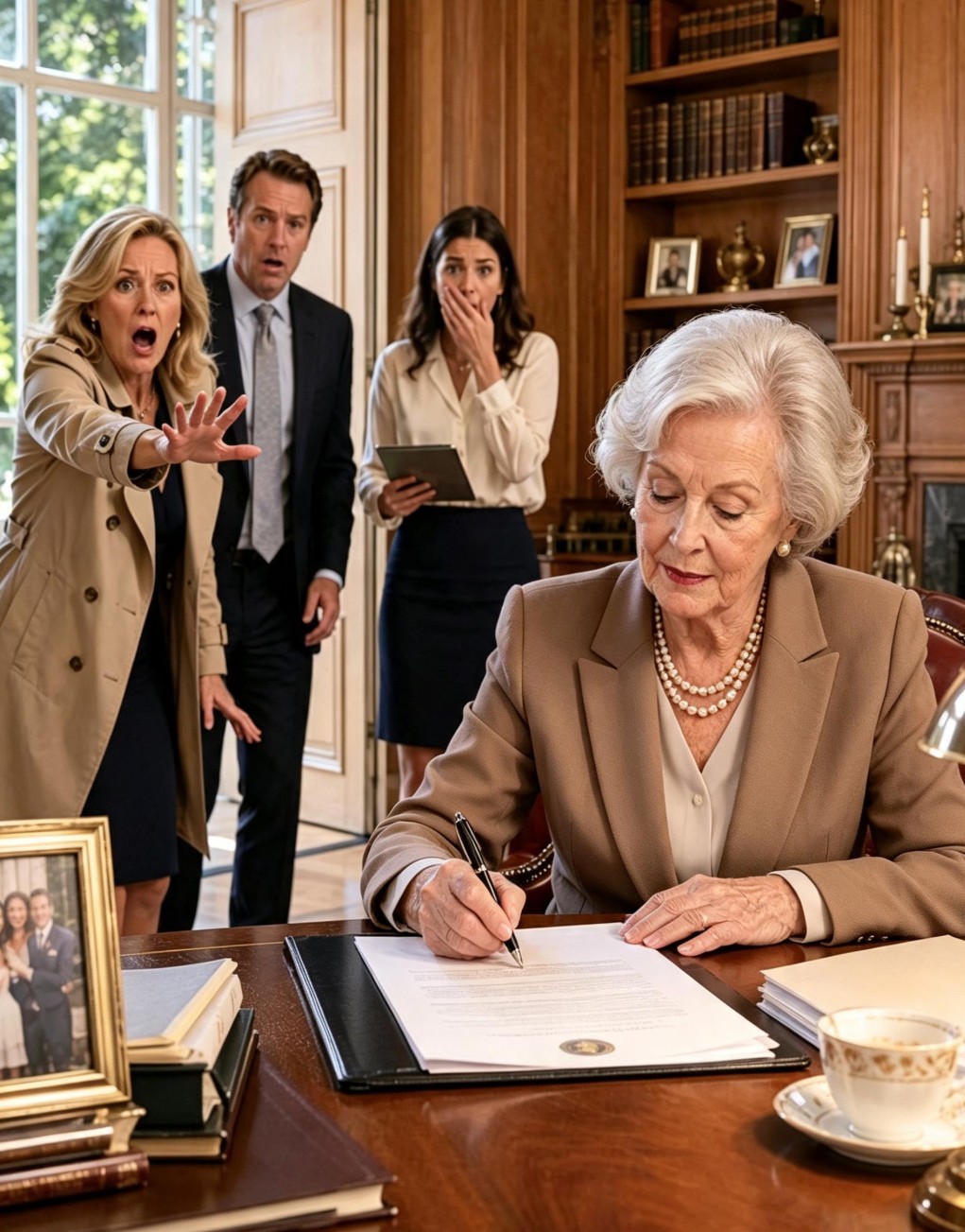
Part 1:
“You weren’t invited. My wife doesn’t want you there.”
By dawn, 174 payments were gone.
“Mom, the plans have changed,” Brandon texted at 6:18 p.m.
Before I could even get up from the kitchen chair, another message followed.
“You weren’t invited. My wife doesn’t want you there.”
My navy-blue dress still had the faint creases from where I had smoothed the fabric with my hands. Outside, rain tapped softly against the kitchen window. The kettle sat cooling on the stove, clicking once as it settled. The room smelled of lemon polish, old wood, and tea that had been left to steep too long.
George’s photograph rested above the mantel.
I touched the silver frame.
It felt cold.
On the table lay the pearl earrings he had given me for our fiftieth anniversary. Beside them was the townhouse brochure Brandon had mailed months earlier—bright white trim, perfectly staged rooms, smiling couples, and promises printed on glossy paper.
“For you too, Mom,” Brandon had told me.
And I believed him, because mothers often hear love in places where there is only convenience.
A bitter taste filled my mouth.
The clock showed 6:20.
I read the message again and again until I knew it was not a mistake.
*You weren’t invited.*
Vanessa never had to raise her voice.
She never needed to.
Her cruelty came through polished manners, folded napkins, and carefully chosen words that were soft enough to deny later.
“Your mother makes things uncomfortable,” she had once said with a smile over a fourteen-dollar coffee I had paid for. “She means well, but still.”
I laughed.
A small, practiced laugh.
The kind women use when they are trying not to become an inconvenience.
I steadied myself against the chair, then opened the old drawer in my mother’s desk.
A folder waited inside.
Its label read:
**BRANDON**
Inside were years of silent rescues.
Tuition payments.
Insurance coverage.
Mortgage assistance.
Country club memberships.
Emergency transfers that somehow became routine.
A $2,800 preschool bill for my granddaughter.
A $6,400 repair bill Vanessa had called “temporary.”
Old paper has its own smell.
Dust.
Ink.
Stored sorrow.
At 6:47 p.m., my granddaughter texted:
“Grandma, are you coming?”
I stared at the screen until my eyes stung.
Children rarely understand which adults are quietly building walls around them.
I replied:
“Not tonight, sweetheart. I love you.”
Then I reached for the landline.
I did not call Brandon.
I did not call Vanessa.
I did not beg for a place at a table I had helped finance.
When I called the bank, my voice stayed steady.
The representative asked for verification, and I gave her everything.
My birth date.
George’s middle name.
The final four digits.
My security phrase.
Then she asked, “Which authorizations would you like to cancel?”
“All of them connected to Brandon Hale.”
There was a brief silence.
Then came the sound of keys tapping across a keyboard.
It sounded like a mother remembering that she was still her own person.
At 7:03 p.m., I sent my son one sentence.
“Then you and your wife can begin paying your own bills.”
I pressed send, switched off my phone, and removed the pearl earrings.
By 8:11 the next morning, I was sitting across from Claire at Harbor National Bank with the folder spread open between us.
She had known our family for twenty-two years.
She had approved George’s first retirement account.
She had sent flowers when he passed away.
She did not offer pity.
I appreciated that.
“Are you certain, Mrs. Hale?” she asked.
I placed both hands on the desk. Blue veins showed beneath my skin. My wedding band hung loosely from my finger.
“I am.”
Eight pages printed.
Mortgage drafts.
Insurance payments.
Utilities.
Club fees.
Tuition.
Subscriptions.
And a business account Brandon had never mentioned.
One hundred seventy-four active payments.
Claire turned the monitor toward me.
Rows of numbers glowed neatly across the screen.
Warmth rose in my chest.
Not shame.
Understanding.
“It never happens all at once,” Claire said quietly.
“No,” I replied. “It doesn’t.”
Wise sayings seem cheap until they cost you something.
After that, they become evidence.
My pen moved across the final document.
That tiny scratching sound closed a door that had remained open for fifteen years.
Back home, I brewed tea in my finest cup.
Not the chipped one.
Not the one I always used because I believed the better things should be saved for guests.
At 11:26 a.m., the first declined payment arrived.
Then another.
And another.
Soon, the driveway echoed with tires rolling across wet gravel.
I pulled back the curtain.
Vanessa stepped out first, her cream-colored coat immaculate, her jaw clenched tight.
Brandon followed, gripping his phone, his face drained of color.
But it was the third person who made me slowly set my teacup down…
Part 2:
My granddaughter, Lily, climbed out of the back seat.
She was seven years old and small for her age, with Brandon’s dark hair and my mother’s serious eyes. She wore a yellow raincoat with one cuff twisted around her wrist. In her arms, she held the stuffed rabbit I had sewn for her the year George died. One ear had already been repaired twice, and the button eyes still didn’t match.
Vanessa didn’t even turn around to make sure Lily was following.
She walked up my front path like someone arriving at a hotel and discovering that the service was not good enough.
Brandon stopped at the gate.
Even through the curtain, I could see him nervously scrolling through his phone. He looked as if the right person might somehow appear on the screen and reverse what I had done.
He had always believed problems disappeared if someone else paid enough money.
Vanessa reached my front door.
She knocked three times.
Sharp.
Then she rang the bell.
Then she knocked again.
I waited.
Not because I wanted to be cruel.
Because for fifteen years, I had answered too quickly.
When I finally opened the door, Vanessa’s smile appeared before the rest of her face did.
“Eleanor,” she said.
Not Mom.
Not Mrs. Parker.
Just Eleanor.
Behind her stood Brandon, wearing the same expression he had worn as a boy whenever he broke something and hoped that staying quiet would make it disappear.
Lily slipped past them.
“Grandma!”
She ran straight into my arms before anyone could stop her.
Her hair smelled like rain and grape shampoo. For one brief moment, holding her softened everything inside me.
It was the dangerous kind of softness.
The kind that could make you forget why you had finally learned to say no.
I kissed the top of her head.
“Hello, sweetheart.”
Vanessa stepped inside without waiting for an invitation.
“We need to talk.”
Brandon finally spoke.
“Mom, what did you do?”
I looked past them at the gray morning sky and the rain-soaked hydrangeas outside. Then I closed the door.
“I had tea.”
“No,” Brandon said. “I mean with the bank.”
“With my bank?”
His face reddened.
“That’s not fair.”
There it was.
Not Why?
Not Please.
Not even I’m sorry.
Only anger that his privileges had been interrupted.
I guided Lily toward the sofa and covered her with the quilt my mother had made.
“Sit here for a minute, sweetheart.”
Vanessa immediately warned her.
“Stay clean, Lily.”
“She’s seven,” I said.
“She understands manners.”
“She understands more than you think.”
For the first time, Vanessa’s smile weakened.
We moved into the kitchen. Lily remained in the living room, close enough to hear everything.
The folder was still lying on the kitchen table.
Vanessa noticed it immediately.
The label on the front read:
BRANDON
Something cold crossed her face.
“Eleanor,” she said carefully, “whatever this is, it has gotten completely out of hand.”
I sat down.
My knees hurt, and I was too old to pretend I was stronger than I felt for people who had spent years confusing my patience with weakness.
“Sit.”
Vanessa stayed standing.
Brandon sat.
His hand trembled slightly as he placed his cracked phone on the table.
I remembered paying for that phone.
Receipts always say thank you.
People rarely do.
“Mom,” Brandon began, “I know last night sounded bad.”
“It was very clear.”
“Vanessa was upset.”
“Don’t put this on me,” Vanessa snapped.
“You sent the message from your phone,” I reminded him.
He looked away.
Vanessa folded her arms.
“There were investors at dinner. Appearances matter.”
“At a family dinner?”
“It wasn’t just family.”
I looked at my son.
“Did my money matter?”
He hesitated.
“Mom, come on.”
“No. Don’t ‘come on’ me.”
The kitchen fell silent.
Rain tapped against the window.
The old house settled with a long, quiet sigh, as if George himself were listening.
I opened the folder.
“Mortgage assistance. Insurance. Tuition. Utilities. Club memberships. Preschool. Medical premiums. Lawn service. Business accounts. Streaming subscriptions. Storage units. Car payments. Personal trainer.”
I looked up.
“One hundred seventy-four active payments.”
Brandon rubbed his forehead.
“They’re stopped?”
“Yes.”
“You stopped everything?”
“I did.”
Vanessa stared at me.
“You can’t do that.”
“My banker disagreed.”
Brandon leaned forward.
“The mortgage bounced this morning.”
“I expected it would.”
“The insurance payment too.”
“Yes.”
“The school already called.”
“That was quick.”
Vanessa gripped the back of a chair.
“Lily’s school is not a weapon.”
“A child isn’t a weapon,” I replied. “That is exactly why I paid for her education while you remodeled your kitchen twice.”
Neither of them had an answer.
For years, I had been treated like a credit card with a pulse.
“Mom,” Brandon whispered.
“Don’t. I’m too old to be silenced in my own kitchen.”
For a moment, I remembered him as a little boy with scraped knees and missing teeth.
He had once been tender.
When had love become a monthly invoice?
Vanessa finally sat down.
“Let’s be reasonable.”
That phrase frightened me more than anger ever could.
Reasonable usually meant someone else had already decided what sacrifice belonged to me.
“I am being reasonable,” I said. “I paid because I chose to. Now I choose not to.”
“You made us dependent.”
The sentence hung in the air.
Ridiculous.
Perfect.
“I made you dependent?”
“You kept offering help. Financially and emotionally. Now you’re punishing us for accepting it.”
At seventy-seven, grief had sharpened me enough to recognize the truth.
“I didn’t insert myself into your lives. I was welcomed whenever money was needed and excluded whenever dignity was required.”
Brandon flinched.
Vanessa studied me carefully, like someone realizing a locked door actually had a bolt.
Finally, Brandon spoke honestly.
“Mom, we’re in trouble.”
There it was.
The first truthful sentence all morning.
“The townhouse deal depends on clean accounts. Investors are involved. Vanessa’s family is involved. If payments start failing, everything falls apart.”
“Everything?”
“Please.”
Once, that word would have opened my checkbook instantly.
Instead, I remembered George dying in the hospital.
I remembered asking Brandon to stay another night, only to hear that Vanessa already had plans.
I remembered lonely Christmases, arriving late and leaving early.
I remembered standing outside a house my money had helped furnish, waiting to be treated like family.
“No.”
His face went blank.
Lily made a small sound from the living room.
“Mom, don’t do this in front of Lily.”
“I’m not the one who brought her here.”
Then Lily appeared in the doorway.
“Mom said Grandma would fix it.”
Silence.
I looked at her.
“Fix what, sweetheart?”
“The house. Daddy’s work problem. My school.”
She looked between her parents.
“Mommy said Grandma always fixes things after she calms down.”
Something inside me became very still.
Not broken.
Just quiet.
Vanessa stood abruptly.
“That’s enough.”
“No,” I said. “Let her finish.”
“She’s a child.”
“She’s the only one telling the truth.”
Lily’s lower lip trembled.
“Did I do something wrong?”
I opened my arms.
“No, sweetheart. You didn’t.”
She ran to me and hugged me tightly.
Brandon tried again.
“I’ll pay you back.”
“Do you know how much you owe me?”
Silence.
I turned another page around.
Fifteen years of transfers, checks, emergency payments, tuition, vehicles, credit cards, and countless rescues.
At the bottom was the total:
$742,918.63
Nearly three-quarters of a million dollars.
Brandon stared at the number.
Vanessa didn’t even look.
That told me everything.
For years, the excuses had been almost identical: they needed time to stabilize, then there was the baby, the house, the business, another house, private schools, clubs, cars, and investments.
“And last night,” I said, “I learned exactly what I mattered.”
Brandon looked devastated.
Vanessa looked inconvenienced.
That was the difference between them.
One still had enough heart to bleed.
The other only hated the stain.
“I didn’t know it was that much,” Brandon whispered.
“I believe you. Because you never wanted to know.”
Eventually, he said the words I had waited years to hear.
“Mom, I’m sorry.”
They sounded real.
But they were much smaller than I remembered needing.
“I hear you.”
Vanessa immediately asked the question hidden beneath every transaction.
“What do you want?”
“I want peace. I want my money to be mine. I want my granddaughter to stop being used as a messenger. And I want both of you to leave.”
Vanessa gave a sharp laugh.
“You’re making a terrible mistake.”
“Possibly.”
“You think this proves something?”
“No,” I said. “I think it ends something.”
She turned toward Lily.
“Come on.”
Lily clung tighter to me.
“No.”
For the first time, I saw fear flash across Vanessa’s face before anger quickly covered it.
“I’m her mother.”
“Yes,” I said. “Try remembering that before using her to collect debts.”
Brandon finally stepped between us.
“Enough.”
Then he surprised everyone.
“Vanessa, wait outside.”
She stared at him.
The request wasn’t loving.
It was exhausted.
She walked outside, already calling someone on her phone.
The moment the door closed, Lily whispered:
“She scares me sometimes.”
Brandon lowered his head.
The quiet honesty of her words made everything worse.
I asked him what Vanessa meant by consequences.
Eventually, he admitted the truth.
The townhouse project required another $250,000 by Friday.
Today was Wednesday.
And yes, they had intended to ask me for it.
At the dinner I had not been invited to.
Vanessa had thought it would be easier that way.
Cleaner.
Then another truth emerged.
I had stopped payments connected to a business account.
Brandon suddenly looked terrified.
I opened the file.
Parker Ridge Consulting
Authorized payer: Eleanor Parker
“I never approved this.”
His eyes filled with tears.
“I was going to fix it.”
“What did you do?”
He confessed.
To secure investment approval from Vanessa’s father, he had falsely presented me as an investor. He had used documents containing my existing signature from previous insurance paperwork.
He had forged my authorization.
The account had been active since August.
Approximately $84,000 had moved through it.
When I stopped the payments, the bank triggered an official review.
The front door opened.
Vanessa had returned.
The polished mask was gone.
“Brandon. Outside. Now.”
I looked at her.
“Did you know my son forged my authorization?”
She glanced at Brandon.
Not surprised.
Not confused.
Calculating.
Then she snapped:
“You told her?”
That answer was enough.
Lily stood in the pantry doorway holding two cookies.
Nobody spoke.
Vanessa sent her outside.
Lily hugged me first.
Then she left.
The moment the door closed behind her, Vanessa turned the lock.
The sharp click echoed through the house.
“Unlock my door,” I said.
Vanessa ignored me and pointed at Brandon.
“You idiot.”
He flinched.
“Vanessa,” he said quietly.
“No. You absolute idiot.”
“Do not speak to him that way in my house,” I said.
She laughed, but there was nothing polished left in that laugh.
“Your house? This precious little house?”
She looked around at the cabinets, the lace curtains, and the copper kettle George had polished every Sunday.
“You have no idea what you just did.”
“I know exactly what I did.”
“No, Eleanor. You got your feelings hurt and pressed a button.”
“My signature was forged.”
“Your son was trying to keep his family alive.”
“By stealing from his mother.”
Her eyes went cold.
“By using money you were sitting on.”
Brandon said, “Stop.”
Vanessa turned on him.
“No, you stop. You wanted comfort? You wanted Mommy to make tea and forgive you? That’s finished. Her bank is asking questions. My father is asking questions. The investors are asking questions.”
“Good,” I said.
She looked back at me.
Age does something strange to threats.
It makes many of them look theatrical.
Vanessa was younger, faster, and sharper. But she had never sat beside a dying husband at three in the morning, counting every breath and wondering if it would be the last.
She had never buried a life and then gone home to make grocery lists.
Her anger did not scare me the way she wanted it to.
“You think nobody can touch you because you’re old,” she said.
“No,” I replied. “I think people underestimate me because I’m old.”
The doorbell rang.
All three of us looked toward the hallway.
Vanessa’s face changed.
Brandon whispered, “Already?”
I stood carefully.
“Who is it?”
Of course, no one inside answered.
The bell rang again.
I walked past Vanessa and unlocked the door.
Claire stood on the porch beneath a black umbrella.
Beside her was a man I had never seen before. He was tall and broad-shouldered, with silver hair and a dark rain-soaked overcoat. Behind them, another car idled near the curb.
Claire’s expression was calm, but her eyes moved past me and into the house.
“Mrs. Parker,” she said, “I’m sorry to arrive without calling.”
Behind me, Vanessa went completely still.
The man stepped forward.
“Eleanor Parker?”
“Yes.”
He pulled a leather folder from inside his coat.
“My name is Michael Reed. I’m with Harbor National Bank’s fraud investigations division.”
The word fraud entered the house like a draft of cold air.
Brandon made a small sound behind me.
Vanessa did not.
That told me more than any confession could have.
Claire spoke gently.
“When we reviewed the stopped authorizations, several items needed immediate escalation.”
“I see.”
Michael looked past me.
“Is Brandon Parker here?”
No one moved.
Then Brandon stepped forward.
His face had turned gray.
“I’m Brandon.”
Michael opened the folder.
“Mr. Parker, we need to discuss several electronic authorizations connected to your mother’s accounts, Parker Ridge Consulting, and a family management trust filed eighteen months ago.”
“A trust?” I asked.
Claire’s eyes met mine.
That was when fear finally found me.
Not because of the money.
Not because of the forged signature.
Because of the way Brandon looked at Vanessa.
As if she had promised him that part would never come out.
Michael continued evenly.
“Mrs. Parker, according to documents filed last year, you transferred conditional authority over this property, your liquid assets, and the remainder of George Parker’s estate into a family management trust.”
My hand tightened around the doorframe.
“No.”
Claire’s voice softened.
“That is why I came in person.”
Vanessa stepped forward.
Her smile returned.
Not elegant now.
Victorious.
“Eleanor,” she said, “before everyone becomes dramatic, you should understand that Brandon was only trying to protect you.”
I turned slowly.
She reached into her purse and pulled out a folded document.
Not a copy.
An original.
Cream-colored.
Notarized.
My name sat at the bottom.
My signature.
Almost perfect.
Almost.
But not quite.
Because after my small stroke eleven years earlier, when my hand sometimes trembled over checks, George had taught me one thing.
“Always cross your T like you’re closing a gate,” he had said, guiding my fingers. “Not like you’re leaving one open.”
The signature on Vanessa’s paper left the T open.
I looked at Brandon.
He was crying now.
Silently.
Uselessly.
Then I looked at Vanessa.
For the first time since I had known her, she looked truly alive.
“By sunrise,” she said, “your little rebellion may not matter at all.”
And from the driveway, Lily screamed.
Part 3:
Lily’s scream cut through the house like glass breaking inside an empty church.
For one second, nobody moved.
Then Brandon ran.
He hit his shoulder against the doorframe on his way out and barely noticed. Claire gasped and stepped back from the porch. Michael Reed followed with the controlled speed of a man trained to expect an ordinary room to become dangerous without warning.
I moved too, slower than the others, one hand gripping the banister.
My heart was pounding so hard that I could feel every beat in my throat.
“Lily!” Brandon shouted.
The rain had softened into a mist, silvering the driveway and blurring the cars.
Lily stood near Vanessa’s cream-colored sedan. One hand was pressed over her mouth. The other pointed toward the side gate.
Her stuffed rabbit lay in a puddle.
For one terrible moment, I thought she was hurt.
Then I saw what she was pointing at.
The gate to George’s old garden stood open.
It had not been open in months.
Beyond it, near the narrow stone path leading toward the shed, a man was crouched beside the hydrangeas. One hand was buried deep in the wet soil.
He froze when he saw us.
Then he stood.
He wore a dark jacket, gray pants, and a cap pulled low over his face.
In his hand was something wrapped in plastic.
“Stop!” Michael shouted.
The man bolted.
Not toward the street.
Toward the garden.
Brandon lunged after him, but Michael caught his arm.
“Don’t,” Michael said sharply. “Let him go.”
“He was in my mother’s yard!”
“And he wants you to chase him away from whatever he came to retrieve.”
Those words stopped Brandon better than force could have.
The man disappeared behind the shed.
A moment later, an engine started on the lane behind my property.
Tires spat gravel.
Then the sound faded.
Lily began to cry.
Brandon rushed to her and dropped to one knee.
“Pumpkin, are you hurt?”
She shook her head, sobbing.
“He was digging. He took something from Grandma’s flowers.”
Vanessa stood on the porch behind us.
Her face was bloodless.
She did not look worried.
She did not look confused.
She looked like someone who recognized exactly what had happened.
That made the rain feel colder.
I looked at her.
“Who was he?”
“I don’t know.”
The lie came too quickly.
Michael turned toward her.
“Mrs. Parker, I suggest you think carefully before answering again.”
Vanessa’s mouth tightened.
Lily clung to Brandon, crying into his coat.
He held her with both arms, rocking her gently.
For the first time in years, I saw my son not as a man filled with excuses, but as a father finally frightened by the storm he had helped invite into his own life.
Claire came beside me.
“Mrs. Parker, we should get you inside.”
“No.”
My voice sounded strange, even to me.
I walked down the porch steps.
Michael stayed close without touching me, ready in case I stumbled.
I went through the garden gate.
George’s hydrangeas bent under the mist. Heavy blue blossoms nodded over the disturbed soil near the old stone birdbath.
The earth had been dug open in a narrow patch, hurriedly and carelessly.
Mud smeared the stones.
I knew that patch.
George had planted lavender there the spring before he died.
It never grew well.
He kept trying anyway, stubborn as always, saying the earth only needed convincing.
I crouched slowly.
There was a hole beneath the roots.
Not large.
Large enough for a box.
My fingers trembled as I touched the wet edge.
Brandon came behind me carrying Lily.
“Mom,” he said softly. “Please come inside.”
I looked at the hole again.
Then I remembered George in his old cardigan, standing at the kitchen sink eleven years earlier, washing dirt from his hands.
“If I forget things someday,” he had said lightly, “check the places I tried to improve.”
I had laughed.
“You mean every corner of this house?”
He had smiled, but his eyes had been serious.
“Especially the stubborn ones.”
At the time, I thought he meant the house.
Now, kneeling in the rain beside an empty space beneath failed lavender, I wondered if he had meant something else.
Twenty minutes later, Nora Blake arrived with wet hair, a navy briefcase, and the kind of calm that made panic look embarrassed.
She took one look at Vanessa.
Then Brandon.
Then Michael.
Finally, she looked at me.
“Nobody leaves until I know who is legally allowed to leave.”
Vanessa gave a brittle laugh.
“You can’t hold me here.”
“No,” Nora said. “But Mr. Reed can ask whether you knew someone was trespassing on my client’s property while you were presenting a disputed trust document.”
Michael lifted one hand.
“To be precise, I am not law enforcement. I’m with the bank’s fraud investigations division. Local police are already on their way regarding the trespass.”
Vanessa’s eyes flicked toward the window.
Nora noticed.
So did I.
Lily sat on the sofa wrapped in my mother’s quilt. Her stuffed rabbit was drying on the radiator beside her.
Brandon sat nearby, elbows resting on his knees, looking as if every wall in his life had suddenly been removed and he no longer knew where to stand.
I remained in George’s chair.
Not because I needed support.
Because that chair faced the entire room.
Nora spread the documents across my coffee table.
The forged trust.
The bank authorizations.
The business account papers.
And the original document Vanessa had produced so confidently.
“This signature is wrong,” Nora said after studying it.
I nodded.
“The T.”
She looked up.
“George taught me to cross it like closing a gate.”
For the first time that morning, Nora’s expression softened.
Then she leaned closer.
“There’s something else. This notary seal is real.”
Vanessa’s shoulders relaxed almost invisibly.
Nora continued.
“But the notary’s commission expired two years before this document was dated.”
The small relaxation disappeared immediately.
Brandon looked at Vanessa.
“You said it was handled.”
Her eyes flashed.
“Don’t start.”
“No,” he said quietly. “I think I should have started a long time ago.”
Lily looked up from beneath the quilt.
The words were small.
But they changed the room.
Nora turned toward Brandon.
“Mr. Parker, you need separate legal counsel. Anything you say now could expose you. But as your mother’s attorney, I am asking one question before I stop you.”
She looked directly at him.
“Did Eleanor Parker knowingly sign any trust transferring control of this property?”
Brandon closed his eyes.
“No.”
Vanessa stood.
“Brandon.”
He opened his eyes.
“No,” he repeated. “She didn’t.”
Nora nodded.
“Thank you. Say nothing else until you have your own attorney.”
I looked at my son.
The apology in his face was not enough.
Nothing could have been enough in that moment.
But truth, even late truth, has a sound.
It is not pretty.
It is not clean.
Still, it is different from a lie.
The police arrived soon afterward.
They took statements.
Lily described the man in the garden.
Brandon mentioned the suspicious car he had seen near the townhouse.
Vanessa claimed she knew nothing, saw nothing, and simply wanted to take her daughter home.
Lily began trembling at the word home.
Brandon noticed.
So did Vanessa.
So did everyone else.
Nora stepped in before anyone could argue.
“Given the open investigation and the child’s distress, perhaps Lily should stay with her father for the afternoon.”
“With her father?” Vanessa snapped. “He has no house if I say so.”
Brandon flinched.
But this time, he did not fold.
“She can stay here,” I said.
Every face turned toward me.
Hope filled Lily’s eyes so suddenly that it hurt.
Vanessa shook her head.
“Absolutely not.”
Brandon stood.
“Yes.”
Her head snapped toward him.
He looked terrified.
But he stayed standing.
“Lily stays with Mom today,” he said. “I’ll stay too, if Mom allows it.”
For years, I had wanted my son to choose me.
But now, watching him choose his daughter’s safety instead, I realized that mattered more.
“You may stay until dinner,” I said. “In the den.”
Brandon nodded as if I had handed him a kingdom.
Vanessa’s face hardened into something smooth and cold.
“You’ll regret this.”
“No,” I said, looking at her and then at my son. “Regret is what brought us here. Something else will have to take us the rest of the way.”
By evening, the rain had stopped.
The house smelled like soup.
I made vegetable barley because George used to say trouble should never be faced on an empty stomach.
Lily sat at the kitchen table drawing uneven flowers with my old colored pencils.
Brandon chopped carrots badly beside the sink.
Some were too thick.
Some were too thin.
Every few minutes, he looked toward the living room, where Nora and Michael were still sorting through documents.
I did not correct the carrots.
Sometimes a man needs to learn the shape of uneven things.
“Mom,” he said quietly.
I kept stirring the soup.
“I know Nora told me not to say anything.”
“Then don’t.”
“I need to say this as your son. Not as anything legal.”
I waited.
He carefully put down the knife.
“I thought needing you meant loving you.”
My hand paused over the soup.
He swallowed.
“When Dad died, I didn’t know what to do with you. You were sad, and I couldn’t fix it. Vanessa could fix things. Plans. Money. Appearances. She made me feel like moving forward meant never looking back.”
I said nothing.
He looked at George’s photograph.
“And every time I needed help, you helped. I told myself that meant we were still close. But I wasn’t close to you.”
His voice cracked.
“I was close to your open hand.”
The soup bubbled softly.
Lily kept drawing, pretending not to listen.
“I don’t know how to repair that,” Brandon said. “I don’t even know if I get to try.”
I lowered the heat.
“No one repairs a roof by apologizing to the rain.”
He nodded, his eyes wet.
“You start with one board,” I continued. “Then another. And you don’t ask the house to thank you for not leaking.”
A broken little laugh escaped him.
Then Lily spoke without looking up.
“Daddy can start by making Grandma tea in the good cup.”
Brandon wiped his eyes.
“I can do that.”
“And washing it afterward,” Lily added.
For the first time that day, I laughed.
It surprised all of us.
Even me.
Later, after Lily fell asleep on the sofa with the repaired rabbit tucked beneath her chin, Nora called us into George’s study.
I had avoided that room for years.
Not completely.
I dusted it.
I opened the window every spring.
I kept the books straight.
I polished the green lamp.
I kept George’s fountain pen in the drawer.
But I never sat in his chair.
I never opened the locked lower cabinet.
A person can preserve a room so carefully that it becomes a museum of unfinished grief.
Nora stood beside the desk.
“Eleanor, the man in the garden likely took something that was hidden there. But whoever sent him may have known that you would eventually ask what Brandon signed after George died. We need to review George’s estate papers again.”
“I gave everything to Henry Blake,” I said.
“You gave him everything you knew about.”
She pointed toward the locked cabinet.
The key was not in the desk.
It wasn’t beneath the lamp.
Then I remembered George’s words.
Check the places I tried to improve.
I went into the living room and lifted the silver frame holding his photograph.
Behind it, taped neatly to the back, was a small brass key.
My knees weakened.
Brandon stepped forward.
Then he stopped himself from helping without being asked.
I took the key.
The cabinet opened with a click so soft I almost cried.
Inside were three folders, a cedar box, and an envelope written in George’s handwriting.
For Eleanor, when the accounts stop making sense.
My breath caught.
Nora did not touch it.
Brandon stepped backward as if the envelope were something sacred.
I opened it with trembling fingers.
George’s letter was dated eight months before he died.
My dearest Eleanor,
If you are reading this, then either I was too cautious, or not cautious enough. Forgive me for hiding this from you. I told myself I was protecting your peace. Husbands can be arrogant even when trying to be kind.
There are irregularities in Brandon’s finances. I do not believe our son is dishonest by nature, but I believe he is easily led by the promise of admiration. I have seen documents he signed without reading. I have seen Vanessa’s family pushing for access to things that are not theirs.
I have placed copies of my concerns here, along with instructions Henry understands. If Henry is gone, Nora will know what to do.
Do not let guilt spend what love saved.
And please, my darling, use the good cup.
A sound escaped me then.
Not exactly a sob.
More like a door opening.
I pressed the letter against my chest.
For years, I had imagined George gone from the world, reduced to photographs, signatures, and memories fading around the edges.
But here he was again.
Not as a ghost.
Not as a miracle.
As a husband who had known me well enough to protect me from my own tenderness.
Nora opened the folders one by one.
Inside were old emails, meeting notes, a memorandum from Henry Blake, a draft revocation of unauthorized financial instruments, and a list of names connected to Vanessa’s father’s investment circle.
And then we found one photograph.
Vanessa.
Fifteen years younger.
Standing beside a woman who looked enough like her to be her sister, although this woman had a softer face and worried eyes. One hand rested protectively over her pregnant belly.
On the back, George had written:
Vanessa Moore and Rachel Moore, March 2011. Ask why Rachel disappeared from the filings.
Brandon leaned closer.
His face changed.
“Rachel,” he whispered.
I looked at him.
“Who is Rachel?”
He sat down slowly.
“Vanessa told me her sister Rachel moved overseas. She said the family didn’t talk about her.”
Nora found another page.
“Rachel Moore was listed as a founding member of Parker Ridge Consulting,” she said. “Then her name was removed the same month Brandon signed the first partnership document.”
“I never knew that,” Brandon said.
Michael, who had remained mostly quiet, reached for the page.
“Rachel Moore filed a complaint against Stonebridge Private Capital nine years ago. It was withdrawn.”
“Why?” I asked.
His expression darkened.
“The record says she settled.”
Nora turned another page.
A handwritten note from George fell out.
Not settled. Silenced. Find child.
The room seemed to stop breathing.
Brandon whispered:
“Child?”
Before anyone could answer, the doorbell rang again.
It was nearly nine.
Lily stirred on the sofa but did not wake.
Nora and Michael exchanged a look.
Brandon stood, but I lifted a hand.
“My house,” I said.
I went to the door.
A woman stood beneath the porch light.
She looked to be in her early forties, with dark hair pulled back from a tired face.
Beside her stood a boy around fourteen.
He was thin and watchful, holding a backpack tightly against his chest.
The woman looked at me with eyes I recognized from the photograph.
“Mrs. Parker?” she asked.
“Yes.”
“My name is Rachel.”
Behind me, Brandon inhaled sharply.
Rachel glanced past me into the house.
“I’m sorry to come so late. I saw the police earlier. Then Vanessa called my father, and I knew she had finally gone too far.”
Her voice shook, but she did not lower her eyes.
“This is my son, Caleb.”
The boy lifted his head.
His eyes were gray.
George’s gray.
Brandon took one step forward, then stopped.
“No,” he whispered.
Rachel looked at him, and her face softened with a sadness so old it seemed to have become part of her.
“Brandon,” she said, “I tried to tell you once.”
The room blurred around me.
Brandon gripped the back of a chair.
“What are you saying?”
Rachel placed one hand on Caleb’s shoulder.
“Vanessa knew before you married her. My father knew. They told me you had chosen the family arrangement. They said George paid me to disappear.”
“I never—”
Brandon’s voice broke.
“I never knew.”
“I know that now,” Rachel said. “I didn’t know it then.”
Nora’s face became very still.
“Rachel, do you have documentation?”
Rachel gave a tired smile.
“I have everything. George helped me save copies before he died. He found me after he realized what my father and Vanessa had done. He sent money for Caleb’s care, but made me promise not to approach Eleanor unless the trust was triggered.”
I pressed a hand over my mouth.
George’s hidden payments.
The accounts that had stopped making sense.
Not betrayal.
Protection.
Caleb looked at Brandon with cautious curiosity.
Not anger.
That nearly undid me.
Brandon sank to his knees in front of the boy as if standing had suddenly become impossible.
“I’m sorry,” he said.
Caleb shifted closer to Rachel.
Brandon wiped his face.
“I don’t expect you to forgive me. I don’t even fully understand what happened yet. But I’m sorry I wasn’t there.”
Rachel’s eyes filled with tears.
“He’s a good boy.”
Caleb looked toward Lily, asleep on the sofa.
“Is she my sister?”
Brandon covered his mouth.
“Yes,” he whispered. “I think she is.”
Lily woke at the sound of voices.
She sat up, her hair mussed, the repaired rabbit resting in her lap.
“Grandma?”
I went to her immediately.
“It’s all right.”
She looked at Caleb.
Caleb looked back.
Children often understand family faster than adults, perhaps because they haven’t yet learned all the reasons love is supposed to be complicated.
Lily held up the rabbit.
“Do you like rabbits?”
Caleb blinked.
Then nodded.
“I guess.”
“This one is Captain Button. Grandma fixed his ear.”
Caleb smiled.
It was small.
But it was enough to light the room.
Part 4:
Over the next week, the world did not heal quickly.
It rearranged itself, truth by truth.
Vanessa moved out of the townhouse before the bank froze the accounts connected to the disputed trust.
Her father’s development group came under investigation for forged instruments, improper collateral filings, and a long-running practice of using family members as financial fronts.
The man in my garden was identified as a courier hired to retrieve the original cedar box George had hidden years earlier. He apparently did not know that George had later moved the important papers into his study after my stroke.
The stolen box contained only old lavender seeds and a note in George’s handwriting.
Too late.
When Nora told me that, I laughed until I cried.
Vanessa did not go to prison immediately.
Life is not a courtroom drama where justice arrives before the next commercial break.
There were interviews.
Filings.
Hearings.
Lawyers.
Delays.
But the trust was frozen and eventually invalidated.
My accounts were secured.
My house remained mine.
Brandon’s forged authorizations became part of a cooperation agreement. He accepted responsibility for what he had personally signed and agreed to testify about the financial arrangements Vanessa’s family had made.
He lost the townhouse.
He lost the club.
He sold the car.
He moved into a small apartment above a bakery that always smelled faintly of cinnamon.
The first time I visited him, he served tea in mismatched mugs and apologized for not having anything better.
I looked down at the chipped blue cup in my hands.
“This is fine,” I said.
He smiled sadly.
“No. It isn’t. But it’s honest.”
That mattered.
Lily spent weekends with me at first.
Then Wednesdays too.
The court arranged family counseling, and Brandon attended every session. Even the ones that left him sitting in his parked car afterward, staring through the windshield like a man learning how to breathe in thinner air.
Rachel and Caleb did not become an instant family.
That would have been too easy.
Too false.
Caleb was polite to Brandon, distant with me, and fascinated by Lily.
He loved astronomy.
He hated mushrooms.
He read books about old ships.
He had George’s habit of tapping two fingers against his knee whenever he was thinking.
The first time I noticed it, I had to leave the room.
Rachel found me in the kitchen, gripping the sink.
“I’m sorry,” she said.
“No,” I whispered. “Don’t be. It feels like getting a piece of him back from a place I didn’t know existed.”
She stood beside me quietly.
Then she said, “George loved you very much.”
I looked at her.
“He talked about you every time he came,” she said. “He said you were the bravest person he knew, but that you sometimes mistook endurance for duty.”
I closed my eyes.
George had known me too well.
On the last Sunday of summer, I invited everyone to dinner.
Not Vanessa.
Some doors, once closed, protect the warmth inside.
But Brandon came.
Lily came.
Rachel and Caleb came.
Claire came because, by then, she had become more than a banker to me.
Nora came too, carrying a pie she claimed was homemade, although the bakery sticker was still stuck underneath the tin.
We ate in the dining room I had saved for too long for occasions important enough to deserve it.
The good plates came out.
The crystal glasses.
George’s serving spoon.
No one mentioned money until after dessert.
Then Brandon stood with a folded paper in his hand.
“I have something,” he said.
Lily groaned.
“Is it a speech?”
“A small one.”
“No speeches over pie,” Caleb said.
Everyone laughed.
Brandon smiled, but his hands were shaking.
“I opened an account,” he said. “For repayments. It won’t be much at first. I’m working again. Not consulting. Real work. Claire helped me set it up so I can’t pretend I forgot.”
Claire lifted her glass slightly.
“I know I can’t repay everything,” Brandon continued. “Not just the money. Maybe not even most of it. But I can start.”
He placed the paper beside my plate.
I did not open it.
Instead, I looked at him.
“Do you know what I want more than repayment?”
His eyes searched mine.
“What?”
“Receipts.”
He blinked.
“Not bank receipts,” I said. “Life receipts.”
I smiled slightly.
“Show up when Lily has a school play. Call Caleb on his birthday. Learn Rachel’s story without making yourself the center of it. Visit your father’s grave without needing an audience. Make your own tea. Wash your own cup. Bring me flowers you paid for yourself, even if they come from a gas station.”
His face crumpled into a smile.
“I can do that.”
“I know,” I said. “That is why I’m asking.”
After dinner, while the others carried plates into the kitchen, Caleb wandered into George’s study.
I found him standing in front of the shelves, staring at the old brass telescope near the window.
“May I?” he asked.
“Yes.”
He picked it up carefully.
“Mom said George liked stars.”
“He did.”
“Did he ever show you?”
“Many times.”
Caleb peered through the telescope toward the garden, although the stars had not appeared yet.
“He used to write to me,” he said.
I went still.
“George?”
Caleb nodded.
“Mom kept the letters. He never said he was my grandfather. Just a friend. He sent me star charts.”
He hesitated.
“Do you think he wanted to tell me?”
I looked at the boy.
At the gray eyes.
At the careful hope he was trying not to show.
“Yes,” I said. “I think he was waiting for the safest moment, and he ran out of time.”
Caleb lowered the telescope.
“That’s sad.”
“It is.”
“But not only sad,” he said after a moment.
I smiled.
“No. Not only sad.”
He reached into his pocket and handed me a folded paper.
“Mom said I could give you this.”
It was one of George’s letters.
The handwriting was familiar enough to ache.
Dear Caleb,
Someday, you may meet a woman named Eleanor. If you do, be kind to her. She keeps more love in her heart than she knows what to do with, and sometimes it spills into places where people do not deserve it.
If you ever sit at her table, ask her for barley soup.
It means you are home.
I pressed the letter to my lips.
Through the study window, I saw Brandon in the garden with Lily.
She was showing him the hydrangeas, explaining which ones Grandpa George had planted and which ones Grandma said were too stubborn to die.
Rachel stood near the porch, watching Caleb through the glass.
Her face was calmer than I suspected it had been in many years.
Nora came to the study door.
“Eleanor,” she said gently, “there’s one final matter.”
I folded George’s letter carefully.
“Is there always?”
“This one is good.”
She handed me a slim envelope from Henry Blake’s archived files.
It had been released only after the trust dispute was resolved.
Inside was a deed.
Not to my house.
To the empty lot behind it.
George had quietly bought it twelve years earlier—the narrow strip of land connecting my garden to the lane.
The same lane the man from the garden had used to escape.
The same piece of land the developers had wanted for access to the townhouse project.
Attached was a note.
For Eleanor, if she ever needs room.
I walked outside with the deed in my hand.
The evening sky had turned lavender.
The grass smelled clean after the rain.
Lily ran ahead, laughing.
Caleb followed more slowly, pretending not to enjoy being chased by a seven-year-old carrying a repaired rabbit.
Brandon stood beside me.
“What is it?” he asked.
I looked toward the empty lot beyond the garden.
“For years,” I said, “I thought this house was becoming too big for me.”
He waited.
“Now I think it may not be big enough.”
The following spring, the first sign went into the ground.
Not a developer’s sign.
Not a bank notice.
A painted wooden sign made by Caleb, decorated by Lily, sealed by Brandon, and corrected twice by me because the letters leaned.
GEORGE PARKER FAMILY GARDEN
Soup Sundays. Open Gate. Good Cups Only.
We planted lavender again in the stubborn patch.
This time, it grew.
Children from the neighborhood came after school.
Claire organized a small financial-literacy workshop for seniors who had quietly supported adult children beyond their means.
Nora offered monthly legal clinics on powers of attorney and estate papers.
Rachel taught art on Saturdays.
Caleb showed children how to find constellations before sunset.
Lily became the official keeper of marshmallows.
Brandon washed cups.
At first, I thought it was punishment enough.
Then I understood it was practice.
Vanessa sent one letter through her attorney that autumn.
It contained no apology.
Only explanations shaped like keys trying doors that no longer opened.
I did not answer.
Not every ending requires a reply.
On the first anniversary of the night I had not been invited, we held dinner in the garden.
Lanterns hung from the apple tree.
The tables did not match.
Neither did the chairs.
The soup was too salty because Brandon made it and forgot that barley expands.
Lily spilled lemonade.
Caleb rescued the telescope from a curious toddler.
Rachel laughed so hard she had to sit down.
And I wore the navy dress.
The same one.
This time, no pearls.
At seven o’clock, Brandon stood and lifted his glass.
“To Mom,” he said.
I braced myself for a speech.
He looked around the table.
Then he looked at me.
“Thank you for closing the door when we needed to learn how to knock.”
No one spoke for a moment.
Then Lily said:
“And for opening it after.”
Brandon’s eyes filled with tears.
I reached for his hand.
Not because everything was forgotten.
Not because the pain had vanished.
Because real love does not erase the ledger.
It teaches everyone at the table to stop pretending there was never any cost.
George’s photograph sat near the lanterns in its silver frame, watching over the garden he had somehow prepared for all of us.
The lavender moved softly in the evening breeze.
I looked at the faces around my table.
My son, changed but still becoming.
My granddaughter, safe and laughing.
Caleb, a surprise stitched into our family fabric.
Rachel, no longer hidden.
Claire and Nora, the women who had stood beside me when politeness tried to bury the truth.
For the first time in many years, I did not feel like a guest in the life I had paid for.
I felt at home.
And when Brandon brought me tea in the good cup, his hands steady and his eyes clear, I took it from him and smiled.
The end.
