
Part 1:
“Mommy… please don’t let Daddy lock me up again.”
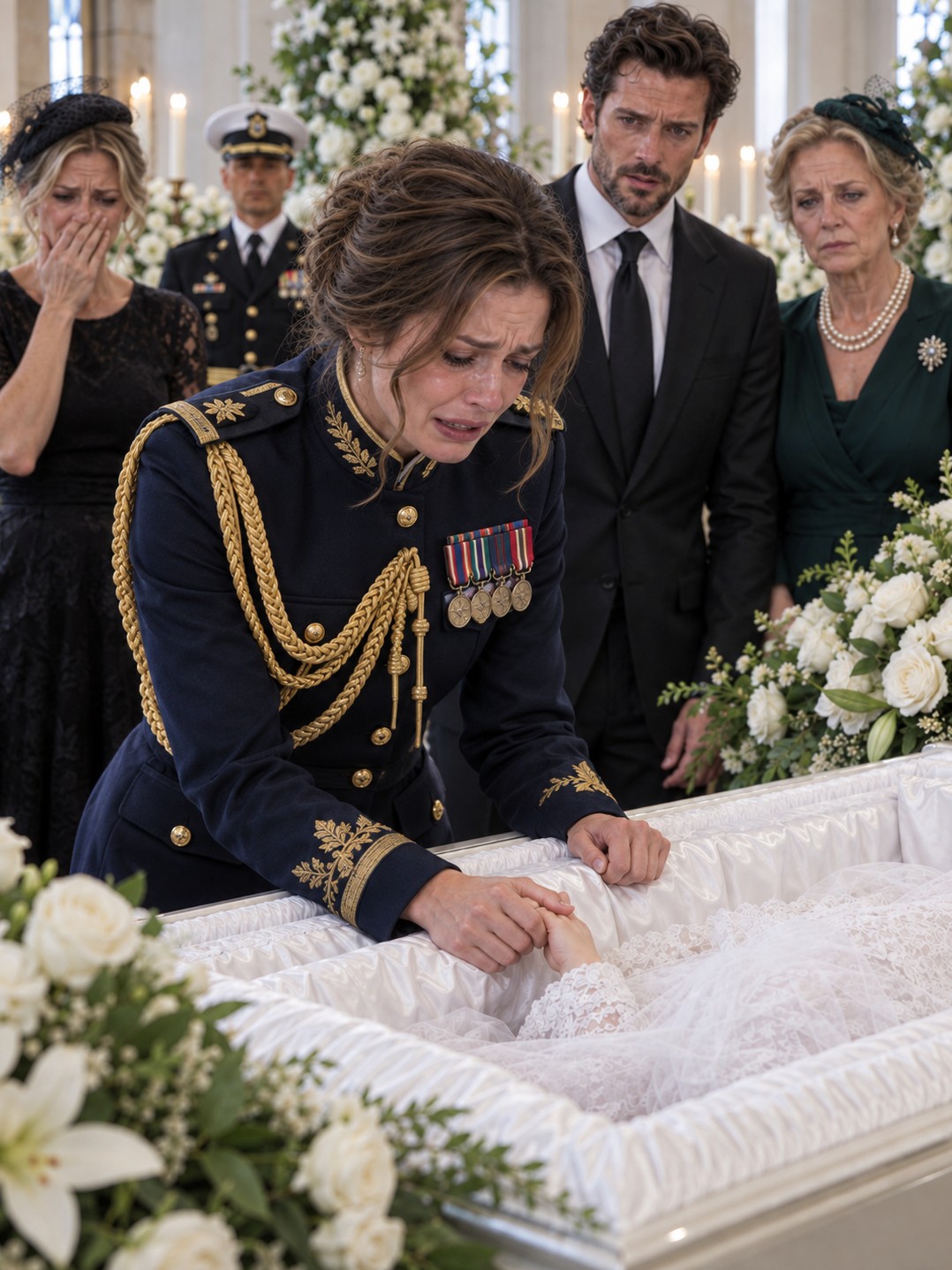
I stood frozen beside the small white casket, certain for one terrible second that my heart had stopped beating.
For two days, I had been forcing myself to accept something I could not accept.
My six-year-old daughter, Penelope, was supposedly dead.
Two days earlier, my ex-husband, Maxwell, had called me with the news.
He said Penelope had suffered a sudden respiratory crisis while sleeping and that she had died before emergency medical help could save her.
The news had destroyed me.
I had immediately demanded to see my daughter.
Maxwell refused.
Then the funeral home refused.
The explanation kept changing.
First, they said Penelope’s condition made viewing her body inappropriate.
Then they said the family had already authorized preparation of the body.
When I demanded her complete medical records, Maxwell’s mother, Beatrice, accused me of trying to create a scene.
She told reporters that I was turning my daughter’s funeral into another ugly chapter of our divorce.
I did not care what anyone thought.
I was Penelope’s mother.
I needed to see my child.
I also happened to be a colonel in the U.S. Army Medical Corps, and after years of working in emergency medicine, I knew enough about sudden death to recognize when something did not make sense.
The story Maxwell gave me had too many holes.
There had been no proper hospital admission.
No emergency department record.
No treating physician willing to speak to me.
No complete medical chart.
And no independent physician had been allowed to examine Penelope after her supposed death.
Still, the funeral had been arranged.
The white casket had been brought into a private viewing room at Fairview Mortuary in Columbus, Ohio.
I stood beside it, barely able to breathe.
Then I heard a sound.
A tiny sound.
A frightened child’s voice.
“Mommy…”
I froze.
My entire body went cold.
I leaned toward the casket.
For several seconds, I heard nothing.
Then it came again.
“Mommy… please.”
My hands began to shake.
“Penelope?”
I looked around the room.
Nobody answered.
I put both hands against the casket.
“Penelope, is that you?”
There was a faint movement beneath the white lace fabric.
I stopped breathing.
I opened the casket.
My daughter was there.
Alive.
Her skin was extremely pale.
Her lips were dry.
Cold sweat covered her forehead.
Her breathing was shallow and slow.
But she was breathing.
I reached for her hands.
Then I saw the restraints.
Her wrists had been secured to the wooden base beneath the mattress lining with heavy plastic restraints.
Two small padlocks held the restraints closed.
For a moment, I could not understand what I was seeing.
Then my training took over.
I checked her breathing.
I checked her pulse.
Weak.
But present.
“Penelope, sweetheart, look at Mommy.”
Her eyelids fluttered.
“Mommy…”
“I’m here.”
“I’m so cold.”
I immediately removed my military jacket and placed it over her.
Then I noticed something on her left arm.
Several fresh needle marks.
My stomach twisted.
“Who did this to you?”
Penelope’s eyes barely opened.
“Daddy said it was special medicine.”
Her voice was so weak that I had to lean close to hear her.
“He said it would help me sleep for a long time.”
My hands clenched.
“Who else was there?”
“Grandma.”
She swallowed.
“She held me down.”
I felt sick.
“And Charlotte?”
Penelope nodded.
“She locked the door.”
Everything suddenly made sense.
Not enough to explain everything.
But enough to terrify me.
Three years earlier, Maxwell had won sole legal custody of Penelope.
I had been serving as an active-duty Army physician. My career involved long hospital shifts, military assignments, and periods when I had to be away from home.
Maxwell used that against me.
He convinced the family court that my demanding medical career made me unreliable as a parent.
He presented character statements that were later shown to contain false information.
He submitted psychological evaluations that had been influenced by people close to him.
Beatrice repeatedly told the court that I was emotionally distant.
She said Penelope needed a “normal mother.”
According to her, a woman who spent her life in military hospitals could never provide the stability a child needed.
I fought the accusations.
I fought every court decision.
But eventually, the judge granted Maxwell sole physical and legal custody.
I was still allowed limited contact.
At least, that was what the order said.
In reality, Maxwell controlled everything.
He said Penelope was sick.
Then he said she was too upset to speak to me.
Then he claimed her therapist recommended that I give her space.
When I called, Charlotte often answered.
Charlotte was Maxwell’s girlfriend.
She spoke to me as though she were Penelope’s actual mother.
Every time I tried to exercise my visitation rights, something happened.
An illness.
A panic attack.
A doctor’s appointment.
A supposed emotional crisis.
For three years, I had been fighting to get my daughter back.
And all that time, they had been teaching her to fear me.
Then, two days earlier, Maxwell had called and said Penelope was dead.
He told me she had stopped breathing during sleep.
But now my daughter was lying in a white casket.
Alive.
The terrible truth was beginning to take shape.
The death had been staged.
I carefully looked at her face.
“Sweetheart, how long have you been like this?”
“I don’t know.”
She closed her eyes.
“Daddy gave me medicine.”
I gently touched her cheek.
“Where?”
“At home.”
Then she whispered something that made my blood run cold.
“Mommy… he said I had to sleep until you went away.”
I searched beneath the satin cushion.
My fingers suddenly touched something hard.
A small metal key.
It had been taped underneath the wooden base.
I ripped it free.
The key fit one of the padlocks.
I unlocked it.
Then the second.
I pulled a small medical scissors from my emergency kit and cut through the restraints.
“It’s okay,” I whispered. “Mommy has you.”
I carefully lifted Penelope from the casket.
She was frighteningly light.
I held her against my chest.
Then heavy footsteps echoed through the marble hallway.
“Gwen?”
Maxwell’s voice.
Angry.
“What on earth are you doing?”
I did not answer.
I carried Penelope into the adjoining preparation room and locked the heavy wooden door.
Then I grabbed the wall phone and called 911.
“My six-year-old daughter was declared dead forty-eight hours ago,” I said. “But she is alive. She has severe sedative exposure and was physically restrained inside her casket. Send an ambulance and police immediately to Fairview Mortuary in Columbus.”
The dispatcher began asking me questions.
I gave her my name, my daughter’s age, the location, and what I had observed.
Then Maxwell began pounding against the door.
“Open this door right now, Gwen!”
I held Penelope tighter.
Beatrice suddenly screamed from the hallway.
“Nobody was supposed to open that casket before the cremation!”
The dispatcher heard her.
So did I.
And so did the police officers who were already on their way.
Penelope wrapped both arms around my military uniform.
“Mommy…”
I looked down.
“Daddy said if I slept for a long time, he wouldn’t have to pay Grandpa back.”
My blood ran cold.
My father, retired Army General Franklin Vance, had created a multi-million-dollar trust for Penelope when she was born.
The trust was intended to pay for her education, medical care, housing, and future living expenses.
Because Penelope was a minor, Maxwell had been able to request certain distributions for her legitimate needs while he had custody.
But the trust itself did not belong to him.
He could not simply take the entire principal.
That was the part Maxwell and Beatrice had been trying to get around.
They needed Penelope to die while Maxwell was still her legal custodian so they could manipulate the estate and trust proceedings, gain temporary access to substantial funds, and use forged documents to support emergency claims.
My daughter had not been killed because Maxwell hated her.
She had been targeted because someone wanted access to her money.
And the police were about to discover that the plan went much deeper than Penelope.
Part 2:
The ambulance arrived within minutes.
Paramedics entered the mortuary with police officers behind them.
When they saw Penelope, they immediately began treating her.
Her breathing was dangerously slow, and she remained barely conscious.
The paramedics gave her oxygen, established an IV, monitored her heart rhythm, and rushed her to Nationwide Children’s Hospital in Columbus.
I went with them.
As a colonel and physician, I understood exactly how serious her condition was.
But I was not her treating doctor.
I was her mother.
And that distinction mattered.
Inside the emergency department, the medical team immediately began evaluating her for sedative poisoning.
Blood tests showed significant levels of sedating medication.
The doctors explained that the drugs had depressed her central nervous system and slowed her breathing.
She had not been dead.
She had been profoundly sedated.
If the dose had been higher, or if she had remained untreated for much longer, she could have died from respiratory failure.
The doctors placed her under continuous monitoring and prepared for respiratory support if her condition worsened.
While they worked, Columbus police returned to Fairview Mortuary.
Maxwell, Beatrice, and Charlotte were separated and questioned individually.
Their stories immediately conflicted.
“This is a terrible medical misunderstanding!” Maxwell shouted.
Beatrice remained remarkably calm.
“The restraints were only there to keep the body secure during transportation,” she claimed.
Charlotte cried.
“I never saw anyone tie that little girl up.”
But investigators had already found physical evidence.
There were restraint marks around Penelope’s wrists.
There were fresh needle punctures.
There were sedative residues.
And there was the most important evidence of all:
Penelope was alive.
The medical examiner’s office was contacted immediately.
The death certificate signed by Dr. Samuel Evans was placed under investigation.
Dr. Evans had claimed that Penelope had died from acute respiratory failure.
But there was a major problem.
He had never properly examined her.
He had relied on information supplied by the family and signed paperwork that falsely represented a medical examination had occurred.
That discovery changed everything.
The prosecutor obtained an emergency search warrant for Maxwell’s home in Dublin, Ohio.
I was standing outside Penelope’s intensive care room when Detective Miller approached me.
He looked exhausted.
“Colonel Vance, we need to talk.”
I turned toward him.
“What did you find?”
He handed me several photographs.
The first showed Maxwell’s basement.
Behind a false wall was a hidden room.
There was a child’s bed.
A camera system.
A small table.
And a heavy electronic deadbolt that could only be operated from outside the room.
My stomach tightened.
“What is that?”
“We believe it was used to confine Penelope.”
He handed me another photograph.
Prescription bottles were scattered across the table.
The labels showed sedating medications.
Some matched substances found in Penelope’s toxicology results.
Then I saw something else.
School notebooks.
Children’s drawings.
A pink backpack.
A school bracelet.
The name written on one notebook was Harper Davis.
I knew that name.
Everyone in the area knew it.
Harper was a little girl who had disappeared three months earlier.
Her father, Lucas Davis, was a prominent developer.
He had filed a major fraud lawsuit against Maxwell’s construction company.
Lucas claimed Maxwell had diverted millions of dollars from a joint commercial project.
I stared at Detective Miller.
“Was Harper kept there?”
“We believe so.”
He showed me another photograph.
Hair samples had been collected from the room.
Investigators had found children’s clothing and personal belongings.
There were drawings that Harper’s family later identified as hers.
And there was her school ID bracelet.
My stomach turned.
“What else?”
Detective Miller hesitated.
“We found forged passports.”
“For Harper?”
“We don’t know for certain yet. But they appear to have been prepared to move a child out of the country under a false identity.”
I felt anger rising inside me.
Then my father arrived.
Retired General Franklin Vance walked quickly down the hospital hallway.
He looked at me.
Then he looked through the glass at Penelope.
For a moment, he said nothing.
Finally, he whispered:
“It was the trust.”
I turned toward him.
“What?”
“Maxwell was drowning financially.”
Dad’s voice was heavy.
“He had debts. His construction company was failing. He had creditors demanding payment. And Lucas Davis was preparing to expose his financial crimes.”
“But the trust doesn’t belong to Maxwell.”
“No,” Dad said. “It doesn’t.”
He took a breath.
“But there are provisions that allow certain funds to be distributed for Penelope’s needs while she is a minor. Maxwell had learned how to exploit those provisions.”
“Exploit them how?”
“He found people willing to manipulate the probate and trust process. He believed that if Penelope died while he remained her legal custodian, he could gain temporary access to a large amount of money.”
I stared at the floor.
“He wanted her dead because of the trust.”
Dad nodded.
“But I don’t think Maxwell created this plan alone.”
The investigators soon discovered another critical connection.
Dr. Samuel Evans, the physician who had falsified Penelope’s death certificate, was Charlotte’s older brother.
Hospital access records showed that he had never properly examined Penelope before signing the death certificate.
He had simply accepted the false account given to him.
Then investigators examined Maxwell’s financial records.
Three weeks before Penelope’s supposed death, Maxwell had requested certified copies of:
The trust agreement.
Penelope’s life insurance documents.
Her birth certificate.
And several other legal records.
He had also met with an attorney experienced in emergency probate proceedings.
The meeting took place shortly before Penelope was supposedly killed.
The evidence showed planning.
This had not been a sudden crime.
It had been prepared in advance.
Then, just before sunrise, another detective hurried into the hospital hallway.
“We found Harper Davis!”
I stood immediately.
“Is she alive?”
“Yes.”
The detective’s answer almost made my knees give way.
“She was found at a secluded rental property outside Cincinnati. A tactical team recovered her alive.”
“Where is she now?”
“On the way to a hospital.”
I looked toward Penelope’s room.
Then the detective added something that changed everything.
“The woman we arrested at the property says Maxwell wasn’t the person running the operation.”
I stared at him.
“Who was?”
He looked at me.
Then he said the name.
“Beatrice.”
My ex-mother-in-law.
The woman who had spent three years telling a court that I was an unfit mother.
The woman who had fought me for access to my own daughter.
The woman who had stood beside Penelope’s funeral casket.
She had been behind it.
Part 3:
The woman arrested with Harper was Martha Higgins, a fifty-eight-year-old former private nurse.
She had worked in private home care for years.
That experience made her especially useful to someone who wanted to keep a child sedated and isolated.
When tactical officers found Harper, the girl was alive but severely dehydrated.
She was weak, frightened, and heavily sedated.
She had spent so much time isolated that she believed her father had abandoned her.
Martha initially refused to talk.
But prosecutors offered her a chance to cooperate.
Eventually, she gave them the name they were looking for.
“Beatrice,” Martha said.
She claimed Beatrice had been paying her in cash.
She also said Beatrice had personally directed the confinement of Harper.
The revelation was horrifying.
But it also explained many things.
Beatrice had never simply disliked me.
She had wanted control.
During my custody battle with Maxwell, she had told the court that my military career proved I was selfish.
She had said Penelope needed a “normal family.”
She had interfered with visitation.
She had helped Maxwell create excuses whenever I tried to see my daughter.
She had even told people that Penelope was happier without me.
Now I understood why.
She had wanted to keep Penelope under Maxwell’s control.
Harper had been their first major criminal operation.
Her father, Lucas Davis, had discovered evidence that Maxwell had been manipulating financial records and diverting millions from their joint development project.
Lucas threatened to take that evidence to federal investigators.
Soon afterward, Harper disappeared after ballet class.
Lucas received a series of frightening calls.
The callers did not initially demand ransom.
Instead, they demanded that he abandon his lawsuit.
They wanted him to sign agreements preventing him from discussing Maxwell’s financial activities.
Lucas refused.
That was when Beatrice escalated the plan.
Martha was ordered to keep Harper sedated and hidden.
Forged passports were prepared.
The intention was to move Harper out of the country under another identity and place her into an illegal adoption network.
The plan failed when the broker responsible for the forged documents disappeared with part of the money.
Harper remained hidden.
Then Beatrice turned her attention to Penelope.
Penelope was already inside the family’s home.
She was easier to control.
She was already isolated from me.
And Maxwell already had legal custody.
The trust gave them another reason.
My father had created the trust to protect Penelope’s future.
But because Penelope was a minor, the trust included limited provisions for necessary expenses.
Those provisions were meant to help a legitimate caregiver pay for housing, education, medical treatment, and other needs.
They were never intended to finance Maxwell’s debts.
But Maxwell believed he could manipulate the court process after Penelope’s death.
He had debts exceeding twelve million dollars.
His construction business was collapsing.
Lucas was threatening legal action.
And I had recently filed a petition seeking to modify custody and regain greater control over Penelope’s life.
Beatrice knew that if I won custody, Maxwell’s ability to control trust distributions would become much more limited.
So she decided Penelope had to disappear.
Dr. Evans would provide the false medical paperwork.
Charlotte would help obtain sedating medications through contacts at local clinics.
Maxwell would administer them.
And Beatrice would control the final operation.
The plan was to make Penelope appear to have died naturally.
But the first attempt nearly went wrong.
After several days of being given sedating medication, Penelope became profoundly unconscious.
Her breathing slowed dangerously.
Maxwell believed she had died.
Dr. Evans was brought in to certify the death.
But when he checked her, he noticed a faint pulse.
Penelope was not dead.
She was deeply unconscious.
Dr. Evans became frightened.
He told Beatrice that they needed to call an ambulance.
Beatrice refused.
“If that girl wakes up in a hospital and tells the doctors what happened, every one of us goes to prison,” she said.
Instead of saving Penelope, they continued with the plan.
Dr. Evans falsified the death paperwork.
Maxwell and Beatrice arranged for Penelope to be transported to the mortuary.
She was placed in refrigeration as a supposed body, even though she was still alive.
The sedative effects continued to suppress her consciousness.
She remained barely responsive.
By the second day, however, the medication level had begun to fall.
She started waking intermittently.
She was cold.
Confused.
Terrified.
But alive.
The family had planned to complete the cremation the following morning before anyone could discover the truth.
They had not counted on me insisting on seeing my daughter.
And they certainly had not expected Penelope to speak.
The evidence against them became even stronger when investigators recovered audio recordings from Maxwell’s house.
A smart-home security system had automatically stored conversations in several areas of the property.
One recording captured Beatrice after Dr. Evans discovered Penelope was still alive.
“If that girl wakes up in a hospital and talks to the doctors, every single one of us will end up in federal prison,” Beatrice said.
Another recording came from the night before the scheduled cremation.
Charlotte was crying.
“This has gone way too far, Beatrice!” she said. “I only agreed to help with the financial paperwork. I never agreed to murder a child!”
Beatrice’s response was cold.
“You are already in this, Charlotte. If I go down, you are coming with me.”
Then Maxwell spoke.
His voice was quiet.
“The cremation is booked for eight in the morning. Once the cremation is finished, there won’t be anything left for anyone to examine.”
When the prosecutor later played that recording for me, I felt something inside me collapse.
I had once loved that man.
We had built a family together.
And he had sat in a room while his own mother planned the death of his child.
He had not stopped her.
He had helped her.
I demanded to see him.
My lawyer told me not to.
The prosecutor told me not to.
But I needed to look him in the eyes.
I walked into the holding area.
Maxwell sat alone at a metal table.
The expensive clothes he always wore were gone.
His belt and shoes had been removed.
The arrogant man I remembered from court had disappeared.
He looked twenty years older.
When I entered, he slowly raised his head.
“Gwen… please.”
I pulled out the chair across from him.
Then I sat down.
“I swear I never meant for things to go this far,” he whispered.
I stared at him.
“You put our six-year-old daughter in a coffin.”
He looked away.
“My mother said it was temporary.”
“They were going to cremate her.”
“I didn’t know—”
“You knew enough.”
He stopped.
I leaned forward.
“Penelope told me you gave her the drugs.”
His face crumpled.
“I love my daughter.”
“Don’t say that.”
He began crying.
“I do.”
“No.”
My voice stayed calm.
“A father who loves his daughter does not drug her until she cannot breathe. He does not hide her in a basement. He does not keep her away from her mother for three years. And he does not place her alive inside a coffin.”
He covered his face.
“I was desperate.”
“You owed more than twelve million dollars.”
“Yes.”
“Your company was failing.”
“Yes.”
“Lucas Davis was suing you.”
He nodded.
“And my daughter’s trust looked like your way out.”
He said nothing.
That silence was an answer.
Finally, he whispered, “My mother said we only needed temporary access to the money.”
“To pay your debts?”
“Yes.”
“How were you going to explain Penelope’s death later?”
He hesitated.
“We were going to claim there had been a mistake in the medical records.”
I stared at him.
“You expected everyone to believe that?”
He looked down.
Then I said the one thing I knew would hurt him more than anything else.
“Penelope told me she tried not to cry when you injected her because you promised she would wake up somewhere better.”
Maxwell began sobbing.
“Gwen…”
I stood.
“You don’t get to call yourself her father when you chose money over her life.”
I walked out.
Part 4:
The deeper investigation uncovered years of abuse.
Penelope had been locked inside the basement room at different times.
Whenever she cried for me, Beatrice sent her into what she called the “quiet room.”
Whenever Penelope became upset before a scheduled call with me, Charlotte gave her strong sleeping medication.
Whenever I arrived at the house with a court order, Maxwell would come outside and tell me Penelope was too sick to leave.
I had believed him.
I had no idea that my daughter was often sitting just a few rooms away, waiting for me.
That discovery destroyed me.
Then investigators uncovered the truth about the custody case itself.
The therapist who had provided favorable reports about Maxwell had accepted hundreds of thousands of dollars through accounts connected to his construction business.
Some witnesses had been paid.
Some statements had been fabricated.
Some psychological reports had been manipulated.
The case that had convinced the court I was an unfit mother had been built on lies.
For three years, I had believed I had somehow failed my daughter.
I had blamed myself.
I had wondered whether my military career had damaged her.
I had wondered whether my long hospital shifts had made me a bad mother.
Now I knew the truth.
I had not abandoned my daughter.
She had been deliberately kept from me.
Penelope remained in intensive care for nine days.
The doctors monitored her closely because severe sedative poisoning can affect breathing and other vital functions even after the immediate crisis has passed.
Thankfully, she improved.
But the psychological damage was harder to treat.
During the first forty-eight hours, she barely spoke.
She woke from sleep screaming.
Sometimes she asked whether the white box was locked.
She became terrified whenever the lights went out.
One evening, a young nurse approached her bed to adjust an IV line.
Penelope suddenly panicked.
“No!”
The nurse froze.
“Please don’t!”
Penelope began shaking.
“They’re going to make me sleep again!”
I immediately moved beside her.
I held her face gently in both hands.
“Look at me, sweetheart.”
She looked at me.
“Look only at Mommy.”
Her breathing was fast.
“Nobody is ever going to give you medicine without telling you what it is first,” I promised.
She stared at me.
“Nobody is ever going to lock a door on you again.”
Her lower lip trembled.
“And nobody is ever going to take you away from me again.”
She was quiet.
Then she asked:
“Not even Grandma Beatrice?”
I swallowed.
“Not ever again.”
She looked at me.
“Not even Daddy?”
That question nearly broke me.
I forced myself to remain calm.
“Not even Daddy.”
Penelope was silent for a long time.
Then she whispered:
“Then you really are my real Mommy.”
I pulled her into my arms.
“Yes,” I whispered.
“I am.”
I held her until she fell asleep.
Across the state, Harper’s recovery was also difficult.
She had been isolated for months.
Martha and Beatrice had convinced her that Lucas had abandoned her.
When her father finally entered the hospital room, Harper hid behind the pillows.
Lucas began crying.
“Harper, it’s Daddy.”
She didn’t move.
He sat down several feet away.
“I never stopped looking for you.”
She still didn’t come out.
It took weeks of therapy before she finally understood that her father had spent every day searching for her.
Eventually, she ran into his arms.
Charlotte agreed to cooperate with federal investigators.
She turned over messages, financial records, secret accounts, and names of people connected to the scheme.
Her cooperation did not make her innocent.
But it helped prosecutors dismantle the larger network.
Dr. Samuel Evans lost his medical license and faced criminal charges for falsifying the death certificate and participating in the attempt to conceal Penelope’s poisoning.
The corrupt therapist lost her professional credentials and was charged with falsifying information used in a custody case.
Martha faced kidnapping and related criminal charges.
Maxwell and Beatrice faced the most serious charges.
The case involved attempted murder, kidnapping, unlawful restraint, child abuse, fraud, conspiracy, and financial crimes.
The legal process took months.
But eventually, the family court judge signed an emergency order restoring my sole legal and physical custody of Penelope.
This time, nobody could take her away from me with a false report.
I did not celebrate.
I was too tired.
Before closing the case, the judge asked to speak with me privately.
“Colonel Vance,” he said quietly, “I know no court order can give you back those three years.”
“No, sir.”
He looked down at the case file.
“But this court can make sure the failures surrounding your custody case are fully reviewed.”
I nodded.
I had spent years wanting someone to admit what had happened.
But by then, I was no longer looking for an apology.
I wanted my daughter.
When I walked out of the courthouse, reporters crowded around me.
Cameras flashed.
People shouted questions.
I ignored them.
I got into my car and drove directly to the pediatric rehabilitation center.
Penelope was finishing a physical therapy session.
She was sitting on a bench wearing a bright pink backpack.
When she saw me, her face lit up.
“Mommy!”
She ran toward me.
I opened my arms.
She hugged me.
Then she handed me a folded piece of paper.
“I made this for you.”
I opened it.
Two figures were holding hands.
One was a tall woman wearing a dark green military uniform.
The other was a little girl wearing a bright yellow dress.
Above them was a giant yellow sun.
I smiled.
“Who are these two?”
Penelope looked at me as if I had asked the easiest question in the world.
“That’s you and me.”
She pointed at the drawing.
“We’re walking out of the dark box.”
I turned my face away.
I did not want her to see me cry.
Part 5:
Months later, the criminal trials finally ended.
Maxwell, Beatrice, and the other principal conspirators received lengthy prison sentences.
The full financial investigation also uncovered additional fraud connected to Maxwell’s construction company.
Eventually, Maxwell sent me a long letter from prison.
He asked for one final meeting.
I refused.
I did not even open the envelope.
I handed it directly to my attorney.
I had already heard everything I needed to hear from him.
My life was no longer about Maxwell.
It was about Penelope.
One cold December morning, I took her to Franklin Park Conservatory.
The sky was bright blue.
The air was freezing.
Penelope did not care.
We bought hot chocolate.
We rode the vintage carousel.
Then we walked through the gardens.
At one point, she ran ahead of me.
She tripped on the grass.
For one terrifying second, I thought she had hurt herself.
Then she sat up.
She laughed.
And she jumped back to her feet.
Watching her run again felt like watching a miracle.
My father sat nearby on a bench.
He watched her with tears in his eyes.
“I truly believed that setting up that trust would protect her,” he said.
I sat beside him.
“Money can’t protect someone from everything.”
He nodded.
“I know that now.”
He looked toward Penelope.
“But we can use the money to do something good.”
We completely restructured the trust.
No single person would ever again have control over Penelope’s assets.
Major distributions would require independent oversight.
A portion of the trust remained dedicated to Penelope’s education, medical needs, and therapy.
Another portion was used to create a charitable foundation focused on helping vulnerable children and families dealing with serious custody disputes and legal abuse.
We did not create it because we wanted publicity.
We created it because we had learned something that we could never forget.
When a child says she is afraid, adults have to listen.
Children do not always have the words to explain what is happening to them.
Sometimes they only know that something is wrong.
Before we left the park, Penelope came running toward me.
Her cheeks were red from the cold.
“Mommy!”
I turned.
“Please carry me!”
I reached down and lifted her into my arms.
She wrapped both arms around my neck.
“Are you cold?” I asked.
She shook her head.
“Not anymore.”
I held her close.
And I finally understood what justice meant to me.
It was not revenge.
It was not watching Maxwell and Beatrice spend their lives in prison.
It was not recovering every dollar they had tried to steal.
Justice was much quieter than that.
It was a little girl sleeping peacefully in her own bedroom with the door wide open.
It was a child who no longer hid food under her pillow because she was afraid someone would take it away.
It was a daughter who no longer flinched when the doorbell rang.
It was a child who could receive medicine without believing she was being punished.
It was a warm hug that did not come with a threat.
Penelope still had nightmares.
Sometimes she woke crying.
Sometimes she asked me whether the white box was really gone.
I always gave her the same answer.
“Yes, sweetheart.”
“It is gone.”
She still had difficult days.
So did I.
There were nights when I woke suddenly, remembering the moment I heard her voice from inside that casket.
Sometimes I could still hear her whisper:
“Mommy…”
But every morning, we pulled back the curtains together.
We let the sunlight into the room.
Then we started another day.
After everything they had tried to steal from us, I finally understood that surviving was not about rebuilding the life we had before.
That life was gone.
Instead, we were building something new.
Something safer.
Something honest.
A life where my daughter knew she was loved.
A life where she knew she was safe.
A life where she would never have to earn the right to be rescued.
And a life where she would never again have to whisper from inside a locked box:
“Mommy, please don’t let them take me.”
Because I was there.
And I would always be there.
THE END.
