
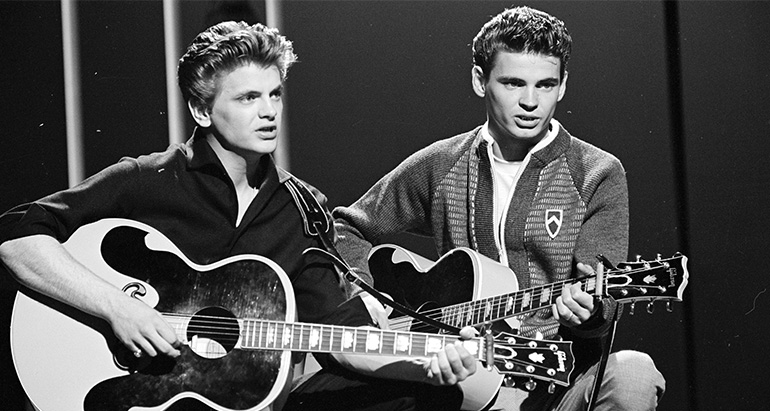
The Everly Brothers were a US guitar and vocal duo that, from the mid-1950s, became one of the most successful music duos in pop history and the most successful vocal group of the pre-Beatles era. Until 1973, the Everly Brothers, Don (real name Isaac Donald Everly, born February 1, 1937, in Brownie, now Central City, Kentucky) and Phil (Philip Everly, born January 19, 1939, in Chicago, Illinois; died January 3, 2014, in Burbank, California), performed as a duo; after a separation of about ten years, they worked together again in the studio and on stage starting in 1983.
The duo reached the top of the US and/or UK singles charts with seven titles: Wake Up Little Susie, All I Have to Do Is Dream, Claudette, Cathy’s Clown, Walk Right Back, Ebony Eyes, and Temptation. They blended the style of their Appalachian folk, bluegrass, and hillbilly country music roots with contemporary rock and roll, and created a pop sound with their harmony-laden two-part vocal style that served as a model for such successful artists as the Beatles, the Beach Boys, the Hollies, Simon & Garfunkel, and many others.
History
1930s to 1955: The Everly Family
Phil and Don Everly come from a family that lived in Muhlenberg County, Kentucky, in the 1920s and 1930s. Brothers Leonard, Charlie and Isaac “Ike” Everly worked in coal mining and played guitar in their spare time. “They couldn’t read music, so they played by ear,” Leonard’s son, the Rev. Ted Everly, later recalled. Ike Everly played a guitar influenced by “black” music, in the style of Sam McGee or Merle Travis. According to the website History-of-Rock.com, the brothers had an original composition in their repertoire, a combination of bluegrass and ragtime. They called the instrumental piece That’s the Mood I’m In, but never registered their rights to it. A very similar piece of music later became a worldwide hit for Glenn Miller and his orchestra under the title In the Mood.
On August 31, 1935, Ike Everly married the neighbor’s daughter, Margaret Embry. In Brownie, a small, now-defunct coal mining community about three miles east of Central City, their first son, Don, was born in 1937. Soon after, the Everlys moved to Chicago, where their second son, Phil, was born in early 1939; Ike’s younger brothers followed them with their families. They performed their country music in various bars and nightclubs in the big city. “My father played in country-and-western honky-tonks with pool tables and a small stage,” Don recalls of that time. But even tho they were doing well in Chicago, Ike and Margaret decided their children should grow up in a rural setting. Ike therefore took a job at the KASL radio station in Waterloo (Iowa) shortly thereafter.
From 1945 onward, the Everlys lived in Shenandoah (Iowa); here, Ike and Margaret, who had by now made a name for themselves as country musicians throughout the southern and midwestern United States, had a daily morning radio show on the local station KMA. Their sons regularly appeared on the show, Don as “Little Donnie” since his eighth year and Phil as “Baby Boy Phil” since his sixth year. Before 1950, the show was given the title The Everly Family Show.
In 1952, the family switched to the station WIKY in Evansville (Indiana), but stayed there for only a year. The triumph of the record-playing disk jockey on the radio began – a group that played live music was slowly becoming an anachronism. In Tennessee, the Everlys found a brief new job at WROL in Knoxville in late 1953, but the concept of the family band that shaped the show had become obsolete. Ike Everly switched to the construction industry, and Margaret began working in a beauty salon.
1955 and 1956: New Beginning in Nashville
When their parents retired from show business, Don and Phil had already graduated from high school. They moved to Nashville, where they initially performed in the city’s clubs. With the help of country musician and producer Chet Atkins, an old friend of Ike’s, they were able to get a job as songwriters at the Acuff-Rose publishing company. One of their songs, Thou Shalt Not Steal, became a country hit (No. 14 for Kitty Wells; December 1954), allowing the brothers to earn a little money on the side.
On November 9, 1955, Don and Phil made their first recordings for Columbia Records – four traditional country songs within 20 minutes, produced by Chet Atkins. In February 1956, two of these songs were released as their first single under the name “The Everly Brothers”: Keep a-Lovin’ Me and The Sun Keeps Shining. Since demand was very limited, the collaboration between Columbia and the Everlys was not extended.
They were now living off performances in clubs again, but traditional country music was no longer what they wanted to play – they had also become acquainted with Elvis’s songs and the sound of rhythm and blues. In search of a new record label, their publisher Wesley Rose, who would soon also become their manager, found a home for them at Cadence Records. The label was run by Archie Bleyer, a former swing bandleader who had previously been responsible for the successes of the Chordettes and Andy Williams, among others.
1957 to 1960: Successes at Cadence Records
Breakthrough with “Bye Bye Love”
With the change of record label, success followed – especially because the Everlys began working with songwriters Felice and Boudleaux Bryant in 1957. They were also backed by a group of professional studio musicians, whose instrumentation became known as the Nashville sound. The Bryants had written the song Bye Bye Love, which had already been turned down by thirty artists and bands, including Cadence’s own Gordon Terry and Elvis Presley. The Everlys liked it, but they had little choice – as Phil said, “We would have recorded anything they gave us, because we were getting $68” – money they needed. Don and Phil gave the song an arrangement they had created for their own song Give Me a Future, and were happy with the result.
In the spring of 1957, Bleyer announced the Everlys’ first Cadence single with a half-page ad in Billboard Magazine. Billboard wrote of the release on April 20, 1957, “These Tennessee teenagers have a distinctive, pleasing sound and could go far in both the pop and country and western fields.” While Don and Phil were on tour in small towns in Florida, Mississippi and Alabama, Bye Bye Love entered the Billboard pop charts. In June and July 1957, the single spent four weeks at number two, behind number-one hits by Elvis Presley (Teddy Bear) and Pat Boone (Love Letters in the Sand). In the country charts, the title climbed to number 1 and even reached number 5 in the R&B charts. Bye Bye Love was the Everlys’ second single release – and the first to sell more than a million copies. The hit also opened the doors to radio and television shows for them. After the end of their small tour thru the provinces, they were allowed to take the stage for the first time in front of 4,000 people on May 11, 1957, at the Grand Ole Opry in the “Mecca of Country Music,” the Ryman Auditorium in Nashville. In addition, they performed nationwide in the Ed Sullivan Show and on Perry Como’s show, among others.
Number one with Wake Up Little Susie
Now a follow-up hit was needed. What could be more natural than to commission the Bryants to write it again? They offered the song Wake Up Little Susie, which Archie Bleyer didn’t like. He thot the lyrics were indecent – to Bleyer, it sounded as if Susie and her boyfriend had slept together in the drive-in. On August 16, 1957, despite these concerns, the Everlys recorded the song, and it was released as the A-side of their next single.
Some executives from various radio stations agreed with Bleyer’s opinion and refused to play the song – which did not change the fact that it became the Everly Brothers’ first number-one hit. On 14 October 1957, “Wake Up Little Susie” replaced Jimmie Rodgers’ “Honeycomb” at the top of the U.S. charts. Don and Phil were on a 78-city tour of the US at the time. The tour lasted almost twelve weeks and was called The Biggest Show of Stars for ’57. In addition to the Everlys, the rock ‘n’ roll greats Chuck Berry, Buddy Knox, The Drifters, Paul Anka, Fats Domino, The Crickets, Eddie Cochran, LaVern Baker, Frankie Lymon, and Clyde McPhatter were also there. More than a million singles of Wake Up Little Susie, which was recorded in just four takes, were sold in the USA. The brothers were friends with Eddie Cochran and Buddy Holly. In 1957, they introduced Cochran to his later fiancée, the songwriter Sharon Sheeley. Holly later wrote the song Love’s Made a Fool of You for the Everly Brothers, but they never recorded it. Phil Everly was one of the pallbearers at Holly’s funeral in 1959.
The next single, “This Little Girl of Mine,” missed the top 20. However, the song was to be found alongside the two big hits on the Everly Brothers’ first album, which was released at the same time. With rock ‘n’ roll standards such as Little Richard’s Rip It Up or Gene Vincent’s Be-Bop-A-Lula and country songs such as Brand New Heartache, the brothers here showed the full range of their repertoire. The LP was simply called The Everly Brothers, but became known as The Everly Brothers – They’re Off and Running, after the slogan that Archie Bleyer had printed on the cover, which can be translated into German as “They’ve stormed off and are unstoppable!” The LP reached the top 20 of the Billboard charts in the USA.
“All I Have to Do Is Dream”
While the first two hits had narrowly missed the top position in the UK (Bye Bye Love became a number-six hit, Wake Up Little Susie reached number 2), the Everlys achieved their definitive breakthrough with their third Cadence single (distributed in the UK by London Records). All I Have to Do Is Dream was again written by Felice and Boudleaux Bryant. Phil Everly heard the song as a demo by Boudleaux Bryant and thot it would be a hit even if they released the demo as a single, “because it was just a great, beautiful song.” On March 6, 1958, the brothers recorded the song, and on May 12, it was number one on the Billboard charts for four weeks, and on July 4, it was number one on the British charts for seven weeks.
All I Have to Do Is Dream not only became a million-seller for the Everlys – since then, there have also been versions by Richard Chamberlain (1963), the duos Glen Campbell and Bobbie Gentry (1969) as well as Victoria Principal and Andy Gibb (1981), and in 1994 by Phil Everly in duet with Cliff Richard that made it to the charts. In the US, the Everly Brothers’ single was one of the few songs to reach number one on the pop, country and rhythm and blues charts. In the UK, All I Have to Do Is Dream was released as a double A-side, so Claudette was also listed as a number one hit from 4 July 1958 – a song written by the then largely unknown Roy Orbison about his wife.
The Break with Archie Bleyer
The chart successes “Devoted to You,” “Bird Dog,” “Problems,” and “Love of My Life” rounded off the year 1958 for the Everly Brothers. In the British music magazine New Musical Express, Don and Phil explained to their fans the secret of their songs’ success: “They are simple, direct and to the point. Young people don’t want to spend a long time trying to figure out the meaning of a song.”
Don Everly married his girlfriend Sue in 1959, which was initially kept secret from the fans; however, the marriage quickly failed. The year brought the brothers three more top 20 hits. At the end of the year, they recorded an adaptation of the Gilbert-Bécaud song “Je t’appartiens” under the title “Let It Be Me” – for the first time outside Nashville, namely in New York, and for the first time with strings. The Everly Brothers were now established stars, but the executives at Cadence Records still paid them according to standard. Don and Phil earned money mainly thru concerts, where the record company had no say. The differences over the tiresome topic, but also over the right to have a say in what should be released when, led to the rift between Archie Bleyer’s record company and the Everly Brothers at the end of the year; however, at the beginning of 1960, Cadence still brought “Let It Be Me” into the charts – as the last new recording of the brothers on their old label.
The most successful single Cathy’s Clown
The new record label responsible for the productions of the Everly Brothers in 1960 was Warner Bros. Pictures – a film company that didn’t even have a record division yet. With the change, the brothers became the first rock ‘n’ roll artists to receive a multi-million dollar guaranty contract. They signed a ten-year contract with Warner Bros. Records. Initially, the change did not alter their status as hitmakers. Their first hit for Warner, Cathy’s Clown, took the brothers back to the top of the charts on both sides of the Atlantic in 1960. With worldwide sales of more than three million copies, it became the brothers’ most successful single, which they had also written themselves. As the first single released by Warner Bros. in the UK, “Cathy’s Clown” was given the catalog number WB1. That year, the Everlys also toured the UK, with the Crickets as their backing band.
The years 1960 and 1961 brought the brothers more big hits, including the British double number one “Walk Right Back / Ebony Eyes.” The follow-up single, “Temptation,” also reached the top in Britain. In another way, this 1933 Bing Crosby piece was significant for the Everly Brothers: The song was published by Acuff-Rose, but Wesley Rose, who was still managing the brothers, did not want it released by the Everly Brothers in their arrangement. This led to a rift between Rose and the brothers, which also meant that they would no longer receive new compositions from Felice and Boudleaux Bryant. Their new manager was Jack Rael, who had previously managed Patti Page.
Military service, addiction problems, and decline
At the end of 1961, Don and Phil were drafted into the United States Marine Corps to serve their six-month military service. They did undertake a six-week “comeback” tour of the US, and Warner Bros. released a Golden Hits album, featuring the Everly Brothers’ top songs for Warner, from Cathy’s Clown to That’s Old-Fashioned (their last top 10 hit in the US), but they were slowly being pushed into the background in their homeland. But they were still stars – even without the Bryants, the Everlys delivered six more top-ten hits by the end of 1962.
However, life as stars also brought its disadvantages. “Don was increasingly struggling with the pressure from tours and recordings, and he became addicted to drugs,” writes Frank Laufenberg. Don’s doctor had prescribed him the drug Ritalin to cope with the stress of touring. On a European tour, Don was said to have collapsed in London. He was “excused with food poisoning and exhaustion,” but in fact he had attempted suicide by overdosing on pills. He was flown back to the US, leaving Phil to finish the tour alone. Despite the problems, Don married for a second time in 1962, to starlet Venetia Stevenson. From this marriage came three children, Stacy, Edan and Erin; Erin was briefly married to Axl Rose, the Guns N’ Roses singer, in 1990. In 1963, Phil also married: Jackie Ertel, the stepdaughter of Archie Bleyer, the president of Cadence Records, became his wife. His son Jason also became a musician and songwriter.
After 1962, the brothers’ success declined. The decline was all the faster as the Beatles, whose close harmonies were based on the Everly Brothers’ singing, musically conquered the USA. As a result of the so-called British Invasion, the successful appearance of British performers in the USA in the first half of the 1960s, the brothers became quieter. In 1963, the Everly Brothers went on tour in Britain again as headliners, along with various other bands. Included were Bo Diddley, Little Richard, the still little-known Rolling Stones, and the German band The Rattles. Cadence Records released a collection of the original hits from the early period titled 15 Everly Hits. In 1964, there was a Warner Bros. compilation album titled The Very Best of the Everly Brothers, which included new versions of six of their Cadence hits (re-recorded in Nashville), alongside six original hits from the Warner era. Some of these re-recordings, including “Devoted to You” and “All I Have to Do Is Dream,” are sometimes played today in place of the originals.
Comeback, style changes, and disharmony
In the UK, the Everly Brothers experienced a small comeback in 1965 with “The Price of Love,” an original composition, and “Love Is Strange,” achieving two more major chart successes. But the landscape of pop music had fundamentally changed. The brothers tried to bridge the gap between their own style and the Beat era with albums like Rock’n’Soul or Beat’n’Soul (both 1965). In 1966, they recorded the LP “Two Yanks in England” with the Hollies, featuring session musicians Jimmy Page and John Paul Jones, to which the Hollies contributed two-thirds of the tracks under the collective pseudonym Ransford. On other albums, the Everlys increasingly dedicated themselves to country music again, such as in 1968 on “Roots,” a concept album that included excerpts from “The Everly Family” radio show from 1952 and marked their return to Nashville in terms of recording.
But all these attempts were indeed recognized, but hardly any buyers. “None of these projects were bad,” writes the Oldie Market, “the brothers’ harmonies and the quite frequent, convincing self-compositions made every record actually worth listening to, with the compilations of country songs being particularly appealing.” With the autobiographical song Bowling Green, they had their last top-40 hit in the USA in 1967. In 1970, the Everly Brothers presented their own television series on the US channel ABC as a substitute for Johnny Cash. Until 1970, they continued to release with Warner Bros., then they signed with RCA Victor, for whom they recorded the country rock album Stories We Could Tell in Los Angeles in 1972 (with colleagues such as Delaney and Bonnie Bramlett, David Crosby and Graham Nash, Geoff Muldaur, and Warren Zevon) and in 1973 (this time back in Nashville, and after a long time once again with Chet Atkins as producer) Pass the Chicken and Listen.
None of these albums were successful, and the atmosphere between the brothers deteriorated increasingly: “Our first joint opus for RCA was a war in the studio […] there was extreme tension between us,” Phil later said – ultimately confirming what the brothers had already stated in 1961: “We’re often asked if it was a hindrance to our career that we were brothers. They just imagine that most brothers have arguments; and for us, if there is no harmony behind the scenes, then there usually isn’t much on stage either.” With a bang, the success story therefore came to a temporary end: The Everly Brothers as a singing duo and the brothers Don and Phil privately separated in 1973.
1973 to 1983: Separation and Solo Paths
The scandal took place on July 14, 1973, at the John Wayne Theater in Hollywood. During a concert, Phil smashed his guitar and stormed off stage. Don explained with the words “The Everly Brothers died ten years ago.” (“The Everly Brothers have been dead for ten years.”) to explain to the horrified concertgoers the end of the band. For Phil Everly, in retrospect, “the main reason why we parted ways was that we realized: we had done everything together that was possible.” The time had come to try it alone.” It wasn’t until 1983 that they performed together again – at the reunion concert at the Royal Albert Hall in London.
As early as 1961, Don Everly had ventured out as a solo artist. As Adrian Kimberly, he even brought his debut single, Pomp and Circumstance, to number 43 on the US charts; however, further releases under this pseudonym flopped. In 1971, he made a second attempt, this time under his real name. Neither with the LP Don Everly nor with the single Tumblin’ Tumbleweeds did he achieve success, although well-known musicians like Ry Cooder and Sneaky Pete Kleinow were involved.
Also before the separation, it was Phil who presented his first solo project in 1973. The folk rock album Star Spangled Springer, produced by Duane Eddy, featured James Burton, Warren Zevon, Jim Horn and Earl Palmer. The song “God Bless Older Ladies” was released as a single – a poor decision, as the B-side “The Air That I Breathe” (written by Albert Hammond and Mike Hazlewood) later became a worldwide hit in a recording by the Hollies.
A year later, Don Everly released the LP Sunset Towers, on which he was accompanied by the English band Heads, Hands & Feet with guitarist Albert Lee, who later became one of Don’s good friends. Lee was also a member of the Dead Cowboys, the name of Don’s touring band during those years. In 1976, there was again a pure country LP from Don, Brother Jukebox, produced by his former manager Wesley Rose. At least the single “Yesterday Just Passed My Way Again” from this album managed to stay in the country charts for a few weeks.
But all attempts by both brothers to achieve a major pop chart success failed – even re-recordings of old hits like “So Sad (To Watch Good Love Go Bad)” (Don, 1977) or “When Will I Be Loved” (Phil, 1975) didn’t help. However, compilation albums of their old hits always found buyers, especially in Great Britain.
It was only in November 1982 – 14 years after the last Top 40 hit by the Everly Brothers – that Phil Everly was able to place a single in the lower regions of the British charts; Louise climbed to position 47. Phil now enjoyed some success as a solo artist; his album Phil Everly, largely recorded in London, featured musicians such as Dire Straits’ Mark Knopfler, Rockpile’s Terry Williams and Billy Bremner, and keyboardist Pete Wingfield. The single “She Means Nothing to Me,” featuring Cliff Richard as co-lead vocalist, gave Phil his first British and German Top Ten hits in early 1983. In the US, the duet was not released as a single, the song was only included on the album, which also briefly charted in the UK.
1983 to 2005: Reunion and More
For five to six years, the brothers had not spoken to each other when their father fell seriously ill. They met in the hospital, then at the funeral, and decided to work together again. Since Phil had just had a hit with Cliff Richard in the UK charts, and since the British had always been their most loyal fans, they chose England for their comeback. Don’s friend Albert Lee, who Phil also knew well, was to put a band together for them, and in the summer it was announced: the Everly Brothers were giving a reunion concert.
On September 23, this “timeless piece of rock music” took to the stage of the Royal Albert Hall in London. Don and Phil played their big hits from the 1950s and 1960s, some as medleys. The concert was filmed and broadcast in the USA by the cable channel Home Box Office. The album from the concert made it into the British charts – reason enough for the brothers to want to try it again in the studio.
In February 1984, Don and Phil jointly signed a contract with Polygram Records. Dave Edmunds, a self-confessed Everly Brothers fan, produced the album The Everly Brothers with them in his Rockfield Studios in Wales, which was released in the USA under the title EB 84. It featured songs written for the brothers by well-known names such as Jeff Lynne and Frankie Miller, and songs such as Asleep, which Don had written himself. On the Wings of a Nightingale, which Paul McCartney had written for the brothers, was a hit single in both the USA and Europe. The album was chosen by TIME magazine as the Rock Album of the Year in 1984.
Following the same recipe, another album, Born Yesterday, was recorded in 1985: Dave Edmunds produced a selection of songs by well-known stars such as Mark Knopfler, Bob Dylan, or Sam Cooke, as well as original compositions by the brothers, including the title track, which was nominated for a Grammy in 1985 for Best Country Duo.
In December 1986, they appeared as guests at the Beach Boys’ anniversary concert celebrating their 25th anniversary at Waikiki Beach in Hawaii. In 1988, they released the single Don’t Worry Baby together with the Beach Boys; the song was used in the film Tequila Sunrise. After 1989, when Some Hearts was released, the brothers did not release any new studio albums, but they were on tour again and again until the mid-2000s. In 2003/04 they were special guests at Simon & Garfunkel concerts during Paul and Art’s Old Friends reunion tour. As a tribute to their idols, Simon & Garfunkel did not make the Everly Brothers the opening act, but instead called them on stage during their ongoing concerts, where they were allowed to perform three of their hits.
The Everly Brothers gave their last concert on 28 November 2005 at the Regent Theater in Ipswich, England. Afterward, they largely withdrew from the music business.
Since 2006: Retirement and Death of Phil Everly
Phil Everly, the younger of the two brothers, died on January 3, 2014, at Providence St. Joseph Medical Center in Burbank, California, just days before his 75th birthday. As his wife announced, he succumbed to the effects of chronic obstructive pulmonary disease, caused by years of smoking.
Don Everly still occasionally makes public appearances; in June 2018, he sang the song “Bye Bye Love” in a duet with Paul Simon at a concert in Nashville.
Style and Influences
The sound of the Everly Brothers thrives on the harmonious singing and guitar playing of the brothers. Both were accomplished instrumentalists (steel-string guitar); their singing was in close harmony style: each brother sang a melody that could often stand on its own as a vocal line. Most of the time, Don sang the main melody, and Phil sang a parallel third above. “The Everlys were similar in vocal range and color/timbre – so similar that even in the chorus it is difficult to pick out the individual voice. This gives the recording a power that was rare at the time, when multitracking was still in its infancy,” Rolling Stone writer Dave Marsh wrote of “Bye Bye Love.” One of the best examples of the brothers’ vocal technique is their 1958 hit Devoted to You. It had its roots in centuries-old Scottish and Irish folk music, as passed down in the Appalachians by duos like the Louvin Brothers.
What set the Everly Brothers apart from the rock and roll stars who preceded them, and who were known before Bye Bye Love, was that they had their own “white” sound. Elvis Presley, Gene Vincent or Buddy Holly before them also played guitar-based music, but their whole attitude was “black,” their guitar playing was influenced by the country steel guitar but remained in the tradition of rhythm and blues. These artists were therefore considered “black” at the beginning of their careers. The Everly Brothers’ guitar playing, on the other hand, was different from that – it was “white,” but had a very distinct sound. It was no longer just a rhythmic background for the vocals, but especially Don’s guitar solos became a distinct musical element of the songs. On the authorized website everlybrothers.com, it states: With Bye Bye Love, a hit formula had been discovered: Boudleaux Bryant’s rhythms, Felice’s lyrics, Don’s guitar intros, and Phil’s harmonies. The Bryant songwriting team began writing songs that were tailored specifically to the Everly harmonies, and that had Don’s expected and equally important guitar solo somewhere in the middle. The result was a mix of country, rock and roll, and R&B that Don and Phil themselves described as: “We’re not Grand Ole Opry […] we’re obviously not Perry Como […] we’re just pop music.” You could maybe call us an American skiffle band.” The arrangement of “Bye Bye Love” provided the “instrumental framework” for their entire time at Cadence Records: In the foreground, alongside the two voices, were the two acoustic guitars, supported by the rhythm section of bass, drums, and piano (usually with Floyd Cramer on the keys). The electric guitar added “colorful accents.”
Chet Atkins, who played guitar on the Everly Brothers’ early recordings, said of Boudleaux Bryant’s songs: “He had a knack for writing those cute little songs with lines like dream, dream, dream.” They were almost like lullabies, which was perfect for the Everly Brothers.” The lyrics are described on the Rock and Roll Hall of Fame website as “the Bryants wrote and the Everlys sang expressively of teenage love and heartbreak as well as tragicomic situations.” In their rock lexicon, Siegfried Schmidt-Joos and Barry Graves describe the Bryants as “two expert songwriters who were able to outline the themes of school, cinema, family home, ice cream parlor and band meeting with catchy phrases.”
Their looks and their songs about teenage angst classified the Everly Brothers as rock & roll, but their muted, often sad close harmonies with full-chord acoustic guitar sounds were clearly country music. Their parallel thirds harked back to the Louvin Brothers, the only concession to rock & roll being the syncopation added by Chet Atkins. This mixture of country and rock & roll influences allowed the Everly Brothers to have a number of crossover hits in both the country & western and pop charts.
The Everly Brothers’ vocal style had a strong influence on the beat groups of the 1960s. Both the Beatles and the Beach Boys developed their vocal style in their early works by copying Everly songs. The vocal arrangement on the Beatles’ song “Please Please Me” is directly based on that of “Cathy’s Clown.” Moreover, the Everly Brothers’ sound influenced the duo Simon & Garfunkel, the Hollies, the Byrds, and the Mamas and Papas, as well as musicians such as Mike Rutherford of Genesis and many others.
The Everlys wrote some of their hits, including (’Til) I Kissed You (Don), When Will I Be Loved (Phil), Cathy’s Clown and The Price of Love (both: Don and Phil together). Various artists have had hits with cover versions of these Everly Brothers songs: “Cathy’s Clown” was a hit for Reba McEntire; “When Will I Be Loved” was a U.S. Top Ten hit for Linda Ronstadt, on which the Everly Brothers sang backing vocals; this recording was a number one hit on the country charts in 1975. Norwegian band a-ha covered “Crying in the Rain” in 1990 on their album East of the Sun, West of the Moon. Thou Shalt Not Steal was already a country hit (No. 14) for Kitty Wells in 1954. Bryan Ferry’s version of The Price of Love reached No. 7 as the main track of his EP Extended Play in August 1976 and No. 49 as a single A-side in a new mix in 1989. Till I Kissed You (in this alternative spelling) became a top 20 hit in Germany in 1974 for John Kincade.
In 1980, Nick Lowe and Dave Edmunds recorded several Everly Brothers hits. The EP Nick Lowe & Dave Edmunds Sing The Everly Brothers, featuring the songs Take a Message to Mary, Crying in the Rain, Poor Jenny and When Will I Be Loved, was never officially released, but was included with the first pressings of the LP Seconds of Pleasure by Edmunds and Lowe’s band Rockpile.
Collaboration with other artists
Throughout their entire career, both Everlys frequently collaborated extensively with other artists, either together or individually, singing duets or providing backing vocals on their recordings. Thus, the brothers had already participated in 1986, long before the joint tour, on the title song of Paul Simon’s bestseller album Graceland.
Another example is Don Everly’s duet “Everytime You Leave” with Emmylou Harris in 1979 on her album “Blue Kentucky Girl”; additionally, he sang in the 1970s with Guy Clark, Bryn Haworth, and Albert Lee.
Phil Everly contributed his voice to J. D. Souther’s “White Rhythm and Blues” from the LP “You’re Only Lonely” in 1976. He duetted with Sondra Locke on Don’t Say You Don’t Love Me No More during a cameo appearance in the film Every Which Way But Loose. In 1983, Phil duetted with Cliff Richard on She Means Nothing to Me, which reached the British and German top 10; in 1994 he recorded a new version of All I Have to Do Is Dream with Sir Cliff, which also became a hit. In 2006, Phil Everly sang the duet Sweet Little Corrina with country singer Vince Gill on his album These Days. In 1988, both brothers recorded the song “Don’t Worry Baby” together with the Beach Boys.
Together with Dean Reed, Phil Everly appeared on East German television in 1979. The show “The Man from Colorado 2,” recorded in February in Karl-Marx-Stadt, was broadcast on October 13, 1979. Phil sang two songs solo and then All I Have to Do Is Dream and Bye Bye Love in a duet with the host and presenter Reed. In 1981, Phil was also a guest star at six Dean Reed concert evenings at the Berlin Palace of the Republic, where they sang Bye Bye Love and Let It Be Me together.
In 1990, Phil Everly recorded his composition “On Top of the World” as a duet with Dutch singer René Shuman. The song was released on Shuman’s album Set the Clock on Rock.
Successes, Awards, Honors
The Everly Brothers recorded 33 Top 40 hits in the UK and 26 Top 40 songs in the US charts during their career. They sold more than 40 million records worldwide. The Everly Brothers’ sound is timeless: in the UK, since 1960, at least one album of the brothers’ hits has made it into the album charts every decade.
In 1986, the Everly Brothers were among the first ten artists inducted into the Rock and Roll Hall of Fame; in the same year, a star was dedicated to them on the Hollywood Walk of Fame. Their hometown, Central City (Kentucky), renamed Chestnut Street to Everly Brothers Boulevard in 1988 in honor of a homecoming concert and dedicated a monument to them in front of the city building. In 1997, they received the Grammy Lifetime Achievement Award. In 2001, they were inducted into the Country Music Hall of Fame and the Nashville Songwriters Hall of Fame, and in 2004, into the Vocal Group Hall of Fame. Also in 2004, Rolling Stone ranked them 33rd on its list of the 100 greatest music acts of all time. In 2008, the same magazine chose the Everly Brothers as number 90 on the list of the 100 best singers of all time.
From 1958 to 1962, the readers of the British music magazine NME voted the Everly Brothers as the world’s best vocal group annually. The Everly Brothers are also represented in the Rockabilly Hall of Fame and the Jukebox Hall of Fame.
