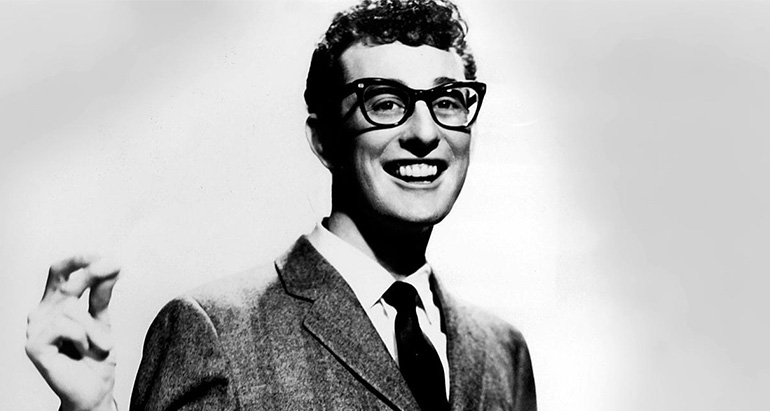
Buddy Holly (born September 7, 1936, as Charles Hardin Holley in Lubbock, Texas; died February 3, 1959, near Mason City, Iowa) was an American rock and roll musician and songwriter. Some of his most famous songs include “That’ll Be the Day,” “Peggy Sue,” “Oh Boy!,” and “It Doesn’t Matter Anymore.”
Biography
Born and raised in Lubbock, West Texas, Holly (then still with his birth surname Holley) began performing at small events at the age of 13. He was the youngest of four children and came from a musical family. At the age of 15, he was already playing guitar, banjo, and mandolin, and formed the duo “Buddy and Bob” with his friend Bob Montgomery.
Beginnings
This period also includes Holly’s first attempts at songwriting with Montgomery, as well as numerous demo recordings of their own compositions starting in 1952. In 1954 and 1955, they even held sessions at the Nesman Recording Studio in Wichita Falls, Texas, where, among other things, the Montgomery compositions “Gotta Get You Near Me Blues,” “Soft Place in My Heart,” and “Door to My Heart” were recorded. From 1955 onward, they played with bassist Larry Welborn, who was soon joined by Jerry Allison on drums. At the beginning of the year, the duo performed as the opening act for Elvis Presley and Bill Haley, which left a lasting impression on the young Holly. During this time, he was heavily influenced by blues and rhythm and blues and believed that these two genres were compatible with country music. Holly and Montgomery therefore also called their music “Western & Bop.”
In the fall of 1955, Montgomery, who leaned more toward traditional country music, left the duo but continued to compose songs with Holly. He then continued to play with Allison and Welborn, as well as with guitarist Sonny Curtis and bassist Don Guess. Together with Ben Hall, Holly and the band also performed on the radio stations KSEL and KDAV.
First successes
Buddy Holly’s professional career began in late 1955 when he was discovered by talent scout Jim Denny. On December 7, 1955, demo recordings were made at the Nesman Recording Studio and sent to Decca Records. Holly recorded his first Decca Records sessions under pressure on January 26, 1956. He was accompanied by Sonny Curtis on electric guitar, studio musician Grady Martin on guitar, Don Guess on double bass, and Jerry Allison on drums. From this session, the songs Love Me, composed by Holly and Sue Parrish, and Blue Days – Black Nights, by Ben Hall, were released. Billboard magazine reviewed Love Me in its issue of April 21, 1956, as follows: Cedarwood succumbs to rock and roll, too. If the public will accept more than one Presley or Perkins, as it well may, Holly stands a strong chance. The B-side was rated similarly well: Warbler, tune, guitar, etc., are patterned very closely after Elvis Presley. Gutes Material und feine Produktion auf beiden Seiten. Should do fine. Despite Billboard’s promising predictions, the single did not make the charts.
In 1956, Holly and his band recorded numerous other songs either at Bradley’s Studio A or at Norman Petty’s studio in Clovis, New Mexico, including the first version of the later hit “That’ll Be the Day.” However, this version, which was more clearly in the rockabilly style, was held back by Decca because they were dissatisfied with the recording due to Holly’s hoarse voice and an overly dominant echo effect. At the end of 1956, Decca released Holly’s second single, “Modern Don Juan,” along with “You Are My One Desire.” Due to the lack of success, Decca lost interest in collaborating further over the course of the year and did not renew the contract.
Holly then looked for a producer suitable for his musical ideas. Since the spring, he and his band had recorded numerous demo tapes in Norman Petty’s studio, and from then on, the collaboration with Petty developed a new perspective for the band. Guitarist Sonny Curtis replaced Niki Sullivan at the end of 1956, while Don Guess was first replaced on bass by Larry Welborn and later in the spring of 1957 by Joe B. Mauldin. On February 25, 1957, Holly at the microphone and electric guitar and his band, consisting of Larry Welborn on bass and Jerry Allison on drums, recorded the piece “That’ll Be the Day” again, which Petty considered promising. Holly took the title line from the very successful John Ford Western The Searchers (German: Der Schwarze Falke), released the previous year, in which the main actor John Wayne makes this statement several times (German: “The day will come”). As the B-side, Holly’s own composition I’m Looking for Someone to Love was recorded. These recordings were initially not intended for release, but they still made it into production and onto the market because they were considered master tapes.
Thru Murray Deutsch, a friend of Petty’s who worked in publishing, the tapes reached Bob Thiele, an executive at Coral Records, who also saw potential in the recordings. However, there were some hurdles before the release: Holly’s Decca contract did not allow him to record tracks he had already recorded for Decca. Moreover, Coral was a subsidiary of Decca, so the release of the single could have been quickly stopped. Despite all this, Thiele managed to get That’ll Be the Day backed with I’m Looking for Someone to Love released on Brunswick Records in May 1957, another Decca subsidiary that was more focused on jazz and rhythm and blues. However, the record was released under the band name The Crickets to disguise Holly’s involvement and deceive Decca. The name for the band was said to have been a joint decision, as the sound of crickets was always heard over the recordings of quiet musical passages in Petty’s small studio. Despite the name change, Decca took notice, leading to a legal dispute.
Breakthrough
In the summer of 1957, it became clear that Thiele was right and “That’ll Be the Day” became a hit. After a good review from Billboard in June (“Fine vocal by the group on a well-made side that should get play. Tune is a medium beat rockabilly. “Performance is better than material.” The song reached number one on the Billboard Hot 100. At that time, Decca already knew that Holly was the singer, but they were convinced by Bob Thiele to release him from his contract. At the same time, the older 1956 version of “That’ll Be the Day” was released to capitalize on Holly’s success.
Since Petty was convinced of the commercial success of his protégés, he suggested releasing later records on two tracks. Thiele agreed, and Holly got a separate record deal with Coral Records, so that recordings were now released on Brunswick under the name The Crickets and on Coral under Holly’s name. Petty became the Crickets’ manager at the same time as the success of That’ll Be the Day. In him, Holly also found someone who was open to innovative studio experiments. Holly, for example, liked to work with the technique of overdubbing or, as heard on Everyday, replaced the drums with the sound of slapping his hands on his thighs and a glockenspiel.
The next successful production followed on June 29, 1957, at Petty’s studio with “Peggy Sue.” Released in late summer of that year, the song, along with Everyday, was now credited to Holly on the Coral label and subsequently reached number three on the Billboard charts. That’ll Be the Day and Peggy Sue had become worldwide hits almost overnight in the summer of 1957. Successful tours and several television appearances in the United States and the United Kingdom followed.
In 1958, Buddy Holly married Maria Elena Santiago (*1932), to whom he had already proposed on their first date. Shortly thereafter, he parted ways with the Crickets and Norman Petty. The other group members received the rights to the name from him and were thus able to continue performing under the name Crickets. In 1958, two more Crickets singles featuring Buddy Holly, “It’s So Easy” and “Think It Over,” were released. As a solo artist, Holly released Rave On, Early in the Morning, and Well… All Right in the same year. In the summer of 1958, Holly acquired his own tape machine and began producing his music demos himself. He planned to take acting lessons, build his own music studio, and began to promote other artists as an independent producer. In October 1958, Holly recorded four pieces with orchestral accompaniment in New York: True Love Ways, Moondreams, Raining in My Heart, and It Doesn’t Matter Anymore.
In December 1958 and January 1959, Holly was preparing for a new album and composed a series of songs, for which he recorded demo versions, including the pieces “Peggy Sue Got Married,” “That’s What They Say,” “Crying Waiting Hoping,” and “Learning the Game.” In January 1959, he began a US tour with his new band (which included bassist Waylon Jennings) with other well-known artists, including Ritchie Valens, The Big Bopper (the stage name of Jiles Perry Richardson), and Frankie Sardo. His last concert was the evening before his death at the “Surf Ballroom” in Clear Lake (Iowa).
Death
On February 3, 1959, Holly, Valens, and The Big Bopper died in a plane crash—likely caused by the pilot’s instrument reading error—on their way to their next performance in Moorhead, near Mason City.
In 1971, Don McLean commemorated this tragedy in his song “American Pie,” referring to that day with the lyric “The Day the Music Died,” calling it “the day the music died.”
The belongings scattered at the crash site, including Holly’s bloodied FAOSA glasses, were secured by the federal police to determine the cause of the crash. They were forgotten and only returned to the families of the crash victims years later. The ongoing tour was completed by Jimmy Clanton and Frankie Avalon. Holly was buried in his hometown four days later. On April 24, 1959, his song “It Doesn’t Matter Anymore” reached the top of the British charts and stayed there for three weeks. In 1986, Holly was posthumously inducted into the Rock and Roll Hall of Fame.
Equipment
The guitar most often associated with Buddy Holly is the Fender Stratocaster. He owned five different examples, most of which were stolen shortly after he acquired them. For acoustic guitars, he used a Gibson J-45, a Gibson “Jumbo,” and a Guild Navarre.
Holly exclusively used Fender amplifiers on stage and in the studio. Initially, he used a Fender Pro, but later he switched to the significantly more powerful Fender Bassman, although the Pro was still used for smaller gigs. Shortly before his death, he received two “Twin” amplifiers from Fender as part of an endorsement contract. He often used a Shure 55 microphone live, but in the studio, he used a model from Telefunken.
Posthumous Fame
Holly’s hometown of Lubbock was slow to react to the fact that it had produced one of the most outstanding artists of the rock ‘n’ roll era. In the meantime, Lubbock has a Buddy Holly Park, a Buddy Holly Avenue and the Buddy Holly Center. A museum has been established there, which on the one hand shows many memorabilia on the subject of Buddy Holly, but on the other hand is also a meeting place for fans on various occasions. In Lubbock, there is also a themed city tour and a Buddy Holly statue. His grave in the cemetery in Lubbock is a pilgrimage site for fans.
At the crash site of the plane, a 12-year-old Beechcraft Bonanza, in which Holly, his friends and pilot Roger Peterson died, Holly fan Ken Paquette erected a stainless steel monument consisting of a guitar and three records. In 1988, the German Federal Post Office issued a Buddy Holly stamp.
On September 7, 2011, Holly was honored with a star on the Hollywood Walk of Fame. The ceremony was attended by Holly’s widow and Phil Everly, among others.
Rolling Stone ranked Holly as the 13th greatest artist, the 29th greatest songwriter, the 48th greatest singer, and the 80th greatest guitarist of all time. This makes him one of eight artists to be included in all four lists.
Memorial events
Every year, numerous memorial events take place, such as the Buddy Holly Week, organized by Paul McCartney, or the Winter Dance Party, which includes all the stops on Holly’s last tour and ends at the Surf Ballroom in Clear Lake (Iowa), where his last performance took place. The Clovis Music Festival and Fifties in February also pay tribute to Buddy Holly.
Film, musical, and tribute shows
Buddy Holly’s life was made into a film, for which Gary Busey was nominated for an Oscar, and it has been performed as a musical, among others, on Broadway and at the Theater im Hafen Hamburg as well as at the Colosseum Theater in Essen. Other productions include shows such as A Tribute to Buddy and the Buddy Holly Rock ‘n’ Roll Show.
Reminiscences of other artists
After his death, other artists also dedicated themselves to the theme of Buddy Holly: Die Ärzte sang about Buddy Holly’s glasses, Bernd Begemann wrote a song called Buddy, nimm lieber den Bus, and Weezer wrote a tribute song called Buddy Holly. Other songs about Holly include Eddie Cochran’s “Three Stars”, Mike Berry’s “Tribute to Buddy Holly”, Alvin Stardust’s “I Feel Like Buddy Holly”, written by Mike Batt, Gyllene Tider’s Swedish song “Ska vi älska så ska vi älska till Buddy Holly”, or Garland Jeffreys’ “Hail Hail Rock’n’Roll”.
Graham Nash cited admiration for Buddy Holly as a reason for the choice of the name The Hollies. In 2011, to mark the 75th anniversary of his birth, a CD, Listen to Me: Buddy Holly, featuring cover versions of his songs by well-known musicians such as Brian Wilson, Ringo Starr and Chris Isaak, was released.
Works
Holly’s influence on the development of rock music was considerable. He was the first successful musician to establish the standard formation of a rock band with lead guitar, rhythm guitar, bass, and drums, which the Beatles then adopted. Paul McCartney acquired all the publishing rights to Holly’s compositions, and on their 1994/1995 world tour the Rolling Stones opened every concert with Holly’s Not Fade Away, which they had released as a single in 1964. The Beatles, then still known as The Quarrymen, recorded Buddy Holly’s biggest hit, That’ll be the Day (released on The Beatles Anthology), for a self-produced single in 1958. They stated that the first 40 songs they composed were written under the direct influence of Buddy Holly’s music.
Buddy Holly wrote almost all of his songs himself, many of which were musically more sophisticated than other hits of the time. His songs were also covered by other musicians. One of the first was Bobby Vee, who stepped in for Buddy Holly at the concert on the day of the accident and sang his songs. Linda Ronstadt was also successful with her version of That’ll Be the Day. The song Peggy Sue Got Married provided the title for the film of the same name, Peggy Sue Got Married, starring Kathleen Turner.
In the studio, Holly often resorted to the technique of overdubbing, which means he added one or more audio recordings over an already existing audio recording. This allowed Holly to sing duets with himself; a prime example of this recording technique is the song “Words of Love.” In addition, after separating from the Crickets and Norman Petty, Holly was the first successful independent musician to produce his pieces independently of record companies.
Buddy Holly was a very productive artist when it came to writing and recording, often in the form of demo recordings. Between 1953 and 1959, he recorded numerous pieces privately (Good Rockin’ Tonight, Rip It Up, Blue Suede Shoes, Two Timin’ Woman, Wait Till the Sun Shines Nellie, Smokey Joe’s Cafe), in the studio (Love’s Made a Fool of You, Baby Won’t You Come Out Tonight, Because I Love You, Bo Diddley, Brown Eyed Handsome Man), or as unused masters (Reminiscing, Come Back Baby, That’s My Desire), which provided ample material for years of releases, both revised and in raw form. Thus, in 1959/1960, six original compositions that Holly had recorded as demos were revised and released. Since 1962, albums by Holly have been regularly released with recordings that Norman Petty subsequently commercialized with more or less success. These recordings were released on the albums Showcase, Giant, Holly in the Hills, It Doesn’t Matter Anymore, and Reminiscing. From the 1980s onward, more and more bootlegs with the original versions of the pieces were released. Additionally, Buddy Holly had repeatedly participated as a guest musician in recordings by other artists starting in 1953.
Posthumous releases
Even long after the artist’s death, a loyal fan base continues to live on with his music. The enduring significance of Holly is evident in the regular re-releases of his works. In addition to the LPs, CDs and MCs that have been circulating in fan circles for decades, the DVD medium has already taken on a great significance. Old recordings from US television, the film The Buddy Holly Story, and memorial broadcasts are now available.
In October 2004, a CD titled “Stay All Nite – The Country Roots of Buddy Holly” was released. In June 2005, Universal Music released a DVD with a CD: The Music of Buddy Holly and the Crickets, which traces the career of the rock ‘n’ roll pioneer in sound and vision. In September 2007, Rollercoaster Records released a 2-CD box set entitled Ohh, Annie!, which contains previously unreleased Buddy Holly recordings from 1956, discovered by chance, alongside the better-known ones, in improved sound quality.
Shortly before his death, Holly had recorded the “Apartment Tapes” on tape in his New York apartment. Accompanied only by his Gibson acoustic guitar, the singer is experienced unplugged here. These titles were officially released only on a 9-LP box set, never on CD. This opened the door to a gray market; countless pressings circulated on which the songs were released. It wasn’t until 2009 that Geffen Records filled this gap with Buddy Holly – Not Fade Away, which included CDs and a book.
