
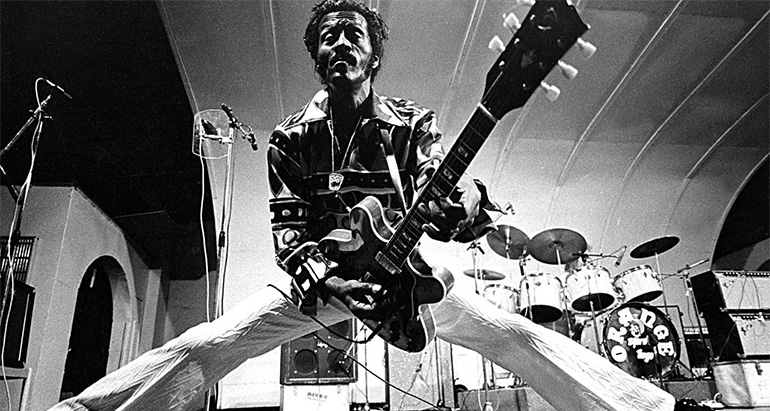
Charles “Chuck” Edward Anderson Berry (* October 18, 1926, in St. Louis, Missouri; † March 18, 2017, in Wentzville, Missouri) was an American singer, guitarist, composer, and a pioneer of rock ‘n’ roll. He was inducted into the Blues Hall of Fame in 1985 and was the first member inducted into the Rock and Roll Hall of Fame in 1986. His role models were Nat King Cole, Louis Jordan, Muddy Waters, and T-Bone Walker. Chuck Berry is considered an important catalyst for the emergence of beat music and the inventor of the duckwalk.
Life
Chuck Berry was the son of Henry Berry, a deacon of a Baptist church, and Martha Berry, a school principal. At Sumner High School in St. Louis, Berry began singing and playing guitar. In 1944, he was convicted of armed robbery after he held up three stores in Kansas City, Missouri. Subsequently, he allegedly stole a car at gunpoint, which was probably just a toy gun. Due to these crimes, he spent three years in the Algoa juvenile prison near Jefferson City until his 21st birthday in 1947. After his early release, he worked as a barber and, according to other sources, in an automobile assembly plant. In 1948, he married Themetta Suggs. Two children were born from the marriage.
From 1951, he was a doorman at the radio station WEW and bought an electric guitar from a musician there. He acquired a tape recorder and began recording his music. In 1952, Chuck Berry had his first public performances at Huff’s Garden—a club in St. Louis. With a performance as a substitute in the Johnnie Johnson Trio, his nearly twenty-year collaboration with pianist and composer Johnnie Johnson began. At the end of 1952, he moved to the Cosmopolitan Club. There, he initially played to an almost exclusively African American audience. However, it quickly became known that a colored hillbilly was performing there, and soon almost half of the audience was white.
In May 1955, he took a trip to Chicago with a school friend to see Howlin’ Wolf, Elmore James, and Muddy Waters live. When he got an autograph from Muddy Waters, he asked where he could make recordings himself. He referred him to Chess Records. After a few days, a demo tape was ready, and Berry approached Leonard Chess with it. The producer was impressed by the song “Ida Red” and promised Berry a recording session. On May 21, the two songs Ida Red – renamed Maybellene – and Wee Wee Hours were recorded.
With “Maybellene,” he immediately achieved a top-ten hit on the Billboard charts. In addition, he received a three-year contract. During the subsequent tours, he showcased the duckwalk, which has since become his trademark. According to his own account, he originally invented this show move to distract from the wrinkles in his suit. In April 1956, Chuck Berry recorded one of his most famous hits, Roll Over Beethoven. In the following years, well-known songs such as Sweet Little Sixteen, Rock and Roll Music, Memphis, Tennessee, Carol, and Johnny B. Goode were created, with Johnson relinquishing his rights to the composer Berry. The song dedicated to Johnson, “Johnny B. Goode,” later became part of the Voyager Golden Records as an example of “earthly pop/rock music” and was sent into space with the Voyager 1 and Voyager 2 spacecraft.
In December 1959, Berry got into trouble with the law. Charged with violating the so-called Mann Act, he was sentenced to three years in prison in March 1961. After being released early in October 1963, he was able to get back on his feet. In particular, in Britain, he had a number of further hits with songs such as No Particular Place to Go and You Never Can Tell.
In 1964, he released an album titled St. Louis to Liverpool. After the Beatles had success with cover versions of Roll Over Beethoven and Rock and Roll Music, Berry also became more in demand again. In 1966/1967, he switched from Chess Records to Mercury. However, they were unable to adequately produce and market his earlier sound there. After five relatively low-selling albums, Berry left the label again in 1969.
Back Home was created again at Chess in 1970. In 1972, his best-selling album, The London Chuck Berry Sessions, was released. The single “My Ding-a-Ling” became his first number-one hit on the pop charts, but was not played by some radio stations because the lyrics contained sexual innuendos. By the early 1970s, Berry had become one of the most in-demand rock idols, making numerous television appearances. For example, in 1973 he was invited as one of many attractions to Dick Clark’s “American Bandstand” 25th anniversary. After his performance, the audience didn’t want to let him go and called for encore after encore. The event thus turned into a small Chuck Berry show, albeit an unintentional one. Berry continued to give numerous concerts worldwide and went into the recording studio less and less often. In 1979, he recorded his penultimate studio album. In the same year, he performed, among others, for US President Jimmy Carter.
Since the mid-1960s, Berry’s performances sometimes evoked mixed feelings among the audience. He was often criticized for not bringing his own backing band, but rather playing with local bands – such as The Firebirds – with whom he had hardly ever rehearsed beforehand. That his concerts could still be an experience was probably due to the charisma of the musician, who performed his old hits in a new guise thru syncopation. Even in old age, he regularly performed at the Blueberry Hill restaurant in St. Louis and went on world tours – often together with Jerry Lee Lewis and Little Richard until 2004.
In 2008, he was awarded the Golden Camera in Germany for his lifetime achievement.
In 2013, the British magazine Guitar & Bass dedicated the cover story to him in its September issue. His life and work were traced over several pages. In the autumn, he gave a few concerts in Europe. Shortly after his 87th birthday, he performed in Moscow, at the Steinegg Live Festival in South Tyrol, in Helsinki and Oulu in Finland, as well as in Oslo. Musically, he was accompanied by his son Charles Berry Jr. (guitar), James Marsala (bass), Robert Lohr (keyboards), and Keith Robinson (drums). Originally, his daughter Ingrid Berry-Clay (vocals and harmonica) was to be included in the band. In Helsinki, he suffered a fainting spell and had to be taken to hospital, but this did not prevent him from giving the last two concerts of this European tour.
In August 2014, Chuck Berry was awarded the Swedish Polar Music Prize alongside American opera director Peter Sellars. The Swedish Queen Silvia and Princess Madeleine had previously cited a certain “dark spot in Berry’s past” as the reason why they were against awarding the ambivalent legend. The Queen has been campaigning for sexually abused children for years, which she also stated as her reason for doing so.
An early hit for Berry was 1958’s Sweet Little Sixteen, in which he told the story of a young girl begging her father to let her go to a rock concert. He also described how the teenager was dressed up in clothes, lipstick and high heels for the concert, but the next day was back to being the sweet 16-year-old in the classroom. In 1957, he sang about the forbidden love of a 17-year-old girl in Little Queenie. Such things were already too much for some in the establishment back then. When he was also in prison in the early 60s, due to an accusation of “promoting the prostitution of minors,” this was his low point. These things from his past were brought up again in connection with the boycott by the Swedish royal family.
On the occasion of his 90th birthday, Berry announced the release of a new album titled Chuck. The album was released in mid-2017 on the Dualtone label and is dedicated to Berry’s wife Themetta “Toddy,” to whom he had been married for 68 years at the time of the announcement. It was released posthumously.
Berry was found dead in his apartment in St. Charles County in the U.S. state of Missouri on March 18, 2017. On April 9, 2017, he was buried in his hometown of St. Louis.
Musical Influence
Chuck Berry almost single-handedly established the guitar as the leading instrument in rock music in the 1950s. Other artists of the time also liked to show off with a guitar, but they only used it for rhythmic accompaniment; solos and interjections came from the backing band. Berry presented the guitar as equal to the vocals. He used it both for accompaniment, mostly with power chords on the lower strings, but also for solos, fills, and licks in the higher registers. For the latter, he usually played over at least two strings (“double stops”), which produced a fuller, more dynamic sound. His bendings often involved two strings as well.
Probably one of the most famous guitar intros or riffs of all time, which was even featured in the 1985 film Back to the Future, is the one from Johnny B. Goode, which ascends from the third to the octave, then descends and builds tension with a staccato of the root note and fifth.
Afterward, there are four measures on a note, the fifth, which he plays syncopatedly, alternating between pulling up from the fourth on the G string and striking straight on the B string. This effect was frequently copied by other guitarists in the following years. Berry himself had taken the intro almost note for note from the piece Ain’t That Just Like a Woman by Louis Jordan, played there by the guitarist Carl Hogan.
The lyrics he wrote for his songs also had a great influence. Thru his bourgeois background, familiar with literature, theater, and the Bible, he made more sophisticated lyrics for pop acceptable thru profound and language-loving poetry, and significantly inspired the early works of Bob Dylan, Mick Jagger, and John Lennon.
Chuck Berry, who has always remained true to his musical style, is one of the legends of rock ‘n’ roll. He is in a league with stars like Little Richard and Fats Domino. His riffs and licks continue to shape rock ‘n’ roll. Many of his hits were covered by rock legends such as the Beatles, the Beach Boys, the Rolling Stones, Jimi Hendrix, Elvis Presley, Buddy Holly, Paul McCartney, The Sonics, or Electric Light Orchestra. The Beatles once said that they would never have started making music without Berry. The Rolling Stones started their career with Chuck Berry songs, and Keith Richards repeatedly called himself Berry’s biggest fan. Musicians such as Simon and Garfunkel, Eric Clapton, Bruce Springsteen, AC/DC (whose guitarist Angus Young is a noted fan of Berry’s music) and Motörhead also covered his songs. For over 40 years, Status Quo have ended their concerts with Bye Bye Johnny and have also played other Berry compositions such as Rock and Roll Music, Carol or Roll over Beethoven live.
Rolling Stone ranked Berry fifth on its list of the 100 greatest musicians, seventh on its list of the 100 greatest guitarists, fourth on its list of the 100 greatest songwriters, and 41st on its list of the 100 greatest singers of all time.
One of his most influential songs is “Roll Over Beethoven.” The university professor and music journalist Lutz Lesle writes about it:
“This demonstrative gesture, which aimed to give a slap in the face to the elitist behavior of the upper social class in the USA, subsequently set a precedent.” The Beatles picked up the song, along with some other musicians from the ‘scene’: And so, gradually, a chapter in the history of Beethoven’s influence within pop music emerged. The bourgeois either/or, ‘Beethoven or rock,’ was attempted to be exposed by rock musicians as an ideological prejudice. They propagated ‘rock with Beethoven’.”
– Lutz Lesle: The Time
The German musicologist Peter Wicke notes:
“The development has literally ‘rolled over’ the esthetic maxims of a Beethoven and the great bourgeois musical tradition with the technology of audiovisual mass communication and the social transformations it has triggered within culture.” The changes were profound. […] They are new experiences in the medium of art, tied to the technology of mass communication, conveyed in the everyday lives of their recipients. They have settled into a concept of music for which the terminology of art esthetics is inadequate. They have robbed the academic art expert of his authority, because in this social model of art, the popular art forms, everyone is an expert. In this lies the deeper truth of Chuck Berry’s 1950s rock’n’roll number, Roll Over Beethoven.”
– Peter Wicke: The Time
What was new was the fundamental examination of the relationship between rock ‘n’ roll and mass communication media such as records, and subsequently radio, TV, and film. Rock ‘n’ Roll had its fundamental prerequisites for existence in these media. He accepted this circumstance uncompromisingly as an opportunity for artistic expression. The lucrative impact that rock ‘n’ roll music and, more generally, pop music demonstrated had not been seen before to this extent. This is not, as is often claimed, due to the interpreted exoticism of its African-American roots. For even in the swing era – more than two decades earlier – “black” artists and bands were confirmed by a very heterogeneous audience. Contrary to what is often claimed, there were already exchanges between so-called “black” and “white” music before that. The partial pretense of a completely separate development of Afro- and Euro-American music was based on racist arguments. With this, attempts were made to legitimize the established racial barriers by claiming a supposed actual cultural contrast between “black” and “white” based on skin pigmentation, which was supposedly bridged only by rock ‘n’ roll. The relationships between the African American minority in the USA and the Americans of “white skin” are, even against the backdrop of arbitrarily erected racial barriers, far more complex than such a schematic black-and-white simplification suggests.
The political climate at the time the song was created was: Just a few months earlier, the Montgomery Bus Boycott of 1955/1956 had called racial segregation into question. This event is considered the birth of the American civil rights movement.
Among other things, it was Berry’s “Roll Over Beethoven” in which the new musical self-understanding of the rock ‘n’ roll enthusiasm, already at its peak in the USA, found its provocative and challenging expression. This remained as something like a leitmotif of rock ‘n’ roll.
Equipment
Chuck Berry played a Gibson ES-350T from the 1950s until the early 1960s, then mainly a Gibson ES-335 in red or a Gibson ES-355 in brown.
