
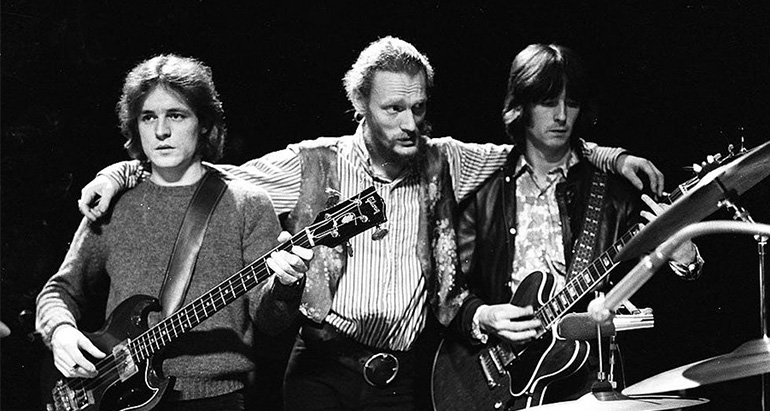
Cream was a British rock band that existed from 1966 to 1968. Band members were Eric Clapton, Jack Bruce, and Ginger Baker. Their sound was a mix of blues, hard rock, and psychedelic rock. Cream is considered the first supergroup in the history of rock music.
Foundation
In April 1966, guitarist Eric Clapton and drummer Ginger Baker, who were friends and played in different bands, discussed the possibility of forming their own group together. Clapton brought Jack Bruce into the conversation as a possible bassist, a musician with whom Baker had already played a year earlier in the band Graham Bond Organization. There had been physical altercations between the two, culminating in Baker throwing Bruce out of the band. Nevertheless, Baker agreed to joint sessions with the bassist, despite the tensions between Bruce and Baker, both continued to respect each other’s musical abilities. Clapton, Bruce, and Baker got together and played a first session. In later interviews and biographies, they described how an immediate “magic” unfolded as they began to rehearse, creating a sound that excited the musicians.
At the band’s second session, manager Robert Stigwood and a reporter from Melody Maker were present. Even before Cream gave their first concert or released any recordings, the combination of Clapton, Baker, and Bruce was discussed as a sensation in the press, as they were already considered the best instrumentalists in their respective fields at that time. In the music press, the term “supergroup” was subsequently coined for the newly assembled formation. The sound of Cream was a fusion of hard-hitting blues and jazz influences, the latter brought in by Bruce and Baker, which manifested in expansive improvisations during their concerts. Cream also developed a distinctive psychedelic sound. The band’s first official concert took place at the Windsor Jazz & Blues Festival in July 1966.
In October 1966, while they were playing a concert, the musicians of Cream were introduced to the still completely unknown guitarist Jimi Hendrix, who had just arrived from the USA to England. Hendrix was managed by Chas Chandler, the bassist of the Animals. Chandler had persuaded Hendrix to travel to England, among other things, with the prospect of meeting the Eric Clapton he admired. Shortly before Cream finished their set, Hendrix asked to come on stage to jam with the band. Guitarist Clapton reluctantly agreed to the request. Clapton describes in his biography how the band started the song “Killing Floor” by Howlin’ Wolf, Hendrix joined in, and practically “played him off the stage.” Nevertheless, a lasting friendship developed between the Cream musicians and Hendrix. Clapton states that he was heavily influenced by Hendrix’s style, while Hendrix often played the Cream piece “Sunshine of Your Love” at concerts.
First recordings
In 1966, Cream released their first single “Wrapping Paper” under manager Stigwood, who had founded the label Reaction for this purpose. Wrapping Paper was primarily produced under Stigwood’s demands to release an original composition that promised commercial success by aligning with the contemporary pop sound of the time. However, the single did not bring the expected sales figures, especially since its sound and composition were in stark contrast to the new and heavy blues rock that Cream would develop from then on. In December 1966, the single “I Feel Free” was released, which reached eleventh place in the British charts in January 1967.
Fresh Cream
From July to September 1966, the first album Fresh Cream was recorded in London and released in December 1966 in the UK and in January 1967 in the USA. It reached the top 10 in the UK. The album features original compositions by Jack Bruce, who also sang most of the tracks, as well as cover versions of blues pieces. In addition, it contains two instrumental pieces, one of which is Toad, which showcases Ginger Baker’s drumming.
On recordings from that time, preserved on bootlegs, Cream can be heard with a much “tighter” sound than on the original album, which was partly due to the songs on the official album needing to fit the radio-friendly three-minute song format. Two months later, Cream began to play extended improvisations of their pieces.
Disraeli Gears
In March 1967, Cream gave their first concerts in the USA. From May 11 to 15, 1967, they recorded their second album, Disraeli Gears, in New York. The producer was Felix Pappalardi, who later played with Mountain. Disraeli Gears was released in November 1967 and reached the top five in both the UK and the US. The album was originally scheduled for release in the summer of 1967, but the record company decided to use a more contemporary psychedelic cover, the production of which delayed the release by several months.
Disraeli Gears is considered a seminal expression of psychedelic rock. The songs on the album have a wider range than Fresh Cream, with blues rock on “Strange Brew,” rock on “SWLABR,” psychedelic elements on “We’re Going Wrong,” and the folk-influenced “Mother’s Lament.” Clapton was also one of the first guitarists, along with Hendrix (who was inspired by Frank Zappa in this regard), to use the wah-wah pedal as a guitar effect (on “Tales of Brave Ulysses”). With few exceptions, most of the pieces were original compositions, with colleagues such as Pete Brown, Pappalardi, and others contributing as composers and lyricists alongside Bruce, Clapton, and Baker.
In concert, Cream played only the songs “Tales of Brave Ulysses,” “Sunshine of Your Love,” and “We’re Going Wrong” from the album Disraeli Gears. The reason for this was partly that the musicians preferred to play songs live that could be used as a basis for long improvisations, and partly that in the studio recordings of Disraeli Gears, a second guitar track was often added, which could not be reproduced on stage.
After the recordings in May 1967, Cream went on tour. In August 1967, they had their first U.S. tour as headliners, playing at the Fillmore West in San Francisco. Some live versions of the pieces now lasted over twenty minutes.
During this time, some changes in rock music occurred, especially regarding the flow of live concerts. This development was shaped by Cream. Thus, the duration of a rock concert changed from the previously common short performances, lasting at most 30 minutes, by beat bands like the Beatles, to multi-hour events. Instead of small guitar amplifiers, large systems for bass or guitar, often comprising several amplifier towers, were now brought onto the stage to produce the desired sound. Clapton and Bruce sometimes played live behind three 100-watt Marshall amplifier towers each. In addition, PA systems were now used. All of this was a result of the previously insufficient volume of small amplifiers in halls full of screaming spectators, where the bands could no longer hear themselves, and the new demands of newer rock bands and their audiences for an appropriate sound at concerts.
Another significant cultural change of that time was the rise of the hippies. The youth culture that emerged in the 1950s, significantly shaped and born out of rock ‘n’ roll, evolved from the 1960s onward, now expanded to include ideological viewpoints (Beatniks, Bob Dylan) and a skeptical to rejecting attitude toward the established adult culture, into an independent subculture with its own ideology. Rock music was the most important medium for its followers, with concerts serving as expression, demonstration, tribal gathering, and sensory event all at once. Cannabis and LSD were the drugs of choice for musicians and audiences alike, consumed with the music and during the concerts. Eric Clapton recounts in his autobiography how, during performances under the influence of LSD, he felt that by playing different chords on the guitar, he could change the mood of the audience and feel connected to them.
Wheels of Fire
Cream achieved their greatest commercial success with their third album, the double LP Wheels of Fire, which includes the key songs White Room and Crossroads. White Room, recorded by Cream in 1967 and 1968, stands out from the rock music of the time, not only because of its lyrics, which describe a drama on several levels in surreal imagery. The piece also surprises with its repeated shifts from 4/4 to 5/4 time and is, like the Mike Taylor songs “Passing the Time” and “Pressed Rat and Warthog” included on the album, an example of the experimental nature of rock music at the time.
“White Room” once again showcased Clapton’s abilities as a guitarist. Baker’s fill-ins on the drums partially took on the role of a solo instrument. The song “Crossroads,” originally a blues classic by Robert Johnson, shows how Cream understood how to translate an acoustic blues song into the format of an electrically amplified rock band. This time Clapton took the vocals. In this version, one can see how the musicians handled the dynamics between the vocal and solo parts. The second part of the album documents, with concert recordings, the long improvisational passages of the instrumentalists, which were new to rock music at the time and inspired by jazz. Cream reached number one on the US charts with it and finally established itself as a supergroup whose live performances could fill any venue.
Since the summer of 1966, Cream had been constantly on tour, and the commitments increased with their growing success. The group was subjected to great stress from concerts, studio recordings, and constant travel. All three musicians describe in their biographies that their drug use soon ceased to be solely for relaxation or consciousness expansion, but rather for stimulation in order to meet the demands of their commitments. In addition, this climate favored the ongoing conflict between Jack Bruce and Ginger Baker, who increasingly engaged in confrontations that were not limited to verbal attacks. Clapton, who tried to mediate, ultimately could not overcome the conflict potential between Baker and Bruce. The internal climate deteriorated so much that in 1968, in the second year of Cream’s existence and at the height of their success, the musicians had themselves accommodated in different hotels during tours and only arrived at the venue shortly before the performances, in order to stay out of each other’s way for as long as possible.
Ginger Baker described in a later interview how the quality of their concerts increasingly deteriorated. Clapton said the same thing (“we weren’t listening to each other any more”) and at one point during a performance he just stopped playing, without Bruce or Baker noticing. Clapton felt it was mainly about showing off. In 1968, Clapton and Bruce played on stage with several Marshall stacks, with Ginger Baker struggling to hear himself over his drums. He complained that Jack Bruce had deliberately turned up his amplifiers to drown out Baker.
Goodbye and dissolution of the band
In the summer of 1968, Cream announced their disbandment, stating that they would embark on a farewell tour thru the USA in the fall. At the same time, Cream began recording their final album, Goodbye. In October and November 1968, the farewell tour thru the USA took place with 22 performances at 19 locations. Deep Purple played as the opening act for Cream at three concerts, but were then removed from the program because they received unfavorable reviews for Cream and the musicians of the two bands did not get along. The remaining concerts were performed by The Taste with the young Irish guitarist Rory Gallagher and the English band Yes. Both support acts received good reviews for their performances, as did Cream. After the farewell tour, the last announced concert took place on 26 November 1968 at the Royal Albert Hall in London. In the official statement regarding Cream’s disbandment, it was stated that their superstar status was contrary to their true musical attitude and ambitions.
After the breakup In early 1969, the album Goodbye Cream was released, which again consisted of a mix of live and studio recordings. Afterward, two more live albums were released, Live Cream I & II, which consisted of compilations of previously unreleased recordings. In the following years, Clapton was able to maintain and even expand his status as a superstar, while Baker and Bruce – at least in commercial terms – never achieved such success again.
Ginger Baker played with Blind Faith in 1969 (among others with Clapton and Steve Winwood) and founded the Afro-Rock big band Ginger Baker’s Air Force in 1970, which was dissolved again in the spring of 1971. Baker went to Nigeria, where he ran a recording studio, a restaurant and a nightclub. He made music together with Fela Ransome Kuti; LP Live (1971). In 1974, he joined forces with brothers Adrian and Paul Gurvitz to form the Baker-Gurvitz Army.
Jack Bruce worked with various musicians after the dissolution of Cream, including John McLaughlin, Larry Coryell, Michael Gibbs, Jon Hiseman, Dick Heckstall-Smith, and Ian Carr. In 1972, he formed the trio West, Bruce & Laing.
Reunion concerts
In 1993, Clapton, Baker, and Bruce performed as Cream once more when they were inducted into the Rock and Roll Hall of Fame, but it remained a one-time event for the time being. Bruce and Baker formed the band BBM with Gary Moore in 1994 and released a studio album under that name.
Tour 2005
On May 2, 2005, Cream gave their first concert since the breakup 36 years ago. The now 60-year-old Clapton is said to have agreed to the reunion mainly because of the poor health of his colleagues: Jack Bruce, then 62, had recently survived a liver transplant and the now 66-year-old Baker was suffering from arthritis. It was the start of four performances at the Royal Albert Hall in London. A representative filmic cross-section of the four reunion concerts, with current interviews, is available on DVD. From October 24 to 26, 2005, the group gave three additional concerts at Madison Square Garden in New York.
According to Jack Bruce, there were very lucrative financial offers for possible further tours in the following years, which the band, however, turned down. Ginger Baker described in interviews how, during a reunion performance in 2005 in New York, he was shouted at and reprimanded by Bruce on stage, after which further collaboration with Bruce was out of the question for Baker. Jack Bruce died in 2014, Ginger Baker in 2019.
Style and Influences
Bruce and Baker originally came from jazz and already knew each other from the Johnny Burch Octet, where they had played together in 1962. Later, both played with the Graham Bond Organization, which Bruce co-founded and which played blues and jazz. The first guitarist in this band was John McLaughlin. In this band, improvisations were a common part of the musical expression.
Clapton, on the other hand, had started with blues. At a young age, he became a member of the band Yardbirds and gained recognition as an outstanding guitarist in London with them. Clapton was known among musicians as a blues purist who rejected the commercial sound the Yardbirds soon adopted. In 1965, he therefore switched to John Mayall’s Blues Breakers, where Jack Bruce was also a band member for some time. At Cream, Clapton initially played a Gibson Les Paul, then a colorful Gibson SG; in film footage, he can be seen with a red Gibson ES-335 starting in 1968. Live, Clapton played thru Marshall amplifiers.
Jack Bruce started with jazz, Scottish folklore, classical music (including Johann Sebastian Bach), and learned cello. In his early jazz years, he played double bass, as was common in jazz ensembles of the time. With Cream, he performed with a red Gibson EB-3 bass thru Marshall amplifiers and established the electric bass as an equal solo instrument alongside the lead guitar.
Ginger Baker’s first instruments were piano and trumpet before he switched to drums in the mid-1950s. His first experience of bands was in the London jazz scene, in more traditional jazz formations. In the late 1950s, he made contact with the London blues scene and in 1962 replaced Charlie Watts at Alexis Korner’s, who had joined the Rolling Stones. With Cream, Baker played a Ludwig drum kit with two bass drums.
In the studio and during rehearsals, Cream also used a variety of other instruments; for example, Bruce played the piano on some recordings. The resulting style was mainly evident in their many live performances, where they incorporated extensive improvisational sections by the individual musicians. For the first time in pop and rock history, all the instruments involved – guitar, bass, drums – played solos equally side by side.
The music magazine Rolling Stone ranked the band 67th among the 100 greatest musicians of all time.
