
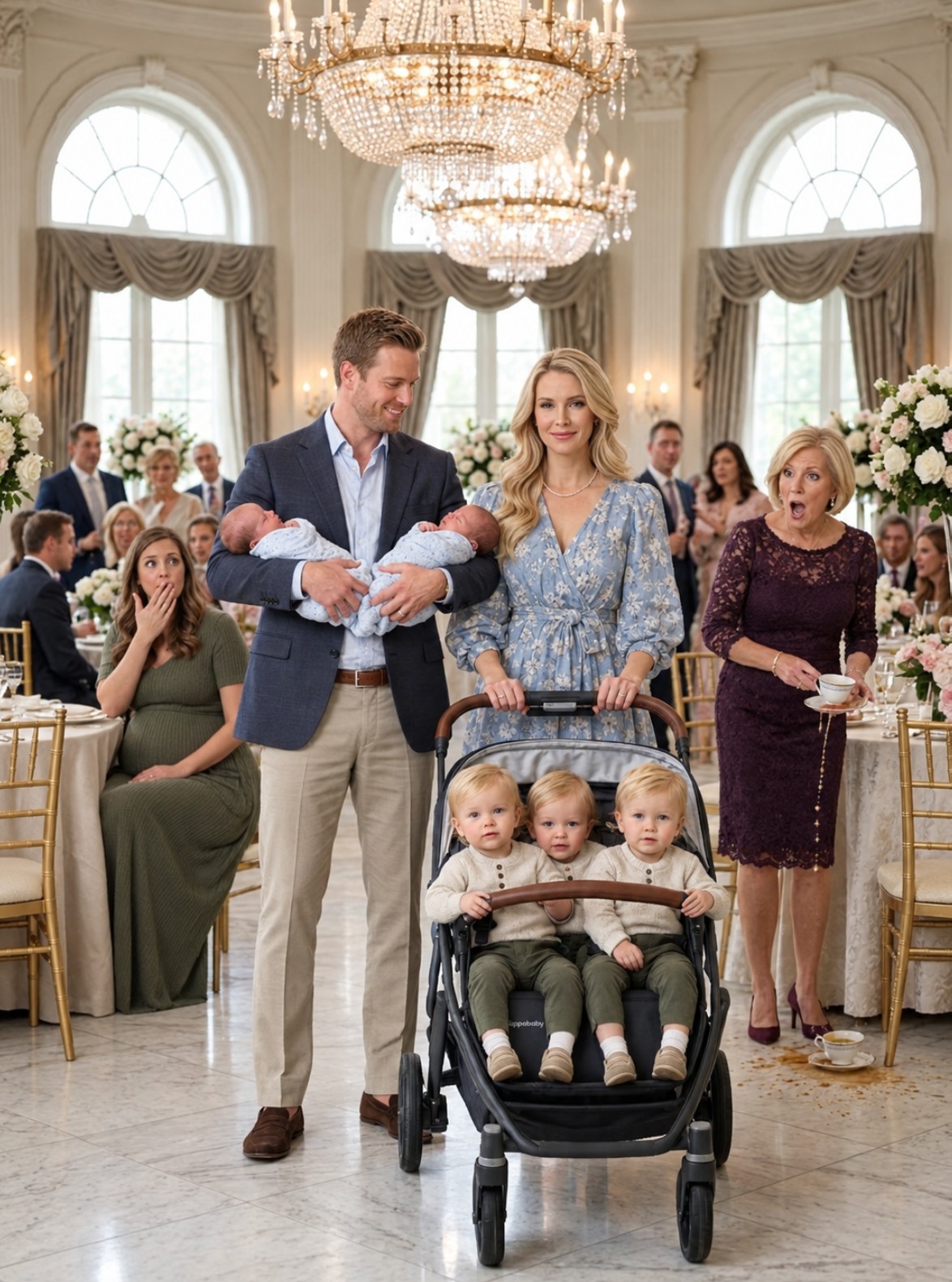
The air inside the Huntington Conservatory smelled of expensive lilies, vanilla buttercream, warm champagne, and the cold judgment that wealthy families often disguised as tradition. I had not breathed that suffocating air in three years, but the moment I stepped across the marble threshold, the familiar smell settled in the back of my throat like heavy smoke.
The Huntington Conservatory had always been my mother’s favorite place to hold court while looking down on everyone around her. It was attached to the eastern side of my parents’ enormous estate in Barrington, Rhode Island. With its towering glass walls, polished steel frames, white orchids, and perfectly trimmed palm trees, it looked more like a cathedral than a room in someone’s home.
When I was a little girl, the windows fogged around the edges on winter mornings, making the entire space feel like something out of a beautiful dream. In summer, however, the room was always too bright and too carefully controlled. Even the sunlight seemed to have been trained to enter quietly and behave itself.
That afternoon, the conservatory had been transformed into a pink-and-cream shrine dedicated to motherhood.
Pastel roses climbed around every doorway. Thick silk ribbons were tied in elegant bows over the backs of gilded chairs. Near the windows stood a dessert table carrying a three-tiered cake decorated with sugar peonies and tiny fondant baby shoes.
A gold plaque rested on top of the cake.
Welcome to the New Huntington Heir.
The words were written in elegant lettering, as if the baby had already been given a place in the family history books.
Crystal champagne flutes chimed softly as the guests laughed in delicate bursts. Their voices floated toward the vaulted glass ceiling while I stood just inside the entrance, instinctively adjusting the silk cuff of my navy blouse.
It was a nervous habit I thought I had left behind when I moved away from this house.
Apparently, old houses remember every version of you. The moment you walk back inside, they hand those memories right back.
In the center of the crowded room sat my younger sister, Penelope, perched on a velvet chair that had been arranged to resemble a royal throne. Her hands rested protectively over her pregnant belly as she smiled at the women gathered around her.
She wore a pale pink silk dress. Penelope had always been good at wearing whatever role someone assigned her, wrapping herself in a softness that made people want to protect her.
Her blonde hair fell in loose waves over one shoulder, and her cheeks were flushed from the warmth of the room.
Even from across the conservatory, I could see the tiny lines of strain around her blue eyes.
Everyone kept telling her how beautiful she looked and how she was glowing. But I knew my sister well enough to recognize that she was performing for the audience.
We all performed when we were around Madeline Huntington.
My mother stood beside Penelope, hovering over her like a hawk guarding a nest she fully intended to claim as her own.
Madeline was sixty-three years old, although no one would have dared to mention her age in her presence. Her hair remained the same icy blonde she had maintained for decades, and her skin had the smooth, carefully preserved appearance of someone who believed aging was a personal failure.
She wore a cream-colored suit, a string of pearls, and the expression of a woman who expected the world to stop turning whenever she decided it should.
For a moment, she did not notice me.
I almost turned around and left.
That is the absolute truth of what happened.
I had spent three years convincing myself that I was finally free of her and the suffocating social rituals in which cruelty wore white gloves and called itself good manners.
I had married a wonderful man without inviting her to the wedding. I had built a loud, joyful life in Philadelphia that she knew absolutely nothing about.
I had survived surgeries, physical pain, and the kind of loneliness that can turn a woman’s bones into cold steel.
Yet, standing in the doorway of that conservatory, I suddenly felt as though I were twenty-seven again.
I was twenty-seven years old when I sat crying in my childhood bedroom while my mother explained that a woman who could not produce children was nothing more than an ornamental object.
I took a deep breath.
I reminded myself that I was now thirty-two years old. I was no longer that frightened young woman waiting for her mother to decide whether she deserved to be loved.
I had not returned to this house to be forgiven. I had not come to seek approval from a woman who did not understand the meaning of love.
I was there because my father had sent me a desperate text message the previous night from a private number.
He had written that Madeline wanted the entire family together for the sake of peace. He begged me to make a brief appearance, even if I stayed only long enough to say hello.
In my family, peace had never meant the absence of violence.
It meant a short pause while everyone reloaded their weapons.
Still, I had agreed to come. I wanted to stand in the room where I had once been labeled broken and decide for myself how my story would end.
I stepped farther inside.
My heels clicked against the polished stone floor, and the sound carried farther than I expected.
Then my mother’s voice cut through the air like a knife hidden beneath a layer of silk.
“Lydia?”
The conversations nearest the entrance immediately slowed.
Several heads turned toward me. Among them was Mrs. Perkins, my mother’s favorite source of gossip since I was in middle school. Beside her stood Sylvia, who tilted her champagne flute and watched me with open curiosity.
My mother approached with measured steps, showing no particular hurry to greet her oldest daughter.
Madeline Huntington never hurried unless someone was bleeding on one of her expensive rugs. Even then, she preferred to supervise the cleaning rather than deal with the problem herself.
“Mother,” I said, keeping my voice calm and even. “The decorations are quite lovely.”
She stopped about a foot away from me.
It was close enough to invade my personal space, but not close enough to offer a hug.
Her eyes traveled over my appearance, inspecting my hair, makeup, and jewelry for any sign of a flaw.
She examined me the way a jeweler looks for cracks in a diamond.
In my case, I suspected she was always hoping to find one.
“I’m honestly surprised you decided to come today,” she said with a pitying smile.
“I told your father that being around all of this new life might be much too painful for you.”
She gestured toward the pregnant women, the baby gifts, the flowers, and the enormous cake. Every object seemed to serve as a monument to everything she believed I had failed to become.
I looked past her shoulder.
Penelope had noticed me. Her smile trembled slightly before she raised one hand and gave me a small wave.
“I’m very happy for my sister,” I replied. “Why would I find this painful?”
Madeline released a theatrical sigh, carefully timed so that everyone standing nearby could hear it.
Mrs. Perkins and Sylvia remained close enough to listen while pretending they were not paying attention.
“Oh, darling, we really don’t have to pretend with each other,” my mother said, placing a cold hand on my arm. “We all know about your difficult situation and the struggles you’ve faced.”
In the Huntington family, words were chosen carefully. Their purpose was rarely to spare someone’s feelings. They were selected to sharpen an injury while allowing the person delivering it to pretend they had done nothing wrong.
“It’s very brave of you to show up today,” she continued, “knowing that you’re essentially incompatible with this world.”
That word was new.
Usually, she preferred to call me defective or unfortunate when she was feeling less creative.
She had once called me damaged goods.
Those two words had ended our relationship.
“I’m doing just fine, Mother,” I said, gently removing my arm from her grasp.
She tilted her head and examined me again.
“You look tired,” she observed. “And that navy dress of yours. Did you buy it off the rack?”
I said nothing.
“I always worried that without a husband to take care of your needs, you’d simply fade away into nothing,” she whispered.
She had no idea how wrong she was.
I had made certain that none of them knew the truth about my life.
They did not know about Marcus. They certainly did not know about our brownstone on Delancey Place in Philadelphia, where five children filled every room with toys, fingerprints, laughter, and the kind of impossible joy my mother could never understand.
They did not know that the severe medical problems she had used as evidence of my failure had become a battle I fought with the help of some of the best specialists in the country.
They did not know about our wedding in a small garden, or the fact that I now owned one of the most respected contemporary art galleries in the city.
Most importantly, they did not know about the five children who called me Mama every single morning.
Leo, Sam, Maya, Jonah, and little Sarah.
Their names were precious to me. I had never allowed my mother to turn them into social currency because I knew exactly what she would do with that kind of information.
I opened my mouth to tell her the truth.
For one heartbeat, I nearly let everything spill out right there between the cucumber sandwiches and champagne flutes.
Then I stopped myself.
The timing of this revelation mattered more than my immediate anger.
Marcus was still parking our large SUV outside. He had insisted on checking the children’s car seats one last time before bringing everyone inside.
That was simply how Marcus operated.
He was brilliant enough to perform complicated brain surgery, yet meticulous enough to spend several minutes adjusting a toddler’s chest clip until he was certain it was positioned correctly.
He never treated the small responsibilities of family life as less important than the great ones.
“I came to wish Penelope well,” I told my mother.
Madeline gave me a dismissive smile.
“Well, do get yourself a glass of champagne. At least you don’t have to worry about drinking for two.”
The women behind her laughed softly into their glasses.
The sound scraped against my nerves like sandpaper on wood.
I walked away before I said something I might regret. A passing waiter offered me a drink, and I accepted a glass of sparkling water before moving to a quiet corner near the palms.
From there, I could see the entire room.
Penelope sat on her velvet throne while my mother arranged the guests around her like chess pieces. Every conversation, every smile, and every little gesture seemed to happen according to a plan Madeline had created long before anyone arrived.
Near the buffet table stood my father, Franklin Huntington, holding a glass of scotch he had not yet touched.
When he spotted me, his expression changed immediately.
Relief crossed his face, followed by a deep, unmistakable sense of guilt.
Franklin Huntington was a man who wanted to be kinder than he was brave enough to be.
He had spent his life earning millions in real estate, building a reputation as a sharp businessman who could recognize a good investment before anyone else.
But inside his own home, he had surrendered nearly all his emotional authority to my mother years ago.
In public, people respected his judgment.
In private, he simply learned to live with whatever emotional weather Madeline created.
I checked my watch.
It was 1:14 p.m.
I had promised myself that I would stay for only a short time. If everything went according to plan, I had five minutes left before I could leave the conservatory and return to the family I had built.
I watched Penelope open her gifts.
There were cashmere blankets, silver rattles, expensive baby clothes, and beautifully wrapped boxes containing things that cost more than some used cars.
Each time she lifted a piece of tissue paper, the guests responded with soft sounds of appreciation.
Penelope smiled and thanked everyone.
Yet that tightness around her eyes never completely disappeared.
I recognized it because I had worn the same expression for years.
Growing up, I had always been the sharp child with too many opinions. Penelope had learned a different lesson: obedience earned affection.
If our mother declared that pink was her color, Penelope wore pink without complaint.
If Madeline announced that a good marriage mattered more than a university degree, Penelope abandoned her studies and married a man from the right family.
I never hated my sister for finding her own way to survive.
But I had stopped mistaking her silence for innocence.
A waiter passed with a tray of cucumber sandwiches. I waved him away because my stomach was too tight for food.
It wasn’t only the insults that hurt.
It was the history behind them.
And the knowledge that, after three years of separation, my mother could still make the same old wounds feel fresh.
Five years earlier, I had been engaged to a man named Chandler.
My mother adored him because he came from old money and carried a famous family name. He had the right connections, the right manners, and the kind of family background that made Madeline believe she had chosen perfectly.
I did not love Chandler enough.
At the time, however, I convinced myself that love might grow if I simply gave it enough time and patience.
Then the pain began.
At first, I tried to ignore it. I was busy planning a wedding and trying to satisfy a family that treated every personal decision as a matter of public importance.
But the pain became impossible to ignore.
There were hospital appointments, examinations, surgeries, and long hours spent waiting in cold rooms while doctors studied test results and discussed my future.
Eventually, I received the diagnosis that changed the direction of my life.
The scarring and damage to my reproductive system meant that my chances of conceiving naturally were extremely low. Even with medical treatment, carrying a pregnancy might be difficult, and there were no guarantees.
The doctors explained everything carefully.
I heard their words, but at the time, all I could think about was the wedding dress hanging in my childhood bedroom and the future I had imagined with Chandler.
At first, Chandler held my hand.
He told me that we would face the uncertainty together.
Then his mother had a long, private conversation with my mother about family expectations and the importance of producing an heir.
After that, something changed.
Chandler began using phrases like future uncertainty. He stopped looking me in the eye when we spoke. Our conversations became shorter, colder, and filled with awkward silences.
I knew what was happening, but I kept hoping I was wrong.
One afternoon, my mother came into my bedroom and sat on the edge of my bed.
She did not ask how I was feeling.
She did not ask whether I was frightened.
Instead, she looked at me with the calm expression of someone delivering a business assessment.
“Lydia, you need to understand something,” she said. “A woman who cannot produce an heir for a family like ours is like a beautiful vase that cannot hold any water.”
I stared at her, waiting for her to realize what she had just said.
She never did.
“You’re decorative,” she continued, “but ultimately useless.”
I felt as if the room had suddenly lost all its air.
Two weeks later, my engagement ended.
Chandler did not even have the courage to face me in person. He sent a letter explaining that our circumstances had changed and that he believed ending the engagement was best for both of us.
My mother told everyone that the separation had been a mutual decision.
She made it sound as though we had calmly discussed our options over tea and agreed to go our separate ways.
The truth was much uglier.
The next morning, I packed two suitcases and left the Huntington estate.
I took the check from a trust my grandmother had secretly left me, a small inheritance my mother had never managed to control.
Then I moved to Philadelphia.
During that first year, I learned how to sleep without waiting for my mother’s voice to tell me I was a disappointment.
I learned how to make decisions without imagining her reaction.
I learned how to walk into a room without wondering whether I looked rich enough, thin enough, beautiful enough, or successful enough to deserve a place there.
It was not easy.
Some nights, I cried until I had no tears left. Other nights, I lay awake remembering the things she had said and wondering whether some part of me believed them.
But slowly, I began to build a life that belonged to me.
I earned my master’s degree in art history and found a job at a small gallery.
The owner, Mrs. Finch, took an immediate liking to me. She was an older woman with sharp eyes, a dry sense of humor, and a genuine love for art.
One afternoon, after watching me explain a difficult painting to a hesitant buyer, she pulled me aside.
“You have the expression of a woman who has survived wealth,” she said.
I laughed because I had never heard anyone describe my childhood quite so accurately.
Mrs. Finch studied me for a moment.
“You’re going to do very well in this business, Lydia. You have excellent taste, and you understand that art is about people, not just money.”
I remembered those words for years.
When Mrs. Finch eventually decided to retire, she offered to sell me the gallery on terms so generous that I began crying in her office.
She handed me the keys and waited until I had composed myself.
“I’m not giving you charity, Lydia,” she said firmly. “I’m simply investing in your excellent taste.”
That gallery became my sanctuary.
I worked long hours, learned every part of the business, developed relationships with artists and collectors, and slowly expanded the space.
Before long, it had become one of the most respected contemporary art galleries in Philadelphia.
My mother continued to believe I worked in a small shop.
I never bothered to correct her.
For once, I was perfectly content to let her underestimate me.
Then, at a charity auction, I met Marcus.
He was standing in front of a modern sculpture, staring at it as if the artist had personally offended him.
I watched him for a moment before walking over.
“You clearly hate that piece,” I said.
He turned around, startled, then gave me a warm smile.
“I’ve been trying very hard to like it,” he admitted. “The cause is important, but I honestly can’t figure out what the artist was trying to accomplish.”
I laughed.
He laughed, too, and something about the sound immediately put me at ease.
As we talked, I discovered that Marcus was a neurosurgeon and one of the most respected specialists in his field. His work was demanding, his schedule was unpredictable, and his mind was constantly occupied with problems most people could not begin to understand.
Yet he never made me feel as though I needed to prove my intelligence to keep up with him.
He asked questions because he genuinely wanted to know the answers.
He listened when I spoke.
And when he disagreed with me, he explained why without making me feel small.
On our third date, I decided to tell him about my medical history.
We were sitting in a small Italian restaurant. The room smelled of garlic, fresh bread, and tomato sauce, but my hands had become so cold that I could barely hold my glass.
I had learned the hard way how expensive it could be to keep secrets from people you cared about.
“Marcus, there’s something you need to know about me,” I began.
He put down his fork and gave me his full attention.
I told him about the surgeries, the scarring, and the diagnosis. I explained that I might never be able to carry a child and that even fertility treatment could not promise a successful pregnancy.
I expected him to pull away.
I expected a careful expression, a polite response, and the slow beginning of an ending.
Instead, Marcus reached across the table and took my hand.
“Lydia, I’m falling in love with you,” he said firmly. “And I’m not falling in love with your reproductive system.”
I stared at him.
He squeezed my hand.
“I want you. I want the life we can build together. If we have children someday, we’ll figure out the best way to make that happen. And if we don’t, we’ll still have each other. You’re not a medical diagnosis, and you’re certainly not a disappointment.”
For the first time in years, I felt as though someone had looked directly at me and seen a whole person.
Not a future mother.
Not a family investment.
Not a broken woman.
Just Lydia.
We married in a tiny garden ceremony attended by our closest friends.
There were no grand chandeliers, no society pages, and no expensive guest list designed to impress anyone.
The flowers were simple. The food was delicious. Marcus looked at me as though I were the only person in the world.
And for the first time, I did not feel that I needed my family’s permission to be happy.
None of the Huntingtons received an invitation.
After the wedding, I sent my father a single photograph of Marcus and me standing beneath an arch of flowers.
He replied with a short message.
You look truly happy for the first time, Lydia. I’m glad.
I read those words several times.
Then I put my phone away and returned to my new husband.
The wedding was only the beginning of our journey.
What followed was a long, difficult road through fertility treatments, injections, medical appointments, and countless moments when hope seemed almost too painful to hold.
People like my mother call children miracles.
I understand why.
But I also know what our journey looked like behind the beautiful photographs. It involved science, needles, carefully timed medications, blood tests, and the courage to try again after disappointment.
Marcus was beside me through every injection.
He learned the names of the medications and the schedule for each appointment. He drove me to the clinic whenever his hospital duties allowed, and when he could not come in person, he called to make sure I was all right.
After our second unsuccessful attempt, I sat on the bathroom floor and cried.
I had done everything the doctors asked me to do. I had followed the instructions, endured the treatments, and allowed myself to believe that this time might be different.
When it failed, I felt as though I had disappointed everyone, even though Marcus had never once made me feel that way.
He found me sitting on the cold tile and lowered himself beside me.
I could barely look at him.
“I’m sorry,” I whispered.
He frowned gently.
“What are you apologizing for?”
“For all of this. For the treatments. For the money. For the fact that we keep going through this and I still can’t give you a child.”
Marcus pulled me into his arms.
“Lydia, listen to me,” he said against my hair. “We are already a complete family, even if it remains just the two of us forever. I married you because I love you. Nothing about this changes that.”
I clung to him and cried until the worst of the pain passed.
Then, when we were ready, we tried again.
And this time, something happened that neither of us had expected.
The embryo transfer succeeded.
More than that, the pregnancy resulted in triplets.
Three babies.
Leo, Sam, and Maya.
When the doctor explained what we were seeing on the scan, I looked at Marcus, then back at the screen, convinced I had misunderstood.
“Three?” I asked.
The doctor smiled.
“Three.”
Marcus sat very still for a moment.
Then he looked at me with wide eyes.
“Well,” he said quietly, “I think we’re going to need a bigger car.”
I laughed so hard that the doctor had to pause the examination.
The triplets arrived early and spent time in the neonatal intensive care unit. Those first days were filled with the constant sound of medical monitors, the smell of disinfectant, and the fear that came with seeing such tiny babies connected to wires and tubes.
We learned to live in short intervals.
One feeding.
One examination.
One reassuring update from a nurse.
One more hour in which all three babies continued to grow stronger.
Marcus knew how to read the monitors, but even his medical training could not protect him from the helplessness of watching his own children struggle.
He held my hand through the frightening moments and reminded me that we had to take things one day at a time.
Eventually, the babies grew stronger, and we brought them home.
Our life became a beautiful, exhausting storm of bottles, blankets, laundry, sleepless nights, and tiny hands reaching for our fingers.
For two years, we lived in a world of joyful chaos.
Then, one morning, I woke up feeling strangely unwell.
At first, I blamed stress and exhaustion. Running a successful gallery while raising three young children was hardly a relaxing lifestyle.
But the symptoms continued, and I finally took a pregnancy test.
I stared at the result, then took another one.
Both were positive.
I called Marcus, who was at the hospital.
When he answered, I could barely get the words out.
“Marcus, I think you need to come home.”
His voice immediately changed.
“What’s wrong? Are you feeling sick?”
I looked down at the test in my hand.
“Not exactly.”
There was a long pause after I explained.
Then he asked, “Are you sure?”
“I’ve taken two tests.”
He let out a breath that sounded half like a laugh and half like disbelief.
“I’ll be home as soon as I can.”
The pregnancy had occurred naturally, something our doctors explained was possible despite my earlier diagnosis. My fertility problems had made conception difficult, not absolutely impossible, and none of us had expected this outcome.
At our next scan, we discovered that we were expecting twins.
Jonah and Sarah arrived eight weeks before Penelope’s baby shower.
They were tiny, beautiful, and determined to make their presence known.
By the time they came home, I was a mother of five children under the age of three, with the triplets approaching their third birthday and the twins still so small that their clothes seemed to swallow them.
Our house was louder than ever.
It was also happier than I had ever imagined possible.
And my mother still believed I was a barren woman living alone in a small studio apartment.
I looked down at my watch.
It was exactly 1:17 p.m.
Then my sister called my name.
Penelope was waving me toward the center of the conservatory.
As I approached, I could feel the eyes of every guest following me. Their curiosity was almost physical, as if my presence had disrupted a carefully arranged picture and they were waiting to see whether I would ruin it further.
I crossed the polished floor and reached for my sister’s hand.
“I’m so glad you came today, Lydia,” Penelope said quietly.
For a moment, she sounded like the sister I remembered from childhood, before our mother had taught us that affection was something we had to earn.
She squeezed my fingers.
“Is it hard for you to be here?” she asked. “I mean, with all the baby things and everything?”
I saw the pity in her eyes, and somehow that hurt more than my mother’s coldness.
“Mother said you might feel jealous,” Penelope admitted. “She said it would probably be difficult for you to watch everyone celebrating.”
I took a slow breath.
“I’m not jealous of anyone, Penelope. I have a very full and happy life.”
She looked at me as though she wanted to believe me but did not know how.
Before she could respond, Madeline appeared beside us.
My mother had a remarkable ability to sense when a conversation was happening without her permission. She placed one hand on Penelope’s shoulder and turned toward the other guests.
Then she raised her voice.
“We should all be especially kind to Lydia today.”
The conservatory fell silent.
My mother looked around the room, making sure she had everyone’s attention.
“It takes an extraordinary amount of strength to celebrate another woman’s happiness when you know you will never experience that same joy yourself.”
Penelope’s face tightened.
“Mother, please stop,” she whispered.
But she did not stand up. She did not remove my mother’s hand from her shoulder. She simply sat there, trapped between the woman who had controlled her life and the sister she had never quite learned how to defend.
Madeline continued.
“Of course, we must remember that not every woman is meant for the same things. Some women are built to carry on a family legacy, while others are simply damaged goods.”
For one second, the entire room seemed to disappear.
I heard nothing except the sound of my own heartbeat.
The old Lydia might have cried. She might have run to the nearest bathroom, locked herself inside, and spent the afternoon trying to convince herself that her mother had not meant what she said.
But the woman standing in that conservatory had endured too much to be destroyed by a few cruel words.
I thought about every night I had cried alone in Philadelphia.
I thought about every injection, every hospital appointment, and every time Marcus had held me while I wondered whether I would ever become a mother.
I thought about Mrs. Finch handing me the keys to my gallery because she believed in me.
I thought about five little faces waiting for me at home.
And suddenly, my mother’s opinion seemed so small that I wondered how I had ever allowed it to control me.
A clean, white flame of anger rose in my chest.
I looked directly at Madeline and smiled slowly.
“Is that really what you think, Mother?”
My voice carried clearly through the conservatory.
She lifted her chin.
“I’m simply being realistic, Lydia. There’s no reason to make this unpleasant.”
“Then let’s talk about reality.”
I turned toward the heavy oak doors at the entrance.
My watch read 1:19 p.m.
“Actually, Mother, I think you should put your teacup down. Your hands look a little shaky.”
Her eyes narrowed.
“What on earth are you talking about?”
I did not answer.
At that moment, the heavy doors began to open.
They groaned softly as someone pushed them from the outside, and every head in the room turned toward the entrance.
The first person to appear was not a waiter carrying another tray of champagne.
It was Rosa, our nanny.
She strode into the conservatory with the calm confidence of a woman who regularly managed five small children and therefore had very little patience for unnecessary drama.
In front of her was a custom-built, triple-wide stroller that looked as though it had been designed by a military contractor.
Inside sat Leo, Sam, and Maya, my two-year-old triplets.
The room released a collective gasp.
Leo clutched a stuffed dinosaur against his chest. Sam was busy examining the stroller straps, apparently considering whether they could be defeated. Maya immediately began waving enthusiastically at the unfamiliar faces around her.
Rosa guided the stroller toward me.
“I’m sorry we’re a little late,” she said. “Sam dropped his pacifier in the fountain outside, and we had to retrieve it before he decided to make the entire situation everyone’s problem.”
I laughed softly.
“That’s all right, Rosa. Thank you for bringing them.”
I leaned down and smoothed Sam’s hair.
He looked up at me with his bright little eyes.
“Mama!”
The word rang out clearly.
My mother’s expression changed.
It was as if something inside her had suddenly shattered, leaving her unable to understand what she was seeing.
She stared at the three children, then at me.
“Whose children are those?” she asked.
Her voice was so thin that I almost felt sorry for her.
Almost.
Before I could answer, the doors opened again.
This time, Marcus stepped into the conservatory.
He wore a charcoal suit, and his broad shoulders filled the doorway. Even in a room full of wealthy people accustomed to commanding attention, he carried an unmistakable sense of confidence and authority.
In his arms were Jonah and Sarah, our eight-week-old twins.
Both babies were sleeping peacefully against his chest, wrapped in soft blankets.
Marcus walked through the stunned crowd without saying a word. He came straight to me, leaned down, and kissed my forehead.
“Sorry I’m late, love,” he said. “The hospital board meeting ran much longer than I expected.”
Then he glanced at the children in the stroller.
“Looks like everyone made it safely.”
“Eventually,” I replied, smiling.
He laughed and adjusted the blanket around Sarah.
For a few seconds, the room remained completely silent.
Then someone whispered a name.
“Dr. Marcus Cross?”
Another guest turned toward him.
“Is that the neurosurgeon?”
The whispers spread quickly.
Several people in the room recognized him. Marcus had earned an international reputation for his work in neurosurgery, and his research had helped advance a spinal repair protocol used by specialists.
My mother seemed unable to process any of it.
Her teacup slipped from her hand.
It struck the saucer with a sharp clatter, spilling tea across the front of her expensive cream suit.
She barely noticed.
Her eyes were fixed on the children.
“Five,” she whispered.
I looked at her.
“Yes, Mother. Five.”
She stared at me as though she were seeing a stranger.
I reached into the stroller and carefully lifted Leo, settling him against my hip. He immediately wrapped one arm around my neck and rested his dinosaur between us.
“Triplets and twins,” I explained. “Five beautiful children.”
Madeline opened her mouth, but no words came out.
I looked her directly in the eyes.
“It turns out I was never broken. I simply needed to get away from the person who was breaking me.”
The words landed harder than I had expected.
For the first time in my life, my mother had no immediate answer.
Penelope slowly rose from her chair.
Her face had gone pale as she approached the stroller and looked down at the three toddlers.
“Are they really yours?” she asked.
She looked from the triplets to the sleeping babies in Marcus’s arms.
“All five of them?”
Marcus answered before I could.
“Yes. Every single one of them is ours.”
Penelope covered her mouth with one hand.
“Oh, Lydia.”
I could see a dozen questions moving behind her eyes. She looked amazed, confused, and deeply hurt that she had been excluded from such an important part of my life.
I understood those feelings, even if I did not regret my decision.
“I didn’t lie to you, Mother,” I said, turning back to Madeline. “I simply stopped giving you access to information you would only use as a weapon.”
Her expression hardened.
“You hid my grandchildren from me!”
“No,” I replied. “I protected them.”
I glanced around the room.
Some of the guests looked embarrassed. Others seemed fascinated by the drama unfolding in front of them.
Mrs. Perkins, naturally, appeared to be experiencing the most exciting afternoon of her social life.
She stepped forward and looked at Marcus.
“Dr. Cross, are you the surgeon who helped develop that famous spinal repair protocol?”
Marcus nodded politely.
“I’ve been fortunate enough to work with some excellent colleagues on that research.”
He did not boast or exaggerate his achievements. That was one of the things I loved about him.
He then placed a hand gently on my back.
“For those of you who haven’t met her, this is my wife, Lydia. She’s a successful gallery owner, an extraordinary mother, and the strongest person I know.”
Each phrase seemed to strike the room like a heavy stone.
My mother stared at him.
A successful gallery owner.
An extraordinary mother.
The strongest person he knew.
Three descriptions of me that she had spent years insisting could never be true.
Madeline finally found her voice.
“Why didn’t you tell me?”
I shifted Leo on my hip as he began reaching toward the flowers on a nearby table.
“Tell you what, exactly?”
“That you were married! That you had children! That you were living this entire life without telling your own family!”
I almost laughed.
“Mother, I sent Father a photograph from my wedding. You chose not to ask about my life after that. And when I did come here, you made it very clear that you believed I had nothing worth telling you.”
“That’s not the point!”
“Then what is the point?”
She looked around at the guests, clearly searching for someone who might support her.
No one spoke.
“You can’t simply decide that I have no right to know about my own grandchildren,” she insisted.
I shook my head.
“My children are not trophies for your vanity, Mother. They’re not props for your social media pages, and they’re not proof that the Huntington family has produced another generation.”
Leo tugged gently at my blouse.
I kissed the top of his head before continuing.
“They are human beings. They have their own personalities, their own feelings, and their own futures. And I made a promise to myself that they would never have to earn your love by meeting your expectations.”
Madeline’s lips parted.
For once, nothing came out.
I had imagined this moment many times over the years. In some versions, I shouted at her. In others, I cried. Sometimes, I imagined delivering a speech so powerful that everyone in the room would stand up and applaud.
But the truth was much simpler.
I no longer needed her to understand me.
I no longer needed her approval.
And I certainly did not need her permission to live my life.
She reached toward Jonah, who was still sleeping peacefully in Marcus’s arms.
Marcus immediately stepped back, keeping the baby safely against his chest.
It was not an aggressive movement. He simply placed himself between my mother and our son.
Madeline froze.
“You don’t get to hold them,” I said firmly. “And you don’t get to become a loving grandmother in public after acting like an executioner in private.”
The word executioner made several guests visibly uncomfortable.
Good.
Perhaps they would remember it the next time they were tempted to confuse cruelty with sophistication.
Penelope began to cry.
“Lydia, please. We’re family.”
I turned toward her.
“Family is supposed to protect you, Penelope. It’s supposed to stand beside you when you’re hurting, not watch you bleed and then tell you that the blood is your fault.”
She lowered her eyes.
“I know,” she whispered.
“Do you?”
My voice softened, but I did not take back my words.
“You watched Mother humiliate me today. You knew what she was doing. And you asked me whether I was jealous instead of asking why she thought it was acceptable to speak to me that way.”
Penelope wiped her cheeks.
“I was afraid.”
“I know you were. I spent years being afraid, too.”
For a moment, we simply looked at each other.
I could see the little girl she had once been, the sister who used to sneak into my bedroom during thunderstorms and climb into my bed because she was frightened of the lightning.
I still loved that girl.
But I could no longer keep sacrificing myself to protect the woman my mother had trained her to become.
“I’m leaving now,” I told her. “I’m going home with my husband, my children, and Rosa. My real family is right here.”
Madeline suddenly snapped out of her shock.
“What will people think if you walk out like this?”
I stared at her.
Then, to my own surprise, I laughed.
It was not a nervous laugh or the polite little sound I had learned to make when my mother embarrassed me in public.
It was a genuine laugh, filled with disbelief at the absurdity of her question.
“What will people think?” I repeated.
I looked around the conservatory.
At the guests who had watched her humiliate me.
At the women who had laughed into their champagne glasses.
At the expensive flowers and the ridiculous cake celebrating a family legacy that apparently mattered more than the people who were supposed to carry it forward.
“Mother, I don’t care what these people think of me anymore.”
For the first time in my life, I meant it completely.
Marcus adjusted the babies in his arms, and Rosa secured the stroller.
Together, we began moving toward the entrance.
The crowd parted to let us through.
I felt their eyes following us, but I no longer felt the need to explain myself.
My children were safe. My husband was beside me. I had built a life filled with love, and none of the people in that room could take it away.
We were almost at the threshold when my father called my name.
“Lydia, wait.”
I turned.
Franklin stood near the buffet table, his untouched glass of scotch still in his hand. His eyes were wet, and he looked at the children with an expression I had rarely seen on his face.
It was not judgment.
It was wonder.
“They’re beautiful, Lydia,” he said softly. “You did a good job.”
For a moment, I could not speak.
Those were such simple words. Yet, coming from my father, they carried the weight of everything he had failed to say when I was younger.
“Thank you, Dad,” I replied.
He took a small step toward me.
“I wish I had known.”
I held his gaze.
“You could have known more about my life if you had asked. But if you really want to be part of it, you need to stop being a spectator.”
He lowered his head.
I could see that the words hurt him, but I also knew they were true.
“Call me when you’re ready to do that,” I told him.
Then I turned and walked outside.
The cool air touched my face, and the bright sunlight seemed almost unreal after the conservatory’s carefully controlled atmosphere.
For the first time that afternoon, I felt as though I could breathe.
We loaded the children into the SUV, checking each car seat and counting everyone twice before pulling out of the estate’s long driveway.
I glanced into the side mirror.
Madeline was standing on the steps of the conservatory.
She looked smaller than I remembered, like a ghost haunting a house that no longer contained anything of value.
I watched her for a few seconds.
Then the road curved, the estate disappeared behind the trees, and I turned my attention back to the life waiting for me.
None of the adults spoke during the first ten minutes of the drive.
The children, however, had plenty to say.
Maya sang a song that appeared to consist mostly of the word “la.” Leo pointed at every tree we passed and announced his observations with great enthusiasm. Sam loudly demanded a snack, apparently convinced that his mother had committed a serious crime by failing to provide one immediately.
Jonah and Sarah slept through most of the commotion.
Finally, Rosa turned around in her seat and looked at me.
“Well,” she said, “that was the best baby shower I’ve ever attended.”
Marcus burst out laughing.
I tried to hold it in, but the laughter escaped me, too.
We laughed until my sides hurt.
It was partly relief and partly exhaustion, but there was something else beneath it.
For years, I had imagined returning to my childhood home as a woman who could finally prove that my mother had been wrong about me.
I had thought the most satisfying part would be watching her face when she learned the truth.
Instead, the greatest relief came from realizing that I no longer needed to prove anything.
My life was already mine.
By the time we reached our home in Philadelphia, my hands had finally stopped shaking from the adrenaline of the confrontation.
Our brownstone looked exactly as it had when we left that morning. The front steps were scattered with a few leaves, and one of the children’s toy trucks sat abandoned near the entrance.
Inside, the house smelled faintly of laundry detergent, baby lotion, and the lunch Rosa had prepared before we left.
It was not a mansion.
There were no towering glass walls or gilded chairs. Our living room was often covered in toys, and the kitchen table rarely remained clear for more than ten minutes.
But it was our home.
And nobody inside it had to pretend to be someone else to deserve love.
That evening, after the children had finally settled down, Marcus and I sat on the kitchen floor because every available chair was covered in toys.
He handed me a glass of wine and leaned back against the cupboard.
“Any regrets?” he asked.
I considered the question.
“No,” I finally said. “Not about what I told her.”
He nodded.
“But?” he asked gently.
I looked down at my hands.
“But it still hurts with Penelope. I know she was afraid, but I wish she had stood up for me.”
Marcus reached for my hand.
“You can love someone and still be disappointed in them,” he said. “You don’t have to pretend it didn’t hurt just because you understand why she acted that way.”
I leaned my head against his shoulder.
That was another thing I had learned since leaving my mother’s house.
Love did not require me to deny reality.
I could forgive someone without trusting them immediately. I could understand their fear without allowing that fear to dictate my life. I could care about my sister without returning to the old role of the daughter who accepted every injury in silence.
For the first time, I could make those choices without feeling guilty.
The next morning, my father called.
I almost let the phone ring, but something made me answer.
“Lydia,” he said, sounding exhausted. “I need to talk to you about yesterday.”
I sat down at the kitchen table while the children played nearby.
“All right, Dad. I’m listening.”
He told me that my mother had spent the evening furious and humiliated. She had called several guests, complained about the way I had treated her, and insisted that I had deliberately ruined Penelope’s baby shower.
I was not surprised.
Then his voice changed.
“After everyone left, I went upstairs and sat in the guest room.”
He paused for a long moment.
“I kept thinking about what you said. About being a spectator.”
I did not interrupt.
“I’ve spent your entire life watching your mother hurt you and telling myself that staying out of it was the same as being neutral. I told myself that I was keeping the peace. I thought I was protecting everyone by refusing to take sides.”
His voice cracked.
“But I wasn’t protecting you, Lydia. I was leaving you alone with her.”
I closed my eyes.
For years, I had wanted my father to understand that his silence had hurt me almost as much as my mother’s cruelty.
Now that he was finally saying it himself, I did not feel the sudden relief I had imagined.
Instead, I felt sad for the years we had lost.
“I should have stood up for you,” he continued. “I should have stopped her. I should have been a better father.”
I swallowed hard.
“Yes, you should have.”
There was silence on the other end.
I did not rush to comfort him. I did not tell him that it was all right or that the past did not matter.
It did matter.
But I was willing to listen.
“I’m seeing a therapist, Lydia,” he said at last. “I want to learn how to be a better man. Not just a better father when things are easy, but someone who can actually stand up for the people he loves.”
I looked out the kitchen window at the small garden behind our house.
“Then keep going, Dad,” I told him. “Don’t do it because you’re afraid of losing me. Do it because you finally understand what you did wrong.”
“I will,” he promised.
For the first time in years, I allowed myself to hope that he meant it.
A few weeks later, Penelope came to visit.
She arrived on a Saturday afternoon carrying a small bag of gifts for the children. When I opened the door, she looked nervous and tired, as though she had spent the entire drive rehearsing what she wanted to say.
“Hi,” she whispered.
“Hi, Penelope.”
For a moment, neither of us moved.
Then I stepped aside.
“Come in.”
She walked into the living room and stopped.
Leo and Sam were building a tower out of wooden blocks. Maya was sitting on the rug with a stuffed rabbit, while Jonah and Sarah slept in their bassinets nearby.
The house was noisy, cluttered, and full of life.
Penelope looked around as if she had entered another world.
Then she began to cry.
“Oh, Lydia,” she whispered. “They’re beautiful.”
I sat beside her on the sofa.
She watched the triplets for several minutes, wiping her cheeks with the back of her hand.
“I can’t believe I didn’t know,” she said. “I can’t believe I thought you were alone all this time.”
“You believed what Mother told you.”
“I did.”
She looked at me.
“And I let her make me believe that you were jealous of me. I thought you were angry because I was having a baby and you couldn’t.”
I shook my head.
“I was never angry that you were pregnant. I was angry that Mother used your pregnancy as another excuse to humiliate me.”
Penelope lowered her eyes.
“I know that now.”
She took a shaky breath.
“I’m tired, Lydia.”
I waited.
“I’m tired of being the good daughter. I’m tired of making every decision based on what Mother will think. I’m tired of pretending I’m happy when I’m not, and I’m tired of being afraid that if I disappoint her, she’ll stop loving me.”
Her voice broke.
“I don’t know how to stop.”
I reached for her hand.
“It starts with one word.”
She looked at me.
“What word?”
“No.”
She gave a small, uncertain laugh through her tears.
“Just no?”
“Sometimes, yes. You don’t have to explain every decision. You don’t have to defend every boundary. And you don’t have to accept something that hurts you just because Mother says it’s what a good daughter would do.”
Penelope looked down at our joined hands.
“What if she gets angry?”
“She probably will.”
“What if she says I’m selfish?”
“She might.”
“What if she tells everyone I’ve changed?”
I smiled sadly.
“Then let her tell them. You cannot build a life around preventing someone else from being disappointed.”
She was quiet for a long time.
Then she nodded.
“I want to learn how to do that.”
I squeezed her hand.
“I’ll help you.”
We spent the rest of the afternoon talking about our childhood, our mother, and the things we had never dared to say aloud.
It was not a perfect conversation.
There were moments when Penelope became defensive, and others when I struggled to explain why her silence had hurt me so deeply. But we kept talking.
For the first time, we were not competing for our mother’s approval.
We were simply two sisters trying to understand what had happened to us.
It was a beginning.
Madeline, meanwhile, did not give up easily.
She called me repeatedly. When I did not answer, she sent messages demanding to know why I was punishing her. Then came letters, each one filled with accusations disguised as expressions of concern.
At first, she insisted that I had misunderstood her intentions.
Then she claimed that the stress of the party had caused her to say things she did not mean.
Finally, she began telling relatives that I had manipulated the situation to humiliate her in front of her friends.
I did not respond.
I had spent too many years trying to make my mother understand the pain she caused. I was no longer willing to spend my life explaining the same truth to someone who refused to hear it.
I had also made a promise to my children.
They would not be used as bargaining chips in an adult’s struggle for control.
If Madeline wanted a relationship with them, she would have to show that she could respect me as their mother.
That meant more than sending gifts or demanding access.
It meant taking responsibility for her behavior.
It meant accepting that being a grandmother was a privilege built on trust, not a right she could claim simply because we shared a last name.
Months passed.
My father continued therapy. He called regularly, asked about the children, and began acknowledging his mistakes without immediately making excuses for them.
He did not expect me to forgive him overnight.
That mattered.
Penelope also began making changes in her life. She started saying no to small requests that she did not want to fulfill. She stopped pretending to agree with everything our mother said.
Some days went well.
Others ended in tears.
Madeline did not welcome these changes. She accused Penelope of being ungrateful and complained that her daughters had somehow turned against her.
But slowly, Penelope began to understand that her mother’s anger was not proof that she was doing something wrong.
It was often simply proof that Madeline was no longer getting what she wanted.
A full year passed before I received a different kind of letter from my mother.
This time, there were no accusations.
No complaints about my behavior.
No demands that I remember my duty to the family.
Instead, she admitted that she had been cruel.
She wrote that she had judged my worth by my ability to produce children, that she had humiliated me when I was already frightened and vulnerable, and that she had used my medical problems as a weapon because she believed she had the right to decide what my life should look like.
She also acknowledged that I had been right to protect my children from the same treatment.
The letter did not erase the past.
It did not make the years of cruelty disappear, and it certainly did not restore the trust she had destroyed.
But it was the first time she had taken responsibility without immediately blaming me.
I read the letter twice before putting it down.
Marcus found me sitting quietly at the kitchen table.
“What’s wrong?” he asked.
I handed him the letter.
He read it, then looked at me.
“What do you want to do?”
I thought about it carefully.
Part of me wanted to ignore the letter and move on with my life. Another part wondered whether my mother might finally be capable of changing.
I knew that one apology did not guarantee a different future.
But I also knew that I did not have to decide everything at once.
“I think I’ll give her one chance,” I said. “One small chance, with clear rules.”
Marcus nodded.
“Then we’ll make sure the rules are respected.”
I agreed to let Madeline meet the children at a public park for one hour.
Marcus and I would both be present. The meeting would take place on a Saturday afternoon, and if she ignored our boundaries or said anything cruel, we would leave immediately.
She agreed to the conditions.
When the day arrived, I watched her approach the park bench with the same carefully arranged appearance she had always maintained.
Her hair was perfect. Her clothes were immaculate. She carried a bag filled with toys and gifts.
But she looked nervous.
For once, she seemed unsure of her place.
The triplets were busy playing nearby while Marcus kept an eye on Jonah and Sarah.
Madeline stopped a few feet away.
“Hello, Lydia.”
“Hello, Mother.”
She looked at the children.
“May I say hello to them?”
I nodded.
“Of course. Just remember that we’ll be staying together while they play.”
She approached the triplets slowly and introduced herself.
Maya looked at her for a moment before returning to her toys. Leo was more interested in showing her his dinosaur, while Sam demanded to know whether she had brought any snacks.
Madeline laughed awkwardly.
“I brought you some presents.”
The children were pleased, although they quickly became more interested in the wrapping paper than the gifts themselves.
For a while, the visit went well.
My mother asked questions about their favorite toys and listened while Maya explained something about a rabbit that had apparently committed a serious offense.
She did not criticize their clothes or complain about their behavior.
She even accepted it when Sam refused to let go of his dinosaur long enough to look at one of her gifts.
At one point, she looked at me.
“They’re wonderful children, Lydia.”
“They are.”
She swallowed.
“You’ve done a good job.”
I felt a familiar ache in my chest.
Once, those words would have meant everything to me.
Now, I could appreciate them without needing them.
“Thank you,” I said.
The hour passed without incident.
When it was time to leave, Madeline looked as though she wanted to ask for more time, but she did not.
Instead, she thanked us for allowing her to meet the children.
We said goodbye and returned to our car.
I did not hug her.
I did not promise that everything was forgiven.
I simply acknowledged that she had respected the rules we had set.
It was a small step, but it was a real one.
Over the following months, we allowed a few more visits. Some were pleasant, while others required gentle reminders about boundaries.
Madeline was not transformed into a perfect grandmother overnight.
She still occasionally made comments that revealed how deeply her old beliefs were rooted. Sometimes she tried to offer advice that no one had asked for, or she spoke as though she knew better than we did about what the children needed.
When that happened, I corrected her.
If she continued, the visit ended.
There were no dramatic arguments.
No long explanations.
Just clear boundaries and consistent consequences.
Slowly, she began to understand that the rules were not temporary obstacles she needed to overcome. They were the conditions under which she could remain part of our lives.
I never went back to calling her Mom.
For years, that word had carried too much pain.
I continued to call her Mother, and I kept a careful distance between us.
But eventually, something changed.
I stopped flinching whenever her name appeared on my phone.
I no longer felt my stomach tighten whenever I knew I would have to see her.
I could hear her voice without immediately feeling like the frightened young woman who had once cried alone in her childhood bedroom.
That was a victory, too.
My father continued his own journey.
He and my mother began addressing the problems in their marriage rather than pretending they did not exist. I did not know what their future would look like, and I stopped trying to manage it for them.
For once, I allowed my parents to be responsible for their own choices.
Penelope also grew stronger.
She learned that she could disagree with our mother without being a bad daughter. She began making decisions based on what she wanted rather than what would keep everyone else happy.
And when she needed support, she called me.
Our relationship was not magically repaired by one conversation. We still had difficult moments, and there were times when old habits returned.
But we were learning.
We were learning to speak honestly.
We were learning to recognize the difference between love and control.
Most importantly, we were learning that being sisters did not mean we had to keep repeating the patterns our mother had taught us.
Years later, when I watched my five children playing together in our garden, I often thought about the girl I had been.
Leo and Sam raced across the grass while Maya chased them, laughing so hard that she could barely keep up. Jonah and Sarah sat on a blanket nearby, arguing over a toy before deciding that sharing it was more fun than fighting over it.
Their voices filled the garden.
Marcus stood beside me with his arms wrapped around my waist.
“They’re getting so big,” he said.
“I know.”
I watched Leo stumble, get back up, and continue running without a second thought.
For a moment, I felt overwhelmed by gratitude.
Not because I had given birth to five children.
Not because I had overcome a medical diagnosis.
Not because I had built a successful business or married a wonderful man.
I was grateful because I had finally learned that my life did not need to prove anything to anyone.
For years, my mother had treated motherhood as the ultimate measure of a woman’s worth. She had convinced me that my inability to conceive naturally made me less valuable, less deserving of love, and less capable of building a meaningful future.
But I had learned something she never seemed to understand.
My children were not proof that I was worthy.
They were not evidence that I had finally become a complete woman.
They were simply five remarkable little people whom I was incredibly fortunate to raise.
Even if I had never become a mother, I would still have deserved love.
Even if I had never married Marcus, I would still have been a whole person.
Even if my gallery had failed, my bank account had emptied, and every carefully planned dream had fallen apart, my worth would not have disappeared.
I wish I had learned that truth sooner.
It might have saved me years of trying to earn affection from someone who believed love was a reward for good behavior.
But I also understood that I could not go back and rescue the younger version of myself from every painful moment.
All I could do was make sure that the next generation did not have to endure the same lessons.
My children would grow up knowing that they were loved for exactly who they were.
They would not have to earn affection through achievement.
They would not have to hide their fears to keep the peace.
They would not be told that their value depended on what they could provide for a family legacy.
They would be allowed to make mistakes, change their minds, express their feelings, and build lives that belonged to them.
And if someone ever tried to convince them that they were broken because they could not meet another person’s expectations, they would know better.
They would know that love was not a prize to be won.
It was something we gave freely, while still respecting the people who received it.
Sometimes, I still remember that afternoon in the Huntington Conservatory.
I remember the pink roses, the expensive cake, and the guests who watched silently as my mother tried to humiliate me.
I remember the look on her face when Rosa wheeled the triplets into the room.
I remember Marcus walking through those doors with our newborn twins in his arms.
And I remember the moment my mother finally understood that the daughter she had dismissed as damaged goods had built a life she could never have imagined.
For a long time, I thought that moment was my greatest victory.
But it wasn’t.
The real victory came later, when I realized that I no longer needed to imagine her reaction at all.
I no longer built my happiness around the possibility of proving her wrong.
I no longer measured my success by whether she approved of my choices.
I had stopped living as though my mother were the judge and my life were a case I had to argue.
She had called me a broken vase, something beautiful but useless because it could not hold water.
But I was never a broken vase.
I was a well.
I had the capacity to give, to love, to heal, and to keep growing even after years of being told that I had nothing left to offer.
And when I finally left the place where I had been made to feel worthless, I discovered that there was no limit to the life I could build.
I had found a husband who loved me without conditions.
I had found work that challenged and fulfilled me.
I had found a family that made room for my fears without allowing those fears to define me.
And I had found the courage to protect the people I loved, even when doing so meant disappointing the people who had raised me.
My mother had spent years trying to control the story of my life.
She had decided who I should marry, what I should value, and what kind of woman I was allowed to become.
But she had never owned my story.
She had only convinced me, for a time, that she did.
I took that power back when I walked out of the conservatory with my husband, my children, and my head held high.
And I kept it every day afterward.
Because the greatest revenge was never watching Madeline Huntington lose control of the room.
It was building a life in which she no longer had the power to define me.
THE END.
