
Part 1:
By the time my future son-in-law asked about the property line for the third time, I could have drawn it for him from memory.
He would stand at the big kitchen window with a coffee mug in his hand, looking as if he already belonged there. His reflection floated over the meadow behind him.
Outside, the Wyoming morning was doing what it always did. Mist lifted from the low ground. Our old barn stood dark against the pale light, and the birch trees along the western edge cast trembling shadows across the grass.
Beyond the vegetable garden and the broken fence nobody had bothered to repair, a ragged line of trees marked where our land ended and the neighbor’s began.
Gavin always stared at those trees.
“Where exactly does your property stop, Frank?” he would ask in that casual, innocent tone he had perfected.
“The tree line,” I would answer while rinsing my mug, as if he had asked about the weather. “See that big birch leaning like it’s tired? That’s the corner marker. The fence runs north from there, and the creek is the boundary on the south.”
He would nod slowly, like a student making an important note.
“Two hundred acres, right?”
“Two hundred fifteen.”
“Wow,” he would say every time. “That’s something else.”
The first time, I thought nothing of it.
People from Salt Lake City came out here and stared at open land as if they had landed on another planet. They asked how many acres we had, how many cows, how far away the nearest neighbor was. It was harmless.
The second time Gavin asked, I figured he had forgotten my answer.
By the fifth time, something in my stomach twisted.
I had spent forty years as an engineer before retiring. Not the glamorous kind who built rockets or designed shiny consumer products. I worked with industrial refrigeration systems.
Big steel machines behind supermarkets, warehouses, and cold-storage facilities. They hummed away in dark rooms while nobody thought about them.
That had been my world.
Engineering teaches you certain habits. You learn that systems usually fail in patterns, not random accidents.
One crack in a pipe might be bad luck.
Three cracks in exactly the same place mean somebody miscalculated the stress.
And when the same variable keeps appearing in different equations, you pay attention.
Gavin’s questions about the property line were that variable.
Still, when I mentioned it to my daughter, she laughed and tossed her hair back the way her mother used to.
“Dad, he’s just fascinated by ranch life,” Grace said, reaching past me for the coffee pot. “You know how city boys are. They see a few trees and think they’re in a movie.”
“Maybe,” I said.
But my gut kept twisting.
Grace had brought Gavin home for Thanksgiving six months earlier, although it somehow felt both much longer and much shorter than that.
Time plays tricks when you’re lonely.
I remember that day clearly, the way you remember the first tremor before an earthquake.
The house smelled like turkey, sage, and the yeast rolls I had been making from the same handwritten recipe card for thirty years.
Diane’s handwriting, neat and looping, stared up at me from the kitchen counter. The card was stained with old grease marks.
Her voice still lived in that kitchen.
I could almost hear her tapping the back of my hand with a wooden spoon whenever I tried to steal a taste. I could hear the little hum she made without realizing it.
Diane had been gone three years by then.
Cancer took her quickly. Faster than I was prepared for, if anyone can ever be prepared to lose half their heart.
One spring, she had been planting tomatoes and laughing at a stupid joke I made.
By fall, I was signing hospice papers and learning just how quiet a house could become.
The ranch had been our dream.
We bought it in 1994, when Grace was eight. Back then, this part of Wyoming was still mostly scrubland, old ranches, and people who thought Salt Lake City was practically another planet.
Two hundred fifteen acres of rough grassland and twisted trees.
An old farmhouse that leaned slightly too far into the wind.
A barn that needed more repairs than we could afford.
We signed the papers with shaking hands, terrified and thrilled at the same time.
People thought we were crazy.
“You’re going to drive forty minutes just to reach a decent grocery store?” Diane’s sister had asked in horror. “What about schools? What about culture?”
“We’ll plant our own culture,” Diane had joked.
“And potatoes.”
We did both.
That first spring, we planted crooked rows of carrots and far too many zucchini. We planted roses along the front fence and lilacs beside the porch.
Grace ran wild with the neighbor kids.
She learned the names of birds before she learned the names of luxury brands.
Out there, we could breathe.
After Diane died, the ranch changed in my mind.
It stopped feeling like a dream and started feeling like a promise I wasn’t sure I could keep.
The house felt too large for one man.
The land felt too wide for one heartbeat.
Sometimes I heard Diane in the creak of the stairs or the slam of the screen door nobody could ever close gently.
Sometimes I looked across the meadow and felt swallowed by the emptiness.
Grace worried I was getting lonely.
For the first month, she called every night.
Then it became every other night.
Then weekends.
She would drive down from Salt Lake City carrying bags of groceries I didn’t need and ask whether I was eating properly.
“Dad, you need to get out more,” she would say while clearing my dishes, just like she had done in high school. “Maybe join a club. Or, God forbid, start dating.”
“At my age?”
I would snort.
“Sweetheart, I’m more likely to start a book club with the cattle.”
She would smile, but I could see the worry around her eyes.
So when she met Gavin at a networking event and they started dating, I was genuinely happy for her.
She had only had one serious relationship before him.
A quiet young man named Kyle.
Except he wasn’t really quiet. He was controlling.
That relationship ended badly enough that Grace called me at one in the morning, crying and asking if she could come home.
So when she later said, “Dad, there’s someone I want you to meet,” I braced myself.
But there was something different in her eyes.
I hadn’t seen that light since Diane’s final good days.
“His name is Gavin,” she said. “He’s an investment adviser. And before you make some joke about Wall Street, he’s actually really sweet.”
“I’ll behave,” I promised.
Gavin was thirty-three.
Clean-cut.
The kind of handsome that looked especially good in photographs.
Strong jaw. Perfect teeth. Hair styled to look like it had not been styled.
He wore a gray sweater over a collared shirt, expensive-looking jeans, and boots that appeared to have spent most of their lives walking on polished floors.
He shook my hand firmly.
“Mr. Miller,” he said, “thank you for having me. Grace has told me so much about you.”
“Frank,” I corrected him. “Mr. Miller makes me feel like I should be grading your homework.”
He laughed easily.
Gavin was good at laughing.
I noticed Grace’s shoulders relax when she heard it. She had been watching the two of us nervously, her eyes moving between us as if she expected an explosion.
Inside, Gavin complimented Diane’s old decorations.
The framed cross-stitch sayings.
The landscape paintings she had found at thrift stores.
The faded floral curtains she had never gotten around to replacing.
“This house has soul,” he said.
Grace gave me a look that clearly said, See? I told you.
At dinner, he praised everything my wife had ever taught me to cook.
“Best turkey I’ve ever had,” he declared. “Sorry, Mom.”
He asked thoughtful questions about ranch life and my career.
“Industrial refrigeration,” I explained while passing him the mashed potatoes.
He blinked.
Then he grinned.
“So you’re the reason my favorite ice cream doesn’t melt at the supermarket?”
“In a roundabout way.”
“You’re welcome,” I said.
He laughed again.
By the end of the evening, I understood why Grace liked him.
He was attentive.
Polite.
Quick-witted.
He helped clear the table without being asked and loaded the dishwasher as if he had done it a thousand times.
After dessert, he and Grace stepped onto the porch.
I watched them through the kitchen window.
Her head tilted toward him as she spoke. His hand rested lightly against the small of her back.
She looked happy.
That mattered more to me than anything else.
Then they came back inside.
Gavin stopped at the same kitchen window, coffee mug in hand.
Outside, the sky had turned black as velvet. The only visible line was the pale ribbon of the gravel driveway cutting through the dark field.
“This land just keeps going,” he said quietly.
Then he looked at me.
“How far does your property go, Frank?”
I told him.
He gave a low whistle.
“Man,” he said with a smile. “That’s something else.”
I thought nothing of it.
At least not then.
Grace and Gavin’s relationship moved quickly after that.
Too quickly, if you asked the cautious widowed father who had spent decades learning to recognize structural failure before it happened.
But I kept those thoughts to myself.
Gavin started visiting the ranch regularly.
Sometimes with Grace.
Sometimes alone to help with projects.
We repaired fence posts, fixed a leak in the barn roof, and cleared dead branches from the creek.
He tried.
I would give him that.
His hands were soft, but he was willing to learn.
He got blisters, swore quietly, then laughed at himself.
“This is good for me,” he said one afternoon, flexing his sore fingers. “Desk jobs aren’t meant for humans.”
On one of those afternoons, we took a break at the kitchen sink.
Golden sunlight stretched across the fields.
“So your land ends at that tree line?” Gavin asked.
“Yep.”
“And all of this?”
He gestured toward the meadow, barn, and distant hill.
“That is included in one parcel?”
“That is right.”
He nodded.
“Must be worth a pretty penny by now, with the city expanding.”
“You’d know more about that than I would.”
He smiled.
“I might have to run some comps just for fun.”
That was the third time he had asked about the property.
And that was when I felt the first real tickle of unease.
By the time Grace called me four months into their relationship, laughing and almost out of breath, to tell me he had proposed, that tickle had become a steady itch in the back of my mind.
“Dad, he proposed!”
“Congratulations, sweetheart.”
“He took me to this restaurant in the city. Candlelight, live jazz, the whole cliché. But it was perfect.”
She laughed again, higher and more nervous this time.
“I said yes. Of course I said yes.”
“I’m happy for you,” I told her. “He seems like a great guy.”
After we hung up, I sat alone in my kitchen.
The refrigerator hummed.
The wind scratched against the windows.
And suddenly the ranch, the land, and the life Diane and I had built seemed like numbers on a ledger in someone else’s hands.
So I did something I hadn’t done in years.
I pulled out the property deed.
The paper was yellow around the edges. The ink had faded slightly, but it was still clear.
Two hundred fifteen acres.
Purchase price: eighty thousand dollars.
I remembered signing that document at a cramped desk in a lawyer’s office downtown.
Grace had been playing with a plastic horse on the floor.
Diane had squeezed my hand so hard my fingers hurt.
Back then, buying the ranch had felt like an insane risk.
We scraped together every spare penny.
We took on a mortgage that made my stomach flip.
For months, we ate rice, beans, and discounted meat.
We drove older cars than our neighbors.
We skipped vacations.
We fixed everything ourselves.
But we had land.
And Diane used to stand at the fence in the evening, watching the sun disappear behind the hills.
“They aren’t making any more of this,” she would say.
She was right.
According to the appraisals I had half-heartedly filed away, the land alone was now worth at least four million dollars.
Possibly more.
Development rights had become increasingly valuable as the city’s expansion moved closer.
New roads were appearing.
New subdivisions.
Names like Pine Ridge Estates and The Meadows at Foothills.
Developers had started circling.
Two years earlier, one had offered me five million dollars over coffee.
“You could retire in Florida, Mr. Miller,” he had said. “Play golf all day.”
“I don’t play golf.”
I had taken another sip of coffee.
“And I already retired.”
He stared at me as if I had just rejected immortality.
What he didn’t know, and what almost nobody knew, was that the ranch wasn’t my only asset.
Not even close.
During my years as an engineer, I had invented a small component used in industrial refrigeration systems.
It wasn’t revolutionary.
It was simply a little part that made certain systems more efficient.
My company didn’t think it was worth patenting.
They allowed me to file the patent in my own name under a licensing agreement.
At the time, it felt like a small victory.
A footnote in my career.
But the component took off quietly.
There were no headlines.
No fame.
The royalties simply started arriving.
Then they kept arriving.
For twenty-five years, they had flowed in from systems used in warehouses and cold-storage facilities.
Combined with careful investments, mostly boring index funds, I had built a nest egg worth just over eight million dollars.
I lived on roughly forty thousand dollars a year.
The rest accumulated quietly, like snowdrifts behind a windbreak.
I had never told Grace the numbers.
She knew we owned the ranch free and clear.
She knew I had a comfortable retirement.
That was all.
She grew up believing we were ordinary middle class people with a slightly unusual love of land.
She wore hand-me-down clothes.
She drove a used car in college.
When her friends showed off designer handbags and spring-break pictures from Cancun, she shrugged and went hiking.
Diane and I had decided early that money would not be the center of our family.
We had seen what money could do.
Diane’s cousins had nearly destroyed each other over their parents’ estate.
There had been screaming matches, lawsuits, and siblings who stopped speaking.
All over money they didn’t even need.
“Money changes people,” Diane had said one evening at the same kitchen table, a newspaper spread between us.
“Or maybe it just shows who they were all along.”
Either way, we chose modesty.
An old truck.
Worn jeans.
Camping trips instead of luxury cruises.
And it worked.
Now, staring at the deed while Gavin’s voice echoed in my mind, I felt exposed.
Like my wallet was sticking out of my back pocket in a crowded bus station.
The next morning, I called Naomi.
She had been our attorney since we bought the ranch.
Sharp as barbed wire and patient as a saint, she had helped us with wills, health directives, property disputes, patents, and royalty agreements.
She was also one of the few people who knew the full extent of my finances.
“Frank,” she said when she answered, “to what do I owe the pleasure on a Saturday morning?”
“I need you to look into someone for me.”
“Someone or something?”
“Someone. Gavin Hatcher. He says he’s an investment adviser. He’s engaged to Grace.”
There was a brief pause.
“Is this about the fiancé?”
“Just a precaution. Call it an old man’s paranoia.”
“Old men don’t usually request background checks on their future sons-in-law.”
“Then I’m breaking new ground.”
She sighed.
“I’ll have someone run a background check. But Frank, if you have concerns, you should talk to Grace.”
“Not yet. I might be wrong.”
Naomi didn’t argue.
“I’ll call you when I know something.”
Three days later, my phone rang.
“Frank,” she said, and her voice sounded different now. More formal. “We need to meet. Not on the phone.”
That alone made my stomach sink.
I drove to her office in Boulder Creek.
The foothills rose on my left. The flat sprawl of the city stretched to my right.
It was a beautiful morning, with a clear blue sky.
I barely noticed.
My hands gripped the steering wheel harder than necessary.
Naomi’s office was in one of those downtown buildings designed to look older than it really was.
Exposed brick.
Big windows.
Reclaimed wood furniture.
She closed the door behind me and gestured toward a chair.
Then she slid a manila folder across her desk.
“Gavin Hatcher,” she said. “Born in Kansas. Moved here for college. Degree in finance. Works for Hatcher Financial Group. Licensed investment adviser. Clean record. No criminal history.”
“So he’s exactly who he says he is.”
I felt relief.
And something sour beneath it.
Maybe I had been unfair.
Maybe I had read too much into innocent questions.
“But,” Naomi said.
I looked at her.
“But?”
She placed another document on top of the first.
“I had our investigator dig a little deeper. Public records, social media, old engagement announcements. Gavin has been engaged twice before.”
I blinked.
“Twice?”
She nodded.
“First to Rebecca Thornton, daughter of a technology CEO. The engagement lasted five months and ended two weeks after Gavin attended a family meeting about the Thornton estate.”
She turned the page.
“Second was Sarah Mitchell, daughter of a real estate developer. That engagement lasted four months and ended shortly after Sarah’s father revised his will.”
I stared at the names.
Photos had been printed and clipped from online announcements.
Smiling couples.
Happy captions.
The staged happiness that fills social media.
“Were there allegations?” I asked. “Charges?”
Naomi shook her head.
“No lawsuits. No restraining orders. Nothing official. Just timing.”
She looked over her glasses at me.
“These families don’t sue, Frank. They make problems disappear.”
She pulled out a handwritten note.
“But I made a few calls.”
My chest tightened.
“Rebecca’s father told me, off the record, that Gavin asked very specific questions about property transfers and inheritance structures after that family meeting.”
She paused.
“He suspected Gavin was planning something but couldn’t prove it. So he called off the engagement and tightened his estate planning.”
A cold feeling settled over me.
“And Sarah?”
“Similar story. Gavin became very close to the family. He attended meetings with their lawyer and asked questions about wills and trusts.”
She looked at me.
“Shortly after Sarah’s father revised his will to lock everything down, the engagement ended. Officially, it was a mutual decision.”
I closed my eyes.
The photographs blurred together.
Two smiling women.
One handsome man.
Two engagements that had ended after their families’ wealth became a subject of interest.
“What about Grace?” I asked.
“Grace doesn’t have significant assets of her own,” Naomi said. “She has a good marketing job, but she’s not a target in the same way.”
She hesitated.
“If Gavin believes she’ll inherit this ranch, and if he has learned anything about your actual net worth, he could be looking at a much longer-term opportunity.”
“Or,” I said slowly, “he has already researched me.”
Naomi nodded.
“I recommend having a serious conversation with Grace.”
I stared down at the folder.
Gavin’s résumé.
His smiling professional photograph.
The engagement pictures.
The stories about the other families.
If I showed this to Grace three weeks before her wedding, what would she think?
Would she believe I was protecting her?
Or would she think I was trying to control her life?
She was in love.
She had chosen her dress.
The flowers were ordered.
Invitations had gone out.
Two hundred guests were preparing to spend their September weekend watching my daughter walk down an aisle made of hay bales and plywood.
My heart told me what I should do.
My head wanted more proof.
“I need to be sure,” I said. “I need more than patterns and coincidences. If I destroy her wedding over this and I’m wrong—”
“You’re not wrong,” Naomi said.
“But if I’m early,” I replied, “if I move before she’s ready to see him clearly, she’ll cling to him even harder.”
I thought of Grace as a little girl, stubbornly holding onto a broken toy while Diane tried to take it away before she cut herself.
“Let me take it, honey,” Diane had said.
“I’ll fix it.”
Grace had screamed, “No! Mine!”
Naomi leaned back.
“What do you propose?”
“I need to know what he’s actually planning.”
I looked at her.
“Not what he’s done before. What he’s planning now.”
“And how do you intend to find that out?”
“If he’s targeting us, I want to hear it from his own mouth.”
The opportunity came sooner than I expected.
The following weekend, Gavin drove to the ranch to help with wedding preparations.
At least, that’s what he said.
He arrived in a crisp polo shirt and new-looking jeans, carrying a six-pack of craft beer he had probably researched to match my supposed rustic tastes.
We spent the morning setting up folding chairs beneath the large oak tree where Grace wanted to say her vows.
Gavin measured distances carefully.
He seemed more interested in angles and sightlines than most grooms would be.
“This is going to look incredible in photographs,” he said, stepping back. “The mountains in the background. The barn to one side. The house behind the guests. Very Americana.”
“Grace always did have a flair for drama.”
After lunch, we sat on the front porch.
The sky was completely clear.
That deep Western blue stretched from horizon to horizon.
“Frank,” Gavin said, settling into the chair across from me, “got a minute? I wanted to run something by you.”
“Sure.”
I already knew I wouldn’t like it.
He leaned forward.
“Look, I know this might be sensitive. Grace and I have been talking about our future. Finances. Planning. All that responsible-adult stuff.”
He chuckled.
“I can’t help it. I’m an investment adviser. I practically talk in spreadsheets.”
I smiled politely.
“We were wondering if you’ve thought much about estate planning,” he continued. “Making sure everything is set up properly for Grace and any future grandkids.”
“My will is in order.”
“That is great,” he said quickly. “Really. But with a property like this, and given your situation…”
He gestured toward the fields.
“You might want to consider more sophisticated planning. Trusts can be much more tax-efficient. They can also protect your wishes long term.”
He smiled.
“I’d be happy to help. No charge, of course. I’m going to be family.”
My blood ran cold.
But my face stayed calm.
I had spent decades in negotiations.
I knew how to listen without showing what I was thinking.
“I’ll think about it.”
He nodded.
Then his voice became softer.
“And Frank, if you don’t mind me saying so, at your age, you should also think about long-term care planning.”
He paused.
“What if something happens? A fall. A stroke. God forbid. Who’s going to manage this place? A ranch is a lot of work for one person.”
There it was.
The script.
“I suppose it is,” I said slowly.
“I’ve helped a lot of clients in similar situations,” he continued. “One day they’re fine. The next day they’re not. It’s heartbreaking when there’s no plan. Kids scrambling. Lawyers involved. It doesn’t have to be that way.”
He pulled out his phone and tapped a note.
“Tell you what. Why don’t we sit down next week? I’ll bring some materials. We can explain some strategies and optimize your situation.”
You have no idea how optimized my situation already is, I thought.
But I nodded.
“Next week.”
He left with a satisfied expression.
Like a fisherman who had just felt a promising tug on his line.
As soon as his Audi disappeared down the gravel driveway, I went inside and called Naomi.
“He brought up estate planning,” I said without saying hello. “Power of attorney. Trusts. Long-term care. He’s positioning himself.”
Naomi exhaled.
“What do you want to do?”
“I need to know what he’s really planning.”
She was quiet for a moment.
“I know someone.”
“Who?”
“A private investigator. Very discreet. Very good.”
“Hire her.”
Patricia turned out to be a compact woman in her fifties who dressed like a school librarian but moved like a cat.
We met at a diner off the highway.
Truckers drank terrible coffee at the counter. High-school kids crowded around milkshakes after football practice.
“Mr. Miller,” she said, sliding into the booth. “I’m Patricia.”
“Frank.”
“I’ve been briefed.”
She opened a small notebook.
“Your future son-in-law, Gavin Hatcher. Previous engagements. Questions about your property. Recent comments about estate planning.”
“That’s the gist.”
“What is your end game?”
She looked directly at me.
“Do you want enough information to scare him away? Criminal charges? Or do you simply want to know the truth before you destroy your daughter’s wedding?”
I appreciated her directness.
“I want my daughter safe.”
I paused.
“If that means criminal charges, so be it. If it means I’m the bad guy in her eyes for a while, I’ll live with it. But I want to know exactly what I’m dealing with.”
She studied me for a moment.
“All right.”
She closed the notebook.
“We’ll start with his financial history to the extent we can access it legally, public records, social media, known associates, and whatever else we can lawfully document.”
She smiled faintly.
“People talk when they think nobody is listening.”
A week later, Patricia called.
“Mr. Miller,” she said, “you need to hear this.”
What she had obtained was evidence from a source connected to Gavin’s vehicle. However, before I used any of it, Naomi insisted we preserve it properly and verify how it had been obtained so that we did not contaminate a potential criminal case.
That evening, I sat alone in my study.
The house was strangely quiet.
Patricia had given me the recording after Naomi had reviewed the circumstances surrounding it and advised me to preserve the original file without editing it.
I pressed play.
For a moment, there was only the sound of an engine.
Then Gavin’s voice.
“Yeah, I’m at the ranch again,” he said. “Playing the beautiful son-in-law. This old man has no idea.”
Another male voice answered.
Marcus, according to Patricia’s notes.
Gavin’s friend.
His best man.
Possibly his accomplice.
“You sure about the value?” Marcus asked.
Gavin laughed.
“Marcus, I’ve checked the county records three times. Two hundred fifteen acres. Bought in 1994 for peanuts. With development reaching that far out, we’re talking minimum four million. Probably closer to five if we play it right.”
“And the old man?” Marcus asked. “He actually owns it free and clear?”
“Yep. Property records show no liens and no mortgage. He’s been retired for five years. Lives alone. No debt I can find.”
Gavin paused.
“Grace says he drove the same truck for a decade. Wears clothes from discount stores. Classic rich-old-dude-hiding-in-plain-sight situation. He’s probably sitting on a couple million in investments. Maybe more.”
Marcus whistled.
“And the daughter has no clue?”
“Nope. She thinks Daddy is just a regular middle-class retiree.”
My hands went cold.
“What is the play?” Marcus asked.
There was a pause.
Then Gavin answered.
“I marry Grace in September. Spend the first year being the perfect husband. The devoted son-in-law.”
His voice sounded almost amused.
“Get him to trust me. Maybe get financial power of attorney under the excuse of helping him. The old guy lives alone. Who knows what could happen? A fall. An accident. Some cognitive decline.”
Marcus was silent.
Gavin continued.
“Before you know it, he’s in a care facility for his own good. I’m managing his affairs. Grace inherits everything. We’ll be divorced before she figures out what happened, and I’ll take my half in the settlement.”
Marcus laughed.
“You’re a cold bastard, Gavin.”
“I’m a practical businessman.”
Gavin sounded completely calm.
“Rebecca was a waste of time. Her father caught on too fast. Sarah was better, but her old man had everything locked in a trust I couldn’t touch.”
He laughed again.
“And this one? This one is perfect. Small-town guy. No sophistication about protecting assets. It’s like he’s asking to be taken.”
I stopped the recording.
My thumb shook.
I had always thought anger was hot.
Red.
Explosive.
This wasn’t.
This was cold.
Like a sheet of ice sliding over everything inside me.
He had been planning how to take control of my life and exploit my daughter.
I sat there for a long time, listening to the wall clock.
Then I called Naomi.
I played the recording for her.
She listened twice.
“We need to preserve this properly,” she said. “Depending on how it was obtained and what else we can corroborate, this could be extremely important evidence. We should involve law enforcement rather than trying to handle this ourselves.”
“And tell Grace her fiancé is a con artist three weeks before the wedding?”
“She deserves to know.”
“She might,” I said. “But she’s in love.”
Naomi was quiet.
“I want her to hear the truth,” I continued. “I don’t want this to become Dad versus Gavin. I want her to have evidence she can understand.”
“You have evidence already.”
“I know.”
“Then why wait?”
I stared at the floor.
“Because if I show her one recording, she might believe he was talking about somebody else. Or that I’m manipulating the situation. I want the evidence preserved, and I want the authorities involved. But I also need to protect Grace from being pulled deeper into this.”
Naomi sighed.
“Then we do this carefully.”
We brought Patricia into the plan.
But there was one major change.
No illegal surveillance.
No hidden recording devices planted without legal authorization.
No attempt to create evidence.
Naomi made that clear.
“We document everything legally,” she said. “Anything suspicious happens in public or on property where recording is lawful. We preserve the original evidence. And if Gavin makes threats, law enforcement handles it.”
I agreed.
I would play my part as the trusting father.
I would meet with Gavin about estate planning.
I would let him explain what he wanted.
I would sign nothing.
And I would keep my cool.
It felt insane.
But it also felt like the only way to protect my daughter without turning the entire situation into a battle of accusations.
The week before the wedding, Gavin showed up at the ranch with a leather briefcase and a smile.
“Ready to talk trusts?”
He stepped into my study.
The room smelled faintly of lemon oil and old books.
Diane’s graduation photograph stood on the bookshelf beside Grace’s kindergarten handprint sculpture, a lumpy blue clay creation she had made when she was five.
In the corner sat a worn leather chair.
Its cushions still carried the shape of years of use.
Gavin placed his papers on the desk.
Flowcharts.
Sample documents.
Glossy brochures from his firm.
“Okay,” he said enthusiastically. “I’ve put together a little proposal. Nothing binding, of course. Just ideas.”
He walked me through different scenarios.
Revocable trusts.
Irrevocable trusts.
Powers of attorney.
Health-care directives.
To someone unfamiliar with the subject, it might have sounded reassuring.
To me, it felt like watching a spider weave a web.
“And this,” he said, sliding a document toward me, “is a durable financial power of attorney.”
I looked down.
“It allows someone you trust, say, a family member with financial expertise, to manage your accounts if you become incapacitated.”
He smiled modestly.
“It’s just smart planning.”
I looked at the name already filled in under Agent.
Gavin Hatcher.
“And this one,” he continued, “updates your will and establishes a trust with Grace as the primary beneficiary.”
He pointed to the page.
“The trustee could manage things until she gains more financial experience. Someone like me could handle the complicated parts. Just to take the burden off her.”
I wondered what would happen if I set the papers on fire.
Instead, I asked in my best interested, slightly unsophisticated voice:
“And this helps with taxes?”
“Absolutely.”
He leaned forward.
“We could be talking about savings in the tens of thousands. Maybe more, depending on the size of the estate.”
“You make a good case.”
I gathered the papers.
“But I’ll need time to think.”
“Of course,” he said quickly. “No pressure.”
I tapped the documents into a neat stack.
“You know, Gavin,” I said, pretending the thought had just occurred to me, “I’ve been thinking. You’re right that this place is getting to be a lot for one person.”
His eyes brightened.
He hid it well.
But I had spent decades reading tiny changes in people’s faces during negotiations.
A slight widening of the eyes.
A spark.
It was all there.
“I might need to start making some changes.”
“I’m glad you’re being practical about this,” he said. “Grace worries about you.”
I nodded as if touched.
“I appreciate that.”
Then I added casually:
“Can I ask you something? You’ve shown a lot of interest in the property boundaries. You keep asking how far the land goes. Why?”
He didn’t hesitate.
“Just thinking long term.”
His smile stayed in place.
“If Grace inherits this place, we might want to sell off some parcels. Keep the house and a few acres for sentimental value, but there’s no point holding land you won’t use.”
He shrugged.
“It’s about optimizing assets.”
“We?”
I let the word hang there.
He laughed.
“Well, Grace and I. As her husband, I’d want to help her make smart financial decisions.”
“Of course.”
I smiled.
“Family helps family.”
He left that day believing he had planted exactly the right seeds.
I waited until his car disappeared.
Then I locked his proposed documents in a drawer.
Later, I gave copies to Naomi.
She read them silently.
“He is very practiced,” she said.
“Professional con artist.”
“That’s what the evidence suggests.”
At home, I tried to act normal.
But Grace noticed anyway.
“Dad, are you okay?”
We stood on the back porch, watching the sunset turn orange and pink.
“You’ve been quiet lately.”
“Just thinking about your mother.”
That was always true.
“Wishing she could be here for this.”
Grace’s face softened.
She wore her engagement ring, a tasteful diamond catching the last sunlight.
“I know,” she said.
She stepped closer and leaned against me.
“I miss her too. But I think she’d be happy for me.”
Then she added, almost defensively:
“Gavin’s wonderful.”
I looked down at her.
The curve of her cheek.
The strand of hair blowing across her face.
In moments like this, she looked so much like Diane that my chest hurt.
“I’m sure she would be,” I said.
And I hated how easily the lie came.
The day before the wedding, the ranch transformed.
Trucks arrived early.
Caterers unloaded metal trays and coolers.
Rental companies brought folding chairs and tables.
A florist filled the driveway with buckets of flowers.
Patricia remained nearby, observing everything.
Naomi had made sure all evidence was preserved and that law enforcement knew about the situation.
Ray, the local sheriff and an old friend, also knew what was happening.
That evening, the rehearsal dinner filled the barn with warm light and nervous laughter.
Strings of bulbs hung from the rafters.
Hay mixed with the smell of roasted chicken and garlic.
Grace moved through the room in a white sundress, her hair twisted up with small flowers.
She looked happy.
Gavin was in his element.
He moved from group to group, shaking hands and remembering names.
He complimented my sister’s casserole.
Charmed the neighbors.
Made the flower girl laugh by pulling coins from behind her ear.
Watching him, I could almost believe I had imagined the recording.
Almost.
Marcus arrived late.
He slipped through the door with an apologetic grin.
I recognized him from Patricia’s information.
Tall.
Early thirties.
Slicked-back hair.
A jaw that looked carved from stone.
He clapped Gavin on the shoulder and murmured something that made them both laugh.
Then he turned his charm on Grace’s bridesmaids.
During dessert, Gavin stood and tapped his glass with a fork.
“First of all,” he said, his voice carrying easily through the room, “I want to thank Frank for welcoming me into his home and his family.”
Everyone looked at me.
I forced a smile.
“When Grace first brought me here,” Gavin continued, “I thought I knew what beautiful meant.”
He placed a hand on Grace’s shoulder.
“I had seen the mountains from a distance. I’d driven past ranches on the highway. But I’d never understood what it meant to belong to a place.”
He looked at Grace.
“And then I met Grace.”
His voice softened.
“I realized beauty isn’t just landscapes or sunsets. It’s the way someone laughs when you say something stupid. It’s the way they talk about the people they love. And the land they grew up on.”
He lifted his glass.
“To Grace, who has made me the luckiest man alive.”
Then he looked at me.
“And to Frank, who trusted me enough to let me join his family.”
He smiled.
“Tomorrow is going to be perfect.”
Everyone raised their glasses.
“To Grace.”
“To Frank.”
“To tomorrow.”
Glasses clinked.
People smiled.
I raised mine too.
I felt like an actor trapped inside the wrong play.
Across the room, I caught Naomi’s eye.
She gave me a small nod.
Everything was ready.
Later that night, after the last guests left for their hotels, the barn became quiet.
I lay awake listening to the old house creak.
Wind hissed through the trees.
Somewhere in the distance, a coyote called.
I wondered what Diane would think if she could see us now.
Her dream ranch had become the setting for a nightmare.
I stared into the darkness.
“Help me get this right,” I whispered.
I didn’t finish the sentence.
The wedding day dawned clear and cool.
September weather in the mountains could be unpredictable, but that morning the sky was perfect.
The mountains rose sharp and blue on the horizon.
The birch trees along the western boundary had begun turning gold.
The house filled with activity early.
Hair stylists.
Makeup artists.
Bridesmaids talking over one another.
Someone knocked over a vase.
Someone else burned toast.
The whole house vibrated with nervous excitement.
Then Grace came out of her room.
For a moment, time folded in on itself.
I saw her at five years old, wearing a pillowcase as a veil and stumbling around in Diane’s oversized heels.
I saw her at sixteen, wearing a thrift-store prom dress and pretending she wasn’t excited.
And now she stood in front of me at thirty.
Her gown was simple and beautiful.
Ivory satin.
Lace sleeves ending below her elbows.
Soft waves in her hair.
Pinned into them was Diane’s pearl comb.
Around Grace’s neck were her mother’s pearls.
I had kept those pearls in a box for three years because I couldn’t bear to see anyone else wearing them.
“Dad?”
Her voice pulled me back.
“What do you think?”
I swallowed.
“Grace, you look like your mother did on our wedding day.”
Her eyes filled with tears.
“And that is the highest compliment I can give you.”
She stepped forward and hugged me carefully.
“Don’t cry,” she whispered. “If you cry, I’ll cry, and then the makeup artist will kill us both.”
I laughed through my own tears.
“I’ll be stoic.”
I straightened my jacket.
“Like a cowboy.”
Outside, guests began arriving.
Cars filled the gravel driveway.
Folding chairs waited in neat rows.
The arbor stood beneath the oak tree, decorated with sunflowers, dahlias, roses, and wild grasses.
The barn doors were open.
Inside, tables waited beneath white linens and mason jars.
Everything had been prepared for a reception that would never happen.
Ray and another deputy were present, ready to intervene if necessary.
Naomi stayed nearby.
Patricia kept her distance, watching.
I was the only person who understood exactly how serious the situation was.
Then the music began.
I walked Grace down the aisle.
Her arm was hooked through mine.
Sunlight hit her veil, making it glow.
Guests turned and smiled.
Some wiped away tears.
I heard little gasps of admiration.
But I felt as though I were walking underwater.
At the front stood Gavin.
His tuxedo was perfectly cut.
His face held the perfect expression of love and awe.
If I hadn’t heard his voice on that recording, I might have believed him.
“I love you, Dad,” Grace whispered.
“I love you too, sweetheart.”
We reached the arbor.
I kissed her cheek.
Then I placed her hand in Gavin’s.
I took my seat in the front row.
The officiant began speaking about love, commitment, and building a life together.
The words washed over me like background noise.
Then Grace began her vows.
Her voice trembled at first.
Then steadied.
She talked about meeting Gavin.
About how he made her laugh.
About the future she imagined.
Every word hurt.
Not because she didn’t mean them.
Because I knew the person receiving those words had another plan.
Finally she said:
“I choose you, Gavin. Today, tomorrow, and every day after.”
Gavin squeezed her hands.
“I love you,” he whispered.
The officiant smiled.
“Gavin, your vows?”
Gavin took a breath.
Then something changed.
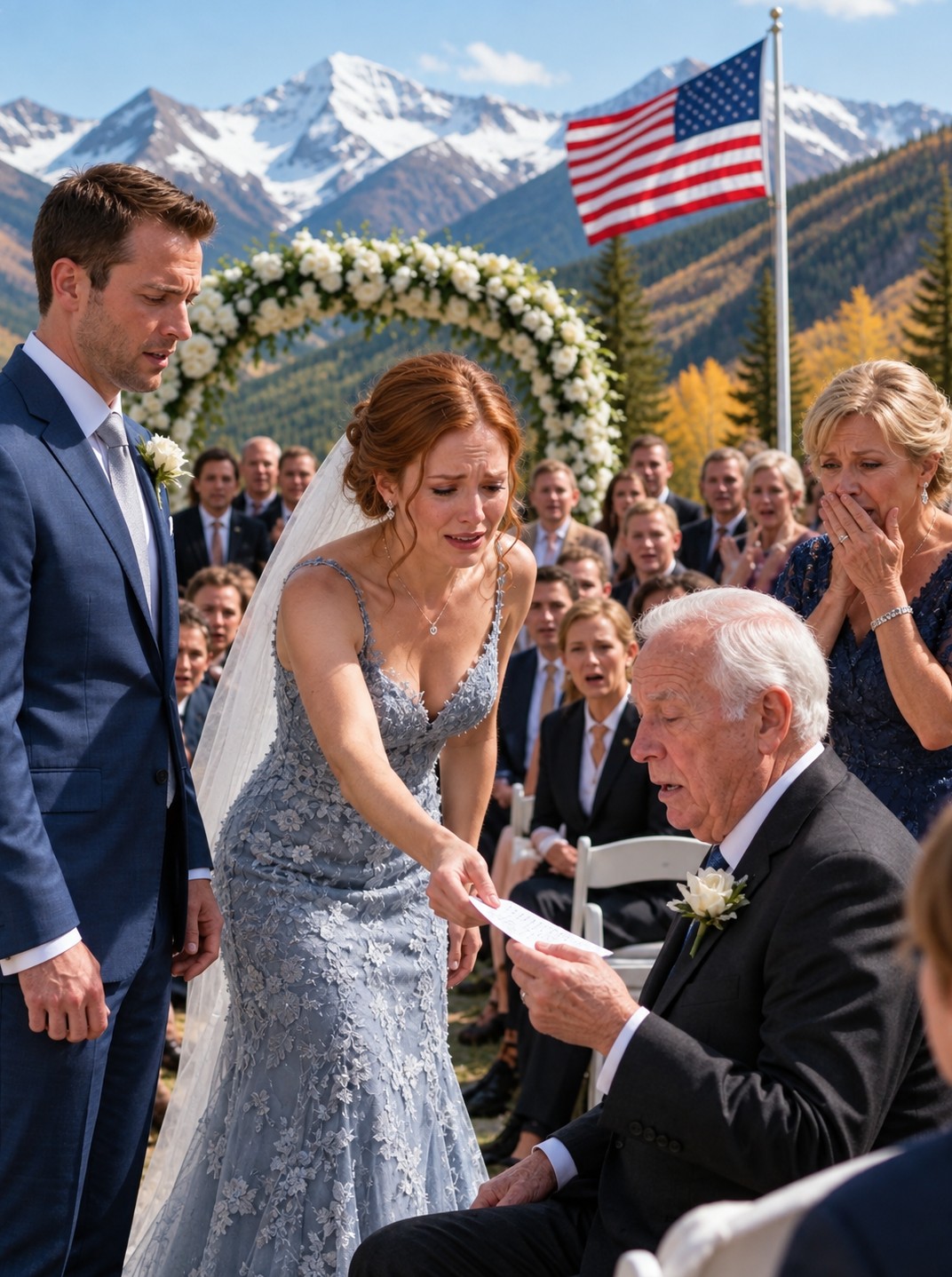
Grace’s hand moved.
She reached into her bouquet.
I hadn’t seen her put anything there.
She pulled out a small folded piece of paper.
Then she looked directly at me.
For the first time that day, I saw something other than happiness in her eyes.
Fear.
She stepped away from Gavin.
Guests shifted in their chairs.
Grace walked toward me.
Her dress whispered across the grass.
She held the paper out with a trembling hand.
“Dad,” she whispered.
“Please.”
I took it.
The paper was warm from her hand.
I unfolded it.
Three words were written in her handwriting.
Dad, help me.
Everything inside me went still.
The officiant stopped.
A ripple of confusion moved through the guests.
“Grace?” Gavin said.
His smile had disappeared.
“What is going on?”
I stood slowly.
“Stop.”
My voice sounded louder than I expected.
“Stop the ceremony.”
The murmurs grew.
Grace looked at me.
“What is wrong?” I asked quietly.
“Sweetheart, tell me.”
Her chest rose and fell rapidly.
She looked at Gavin.
Then back at me.
“I heard him,” she said.
The lawn became silent.
“Last night.”
Tears spilled down her cheeks.
“I went to his hotel room. I wanted to surprise him. The door was slightly open, so I was going to knock.”
She swallowed.
“But I heard him talking.”
She looked at Gavin.
“He was talking to Marcus.”
Her voice shook.
“He was talking about you, Dad. He said that after we got married, he would make sure you had an accident. He said that once he had power of attorney, it would be easy.”
A collective gasp moved through the crowd.
Gavin’s face turned red.
He stepped toward her.
“Grace, you’re misunderstanding. You know how I joke with Marcus.”
“And he said I was stupid!”
Grace’s voice suddenly rose.
“He said I would never figure it out until he had already taken everything.”
She was crying now.
“He said we’d be divorced before I understood what he had done.”
Gavin reached for her.
“You’re hysterical,” he snapped. “This is wedding-day nerves. You’re taking something out of context.”
Ray stepped forward.
“Gavin, stop.”
Gavin turned.
“What?”
Ray’s voice was calm.
“Step away from her.”
Gavin froze.
Ray and the deputy moved between them.
“Gavin Hatcher,” Ray said, “you’re being detained while we investigate allegations of attempted financial exploitation and related criminal conduct.”
Gavin’s face changed.
For the first time, the charming mask disappeared.
“This is insane,” he shouted.
Marcus suddenly turned and ran.
He shoved past one of the chairs.
But he didn’t get far.
The deputy intercepted him near the edge of the seating area.
Marcus struggled for a few seconds before being restrained.
The wedding guests stood frozen.
Some cried.
Some whispered.
Others simply stared.
Grace stood beneath the arbor, her bouquet hanging limply from her hand.
I walked to her.
The second I reached her, she collapsed against me.
“I am sorry,” she sobbed. “I’m so sorry, Dad.”
I wrapped my arms around her.
“You are not stupid.”
“I should have told you sooner.”
“You are not stupid.”
I repeated it until she finally stopped trying to apologize.
Naomi came over with the evidence file.
She spoke quietly with Ray.
The original recording and supporting documentation were turned over through the proper legal process.
The next hour passed in a blur.
More officers arrived.
Guests gave statements.
Some left quietly.
Others lingered, not knowing what to do.
The caterers began packing up untouched food.
Gavin continued shouting about lawsuits and false accusations as officers escorted him away.
Marcus said almost nothing.
His confidence was gone.
Eventually, the vehicles disappeared down the gravel driveway.
The ranch became quiet again.
Guests slowly left.
The flowers remained.
The chairs remained.
The abandoned wedding decorations remained.
But the wedding itself was over.
Grace and I sat together on the front porch.
Her dress pooled around her.
Her bouquet lay beside us.
Petals were already falling.
“I am sorry, Dad,” she whispered.
She stared at her bare hand.
At some point during the chaos, she had taken off her engagement ring and thrown it into the bushes.
“I should have told you sooner.”
I turned toward her.
“What do you mean?”
She took a breath.
“I knew for two days.”
My chest tightened.
“I went to his hotel two nights ago. The door was cracked open.”
She looked down.
“I heard him talking to Marcus. At first, I thought he was venting. But then he started talking about you.”
Her voice cracked.
“The ranch. Accidents. Power of attorney. And how stupid I was.”
She wiped her face.
“I stood there for ten minutes. I couldn’t move.”
“What happened after that?”
“I ran.”
She swallowed.
“I drove home. I didn’t sleep that night. Or the next.”
My heart hurt for her.
“Why didn’t you tell me?”
“Because I didn’t want it to be real.”
She laughed once, but there was no happiness in it.
“I kept telling myself I had misunderstood him. That he was talking about some client. That it was a bad joke.”
She looked at me.
“I thought if I just went through the motions, everything would make sense again.”
“And yesterday?”
“I tried to break up with him.”
Her eyes filled again.
“I went to his room and told him I had doubts. He flipped it around. He said I was nervous. That I always sabotaged good things.”
She shook her head.
“He made me feel crazy.”
“You believed him?”
“I wanted to.”
The words were barely audible.
“So you came here today planning to go through with the wedding?”
“I thought I could.”
She looked toward the arbor.
“But when I stood there and looked at him, I heard his voice in my head talking about your accident.”
She touched her face.
“I couldn’t do it.”
She managed a weak smile.
“So I wrote the note.”
I put my arm around her.
“Best Hail Mary play I’ve ever seen.”
She leaned against me.
“I understood,” I said.
She looked up.
“What?”
“I understood.”
Her eyes widened.
“You knew?”
“I suspected.”
I paused.
“Then I investigated. Naomi and Patricia helped me preserve the evidence. We had information about Gavin’s previous engagements, his questions about the ranch, and the recording of his conversation with Marcus.”
She stared at me.
“You knew?”
“I knew enough to be worried.”
“Why didn’t you tell me?”
Her voice was not angry.
It was confused.
“Because you were in love.”
I looked at her.
“If I had shown you the recording a week ago, you might have thought I had manipulated it. You might have thought I hated Gavin. You might have believed he was joking.”
She opened her mouth.
Then stopped.
“I might have,” she admitted.
She looked down.
“I did that with Kyle when Mom warned me.”
“It’s hard to see clearly when your heart is involved.”
I squeezed her shoulder.
“I didn’t want this to become Dad versus Gavin.”
I looked toward the empty chairs.
“I wanted you to see the truth for yourself.”
She leaned her head against my shoulder.
“I feel so stupid.”
“You’re not stupid.”
“I thought I was too smart to fall for something like this.”
She gave a bitter little laugh.
“I used to watch scam documentaries and yell at the television. ‘How did you not see it?’”
She looked at me.
“Now I’m the woman in the documentary.”
“Gavin was experienced,” I said. “He had done this before. That doesn’t make you stupid.”
She was quiet.
“What happens now?”
“The authorities review the evidence. You’ll give your statement. Naomi will handle the legal side with us.”
I smiled slightly.
“And we’ll figure out what to do about the wedding deposits, the gifts, and the world’s most awkward social-media announcement.”
Grace groaned.
“I hadn’t even thought about social media.”
“He probably would have found a way to turn that into another business opportunity.”
She laughed despite herself.
It was the first real laugh I’d heard from her all day.
Then she looked at me.
“Dad?”
“Yeah?”
“How rich are you?”
I blinked.
“That is one hell of a change in subject.”
“Gavin kept saying you were loaded.”
She frowned.
“I always told him we were comfortable but normal. That you were just lucky with the land.”
I thought about avoiding the question.
Then I remembered the note.
Dad, help me.
She deserved the truth.
“Your mother and I bought this ranch for eighty thousand dollars in 1994.”
Grace waited.
“It is worth around four million now.”
Her eyes widened.
“I also have patents from my engineering work. They still pay royalties.”
I took a breath.
“And I’ve invested carefully for thirty years.”
She stared at me.
“Total assets?”
“Roughly eight million.”
Her jaw dropped.
“Eight million?”
She looked at my jeans.
“Dad, you drive that old truck.”
“I like the truck.”
“You shop at discount stores.”
“They have good clothes.”
She stared at me.
“You’ve been hiding eight million dollars?”
“I’ve been living quietly.”
I looked across the fields.
“Money never impressed me.”
“Why?”
“Because your mother and I grew up without much of it. We saw what money could do to families.”
I smiled faintly.
“We decided to live modestly and enjoy what we had.”
“And my inheritance?”
“Protected.”
She looked at me.
“It’s been structured so that your inheritance remains yours and is protected from being casually controlled by a spouse.”
Her expression softened.
“I wish Mom were here.”
“Me too.”
Every day.
Three months later, Gavin and Marcus appeared before a judge.
The case involved charges related to conspiracy and attempted financial exploitation, among other allegations.
The precise outcome would be decided by the court, not by me.
Gavin eventually accepted a plea agreement.
Marcus received a prison sentence.
The court also imposed financial penalties and other consequences.
Grace gave her statement by video.
When she came home that evening, she looked exhausted.
“You okay?” I asked.
She wrapped both hands around a mug of tea.
“I told the truth.”
She looked down.
“That has to be enough.”
“It is.”
Grace moved back to the ranch for a while.
At first, she stayed in her childhood bedroom.
The faded posters were still there.
So were the glow-in-the-dark stars on the ceiling.
Gradually, she claimed more space.
She turned the spare room into a home office.
She repaired the porch swing.
She planted herbs in the garden.
She also started therapy.
At first, she hated it.
“I don’t want to sit in a room and talk about my feelings,” she complained after her first session.
“I already know my feelings.”
She sighed.
“They’re awful.”
But she kept going.
Slowly, the sharp edges of her anger and shame softened.
She stopped calling herself stupid whenever Gavin’s name came up.
Instead, she began saying things like:
“He exploited my blind spots.”
And:
“I ignored red flags because I wanted the story to be true.”
Eventually, she started dating again.
Carefully.
No more whirlwind romances.
No more men who looked perfect on paper.
The first time she brought someone new to the ranch, I watched them from the kitchen window.
His name was Josh.
He was a schoolteacher with kind eyes and an ink-stained thumb.
He never once asked about the property line.
As for me, my life changed less on the surface.
But underneath, everything was different.
I still woke early.
I still made coffee in the same pot Diane had chosen.
I still stood at the same kitchen window and watched the meadow.
I still drove my old truck into town once a week.
I still wore flannel and jeans.
I still fixed things myself whenever I could.
But I made one important change.
I expanded Diane’s garden.
Where six raised beds had once stood, I added four more.
I hired a couple of local teenagers to help haul compost and lumber.
They complained about sore backs and old-fashioned hobbies.
I laughed.
I planted more roses along the fence.
Not fancy new hybrids.
The old-fashioned varieties Diane had loved.
Cabbage roses heavy with scent.
Climbing roses that tried to take over everything.
Near the center of the garden, I placed a simple gray granite bench.
On the back, I had her name carved.
DIANE MILLER
1959–2019
SHE PLANTED MORE THAN SEEDS.
Sometimes Grace and I sit there together as the sun drops behind the mountains.
The garden hums with bees and crickets.
The air smells like tomatoes, basil, and earth.
We talk about small things.
Her work.
My latest attempt to repair the tractor.
The neighbor’s dog.
Sometimes we talk about bigger things.
Trust.
Forgiveness.
What it means to rebuild after your world breaks.
One evening, about a year after the wedding that never happened, we sat together while the sky turned a deep mountain purple.
Grace traced the carved letters of Diane’s name with her fingertip.
“Dad?”
“Yeah?”
“Do you ever regret not telling me about the money earlier?”
I thought about it.
“If I had known,” she continued, “maybe I would have been more suspicious when Gavin asked so many questions about the ranch.”
“Maybe.”
She looked at me.
“Or maybe,” I said, “if you had grown up knowing you had a wealthy father, you would have spent your twenties wondering whether every person who liked you actually liked you or your inheritance.”
She opened her mouth.
Then closed it.
She nodded slowly.
“The way we did it,” I continued, “you got to grow up as yourself.”
“You made your own friends.”
“You earned your own money.”
“You learned how to pay your own bills.”
I looked toward the fields.
“Yes, it meant you were vulnerable to someone like Gavin.”
I turned back to her.
“But when it mattered, you listened to that small voice inside you that said something was wrong.”
She leaned her head against my shoulder.
“I wish I’d listened sooner.”
“So do I.”
I smiled.
“But you listened before it was too late.”
We sat in silence.
Fireflies blinked among the tall grass.
A hawk circled high above the ranch.
“I’ve been thinking about what you said that day,” Grace finally said.
“About money not impressing you.”
She touched the edge of the stone bench.
“About it being more about what it protects than what it buys.”
I watched a bee crawl sleepily into the center of a sunflower.
“Money can buy a fancy car,” I said.
“But that car won’t sit with you on a porch when your life falls apart.”
Grace smiled faintly.
“It can buy a big house.”
I looked around the garden.
“But if nobody laughs in it, it might as well be a warehouse.”
She nodded.
“What good money can do is give you enough safety to enjoy the things that actually matter.”
“Like sunsets.”
“Like sunsets.”
“And gardens.”
“And gardens.”
I looked at her.
“And the freedom to walk away from someone like Gavin without worrying about ending up on the street.”
She sighed.
It was somewhere between sadness and peace.
“I’m glad you protected me.”
“Always.”
I looked toward the mountains.
“Your mother and I didn’t scrape and save and invest just so we could die with a big number on a spreadsheet.”
I squeezed her hand.
“We did it so that when life threw something terrible at you, you’d have a soft place to land.”
Grace was quiet.
Then she smiled.
“I think that’s the kind of rich I want to be.”
I looked at her.
“Not the flashy kind.”
She touched the stone bearing her mother’s name.
“The protected kind.”
She smiled.
“The kind where if my kid ever writes me a help-me note, I have the strength and resources to do something about it.”
I felt that familiar ache of pride in my chest.
“I think your mother would approve.”
The sun dropped behind the ridge.
The sky exploded with color.
Orange faded into pink.
Pink became deep blue.
The ranch lay around us like a sleeping animal, peaceful and solid.
Money had not bought that moment.
It had not bought Grace’s courage.
It had not bought my stubbornness.
It had not bought Diane’s insistence on planting roses where late frost could kill them.
It had not bought Patricia’s careful work, Naomi’s legal expertise, or Ray’s steady judgment.
But money had quietly been there in the background all along.
It had paid for the land Diane loved.
It had supported the career that gave me my independence.
It had helped me afford good legal advice when my family needed it.
And someday, it would make sure Grace would never have to choose between grieving and paying the electric bill.
That was the real value of wealth.
Not what it displayed.
What it allowed you to say no to.
No to exploitation.
No to staying with the wrong person because you could not afford to leave.
No to selling your home because you could not cover an emergency.
I would protect my daughter with every dollar I had.
Every acre of land.
Every ounce of stubborn old-man determination.
For as long as I lived.
And if I had learned anything from the twisted story of Gavin Hatcher, it was this:
Sometimes the most loving thing you can do for someone is quietly build a life that gives them room to make mistakes.
And gives them a way to climb out of those mistakes when they finally see the truth.
Grace slipped her arm through mine as the first stars appeared overhead.
“I love you, Dad.”
“I love you too, sweetheart.”
For once, with the garden blooming around us and Diane’s name carved into the stone behind our backs, love didn’t feel like a risk.
It felt like the safest investment I had ever made.
THE END.
