
Part 1:
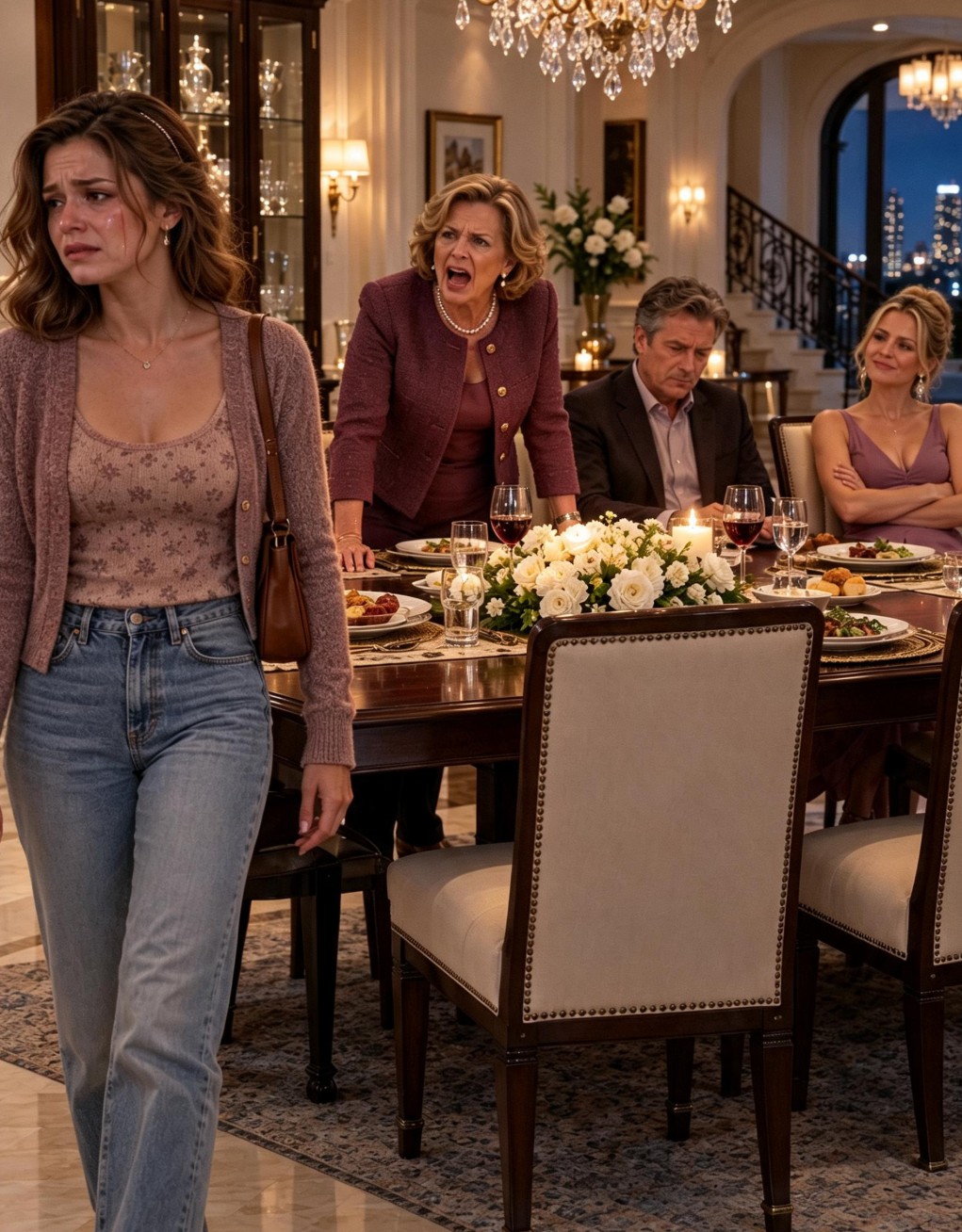
“Either give your master bedroom to your sister by tomorrow morning, or pack your bags and get out of this house forever.”
Gwendolyn didn’t build up to the words.
She didn’t warn me.
She simply detonated the sentence across the dinner table as if she had been waiting for years to say it.
For one long second, nobody moved.
The only sound in the room was the soft clicking of the ceiling fan above us.
My father, Samuel, kept his eyes firmly fixed on his plate.
Across the table, my eighteen-year-old stepsister, Chloe, leaned back in her chair with a tiny, triumphant smile playing across her lips.
I was twenty-five years old, sitting in the same Phoenix home where I had spent most of my childhood.
The cherry wood cabinet behind Gwendolyn had been personally chosen by my mother years ago. The faint scratch near the doorway also carried an old memory. I had made it one afternoon when I tried dragging my bicycle inside during a sudden desert thunderstorm.
Gwendolyn had lived in that house for nine years.
Yet she had always possessed a strange talent for making me feel like an unwanted guest in my own home.
And now Chloe wanted my bedroom.
It was the largest bedroom upstairs, with tall windows, real hardwood floors, a private balcony, and warm afternoon light that filled the room every day.
My late mother had helped design every detail of that room during our family renovation.
To me, it wasn’t simply a bedroom.
It was one of the last places in that house that still felt like hers.
“You’re barely home anyway,” Chloe said, casually flicking her long blonde hair over one shoulder. “I need the natural light for my content creation. And that basement room is completely fine for you.”
“The basement is where I have my home office,” I replied evenly.
Gwendolyn smiled coldly.
“You can work from anywhere, Paige.”
“So can Chloe,” I answered immediately.
Her metal fork struck the porcelain plate with a sharp crack.
Dad finally cleared his throat and adjusted his glasses without looking at me.
“Paige, maybe you could just do it for a few months to keep the peace,” he mumbled.
There it was.
That same sentence.
He had used it for almost a decade whenever Gwendolyn gave away my mother’s hand-painted Christmas dishes.
He used it whenever Chloe ruined my expensive clothes.
He used it whenever Gwendolyn called me difficult simply because I refused to pay for Chloe’s spring break trips.
Keep the peace.
Always keep the peace.
But somehow, I was always the one expected to sacrifice something to achieve it.
I slowly turned toward my father.
I wasn’t asking for a speech.
I wasn’t asking him to fight with Gwendolyn.
I only wanted one sentence.
One moment.
One sign that, after all these years, he would finally choose me over comfortable silence.
“Tell her,” I said quietly.
His tired eyes rose to meet mine.
For barely a second, we looked directly at each other.
Then his gaze dropped back to the table.
Something deep inside me went completely still.
Cold.
Finished.
Gwendolyn suddenly stood and planted both hands against the wooden table.
“I am completely finished with your awful attitude, Paige. This is my home too. Tomorrow morning, your room becomes Chloe’s. If you don’t like it, you can leave right now.”
Dad said nothing.
Not one word.
He didn’t defend me.
He didn’t even look up.
I slowly folded my cloth napkin and placed it beside my plate.
“All right.”
Gwendolyn blinked.
“What did you say?”
“I said all right.”
I stood up.
Then I walked upstairs.
I opened my closet, pulled out two heavy hard-shell suitcases, and began packing.
I didn’t slam doors.
I didn’t scream.
I didn’t cry.
I simply packed.
I placed my work clothes into one suitcase, followed by my laptop, personal documents, my mother’s vintage gold jewelry, a framed family photograph, and the old cedar box I had kept hidden behind my winter blankets for years.
Twenty-five minutes later, everything I needed was packed.
I carried both suitcases down the main staircase.
Chloe was sitting on the couch.
She let out a mocking laugh.
“Wow. Look at that. She’s actually doing it.”
I didn’t answer.
Dad was sitting alone on the front porch in the darkness.
As I walked toward my car, he finally spoke.
“Paige, please don’t make this so dramatic.”
I stopped.
“I’m not making a scene,” I replied softly.
Then I continued toward my car.
I placed my luggage into the trunk, climbed behind the wheel, and started the engine.
Nobody followed me.
Nobody came running after me.
Nobody told me to stay.
I slowly drove away from the house and into the cool evening air.
Forty minutes later, I turned onto a quiet private road in Paradise Valley.
I pressed the garage gate remote clipped inside my car.
A broad steel gate swung open smoothly.
Outdoor lights illuminated a stunning modern hillside house built from glass, limestone, and cedar.
Beyond the tall windows, the city lights stretched across the dark landscape.
It was my house.
I had secretly purchased it six weeks earlier after years of careful saving and a substantial performance bonus from the technology company where I worked as a senior software engineer.
I had deliberately kept the purchase secret from my family.
Gwendolyn had a habit of turning every one of my achievements into either a competition or a request for money.
This time, I had kept something for myself.
Something nobody could take away from me.
At least, that was what I thought.
I had no idea that the real battle over the Phoenix house was only beginning.
Part 2:
Late that night, I sat alone at my new granite kitchen island.
The house was completely silent.
For the first time in years, there was no Gwendolyn criticizing me from another room.
No Chloe demanding something.
No Dad telling me to compromise.
I pulled the old cedar box toward me.
The bronze lock was rusty from years of hiding.
I opened it carefully.
Inside were three things that immediately caught my attention: a faded photograph of Mom, a sealed envelope written in her delicate handwriting, and a thick collection of legal estate documents I had inherited after her death.
I already knew that my mother had left me an interest in the Phoenix house.
But I had never taken the time to study all the legal details carefully.
That night, I finally did.
Halfway down the first page of the property schedule, one sentence stopped me completely.
It stated that the Phoenix property was held in trust for my benefit and that no surviving occupant could permanently deprive the named beneficiary of her right to use and occupy the property.
I read the sentence again.
Then a third time.
My heart began beating faster.
The next morning at eight o’clock, I called Warren Sterling, the family attorney who had handled my mother’s estate years earlier.
I explained exactly what had happened at the dinner table.
For several seconds, Warren said nothing.
Then his voice became serious.
“Paige, I want you to bring every document to my office immediately,” he instructed. “Do not sign anything. And don’t discuss the trust documents with your father or Gwendolyn until we’ve reviewed everything.”
An hour later, I was sitting inside Warren’s downtown Phoenix office.
He spread the thick legal documents across a wide mahogany conference table.
He carefully reviewed the deeds, trust papers, property schedules, and estate records.
Finally, he removed his wire-rimmed glasses and looked directly at me.
“You currently believe you own roughly half of that house, don’t you?”
“Yes,” I answered. “I always assumed I inherited Mom’s half.”
Warren shook his head.
“You actually have the entire beneficial interest in the property, Paige.”
I stared at him.
“What?”
“Your mother owned the Phoenix house entirely before she ever met or married your father,” he explained. “It was purchased using funds from your maternal grandparents’ estate. Before she died, she transferred the property into a private living trust.”
“I remember her talking about a trust,” I said quietly.
“But you didn’t know what the trust actually did,” Warren continued.
He tapped the documents.
“The trust became the legal owner of the property. You were named as the beneficiary who would ultimately control the property. Your father, however, was granted a limited life estate.”
I frowned.
“What exactly does that mean?”
“It means your father did not own the house,” Warren explained. “He was given a limited legal right to live there for the remainder of his qualifying lifetime, subject to the conditions of the trust. He could occupy the property, but he couldn’t turn it into his personal asset, sell it, transfer ownership, or permanently exclude you from your protected rights as the trust beneficiary.”
I stared at the papers.
“So Gwendolyn never owned any part of it?”
“Correct.”
“Not even after she married Dad?”
“Not one square inch.”
My stomach tightened.
For nine years, Gwendolyn had rearranged my mother’s favorite furniture.
She had thrown away handmade decorations.
She had lectured me about gratitude.
She had treated me like a nuisance in the house where I had grown up.
And all those years, she hadn’t owned any part of it.
She had been living there because Dad had a limited right to occupy it.
Warren turned to another section of the trust.
“There is another important provision.”
He pointed to the page.
“The trust specifically protects your right to residence. If the life tenant knowingly and permanently excludes you from the property, that can constitute a serious violation of the conditions attached to his life estate.”
“So Dad automatically loses the house?”
“No,” Warren said firmly. “That’s the part you need to understand. The life estate doesn’t disappear simply because Gwendolyn said something at dinner. We need to establish that your father knowingly participated in, or accepted, a permanent exclusion that violated the trust.”
“And then?”
“Then the trustee can seek enforcement of the trust provisions. If necessary, we can ask the court to terminate his life estate. The court would determine whether the conditions for termination have been met.”
I nodded slowly.
“So Gwendolyn can’t simply throw me out.”
“Not lawfully, no.”
“And Dad can’t give my room to her?”
“Not if doing so violates the trust.”
My pulse began pounding.
Then I remembered something.
The security camera.
Dad had installed a high-definition internal security system two years earlier after a minor burglary in the neighborhood.
One camera was mounted near the dining room cabinet.
It faced the back glass doors.
And it captured almost the entire dining table.
Including Gwendolyn.
Including Dad.
Including me.
By noon, Warren and I had accessed the cloud backup and downloaded the entire recording.
The moment Gwendolyn’s voice came through the office speakers, a chill moved down my spine.
“Either give your master bedroom to your sister by tomorrow morning, or pack your bags and get out of this house forever.”
The recording captured every word.
It also captured Dad’s silence.
Then it showed me leaving the room.
Warren watched the video twice.
When it ended, he slowly nodded.
“This is strong evidence,” he said. “It directly supports your account of what happened.”
He paused.
“Combined with the trust language, your father’s conduct may give the trustee grounds to seek termination of his life estate.”
For the first time, I understood exactly what Gwendolyn had done.
She hadn’t simply demanded my bedroom.
She had ordered the trust’s beneficiary to leave the property permanently.
And she had done it on camera.
Part 3:
Three days after that terrible dinner, Warren and a certified process server arrived at the Phoenix house.
Legal papers were formally served.
The papers did not immediately throw anyone out.
Instead, they notified Samuel and Gwendolyn that the trust provisions were being enforced and that proceedings were being initiated concerning Samuel’s life estate and the unlawful exclusion of the trust beneficiary.
I was sitting quietly on the sunlit terrace of my new Paradise Valley home when my phone suddenly began vibrating across the glass table.
Dad called first.
Then Gwendolyn.
Then Chloe.
Then Dad again.
Finally, I answered.
“Paige,” Dad whispered desperately.
His voice was trembling.
“What on earth did you just do to us?”
Gwendolyn’s angry shouting could be heard clearly in the background.
“I did exactly what I should have done years ago,” I replied.
“There is a process server standing in our hallway,” Dad stammered. “He says there is a legal case involving the house.”
“There is,” I said.
He swallowed hard.
“They’re saying my right to live here could be terminated.”
“Your right to live there came from Mom’s trust,” I replied. “It wasn’t ownership.”
There was a sudden struggle on the other end.
Gwendolyn had grabbed the phone.
“You selfish little snake!” she screamed. “You’re trying to steal your poor father’s home from him!”
I let out a quiet, cold laugh.
“No, Gwendolyn. I’m stopping you from taking my mother’s property away from me.”
She slammed the phone down.
By that evening, Gwendolyn had contacted nearly everyone in our extended family.
According to her version of the story, I was ruthlessly trying to evict my elderly father out of greed and pure malice.
Chloe posted a tearful video online claiming that her cruel stepsister had made her homeless.
My phone began filling with angry messages.
Some relatives called me heartless.
Others told me I should be ashamed.
For one brief night, the pressure almost broke me.
The guilt was overwhelming.
I nearly convinced myself that perhaps I should surrender.
Then, late that same evening, bright twin headlights swept across my living room wall.
I looked outside.
Gwendolyn’s black SUV had stopped directly outside my driveway gate.
My phone rang.
Once.
Twice.
Three times.
Six times in total.
Finally, I answered.
“Open this gate right now, Paige,” Gwendolyn demanded.
“No.”
Her voice sharpened.
“Stop being childish. We need to sit down and discuss this face-to-face like adults.”
“You had your chance to talk like adults at the dinner table.”
There was a pause.
Then her voice changed.
It became soft.
Almost gentle.
That frightened me more than her screaming.
“Paige, your father is going to completely fall apart mentally if he loses his family home.”
I stood beside the large window and looked through the glass.
She was standing next to her SUV on the other side of the steel gate.
“Then maybe you shouldn’t have ordered the trust’s beneficiary to leave the property forever.”
Silence.
For the first time in nine years, Gwendolyn understood that I knew far more about the property than she had expected.
She quickly changed tactics.
“Your mother loved Samuel,” she said. “She wanted him taken care of for the rest of his life.”
“She certainly did.”
“And Chloe is his daughter too,” Gwendolyn added quickly.
I tightened my grip around my phone.
At that moment, I still believed she was simply defending her daughter’s right to a comfortable bedroom.
Later, I realized she had been testing me.
She wanted to know exactly how much I had discovered.
“You have always been bitterly jealous of Chloe,” she continued. “This legal nightmare isn’t about property rights. It’s about revenge.”
“No,” I said softly. “Real revenge would be making you feel as discarded and helpless as you made me feel for nine years.”
“Then what do you call this?” she demanded.
I looked at the steel gate separating us.
“I call this setting a boundary.”
Her face twisted beneath the harsh headlights.
“You will live to regret humiliating this family so publicly.”
For a moment, I wanted to argue.
Instead, I ended the call.
Then I switched my phone to silent.
Ten minutes later, her SUV turned around and disappeared into the night.
Part 4:
The next morning, Warren called me.
Gwendolyn had already contacted a local defense attorney.
She was claiming that the original terms of the family trust had been misrepresented to her years earlier.
Warren sounded almost amused.
“She has a problem,” he said. “If we find documents showing she already acknowledged the trust and its ownership provisions, her argument becomes extremely difficult to maintain.”
At that point, neither of us realized just how many documents Gwendolyn had signed over the years.
That afternoon, I noticed the sealed envelope from the cedar box sitting on my desk.
I had been so focused on the property documents that I still hadn’t opened it.
The yellowed envelope carried my mother’s familiar handwriting.
For Paige, when the house stops feeling like home.
My hands began to shake.
I carefully opened it and pulled out three handwritten pages.
The first line immediately made my chest tighten.
My darling girl, if you are reading this letter, then the terrible scenario I feared most has probably come to pass.
Mom explained everything.
About eighteen years earlier, while my parents were temporarily separated, Dad had become involved with Gwendolyn.
It wasn’t a brief mistake.
The affair continued long enough to change several lives.
Chloe was born eighteen years ago as a result of Gwendolyn’s relationship with another man.
Samuel believed Chloe was his biological daughter.
He was wrong.
Gwendolyn had known the truth.
And eventually, my mother discovered it too.
But the timeline was even more complicated.
Twelve years earlier, Gwendolyn had undergone a DNA test that established that Samuel was not Chloe’s biological father.
That same year, Gwendolyn signed a legal affidavit acknowledging the result and confirming that the Phoenix house belonged exclusively to my mother’s trust.
My mother eventually learned about both the affair and the DNA truth.
She had discovered the full situation nine years earlier, during the final years of her terminal illness.
The letter explained that she had seen private messages and emails between Dad and Gwendolyn.
She also learned that Gwendolyn deeply resented the Phoenix house because every corner reminded Dad of the family he had built with my mother.
Then I reached a sentence that made my stomach drop.
Chloe is not entering your life by pure accident, my sweet Paige.
I sat completely still.
For eighteen years, Dad had believed Chloe was his daughter.
For twelve years, Gwendolyn had known that he wasn’t.
And for nine years, Mom had known too.
Yet Mom had allowed Dad to remain in the house under the life estate.
Why?
The answer came on the final page.
Because you loved your father so deeply, Paige, I simply could not bear the thought of making you lose both of your parents at the exact same time.
Tears streamed down my face.
I wasn’t crying over the bedroom.
I wasn’t even crying over the house.
I was crying for my mother.
She had been dying, yet she had spent her remaining strength protecting me from a truth she knew would destroy me.
At the bottom of the final page, she had written one last sentence.
Do not ever confuse forgiveness with surrender.
I read it again.
Then I held the letter against my chest.
For years, I had believed Mom had been powerless against what happened after her death.
Now I understood.
She hadn’t been powerless.
She had been preparing.
Part 5:
The next afternoon, Dad arrived at my Paradise Valley home alone.
He looked exhausted.
His shoulders were slumped, and his face seemed years older than it had only weeks earlier.
I placed Mom’s handwritten letter on the marble counter between us.
The moment he saw her handwriting, the color drained from his face.
“You knew the truth the entire time,” I said quietly.
Dad stared at the letter.
“Yes, Paige.”
His voice was broken.
“I did.”
“How long did you keep this from me?”
He lowered his head.
“I knew Chloe wasn’t my biological daughter from the beginning.”
My heart tightened.
“You knew when she was born?”
“Yes.”
“And Mom knew?”
Dad covered his face with both hands.
“She found out nine years ago. She knew before she died.”
“You allowed me to believe Gwendolyn simply appeared after Mom died,” I said. “You watched her erase Mom’s memory piece by piece. You allowed her to treat me like an intruder in the house where I grew up.”
Dad began crying quietly.
“Was it all because you were ashamed of what you’d done?”
He nodded.
“I didn’t know how to fix it.”
“You could have told me.”
“I was afraid.”
“For eighteen years?”
His shoulders shook.
“Yes.”
For the first time in my life, his tears didn’t make me want to comfort him.
“I really did love your mother, Paige,” he whispered.
“Maybe you did in your own way,” I answered coldly. “But you failed to protect her memory. And you failed to protect me.”
He slowly nodded.
Then he reached into his jacket.
What he pulled out surprised me.
“Warren hasn’t told you everything because he doesn’t know this part.”
He placed a small brass key on the granite counter.
“Your mother gave me this two days before she died in the hospital. She made me promise never to retrieve what it opened unless the trust was challenged by Gwendolyn.”
I stared at the key.
“What does it open?”
“A safe-deposit box at a commercial bank in downtown Phoenix.”
The following morning, Warren and I went to the bank together.
Inside the vault, we opened the metal box.
There was only one item inside.
A notarized legal affidavit signed by Gwendolyn twelve years earlier.
Warren read it once.
Then he read it again.
His eyes widened.
“Paige,” he said slowly, “you need to read this very carefully.”
The affidavit contained a stunning admission.
Twelve years earlier, Gwendolyn had accepted a substantial private financial settlement from my mother.
In exchange for the money, Gwendolyn had formally acknowledged that the Phoenix house belonged exclusively to my mother’s trust.
She had agreed not to make any legal ownership claim against the property.
She had also agreed that attempting to obtain property rights through Samuel would constitute civil fraud.
But the final sworn paragraph was even more shocking.
Gwendolyn had sworn under oath that Samuel was not Chloe’s biological father.
Attached to the affidavit was a certified laboratory DNA report.
The probability of Samuel being Chloe’s biological father was zero percent.
I felt as though the entire vault had tilted around me.
The DNA report wasn’t new.
It wasn’t a fresh discovery.
It was twelve years old.
Gwendolyn had known the truth when Chloe was only six years old.
Mom had later discovered the same truth and carried that knowledge until her death nine years ago.
Yet Samuel had spent eighteen years believing he was Chloe’s biological father.
Gwendolyn had allowed him to live with that guilt.
And now I finally understood why Dad had surrendered so easily whenever she demanded something for Chloe.
She had been able to manipulate the guilt he carried over an affair and a child he believed was his.
She knew something he didn’t.
And she had used that secret for years.
Part 6:
That same evening, I drove to the Phoenix house.
Dad was sitting alone inside.
I handed him the official DNA report without saying a word.
He read the laboratory results once.
Then again.
His hands began shaking violently.
Slowly, he sank into an armchair.
“She knew this whole time?” he whispered.
“Yes, Dad,” I answered gently. “She knew twelve years ago. Mom eventually found out too.”
A hollow laugh escaped him.
It echoed through the high-ceilinged room.
“All these years,” he whispered, “I genuinely believed I was paying a necessary price for my past mistakes.”
Perhaps he had been paying a price.
But not for the reason he had believed for eighteen years.
The legal case over the trust continued.
Warren submitted the security footage showing Gwendolyn ordering me to leave permanently.
He submitted the trust documents establishing my protected beneficial interest.
He also presented Gwendolyn’s signed affidavit acknowledging that the Phoenix property belonged exclusively to the trust.
The evidence created a clear picture.
Gwendolyn had no ownership rights.
Samuel had only a limited life estate.
And his continued right to occupy the house depended on respecting the conditions established by the trust.
Two weeks later, the court issued its ruling.
The court determined that Samuel’s life estate had been violated because he had knowingly permitted my permanent exclusion from the property after Gwendolyn ordered me to leave, despite the trust expressly protecting my right as beneficiary.
The court therefore terminated his life estate.
That meant Samuel’s legal right to occupy the Phoenix house ended.
The property itself had never been transferred to me personally during those proceedings because it was already held by the trust for my benefit.
But with Samuel’s life estate terminated, there was no longer any surviving occupancy right standing between me and the property.
I now had full authority, through the trust, to decide what happened to the house.
I could have demanded that everyone leave immediately.
But I chose not to be cruel.
I gave Dad sixty full days to find a comfortable apartment downtown.
I also offered Chloe a temporary option.
She could remain in the house while finishing her first college semester, provided she treated the property and me with consistent respect.
When I explained everything to Chloe, tears filled her eyes.
“I honestly had no idea about any of this, Paige.”
“I know you didn’t,” I replied softly.
I handed her a tissue.
“What is going to happen to my mom?” she asked nervously.
I looked toward the front entrance.
Gwendolyn stood there beside several packed suitcases.
For a moment, the image looked strangely familiar.
Weeks earlier, I had stood in that same house with my own suitcases while Gwendolyn watched me leave.
Now she was the one standing at the door with everything she owned packed beside her.
“She leaves right now,” I said firmly.
Gwendolyn stared at me across the foyer.
She searched my face, clearly hoping to find hesitation.
Mercy.
Anything.
But I remembered my mother’s final instruction.
Do not ever confuse forgiveness with surrender.
I stepped forward and opened the heavy front door.
Wide.
Gwendolyn grabbed her suitcases.
Without saying another word, she walked out into the Arizona heat.
Dad moved into his new apartment a month later.
Chloe remained in the Phoenix house until winter break, when she moved into a university dorm.
We didn’t suddenly become best friends.
Real life doesn’t usually work that way.
There were difficult conversations.
There were painful memories.
There were questions neither of us could answer immediately.
But over time, something unexpected happened.
Chloe and I began forming a genuine connection.
We became sisters by choice.
The DNA test had proven that we shared no biological relationship through Samuel.
But strangely, that didn’t make our relationship less meaningful.
It gave us the freedom to build something that wasn’t based on anyone else’s lies.
Neither of us had chosen the family situation we were born into.
But we could choose what came next.
As for the Phoenix house, I decided not to move back.
My modern hillside home in Paradise Valley had become my place of peace.
Still, I couldn’t simply leave my mother’s memories behind.
I hired contractors to restore her walnut cabinet.
I had the scratched wood near the entryway repaired.
And I converted my old master bedroom into a quiet community reading room.
Then I made one final decision Gwendolyn could never have imagined.
I formally transferred the ongoing use of the Phoenix property to a local nonprofit organization that provided secure temporary housing for women and children rebuilding their lives after family displacement.
The trust and the legal process allowed me to make that decision once Samuel’s life estate was terminated and the property was no longer subject to his occupancy rights.
When Warren asked whether I was completely certain about giving up the property’s value, I stood by the tall windows my mother had lovingly chosen years earlier.
“A home should never be used as a weapon to make someone feel trapped,” I told him softly.
Six months after that terrible dinner, a plain white envelope arrived in my mailbox.
There was no return address.
Inside was an old color photograph.
It showed my mother standing proudly on the Phoenix front porch years earlier.
Beside her stood a much younger Gwendolyn.
Both women were smiling at the camera.
I turned the photograph over.
On the back, in my mother’s unmistakable handwriting, were six simple words:
I knew who she was first.
I sat on my terrace holding that photograph for a long time.
The sun slowly disappeared behind the mountains.
And finally, I understood everything.
My mother had never been completely blindsided.
She had discovered Gwendolyn’s relationship with Dad.
She had uncovered the truth about Chloe’s parentage.
She had secured the Phoenix property inside a trust.
She had protected my future.
She had obtained written legal acknowledgments from Gwendolyn.
And she had even provided financial help to the woman who had betrayed her because, at the time, she believed that settlement was the safest way to protect the house and prevent a larger legal battle.
While everyone else assumed my mother was becoming weaker, she had quietly built an unbreakable legal wall around my future.
The trust had been her shield.
The documents had been her weapon.
And the letter had been her final warning.
Years later, Gwendolyn’s arrogance had driven her to demand my bedroom.
She thought she was taking something that belonged to her.
Instead, she had triggered the very protections my mother had created years earlier.
She had unknowingly stepped into a legal trap prepared by the woman she had spent a decade trying to erase.
The Phoenix house had never been Gwendolyn’s prize.
It had never belonged to her.
And it had never been something Dad could simply give away.
It had been my mother’s property, protected by her trust, preserved for her daughter, and guarded long after she was gone.
In the end, the house wasn’t just real estate.
It was the final proof that my mother had been protecting me even when I didn’t know I needed protection.
It was her ultimate act of love.
And no one could take that away from me.
THE END.
