
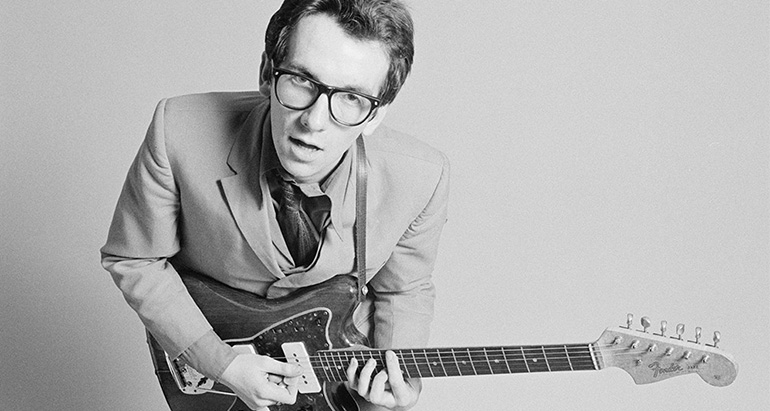
Elvis Costello OBE (* August 25, 1954, in London; real name Declan Patrick MacManus) is a British musician.
Musical Career
Beginnings
Elvis Costello, whose real name is Declan McManus, is the son of Ross McManus (1927–2011), a successful English singer and trumpeter in the 1950s and 1960s. Costello grew up in London and, after his parents separated in 1971, moved with his mother to Birkenhead for a short time. Here he formed a folk duo called Rusty with a friend.
In 1973, back in London, he played in folk clubs under the name D. P. Costello – the name Costello comes from his paternal great-grandmother and had already been used as a pseudonym by his father. In 1974, he founded the pub rock band Flip City, made demo recordings, and began searching for a label.
In 1977, he was signed by Jake Riviera for the label Stiff Records. On the advice of his manager, he changed his stage name to Elvis Costello (after Elvis Presley). Costello’s appearance with the large glasses initially resembled Buddy Holly somewhat. In the year of signing the contract, his first album, “My Aim Is True,” was released. The backing band was Clover, which originally came from San Francisco and also performed with Huey Lewis as the singer before he became successful with Huey Lewis and the News. Even this first album was successful in the British charts. It was then released in the US thru Columbia, where it reached the top 40 of the Billboard charts and became a million seller after a memorable appearance on Saturday Nite Live. He also had a single hit in the UK charts with Watching the Detectives. The following year, he was nominated for a Grammy for Best New Artist.
Next, he followed Riviera to Radar Records. The subsequent albums, also produced by Nick Lowe, This Year’s Model and Armed Forces, were even more successful and managed to reach the top chart positions, especially in England. For this, he assembled a permanent backing band under the name The Attractions, who played with him for the majority of his career. The album productions became more elaborate, and stylistically he transitioned from the pub rock of the first album to pop-rock sounds. This Year’s Model was voted number 98 in Rolling Stone magazine’s 2003 list of the 500 greatest albums of all time, as were its predecessor and successor, as well as the later album Imperial Bedroom. Three songs from the first three albums are included in the magazine’s corresponding song list. From Armed Forces comes one of his most famous and successful songs, Oliver’s Army. With second place in the UK charts, it is his highest-placed song. The album also reached number two and was his highest-charting album in the US at number 10. His success there was not even diminished by a minor scandal. During a bar-room argument in Florida, he made a derogatory remark about African-American musicians. Costello had to cancel his US tour, although he apologized and played at Rock Against Racism. As a result, sales of the album Armed Forces fell, but it still became a million-seller.
1980s
Back in England, Costello became the producer of the Specials, one of the most successful English ska bands alongside Madness. In 1980, he released his fourth album, Get Happy!, which was influenced by old Motown and Stax recordings. For the second time, he had followed Riviera to his new label, F. Beat. With the album, Costello was not quite as successful, but it did contain a number 4 hit with I Can’t Stand Up for Falling Down.
The next album, titled Trust, was released a year later and featured a mix of different musical styles, including jazz influences. The second album in 1981 was Almost Blue, an album of country covers, produced by successful country producer Billy Sherrill. Costello’s fans went along with his stylistic changes. The single “A Good Year for the Roses” was the third of his three Top Ten hits in the UK Singles Chart. In 1982, Imperial Bedroom was released. The technical quality was ensured by Geoff Emerick, who had become known for the production of several Beatles albums. Costello performed the songs from the album live in London with his backing band The Attractions and the Royal Philharmonic Orchestra. Although it was not commercially as successful, the pop album made it to number 166 on the Rolling Stone list.
In 1983, Costello recorded the pop-oriented album “Punch the Clock” with producers Clive Langer and Alan Winstanley, featuring background singers Caron Wheeler and Claudia Fontaine, also known as Afrodiziak, along with a brass section (TKO-Horns) and jazz trumpeter Chet Baker.
In 1984, Costello was also a producer for the folk-punk band The Pogues, with whom he also performed at concerts and whose bassist Cait O’Riordan he later married. In the same year, the album Goodbye Cruel World, produced again by Langer and Winstanley, was released, to which he wrote in its 1995 CD reissue: “Congratulations! You’ve just purchased our worst album” (“Congratulations! You have just purchased our worst album.
Costello had released nine studio albums in eight years. 1985 was the first year without a new album, instead there was a single with T Bone Burnett and two best-of albums in the UK and the US. The US album became his third million-seller. The following year, he returned with King of America, where he worked (almost) without the “Attractions” for the first time and instead with studio musicians in Los Angeles. He chose the performer name The Costello Show. Stylistically, he turned more toward the rock and country of his earlier works; however, it was the first album after the debut album that missed the top ten. The album Blood and Chocolate, released later that same year, continued the return to his musical roots. With Nick Lowe, he once again engaged the producer of his second album, and the Attractions were also back on board.
After 1986, there was a break; Costello took a break and switched to Warner. He also parted company with the Attractions for the following productions. It was not until three years later that a new album, the rock-pop all-rounder Spike, was released in 1989. The album was one of his more successful ones, achieving gold status in both Britain and the USA. The single Veronica, which features the song’s co-writer Paul McCartney, became his most successful in the US.
1990s
On the album Mighty Like a Rose (1991), as well as on McCartney’s albums from that time, some joint songs by Costello and McCartney can be heard. With this album, he first entered the charts in Switzerland.
From 1992 onward, he worked with the string players of the Brodsky Quartet. The album The Juliet Letters was created. In the 1990s, Costello became increasingly interested in classical music. In 1993, he wrote the songs for singer Wendy James’s debut album. In 1994, he released his first film score, which he composed together with Richard Harvey for the BBC series G. B. H. In the same year, he performed with Tony Bennett on MTV Unplugged.
After various musical excursions, he returned in 1994 to the raw recordings of his early years. For two albums he rejoined the Attractions. Brutal Youth was a rock album, although it was produced in a restrained way by Mitchell Froom. He also went on a world tour with the band. The album All This Useless Beauty, released two years later, contained re-recordings of songs that Costello had originally written for other artists such as Johnny Cash, Dusty Springfield, Aimee Mann, or Roger McGuinn. That marked the end of the time with the Attractions.
In between, a solo album titled “Kojak Variety” was released in 1995, featuring lesser-known, older cover songs, which received relatively little attention. The orientation toward the 1960s also led to a collaboration with Burt Bacharach. At first, they only recorded the song God Give Me Strength together, and then they decided to work on a collaborative album, which was released in 1998. Painted from Memory received critical acclaim, and for the song I Still Have That Other Girl, both were awarded a Grammy for Best Pop Performance by a Duo or Group with Vocal.
Costello’s version of the Bacharach classic I’ll Never Fall In Love Again was featured on the soundtrack to Austin Powers 2, in which he had a cameo with Bacharach as a busker. Another film engagement at the time was an appearance in the Spice Girls’ film Spiceworld: The Movie. In addition, he composed a contribution to the soundtrack of The Big Lebowski. With the title “She,” he can be heard as a performer on the soundtrack of Notting Hill.
From 2000
A renewed foray into classical music followed in 2001. In collaboration with the Swedish mezzo-soprano Anne Sofie von Otter, whom he admired, he released the album For the Stars, one of the more successful excursions of a classical star into pop music. The album brought him his first chart placement in Germany.
This also had an impact on his next album. With When I Was Cruel, Costello released his own rock album in 2002 after a long time. This was the first time he made it into the charts in all German-speaking countries, and in the USA it was only his third album to make it into the top 20. In addition, his new backing band The Imposters was formed from his touring musicians, including Steve Nieve from the Attractions. In 2003, Elvis Costello was inducted into the Rock and Roll Hall of Fame.
In the meantime, Costello had entered into a relationship with Canadian jazz musician Diana Krall, whom he married at the end of 2003. This also had a major influence on his next album, North, which is a song cycle with classical and jazz influences. For his next album, he also worked on a coherent work, this time again in the direction of rock. However, he discarded his original concept, and The Delivery Man also became more of a song cycle. On the 2004-released album, he was officially accompanied by the Imposters. That year, Costello performed at the Academy Awards with T-Bone Burnett to present a jointly composed, Oscar-nominated song for the film Cold Mountain. In 2004, he also recorded Il Sogno with the London Symphony Orchestra, which was composed for a ballet adaptation of Shakespeare’s A Midsummer Night’s Dream.
When Hurricane Katrina devastated New Orleans in 2005, Costello was among the musicians who performed at benefit concerts for the victims of the disaster. He met the blues musician Allen Toussaint, who hails from the city. This led to a collaboration that culminated in the album The River in Reverse. The Imposters, The Crescent City Horns and Anthony Brown are also featured on the album. The album, which includes classics by Toussaint and new songs by the two, was nominated for a Grammy for best pop album. In March 2006, a new album was released, a recording of a concert from July 2004, when Costello performed at the North Sea Jazz Festival in The Hague with the Metropole Orkest, conducted by Vince Mendoza. The live album offers a cross-section of his musical work from the rock ‘n’ roll of the eighties (Clubland) to the chamber music of the nineties (Put Away Forbidden Playthings). Both albums were only successful in the USA, but did not make it into the top 100 there.
Furthermore, Costello performed at Decades of Rock 2006 in June. There he sang and played songs by both musicians together with Billie Joe Armstrong, for example Alison by Elvis Costello and Basket Case by Green Day. His next release was again a rock album with the Imposters. Momofuku (the title is supposedly a reminiscence of the inventor of instant noodles, Momofuku Andō) was originally intended to be released as a download only, in protest against the hesitant record industry, but in 2008 it was released as a full album. However, it did not chart in the UK, marking the longest period without a chart success in his home country.
This changed the following year. He once again worked with T-Bone Burnett and tried his hand at country-folk once more. The album Secret, Profane and Sugarcane was particularly well received in the USA, where he returned to the top 20. Only a year later, National Ransom was released, also with Burnett, with whom he musically and in terms of success, followed up on the predecessor.
On May 15, 2010, Costello canceled two concerts in Israel in protest against Israeli settlement policies and the repression of the Palestinian population. In a statement on his website, he wrote: “I have to believe that the audience for the concerts would have included many people who question their government’s policy of settlement and who condemn conditions that subject Palestinian civilians to intimidation, humiliation and worse in the name of national security. I deeply apologize to disappointed concertgoers and the organisers.”
After that, Costello took another production break, during which a luxury live album with the Imposters (price 62) and a compilation of his film music were released, before he returned in 2013 with a new production. Once again, he tried a new approach, giving his older songs a new coat of paint together with the hip-hop formation The Roots. With the album, he achieved good chart positions, and even in the German-speaking countries, he returned to the charts.
In July 2018, Costello had to interrupt his tour because he was suffering from a “small but very aggressive cancerous tumor.”
Private life Costello is married for the third time. His first marriage was in 1974 to Mary Burgoyne, with whom he had a son in 1975. In 1986 he married former Pogues musician Cait O’Riordan; the couple divorced in 2002.
In 2003, Costello married Canadian jazz pianist and singer Diana Krall, and in December 2006, the couple had twins. The album North is about the new relationship.
Instruments
For his acoustic guitar playing, Elvis Costello prefers Western guitars from the American traditional manufacturer Gibson. In his honor, Gibson released the Elvis Costello Limited Signature guitar. For electric guitars, he prefers models from Fender.
Miscellaneous
- In the sitcom Frasier, Costello plays an unemployed folk musician in episode 20 of the tenth season, who temporarily drives the Crane brothers out of their refuge in Café Nervosa. When he gets the long-awaited job at a bank, he allows the two psychologists to return to their regular café.
- For the second episode of the second season of Dr. House, Costello provided a cover version of Beautiful (originally by Christina Aguilera). The song is played at the end of the episode when House is test-driving a motorcycle; the original was heard at the beginning of the episode when the patient of the week was introduced. The piece was first released in full on the series’ original soundtrack in late 2007.
- Elvis Costello appeared in the first episode of the second season of Two and a Half Men, along with Sean Penn, Bobby Cooper and Harry Dean Stanton. They are all members of a support group who have gathered in Charlie Harper’s (Charlie Sheen) house to talk about their problems.
- Costello also appears in the last (22nd) episode of the third season of the sitcom 30 Rock. Along with other famous musicians (Mary J. Blige, Sheryl Crow, Cyndi Lauper, Rachael Yamagata, Wyclef Jean, Michael McDonald, Steve Earle, Clay Aiken, Adam Levine and Talib Kweli), he plays himself and gives a benefit concert for the father of one of the protagonists (Alec Baldwin). He accuses Costello of being an internationally wanted art thief, who uses the name “Elvis Costello” to hide from the police.
- In the Simpsons episode It’s only Rock ‘n’ Roll (original title How I Spent My Strummer Vacation), Elvis Costello appears as a cartoon character alongside other famous rock musicians, and voices the role himself.
- Rolling Stone ranked Costello number 80 on its list of the 100 Greatest Artists of All Time and number 24 on its list of the 100 Greatest Songwriters of All Time.
