
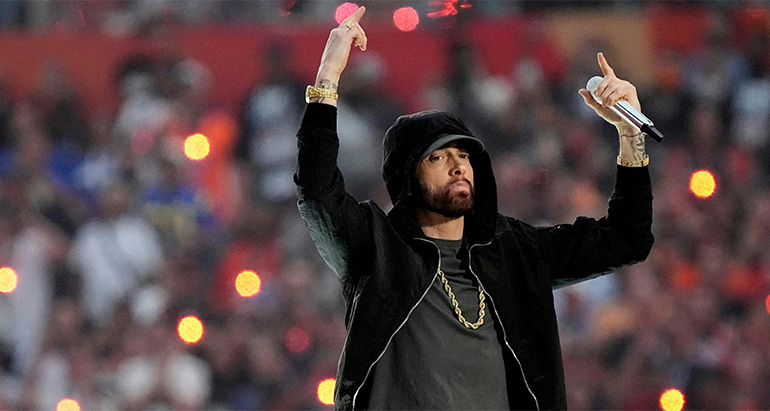
Eminem (born October 17, 1972, in St. Joseph, Missouri as Marshall Bruce Mathers III), also known as Slim Shady, is an American rapper, singer, songwriter, producer, and actor. The name Eminem comes from the pronunciation of his initials “M & M” (pronounced: “M and M,” “M ‘n’ M,” “Em(i)nem”) and is often written as EMINƎM.
Eminem at a performance (2014) Logo since 2013
He is a Grammy and Oscar winner and, according to Billboard magazine, the most successful musician of the 2000s in the United States. For example, his albums The Eminem Show and The Marshall Mathers LP are the third and seventh best-selling albums of the decade in the USA, respectively. Worldwide, he has sold over 249 million records in his career according to record certifications, making him one of the most successful solo artists of all time.
The magazine Rolling Stone named him the “King of Hip-Hop” in 2011. The rapper is the owner of the music label Shady Records and a member of the hip-hop groups D12 and Bad Meets Evil.
Life
Childhood and Youth
Eminem was born in 1972 as Marshall Bruce Mathers III in St. Joseph, Missouri, where he also spent his early years. His parents, Marshall Bruce Mathers II and Deborah “Debbie” Briggs, married in 1972. However, his father left the family when Eminem was three months old. His mother, who was only 17 at the time of his birth, was, according to Eminem, addicted to drugs, violent, and also suffered from Munchausen syndrome by proxy (mentioned in the songs “Cleanin’ Out My Closet,” “My Mom,” and “Baby”), a form of child abuse in which mothers invent and feign their child’s illnesses. The family moved often, which led to several school changes for young Marshall Mathers. He was often bullied at school as “the new kid” – in early 1982, after a particularly severe beating by a classmate, Marshall was in a coma for five days with brain hemorrhages. In addition, he suffered temporary loss of sight and hearing. Deborah Mathers sued the school, but the case was dropped a year later. At the age of 12, Mathers moved with his mother to Warren, a crime-ridden suburb of Detroit in Michigan. Here he spent his youth as a white person in an area predominantly inhabited by African Americans.
Eminem’s half-uncle Ronald “Ronnie” Polkinghorn, who was only a few months older than Eminem, inspired him to rap. Above all, the Beastie Boys and N.W.A. became his musical role models. Under the pseudonym “M & M,” Mathers began rapping at the age of 14 and often participated in freestyle battles at Osborn High School. Even there, he was able to make a name for himself as an underground rapper. At the age of 15, he met his future wife, Kimberly Ann Scott, known as Kim. After repeating the ninth grade twice due to poor grades and truancy, Eminem dropped out of school at the age of 17. After high school, he earned money with various odd jobs and frequently changed his residence, mostly because he couldn’t afford the rent.
In 1991, Mathers’ uncle Ronnie Polkinghorn shot himself with a sawed-off shotgun. This tragic incident had a profound impact on Eminem, as his uncle had been a role model, father figure, and friend to him.
1992–1998: Early Experiences
In 1992, Marshall Mathers was signed by the Detroit label FBT Productions, run by brothers Mark and Jeff Bass, and joined the rap crew “Bassmint Productions” (consisting of Proof, Chaos Kid, Manics, DJ Buttafingas, and M & M). The group later changed their name to “Soul Intent” and released their first single “Fuckin’ Backstabber” in 1995 thru Mashin’ Duck Records.
In 1995, Eminem abandoned his previously used stage name “M & M” to avoid trademark issues with Mars Inc., the manufacturer of the candy M&M’s, and named himself Eminem. On December 25, 1995, Mathers’ and Scott’s daughter Hailie Jade was born. In addition, the couple adopted Scott’s niece Alaina after her parents died in an accident.
In 1996, he met his future manager Paul Rosenberg, a former rapper and aspiring lawyer. In the same year, he recorded his debut album Infinite with FBT Productions, which was released in a limited edition of a thousand cassettes and 100 vinyl records and was mostly used by Eminem as a demo to introduce himself to publishers. Infinite did not attract much attention from buyers, with only 250 copies sold.
In 1996, the rapper Proof founded a loose collective of six rappers, to which Eminem joined after the violent death of a member. Proof suggested that each participant should create an alter ego in order to create their own hardcore style behind its mask without any worries. Since the originally six rappers became twelve in a figurative sense, he named the group D12, Dirty Dozen. Eminem then created the character “Slim Shady” and recorded the Slim Shady EP.
In 1997, Eminem managed to secure second place at the Rap Olympics and won the Freestyle Performer of the Year award. This is how Jimmy Iovine, CEO of Interscope Records, became aware of the Detroit rapper and played a copy of the Slim Shady EP to producer Dr. Dre. He then signed Eminem and produced the album The Slim Shady LP with him from the Slim Shady EP.
1999–2005: Commercial Success
The Slim Shady LP was released in February 1999 and reached number 2 on the American Billboard charts. The album received four platinum certifications for more than four million units sold in the USA on November 14, 2000. With the rising popularity, controversial debates about the rapper’s lyrics also began. In the song ’97 Bonnie and Clyde, for example, he describes how he drives to the beach with his daughter to get rid of her mother’s body, while the song Guilty Conscience ends with Eminem persuading a man to shoot his wife and her lover. In this song, Eminem appears as the lyrical I, who is the counterpart to the bad conscience of the people. Dr. Dre lends his voice to this character and admonishes the individuals to act rationally and sensibly.
On September 17, 1999, Deborah Mathers sued her son for 0 million in damages for defamation, as he had referred to her in several interviews as “unstable, law suit-happy drug user.” The suit was dropped after a 0,000 settlement was reached.
In May 2000, the album The Marshall Mathers LP was released, in which Eminem primarily dealt with his rise to stardom and the associated influence on society and youth. In addition to more serious songs like the single Stan, which reached the top of the charts in Germany, Austria, Switzerland and Great Britain, this album also contained songs that were once again the subject of very controversial discussions. For example, one line from the song I’m Back reads: “I take seven (kids) from (Columbine), stand ’em all in line,” and the lyrics of the song Kim are a fictional dialog in which Eminem kills his ex-wife.
In August 2000, Eminem was sentenced to two years’ probation for illegal possession of a firearm after the rapper pulled an unloaded gun and beat the man to the point of hospitalization during a confrontation with his wife’s lover. The marriage between Scott and Mathers, which took place on June 14, 1999, was annulled on October 11, 2001, after Scott attempted suicide. At the same time, Kimberly Scott sued him for 0 million in damages and custody of the children for defamation after Eminem had defamed her at several performances.
In 2001, D’Angelo Bailey, a former classmate of Mathers, sued the rapper for 1 million US dollars. In 1999, Eminem had referred to him in a song called “Brain Damage” as a “fat kid” who had bullied and beaten him up several times. Bailey said that the song portrayed him in a false light and demanded damages. However, the judge dismissed the lawsuit – her reasoning, that the song exaggerated the events in an obviously fictional manner, was announced in rap form.
In May 2002, Eminem’s fourth studio album, The Eminem Show, was released. This album was also the first release of the music label Shady Records, which was founded in 1999 by Eminem and his manager Paul Rosenberg. The album differs from its predecessors primarily in that the lyrics are less aggressive. Although it still addresses controversial topics such as racism, criticism of the U.S. government, terrorism, and misogyny, the album has a somewhat softer tone due to the departure from horrorcore rap and Eminem’s serious and personal delivery. Only the first single, “Without Me,” continued the tradition of mocking other celebrities. In the same year, Eminem starred in the semi-autobiographical film 8 Mile. In it, he played a white rapper named Rabbit. For his film debut, Eminem received mostly positive reviews and even won an Oscar for “Lose Yourself” as Best Original Song. The song also won the Grammy Award for Best Rap Song and the Grammy Award for Best Male Rap Solo Performance and was nominated for the categories Record of the Year and Song of the Year.
In 2003, Mathers also took custody of Kimberly’s second daughter, Whitney, whose biological father he is not. At the Grammy Awards, Eminem received three awards. But the downsides of success were not long in coming: Mathers, who was under the influence of drugs at the majority of his concerts, became addicted to Vicodin, Valium, and Ambien. Initially, the rapper denied rumors about his addiction.
In November 2004, the follow-up album Encore was released. Throughout the year 2004, there had been persistent rumors that Eminem only wanted to make one more album and then retire from the music business. The rapper did not comment on this and even kept quiet about it at the album presentation. Encore continued Eminem’s departure from horrorcore rap and contained many serious tracks. For example, Mathers criticized George W. Bush’s policies, addressed various beefs, and dedicated the song “Mockingbird” to his daughter. However, this album also contained some controversial songs. In “Just Lose It,” Eminem mocks Michael Jackson and his child molestation trial multiple times. A week after the single’s release, Jackson expressed his displeasure with the song on a radio show, and Stevie Wonder called the music video “beating a man while he’s down.” As a result, some American TV stations decided not to play the video.
In August 2005, Eminem had to cancel the “Anger Management” tour due to exhaustion and went into therapy because of his medication addiction. However, this was unsuccessful.
2006–2008: Musical Break
On December 2, 2005, the best-of album Curtain Call: The Hits was released. According to Eminem, it was supposed to be “the end of a chapter [of his] career” and also the end of his alter ego Slim Shady. On January 14, 2006, Mathers and Scott married for a second time, but on April 6 of the same year, divorce papers were filed again. On April 11, 2006, Proof, Eminem’s best man and close friend, was shot and killed in a shooting outside a Detroit nightclub. These tragedies led to a worsening of Mathers’ drug and alcohol problems.
In December 2006, the sampler Eminem Presents: The Re-Up was released, featuring all the artists signed to Shady Records at that time.
From mid-2007 onward, rumors about a new Eminem album circulated, based on statements from other rappers on his label Shady Records. Jeff Bass worked with Eminem on over 25 tracks, none of which made it onto the album. During this period, the rapper also suffered from writer’s block.
At the end of 2007, Mathers was hospitalized after taking a methadone overdose and began a detox program for his opioid addiction, which this time ended successfully. According to his own statement, Eminem has been clean since April 20, 2008. Starting in September 2008, Eminem and Dr. Dre recorded new songs in Florida and completed the new album within the next few months.
2009 to present: Continuation
It wasn’t until May 2009 that Eminem’s next studio album, Relapse, was released. The album’s main themes are his overcoming of his pill addiction and his rehabilitation, but he also alluded to his four-year absence from the public eye. Contrary to his announcement in 2005, he allowed his alter ego Slim Shady to “resurrect” in some songs, in which he plays the role of a serial killer.
To bridge the time until the release of another album, a re-release of Relapse under the name Relapse: Refill with seven additional songs was released in December 2009. In June 2010, Eminem’s seventh solo album, Recovery, was released, which had originally been announced under the name Relapse 2 for the end of 2009. On Recovery, collaborations with well-known music stars such as Rihanna, Pink, or Lil Wayne can be found – a clear break from earlier albums, where only artists closely associated with Eminem were featured. Notably, Eminem distances himself on this album from his earlier albums Encore and Relapse, as he was under the influence of drugs or in therapy while recording those albums. Recovery was able to seamlessly build on the success of earlier releases, reaching number one on the charts in many states and earning the rapper several Grammy nominations. The first two singles, “Not Afraid” and “Love the Way You Lie,” were also extremely successful and sold millions of copies.
In July 2010, Eminem performed at major festivals for the first time in five years, including the famous Openair Frauenfeld. These performances, referred to as The Recovery Tour, were also the first in his career where he was sober and clean.
On June 13, 2011, the EP Hell: The Sequel was released, which Eminem recorded together with his friend and rapper Royce da 5′9″.
In May 2012, Eminem announced that he was working on his eighth solo album, from which the first song, “Survival,” was released on August 14, 2013, and was also included in the soundtrack of the video game Call of Duty: Ghosts. At the MTV Video Music Awards on August 25, 2013, Eminem’s eighth studio album, The Marshall Mathers LP 2, was announced to be released on November 5, 2013. The first single, “Berzerk,” was released on August 27. After the tracklist of the album and a video for “Survival” were released in early October, another single, “Rap God,” was released on October 15. On October 29, 2013, the song “The Monster,” in which Eminem collaborates again with singer Rihanna, was released as the fourth single. The album was able to build on the commercial success of Recovery and reached the top of the charts in over ten countries, including Germany, the USA, and the UK.
In the following three years, Eminem primarily appeared as a featured guest and producer – for example, he served as the executive producer for the albums of Skylar Gray (Don’t Look Down) and Yelawolf (Love Story). For the film Southpaw, in which he was supposed to take the lead role in the meantime, he was responsible for the soundtrack. In 2014, he presented the live battle rap format Total Slaughter with his manager Paul Rosenberg and the group Slaughterhouse. The main event took place on July 12 at the Hammerstein Ballroom in New York City, after a four-episode Road to Total Slaughter video series was produced in collaboration with the music website WatchLOUD.
In the same year, Eminem was featured on his label’s compilation album Shady XV, which was released to commemorate the 15th anniversary of The Slim Shady LP. It features songs by all artists signed to Shady Records at the time and was released on November 24, 2014. In an 18-minute promo video released on November 10—a cappella cipher recorded in the respective hometowns of Yelawolf, the Slaughterhouse artists, and Eminem himself—he raps for nearly seven minutes without a cut, delivering a battle-heavy arrangement of freestyle and lyrics.
He chose the same form of promotion again in October 2016 when he released the seven-minute free track “Campaign Speech” – recorded in one take, accompanied by minimal instrumentation – and announced that he was working on a new album.
At the 2017 BET Hip Hop Awards, another a cappella performance by Eminem titled “The Storm” was aired, in which he attacked the sitting US President Donald Trump. In it, he attacked Trump’s handling of crises such as the Puerto Rico hurricane disaster and the Las Vegas mass shooting, accusing him of trying to distract from real issues with Twitter spats over National Football League protests against racism, portraying him as unpatriotic and racist and using vulgar insults. He also accused Trump of warmongering, comparing his North Korea policy to a kamikaze pilot who could trigger a “nuclear holocaust.”
On November 10, 2017, the first single from his ninth studio album Revival, titled “Walk on Water,” featuring the singer Beyoncé, was released, with the album itself coming out on December 15, 2017. Above all, the single “River,” featuring British singer Ed Sheeran, achieved high chart positions.
On August 31, 2018, Eminem unexpectedly released his tenth studio album, Kamikaze.
As in 2018, Eminem released his eleventh studio album, Music to Be Murdered By, on January 17, 2020, without prior announcement.
Text content
His often aggressive lyrics are particularly well-received by teenage listeners. Critics complain that the lyrics often contain exaggerated, surreal fantasies of violence. He presents himself as homophobic and misogynistic.
Eminem verbalizes conflicts within American society thru his statements as he sees them. LGBTs call him a “homophobe” and generally a “hate preacher.” He himself sees himself as an honest person who only says what comes to his mind and expresses what others also think but do not say. The question is much more why all these things are in his head:
“My thing is this: If I’m sick enough to think it, then I’m sick enough to say it.” Why are these thoughts in my head? A lot of people think a lot worse shit than I do. They just don’t say it.”
– Eminem
He sees his homophobic-sounding lyrics as a result of his upbringing. When you call your opponent a “faggot” on the street, you don’t mean gay people in general, but you just want to take away that person’s masculinity. That’s how he learned this word and that’s how he uses it:
“People just don’t understand where I come from.” “Faggot” to me doesn’t necessarily mean gay people. ‘Faggot’ to me just means… taking away your manhood. You’re a sissy. You’re a coward. […] Así fue como aprendí la palabra. Battling with somebody, you do anything you can to strip their manhood away.”
– Eminem
In October 2010, Eminem made his first direct public statement about his attitude toward homosexuals, responding to the question of how he would react to the introduction of “same-sex marriage” in Michigan:
“I think if two people love each other, then what the hell? I think that everyone should have the chance to be equally miserable, if they want.”
“When two people love each other, I think: Where’s the problem? I think everyone should have the chance to be equally miserable if they want to be.”
– Eminem
Eminem sees himself as someone who ironically exaggerates the “stereotypical rapper behavior” with his lyrics, and wants his other lyrics to be interpreted the same way: “Don’t do drugs, don’t have unprotected sex, don’t be violent – leave that to me!”
Mainly, however, the themes of his lyrics revolve around processing his childhood and youth (e.g., Cleanin’ Out My Closet) as well as his failed marriage with Kimberly Scott. On the Marshall Mathers LP, there is the track “Kim,” which dramatically portrays a fight between Eminem and his then-wife. During the course of this argument, Eminem drags his wife into a car. When she tries to run away toward the end of the song, he slits her throat with the words “Bleed, bitch, bleed” and puts her in the trunk. On several occasions, Eminem brought a sex doll on stage during performances, which was supposed to represent Kimberly Scott. This doll was then insulted and seemingly raped by him to the applause of the audience.
In the song “Mockingbird” from the album “Encore,” he sings about Lainie and Hailie, but Eminem also references his daughters in many other songs (e.g., “Hailie’s Song,” “When I’m Gone,” “Going Thru Changes”).
Reactions
Due to the violent content of his lyrics, Eminem was often subjected to strong criticism, which included calls for boycotts by politicians and parent associations, as well as demonstrations by gay and lesbian associations outside his concerts. After the Littleton school massacre, Eminem’s lyrics were held partly responsible for the bloodshed. In New Zealand, the album The Marshall Mathers LP was only allowed to be sold to people over 18. Lynne Cheney, wife of former US Vise President Richard Cheney, initiated a congressional committee in the US against inappropriate depictions of violence in pop music. However, this is not a rare case in the publicized internal political struggles within the USA. Tipper Gore, the wife of former US Vise President Al Gore, founded the Parents Music Resource Center in the 1980s, an organization against music with “explicit lyrics” (which primarily meant certain metal and rap albums). The committee achieved that stickers with the words “Parental Advisory” must be affixed to the relevant records and CDs with such “explicit lyrics.” However, the stickers turned out to be more of a sales aid than the desired effect. As a result, for example, a toned-down version of The Eminem Show was released without track 9, as the track Drips on the album was considered too harsh by some politicians.
Rolling Stone ranked Eminem at number 83 on the list of the 100 greatest musicians and at number 91 on the list of the 100 greatest songwriters of all time.
Conflict with Mariah Carey
Eminem has written several songs that refer to his alleged relationship with singer Mariah Carey. Carey denies having had a sexual relationship with the rapper, saying they did hang out a few times, but nothing intimate happened. This episode runs thru several songs by Eminem and Carey.
In the song “Bagpipes from Baghdad” from the album “Relapse,” Eminem insults Carey’s relationship with her black husband, Nick Cannon. Cannon then said that Eminem had crossed the line, calling him a “natural born racist in disguise” and challenged him to meet. Later, Eminem described the lyrics of “Bagpipes from Baghdad” as harsh, expressed surprise at Nick Cannon’s reaction, and stated that he wished Cannon all the best. Nick Cannon also backtracked and said he had only wanted to express his feelings about the song and not insult Eminem himself.
A few months after “Bagpipes from Baghdad,” Mariah Carey’s song “Obsessed” was released. In it, she sings about a man who claims to have a relationship with her. Eminem released the song “The Warning” in response to the song. This contains answering machine messages that, according to Eminem, come from Carey herself when the two were together. At the same time, Eminem hinted that he has further evidence of their relationship. Neither Carey nor Cannon have commented on the song. In a special fifteenth anniversary issue of Vibe magazine, Eminem was asked about the conflict again, but he said he was done with it and didn’t want to talk about it anymore.
