
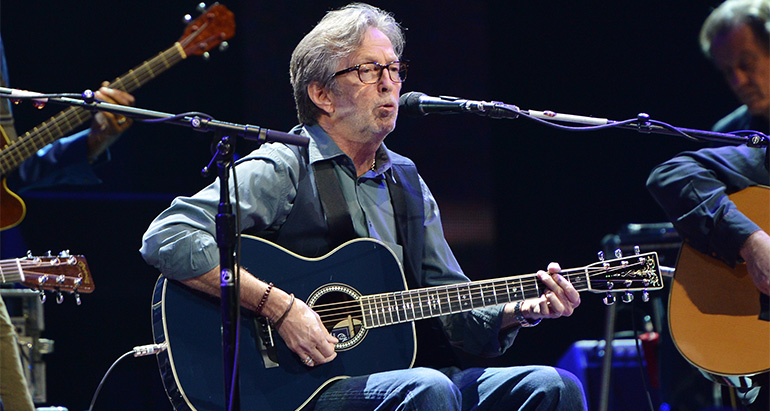
Eric Patrick Clapton, known as “Slowhand,” CBE, COAL (born March 30, 1945, in Ripley, Boro of Guildford, England), is a British blues and rock guitarist and singer. He is a 17-time Grammy winner and the only musician to be inducted into the Rock and Roll Hall of Fame three times. He has significantly shaped the development of blues rock since the 1960s and is considered one of the most important guitarists. On the 2011 updated list of the 100 Greatest Guitarists of All Time by the American music magazine Rolling Stone, Clapton is ranked second. With more than 130 million records sold worldwide, Clapton is one of the most successful artists of all time.
Life
Childhood
Eric Clapton was born on March 30, 1945, in Ripley, Surrey, England. His mother, Patricia Molly Clapton, was only 16 years old at the time of his birth. His father was the 24-year-old Canadian soldier Edward Walter Fryer, stationed in England, who had already left the country by the time of his birth. As an illegitimate child, Clapton grew up from the age of two with his maternal grandparents in Ripley. They concealed his parentage from him and led him to believe that his mother was his sister. The young Clapton was a rather quiet but exceptionally gifted child during his school years.
Career
1960s
Clapton dropped out of his art studies at Kingston University in London to join his first band, the Roosters, in January 1963 at the age of 17. In this R&B band, he met Tom McGuinness. After the group’s dissolution in August 1963, Clapton and McGuinness performed with Casey Jones & the Engineers a few times. In October 1963, Clapton became the guitarist for the Yardbirds, with whom he recorded their biggest hit “For Your Love” in 1965. After leaving the group in April 1965, he joined John Mayall’s Bluesbreakers. He participated in the recordings for the album Blues Breakers with Eric Clapton.
In mid-1966, Clapton left the Bluesbreakers and formed Cream with Ginger Baker (drums) and Jack Bruce (bass), both of whom had previously played with the Graham Bond Organization, the first supergroup in rock music. The group had several hits such as “I Feel Free,” “Sunshine of Your Love,” “White Room,” “Crossroads,” “Strange Brew,” and “Badge,” achieving corresponding commercial success. In particular, the openly expressed differences between Bruce and Baker permanently hindered the musical collaboration within the band.
Clapton began to sing and write songs himself. His compositions and overall style were heavily influenced by the group The Band during this time. With George Harrison of the Beatles, he wrote the Cream song Badge. The lifelong friendship between the two also led to Clapton’s participation in the Beatles’ recording of While My Guitar Gently Weeps (1968). Until Harrison’s death in 2001, Clapton often played on his solo recordings and they also performed live together. After Cream’s surprise break-up in 1968, Clapton played a performance in the Rock and Roll Circus in December of the same year, where he appeared with John Lennon, Keith Richards, and Mitch Mitchell as The Dirty Mac. In March of the following year, he formed the group Blind Faith together with Steve Winwood – with Clapton (lead guitar), Winwood (organ, piano, vocals), Ginger Baker (drums), and Ric Grech (bass, violin). After the release of the award-winning album Blind Faith and a tour, this formation also disbanded in September 1969. The differences between the individual band members had become too great regarding the future musical direction. A short time later, Clapton participated in John Lennon’s new live band, the Plastic Ono Band, as well as on the album Friends and Angels by Martha Veléz.
At the end of 1969, he toured with Delaney & Bonnie after moving to New York City. In 1970, he recorded his first solo album. With the release of the J.J. Cale song “After Midnight,” he achieved a notable success in the US charts. Furthermore, during this time he often played on recordings by other musicians, such as with the Plastic Ono Band and Dr. John. With some of the band musicians from Delaney & Bonnie, he then founded Derek and the Dominos, who recorded the album Layla and Other Assorted Love Songs, which also featured Duane Allman. The album is heavily influenced by blues and is still considered one of Clapton’s best albums, particularly because of the interplay between the two outstanding guitarists. The title song Layla is one of the most played rock songs of the 1970s. It draws on themes from the Persian poet Nezami’s love story Leila and Majnun; Clapton felt he was in a similar situation because of his unrequited love for Pattie Boyd Harrison at the time. The group, which toured without Allman, released a live double album, but broke up shortly thereafter.
1970s
Clapton continued to play on numerous studio recordings for friends like John Lennon and Billy Preston, and with Howlin’ Wolf during his London session. During this time, he fell into drugs and became addicted to heroin. In 1971 Clapton took part in George Harrison’s concert for Bangladesh, where he collapsed on stage. He had been living in a “cloud of pink cotton wool,” he told Rolling Stone magazine, but he was able to overcome his addiction thru a new form of electrotherapy.
In 1973, he performed at the Rainbow Concert organized by Pete Townshend – his prominently cast backing band was called The Palpitations. Townshend thus helped Clapton make a comeback after his drug-laden period. In 1974, Clapton recorded 461 Ocean Boulevard. His version of Bob Marley’s I Shot the Sheriff became a hit and introduced Marley and reggae to a wider audience. During a 1976 concert in Birmingham, Clapton made racist remarks, calling black people “wogs” and urging all “foreigners” to leave not just the venue but the country. He called for the election of British politician Enoch Powell, as he would prevent Britain from becoming a “black colony.” Clapton used the slogan of the far-right National Front “Keep Britain white!” The racism expressed by Clapton was, among other things, the reason for the founding of the musicians’ initiative Rock Against Racism. In his biography Clapton apologized; he said he had been drunk at the time. However, a week after the performance, he had confirmed his outbursts to a music magazine. As late as 2004, he told Uncut that Powell had been “incredibly brave.” Clapton had been living with Pattie Boyd since the mid-1970s, and they married in 1979. During this time, he was heavily dependent on alcohol, and after the first rehab, he relapsed; the second prompted him to establish the Crossroads Center Antigua rehabilitation center in Antigua.
1980s
After treating his addiction problems, Clapton began recording albums again in the 1980s. In October 1985, Clapton appeared alongside musicians such as Rosanne Cash, Ringo Starr, and George Harrison at Carl Perkins’ television concert “Blue Suede Shoes: A Rockabilly Session” recorded in London. The albums Behind the Sun (1985) and August (1986), produced with Phil Collins, clearly showcased Collins’ preferred pop-oriented style with synth drums and brass, but above all, they achieved remarkable sales success, especially in the UK. The album August reached number 3 in the UK charts. The opening track, “It’s in the Way that You Use It,” was used in the soundtrack of the film The Color of Money, starring Tom Cruise and Paul Newman. Also in 1986, Clapton performed with his idol Chuck Berry at his concert for his 60th birthday in St. Louis. In 1989, the album “Journeyman” was released. Since the 1980s, Clapton has also been active as a composer for film music. He worked with Michael Kamen on the soundtrack for Edge of Darkness and for the Lethal Weapon film series. In 1989, he divorced Pattie Boyd-Harrison, after having already become a father of two children from casual relationships in 1985 and 1986. Clapton was dressed by Gianni Versace in the 1980s and early 1990s.
1990s
At the beginning of the 1990s, Clapton had to endure some tragic events. On August 27, 1990, Stevie Ray Vaughan, who had participated as a guest musician at two concerts of the Journeyman World Tour at Clapton’s invitation, died in a helicopter crash; on March 20, 1991, his four-and-a-half-year-old son Conor died after falling from the 53rd floor of a high-rise building in New York. Part of his grieving process was the song Circus and Tears in Heaven. The MTV Unplugged session earned him six Grammys in 1993. In 1991, his live album 24 Nites was released, which had been recorded at the Royal Albert Hall in 1990 and 1991 with an orchestra, blues band, and 4- and 9-piece band. The album includes the rock hits “Pretending” and “Bad Love,” which brought Clapton to number one on the mainstream rock charts and earned him a Grammy for Best Rock Song in 1991. With the album From the Cradle, he returned to his blues roots in 1994. On the album Pilgrim (1998), produced by Simon Climie, more pop-oriented songs dominated. In 1996, he released the hit single “Change the World,” for which he received three Grammys in 1997. Since the mid-90s, Clapton has been dressed by his close friend Giorgio Armani. In 1996 Clapton opened two Emporio Armani stores in New York for Armani and in 1997 he composed pieces for Armani’s fashion shows. His critics were particularly convinced by joint recordings with Carlos Santana. In the late 1990s, he had a relationship with the musician Sheryl Crow. In 1999, he met the then 25-year-old graphic artist Melia McEnery, whom he married in 2002. With her, he has three children. In the same year, Clapton auctioned a selection of his guitars and amplifiers for the first time in favor of the Crossroads Center. The accompanying benefit concert, “In Concert: A Benefit for the Crossroads Center at Antigua,” was released on DVD. In addition, the compilation album Clapton Chronicles: The Best of Eric Clapton was released, which includes the song Blue Eyes Blue. The song is part of the soundtrack in the film Runaway Bride.
2000s
In 2000, Clapton released “Riding with the King” together with B. B. King. In 2001, the album Reptile was released, which was marketed with the Reptile World Tour. In 2002, Clapton held the Concert for George at the Royal Albert Hall on November 29, a memorial concert for George Harrison one year after his death. He invited Harrison’s friends, including Paul McCartney, Ringo Starr, Jeff Lynne, Tom Petty & the Heartbreakers, Ravi Shankar, Billy Preston, Gary Brooker, Klaus Voormann, and Joe Brown. Also present were Olivia Harrison and her son Dhani, who also played in the band. In 2004, Clapton organized the first Crossroads Guitar Festival in Dallas, the proceeds of which were donated to his eponymous rehabilitation clinic in Antigua as a charity event. Still in the same year, he recorded the blues documentary “Sessions for Robert J” and the album “Me and Mr. Johnson.” In May 2005, Clapton performed at the Royal Albert Hall in London with Ginger Baker (drums) and Jack Bruce (bass) in an original lineup “Cream Reunion Concert.” Shortly thereafter, he had a Martin guitar case made by Hermès in crocodile skin for 00,000. In November 2006, The Road to Escondido, a joint album with J. J. Cale, was released. The proceeds from the second Crossroads Guitar Festival on July 28, 2007, in Chicago also benefited the rehab clinic. The event featured Jeff Beck, Doyle Bramhall II, Robert Cray, Sheryl Crow, Vince Gill, Buddy Guy, B.B. King, Alison Krauss and Union Station, Sonny Landreth, Albert Lee, Los Lobos, John Mayer, John McLaughlin, Willie Nelson, Robert Randolph, Hubert Sumlin, Derek Trucks, Jimmie Vaughan, and Steve Winwood.
In 2008, Clapton won the Primetime Emmy Award in the Outstanding Special Class category for the 2007 Crossroads Festival. After a series of concerts with Steve Winwood in February 2008, Clapton completed a tour in the USA and Europe in the summer of 2008. He continued this in early 2009 in Japan and Australia. In May 2009, Clapton played a series of concerts at the Royal Albert Hall in London. In the fall of 2009, he returned to the USA for 14 concerts with Winwood and released the album and DVD Live from Madison Square Garden. In March 2009, Clapton appeared at the Beacon Theater in New York City for two nites as a guest with the Allman Brothers Band. The band played a series of concerts to celebrate their 40th anniversary.
2010s
After the concerts with Winwood, he continued the 2010 tour in Europe. At the beginning of the year Clapton also performed with Jeff Beck. In between, he played a small series of solo concerts in the USA with Roger Daltrey as support. Clapton started another world tour, which ended with the Crossroads Guitar Festival 2010 in Illinois. The video recording achieved platinum status in Germany. In September 2010, his 14th solo album titled Clapton was released, which reached number three on the German charts.
In 2011, he worked with jazz trumpeter Wynton Marsalis on the release “Play the Blues: Live from Jazz at Lincoln Center,” for which he received an ECHO Jazz award. In addition, he worked as a studio guest for Chris Barber and Robbie Robertson. In 2012, Clapton participated in the concert Howlin’ For Hubert for Hubert Sumlin and played guitar on Paul McCartney’s album Kisses on the Bottom. In 2012, he was a guest guitarist for the Rolling Stones at a concert in London. In December of that year, he performed with Steve Jordan and Willie Weeks at the 12-12-12: The Concert for Sandy Relief. In 2013, the fourth Crossroads Guitar Festival was held in Chicago, and the album Old Sock, which consists mostly of cover versions, was released on Clapton’s own label. In the same year, Bobby Whitlock’s release Where There’s a Will, There’s a Way was released, on which Clapton played bass.
In 2014, he released the album The Breeze – An Appreciation of JJ Cale, together with musicians such as Mark Knopfler and Willie Nelson, which reached number 2 on the charts in Germany. In addition, Clapton played several concerts in Europe, East Asia, and the USA. On June 24, 2014, he played his only concert in Germany at the SAP Arena in Mannheim. In the same year, the documentary and concert film “Planes, Trains and Eric” was released. In 2015, the British guitarist celebrated his seventieth birthday and released the live album and concert film “Slowhand at 70 – Live at the Royal Albert Hall.” The following year, the studio album I Still Do, the live album Live in San Diego as a tribute to J.J. Cale, and the compilation Crossroads Revisited with recordings from Clapton’s benefit concerts followed.
In early 2018, Clapton said in an interview with BBC Radio 2 that he was suffering from tinnitus and hearing loss, in addition to peripheral neuropathy (a nerve disorder that causes sensory disturbances and pain). Nevertheless, the Briton embarked on his Eric Clapton World Tour 2018 and released his first Christmas album, Happy Xmas, in October 2018. For 2019, Clapton announced concerts in, among others, Vienna, Mannheim, and Berlin, and he also concluded the Dresden Music Festival as part of his Eric Clapton World Tour 2019. In the fall, Clapton once again held another Crossroads Guitar Festival in Dallas, Texas, and announced a European tour for 2020 on October 2, the Summer European Tour 2020.
Private life
Eric Clapton has been married to Melia McEnery, who is 31 years younger, since 2002. With her, he has three daughters (* 2001, * 2003, * 2005). Another daughter (*1985) and a son (*1986; †1991) come from relationships with Yvonne Kelly and Lory Del Santo, whom he had during his first marriage (1979–1988) to Pattie Boyd.
Clapton as a guitarist
Style
Clapton’s musical roots lie in the blues of the 1930s and 1940s. His idols were primarily Robert Johnson and Chuck Berry, as well as Muddy Waters, B. B. King, Albert King, Freddie King, and Otis Rush. Although Clapton is capable of fast tempos (as in the live version of “Crossroads” from the 1968 album Wheels of Fire), he is not primarily known for it. The value of Clapton’s playing lies particularly in his ability to improvise solos with coherent musical architecture (building tension, climax, and resolution).
Nickname Slowhand
Clapton explains in his autobiography “My Life” how he got this nickname: At that time, Clapton was part of the band “The Yardbirds.” They played, among other places, at the CrawDaddy Club, whose owner was Giorgio Gomelsky. The band usually played cover songs that were normally three minutes long and stretched them to five or six minutes. At that time, Clapton played very thin strings, because you can bend the notes better on them, and it happened more often that a string broke in the middle of a piece. While Clapton was putting on the new string, the audience fell into a slow clap. This “slow handclap” inspired Gomelsky to call him “Slowhand” Clapton.
Instruments
Clapton played a Fender Telecaster and a Gibson ES-335 with the Yardbirds at the beginning of his career. With John Mayall’s Bluesbreakers and Cream, he switched to the Gibson Les Paul and Gibson SG. He was one of the blues musicians whose success prompted the guitar manufacturer Gibson to reintroduce the Les Paul. Since Derek and the Dominoes, Clapton has mainly played Fender guitars, particularly his “Brownie,” a two-tone sunburst Stratocaster from 1956. Three years later, at the Rainbow Concert, Brownie was replaced by Blackie, a black Fender Stratocaster that he had assembled from three instruments. Other guitars include the Cherry Red, 1977 Juan Alvarez, Martin 000-42.
Fender Eric Clapton Stratocaster
Clapton was honored by Fender in 1986 with his signature model. The “Eric Clapton Stratocaster” is still in production today and is the second most successful signature guitar after Steve Vai’s Ibanez Jem. Innovative technology was used on Clapton’s guitars, significantly expanding the sound spectrum. With the mid-boost, you can change the guitar from clean to distorted sounds without changing the volume with a knob. Thanks to the Fender Noiseless pickups built into the guitar by Fender in 1999, the guitar is very low in hum compared to other Stratocaster models. Until then, Lace Sensor pickups were used.
The “Artist Series” was built according to Clapton’s specifications, based on his favorite model “Blackie” from the 1970s. The special thing is the guitar neck with a V profile, which is good for his playing style. It also has very modern features such as the Noiseless pickups, which are very low in hum, a 25 dB active mid booster with a 9-volt battery, and a blocked tremolo, since Clapton never uses it.
In 2007, the “Eric Clapton Crossroads Stratocaster” was produced. The guitar adorned with the Crossroads Center logo was limited to 100 copies. The proceeds from the sale of these instruments went to the Crossroads Center. The price for the Stratocaster with case and strap was 0,000. Other special editions included the Custom Artist Series and the 2009 Limited Edition. In addition, there was the Custom Thinskin Nitro series. This nitro finish is supposed to provide a more natural, clearer, and “thinner” sound for the guitar.
The “Eric Clapton Gold Leaf Stratocaster” was custom-made for Clapton according to his special requests for his “Legends Tour 1998.” The Stratocaster was equipped with an alder body, Lace Sensor pickups, and a flamed AAA birdseye maple neck. The body was covered with 24-carat gold (gold leaf). Clapton auctioned this guitar at Christie’s in New York in 1999 at his first auction of guitars and amplifiers to support the rehabilitation center he founded in Antigua; it fetched a price of $455,500. There were also the Crashocaster models, which were decorated with graffiti motifs by British artist John Matos for Clapton.
Martin Eric Clapton Series
Martin Guitar dedicated the first signature acoustic guitar in the world to Clapton after the success of Unplugged. Clapton had already used Martin guitars of the 000-28 and 000-42 models live and in the studio since the 1970s.
Film Music and Advertising
Alongside many other well-known artists, Clapton plays a guitarist in the band Louisiana Gator Boys, assembled for the film Blues Brothers 2000. In the feature film Water – The Film, produced by George Harrison, Clapton can be seen in a small supporting role alongside other musicians. In addition, in 1975 he played the preacher in the film version of the rock opera Tommy.
Clapton contributed the song I Looked Away to the 1973 TV series, The Wrecking Crew. Other Clapton songs used in Miami Vise include “Wonderful Tonight”, “Knock On Wood”, “She’s Waiting” and “Layla”; Back to the Future, “Heaven Is One Step Away”; The Color of Money, “It’s In The Way That You Use It”; L.A. Confidential, “Knockin’ On Heaven’s Door”; Goodfellas, “Layla”, “Sunshine Of Your Love”; Friends, “The One with the Proposal”, “Wonderful Tonight”; and Men in Black II, “Strange Brew”. Opel and Vauxhall also used the riff from “Layla” in their advertising campaigns from 1987 to 1995.
In September 1987, Clapton became the face of Michelob Beer. He recorded a slower version of After Midnight for the commercial. In 1990, Honda used the song Bad Love for advertising. Clapton used his guitar “Blackie” for the video at Honda’s request. He contributed to the film scores of the Lethal Weapon film series, the film Fish & Chips (1996), and Along Came Polly (2004), and provided soundtracks for the films Phenomenon (Change the World), The Visitors, and Rush. In 1998, Lexus used some concert footage from Clapton’s Pilgrim World Tour. In 2005, Yahoo used some of his songs for advertising purposes.
Successes and Awards
Clapton has to date sold more than 115 million albums, over five million singles, and more than ten million videos, as well as over 20 million radio broadcasts of his songs. His most commercially successful album is Unplugged, which has sold more than 26 million copies worldwide.
Clapton was inducted into the Grammy Hall of Fame four times; in the “Rock Single” category in 1998 with Layla and in 2003 with his version of I Shot the Sheriff, as well as in the “Rock Album” category in 1999 with Disraeli Gears and in 2000 with Layla and Other Assorted Love Songs.
In 1987, Clapton won the “Lifetime Achievement Award” from the British Phonographic Institute. In 1990, he was awarded the “Top Rock Album” at the Billboard Music Awards. Additionally, he received a World Music Award for the categories of World’s Best-Selling Rock Artist of the Year (1993) and Best-Selling British Artist of the Year (1994). At the American Music Awards, he was nominated five times, and three times he was awarded Favorite Pop/Rock Artist (1994, 1997, and 1999). In 1990, the asteroid (4305) Clapton was named after him.
In 1992, Clapton was nominated for a Golden Globe Award for Best Original Song for “Tears in Heaven.” His work on the Lethal Weapon film series earned him the BMI Film & TV Award in 1988, 1990, and 1993, a BAFTA Award in 1986, and the Ivor Novello Award for the soundtrack of Edge of Darkness. He was nominated three times at the MTV Movie Awards.
In 1994, he was appointed Officer of the Order of the British Empire by Queen Elizabeth II for his contribution to music history. In 2004, he was appointed Commander of the Order at Buckingham Palace. Rolling Stone ranked Clapton 55th on its list of the 100 greatest musicians and second on its list of the 100 greatest guitarists of all time. In February 2015, Clapton was inducted into the Blues Hall of Fame.
