
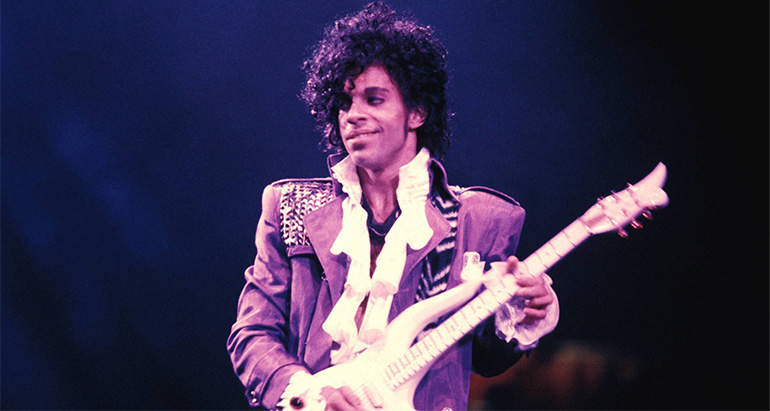
Prince Rogers Nelson (June 7, 1958 – April 21, 2016) was an American singer, composer, songwriter, multi-instrumentalist, music producer, and actor.
Prince had been in the music business since 1978. Especially in the 1980s, he influenced the international music scene by combining different music genres. The stylistic range of his music spanned from R&B, funk, soul, pop, and rock to blues and jazz. Prince wrote his own lyrics, and he also composed, arranged, and produced his songs. He also played instruments such as guitar, electric bass, piano, keyboard, and drums. In most of his studio recordings, he played all the instruments himself.
Prince achieved international fame in 1984 with the single and album “Purple Rain” for the eponymous film, in which he also played the lead role. During his lifetime, more than 100 million of his records were sold worldwide and Prince won seven Grammy Awards, an Oscar in 1985 and a Golden Globe Award in 2007. In 2004, he was inducted into the Rock and Roll Hall of Fame.
In the 1990s, Prince vigorously defended the rights to his intellectual property, which he demonstrated, among other things, thru his opposition to record companies. Due to differences with his then-record label Warner Bros. Records, he dropped his stage name from 1993 to 2000. During this time, instead of a pronounceable name, he used a symbol as a pseudonym and was often referred to as “The Artist Formerly Known As Prince” or simply TAFKAP. After the end of the contract with Warner Bros. Records, the musician called himself Prince again from May 2000.
At the beginning of the 21st century, he increasingly distanced himself from the music industry and chose unconventional distribution channels for his recordings; some of his albums were at times only available over the internet or as a supplement to a commercial newspaper.
Posthumously, among others, Barack Obama, Bono, Bruce Springsteen, Elton John, Madonna, Mark Knopfler, Michael Jordan, and Mick Jagger honored Prince’s career. Since 2018, all of the musician’s recordings have been officially managed by The Prince Estate.
Life
Childhood and Youth
Prince Rogers Nelson was born in 1958 in Minneapolis. He was named after his father John Louis Nelson’s stage name “Prince Rogers,” who was a full-time employe of Honeywell International in Minneapolis and performed as a jazz pianist with his band The Prince Rogers Trio on local stages in his spare time. During one of his performances in 1956 in Minneapolis, Nelson met the jazz singer Mattie Della Shaw (* November 11, 1933; † February 15, 2002), who had both black and white ancestry. He hired her as a singer in his jazz band, and on August 31, 1957, the two married. From his first marriage to his wife Vivian (* October 20, 1920; † June 25, 1973), Nelson had four children. Mattie Shaw also already had a son (1953–2019) with her first husband (1924–1992).
In a later interview, John L. Nelson explained that he named his first son in his second marriage Prince so that he could achieve what Nelson had set out to do himself. On May 18, 1960, the Nelsons had a daughter, Tyka Evene, who is thus Prince’s only full-blooded sister.
The couple lived together with seven children from three different relationships in a house in Minneapolis until they separated in 1965 and divorced on September 24, 1968. John L. Nelson moved out, and Prince stayed with his mother, who was in a relationship with Hayward Julius Baker (* September 23, 1915; † December 29, 2010) from 1967 and later married him. “I never liked him from the beginning,” Prince said of his stepfather in a later interview. In October 1970, Mattie Shaw and Baker had a son together, making him one of Prince’s six half-siblings.
Due to disputes with Baker, Prince moved in with his biological father in 1970 at the age of twelve. But John L. Nelson threw his son out of the house in 1972 because he was dating a girl. From then on, Prince lived with his aunt, the sister of John L. Nelson, until he was finally taken in by Bernadette Anderson (1932–2003) in 1973. She was divorced and also had six children. Her son André Simon Anderson (* June 27, 1958), who later called himself André Cymone, had already met Prince at school in 1965.
In June 1976, Prince graduated from Central High School, and in December 1976, at the age of 18, he moved into his first apartment in Minneapolis.
Family
From August 1985 to the end of April 1986, the 160 cm tall singer Prince was engaged to Susannah Melvoin and lived with her in Chanhassen, Minnesota. From 1987, he was engaged to Sheila E., who ended the relationship in 1988. The couple kept the partnership and engagement secret at the time. It was only in September 2014 that Sheila E. made both public in her autobiography.
On August 8, 1990, Prince met the 15 years younger dancer Mayte Garcia at a tour concert in Mannheim. Prince then kept in constant contact with the then underage Garcia; he integrated her as a dancer and backing singer into his backing band The New Power Generation in 1992. On February 14, 1996, the two married in Minneapolis, and from the marriage came a son, who was born on October 16, 1996, in Minneapolis. The child was born prematurely, suffered from Pfeiffer syndrome type 2 with physical and mental disabilities, and died a week later on October 23, 1996. In August 1997, Garcia was pregnant again, but suffered a miscarriage three months later. In the summer of 1998, Prince and Garcia split, with Garcia moving to a mansion in Marbella that Prince had bought for her. In May 2000, the marriage was divorced.
The second time Prince married was on December 31, 2001, in Hawaii, this time to the Canadian Manuela Testolini (* September 19, 1976), whom he met in 1997 during his then Love-4-One-Another-Charities tour, where she worked as a consultant. The marriage remained childless, and on May 24, 2006, Testolini filed for divorce.
From the fall of 2014 until his death, Prince was in a relationship with singer Judith Hill, which Hill only revealed on June 16, 2016 – two months after Prince’s death. Prince commented on reports and articles about his private life extremely rarely. He shielded it rigorously.
Death
On the evening of April 14, 2016, Prince finished his second concert of the day at the Fox Theater in Atlanta (Georgia) around 11:30 PM. On the nite flight home, he lost consciousness and his hired private jet made an emergency landing in Moline, Illinois, at 1:00 a.m., about 60 minutes of flight time before the planned arrival in his hometown of Minneapolis. He had overdosed on the painkiller Percocet, a combination of oxycodone – a powerful opioid – and acetaminophen, and was given the opioid antagonist naloxone by paramedics at the airport as an antidote. He was then taken to a hospital. According to The New York Times, he had been addicted to medication for years, and Sheila E. said after Prince’s death that as a result of years of dancing in high heels, he had suffered from hip and knee pain.
Prince left the hospital in Moline on April 15 around 8:30 a.m. and flew back to Minneapolis. On April 20, his management contacted California-based doctor Howard Kornfeld, who specializes in patients with drug dependency, due to a “grave medical emergency.” Because Kornfeld was unavailable, his son Andrew, an employe and then-medical student, flew to Minneapolis to see Prince the next day.
On April 21, 2016, Prince was found lifeless in an elevator at his Paisley Park studio in Chanhassen by his personal assistant and employe Kirk Johnson, who then called emergency services at 9:43 AM local time. The attempt at resuscitation was unsuccessful and Prince was pronounced dead at 10:07 a.m. local time at the age of 57. The next day, his body was cremated, and Prince’s urn is designed as a miniature model of his Paisley Park studio, decorated with the purple symbol he used as his stage name from 1993 to 2000. The urn is located at Paisley Park Studios, but is no longer open to the public.
On June 2, 2016, the medical examiners in Minnesota released the autopsy report; the cause of death was determined to be an overdose of the painkiller fentanyl, which Prince had accidentally administered to himself. The musician’s death is described as an accident. In August 2016, investigators announced that during a search on April 21, 2016, at 2:28 PM local time at Paisley Park Studio, they had found pills that were labeled as the painkiller hydrocodone; however, the pills actually contained the much stronger opioid fentanyl, for which Prince did not have a prescription. Doctors did not write prescriptions in his real name, but used a pseudonym for Prince to protect the musician’s anonymity. The evidence suggests that there is no indication that Prince knowingly took fentanyl. It could not be established where the musician had obtained the fake painkillers.
Two years after Prince’s death, the prosecutor’s office ended its investigation on April 19, 2018, without charges; no evidence of malicious intent, a crime, intent, or conspiracy was found. After the conclusion of the investigation by the prosecutor’s office, Prince’s family filed lawsuits against the musician’s treating physicians, all of which were dismissed by U.S. courts at the end of 2019.
Career
Musical beginnings
When Prince’s father, John L. Nelson, moved away from his family, he left his piano in the house. Prince used it to learn to play the piano himself. When he lived with André Anderson’s family starting in 1973, the two teenagers did a lot together and learned to play guitar, electric bass, keyboards, drums, and later also synthesizers. Together with a second cousin of Prince, they founded their first band, Phoenix. It was named after a 1972 album by the band Grand Funk Railroad, and Prince took on vocals and played electric guitar. After Phoenix was renamed Soul Explosion, Grand Central Corporation became the new name of the band in 1974. They covered songs by well-known artists. The drums at Grand Central Corporation were taken over later that year by Morris Day, who later became the lead singer of the band The Time. In 1975, Prince was hired as a studio musician by musician Pepé Willie (* 1948) and recorded various songs with his band 94 East, which were not released until 1986 on the album Minneapolis Genius.
In the spring of 1976, Grand Central Corporation was renamed Shampayne, and Prince recorded more songs with the band at MoonSound studio in Minneapolis. This studio belonged to the Englishman Chris Moon (* 1952), who wrote poems and lyrics that he wanted to set to music. Prince helped him with this and, in return, was allowed to record his own music at the MoonSound studio for free. This allowed him to further develop his knowledge in sound engineering and also to advance his skills as a musician. The band Champagne disbanded during this time. Chris Moon advised Prince to drop his last name Nelson and perform under the stage name “Prince.” However, Moon declined to become Prince’s manager. Instead, he contacted Owen Husney (* 1947), owner of an advertising agency in Minneapolis, and played him songs by Prince. In December 1976, Husney became Prince’s first manager under contract, and in early April 1977, the two flew to California. There, Husney had organized meetings with representatives of various record companies to finalize an artist contract for Prince. On June 25, 1977, Prince signed his first recording contract with Warner Bros. Records, which included a budget of 80,000 for his first three albums. Prince was under contract with Warner Bros. Records until December 31, 1999.
The First Steps in the Music Business (1978–1981)
The debut album For You was released in April 1978. However, the album was not commercially successful; it did not achieve gold status in the USA. In addition, the production costs were so high that the budget of 180,000 US dollars planned for the first three albums was almost entirely used up with the first one.
In the spring of 1979, Prince hired the management agency Bob Cavallo and Joe Ruffalo, jokingly referred to as Spaghetti Inc. at the time due to their Italian heritage. These, together with partner Steve Fargnoli (1949–2001), took on advisory roles for the artist until December 31, 1988. His second album, Prince, was significantly more successful than his first, but Prince considered it a concession to public musical taste. He himself would have preferred to take other musical directions and try new things.
In 1980, his third album, Dirty Mind, was released, with which Prince definitively bid farewell to the image of possibly becoming the new Stevie Wonder. He parted ways with his Afro look and got a short hairstyle. In addition, during this time he often appeared in public wearing a thong and trench coat, combined with over-the-knee stockings and high heels. Musically, Prince became increasingly experimental and delved into genres that had not appeared on his first two albums.
Prince’s music contained different styles and thus did not target a specific audience. His androgynous appearance and extraordinary clothing style early on gave Prince the image of an eccentric. His sometimes very suggestive lyrics and his media shyness also made him seem mysterious. In one of his rare interviews, Prince said at the time that he was “really very shy” around strangers. From 1982 to 1990, he gave only five interviews.
The national and international breakthrough (1982–1986)
The double album 1999, released in October 1982, initially did not play a significant role in the US charts until the television channel MTV included the music video for the single 1999 in its rotation in December 1982. The album and the singles “Little Red Corvette” and “Delirious” became Prince’s first top ten hits in the U.S. in 1983. With that, he had achieved commercial success and crossover on a national level.
But behind the scenes, tensions arose between him and his band members. Prince had a personal bodyguard shield him. Only during live performances was he still with his musicians. In August 1983, Prince finally introduced a new backing band and named it The Revolution.
1984 followed as the most commercially successful year in Prince’s career. The album Purple Rain was released and held the number one spot on the US album charts for 24 consecutive weeks. It also won two Grammy Awards. The advance single “When Doves Cry” already topped the US singles chart for five weeks. The Purple Rain tour became the most successful tour of Prince’s career; for the musical film Purple Rain, he received an Oscar for Best Original Song Score. Prince also achieved commercial success internationally. The rock ballad Purple Rain and the album of the same name reached top ten positions in a number of countries. Purple Rain is Prince’s best-selling album worldwide, with 25 million records sold.
In the meantime, Prince placed more emphasis on choreography in his performances; idiosyncratic costumes continued to be part of his image. Striking about Prince’s stage outfit in the years 1984 and 1985 were, in addition to his high heels, tight pants with ruffled shirts and lace cuffs, as well as a purple trench coat.
Immediately after the American Music Awards ceremony on January 28, 1985, where Prince won in three categories, numerous musicians gathered to record the song “We Are the World” for the USA for Africa music project. Prince was given a line to sing and a spot in the studio was reserved for him to sing it right next to Michael Jackson. However, for reasons unknown, Prince did not show up, and instead later contributed his own song to the album. This solidified his reputation as an egotist.
In 1985, Prince founded the music label Paisley Park Records with financial backing from Warner Bros. Records. His album “Around the World in a Day” was released on this label in the same year. It did not reach the sales figures of Purple Rain, but it still topped the US album charts for three weeks. At the end of March 1986, Parade was released, the last album Prince recorded in collaboration with The Revolution. It contains one of his most successful singles, Kiss. Parade serves as the soundtrack for the second Prince film, Under the Cherry Moon, which, however, did not achieve anywhere near the success of the film Purple Rain. On October 17, 1986, the official announcement of the split from The Revolution was made.
Sign “☮” the Times until the name change (1987–1992)
In March 1987, the double album Sign “☮” the Times was released, which critics consider a peak of Prince’s musical career. Warner Bros. Records wanted Prince to go on tour in the USA at that time, but he declined.
On September 11, 1987, Prince opened the Paisley Park Studio in Chanhassen, Minnesota, a building complex that cost ten million US dollars at the time. The estate was his private primary residence and private music studio until his death, and it featured various recording studios as well as spaces for concert, video, and film recordings. Posthumously, the Paisley Park Studio can be officially visited for a fee. Prince’s half-sister Sharon Nelson (* 1940) said, “He wanted it to become a museum.” All items are strategically placed. The fans will see that. Prince planned this out exactly. He had a vision, and he executed it.
Prince’s subsequent album was supposed to be released in December 1987 under the name Black Album. But a week before the release date, Prince canceled the album’s release. He said in 1990 that he had realized that you could die at any moment and would be judged on what you had left behind. The Black Album became one of the best-selling bootlegs in music history with over 250,000 copies, before it was officially released by Warner Bros. Records in November 1994.
Despite good reviews for his latest albums, Prince’s popularity in the USA declined in 1988, and his commercial success there diminished. In contrast, his popularity grew in Europe. For the first time, a Prince album sold better in Europe than in his homeland with Lovesexy.
When the Batman movie was released in June 1989, national commercial success returned for Prince. His eponymous album was released as the film’s soundtrack and, like the single “Batdance,” reached number one on the U.S. charts. The following year, his album Graffiti Bridge served as the soundtrack for his eponymous musical film, which, however, was a failure. Unlike the Batman film, Graffiti Bridge was hardly attended in theaters. As a result, Prince dismissed his management at the end of 1990. Since then, he no longer had a manager and handled his business affairs on his own.
At the end of 1990, Prince formed his new backing band, The New Power Generation, abbreviated as The NPG. This band, whose lineup he changed over the years, supported him in concerts and studio recordings from then on. Thanks to the single successes of Gett Off and Cream, his 13th album Diamonds and Pearls (1991) became Prince’s second best-selling album worldwide after Purple Rain. But, as in 1983, tensions between Prince and his musicians were brewing behind the scenes during the Diamonds and Pearls tour in 1992. For example, the band traveled together in a tour bus, while Prince traveled separately with bodyguards and dancers in a limousine.
On August 31, 1992, Prince extended his ongoing contract with Warner Bros. Records for six more albums until December 31, 1999. All information about the financial details of the contract’s contents is speculation, as there are only very different reports on it, but no official statements. For the moderate sales figures of the subsequent album Love Symbol, measured against Diamonds and Pearls, Prince blamed the record company Warner Bros. Records in 1992. He accused it of not promoting the album enough. In addition, Prince generally disagreed with the record company’s sales strategy. In the past, they had repeatedly urged him not to release too many albums in a row, so as not to saturate the music market with his music. Alan Leeds, then managing director of Paisley Park Studios, said of the musician after Prince’s death in 2016: “But if something didn’t go the way he wanted, he decided that management and the record company were to blame, and ignored decisions he had made.”
The Unnamed Era (1993–2000)
In early 1993, an open conflict finally arose between Prince and Warner Bros. Records. The record company demanded a creative break and wanted to release a greatest-hits album by him. Prince then felt that his artistic freedom was being restricted. On June 7, 1993, the musician’s 35th birthday, Paisley Park Studio announced via press release that Prince was changing his stage name to an unpronounceable symbol, which he copyrighted under the designation “Love Symbol #2.”
In his private circle, Prince didn’t mind if family members and longtime friends continued to call him “Prince,” but in public, he no longer wanted to be addressed by his old stage name. In the mass media, he was now referred to as “The Artist Formerly Known As Prince” – abbreviated as “TAFKAP” – or simply “The Artist,” and Prince wrote the term “Slave” on his cheek. As an explanation, he stated: “If you don’t own your masters, your masters own you.” This statement referred to the fact that Warner Bros. Records at that time owned the copyright to all the songs Prince recorded for them during his career. He felt “beaten and restricted,” Prince stated in an interview in 1994.In the following period, Prince increasingly distanced himself from the ongoing contract with Warner Bros. Records. He himself organized only minimal or no advertising at all for his albums and singles released by Warner. From 1993 onward, Prince primarily delivered older and lower-quality song material to the record company to fulfilll the contract. However, Warner lawyers refrained from suing the artist for this. A similar lawsuit by Geffen Records against Neil Young in 1983 had led to a lengthy trial, and Warner Bros. Records feared potential damage to its image. In 1994, Warner Bros. Records ended its relationship with Prince’s label Paisley Park Records, which led Prince to start his label NPG Records that same year, which still exists today. In 1995, Prince brusquely offended Warner Bros. Records by stating that he had 50 new songs and had been working on an album called Emancipation for some time, which would be his first album when he was free again. In the booklet of the album Chaos and Disorder (1996), the following text could be read: “Originally intended 4 private use only, this compilation serves as the last original material recorded by O(+> 4 warner brothers records” (German: “Ursprünglich nur zur privaten Nutzung beabsichtigt, dient diese Zusammenstellung als das letzte Originalmaterial, das O(+> für Warner Brothers Records aufgenommen hat”).
From 1994 to 2000, Prince also signed contracts with various other record companies under the name of the unpronounceable symbol, during which he released several albums in parallel to the ongoing contract with Warner Bros. Records. In all the record contracts that Prince signed after his last signature with Warner Bros. Records, he secured the copyright to his own songs. The albums that Prince released as “Symbol” with record companies such as EMI or Arista Records were marketed very intensively. On the occasion of the release of the album Emancipation (1996), for example, Prince was a guest on the Oprah Winfrey Show, and as part of the international advertising campaign for Rave Un2 the Joy Fantastic (1999), he appeared as a musical guest on the Harald Schmidt Show, marking his first appearance on German television.
On August 23, 1997, Prince met bassist Larry Graham at an aftershow in Nashville, Tennessee, after which a friendship developed between the two musicians. From 1998, Graham was a regular guest musician at Prince’s concerts and also worked as a studio musician on Prince’s productions. Graham was, as he is today, a Jehovah’s Witness; Prince also joined this religious community in 2001 and remained a member until his death.
In January 1998, Prince released the album Crystal Ball. After his years of differences with Warner Bros. Records, he distanced himself from the record industry in general for the first time: he distributed his album exclusively on the internet thru his then-website. There, a limited 5-CD set edition could be ordered, which was released only by his own label, NPG Records.
On December 31, 1999, the contract with Warner Bros. Records ended, and on May 16, 2000, The Artist Formerly Known As Prince announced at a press conference in New York that he would be returning to his original stage name, Prince.
Prince and the Internet (2001–2004)
After the end of his contract with Warner Bros. Records, Prince did not work with any major label for more than four years. Instead, in February 2001, he created his website NPG Music Club.com, where one could register as a lifelong member for a fee. With the help of this website, Prince conducted his music distribution from 2001 to early 2004. This way, he could decide for himself how many and which songs he wanted to release and when, as he was no longer dependent on the decisions of a record company. In addition, he was able to make his music more accessible, with some of his albums available exclusively as downloads.
For some albums, Prince also entered into contracts with independent labels that distributed the albums in the traditional way. Members of NPG Music Club.com were able to download or pre-order the albums four weeks before their regular release for retail. Prince offered members additional options; for example, they could reserve the best seats for the One-Nite-Alone Tour (2002) thru the website and had access to soundchecks that Prince usually held before each concert.
Prince was honored with the Webby Lifetime Achievement Award, recognizing his use of the internet. On the one hand, he was the first established artist in the music industry to sell an album—Crystal Ball in 1998—exclusively over the Internet, and on the other hand, he created a novel contact and distribution platform with NPG Music Club.com in 2001. NPG Music Club.com, which not only served as the official website but also became a popular fan platform with its extensive information, chat, and download options, was closed by Prince in July 2006.
The Comeback (2004–2007)
Prince’s level of fame had declined over the years, and he was hardly present in international charts, when he made a comeback in 2004. At the Grammy Awards in February 2004, he performed with Beyoncé and sang his hit Purple Rain as a duet with her. The Grammy Awards were broadcast on television in various countries, bringing him back into the international spotlight.
In April 2004, Prince released his album Musicology. After five years, an album was released again that was marketed worldwide in the conventional way with the support of a major label, Columbia Records. Musicology reached double platinum status in the USA and was awarded two Grammys. The Musicology Tour was the most successful tour in the world in 2004.
In 2006, Prince released the album 3121 with the Universal label, which received good reviews. After Purple Rain (1984), Around the World in a Day (1985), and Batman (1989), it became his fourth and final number one in the US album charts during his lifetime.
In early February 2007, Prince had a live performance during the halftime show of Super Bowl XLI in Miami, Florida, which reflected his regained national popularity. The performance was watched by approximately 140 million U.S. television viewers. Prince was also successful internationally; for example, tickets for his performance at the Montreux Jazz Festival in July 2007 sold out within ten minutes.
Separation from the Music Industry (2007–2013)
Despite the regained success, Prince did not want to submit to any record company. The album Planet Earth, released by Sony BMG Music Entertainment at the end of July 2007, was given away free to readers of the British Sunday newspaper The Mail On Sunday on 15 July 2007, as Prince had made a deal with the newspaper. Sony BMG Music England considered this an affront and subsequently did not release the album Planet Earth in Great Britain.
A year later, Prince published the coffee table book 21 Nights. The 256-page photo book documents Prince’s stay in London during his concert series from August to September 2007. In addition, the book contains the CD Indigo Nights, a compilation of various aftershows at the music club indigO2, which Prince gave after the regular London concerts. Indigo Nites was released exclusively as a book supplement and was not sold as a standalone CD.
In March 2009, the two albums Lotusflow3r and MPLSound were released, which were only available for purchase thru Prince’s then-website and the American retail chain Target Corporation, with which he had signed a contract. This allowed Prince to avoid record companies and sell his CDs thru alternative channels. He ran elaborate advertising campaigns for the albums in the USA and appeared on various television shows. Outside the USA, the albums were only available as imports at that time.
Prince’s album 20Ten, released in July 2010, was sold exclusively as an insert in the August issue of the music magazine Rolling Stone in Germany, Austria, and Switzerland. In other European countries, the CD was also only available as an insert in a newspaper. With this, Prince once again distanced himself from the music industry and released an album in a similar manner as he did in 2007. After ten years, he gave an interview to a British newspaper again. In an interview with the Daily Mirror, he said that the Internet was “completely over.” There will be no downloads of his new songs because he doubts the acceptance of the payment system. However, he believes he will find new ways to distribute his music.
Although Prince signed a contract with the Swiss independent label Purple Music in October 2011, he said in September 2012 that he did not want to record a new album at that time: “We’re back in a singles market. It seems crazy to me to come in with a new album.”
In December 2012, Prince formed a new backing band called 3rdEyeGirl. This band consisted of the three musicians Hannah Ford on drums, Ida Nielsen on electric bass, and Donna Grantis on electric guitar.
Final creative phase (2014–2016)
As the record contract with the major label Universal, which had been in place for Prince since 2005, ended on March 31, 2014, he signed a new twelve-month contract with Warner Bros. Records in April and returned to the label. According to the company, he now owned all rights to songs he had recorded for Warner. No financial details of the contract were disclosed. At the end of September 2014, Prince released two studio albums, Art Official Age and PlectrumElectrum, with Warner Bros. Records. In addition, he deleted his user accounts on Facebook, Instagram and YouTube at the end of November. Prince did not provide an official reason for this.
In December 2015, Prince released his 39th studio album titled HITnRUN Phase Two, which thus became his last album released during his lifetime. HITnRUN Phase Two was distributed thru his own music label, NPG Records.
On the evening of April 16, 2016, Prince made his last public appearance; he played two songs on the piano during a “dance party” at his Paisley Park studio in Chanhassen and announced a new live album titled Piano & A Microphone.
Posthumous
Will
Since Prince did not draft a will before his death, his biological sister and his five surviving half-siblings at the time were appointed as heirs by court order. A probate court is responsible for processing Prince’s estate, which is estimated to be worth between 200 and 300 million US dollars, but to this day the exact value has not been determined. A legal decision on how to distribute the estate has yet to be made. In addition, a half-brother of Prince who was entitled to inherit died in August 2019, complicating the situation (as of February 2020).
Dispute over Prince’s music catalog (2016–2017)
Posthumously, Prince’s siblings initially could not agree on how to oversee and manage their brother’s music catalog. In 2016, the financial company Bremer Trust was appointed to manage the estate by court order, but since 2017, the financial company Comerica has been appointed, which guaranties the siblings a greater say. In July 2017, the user account on YouTube, which Prince had deactivated in 2014, was reactivated, allowing the musician’s music videos to be watched online again.
The Prince Estate (since 2018)
Since 2018, all of Prince’s record releases have been officially managed by Comerica in collaboration with The Prince Estate. The curators of The Prince Estate are the Americans Troy Carter (*1972) and Michael Howe; Carter was formerly Lady Gaga’s music manager and has also been an advisor at Spotify since September 2018. Howe was Vise President of the Artists and Repertoire department at Warner Bros. Records from 2014 to 2017.
At the end of June 2018, The Prince Estate announced that the major label Sony Music Entertainment had acquired the distribution rights for 35 previously released Prince albums. The deal is staggered in two phases: Starting now, Sony can release 23 albums that Prince released between 1995 and 2010, including singles, B-sides, remixes, non-album tracks, live recordings and music videos released during that time. The second phase will begin in 2021 and will include 12 more Prince albums from 1978 to 1996, as well as songs from 2014 to 2015. The purchase price has not been made public. Until 2021, Warner Bros. Records owns the distribution rights to Prince songs from 1978 to 1994 and from 2014 to 2015.
In 2019, Michael Howe said it was “detective work” to catalog the Prince archive because many recordings were unlabeled. In addition, the amount of music that Prince produced and then discarded was “huge.” The archive has now been moved from the Paisley Park Studio in Minneapolis “to a secret and secure location in Hollywood,” where it is “very well guarded”; you could call it “a fortress,” said Howe. Prince’s heirs decide on every Prince release in cooperation with The Prince Estate, he said. In addition, Howe is in contact with some fan experts. However, many tapes are not in good condition, as they have “been collecting dust for decades.” But nothing has been “beyond saving” so far. Howe knows that Prince said several times that he was aware that the contents of his archive would be published posthumously. There is enough material to release “many, many, many years of Prince albums.” But the legal situation is not simple, because various record companies and musicians are involved.
In November 2019, The Prince Estate released the five-disc album 1999 Deluxe, which includes previously unreleased songs from the years 1981 to 1983, among other things. Prince released the original 1999 album in October 1982.
Music
Since Prince’s debut album For You in 1978, the phrase “Produced, Arranged, Composed and Performed by Prince” can be found on the records he released, and it can almost be considered his trademark. Prince wrote all the lyrics and melodies of his songs, and he also played many musical instruments on his studio albums himself. The accompanying musicians who supported him in the recordings of his studio albums played instruments like bass, drums, or guitar only on individual songs. Regular guest musicians on Prince’s studio albums included Sheila E. and Clare Fischer from the 1980s, Candy Dulfer, Larry Graham, and Maceo Parker from the 1990s, and trombonist Greg Boyer from 2002. Furthermore, Prince worked with violinist Vanessa-Mae in 2003 and with former The Revolution members Wendy Melvoin and Lisa Coleman in 2007.
Musical Style
The typical characteristic of Prince’s musical work is its stylistic diversity. First, he moved thru very different musical terrain during his career, and second, he repeatedly combined different musical styles in his albums and songs. He cannot therefore be assigned exclusively to a specific music genre.
Prince’s musical development began in the 1970s. As a teenager, he played covers with his bands at the time, including songs by artists such as Earth, Wind and Fire, Grand Funk Railroad, James Brown, Jimi Hendrix, Parliament, Sly & the Family Stone, and Stevie Wonder. Prince was also influenced by Carlos Santana and Joni Mitchell.
On his first two albums, For You (1978) and Prince (1979), R&B, as well as funk, rock, and pop with disko influences, dominate. In the 1980s, Prince expanded his musical spectrum and became increasingly inventive in combining different music styles. Songs from the new wave, rockabilly, and rock ‘n’ roll genres were added to the albums Dirty Mind (1980) and Controversy (1981). 1999 (1982) and Purple Rain (1984) are also characterized by dance and electro funk. On Around the World in a Day (1985), Prince discovered the hippie era and created an album of psychedelic soul, psychedelic rock, and R&B songs.
Notably during this time, Prince initially refrained from using standard instruments typical for R&B music, such as brass. Instead of saxophones and trumpets, he used synthesizers. Only with his album Parade (1986) did Prince – partly in collaboration with the arranger Clare Fischer – also use wind and string instruments. At the same time, the first jazz influences appeared in his music. The stylistic range of his album Sign “☮” the Times (1987) spans from gospel and soul ballads to R&B and funk, all the way to rock. On the album Batman (1989), Prince used samples from film quotes from the Batman movie for the first time in some of his songs.
In 1981, Prince first used the Linn LM-1 as a drum machine and used it for the recordings of some of his songs until 1987. Before and in the following years, he usually played the beats on the drums. It was only on the albums Rave Un2 the Joy Fantastic (1999) and 20Ten (2010) that Prince again used the Linn LM-1, typical of the 1980s, to record some of his songs. Another characteristic of his studio albums is guitar-heavy songs, which is why Prince was occasionally compared to Jimi Hendrix, although Prince himself believed he sounded more like Carlos Santana.
In the 1980s, Prince was considered a rebellious pioneer who was not afraid to combine different musical styles with sometimes very suggestive lyrics. But he gradually lost this reputation in the 1990s. In his albums Diamonds and Pearls (1991) and Love Symbol (1992), he dedicated himself to genres such as rap and hip-hop, which were increasingly influencing the international music scene at the time. For the first time, Prince followed trends, after having previously set them himself. Critics accused him of waning creativity in the 1990s. The acoustic guitar-dominated unplugged album The Truth (1998) went largely unnoticed as it was only released thru his then websites. The same applied to the album Crystal Ball (1998), which features songs from the reggae and blues genres, among others.
At the beginning of the 21st century, Prince’s albums were characterized by jazz influences. This includes The Rainbow Children (2001) as well as the instrumental fusion albums C-Note and N.E.W.S. from 2003. The album One Nite Alone … (2002) is once again an acoustic album, on which Prince this time plays all the songs on the piano.
Since his 2004 album Musicology, Prince returned to the mix of musical styles that had made him famous and successful in the 1980s; R&B, funk, soul, pop, and rock elements, supported by brass and string instruments, were present on the subsequent albums.
Song lyrics
Prince’s lyrics mostly deal with love, interpersonal relationships, or sexuality. But political and social criticism, as well as religious and spiritual content, also appear in his lyrics.
In the 1970s, 1980s, and 1990s, Prince dedicated his song lyrics to various facets of sexuality, among other things. In 1979, for example, he sang about lesbian love in the song “Bambi,” and the lyrics of the album “Dirty Mind” (1980) were considered obscene at the time. Whether it was about sexual intercourse, allusions to oral sex, or incest – Prince provoked on all levels. He used metaphors in his lyrics. For example, the song Little Red Corvette (1982) seems to be about a vagina rather than a sports car. Cars and horses serve as a metaphor for lust. The song Darling Nikki from the album Purple Rain was the reason in 1984 that the warning label “Parental Advisory – Explicit Lyrics” was introduced on music releases in the USA at the initiative of Tipper Gore. Tipper Gore was offended when her then-11-year-old daughter heard a line in the song that referred to masturbation. However, in the following years, Prince also incorporated obscenities and innuendos into his song lyrics. The single “Sexy MF” (1992) was mainly played on the radio in a censored version at the time, as the word “motherfucker” appears in the chorus. As is clear from song titles like Orgasm (1994) and Pussy Control (1995), Prince continued to not shy away from lyrics with sexual content.
Since the 21st century, however, Prince distanced himself from his overly explicit lyrics and no longer performed corresponding songs live. In 2001, he stated in an interview that he wanted to remove all profanity from his lyrics. Since then, Prince adhered to it. Only on posthumous album releases are his song lyrics with sexual content heard again.
When his lyrics address political or social issues, Prince typically describes a situation or a theme without expressing his own opinion. For example, in the song “Annie Christian” (1981), he addresses the murder of John Lennon. In the songs 1999 (1982), America (1985), and Crystal Ball (1998), he depicts fears of nuclear wars. Further apocalyptic tendencies can be found in the songs Sign “☮” the Times (1987), in which he sings about AIDS and the Challenger disaster, and Planet Earth (2007), in which he describes climate change. Prince also refers to the second Gulf War in the songs Money Don’t Matter 2 Nite (1991) and Live 4 Love (1991). In the song Cinnamon Girl (2004), Prince addresses the terrorist attacks of September 11, 2001.
In some of his song lyrics, Prince dedicated himself to religious and sometimes spiritual themes. In the song “Controversy” (1981), he quoted the Lord’s Prayer, and especially the lyrics of the album “Lovesexy” (1988) are influenced by mystical enlightenment and Christian motifs; they deal with God, the devil, guilt, and atonement. In the song Dolphin (1995), Prince sings about reincarnation, and on the concept album The Rainbow Children (2001), there are allusions to the Jehovah’s Witnesses.
Singing
Characteristic of Prince was his sometimes high falsetto singing. Since Prince predominantly sang with a very high falsetto on his first two albums, For You and Prince, the music magazine Rolling Stone compared his singing to that of Smokey Robinson in 1979. Further examples of Prince’s falsetto singing can be found on the singles Kiss (1986), The Most Beautiful Girl in the World (1994), and Breakdown (2014).
For some songs, Prince created a vocal effect that he called “Camille.” The tape runs slower than normal during the vocal recording. When the tape is played back at normal speed, a pitch-shifting effect occurs, making Prince’s voice sound slightly higher and faster, as if he were singing under the influence of helium. In particular, this vocal effect can be heard on some songs on the album Sign “☮” the Times (1987). “Camille” is interpreted as Prince’s alter ego – his evil side. The voice effect opposite to “Camille” results in Prince’s voice sounding much slower and very deep, similar to that of Barry White. This deep voice can be heard, for example, in the song Bob George (1994) or on the album The Rainbow Children (2001).
Most of his lyrics are sung melodically by Prince, but occasionally there are also passages of spoken word in his pieces. Examples of this are songs like “Controversy” (1981), “Girls & Boys” (1986), or “Dead on It” (1994), which Prince originally recorded in 1986 and intended for the Black Album. In this song, he stutters a text that makes fun of the rap genre. Nevertheless, Prince occasionally resorted to this form of delivery, especially in the 1990s, and performed rap-like vocals in some songs.
Prince took on both the lead vocals and additional multi-part vocal tracks in his songs, for example in the a cappella piece “For You” (1978) or in the songs “When Doves Cry” (1984) and “Gold” (1995). The backing vocals in his songs are also predominantly by him, although he is occasionally supported by band members. Occasionally, band members sing complete lines in Prince’s songs, such as Wendy Melvoin and Lisa Coleman in songs from the 1980s, Rosie Gaines in songs from the 1990s, Shelby J. in songs from the 2000s, or 3rdEyeGirl in songs from 2013 onward.
On certain songs, Prince sings duets with guest female vocalists such as Apollonia Kotero (1984), Sheena Easton (1987 and 1989), Carmen Electra (1992), Nona Gaye (1994), Gwen Stefani (1999), Angie Stone (2001), Lianne La Havas (2014), as well as Judith Hill, Ledisi, and Rita Ora (all in 2015). As guest rappers, among others, Doug E. Fresh (1998), Chuck D (1999), Eve (1999), and Q-Tip (2009) contributed to some of his songs.
Influence on other artists
The musical influence of Prince is reflected in various areas of the international music scene. The Boston Globe wrote in 2002 that Prince was one of the most covered artists of his time and that many contemporary musicians incorporated elements of Prince’s musical style into their sound. Musicians from various genres have recorded cover versions of Prince songs, including Iain Matthews (1981), Mitch Ryder (1983), Tina Turner (1985), The Art of Noise featuring Tom Jones (1988), Herbie Hancock (1990), The Flying Pickets (1992), The Hollies (1992), Bob Belden (1994), Laibach (1996), Mariah Carey (1997), Ice-T (2000), Rod Stewart (2001), Patti Smith (2002), Foo Fighters (2003), Etta James (2006), Nina Simone (2008), Incubus (2009), Glee Cast (2011), Sufjan Stevens (2012), Aretha Franklin (2014), Steven Wilson (2014), Manfred Mann (2014), and Kelly Clarkson (2017). Various musicians cite Prince as a role model or formative influence, including Alicia Keys, Beck, Bruno Mars, D’Angelo, Lenny Kravitz, Macy Gray, Maroon 5, OutKast, and Taio Cruz.
German musicians such as the Palast Orchester featuring Max Raabe (2001), Joy Denalane (2004), Roger Cicero with Soulounge (2004), Texas Lightning (2005), Uwe Schmidt under the pseudonym Señor Coconut (2008), Lisa Wahlandt (2010), Barbara Morgenstern (2011), and David Garrett (2017) also reinterpreted songs by Prince. The first German-language version of a Prince title was recorded by Michy Reincke in 1992; his version “Ich bin nicht Dein Mann” is based on the song “I Could Never Take The Place of Your Man” from the album “Sign “☮” the Times,” and Adel Tawil makes references to the songs “Purple Rain” and “When Doves Cry” in the song “Lieder” (2013). Furthermore, pop singer Helene Fischer included Purple Rain in the setlist of her Farbenspiel tour (2014).
The Swiss rock band Züri West recorded a Swiss German version of “When You Were Mine” from the album Dirty Mind with “I ha di gärn gha” (1996), and the Austrian jazz musician David Helbock released an album with Prince’s songs in 2012.
Some of Prince’s songs became known not thru their original versions, but only thru re-recordings by other musicians. Chaka Khan had an international top ten hit in 1984 with I Feel for You, and Sinéad O’Connor had a worldwide hit in 1990 with the single Nothing Compares 2 U. Originally, Prince wrote the song for the band The Family – his side project at the time – who released Nothing Compares 2 U on their album The Family in August 1985. A version sung by Prince himself was not released until 1993 on The Hits/The B-Sides, sung as a live duet with Rosie Gaines.
Prince, for his part, very rarely covered songs by other artists to release them on his own studio albums; only on Emancipation (1996), Rave Un2 the Joy Fantastic (1999), One Nite Alone … (2002), Lotusflow3r (2009), and PlectrumElectrum (2014) can songs by other musicians interpreted by him be found.
In addition, Prince composed songs for various artists, sometimes under pseudonyms such as Alexander Nevermind, Camille, Christopher, Jamie Starr, and Joey Coco. These include Stevie Nicks (1983 Stand Back), Sheena Easton (1984 Sugar Walls), The Bangles (1985 Manic Monday), Kenny Rogers (1986 You’re My Love), Madonna (1989 Love Song), Patti LaBelle (1989 Yo Mister), Joe Cocker (1991 Five Women), Martika (1991 Love… Thy Will Be Done), Paula Abdul (1991 U), Céline Dion (1992 With This Tear), Earth, Wind and Fire (1993 Super Hero), and No Doubt (2001 Waiting Room). In addition, Prince wrote songs for Miles Davis, but Davis never released them as studio versions. On December 31, 1987, Davis appeared as a guest at a Prince concert at Paisley Park Studio for about 30 minutes. When Miles Davis died on September 28, 1991, Prince wrote the instrumental song Letter 4 Miles two days later in memory of him, but he did not release it.
Additionally, Prince founded bands such as Apollonia 6, Madhouse, The Family, The New Power Generation, and The Time. He wrote and produced songs for these bands and mentored the careers of, among others, Andy Allo, Carmen Electra, Jill Jones, and Sheila E. When the musical careers of Chaka Khan, George Clinton and Mavis Staples were commercially at a low point, Prince signed these artists to his labels Paisley Park Records and, from 1994, NPG Records. He wrote songs for them, allowing the aforementioned musicians to continue their careers.
Occasionally, Prince acted as a guest musician; for example, in 1999 he sang backing vocals for Ani DiFranco, played keyboard for Common in 2002, electric guitar for Stevie Wonder in 2005, bass guitar for Janelle Monáe in 2013, and various instruments for Judith Hill in 2015.
Concerts
Prince went on over 30 tours in his career. He not only took on the singing at his concerts but also played various musical instruments. Thus, he regularly played guitar or piano at his performances, sometimes giving a medley of about 15 minutes. Occasionally, he also picked up the drums, bass, or synthesizer. The typical Prince concerts of the 1980s and 1990s were glamorous stage shows with elaborate choreography and dozens of costume changes. From the 21st century onward, Prince largely dispensed with such show effects and focused more on his actual musical abilities; for example, he customized each concert with a different selection of songs. At his live concerts, Prince was accompanied by the musicians and background singers who also participated in the recordings of his respective current studio albums. Sheila E. occasionally performed with Prince on stage from 1984 to 2011.
Prince made his concert debut on January 5, 1979, in Minneapolis in front of approximately 300 spectators. Before this concert, he had admitted that he found it extremely difficult to play in front of an audience. In 1980, Prince appeared with his then band as the support act for Rick James. Prince accompanied James for two months on his Fire-It-Up tour, gaining live experience in the process.
In the spring of 1981, Prince gave his first concerts in Europe, but the club performances in Amsterdam, London, and Paris received little attention. At that time, Prince was still too unknown in Europe. A low point in Prince’s career was two concerts at the Los Angeles Memorial Coliseum in October 1981. At that time, he performed with his band as the opening act for the Rolling Stones to promote his fourth album, “Controversy.” But the performances were a debacle: Booing and flying projectiles caused Prince to end his first concert on October 9 after 15 minutes; he finished the second concert on October 11 despite again flying projectiles.
Three years later, Prince was at the commercial peak of his career, and the Purple Rain Tour from 1984 to 1985 became his most successful tour in his career with 1.75 million visitors in the USA. His first world tour took Prince to Germany and Japan for the first time in 1986, among other places.
After Prince changed his stage name in 1993, he selected the songs for his concerts differently. So, from 1994 to 1996, he did not play hits like When Doves Cry, Purple Rain, or Kiss. Instead, Prince played songs that had not yet been released at that time. It was not until 1997, during the successful Jam-of-the-Year tour thru the USA and Canada, that he returned to the songs that had made him famous. The tour grossed 30 million US dollars.
The Musicology tour in 2004 was also successful, attended by approximately 1.5 million people in the USA and grossing 87 million US dollars. “Real music 4 real music lovers” was the slogan of this tour, where every concertgoer received a copy of the album CD. From August 1 to September 21, 2007, Prince gave 21 concerts at the O2 Arena in London, all of which were sold out and grossed 22 million US dollars. Every concertgoer received a copy of a Prince CD, Planet Earth, and on September 13, Elton John appeared live on stage with Prince.
In the 21st century, Prince performed at music festivals multiple times, which he had rarely done before. For example, he performed at the Montreux Jazz Festival in 2007, 2009, and 2013, participated in the Coachella Valley Music and Arts Festival in 2008, and performed at the Roskilde Festival in 2010. From December 2010 to September 2012, Prince and his backing band The New Power Generation were on the Welcome 2 America Tour worldwide. During the tour section in the USA, various guest musicians appeared, such as Alicia Keys, Carlos Santana, Janelle Monáe, Nicole Scherzinger, and Whitney Houston. In 2013 and 2014, Prince primarily performed live with his backing band 3rdEyeGirl.
On June 13, 2015, Prince gave a live concert for 500 invited guests at the White House. The hosts were Barack Obama and his wife Michelle Obama. Among others, Stevie Wonder performed on stage with Prince, and among the audience were politicians such as Arne Duncan, Eric Holder, and Susan Rice, actors such as Angela Bassett, Connie Britton, Tracee Ellis Ross, and Tyler Perry, as well as musicians such as Ciara, James Taylor, and Jon Bon Jovi. The Prince concert was held in honor of African-American Music Appreciation Month, which is celebrated every June in the U.S.
Prince’s last tour, Piano & A Microphone, from February 16 to April 14, 2016, took place in Australia, New Zealand, Canada, and the USA.
Aftershows
Starting in 1986, Prince occasionally played aftershows following his concerts. Sometimes these additional concerts were announced over loudspeakers after the end of his main concerts, and sometimes the location was made public thru word of mouth and Twitter. His aftershows began after midnight and took place in smaller music clubs in front of around 300 to 1,000 spectators. At the aftershows, a more intimate atmosphere usually developed between Prince and the audience, as he forwent stage shows, choreography, and the elaborate light shows of his main concerts.
Prince’s song selection was different from his main concerts; he often omitted hits like 1999, Purple Rain, or Cream. Ten-minute instrumental versions of songs by Billy Cobham, Duke Ellington, or Miles Davis, and cover versions of songs by Aretha Franklin, Carlos Santana, James Brown, Jimi Hendrix, Mother’s Finest, Parliament / Funkadelic, or Sly & the Family Stone were not uncommon. His backing singers took on a much larger role than in the main concert and occasionally performed songs as soloists, during which Prince then focused on accompanying them with instruments such as guitar, drums, or bass.
Highlights of some of Prince’s aftershows were guest appearances by well-known musicians. At such live events, he has already played with, among others, Eric Clapton (August 14, 1986 in London), Ron Wood (July 26, 1988 in London), Buddy Miles (April 6, 1993 in Chicago), Bono (March 31, 1995 in Dublin), Rufus Thomas (August 24, 1997 in Memphis), Lenny Kravitz (December 24, 1998 in Utrecht), Alicia Keys (April 10, 2002 in New York), Amy Winehouse (September 22, 2007 in London), Janelle Monáe (December 30, 2010 in New York), as well as Flavor Flav and Seal (both on May 13, 2012 in Sydney).
Defense of intellectual property
In the 1990s, Prince began to consistently protect his intellectual property; in particular, in the 2000s, he brought various cases of copyright infringement to court.
In 1992, Prince sued the hip-hop group Arrested Development for unauthorized sampling of the word “Tennessee” for their eponymous single from Prince’s top-ten hit Alphabet St. (1988). Arrested Development eventually had to pay Prince 00,000. Prince’s then-lawyer L. Londell McMillan (* 1966) prohibited reporters from recording interviews in 1998. He explained that Prince wanted to prevent his image, likeness, or voice from being used in a way that was not originally intended. In early 1999, Prince commissioned a law firm to take legal action against various fan sites on the internet. He accused the operators of the websites of profiting from his image and deliberately giving the impression that he approved of their sites. In addition, they were accused of copyright infringement because they used the Prince symbol for their own purposes.
In 2006, Prince filed a lawsuit with the Berlin Regional Court because a DVD containing an illegal recording of a Prince concert from 1983 was being distributed in Germany. The competent court upheld his lawsuit in all respects, and the DVD was no longer allowed to be sold. From September 2007, Prince, with the help of the company Web Sheriff, took legal action against cases of alleged copyright infringement, including on the video portal YouTube. A mother from Pennsylvania had posted a 29-second video on YouTube of her toddler dancing to Prince’s song Let’s Go Crazy. Prince had the video removed and was involved in a legal dispute with the mother, but in August 2008 the case was decided in the mother’s favor. Prince also had the music video for his cover version of the song “Creep” by the band Radiohead removed from YouTube in 2008 because he considered himself the copyright holder. However, Thom Yorke, the singer of Radiohead, campaigned for the video to be viewable online again. Nevertheless, Prince continued to take legal action in such cases. For example, no mobile phone video recordings of Prince concerts were allowed to be published on the internet. John Giacobbi of Web Sheriff said that Prince had become smarter about protecting his rights thru the Warner Bros. dispute; if it was about records and CDs back then, he was fighting for his online rights in the digital age.
In 2010, Prince had the symbol, which he had used as a pseudonym from 1993 to 2000, removed from the cover of the Michael Jackson album Michael before its release. In June 2011, Prince told the British newspaper The Guardian that he should “go to the White House to talk about how to protect copyright.” In 2013, he filed a cease-and-desist order against Twitter Inc. because eight videos on the video portal Vine showed moving images with sound recordings of him, which he had not released. Subsequently, Vine removed the videos.
In January 2014, Prince filed a lawsuit in a San Francisco court in California for 22 million US dollars against 22 pirates who allegedly produced bootlegs of concert recordings of the musician and distributed and uploaded them over the internet. “No one is suing fans,” Prince said in an interview. Sharing music is “cool,” but selling bootlegs is not. As early as February, Prince withdrew the lawsuit because the defendants had removed all illegal downloads.
Film
Prince as an actor and film director
From 1984 to 1990, Prince worked as an actor and film director. However, he was unable to follow up on his successful acting debut in the musical film Purple Rain. Although he is the lead actor in three other films, in which he also directed, none of these came anywhere near the commercial success of his film debut.
Purple Rain premiered in U.S. theaters on July 27, 1984. With a budget of seven million dollars, director and screenwriter Albert Magnoli managed to achieve commercial success, as the film grossed nearly 70 million dollars at the US box office and 156 million dollars worldwide. Prince plays a young musician in the film who wants to make it big at the First Avenue music club in Minneapolis. The main actress is Apollonia Kotero. In 1985, Prince received an Oscar for the film in the category of Best Original Song Score.
The US premiere of the black-and-white film Under the Cherry Moon took place on July 1, 1986. Prince, this time himself a film director, plays a gigolo who falls in love with a rich man’s daughter on the Côte d’Azur. This role is played by Kristin Scott Thomas, who made her film debut at the time. But the film was a flop: it cost twelve million US dollars, but only made ten million US dollars and received several Golden Raspberries. Prince received this negative award at the 1987 ceremony in the categories of “worst leading actor” and “worst director” as well as “worst original song” for the song Love or Money – the B-side of the Grammy-winning single Kiss. Jerome Benton was also voted “worst supporting actor” and Under the Cherry Moon was named “worst film” of 1986.
Notwithstanding, Prince directed a film again, this time the concert film Prince – Sign O’ the Times, which premiered in US cinemas on November 20, 1987. The film consists mainly of concert footage in Rotterdam and Antwerp during Prince’s 1987 European tour. Additionally, some scenes were filmed at the Paisley Park Studio in Chanhassen. After the commercial failure of the predecessor film Under the Cherry Moon, however, Warner Bros.’ film department did not support the film, forcing Prince to seek another distributor. Prince – Sign O’ the Times cost .5 million and grossed $3 million. The film was very positively received by critics.
Graffiti Bridge is the last film in which Prince directed. He once again took on the lead role and also worked as a screenwriter. Madonna was originally intended to be the lead actress, but she declined the role after reading the script. Instead, Ingrid Chavez (* 1965) took on the female lead role. Furthermore, George Clinton, Jill Jones, Jimmy Jam and Terry Lewis, Mavis Staples, and Tevin Campbell appeared in small supporting roles, playing themselves. He didn’t want to become a Francis Ford Coppola, Prince admitted after the U.S. cinema premiere on November 2, 1990. Graffiti Bridge was conceived as a sequel to the cinematic success Purple Rain, but once again fell short of expectations: The film cost seven million US dollars, but only grossed 4.2 million dollars in the USA. Prince was again nominated multiple times for the Golden Raspberry, but at the 1991 ceremony, he was spared from receiving an award.
Other Film Projects
Without appearing as an actor himself, Prince was involved in various other film projects. In June 1989, the film Batman was released in US cinemas, becoming one of the most successful films of the year worldwide. Prince contributed the soundtrack of the same name, and various songs from the album Batman can be heard in the film. In March 1996, Spike Lee’s film Girl 6 was released in U.S. theaters, and the film’s soundtrack consists of music from Prince compositions. In 1997, he guest starred on Muppets Tonight! and in 2014 in an episode of the U.S. sitcom New Girl. In both appearances, he plays himself. Prince received his only Golden Globe Award in 2007 in the category of Best Original Song for the song “The Song of the Heart,” which he contributed to the soundtrack of the computer-animated film “Happy Feet.”
In addition, Prince has occasionally been thematized or quoted in American films since the 1980s; for example, Spike Lee makes positive references to Prince as an identification figure for African Americans in his 1988 film Do the Right Thing. Another example is the 1990 film Pretty Woman, in which the title character played by Julia Roberts sings a few lines of the song Kiss in the bathtub and shortly thereafter talks about Prince.
Furthermore, Prince songs can be heard in various films, such as Loose Screws (1983), Showgirls (1995), Striptease (1996), William Shakespeare’s Romeo + Juliet (1996), Scream 2 (1997), Get Rich or Die Tryin’ (2005), P.S. I Love You (2007), Sex on the Beach (2008), and Gulliver’s Travels (2010).
Reception
Prince was able to sell over 100 million of his records during his career. After changing his stage name to an unpronounceable symbol in 1993, his commercial success declined. Before the name change, most of his album releases had gone platinum in the US, but after the name change, his albums rarely achieved this status. Only after Prince had returned to his original stage name in 2000 and returned to a major label in 2004 did he again achieve top ten placements in international charts.
From 1978 to 2015, Prince released 39 studio albums, of which 19 reached the top ten in the USA and 4 of them reached number one on the charts. In the US singles charts, he had 19 singles in the top ten, of which 5 reached the top position. In Germany, Prince brought 13 albums into the top ten, but he was denied the number one spot. In the German singles charts, 4 of his songs made it into the top ten, with the highest placement being Kiss, which reached number four in 1986.
According to official reports, Prince wrote nearly 900 songs, some of which were not released by him but by other musicians. In 1986, he revealed in a radio interview that he had 320 unreleased songs in his safe; this cemented his reputation as a workaholic. In his life, Prince wrote over 1,000 unreleased songs.
1980s
The commercial success of Prince in the 1980s was analyzed by Der Spiegel: “This success is fundamentally linked to his above-average talents as a composer, producer, lyricist, and as an inventor of synthetic timbres.” In addition, he is a virtuoso musical craftsman.” The Frankfurter Allgemeine Zeitung (FAZ) called Prince a “highly talented composer” and wrote: “This talent, largely free from self-citation, enabled Prince to achieve something that is hardly conceivable in the pop business, namely to combine high musical standards with commercial reality.” On the one hand, he was able to make “music for musicians’ sake” – that is, to be heard and appreciated by active music colleagues such as Sting or Bryan Ferry – and on the other hand, to attract the masses. In another article, however, the FAZ stated: “Prince sells himself with the often typical mixture of ideological naivett and targeted image strategy for American idols.” The Melody Maker simply stated with regard to Prince: “This man is truly a genius!” The music journalist Barry Graves considered Prince to be very polarizing: One either felt “complete aversion or total sympathy” toward Prince. Graves also wrote: “Prince offers more than just a sexy gesture, he presents lust and frustration, great drama and gentle poetry, power and vulnerability – the complete potential palette of rock music. […] He can do everything and shows everything.”
Musical colleagues also commented on Prince; Bob Dylan called him a “wonder boy” and Eric Clapton said: “There is no one I have ever met who can just say, ‘Well, he’s OK.’ You either hate him or you love him.” Randy Newman admitted: “I admire Prince.” He has something to say. I prefer him to Springsteen and actually to any other musician. He tries new things. And he also takes risks with things that people might not immediately like in his music. Miles Davis said: “You’d be surprised how much Prince knows about music. And he plays as well as any jazz musician I know.” Rick James had a different opinion: “Prince is a young lunatic.” He is completely off. You can’t take his music seriously. He sings songs about oral sex and incest.” Keith Richards also didn’t think much of Prince’s music, saying, “I consider Prince to be totally superficial.” He rides a wave like The Monkees did. He juggles the media very skillfully, but his music is child’s play.”
In the 1980s, various media reported on an alleged rivalry between Prince and Michael Jackson, both of whom were commercially very successful at the time. Alluding to such comparisons, the British magazine The Face referred to Prince at the time as “Lucifer’s answer to Michael Jackson.” The magazine Stern wrote that Prince’s music was “more exciting than anything Michael Jackson will ever come up with: a mixture of hard rock and soul, punk and blues, carried by a falsetto voice, garnished with shrill guitar solos that clearly show the master’s admiration for Jimi Hendrix.”
The Stuttgarter Zeitung described Prince’s eccentric image in 1987: “He occupies 27 single rooms, ten double rooms, and three suites at the ‘Graf Zeppelin’ hotel, because he already has five bodyguards with him.” Not to mention the cook, who is supposed to look over the shoulder of the Zeppelin colleagues, so that they do not over-salt the prince’s breakfast egg. His Highness himself deigned to grace two suites with his presence, because a Bechstein grand piano and all the body-building equipment simply need space. He also had his own bed linen flown in: white satin with yellow and pink flowers on it, and as a set, two sheepskins. The man wants to be comfortable, that much is certain.” In contrast, Cat Glover, Prince’s dancer in 1987, said after the musician’s death: “We were in the tour bus; Prince drove us to McDonald’s and ordered cheeseburgers for everyone. That was his way of saying, ‘I can be normal too.’”
In a retrospective of the 1980s, Melody Maker wrote in 1990 about Prince: “He was to the 80s what Little Richard, Bob Dylan and Johnny Rotten were to the 50s, 60s and 70s.” The Süddeutsche Zeitung said: “If Elvis dominated the 1950s, the Beatles the 1960s and David Bowie the 1970s, then this decade is the decade of a physically small but creatively great pop genius from Minneapolis.” Pop music critic Karl Bruckmaier said: “Prince is far ahead on his way into the next decade, and we can all consider ourselves lucky to be able to travel in his entourage.”
1990s
In the 1990s, Prince’s popularity increasingly declined. Part of the reason for this was his name change in 1993, which was mocked in various media. Referring to the lyrics “My Name Is Prince – and I am funky” (1992), the New Musical Express wrote: “My Name Is O(+> – and I am crazy!” US radio journalist Howard Stern called Prince “The artist people formerly cared about.” US music magazine Rolling Stone wrote: “Normal artists screw up sometimes, but this guy has made a career out of public relations disasters that confuse his loyal fans and thoroughly undermine his status as one of the great genre-bending innovators of the past decade.”
From 1993 to 2000, Prince gave more interviews than ever before in his career, sometimes referring to himself in the third person during this time. For example, he told the British magazine Time Out in 1995: “Prince never used to give interviews. You have to ask Prince why he did that, and at the moment, you’re not talking to him. They are talking to me.” In 1999, he stated to Welt Online: “Me?” I didn’t have success in the Eighties. Prince had hits in the eighties.”
On Prince’s musical qualities in the 1990s, Entertainment Weekly said, “This clever fellow keeps coming up with a few good tricks, but the holes in between are getting bigger on every record” and the Chicago Sun-Times asked, “Prince: what happened? In the Eighties, Prince Roger [sic] Nelson ruled pop music as Elvis Presley did the Fifties and John Lennon and Paul McCartney the Sixties. The bold experimentation of songs like Kiss and When Doves Cry, with their minimalist rhythm tracks and jagged guitar solos, has been replaced by clumsy pandering to the rap market – and an esthetic more marked by indifference than innovation. The fresh energy that drove his best songs – starting with tracks like 1982’s 1999 and even 1990’s Graffiti Bridge – seems to have weakened with each album released in the 90s.”
In 1995, Rolling Stone considered the release of the album The Gold Experience an artistic highlight: “On this LP, our former Prince shows himself in his most versatile form since the 1987 release of Sign “☮” the Times.” Similarly, the Detroit Press said in 1996: “Emancipation forcefully reminds us that the former Prince is one of the most creative and innovative musicians of the late 20th century – at least when he tries.” Prince had his own take on those years of his career; when asked by The New York Times in 1999 if his album Rave Un2 the Joy Fantastic was a comeback of sorts, Prince replied, “I never went anywhere.” Entertainment Weekly summed up that “Prince is not a pop star by design, but an unusual and brilliant oddball with cult potential who has had a few huge hits along the way.”
When Prince resumed his original stage name in 2000, he said at a press conference in New York that the unpronounceable symbol had been a means to break free from “unwanted relationships.”
21st century
In 2004, Prince was inducted into the Rock and Roll Hall of Fame. OutKast and Alicia Keys delivered the tribute, and Keys said about Prince: “There is only one man who can be so loud that he can make you feel soft, so strong that he can make you weak, and so honest that you feel ashamed.” Prince also gave a speech, saying among other things: “Without true spiritual guidance, too much freedom can cause the soul to rot. So a word to the young artists: A true friend and mentor is not on your payroll. I wish you all the best on this fascinating journey. It’s not too late yet.
As a result, the media became more interested in Prince again. Also in 2004, his album Musicology was released, in which several critics saw a comeback of Prince. The US music magazine Rolling Stone wrote: “Since the early 90s, he seemed to be running off the rails with his own bizarre fixations – the murky, religiously tinged fusion jazz of 2001’s The Rainbow Children and the aimless instrumental improvisations of 2003’s N.E.W.S were just the latest examples. Musicology, on the other hand, is the most engaging, focused and downright satisfying album Prince has made in ages.” The British daily newspaper The Guardian found that “Prince has finally emerged from the self-pitying stupor that has lasted for a decade.” E-zine PopMatters celebrated Prince as “one of the last of a dying breed: the cross-generational pop icon. There is no successor in sight, and so we should be grateful that he has not yet run out of juice.” But there were also less enthusiastic voices. The New Musical Express said it was “wishful thinking, I’m afraid, to suggest that Musicology is the first really good Prince album since his Eighties heyday.” Pitchfork Media said: “I can’t see how anyone could seriously call this a comeback or suggest that he’s back to his old form.”
In 2010, Prince was awarded a BET Lifetime Achievement Award. Stephen G. Hill, president of the BET network, highlighted Prince’s “unique style,” saying, “Prince is dynamic, Prince is genius, Prince is music.” In 2011, Rolling Stone updated its list of the “100 Greatest Artists of All Time,” placing Prince at number 27.
In 2013, Prince was voted second behind Bruce Springsteen in Rolling Stone’s “50 Greatest Live Acts Right Now.” Furthermore, he was inducted as a member of the Academy of Motion Picture Arts and Sciences (AMPAS); the Academy selects the Oscar winners every year. In 2015, Rolling Stone created a list of the 100 greatest songwriters of all time, placing Prince at number 18. In the same year, the same magazine placed the musician at number 33 on their list of the 100 greatest rock guitarists of all time.
After Prince’s death
After Prince’s death on April 21, 2016, many celebrities spoke about the musician, for example, the then President of the United States, Barack Obama, said: “Today, the world has lost a creative icon.” Few artists have influenced the sound and evolution of popular music more distinctly or touched so many people with their talent. He was a virtuoso instrumentalist, a brilliant bandleader, and an electrifying artist.” Bono from U2 tweeted: “I never met Mozart, I never met Duke Ellington or Charlie Parker.” I never met Elvis. But I met Prince.” Bruce Springsteen stated, “I felt a great kinship with Prince.” Since the 60s and 70s and your Sam & Daves and your James Browns, he is one of the greatest showmen there is.” Madonna wrote on Instagram that Prince changed the world and was a true visionary. Elton John also took to Instagram and said, “The best artist I have ever seen.” A true genius. Musically far ahead of all of us.” Mark Knopfler said, “He was a versatile songwriter, singer, instrumentalist, and producer who brought great joy to so many.” Michael Jordan said: “In a world of creative artists, Prince was a genius. His influence not only on music but also on culture is truly immeasurable,” and Katy Perry wrote, “And just like that…the world lost a lot of magic.” Mick Jagger said: “Prince was a revolutionary artist as well as a wonderful musician and composer.” His lyrics were original and he was an excellent guitarist. His talent was inexhaustible. He was one of the most outstanding artists of the last 30 years.” In addition, among others, Aretha Franklin, Dwayne Johnson, Eric Clapton, Keith Richards, Kevin Bacon, Magic Johnson, Olivia Wilde, Paul McCartney, Reese Witherspoon, Russell Crowe, Samuel L. Jackson, Slash, and Susan Sarandon expressed their thoughts.
The Recording Academy, which awards the Grammy Awards every year, wrote: “Never conformist, he redefined and forever changed our musical landscape.” Prince was an original who influenced so many, and his legacy will live on forever.” He was one of the most talented artists of all time.
Prince died on the Queen’s 90th birthday, which is why, among other things, the Niagara Falls were illuminated in purple. Various mass media erroneously reported that this was done in honor of the musician, which was not true; the plan had been announced a week earlier, because the color purple is associated with the royals, among others. Only when Prince’s death was announced on 21 April 2016, the organizers spontaneously announced that the Niagara Falls would be illuminated purple in honor of the musician.
Shortly after Prince’s death, many countries saw older albums and songs by the musician reentering international charts; for example, in Germany, seven albums and four singles posthumously made it into the top 100. In the USA, from April 21 to April 28, 2016, a total of 4.41 million Prince albums were sold, and in May, Prince posthumously set a new record; within a week, 19 of his albums were simultaneously in the Billboard 200, something no artist had achieved before. In addition, five of his albums were in the top ten, which no other artist had achieved before. Before Prince, The Beatles held the record in 2004 with 13 albums simultaneously in the top 200.
In 2017, the American company Pantone LLC officially added a purple shade to the color register in honor of the musician, named after his pseudonym “Love Symbol #2” from 1993 to 2000. In February 2018, Justin Timberlake paid tribute to Prince at Super Bowl LII in Minneapolis, performing “I Would Die 4 U” (1984), with scenes from the music video displayed on a large screen. On September 26, 2018, the University of Minnesota awarded Prince an honorary doctorate for his influence on the international music scene and his hometown of Minneapolis.
In October 2019, the business magazine Forbes updated its list of the “Highest-Paid Dead Celebrities,” in which Prince ranked 9th with 12 million US dollars (approximately 10.8 million euros), and on October 29, 2019, the Heyne Verlag published the book The Beautiful Ones – The Unfinished Autobiography, which Prince had worked on in the last three months of his life.
