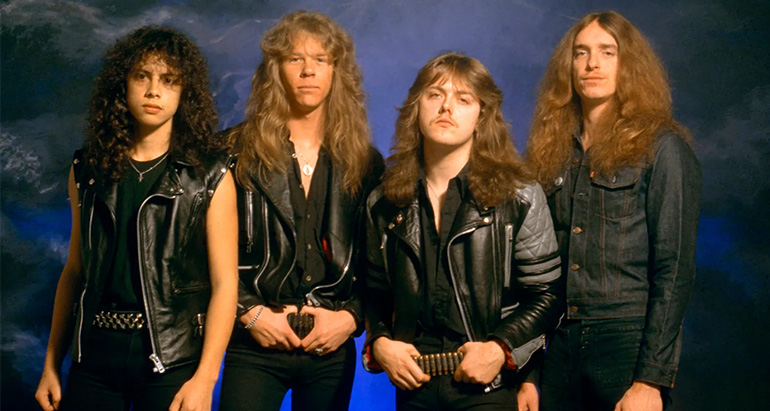
Metallica is a US-American metal band. It was founded in 1981 in Los Angeles and has been based in San Francisco since 1982. It is one of the most successful metal bands in the world and has sold over 110 million albums to date. In the USA alone, the band sold over 62 million albums, making them the seventh most successful artist group in the country. Metallica has won nine Grammy Awards.
Alongside Slayer, Megadeth, and Anthrax, Metallica was part of the “big four” of thrash metal in the 1980s and is considered the most influential metal band of that decade. During the 1990s, Metallica opened up to new musical influences such as blues rock and other rock styles, thereby appealing to a broader audience while simultaneously irritating their existing fans, before the band returned to their musical roots starting in 2002.
Band history
Beginnings (1981–1983)
In April 1981, the Danish-born drummer Lars Ulrich placed an ad in the Southern California local newspaper “The Recycler” to look for musicians for a band:
“Drummer looking for other metal musicians to jam with.” Tygers of Pan Tang, Diamond Head, Iron Maiden
The rhythm guitarist and singer James Hetfield and the bassist Ron McGovney then invited Ulrich to their rehearsal space and played some cover versions of Judas Priest songs. Since Hetfield and McGovney considered Ulrich to be a bad drummer, the musicians parted ways for the time being. Meanwhile, Ulrich became friends with Brian Slagel, who published the metal fanzine “Heavy Metal Revue” and had founded his own music label, Metal Blade Records. Its first release was to be the Metal Massacre sampler with local bands. Although Ulrich himself didn’t have a band yet, he asked Slagel for a spot on the sampler. After receiving the confirmation, he got back in touch with Hetfield and formed the band.
Ulrich and Hetfield then decided to use their first original composition, “Hit the Lights,” for the sampler. With another advertisement, the band was looking for a lead guitarist, and they found the Jamaican Lloyd Grant. After the recordings were completed, guitarist Dave Mustaine contacted them, and he was eventually added to the band in place of Grant. However, due to time constraints, the version with Grant’s solo made its way onto the first edition of the sampler. For the sampler, a band name was needed on short notice; the suggestions Thunderfuck, Helldriver, Grinder, Blitzer, Red Vette, Deathchamber, and Flying Tigers were rejected.
The band got their name from Ulrich’s friend Ron Quintana. He was looking for a name for his fanzine and had presented Ulrich with a list of possible names. The name Metallica on the list appealed to Ulrich so much that he persuaded Quintana to name his fanzine “Metal Mania,” allowing Ulrich to adopt Metallica as a suggestion for his own band. Ulrich’s bandmates reacted enthusiastically, and Hetfield designed the corresponding band logo. On March 14, 1982, Metallica played their first concert at the Radio City Hall in Anaheim. A month later, the band recorded their first demo, Power Metal, named after the enclosed business card. The Metal Massacre sampler was released on June 14, 1982. Due to a printing error, the band was announced as Mettallica. In July 1982, the band recorded their second demo, No Life ‘Til Leather, which was enthusiastically received in the underground scene of the San Francisco Bay Area.
In the fall of 1982, McGovney left the band. His successor was Cliff Burton, who left his former band Trauma in favor of Metallica. However, Burton stipulated that the remaining Metallica members would have to move to San Francisco with him. At the same time, the No Life ‘Til Leather demo fell into the hands of former stockbroker Jon Zazula. He contacted the band and got them gigs on the East Coast. As the disputes with Dave Mustaine escalated, Ulrich, Hetfield, and Burton decided to kick Mustaine out of the band while still on their way to New York.
The new lead guitarist was Kirk Hammett, who had previously played with Exodus. On April 16, 1983, the first Metallica concert with Hammett took place in Dover. At that time, the band was living in an old New York factory building where Anthrax had their rehearsal space.
“Sometimes we picked up girls and went home with them just so we could at least take a shower.” We were really fighting for survival, but looking back, it was a nice time.”
– James Hetfield
Zazula tried to get a record deal for Metallica. Since he received only rejections from all the labels, he founded his own label, which he named Megaforce Records at Burton’s suggestion.
Kill ‘Em All and Ride the Lightning (1983–1984)
Zazula borrowed 2,000 and financed studio time for the band at Music America Studios in Rochester. As Hetfield had doubts about his singing ability, the band considered hiring a permanent vocalist. Jess Cox of Tygers of Pan Tang was considered too old by the band, while Armored Saint singer John Bush turned down the offer. The band therefore began recording as a four-piece, completing the album in 17 days. The album contains, among other things, four songs co-written by Dave Mustaine, who was no longer a band member at that time. Originally, the album was to be called Metal Up Your Ass and the cover was to show a dagger emerging from a toilet. Zazula’s distribution partner Relativity rejected both.
Following Burton’s defiant exclamation, “Well, let’s kill ’em all!” came Metallica’s suggestion to choose Kill ‘Em All as the album title. This title was readily accepted by Relativity. The album was released on July 25, 1983, and initially sold slowly in the USA. In contrast, Metallica was celebrated in England as the band of the hour. On a five-week tour thru the USA, the band Raven was supported by Metallica as the opening act. By the end of 1983, Kill ‘Em All had sold about 17,000 copies in the USA. During the concert tours, the band wrote new songs that were more progressive and slower than those on the debut album. Metallica’s first concerts in Europe took place as the opening act for Venom.
Due to the favorable exchange rate between the US dollar and the Danish krone, the recordings for the second studio album “Ride the Lightning” took place at the Sweet Silence Studios in the Danish capital, Copenhagen. For cost reasons, the recordings took place at nite. Lyrically, the band distanced itself from the usual metal clichés. For example, the song “Creeping Death” is about the exodus of the Israelites from Egyptian slavery. Ride the Lightning was awarded a silver disk in the UK. Metallica’s first headlining tour of Europe followed at the end of 1984.
Master of Puppets and Cliff Burton’s Death (1985–1986)
Metallica was signed by the major label Elektra Records and received professional management with Q Prime. Ride the Lightning was re-released in the USA and reached number 100 on the US album charts without radio airplay. In early 1985, Metallica toured the US again with W.A.S.P. and Armored Saint before working on new songs. In August 1985, the band played at the Monsters of Rock at Donington Park for the first time.
In September 1985, the band returned to Sweet Silence Studios to begin recording their third album, Master of Puppets. They received a large advance from their record label, which led Metallica to briefly consider hiring producer Martin Birch, known for his work with Iron Maiden. However, they decided to work with Flemming Rasmussen again. The recordings lasted a total of three months and were only interrupted by an appearance at the Loreley Festival in Germany.
Master of Puppets was released in March 1986 and reached number 29 on the US album charts. Just one month later, the album received a Gold record. Metallica went on tour thru North America as the opening act for Ozzy Osbourne. Before the Evansville concert, Hetfield broke his wrist while skateboarding. Hetfield limited himself to singing at some concerts, while guitar technician John Marshall (later of Metal Church) played rhythm guitar.
In the fall of 1986, Metallica went on a European tour with Anthrax. On September 27, 1986, the tour convoy was on its way from Stockholm to Copenhagen. Near Ljungby, Metallica’s bus skidded on the icy road and overturned. Burton was thrown out of his bunk and onto the road before the bus fell on him.
“I tore open the emergency exit and climbed outside in my underwear into the icy cold.” […] A couple of our crew members were already running around the bus to check out what had happened. I hear Kirk [Hammett] from inside yelling, “What’s going on?” and then I turned around and saw Cliff [Burton’s] legs sticking out from under the vehicle.”
– James Hetfield
An autopsy revealed that Burton’s chest had been crushed and his lung had been punctured. The other passengers on the bus suffered only minor injuries. Kirk Hammett was lucky in his misfortune, as he had previously always slept in Burton’s bunk. Before the trip to Copenhagen, the band had decided to redistribute the bunks using playing cards. Burton drew the ace of spades and chose Hammett’s bunk by the window. Burton was buried on October 7, 1986, in Castro Valley.
Two weeks later, the band began the search for a successor. Metallica received a rejection from their preferred candidate, Joey Vera (Armored Saint). About 40 bassists, including Les Claypool (Primus) and Greg Christian (Testament) auditioned. Jason Newsted, who had earned a reputation as an excellent songwriter with his old band Flotsam and Jetsam, got the job.
…And Justice for All (1987–1990)
On November 8, 1986, Metallica played their first concert with Newsted on bass in Reseda. After a short tour thru Japan and Canada, the band resumed the concerts in Europe from January 1987 that had been canceled due to Burton’s accidental death, which also included two concerts in then-communist Poland. In March 1987, Hetfield broke his wrist again while skateboarding, which forced the band to cancel their appearance on the television show Saturday Nite Live. After Hetfield’s recovery, the EP Garage Days Re-Revisited was recorded in Ulrich’s garage, which contains cover versions of Diamond Head, Holocaust, Killing Joke, Budgie, and the Misfits.
Starting in October 1987, the band began preparations for their fourth studio album … And Justice for All. Since Flemming Rasmussen was otherwise occupied, the band was looking for a new producer. The collaboration with Mike Clink, who had recently produced Guns n’ Roses’ debut Appetite for Destruction, turned out to be a mistake, so Ulrich urged Rasmussen to quickly finalize his productions. … And Justice for All was released in August 1988 and reached number 6 on the US charts. On Halloween, the album was certified platinum. Critically, …And Justice for All was viewed, however, as having a clinically cold sound and for almost completely muting Jason Newsted’s bass playing.
After years of the band resisting the idea of making a music video, this time a video was made for the song “One,” which included excerpts from Dalton Trumbo’s film Johnny Got His Gun. MTV put the video into heavy rotation and the single reached the top 40 of the US charts. A nomination for Metallica for the Grammy in the category “Best Hard Rock/Metal Performance” was unsuccessful, the award went to Jethro Tull. The band reacted with humor and labeled part of the … And Justice for All edition with a sticker reading “Grammy Award Losers.” The tour for the … The And Justice for All album tour included a total of 230 concerts and lasted until October 1989. Subsequently, Metallica took a break and played only a few concerts.
Load and ReLoad (1994–1997)
Aside from a three-month tour of North America, including a headlining appearance at the Woodstock II festival, the Metallica band members withdrew from the public eye in 1994 and took care of their families. In October, the band began writing new songs. The recordings began in May 1995. Due to the bad experiences during the recording of the black album, the band didn’t want to stress themselves this time and took regular breaks. After a performance as headliner of the Monsters of Rock festival, a Metallica concert followed on 3 September 1995 in Tuktoyaktuk, the northernmost community on the Canadian mainland. Numerous oil heaters were needed to ensure the instruments worked at all. On the occasion of Motörhead singer Lemmy Kilmister’s 50th birthday, Metallica played a concert in Los Angeles under the name “The Lemmys,” where only Motörhead songs were covered.
A total of 27 songs were recorded, and the band planned to release a double album. Instead, the songs were distributed across two albums, which were released within a year and a half. The first was Load in June 1996. The album cover, designed by provocateur Andres Serrano, featured a mixture of Serrano’s semen and cow’s blood, which he pressed between two sheets of Plexiglas. The band’s new musical direction, which showed influences of country and blues, was as controversial among many fans as the band members’ short haircuts.
“For me, metal in its familiar form is in a coma.” The bands are repeating themselves and have thus dug their own graves. Let’s be honest: Who really needs the tenth version of the same album that, for example, Running Wild re-records year after year? […] Heavy metal, in its original form as a rebellious, fresh underground movement, is devoid of meaning.
– Lars Ulrich
Metallica participated as the headliner in the Lollapalooza tour. During this tour, Jason Newsted traveled in his own bus, which had a mobile recording studio installed. Together with Exodus drummer Tom Hunting and Devin Townsend, he founded the project “IR8” (synonym for the English adjective irate) and recorded a demo. In particular, James Hetfield took umbrage at this side project, while Newsted claimed that he was not wanted as a songwriter in Metallica and therefore was not being fulfilled. At the 1996 MTV Europe Music Awards, the band played a medley of “So What” and “Last Caress” instead of “King Nothing.” Due to the obscene lyrics of “So What”, MTV cut Metallica’s performance from all reruns of the show.
In November 1997, ReLoad was released. The album cover, also designed by Andres Serrano, this time contained a mixture of blood and urine. As with Load, ReLoad debuted at number one on the US charts. The first single, “The Memory Remains,” featured a guest appearance by British singer and actress Marianne Faithfull, as did the accompanying music video. The tour for the album was relatively short.
Garage Inc. and S&M (1997–1999)
Without much preparation, the band recorded eleven cover versions in the fall of 1998 from bands and artists such as Black Sabbath, Thin Lizzy, Mercyful Fate, Bob Seger, and Discharge. Together with all previously released cover versions, the album was released under the name Garage Inc. In March 1999, Metallica was inducted into the Walk of Fame in Los Angeles. The then-mayor Willie Brown proclaimed March 7, 1999, as “Official Metallica Day.”
On April 21 and 22, 1999, the band recorded two performances with the San Francisco Symphony Orchestra conducted by Michael Kamen. Kamen, who had extensive experience in implementing such projects beyond his classical training and success as a film composer, had arranged the string instruments for the song Nothing Else Matters from the black album. At that time, Kamen tried to convince the band to perform their music with the accompaniment of a symphony orchestra. For the performance, the band composed two new songs, “No Leaf Clover” and “-Human.” The recording of the performance was released in November 1999 under the name S&M. “Nothing Else Matters” was released as a single and reached number 2 on the German singles chart. Further performances with symphony orchestras took place in November of that year in Berlin and New York City.
The Napster Controversy and Newsted’s Departure (2000–2001)
Exclusively for the film Mission: Impossible II, Metallica recorded the song “I Disappear.” After the band discovered that a demo version was being played by various radio stations, it was found that all of the band’s previously released tracks were available for free download on the peer-to-peer file-sharing service Napster. Metallica subsequently sued Napster and the universities of Southern California, Yale, and Indiana for copyright infringement and violation of the Digital Millenium Copyright Act (DMCA). In response, Yale and Indiana blocked Napster on all computers, after which Metallica dropped the lawsuits against both universities.
With the help of the online service provider “NetPD,” Napster was presented with a 60,000-page list of 335,435 users, requesting that these users be banned. Rapper Dr. Dre joined Metallica’s lawsuit, resulting in an additional 230,142 users being banned from Napster.
“It hurts us to know that our good is treated more like a mass commodity and less like the art it actually is.” From a business standpoint, it’s pure piracy to take something that doesn’t belong to you. The exchange of such information, whether it is music, videos or photos, is nothing more than the trade of stolen goods.”
– Lars Ulrich
Napster then began in March 2001 to block users and Metallica songs by activating filters based on lists of IP addresses; in July, the band subsequently withdrew their copyright lawsuit. In a Yahoo chat in 2000, Ulrich explained that the band had sued Napster solely for the distribution of their studio albums. However, they want to continue to allow the exchange of homemade live recordings, so-called bootlegs.
In the summer of 2000, the band went on the “Summer Sanitarium” tour thru North America together with Korn, Kid Rock, and System of a Down. On July 4, 2000, a fan fell from the upper tier of the PSINet Stadium during the concert in Baltimore and died. Two weeks later, another fan died during a secret concert in Hollywood.
During the “Summer Sanitarium” tour, Newsted increasingly isolated himself from the band. Tensions also grew between Hetfield and Ulrich. On the advice of their manager, the band decided to hire psychologist Phil Towle. Before the first session, Newsted had already decided to leave the band. Officially, the departure was justified by the claim that Newsted had ruined his cervical spine thru excessive headbanging. However, the true reasons for Newsted’s departure lay elsewhere.
Since 1996, Newsted had been working with the band Echobrain. As Metallica was going to take a long break, Echobrain planned to record an album. Hetfield was against it and questioned Newsted’s loyalty to the band.
“The band died for me on September 27, 2000.” On that day, James [Hetfield] stomped me into the ground. He had a lot of personal problems at the time, and I had to deal with it. […] My last meeting with the band took place on January 8, 2001. After I announced my departure, I broke down in front of the others. Everyone in the room was crying, the tension was unbearable. In the end, I shouted: ‘I don’t want to do this, but I have to, because I want to be able to look myself in the eye.’
– Jason Newsted
Without a bassist, the band began preparations for a new studio album in April 2001 on the grounds of the former Presidio military base. Metallica was accompanied by filmmakers Joe Berlinger and Bruce Sinofsky, who recorded over 1,000 hours of footage over the course of two years. Due to constant bickering between Hetfield and Ulrich, the band made slow progress. In July, Hetfield dropped out and underwent rehabilitation to treat his alcoholism. The withdrawal lasted until December. Around the same time, the band moved into their “headquarters” in San Rafael, a complex that housed rehearsal and recording rooms as well as offices.
St. Anger (2002–2005)
Metallica began recording their eighth studio album, St. Anger, with Bob Rock as the bassist. The pent-up anger among the band members was channeled into eleven raw, hardcore-heavy songs. There are no guitar solos, while Ulrich’s snare sounds like a timbale. After the recordings were completed, the search for a new bassist began. Among those who auditioned were Pepper Keenan (Corrosion of Conformity), Scott Reeder (Kyuss) and Jeordie White (Marilyn Manson), but the band chose former Suicidal Tendencies and Ozzy Osbourne bassist Robert Trujillo. Jason Newsted joined the Canadian band Voivod and played in Ozzy Osbourne’s band during the Ozzfest tour in 2003.
On the occasion of their 20th anniversary, the band was honored with the “mtvIcon” award. During the hour-long show, Metallica-influenced bands such as Korn, Staind, Limp Bizkit and Sum 41, as well as Snoop Dogg and Avril Lavigne, performed Metallica songs from various albums. At the end of the show, Metallica performed with Robert Trujillo for the first time, playing a medley of “Hit the Lights,” “Enter Sandman,” “Blackened,” “Creeping Death,” and “Battery.” In May 2003, the music video for the song “St. Anger” was filmed at San Quentin State Prison.
St. Anger, released on June 5, 2003, became the most controversial album in the band’s history. While some appreciated the raw sound of the album, many longtime fans rejected St. Anger. Nevertheless, the album reached number one on the album charts in over 30 countries. However, during the subsequent “Madly in Anger” world tour, only two songs from the album, “Frantic” and the title track, were usually played. Shortly before the Download Festival, Lars Ulrich had to be taken to a Zurich hospital because of severe stomach pains, which turned out to be harmless. Metallica played a shortened concert, with Dave Lombardo (Slayer), Joey Jordison (Slipknot) and Ulrich’s drum technician Flemming Larsen filling in.
In the summer of 2004, ten albums by Metallica were simultaneously in the Swedish album charts. Overall, the band earned 43 million dollars in 2004, making them the third most successful act in the USA after Prince and Madonna. Also in 2004, the documentary film Some Kind of Monster was released, which was made during the recording of the St. Anger album. In 2005, Metallica played only two concerts as the opening act for the Rolling Stones in San Francisco. A year later, the band played their first concerts in South Africa.
Death Magnetic (2006–2010)
After Bob Rock produced the band’s last six albums, the band announced in February 2006 that the next studio album would be produced by Rick Rubin. Rubin had made a name for himself producing artists such as AC/DC, Slayer, System of a Down, the Red Hot Chili Peppers, and Johnny Cash. As part of their “Escape from the Studio ’06” tour, the band performed for the third time at the Rock am Ring / Rock im Park festivals and at the Waldbühne in Berlin in June 2006. On this occasion, all the songs on the album Master of Puppets were performed to celebrate the twentieth anniversary of its release. In Berlin, Metallica also played a new untitled song. A compilation of all music videos was released on DVD in December 2006 under the title The Videos: 1989–2004.
Metallica recorded a cover version of the song The Ecstasy of Gold, which was released on a tribute album for the composer Ennio Morricone. The Ecstasy of Gold comes from the Italian Western film The Good, the Bad and the Ugly and has been used as an intro for every concert since 1983. The recordings for the ninth studio album Death Magnetic began in March 2007. In the summer of the same year, Metallica played a short stadium tour thru Europe. The announcement of the concert in the Finnish capital Helsinki led to ten Metallica albums appearing in the Finnish album charts at the end of May 2007. For the Iron Maiden tribute album Maiden Heaven, Metallica recorded the song “Remember Tomorrow,” which was a blueprint for the band for songs such as “Fade to Black” or “Welcome Home (Sanitarium).”
On September 2, 2008, ten days before the planned release, the first copies of the new album were mistakenly sold in France. The album immediately appeared on Internet file-sharing sites. Lars Ulrich remained calm about this premature leak and described it as a success that the album only appeared on the internet ten days before its release. Death Magnetic entered the album charts at number one in 32 countries worldwide. In the USA, Death Magnetic was the fifth Metallica album to go straight to number one. Previously, Metallica shared the record with four albums with the Beatles, U2 and the Dave Matthews Band.
On the day of its release, Death Magnetic was introduced in a concert at the Berlin multifunctional hall O2 World. In October 2008, the “World Magnetic” tour began.
Panorama of the Ahoy Rotterdam during the Death Magnetic Tour on March 30, 2009
On April 4, 2009, Metallica was inducted into the Rock and Roll Hall of Fame. For the first time since the split in 2001, Metallica played both Master of Puppets and Enter Sandman with former bassist Jason Newsted. In April 2010, Metallica won the Revolver Golden God Award in the category of “Best Live Band.” In June 2010, Metallica went on the The Big Four tour with Slayer, Megadeth, and Anthrax. On October 29, 2010, the DVD/Blu-ray The Big Four Live from Sofia, Bulgaria, recorded during this tour, was released.
Lulu and Hardwired…to Self-Destruct (since 2011)
On the occasion of Metallica’s induction into the Rock and Roll Hall of Fame, Metallica performed with Lou Reed, among others, in 2009. After this performance, the idea of releasing a joint album emerged. On October 31, 2011, the album Lulu was released worldwide but received mostly negative reviews. Due to the euro crisis, the band announced at the end of 2011 that they would change their tour plans and bring forward various performances. Band manager Cliff Burnstein explained that they were expecting the euro to weaken in the coming years and therefore wanted to give concerts while they were still as profitable as possible. Therefore, Metallica will play its black album at various festivals in Europe in 2012, rather than in 2013 as originally planned.
On December 14, 2011, Metallica released the EP Beyond Magnetic digitally, featuring four previously unreleased songs from the Death Magnetic recordings. The songs were first played live at the four concerts celebrating the band’s 30th anniversary in December 2011 in San Francisco. The band worked with Nimród Antal on the 3-D film Metallica Thru the Never, which was released on September 27, 2013. The film features footage of the band’s concerts in Mexico and Canada in the summer of 2012, among others. However, the film proved to be a flop due to low earnings. Metallica contributed the song “When a Blind Man Cries” to the Deep Purple tribute sampler “Re-Machined: A Tribute to Deep Purple’s Machine Head.”
On December 8, 2013, Metallica became the first band to play in Antarctica. Thus, they are the only band in the world that performed on all continents within a year.
On January 26, 2014, Metallica performed at the 2014 Grammy Awards alongside Chinese pianist Lang Lang, where they played the song “One” together. Shortly afterward, it was announced that Metallica had recorded a medley of some of his well-known Rainbow hits for a Ronnie James Dio tribute sampler. It is said to last around 9 minutes and contain parts of the songs A Light In The Black, Tarot Woman, Stargazer and Kill The King. The album will be called This Is Your Life. On March 16, 2014, Metallica performed in Bogotá and introduced their new song “Lords of Summer.” It was also confirmed that a new studio album would be released in 2016. In the terrorist attacks on November 13, 2015, in Paris, Metallica’s longtime project manager in France, Thomas Ayad from Universal Music France, was killed during the hostage-taking massacre at the Bataclan.
The performance fees for Metallica are in the single-digit millions range. As the main act for the twin festival Rock im Revier and Rockavaria organized by DEAG, Metallica received 7.3 million US dollars (approx. 6.6 million euros).
On November 18, 2016, eight years after Death Magnetic, the release of the tenth studio album titled Hardwired…to Self-Destruct was announced on the band’s homepage: It is a double album with twelve new songs, with the song “Hardwired” along with its music video being released as a single on August 18, 2016. At the same time, the tracklist and the album cover were announced. On February 12, 2017, Metallica performed at the 2017 Grammy Awards together with Lady Gaga. Hetfield sang a duet with her of the song Moth Into Flame from the 2016 album Hardwired…to Self-Destruct.
Reception
Metallica is one of the most influential and successful metal bands worldwide. Korn singer Jonathan Davis calls Metallica his favorite band because they “have always gone their own way and are still relevant today.” According to Godsmack drummer Shannon Larkin, Metallica is the biggest influence on his band. Larkin said that Metallica changed his life when he was 16, as he had never heard anything that heavy before. Trivium guitarists Matthew Heafy and Corey Beaulieu learned their instrument after first being exposed to Metallica’s music. Joey Z., the guitarist of Life of Agony, cites Kirk Hammett as his idol and says he started playing guitar because of him. For Avenged Sevenfold singer M. Shadows, the joint concerts were the highlight of his musical career. Armored Saint singer John Bush praised Metallica for “having gone down a model career path and never letting themselves be talked into anything.” For Kim Thayil of the band Soundgarden, Metallica is an “example of honest success without TV and radio hype.”
The British rock magazine Kerrang! released a tribute album titled Master of Puppets: Remastered in April 2006 to commemorate the 20th anniversary of the album Master of Puppets. The album features cover versions of the eight songs by bands such as Machine Head, Bullet for My Valentine, Chimaira, Mastodon, Mendeed and Trivium. In 1996, Finnish band Apocalyptica released their debut album Plays Metallica by Four Cellos, which features eight Metallica songs played on cellos. The parody band Beatallica combines the music of Metallica with that of the Beatles. The owners of the Beatles’ musical rights, Sony, sued Beatallica, claiming the band had caused “substantial and irreparable harm.” Lars Ulrich asked Metallica’s lawyer, Peter Paterno, to provide legal assistance to Beatallica.
MTV placed Metallica at number three on its list of the “Greatest Metal Bands of All Time.” The TV channel VH1 placed the band at number five on their list of the 100 greatest hard rock bands. The album Master of Puppets was ranked first in the list of the “100 best metal albums” by the online magazine Metal Rules. In the book Best of Rock & Metal by the German magazine Rock Hard, which lists the 500 strongest metal and hard rock albums of all time according to the Rock Hard editorial team, Metallica is represented with five albums. Master of Puppets is in second place, followed by Ride the Lightning. The debut album Kill ‘Em All is in 12th place, the self-titled fifth album is in 79th place, and Garage Inc. is in 500th place.
The game manufacturer Activision, together with Neversoft, produced a Metallica offshoot of their popular music game series Guitar Hero. Guitar Hero: Metallica contains (not counting download content) 31 Metallica songs and 21 guest songs chosen by the band themselves. Both the band itself (which brought all animations with characteristic poses and movements into the game via motion capture) and the two guest stars, King Diamond from Mercyful Fate and Lemmy Kilmister from Motörhead, are playable characters. The game was released on May 22, 2009 in Europe for Sony PlayStation 2, PlayStation 3, Xbox 360, and Nintendo Wii. Additionally, more songs as well as the complete album Death Magnetic can be downloaded for this game from the PlayStation Store and Xbox Live.
Since 2008, there has been the internet project A German Tribute to Metallica, where German bands provide cover versions of Metallica songs. Participants included In Extremo, Madsen and the Donots.
Rolling Stone ranked Metallica 61st in their 2011 list of the 100 greatest artists of all time.
