
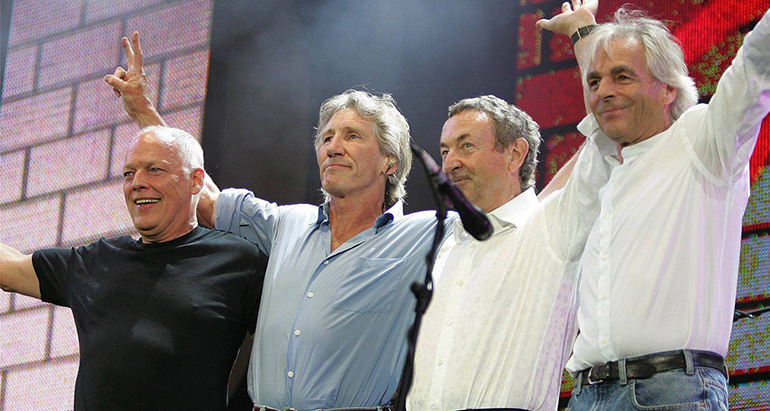
Pink Floyd was a British rock band formed in 1965. With their music and the visual design of their records and stage performances, they created a novel style at the time. The figures regarding the number of their records sold fluctuate between 260 and 300 million. Pink Floyd is therefore one of the most successful bands of all time. The concept album The Dark Side of the Moon is the third best-selling album worldwide, and the concept album The Wall is the best-selling double album.
Under the leadership of the first singer and guitarist Syd Barrett, the band initially belonged to the British psychedelic rock movement. After the frontman’s departure due to drug use and mental health issues, the group, consisting of Roger Waters, David Gilmour, Richard Wright, and Nick Mason, developed a distinctive style with influences from progressive rock, blues, jazz, as well as classical and contemporary music. The lyrics, which were entirely written by Waters from 1973 (The Dark Side of the Moon) to 1983 (The Final Cut), often critically address social and political issues.
History
The roots of the band go back to the school days of Syd Barrett, Roger Waters, and David Gilmour in Cambridge. Barrett and Waters attended Hills Road Sixth Form College, Gilmour the Perse School in the same street. Barrett and Gilmour met up at lunchtimes to play guitar and occasionally gave street concerts. However, they did not form a band. In 1963, Barrett went to London. Gilmour formed the band Joker’s Wild and, starting in 1966, toured relatively unsuccessfully thru Spain and France with another band.
The Syd Barrett Era: 1965 to 1968
In 1964, Roger Waters came to London and met Nick Mason and Richard “Rick” Wright while studying architecture at the Polytechnic Institute. They formed the cover band Sigma 6 and interpreted current blues and beat songs. Band members also included singer and later wife of Rick Wright, Juliette Gale, bassist Clive Metcalf, and singer Keith Noble. They changed the name to The Tea Set, and guitarist Bob Klose joined.
In 1965, Syd Barrett joined the band as a singer and guitarist. Gale, Metcalf, and Noble soon left, and Waters switched from guitar to bass. Barrett gave the band the name The Pink Floyd Sound, derived from the first names of his two favorite blues musicians, Pink Anderson and Floyd Council. After recording the demos “Lucy Leave” and “I’m a King Bee,” Bob Klose also left the group. The name was shortened to The Pink Floyd and finally to Pink Floyd in 1968.
From 1966 onward, Pink Floyd played at the London underground club UFO and became the house band there. The first mentions in the press occurred in the underground newspaper International Times and in the Sunday Times in October 1966; both articles reported on their performance at the London Roundhouse. On 10 March 1967, Pink Floyd released their first single, “Arnold Layne”, on EMI. A London radio station refused to play it because it was about a transvestite who stole women’s underwear. Sources disagree on whether it was Wonderful Radio London or BBC Radio London. On June 16 of the same year, their second single, “See Emily Play,” was released.
Barrett was formative for the early years of Pink Floyd, setting the psychedelic direction and writing almost all the pieces for the first album The Piper at the Gates of Dawn as well as the first three singles. With the band’s growing popularity, his mental state gradually deteriorated, exacerbated by excessive drug use, making collaboration with him increasingly difficult. At times, Barrett would just stand motionless on stage instead of playing. This is how his school friend David Gilmour, whose own band was just breaking up, was brought on board as the fifth member in early 1968. On this occasion, a series of official photos were taken, which are the only ones to show all five musicians together. Gilmour was initially supposed to support Barrett at live performances, but eventually replaced him entirely. Barrett remained as a songwriter for a while, until it was decided in March 1968 to continue without him. On the second album, A Saucerful of Secrets, there is only one composition by Barrett (Jugband Blues). His remaining pieces from that time were recorded in 1970 on two of Barrett’s solo albums, partly with the participation of Pink Floyd members, and released in the box The Early Years in 2017. The remaining group’s engagement with Barrett’s departure and his mental illness was repeatedly addressed in the group’s later work – and especially on the album Wish You Were Here.
Development of a new style: 1968 to 1970
The group’s performances, especially at the London UFO Club, sparked the interest of film directors in their music. The band received several commissions to contribute to film soundtracks, such as in the films Zabriskie Point and More. The album More was released almost simultaneously with the double album Ummagumma, which includes a studio album, with music each contributed a quarter by each of the four band members, and a live section.
The phase of artistic reorientation continued with the next work. However, Atom Heart Mother from 1970 was the first Pink Floyd album to reach number one in the UK album charts. In addition to three songs influenced by folk, it includes the 23-minute suite “Atom Heart Mother,” which features an orchestra and a choir that is partially experimental, as well as the 13-minute sound collage “Alan’s Psychedelic Breakfast.” The successor Meddle came in at number 3. The second side of the record is filled with the 23-minute-long “Echoes,” which is considered groundbreaking for the band’s subsequent development. In the USA, however, the success was initially lacking – despite well-attended and extensive tours, they did not get beyond 55th place. However, the film soundtrack Obscured by Clouds was a success there, being the first of their albums to enter the American Top 50. Free Four, a song with a relatively fast tempo, was played more often by US radio stations than any of their previous singles.
Worldwide Success: 1971 to 1975
In the following years, Pink Floyd became one of the most successful rock bands worldwide. In the process, Roger Waters increasingly developed into the bandleader and main songwriter. From 1973 onward, he wrote all the band’s lyrics – until his departure in the mid-1980s – and his influence on the music also grew increasingly. His ideas also formed the basis for the group’s first concept album, The Dark Side of the Moon, which was released in March 1973 with compositions by all four members. Initially received with restraint by contemporary critics, it became a classic of rock music. It was the band’s first release that also achieved resounding success in the USA, documented by reaching number 1 on the charts and a very successful tour that cemented the band’s superstar status. The album, which was characterized by the leitmotif of “madness,” spent 740 weeks on the American Billboard charts from 1973 to 1988 – an unmatched record to this day (these charts include the top 200 albums and take into account not only sales but also radio play). It is thot that the multiple purchases required for this record were also due to the fact that the album, because of its exceptional sound quality, was used as a reference album to test high-end stereo systems, and scratches on the record prompted audiophile fans to buy it again. When the album was released on CD in 1983, there was again a surge in purchases, until the work gradually disappeared from the Billboard charts.
The follow-up work, Wish You Were Here, from 1975 was explicitly dedicated to Syd Barrett. The songs “Wish You Were Here” and “Shine On You Crazy Diamond” refer to the founding member. During the studio work, the band received a visit from the psychotic Barrett, who had changed a lot in the past few years and had lost touch with reality. Richard Wright later called the album the best Pink Floyd album and Shine On You Crazy Diamond the best Pink Floyd song, which he would not change in the slightest. The album was pre-ordered 250,000 times in the UK. The album is considered the second classic in the band’s catalog.
In 1975, Pink Floyd bought a former church on Britannia Row in the London district of Islington, where they housed their own Britannia Row Studios alongside offices and storage. Parts of the albums have been recorded there since then. The event technology was outsourced in the same year as Britannia Row Productions and was initially housed in the same building complex.
The Era Roger Waters: 1976 to 1985
The 1977 album Animals, which was also partially pressed on pink vinyl, consists of three compositions with durations between ten and 17 minutes and the framing acoustic piece Pigs on the Wing. For the first time, a Pink Floyd album contained almost exclusively songs by Roger Waters; only on Dogs was Gilmour significantly involved as a composer. However, the song filled an entire side of the album. Musically rougher than the previous albums and featuring political as well as sarcastic lyrics, the album was overall received less positively by fans and critics than its direct predecessors. Waters, in particular, found the concerts in front of large audiences to be very exhausting and alienating. In later tours, no songs from “Animals” were played anymore. Only as a solo artist did Waters regularly perform large parts of the album again years later.
The most ambitious and largest project was then the conception of the album The Wall in 1979. The recordings marked the first serious differences between the band members, primarily Gilmour and Waters, over the question of where the band should develop. For the last time, however, the conflicts were transformed into creativity, not least due to the mediation of the young Bob Ezrin, whom the band had brought in as producer. Waters was able to impose his line overall, with the exception of a few songs, all of which were written by him. Gilmour was primarily involved as a composer on “Run Like Hell” and “Comfortably Numb,” the latter of which was originally supposed to appear on his solo album, but he also contributed significant vocal and guitar parts to other songs. Wright, who also faced criticism from the other band members as a musician, left the band after the recording sessions ended: The break came in the autumn of 1979 when Wright refused to cut short his family holiday in Greece to attend a final session that had become necessary to release the album before Christmas, as required by the record company. Waters was then able to convince Gilmour to fire Wright, threatening to realize The Wall as a solo project otherwise. Although Wright participated in the subsequent The Wall concerts, he was officially never announced, but he was bought out of the Floyd partnership; additionally, further fees dependent on the completion of the various Wall projects were agreed upon. Waters later claimed that Wright was too burned out to “play” and had left many keyboard parts on The Wall to Bob Ezrin and session musician Peter Wood. According to other reports, he was fired by Waters due to drug problems. However, Wright said: “Roger and I just couldn’t get along anymore. Whatever I did, he was against it. It was impossible for me to work with him.
The album is generally considered, although quite controversial at the time of its release, to be the band’s last “classic” work. The concept album bears autobiographical traits of Roger Waters and describes the increasing isolation of a rock singer, rooted in the mother’s overprotection and the loss of the father. For the last time, there were also allusions to the fate of Syd Barrett, because Pink, the main character of The Wall, is also a rock musician who loses touch with reality. A corresponding stage show framed this content: During the first half of the concert, a wall was erected on stage to symbolize the alienation between the musicians and the audience. In the second half, the band played behind the wall, with various clips projected on the front. The Wall was only performed live in four locations: in Los Angeles, New York, London, and Dortmund (1981). In 1990, shortly after the fall of the Berlin Wall, Roger Waters performed The Wall once again with his own guest musicians on the Wall strip in Berlin between Brandenburg Gate and Potsdamer Platz. Starting in 2010, Roger Waters performed The Wall again with his solo project in a long, worldwide tour featuring a multimedia show in several countries.
The Wall was filmed in 1982 by Alan Parker with Bob Geldof in the lead role under the title Pink Floyd – The Wall, with the music in the film and on the concept album differing in some pieces and vocal parts. Gilmour later stated that the conflicts between him and Waters escalated in this context, rather than during the work on the album. He now claimed absolute artistic control.
The subsequent album The Final Cut from 1983 was therefore entirely written by Roger Waters and is dedicated to his father Eric Fletcher Waters, who fell in World War II. Compositionally, the album is a Waters solo work (“written by Roger Waters, performed by Pink Floyd”) and contains several songs that the other musicians had originally rejected as “too weak”; the critics’ reactions were also generally rather restrained. Gilmour, who was still very prominent as a singer and guitarist on The Wall, hardly appears on the album, as he was working on his solo album About Face at the same time.
The David Gilmour Era: 1987 to 1995
In 1985, tensions between Waters and Gilmour led to Waters’ departure, who then declared the band dissolved on his own. A long legal battle over the band’s name followed: Gilmour, whose solo project had previously received little attention, wanted to continue under the name Pink Floyd together with Mason and eventually won in court. Years later, Waters admitted that his attempt to dissolve Pink Floyd against the will of the other musicians had been a mistake.
During the recordings for the new project A Momentary Lapse of Reason, Wright also rejoined, but not yet as a full member, as Gilmour and Mason had financed the album themselves. In the end, it was more of a solo project by Gilmour, who relied on the help of various studio musicians and songwriters, and it met with enthusiasm from the fans. The critics’ reactions, which noted weaknesses in the song material, which were covered up by a bombastic, zeitgeist-appropriate production, and particularly criticized the quality of the lyrics, were divided. The album sold excellently.
Despite the ongoing legal dispute with Waters, they embarked on a world tour on September 9, 1987. Pink Floyd also played some pieces from the Waters era, but continued to limit themselves, in accordance with the agreement with Waters, to performing no more than three pieces from The Wall per concert (with the exception of Another Brick in the Wall and Gilmour’s compositions Run Like Hell and Comfortably Numb). One stop on the tour was the Reichstag in Berlin on 16 June 1988, close to the Berlin Wall. On the other side of the wall, on Unter den Linden street, around 5,000 people stood to listen.
Toward the end of the tour, on July 15, 1989, a concert was held on a floating island in front of St. Mark’s Square in Venice, attended by around 200,000 spectators. The final event was on 18 July 1989 at the Stade Vélodrome in Marseille. The disputes between Waters and the rest of the band ended with a preliminary agreement that regulated the rights and shares to the albums, the songs, and the band name. Roger Waters continued to tour with well-known guest musicians and wrote his own material. In his live program, he also drew on many Pink Floyd pieces.
Since the 1992 video La Carrera Panamericana was released, Wright was a full member of the band again. The soundtrack of the video contains several pieces of music published only there, written by the three remaining Floyds. The trio then released the album The Division Bell in the spring of 1994. The band had returned to their earlier working methods this time, and for the first time since 1975, Wright and Mason were again intensively involved in the songwriting. However, the commercial success of the CD was much greater than the critical approval, which predominantly noted artistic stagnation, sentimentality, self-plagiarism, and lack of originality. This was followed by a world tour and the live album Pulse (1995). In the following 19 years, no new material was released.
Post-Division Bell Era: 1996 to 2005
Pink Floyd were inducted into the Rock and Roll Hall of Fame in 1996.
In 2000, the double album Is There Anybody Out There? was released. The Wall Live 1980-1981 was released, and in 2001 a double CD (Best of) called Echoes. At that time, rumors first emerged that Waters, thru Mason, was slowly reconciling with the other musicians. A DVD version of the 1971 concert at the amphitheater of Pompeii was released in 2003, without the musicians’ cooperation. Gilmour later distanced himself from this DVD.
As part of the Live 8 event organized by Bob Geldof, which included a concert in London’s Hyde Park, Pink Floyd, including Roger Waters, performed in July 2005. This was the first time (and also the last) since 1981 that they played together in the lineup of their most successful period, fueling speculation about a “reunion tour” or even a new album. They played Speak to Me/Breathe/Breathe Reprise, Money, Wish You Were Here, and Comfortably Numb. Regarding further performances, Gilmour changed his mind several times in interviews during his solo tour in 2006. Waters, on the other hand, stated, as did Nick Mason, that he would be very happy to collaborate. In an interview in September 2007, Gilmour expressed his skepticism about a reunion of the band: “What I can tell you is that the chances of a Pink Floyd reunion are really extremely low, apart from one-off, important occasions, like ‘Live 8’ was.” However, he could and would not announce the official end of Pink Floyd, especially since there were legal reasons that prevented him from doing so.
Recent developments since 2006
On July 7, 2006, Pink Floyd co-founder Syd Barrett died at the age of 60. At a memorial concert on 10 May 2007, alongside artists Chrissie Hynde and Damon Albarn, Roger Waters and the other three members of Pink Floyd also performed, but separately. Waters played his piece Flickering Flame at the end of the first half. He was accompanied by keyboardist Jon Carin, who had previously played on Floyd tours between 1987 and 1994, on Waters’ solo concerts in 2000 and between 2006 and 2008, at Pink Floyd’s Live 8 performance, and on Gilmour’s 2006 tour. Gilmour, Wright and Mason then played Arnold Layne as the last artists of the evening (before the finale). Actually, Waters was supposed to play Shine On You Crazy Diamond in the second half of the concert; however, he left during the intermission and therefore was not present for the finale.
The DVD release of a recording of the 1994 tour titled Pulse, which was documented in 1995 by the live album of the same name, became one of the best-selling music DVDs in 2006 and won numerous awards.
In 2007, to celebrate the fortieth anniversary of the original release of the album The Piper at the Gates of Dawn, a limited 3-CD box set was released featuring the album’s stereo and mono mixes, along with the three singles from 1967 and previously unreleased alternate versions of the album’s songs.
In 2008, Pink Floyd were awarded the Polar Music Prize. At the award ceremony by the Swedish King Carl XVI. Gustaf, Nick Mason and Roger Waters were present.
On September 15, 2008, Pink Floyd co-founder Richard Wright died of cancer at the age of 65. David Gilmour paid tribute to Wright on his website with an emotional obituary, in which he described him as a calm and modest person, as well as an important friend and part of his musical career. Waters also used his internet appearance to remember Richard Wright. He noted that Wright’s musical influence on Pink Floyd could not be overestimated. He recalled songs like Us & Them or The Great Gig In The Sky, both of which were written by Wright. At the same time, he expressed that he felt lucky to have performed with Wright once again at Live 8, and he regretted that there had been no further performances with Wright, Gilmour, and Mason afterward.
In an interview in April 2009, Nick Mason stated that after Wright’s death, he found it very hard to imagine that Pink Floyd would perform again. On July 10, 2010, Waters and Gilmour performed together for about 200 invited guests in aid of the “Hoping Foundation” (Hope and Optimism for Palestinians in the Next Generation), playing a cover version of “To Know Him is To Love Him,” the Pink Floyd songs “Wish You Were Here” and “Comfortably Numb,” and as an encore, “Another Brick In The Wall (Part 2).” The two were accompanied by Chester Kamen, Harry Waters, Andy Newmark and Guy Pratt, among others. Waters then announced that a performance by David Gilmour was planned for Waters’ upcoming tour. Finally, on May 12, 2011, at the London O2 Arena, David Gilmour made the announced guest appearance in the piece “Comfortably Numb.” At the end of the concert, Waters and Gilmour, accompanied by drummer Nick Mason, who was also present, played Outside The Wall. Waters played the trumpet, while Gilmour played the mandolin and Mason played the tambourine. Afterward, the three surviving members of Pink Floyd left the stage together to the frenzied cheers of the fans. However, it was not an official Pink Floyd reunion, as part of the press erroneously reported afterward.
Later, the remaining Pink Floyd members no longer performed together, but there were appearances by individual members who then played pieces by Pink Floyd. Most recently, Nick Mason performed the piece “Wish You Were Here” during the closing ceremony of the Olympic Games in London on August 12, 2012.
On July 5, 2014, Gilmour’s wife Polly Samson announced via a message on the social media platform Twitter the release of a new album featuring material largely recorded in 1994 with Richard Wright during the sessions for The Division Bell, set for October 2014. The album was to be called The Endless River. The title goes back to a line of text from the song High Hopes. The compositions, originally conceived as instrumental pieces, had been revised, expanded, and partially provided with lyrics and vocals by Gilmour and Mason since 2013. They decided to go viral because an unnamed insider had previously leaked information about the album to the tabloid The Sun. Contrary to the statements of Polly Samson, the new album was now to be released in November 2014. It was finally released on 7 November 2014 on CD, LP and Blu-ray. Waters was not involved in the recordings. Gilmour and Mason confirmed to BBC editor Matt Everitt that they would not be releasing any more albums by Pink Floyd after The Endless River.
Style
Innovative use of technology
Pink Floyd were the first to deliberately use the Binson Echorec as an effect device, among other things, to create the bass lines of “One of These Days” (on Meddle). They also used analog sampling in the form of tape loops. Pink Floyd discovered this technique in 1970 with avant-garde artist Ron Geesin, who also collaborated on their album Atom Heart Mother. In particular, the technique was used on The Dark Side of the Moon, including the cash register loop of the song Money and the album intro Speak to Me.
In the studio, the band benefited from the recording conditions of Abbey Road Studios, where the Beatles had already worked, as well as – on Atom Heart Mother and The Dark Side of the Moon – from the involvement of sound engineer Alan Parsons, who also acted as producer. In their live shows, Pink Floyd used quadrophonic technology (which they unsuccessfully tested on some albums) by using a so-called azimuth coordinator to move pre-recorded sounds around the hall, including behind the audience. Finally, Pink Floyd were among the first rock bands to use a synthesizer as a central instrument (on the album The Dark Side of the Moon), the EMS Synthi AKS synthesizer. For example, the song “On the Run” is almost entirely based on a repetitive synthesizer sequence.
Instrumental
David Gilmour was influenced in his playing styles by both blues and rock ‘n’ roll as well as folk music. Typical blues techniques such as bends and slides run thru several famous solos. Gilmour mostly played electric guitars of the models Fender Stratocaster and Fender Telecaster thru Hiwatt amplifiers with WEM (4×15) and Marshall (4×12) cabinets, and several effect pedals were also used. In addition, he played lap steel slide guitars, heard in Breathe, The Great Gig in the Sky, Shine On You Crazy Diamond (Parts 6–9), High Hopes, or One of These Days.
Richard Wright initially used various organs, with the sound of the Hammond B-3 organ being particularly characteristic. Synthesizers were used by Pink Floyd starting in 1972, with the EMS VCS 3 and Minimoog models shaping his solo parts on the albums The Dark Side of the Moon, Wish You Were Here, and Animals. Wright learned to play the piano as a self-taught musician. Among his earliest influences are Bach, Beethoven, and composers of the Romantic era. Like Gilmour later, he preferred to use extended chords in his compositions. This approach was contrary to the compositional style of Roger Waters, who preferred simple chord progressions.
The characteristic sound is defined by Gilmour’s melodic guitar playing and the soundscapes of Richard Wright. Unlike the bands of the simultaneously flourishing Progressive Rock, the rhythm section with electric bass and drums plays a rather subordinate role. Uneven meters like the 7/8 time signature in the intro and verse of “Money” are more the exception than the rule; the compositions primarily move in the down- to mid-tempo range. Typical of the bass playing is the accentuated switch between the chord root note and its octave, complemented by varying transitions. Nick Mason’s drumming generally stays in the background, but offers fine nuances. In particular, each of his breaks is crafted individually and uniquely.
Vocals
After Syd Barrett’s departure as the frontman, the vocals were generally divided, sometimes even within a piece, between David Gilmour and Roger Waters. Richard Wright occasionally took on a second voice. Nick Mason’s voice is only heard on a few tracks: In “One of These Days,” he says the only line of the piece, “One of these days I’m going to cut you into little pieces,” while in “Corporal Clegg,” he alternates singing the verse with David Gilmour. On the two albums The Dark Side of the Moon and Wish You Were Here, a guest singer can be heard on one track each: The soul singer Clare Torry improvised a vocal performance to the piano chords of “The Great Gig in the Sky”; the singer-songwriter Roy Harper appeared as the vocalist on “Have a Cigar,” as Waters felt he was not up to the song at that time. Choral arrangements were used in a variety of musical contexts by Pink Floyd: Atom Heart Mother contains a passage lasting several minutes in which a mixed choir, accompanied by organ, bass, and drums, presents melodic fragments with increasing intensity. The inclusion of a group of soul singers at several points on The Dark Side of the Moon and Wish You Were Here serves primarily to round out the atmosphere. After all, Another Brick in the Wall, Pt. 2, one of the most famous Pink Floyd singles, was sung in half (the second verse) by a school choir.
Influences on later bands
The Krautrock bands Amon Düül, Ash Ra Tempel, Guru Guru, Novalis, Kraftwerk, and Tangerine Dream are heavily influenced by the Pink Floyd sound. In 2007, Tangerine Dream released the album Madcap’s Flaming Duty, conceived as a tribute to Syd Barrett. While Amon Düül was more oriented toward the sound experiments of the “psychedelic phase” of Pink Floyd’s music, Tangerine Dream followed more the music of the “programmatic phase” with its long sustained harmonies and structures.
Porcupine Tree quoted passages from the Animals album, the song Dogs, in their song Time Flies.
The British new art rock band Crippled Black Phoenix is often compared to Pink Floyd, among others. Their third EP, called Oh’Ech-Oes, contains only reinterpretations of the songs Echoes from the Pink Floyd album Meddle and Childhood End’s from Obscured by Clouds.
The music of Pink Floyd had a profound influence on numerous musicians. Thus, particularly bands from the progressive rock scene, such as Yes, Tool, Porcupine Tree, Pure Reason Revolution, RPWL, Shamall, Solar Project, and Pallas, revisit the musical techniques and styles of Pink Floyd. Dream Theater performed the entire album The Dark Side of the Moon live in 2005.
New-age musicians like Kitarō have borrowed a lot of musical essence and techniques from Pink Floyd.
The metal bands Anathema, The Gathering, and Tiamat are also influenced by the music of Pink Floyd. In 1994, Tiamat recorded the concept album Wildhoney, which was apparently inspired by Pink Floyd. Bands like Fields of the Nephilim and some industrial bands also have their roots partly in the music of Pink Floyd.
At concerts or in studio recordings, musicians of various styles covered pieces by Pink Floyd, including Pearl Jam (Interstellar Overdrive), the Foo Fighters with Brian May (Have a Cigar) and later with Roger Waters (In The Flesh?), the Scissor Sisters (Comfortably Numb), Nightwish (High Hopes), Wyclef Jean (Wish You Were Here), Korn (Another Brick in the Wall), Shadows Fall (Welcome to the Machine), as well as the Bloodhound Gang and the ska band The Busters.
Furthermore, several bands covered the commercially most successful album, The Dark Side of the Moon, in its entirety. The Flaming Lips presented their interpretation of the classic as Flaming Side of the Moon.
In addition, there are tribute bands worldwide that perform Pink Floyd pieces faithfully, including The Australian Pink Floyd Show and Echoes.
Musical development
In the assessment of the band’s various creative phases, opinions vary widely. The following is an attempt at a rough periodization.
Psychedelic phase
Pink Floyd was one of the most popular bands of psychedelic rock. The driving artistic force was Syd Barrett. This was particularly evident in his songwriting. In addition to the first five singles, which were included in 1992 on the remastered CD The Early Singles at EMI Records Ltd. as part of the box set Shine On, the first five albums belong to the psychedelic phase.
Singles
- 1967 – Arnold Layne / Candy and a Currant Bun
- 1967 – See Emily Play / Scarecrow
- 1967 – Apples and Oranges / Paintbox
- 1968 – It Would Be So Nice / Julia Dream
- 1968 – Point Me at the Sky / Careful with That Axe, Eugene
Albums
- 1967 – The Piper at the Gates of Dawn (title of the seventh chapter of The Wind in the Willows)
- 1968 – A Saucerful of Secrets (transitional)
- 1969 – More (soundtrack)
- 1969 – Ummagumma
- 1971 – Relics (transitional – this is a compilation of tracks from 1967–1969, some of which did not appear on albums).
The band’s music during this time is characterized by psychedelic influences from the Byrds (see the song Eight Miles High) and the Beatles (Revolver and Sgt. Pepper’s Lonely Hearts Club Band). Many tracks on the first album, such as “The Gnome,” “Flaming,” or “Arnold Layne,” are still firmly rooted in the tradition of 1960s beat music. At times, a bizarre musical humor is revealed in titles such as Scarecrow or Bike. In the title “Corporal Clegg” (audio sample?), for example, there is a part that, with its nasal melody and cymbal crashes, is reminiscent of birthday or circus music.
Modal jazz and world music experiments, such as those by Yusef Lateef or John Coltrane, increasingly influence the band, however. For example, the organ solo in “Matilda Mother” is based on a phrygian dominant scale. Tracks like Careful with That Ax, Eugene, or the also modal Set the Control for the Hearts of the Sun (audio sample?) with its ostinato bass, subtle timpani strokes, and scattered “keyboard dabs,” unfold a hypnotic effect reminiscent of Arabic and Indian music. Harmonically, the music is bolder than the band’s later works. For example, Astronomy Domine (audio sample?) surprises with the unusual chord progression E – Es – G – A – E6 – F – E6 – G. On the album Ummagumma, the band’s experimental ambitions reach a peak. Tracks such as the atonal Sysyphus, the largely noise and multi-coloured percussion based A Saucerful of Secrets, and the musique concrète styled Several Species of Small Furry Animals Gathered Together in a Cave and Grooving with a Pict, reference 20th century classical music. On More, the band appears in tracks like “Green Is the Colour,” “Cymbaline,” and the harmonically daring “Cirrus Minor” within the rock context, significantly influenced by acoustic folk music.
The first two single releases by Pink Floyd (Arnold Layne and See Emily Play) only partially expressed the band’s psychedelic inclination.
Programmatic Phase
Pink Floyd developed their characteristic ethereal sound, which, despite its “atmospheric appeal,” never denied the influences of rock and blues history. Milestones of this phase are the 23-minute piece “Echoes” from the album “Meddle” as well as the also 23-minute piece “Atom Heart Mother” from the album of the same name. The individual instruments subordinate themselves to the overall sound and “rarely allow themselves a distinct profile, sacrificing individual identity for an encompassing sound cosmos.”
The titles from this phase, some of which are over 20 minutes long, are constructed using overarching musical design features and arcs. For example, Echoes unfolds from the simplest conceivable musical seed, a single note. Over a repeated B in the sound of an echo sounder (played on the piano thru a Leslie cabinet), the first two triads (C-sharp minor and G-sharp minor) of the song unfold successively (audio example?). In parallel, the instrumentation is arranged. One after the other, bass, drums, additional keyboard sounds, and vocals are added. The piece features a large-scale three-part structure, in which two harmonically more conventionally designed sections enclose a sound-painting middle section primarily composed of noises. The dynamic development, which only makes itself heard toward the end with a “stronger drum,” further supports this process.
The various design elements of this phase are balanced by a simpler harmony compared to the psychedelic phase. Thus, the vocal part of “Echoes” is based on a “conventional” chord progression consisting of pure triads: C-sharp minor – G-sharp minor – F-sharp minor – G-sharp major – C-sharp major – G-sharp major – F-sharp minor – G-sharp major, a modulation to A major, and back to C-sharp minor (audio example of a “piano reduction” of “Echoes”).
“Overall, Pink Floyd’s music sounds hardly different from playing a 19th-century violin sonata on the Hammond organ.”
There is a conscious reference to classical forms and esthetics, as on Atom Heart Mother. Here, for example, the cantilena of the cello in “Father’s Shout” from the eponymous title song, built over simple triads, is accompanied by simple, broken triads. Nevertheless, even in this phase, more harmonically daring parts are incorporated into the titles. Thus, the upward-directed, diatonically clear brass line at the beginning of Atom Heart Mother (audio sample?) is later answered by a chromatic line accompanied by fourths and fifths, which sounds atonal.
The special charm of the entire piece arises from the interplay of a traditionally orchestrated orchestra and the instruments of a rock band, as well as the experimental vocal use of a choir.
- 1970 – Atom Heart Mother
- 1971 – Meddle
- 1972 – Obscured by Clouds (Soundtrack) (Transition)
Classical Phase
Three initial concept albums emerged, which did not consist of individual tracks but rather brought them together within an overarching context. David Gilmour emancipated himself from Roger Waters thru his melody playing and his concise motifs (Shine On You Crazy Diamond). Milestones in this regard are the albums The Dark Side of the Moon and Wish You Were Here. The music combines the tried-and-true, “textural elements” of the programmatic phase, as in Breathe (Reprise) or Shine on You Crazy Diamond (Part 1), with harder, electric guitar-driven, more rock-oriented songs, such as in Time, Money (audio sample?) or Pigs (three different ones). The use of Clare Torry’s ecstatic vocals in “The Great Gig in the Sky” as well as slight jazz influences thru Dick Parry’s saxophone in “Money,” “Us and Them,” and “Shine on You Crazy Diamond (Part 5)” (audio sample?) shape the music.
Nevertheless, the different individual tracks are held together by overarching musical structures. Thus, despite its musical diversity, The Dark Side of the Moon is united by overarching structural ties. The prominent semitone step from F# to F is a consistent characteristic of many songs. The interval of the tetrachord in ascending and descending form is also a unifying element between the individual songs. It appears in Breathe, Us and Them, and in the passacaglia bass of Eclipse.
The “aggressively sounding” album Animals, despite the “excessive length” of its songs with its raw sound, characterized more by electric guitars than by keyboards (listen to a sample from Pigs (Three Different Ones)?/i), is considered more of a transitional work to the following phase.
- 1973 – The Dark Side of the Moon
- 1975 – Wish You Were Here
- 1977 – Animals
“Intellectual” Phase
This phase was dominated by Roger Waters, although Gilmour initially made important contributions. The lyrics and the intellectual concept received a significant upgrade, but critics of this phase complained that it ultimately came at the expense of esthetics. Nevertheless, the double album The Wall, with its comparatively concise songs, is considered one of the three most important albums of the band, alongside The Dark Side of the Moon and Wish You Were Here. In order to adequately convey the lyrical content, the band employs a variety of musical means and styles in this 1979 work. Familiar orchestral-sounding tracks like “Comfortably Numb” are contrasted with rock and hard rock-oriented songs like “Young Lust,” “Run Like Hell,” or “The Happiest Days of Our Lives.” The single “Another Brick in the Wall (Part II),” the most successful song in the band’s history, draws on influences from the dance music of the time. In addition, sparsely arranged ballads with acoustic instruments, such as “Nobody Home,” are included. This song, inspired by Randy Newman, which is later joined by strings, begins fittingly with just piano and Waters’ vocals, reflecting the lyrical themes of loneliness and isolation (audio sample of the piano intro?).
Musical parody is another stylistic device. Thus, the accusation against the “clinging mother” in “Mother” is musically countered with simple chords in a folk guitar style. On Bring the Boys back Home, the pacifist message is absurdly countered by snare drum rhythms, brass instruments and “mass choirs” borrowed from military music. In the finale The Trial, reminiscent of the comic opera by Gilbert and Sullivan, Waters sings to orchestral accompaniment.
A subordination of the music to the message becomes clearly noticeable only in The Final Cut, which was released in the midst of the Cold War with a clear anti-war message and contains explicit references to the Falklands War. What was still successful on The Wall now failed, according to most critics. This is evident here in the recitative declamation of texts over a reduced foundation of slowly changing harmonies, bass tones, and noises, as in “Paranoid Eyes” or “The Post War Dream” (audio sample?), where the music almost only serves as a background for the message of the texts. The album is thus more subdued and less oriented toward rock music than its predecessors.
With Roger Waters’ departure due to artistic differences with David Gilmour and Nick Mason, this phase came to an end. Some critics consider the album The Final Cut to be Waters’ first solo album, with the other members appearing only as guest musicians, which is also reflected on the back cover: The Final Cut – a Requiem for the post war dream by Roger Waters. Performed by Pink Floyd.
- 1979 – The Wall
- 1983 – The Final Cut
Post-Waters Phase
Without Roger Waters, the band was shaped by Gilmour and released two more albums, A Momentary Lapse of Reason and The Division Bell, with great commercial success, as well as two live albums from the accompanying tours. They represent, in contrast to The Wall and especially The Final Cut, a synthesis (which, in retrospect, can hardly be described as innovative) between the programmatic and the classical phase of their earlier music. While A Momentary Lapse of Reason was primarily criticized for its lyrics, which could not match the level of Waters’ works, The Division Bell was considered by most critics – tho not by many fans – to be musically unsuccessful and uninspired. In 2014, the largely instrumental album The Endless River followed, based on unreleased recordings from the 1993/94 sessions.
- 1987 – A Momentary Lapse of Reason
- 1994 – The Division Bell
- 2014 – The Endless River
All band members have also released solo albums, which have met with varying degrees of success.
Panorama shows in planetariums
The Pink Floyd Panorama Shows for the musical albums The Wall, Dark Side of the Moon, and Wish You Were Here by the British rock group Pink Floyd are 360-degree multimedia choreography performances developed for planetariums, featuring additional laser effects and artificial smoke from fog machines. They are based on the band’s songs and are considered a cosmic tribute to its members Roger Waters, David Gilmour, Nick Mason and Richard Wright.
The Wall
The show is based on the album The Wall from 1979. It begins like the LP with the song In the Flesh?, and some of the images already known from the film or the cover of the album The Wall are projected onto the dome of the planetarium. The whole show lasts over 60 minutes and includes other well-known songs such as Another Brick in the Wall, Comfortably Numb, Goodbye Cruel World, and Is There Anybody Out There? The whole thing is told as the story of little Pink, who lost his father in the war. The song Goodbye Blue Sky is accompanied by images of falling bombs and planes. The wall keeps piling up higher and higher until it finally collapses, and the show ends with Outside the Wall.
Dark Side of the Moon
The projection, accompanied by the sounds of the 1973 album, delves into the depths of the universe as well as the abysses of the human soul. To songs such as Speak to Me, Time, Money or Eclipse, images from three-dimensional worlds are shown and enhanced by light effects. The images themselves tell the story of the songs.
Wish You Were Here
The songs on the 1975 album flow seamlessly into each other. Shine On You Crazy Diamond forms the central theme, musically heavily infused with Richard Wright’s keyboard and synthesizer sounds. The title track, “Wish You Were Here,” is a melancholic homage to the former bandleader Syd Barrett. The 360° fulldome visualization by Aaron McEuen is tailored to the style of the music, avoiding narrative effects and focusing on visualizing the music, sometimes using psychedelic color effects that can captivate the listener and enhance the impact of the music.
Receptions
“We’re still producing shows like No Doubt, we’re even thinking about an OutKast show, but we cannot take Pink Floyd off the system […] We updated ‘Dark Side of the Moon’ just last year.”
“Pink Floyd’s album The Wall from 1979 is considered one of the most creative creations in rock music.” Another Brick in the Wall, Hey You, Run Like Hell, among others, depict the story of an anti-hero caught between war and longing in the 20th century.
– Jay Heck, Art Director of LFI International (February 5, 2005)
Honors
In 2003, the asteroid (19367) Pink Floyd, discovered on December 3, 1997, at the Observatoire de Calern, was named after the band.
Rolling Stone ranked the band 51st on its list of the 100 greatest musicians of all time in 2011.
In 2017, the species Synalpheus pinkfloydi, first scientifically described, was named after Pink Floyd due to its ability to produce snaps with its large, pink pincers at the volume of a rock band. The species was discovered off the Pacific coast of Panama, and the type specimens were deposited in the Museu de Zoologia of the Universidade de São Paulo in São Paulo (Brazil) and in the Zoological Collections of the Oxford University Museum of Natural History in Oxford (England).
