
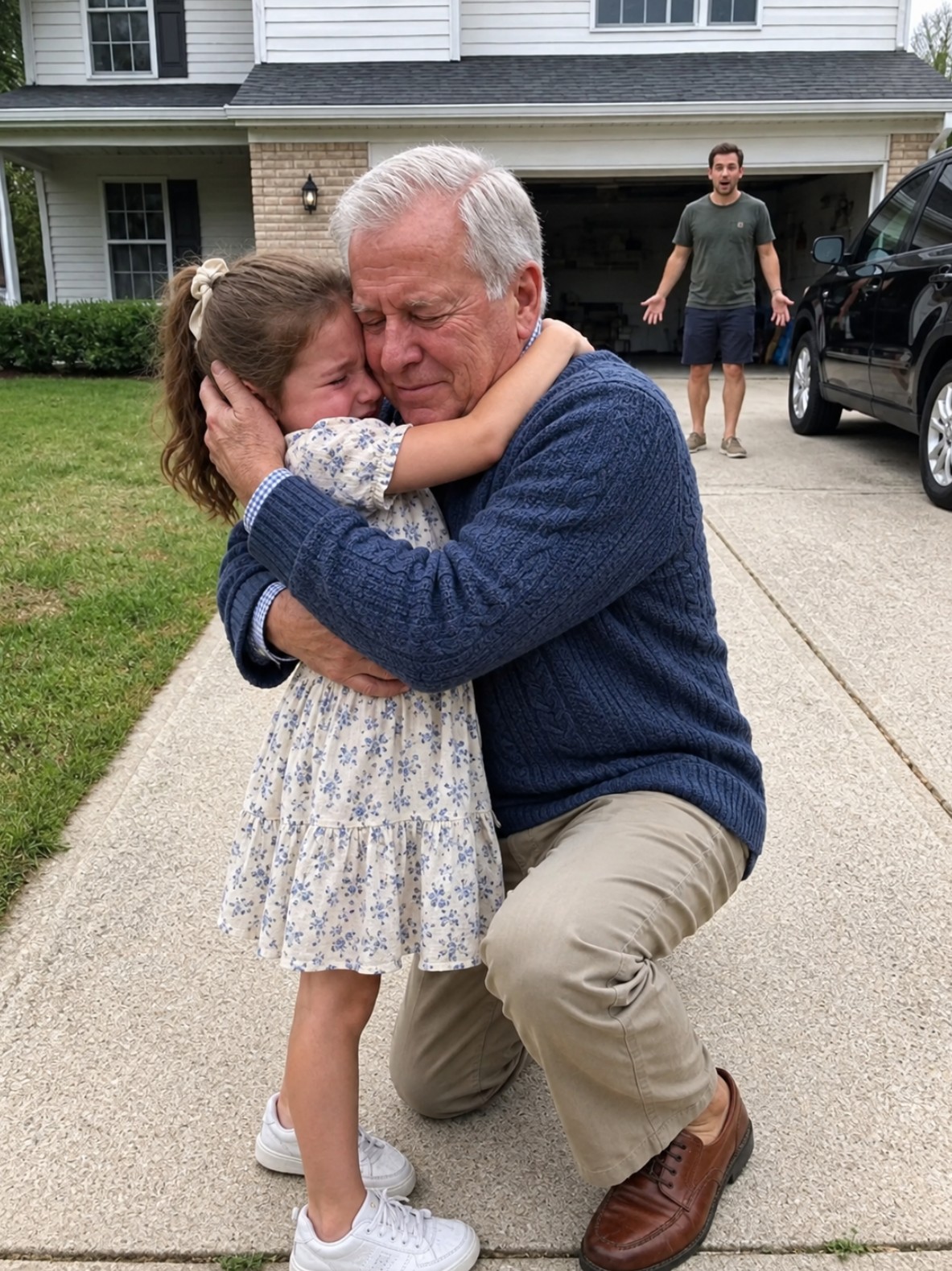
Part 1:
I thought I was honoring my daughter’s last wish.
Laura was my only child. Before she died, she made me promise her one thing.
“Dad, whatever happens, make sure Emma is safe.”
Those words stayed with me long after she was gone.
Seven years ago, Laura was killed in a terrible accident on Highway 24. According to the police, the car had burned so badly that there was nothing left to identify her body. They told us there could be no viewing before the funeral.
My son-in-law, Mark Stevens, stood beside my wife, Eleanor, and me throughout the funeral. He cried with us, held our hands, and told us how much he would miss Laura.
We believed every word he said.
A few days later, we received a sealed urn containing what we were told were Laura’s ashes.
Six months after that, Eleanor died, too.
The doctors said it was cardiac arrest.
I called it heartbreak.
She had never recovered from losing our only child. Watching her fade away was almost as painful as losing Laura herself.
After Eleanor’s death, my world became painfully small. I had my family grocery store, Miller’s Corner Market, and my granddaughter, Emma. She was the only piece of Laura I believed I had left.
I promised myself I would do everything in my power to give that little girl a good life.
Every January, I wired Mark $40,000 to cover Emma’s expenses.
School fees.
Food.
Clothes.
Medical bills and anything else she might need.
At least, that was what I believed the money was paying for.
Over seven years, I sent Mark a total of $280,000. I never demanded receipts or questioned how he spent it. He was Emma’s father, and I trusted him to take care of her.
Every other Saturday, I picked Emma up for ice cream. She always ordered strawberry swirl, and we sat beneath the same big oak tree in the town park while she told me about school.
Those afternoons became the brightest part of my life.
That September afternoon, Emma had just finished telling me about getting an A on her spelling test when her smile suddenly disappeared.
“Grandpa?”
“Yes, sweetheart?”
She looked around as if she were afraid someone might be listening. Then she grabbed my sleeve with her small fingers.
“Please stop sending Dad money.”
I stared at her, certain I had misunderstood.
“What?”
“The money you give him,” she whispered. “Please don’t send it anymore.”
I leaned closer to her.
“Emma, that money is for you. It’s to make sure you have everything you need.”
She shook her head.
“No, Grandpa.”
Something in her voice frightened me. This wasn’t the way an eight-year-old should talk about money. She sounded scared, as though she had been carrying a terrible secret for a long time.
I reached for her hand.
“Sweetheart, is your father hurting you?”
Her fingers tightened around my sleeve.
“I can’t tell you.”
My heart began to pound.
“Why not? You can tell me anything.”
“Dad will get angry.”
I looked into her eyes, searching for some sign that I had misunderstood the situation. But all I saw was fear.
I wanted to ask a hundred questions. I wanted to take her home with me that very moment and refuse to let her go back.
Instead, I tried to keep my voice calm.
“Emma, whatever is happening, you don’t have to be afraid of telling me the truth.”
She glanced around the park again. Then she leaned toward me until her mouth was almost against my ear.
“Just follow him one day.”
I went still.
“Follow your father? Where would I follow him?”
She looked toward the parking lot.
“Don’t tell him. Just watch where he goes.”
Before I could ask another question, Emma suddenly jumped off the bench.
“We have to leave, Grandpa. Dad gets mad when I’m late.”
I stood up and took her hand, but my mind was racing.
Something was terribly wrong.
That night, I sat alone at my kitchen table with my bank statements spread out in front of me. I went through seven years of transfers, checking each date and amount.
Forty thousand dollars every January.
Year after year.
The total was $280,000.
I had never once asked Mark for receipts. I had never checked where the money went. I had simply trusted him because he was my son-in-law and the father of the little girl I loved more than anything.
Now I remembered things I had tried not to think about.
Why was Emma still wearing secondhand coats when I sent enough money to buy her an entirely new wardrobe every year?
Why did Mark constantly complain that money was tight?
Why had he once told me that Emma couldn’t afford a school trip, even though I had transferred her annual allowance only a few months earlier?
At the time, I had accepted every explanation he gave me.
Now, I wondered whether he had been lying to me all along.
The following Tuesday, I did something I never imagined I would do to a member of my own family.
I closed Miller’s Corner Market early, got into my truck, and drove to Mark’s office.
I parked across the street, switched off the engine, and waited.
I had no idea what I was looking for. I only knew that Emma had been frightened enough to beg me to stop sending her father money.
At 4:37 p.m., Mark’s black SUV pulled out of the parking lot.
I started my truck and followed him, keeping two cars between us whenever possible.
For the first twenty minutes, he drove along familiar roads. Then he turned onto a highway leading toward the neighboring town.
Forty minutes after leaving his office, Mark turned onto a quiet residential road.
I knew that road.
I had driven past those houses countless times over the years, never imagining that one of them might hold the answer to the questions that had haunted me since Laura’s death.
Mark slowed down and pulled up outside a gated cottage.
I parked farther down the road, my hands tightening around the steering wheel.
Then I saw someone standing on the porch.
A woman was laughing as she took a bag of groceries from Mark’s hands.
My breath caught in my throat.
I knew that face.
I knew that smile.
I knew the way she tilted her head when she laughed.
It was the face I had kissed goodbye in my memories every night for seven years.
Because the woman standing outside that cottage was someone I had mourned for seven long years.
Someone whose ashes were supposedly sitting in an urn on my living room mantel.
My daughter, Laura, was alive.
Part 2:
My heart hammered against my ribs so violently that I could hear it in my ears.
I sat frozen in my truck, staring through the windshield at the quiet suburban house.
Laura had cut her hair short and dyed it dark brown, but there was no mistaking her. I knew the arch of her eyebrows, the familiar tilt of her head, and the crescent-moon-shaped birthmark near her collarbone.
I had seen that birthmark countless times when she was a little girl.
There was no doubt in my mind.
My daughter was alive.
For several seconds, I couldn’t move. Cold sweat soaked the collar of my shirt, and my hands trembled against the steering wheel.
My mind raced backward through seven years of unbearable grief.
I remembered the sealed urn sitting on my living room mantel. I remembered Mark weeping at the funeral and holding me while I struggled to accept that Laura was gone.
Most of all, I remembered Eleanor.
My poor wife had cried herself to sleep for months after our daughter’s supposed death. She had stopped enjoying the things she once loved. Every time she looked at Emma, she saw the daughter she had lost.
Six months after the funeral, Eleanor was dead, too.
And now I was looking at Laura, alive and well, standing outside a house less than an hour from my home.
The truth hit me with the force of a physical blow.
If Laura had never died, then the funeral had been a lie. The urn on my mantel might contain nothing more than ordinary ashes. Every tear I had shed, every sleepless night, and every painful memory of saying goodbye to my daughter had been built on a lie.
A cruel, calculated lie.
I watched as Mark stepped inside the house and closed the door behind him.
For one wild moment, I wanted to storm up the steps, kick the door open, and demand an explanation.
I wanted to grab Mark by the collar and ask how he could have done this to us. I wanted to look Laura in the eyes and ask how she could have allowed her own mother to die believing she was gone.
But I forced myself to stay where I was.
I had spent fifty years running a business. Experience had taught me that when someone caught you completely off guard, the worst thing you could do was react without thinking.
Anger could wait.
First, I needed proof.
I took out my phone and photographed the cottage, the gate, and Mark’s SUV. I zoomed in on the license plate and took several more pictures. Then I tried to capture Laura through the front window without drawing attention to myself.
Once I had gathered what I could, I started my truck and drove away.
I didn’t go home.
Instead, I drove straight to a private investigation agency in the city. I explained that I suspected my supposedly deceased daughter was alive and that I needed someone to investigate without alerting my son-in-law.
The investigator listened carefully, took copies of my photographs, and promised to look into the matter.
Three days later, I returned to the agency.
This time, I was shown into the office of Ray Vance, a former state police detective who had spent years investigating fraud and organized criminal activity.
Ray sat behind his desk with a thick blue folder in front of him.
He looked at me for a long moment before speaking.
“Thomas, I need you to prepare yourself. What we’ve uncovered is worse than you think.”
My stomach tightened.
“What did you find?”
He pushed the folder across the desk.
“Take a look.”
I opened it.
Inside were tax documents, property records, bank information, and photographs taken during the investigation. There were also records connected to Laura’s supposed death and documents tracing the money I had sent to Mark over the years.
Ray leaned forward and began to explain.
“Seven years ago, Laura and Mark were drowning in gambling debts. Mark owed more than $300,000 to people who weren’t going to accept excuses or payment plans.”
I stared at him.
“More than three hundred thousand dollars?”
Ray nodded.
“Instead of coming to you for help or facing the consequences of their financial problems, they decided to make everyone believe Laura was dead.”
My mouth went dry.
“How?”
“They staged a fatal single-vehicle crash on Highway 24. According to the evidence we’ve found, they used a stolen vehicle and unidentified human remains obtained through a corrupt contact connected to an out-of-state morgue. Mark bribed that contact to help make the death appear real.”
I struggled to breathe normally.
“And the funeral? The urn?”
“The authorities and funeral arrangements were manipulated to support the story. We’re still verifying every detail, but the evidence indicates that the remains were not Laura’s.”
I lowered my eyes to the documents.
For seven years, I had believed my daughter was buried somewhere, while the urn on my mantel held the last physical trace of her existence.
Now I was learning that even that small comfort might have been part of the deception.
Ray continued.
“Laura then assumed the identity of a woman named Sarah Jenkins, who had died in Oregon ten years earlier. They used that identity to help conceal Laura’s whereabouts.”
I looked up sharply.
“Why would they go to such lengths?”
“Because they needed money, Thomas. A lot of it.”
He turned to another page in the folder.
“Mark collected a $500,000 life insurance payout connected to Laura’s supposed death. That money allowed him to pay off his gambling debts and get the creditors off his back.”
I felt sick.
They had not only stolen my daughter from me. They had turned her supposed death into a business transaction.
“And Laura?” I asked. “What happened to her after the accident?”
“She disappeared from public view and stayed in that rental cottage in Lakewood. She couldn’t risk being recognized, so she kept her life small and relied on Mark to bring her what she needed.”
I thought about the woman I had seen on the porch, accepting groceries as if she were living an ordinary life.
“How long has she been there?”
“The evidence suggests she has been hiding there for years.”
I looked down at the bank records again.
Then I saw the transfers.
My transfers.
Forty thousand dollars every January.
For seven years, I had sent Mark $280,000 because I believed I was helping my granddaughter build a better future.
“Where did my money go?” I asked.
Ray’s expression hardened.
“Not where you thought. We traced much of it through accounts linked to Mark and Laura. The evidence suggests the money was used to support Laura’s hidden lifestyle, pay for shopping and living expenses, and fund Mark’s continued gambling.”
My eyes burned with tears, but these were no longer tears of sadness.
They were tears of rage.
I had worked my entire life to build my grocery business. Every dollar I sent had come from years of hard work, long days, and sacrifices I had made for my family.
And they had treated it as their personal fortune.
“What about Emma?” I asked, my voice trembling. “Did they ever spend any of it on her?”
“Some money may have gone toward ordinary household expenses, but the evidence does not support the claim that the transfers were being used solely for her care. We believe Mark kept Emma with him partly to maintain the appearance of a struggling, grieving widower.”
I closed my eyes.
My granddaughter had been used as a reason to keep the money flowing.
But Ray wasn’t finished.
“There’s something else you need to know. Emma appears to have discovered the truth about her mother about six months ago.”
I opened my eyes.
“How?”
“She found a hidden key in Mark’s desk. It led her to the cottage in Lakewood. She eventually realized Laura was alive and confronted them.”
My hands curled into fists.
“What did they do to her?”
“Mark threatened to send her away to a strict boarding school if she ever told you what she had discovered. She was frightened of being separated from everyone she knew, so she kept quiet until she finally found the courage to speak to you.”
Suddenly, Emma’s frightened face at the park made sense.
She hadn’t simply been worried about money.
She had been carrying a secret that no child should ever have been forced to keep.
For six months, she had known that her mother was alive while her grandfather mourned her. She had watched her father continue to lie, and she had been threatened into silence.
I could hardly bear to imagine what that had done to her.
They had stolen seven years of my life, taken hundreds of thousands of dollars, and allowed Eleanor to die believing her only child was gone forever.
I thought of the urn on my mantel.
I thought of my wife lying awake at night, crying for Laura.
And I thought of Emma, sitting across from me beneath our oak tree, whispering that she was afraid of her own father.
When I finally spoke, my voice was low and steady.
“Ray, how do we make sure they never hurt her again?”
Ray leaned back in his chair.
“Insurance fraud involving half a million dollars, a staged death, identity theft, tax evasion, and possible child endangerment. Depending on what the authorities can prove, both state and federal charges may be involved.”
He tapped the folder.
“The state police and the FBI will handle the investigation. You don’t need to take the law into your own hands, Thomas. You need to help us secure the evidence and make sure Emma is safe.”
I nodded slowly.
For the first time in seven years, I had something more powerful than grief.
I had the truth.
And I was going to use it to protect my granddaughter.
Part 3:
The following Saturday was Emma’s eighth birthday.
I had spent the days since meeting Ray Vance working with the authorities. We gathered the financial records, documented the money transfers, and provided the photographs I had taken of the Lakewood cottage.
The investigators also worked to confirm Laura’s identity and connect the evidence to the insurance claim and the staged accident.
They told me not to confront Mark before they were ready to act.
I agreed.
But I had one more thing to do.
Mark had invited me to his house for a small family birthday dinner. Two days earlier, he had called me with the same false warmth I had grown used to hearing in his voice.
“Thomas, I know things have been difficult lately,” he had said. “Emma’s birthday is coming up, and I want to make it special for her. But money has been tight. Would it be possible to send next year’s $40,000 a little early?”
I had almost laughed at the audacity of the request.
After everything I had learned, he still believed I was the same trusting old man who would hand over money without asking questions.
I kept my voice calm.
“Of course, Mark. I’ll see what I can do.”
He sounded relieved.
“Thank you, Thomas. I really appreciate it. Emma is lucky to have you.”
Those words nearly made me lose my temper.
Instead, I agreed to attend the birthday dinner.
By then, the authorities had coordinated their next steps. The plan was to secure the evidence and arrest Mark and Laura once they were together and the investigators were ready.
At six o’clock that evening, I arrived at Mark’s house carrying a wrapped present for Emma and a thick manila envelope under my arm.
The envelope contained copies of the evidence I wanted Mark to see before the authorities took him away.
Mark opened the door wearing an expensive designer sweater. I couldn’t help wondering how much of my money had paid for it.
“Thomas! Come in, come in!” he said, clapping me on the shoulder. “It’s good to see you. Emma’s in the kitchen putting candles on her cake.”
I stepped inside.
The house looked perfectly ordinary. There were birthday decorations on the walls, balloons tied to chairs, and a cake waiting on the kitchen counter.
It was almost impossible to believe that the people who had destroyed my family could still pretend to be living an ordinary life.
Then Emma came running out of the kitchen.
Her face lit up when she saw me.
“Grandpa!”
She wrapped her arms around my waist, and I held her close.
For a moment, I forgot about the photographs, the bank statements, and the lies. All I could think about was how much I loved this little girl.
I leaned down, kissed her forehead, and whispered so quietly that only she could hear me.
“I followed him, sweetheart. You’re safe now.”
Emma pulled back and looked up at me.
Her big brown eyes filled with sudden understanding and overwhelming relief. She didn’t ask any questions. She simply squeezed my hand as tightly as she could.
I gave her the birthday present and followed Mark into the living room.
Then I placed the manila envelope on the coffee table.
Mark’s eyes immediately went to it.
“Is that the draft for the early transfer, Thomas?” he asked. He tried to sound casual, but I could see the greed behind his smile. “Things have been so tight with Emma’s private tutoring costs lately.”
I sat down in the armchair opposite him.
“It’s not a check, Mark.”
His smile faded.
“What do you mean?”
I picked up the envelope and removed the documents inside. Then I laid three photographs and records side by side on the coffee table.
The first was a copy of Laura Miller’s official death certificate.
The second was a photograph of Laura standing on the porch of the Lakewood cottage, taken three days earlier.
The third was a certified bank statement tracing the $280,000 I had wired over seven years to an account linked to Laura’s assumed identity and their hidden financial arrangements.
Mark stared at the documents.
For several seconds, he didn’t move.
Then the color drained from his face. He took a staggering step backward and knocked over his glass of bourbon.
The drink spilled across the floor.
“Thomas…” he stammered. His hands began to shake. “I… what is this?”
I looked him straight in the eye.
“You know exactly what it is.”
He shook his head violently.
“That can’t be! That’s not—”
“She’s alive, Mark.”
My voice was quiet, but every word carried the weight of seven years of grief.
“You let my wife die believing her only child was gone. You let me cry over a grave that meant nothing. You took nearly $300,000 from me while my granddaughter wore hand-me-down clothes.”
Mark raised both hands as if he could somehow stop my words from reaching him.
“Thomas, please, listen to me! It was Laura’s idea! She wanted out! She was the one who didn’t want to be a mother anymore! I only went along with it because I wanted to protect Emma!”
I felt disgust rise in my throat.
“Protect Emma? Is that what you call threatening an eight-year-old child into keeping your secrets?”
Mark’s mouth opened, but no answer came.
Then a voice spoke from the hallway.
“You did it for money.”
Mark spun around.
Standing near the front door was Laura.
She wore a dark coat and held a pair of sunglasses in one hand. She had come to collect money from Mark, apparently expecting another ordinary meeting. She had no idea that the evidence against them had already been gathered or that the authorities were preparing to act.
The moment Laura saw me, she stopped.
For a long time, neither of us spoke.
I looked at the face I had mourned for seven years. I had imagined this moment countless times since seeing her outside the cottage. In some of those imagined moments, I ran to her and held her as tightly as I had when she was a little girl.
But standing there in Mark’s living room, I felt no joy.
Only a terrible emptiness.
“Dad…?” Laura whispered.
Her voice trembled.
I slowly rose from my chair.
For years, I had kept a place for my daughter in my heart. I had remembered her as the little girl who used to run into my arms, the young woman who had promised to take care of her family, and the mother who had asked me to protect Emma.
Now I understood how badly I had misunderstood the person she had become.
“Don’t call me Dad,” I said quietly. “My daughter died seven years ago on Highway 24.”
Laura’s face crumpled.
“Dad, please!”
She took a step toward me, tears filling her eyes.
“Mark forced me into it! He owed money to bookies, and they were threatening us! I was terrified! I wanted to come back, I swear I did!”
I stared at her.
“You lived ten miles away for seven years, Laura. You could have come back at any time. You could have told the truth. Instead, you let your mother die believing you were gone forever.”
She began to cry harder.
“I didn’t know she would die! I never wanted that to happen!”
“Perhaps not,” I said. “But you knew she believed you were dead. You knew I believed it, too. And all that time, you let me pay for your life while I thought I was helping your daughter.”
Laura lowered her head.
“You watched Emma grow up from a distance while I paid for her groceries. You let her believe she had lost her mother. And when she discovered the truth, you helped frighten her into silence.”
“Dad, please, you have to understand—”
“I understand enough.”
Outside, a siren sounded in the distance.
Then another joined it.
Laura looked toward the window. Mark’s face turned pale.
Red and blue lights flashed against the walls as police vehicles pulled up outside.
Mark suddenly bolted toward the back door.
But the moment he threw it open, two armed state troopers stepped onto the patio.
“Mark Stevens! Stay where you are! Put your hands where we can see them!”
Mark froze.
At the front of the house, officers and federal agents entered with the appropriate arrest warrants. The investigation had brought together state and federal authorities because the evidence involved the staged death, the insurance payout, the false identity, and the movement of money across accounts.
Laura let out a scream as an officer took hold of her arms and placed her in handcuffs.
“Thomas! Tell them! Tell them it’s a mistake!” she sobbed as the officer led her toward the front door. “I’m your daughter!”
I didn’t answer.
I couldn’t.
I stood still as they led her out of the house. I didn’t follow her with my eyes. I had spent seven years grieving the daughter I thought I had lost. I could not pretend that seeing her alive erased what she had done.
Mark was forced to the floor, handcuffed, and informed of his rights. When the officers pulled him to his feet, he turned toward me with pure hatred in his eyes.
“You ruined everything!” he shouted.
I met his gaze.
“No, Mark,” I said. “You did.”
The officers led him away.
For several moments, I remained where I was, listening to the footsteps and voices outside. The house that had seemed so ordinary only an hour earlier was now filled with the consequences of seven years of lies.
At last, the noise began to fade.
Ray Vance entered the house alongside a representative from Child Protective Services. They carried the temporary custody authorization papers I had signed earlier that morning.
The authorities had arranged for Emma to stay with me while the appropriate legal process continued.
I looked toward the kitchen.
Emma stood there quietly, holding my hand so tightly that her knuckles had turned white.
She had heard enough to understand that something enormous had happened, even if she couldn’t understand every detail.
I knelt beside her.
“It’s over, Emma,” I whispered gently. “You’re coming home with me. We’ll take things one day at a time, and I’ll make sure you’re safe.”
Her lower lip trembled.
“Really, Grandpa? I don’t have to go back?”
I brushed a tear from her cheek.
“No, sweetheart. You’re coming home with me.”
She stared at me for a moment, searching my face to make sure I meant it.
Then a small, genuine smile broke through her fear.
She threw her arms around my neck and buried her face against my shoulder.
I held her close, silently thanking every force in the world that had given me the chance to protect her.
At last, I had done what Laura had once asked me to do.
I had made sure Emma was safe.
Part 4:
Three weeks later, the urn that had sat on my living room mantel for seven years was finally removed.
For so long, I had treated it as the last physical connection I had to my daughter. I had dusted the mantel around it, sometimes stood in front of it when I couldn’t sleep, and whispered things to Laura that I had never been able to say before her supposed death.
Now, the results of the examination confirmed what the investigation had suspected.
The ashes were a mixture of wood ash and crushed stone.
There had never been any reason to believe they were Laura’s remains.
The urn had been nothing more than a prop in an elaborate fraud.
I stood in my living room after it was taken away, staring at the empty space on the mantel.
I thought about Eleanor.
She had died believing our daughter was gone. She had never learned that Laura was alive, that the accident had been staged, or that the funeral had been built on lies.
There was no way to give my wife those final years back. No court case could undo the pain she had endured. No prison sentence could restore the time we had lost.
That was the part of the truth I found hardest to accept.
The investigation continued, and the evidence against Mark and Laura proved overwhelming. The authorities established their roles in the insurance fraud, conspiracy, identity theft, and tax evasion scheme. Financial records, false documents, and other evidence connected them to the deception.
Both were convicted on federal charges and sentenced to fifteen years in federal prison, with orders to pay restitution.
Their punishment did not erase what they had done, but it meant they could no longer use Emma or my money to continue their scheme.
For the first time in years, I could look toward the future without wondering what else Mark might be hiding.
Emma slowly began to settle into her new life with me.
At first, she was quiet. Sometimes she woke from nightmares, and sometimes she would ask whether I was sure she could stay. I always gave her the same answer.
“You’re home, sweetheart. I’m not sending you away.”
I didn’t expect her to forget what had happened overnight. She had been frightened and manipulated by the very people who should have protected her. She needed time, patience, and the chance to feel safe again.
So we kept our Saturdays.
We went for walks, visited the grocery store, and spent afternoons doing simple things together. I made sure she had the school supplies she needed, warm clothes that fit, and a bedroom where she could leave her toys scattered without worrying that someone would get angry.
Most importantly, I listened.
Whenever Emma wanted to talk, I put everything else aside and listened to what she had to say.
I wanted her to know that she never had to carry another terrible secret alone.
On a bright, clear Saturday afternoon in October, we returned to the town park.
The big oak tree stood exactly where it always had. Its branches spread above the bench, and the autumn sunlight filtered through the leaves.
Emma sat beside me wearing a warm, brand-new winter coat. She held a large ice cream cone, strawberry swirl, her favorite.
She took a bite and smiled.
“Grandpa, did I tell you about the new girl in my class?”
I shook my head.
“No, sweetheart. Tell me.”
“She moved here last week. Her name is Lily, and she likes drawing animals just like I do. We’re going to work on an art project together.”
I smiled as she continued telling me about her new friend, her teacher, and everything that had happened at school.
Her laughter sounded different now. It was lighter, freer, and no longer interrupted by the fear that had once followed her everywhere.
I took a sip of my coffee and looked up through the oak leaves at the blue sky.
For the first time in years, I felt something that resembled peace.
I thought about Eleanor and imagined her sitting beside me, listening to Emma’s stories and smiling at the sight of her granddaughter enjoying a simple afternoon.
I wished more than anything that my wife could have been there to see it.
My daughter was alive, but the daughter I had loved and trusted was no longer someone I could reach. Whatever happened to Laura in the years ahead, the damage she had done could never simply be erased.
The past would remain a scar that might never fully heal.
But Emma was here.
She was safe, she was loved, and she could finally grow up without being used as a weapon in someone else’s lies.
I looked at her bright, happy face as she laughed about her art project.
For seven years, I had believed that honoring Laura’s last wish meant sending Mark money every January and trusting him to raise my granddaughter.
Now I understood what that promise had really meant.
It had never been about money.
It had been about showing up when Emma needed me, believing her when she was afraid, and refusing to let anyone use her again.
I had lost my wife. I had lost the daughter I thought I knew. I could never recover the years stolen from us or undo the heartbreak that had followed Laura’s supposed death.
But I could give Emma a future.
And as I sat beneath that old oak tree, listening to my granddaughter laugh, I knew that was the promise that mattered most.
Emma was safe.
And this time, I would never let her face the world alone.
The End.
