
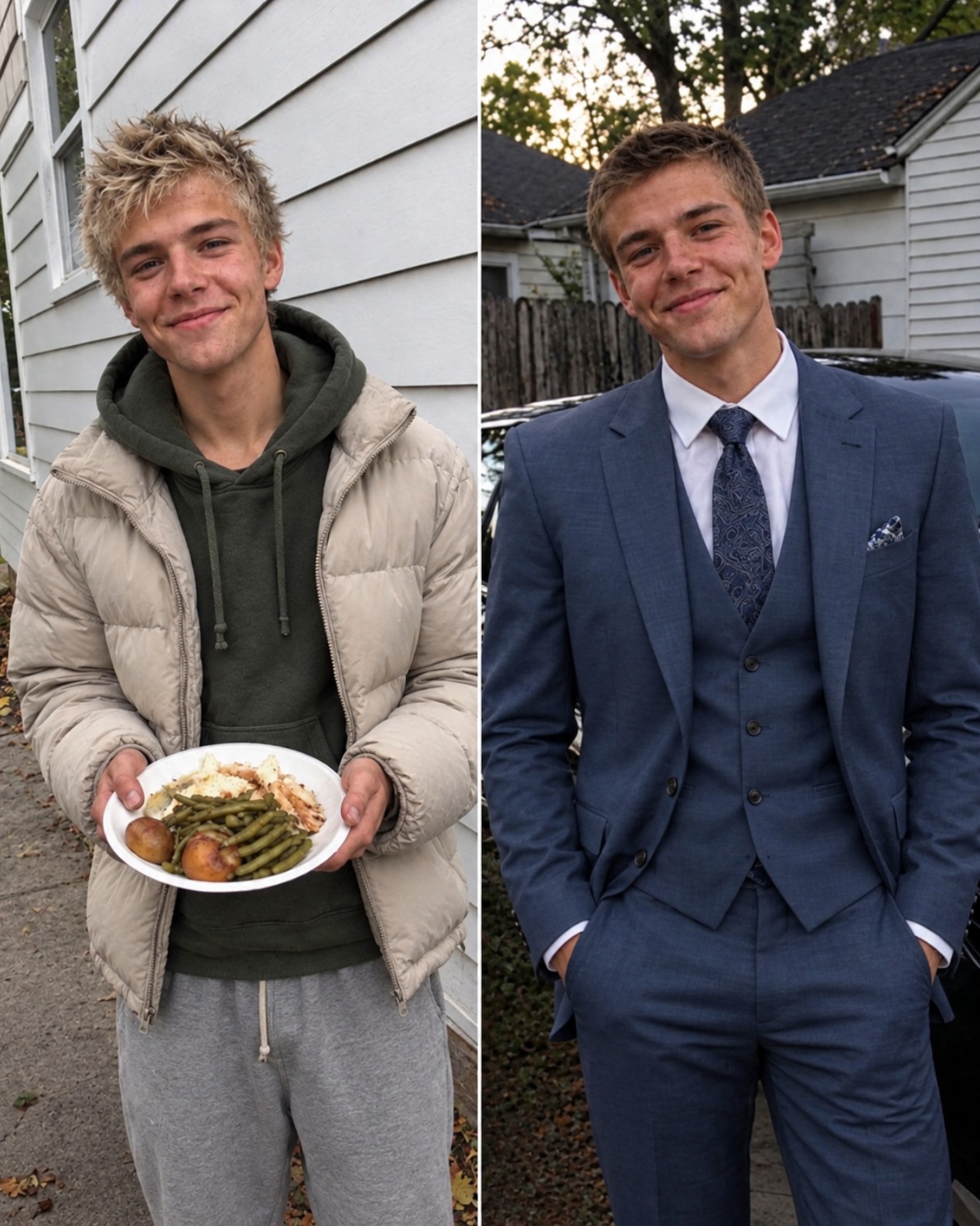
Part 1:
When I was eight years old, my mother gave our best food to a homeless teenager while her own children struggled to eat. Back then, I was convinced he had stolen something precious from me. I never understood why she cared so much about a stranger until years later, after her funeral, when I went looking for him and discovered a man I barely recognized standing outside our old house in Bluebell Valley.
I was eight when Gabriel first began sleeping beside the municipal dump beyond Oakridge Avenue. He had made a shelter for himself beneath a sheet of rusted roofing tin, with a few old blankets spread across the cold ground.
He looked about eighteen, perhaps even younger. His cheeks were hollow, his sleeves were always dirty, and his eyes carried the cautious look of someone who expected trouble from everyone he met.
My father had died that spring, leaving my mother with unpaid bills, unbearable grief, and two young children to raise. Our kitchen had become a place where every meal required careful planning. Mom counted every dollar, stretched every ingredient, and sometimes pretended she wasn’t hungry so my little brother and I could have a little more.
Yet every afternoon, without fail, she prepared an extra meal.
She packed a plate, wrapped it in silver foil, and walked toward the dump without explaining herself to anyone.
Sometimes she took Gabriel baked chicken while my little brother and I ate thin vegetable soup. Other times, she brought him fresh bread while telling us she wasn’t hungry.
I watched everything from the living room window.
Gabriel always accepted the food with both hands. He thanked Mom as though she had given him something far more valuable than a meal. Sometimes, I could even see tears in his eyes as he watched her walk away.
But I didn’t see a hungry teenager who had nowhere to sleep.
I saw someone taking what belonged to me.
Every day, resentment grew inside me. I couldn’t understand why a stranger deserved the best food in our house when Mom’s own children were going without. I missed Dad terribly, and I was frightened by how much our lives had changed since his death. I wanted Mom’s attention, her comfort, and the feeling that someone was still looking after us.
Instead, I watched her give those things to Gabriel.
Then came the Saturday afternoon that made my resentment explode.
I was sitting at the kitchen table when Mom walked in carrying a freshly baked apple pie. Its golden crust was still warm, and the sweet smell filled the entire room. She had placed a glass cover over the pie to protect it.
Apple pie was my favorite dessert. Mom didn’t make it often anymore because the ingredients cost money we could barely spare.
The moment I saw it, I smiled.
“Is that for dinner tonight?” I asked eagerly.
Mom stopped near the back door. She shifted the baking dish against her hip and avoided looking directly at me.
“No, sweetheart,” she replied quietly. “It’s for Gabriel. There’s vegetable soup waiting on the stove for us.”
For a moment, I couldn’t believe what I had heard.
She had baked an entire pie for him while we were eating soup again.
Something inside me broke. Tears filled my eyes, and all the sadness I had been carrying since Dad’s death came pouring out as anger.
“Why does he get dessert when we can’t even have decent food?” I screamed.
Mom turned toward me so quickly that I stopped crying for a moment.
Her expression changed completely. The gentle woman who had spent years comforting me suddenly looked furious.
“Never say that about Gabriel again!” she snapped. “Do you hear me? I never want to hear you speak about him that way again!”
I stared at her in shock.
She had never spoken to me like that before.
Without another word, she walked out through the back door with the pie.
I remained alone in our dim kitchen, feeling ashamed, furious, and completely certain of one thing: Gabriel had somehow replaced me in my mother’s heart.
After that terrible afternoon, I hated him with the intensity only a heartbroken child can manage.
Whenever I passed the dump on my way home from school, Gabriel sometimes tried to wave at me. He never demanded that I speak to him, and he never complained when I ignored him.
Once, he even carved a small wooden songbird for me.
He approached me with the little bird resting in his palm. The carving wasn’t perfect, but someone had clearly spent hours working on it.
“I thought you might like this,” he said with a shy smile.
I looked at the bird, then at him.
Instead of accepting it, I deliberately dropped it beside his worn shoes.
Then I lifted my chin and walked away as though I had done nothing wrong.
I expected him to shout at me or tell Mom what I had done.
He didn’t.
Behind me, I heard him quietly pick up the wooden bird.
“You don’t have to like me,” Gabriel called after me. “But your mother worries whenever you walk too close to traffic after school. Please be careful.”
I ignored him and walked faster.
I convinced myself that his concern was just another trick to steal even more of Mom’s affection.
As far as I knew, Gabriel had no parents, no home, and no job in our small town. I had no idea what had happened to him before he arrived at the dump, and Mom never explained why she seemed to feel so responsible for keeping him alive.
I didn’t ask again.
As the years passed, I grew older, but my resentment remained. I never learned to see Gabriel as anything other than the boy who received our food while my family struggled.
Then, sometime before I finished high school, he disappeared from the dump.
His little shelter vanished. The rusted roofing tin was gone, and I stopped seeing him near Oakridge Avenue.
I asked Mom where he had gone, but she refused to give me a clear answer.
“He’s somewhere safe,” she told me once.
That was all she would say.
I wanted to ask more questions, but I was tired of arguing with her. By then, I had already decided that leaving Bluebell Valley was the only way to build a life that didn’t revolve around our family’s grief.
The moment I graduated, I moved three hours away to a small apartment in Pine Ridge. I accepted the cheapest lease I could find and started working hard to support myself.
At first, I called Mom every week.
Then the calls became less frequent. We spoke on birthdays, then major holidays, and eventually only when one of us felt guilty enough to reach out.
Neither of us knew how to repair the distance between us.
I told myself that I was busy building my future. I had work to do, bills to pay, and a life of my own to create.
But the truth was that talking to Mom often brought back memories I didn’t want to face. I still remembered the apple pie, the shouting, and the feeling that I had somehow lost my place in her heart.
Eleven years passed.
Then, one ordinary workday, my phone rang while I was sitting at my office desk.
A nurse from St. Jude Regional Hospital was calling.
“Am I speaking to Abigail Miller’s daughter?” she asked.
“Yes. What’s happened?”
There was a brief pause before she answered.
“Your mother has suffered a severe stroke. Her condition is critical, so you need to come to St. Jude Regional Hospital as soon as possible.”
My entire world seemed to stop.
I left work immediately and drove toward the hospital, my hands gripping the steering wheel as fear filled my chest.
Whatever had happened between Mom and me, she was still my mother.
And I wasn’t ready to lose her.
When I finally reached her hospital room, medical machines surrounded her bed. Tubes and wires connected her to equipment that beeped softly in the background.
She looked so small beneath the white sheets.
Her face was pale, and her body seemed almost fragile enough to disappear. The woman who had once carried heavy pots of food to the dump could barely turn her head.
I walked to her bedside and took her hand.
“I’m here, Mom,” I whispered.
Her fingers moved weakly around mine.
“I’m sorry,” I continued, struggling to hold back my tears. “I’m sorry I stayed away for so long. I should have called more. I should have visited more often.”
Her eyes remained fixed on my face.
Even in her weakened state, they were painfully clear.
“I am here now, Mom,” I told her gently. “You don’t have to worry about anything anymore. I’ll take care of the house, the bills, and everything else.”
Her lips moved, but no sound came out at first.
I leaned closer, trying to understand what she was saying.
Then, with tremendous effort, she whispered two words.
“Gabriel… please.”
I froze.
After all these years, she was still thinking about him.
“Don’t abandon Gabriel,” she whispered. “Promise me right now.”
I stared at her, unable to believe what I was hearing.
She was lying in a hospital bed, barely able to speak, and she was using what might be her final moments to ask me to protect the boy she had once fed while her own children went hungry.
For one brief moment, anger rose inside me again.
Gabriel hadn’t even come to see her, as far as I knew. Yet Mom was still worrying about him.
Still protecting him.
Still placing him ahead of me.
But then I looked at her face, and the anger gave way to the terrible knowledge that I might never hear her voice again.
“I promise,” I whispered.
The words tasted bitter, but I meant them enough to give her the peace she seemed to need.
Mom’s fingers relaxed around mine.
She closed her eyes, and her breathing gradually slowed.
Before sunset, she was gone.
I sat beside her bed long after the nurses had finished their work, holding her hand and thinking about everything I had left unsaid.
I had promised to help Gabriel.
I just didn’t know where to find him, or why my mother had been so determined to protect him.
After the funeral, I returned to Bluebell Valley to settle the house and deal with the remaining paperwork.
One afternoon, I cooked a fresh pot of beef stew, packed some bread, and placed everything in a covered container.
I told myself I was doing it only because of my promise.
I would find Gabriel, give him the food, tell him Mom had died, and then consider my obligation fulfilled.
I expected to search the old dump or ask the neighbors whether he still wandered around the area.
Instead, when I arrived at our old house, I noticed a sleek black SUV parked along the curb.
Beside it stood a man wearing an expensive wool coat.
He was clean-shaven, with neatly styled hair and polished shoes. He looked nothing like the desperate teenager I remembered.
He watched as I parked my car and stepped outside.
There was something strangely familiar about his face, but I couldn’t immediately place it.
Then he looked directly at me, and I noticed the same cautious eyes I remembered from the dump.
His eyes were older now, marked by exhaustion and sadness, but they were unmistakable.
“I thought you wouldn’t come,” he said softly.
I stopped on the curb, still holding the covered pot against my chest.
I stared at him for several seconds.
“Gabriel?”
He gave me a small, uncertain smile.
“Hello.”
My gaze moved from his face to the black SUV, then back again.
“What happened to you?” I asked. “Where have you been all these years? And how can you afford a car like that?”
He glanced toward the dark windows of our old house.
Then his eyes dropped to the food in my hands.
“You brought dinner,” he said quietly.
I felt embarrassed by the cheap plastic container, especially standing beside his expensive vehicle.
“Yes,” I replied. “I made beef stew.”
He looked at the container for a moment, and something in his expression softened.
“Your mother would have liked that.”
I tightened my grip on the pot.
“Don’t change the subject. Mom spent years acting as though you still needed her help. She worried about you until her final breath. Yet here you are, dressed like a businessman, driving a luxury car, and apparently doing very well for yourself.”
Gabriel didn’t become defensive.
He simply looked toward the house again and let out a long sigh.
“Your mother hid something very important from you,” he said.
I felt a chill move through my body.
“What are you talking about?”
“Before she died, she made me promise to keep a secret until the right moment.”
I stared at him, suddenly aware that my mother’s last request had been only the beginning of something much bigger.
“What secret?”
Gabriel opened the back door of his SUV and reached inside.
When he turned around, he was holding a dented metal box that looked as though it had been stored away for decades.
He carried it carefully toward me.
“Before we go inside,” he said, “there’s something you need to know about your father.”
Part 2: The Secret My Father Left Behind
I stood beside the curb, staring at the dented metal box in Gabriel’s hands.
The evening air had grown colder, and the streetlights were beginning to flicker on. Somewhere nearby, a dog barked, but neither of us paid attention.
“What does my father have to do with any of this?” I asked.
Gabriel placed the box carefully on the hood of his SUV.
“Your father’s death wasn’t the first loss connecting our families,” he said.
I felt a knot tighten in my stomach.
“Why didn’t anyone tell me?”
“Because your father hated being praised for doing good things. He never wanted anyone to feel they owed him something.”
I frowned.
I had known Dad as a hardworking man who worried about bills, repaired broken things around the house, and tried to make us laugh even when money was tight. But I had never heard anything about him helping Gabriel’s family.
Gabriel rested one hand on the metal box.
“My mother’s name was Clara,” he began. “She cleaned offices at your father’s factory. She worked hard, and your father respected her. He knew she was raising me alone, but she never asked him for special treatment.”
According to Gabriel, everything changed when he was sixteen.
Clara became seriously ill and began missing work. She tried to keep going for as long as she could, but eventually she became too weak to continue.
Without her regular wages, they fell behind on rent.
Their landlord didn’t care about her illness or their circumstances. He wanted his money, and when they couldn’t pay, he evicted them.
“They put our belongings into bags and left them outside,” Gabriel recalled. “My mother was so sick that she could barely stand. I remember trying to keep her warm while wondering where we were going to sleep that night.”
He paused, looking down at the box.
“Your father found out what had happened. He paid for a motel room without telling anyone at the factory. He also arranged for groceries to be delivered every week.”
I listened in silence.
“Why didn’t Dad tell us?”
“Because he didn’t want charity to become a public performance. He told my mother that she didn’t owe him anything. He said she could repay him by getting better and taking care of herself.”
Gabriel explained that my father had also encouraged him to apply for job training programs. Dad believed Gabriel was capable of building a future for himself, even when Gabriel couldn’t imagine one.
For a while, things improved.
Then Dad died unexpectedly.
Clara’s health deteriorated further, and Gabriel was forced to leave high school so he could care for her full-time.
He worked whatever small jobs he could find, but most of his time was spent looking after his mother. Several months later, Clara died.
Gabriel was still a teenager.
He had no parents left to care for him, no permanent home, and no steady income.
“By the time I ended up near the municipal dump, I was seventeen,” he continued. “I had nowhere else to go. Sometimes, the recycling yard paid me a little cash for sorting scrap metal. It wasn’t regular work, and the local shelters were always full.”
I remembered the dirty sleeves, the hollow cheeks, and the makeshift shelter beneath the rusted roofing tin.
For the first time, I began to understand what I had actually been looking at all those years ago.
Gabriel hadn’t been a stranger who had simply appeared to take our food.
He had been a grieving teenager who had lost both parents and had almost nothing left.
“Mom fed you because she believed Dad would have done exactly the same thing,” I said slowly.
Gabriel nodded.
“She told me that more than once. She said your father had helped my mother when she had nowhere to turn, and she couldn’t stand the thought of letting his son go hungry.”
I swallowed hard.
“Even when we barely had enough ourselves.”
“Yes.”
I thought about the thin soup, the fresh bread, and the apple pie.
I had spent years remembering those meals as proof that Mom loved Gabriel more than she loved me.
Now I was beginning to understand that she had been trying to honor the kind of man my father had been.
But one question still bothered me.
“If that’s all there was to it, why did she keep you a secret from me for eleven years?”
Gabriel looked at the metal box.
“Because this box was supposed to be delivered to you when you turned eighteen.”
He took a small brass key from his leather wallet and unlocked the latch.
Inside were dozens of cassette tapes, each neatly organized and carefully labeled.
I leaned closer.
The labels were written in my father’s familiar handwriting.
*When You Think Nobody Understands You at All.*
*Eighteenth Birthday.*
*High School Graduation.*
*Wedding Day.*
*First Big Failure.*
*Becoming a Parent.*
For a moment, I couldn’t breathe.
I recognized the way Dad formed his letters. I remembered watching him write birthday cards and grocery lists, sometimes adding little jokes in the margins.
There was no mistaking it.
Those were his words.
My knees weakened, and Gabriel reached for my elbow to steady me.
I pulled away instinctively, overwhelmed by the sight of something I had never known existed.
“He recorded all these messages for me?”
“Yes.”
I looked at him, tears gathering in my eyes.
“Why?”
“Your father knew his health was failing. He wanted to leave you something you could turn to as you grew older. He recorded messages for the important moments in your life, including the difficult days he knew he might not be there to help you through.”
I reached toward the box but stopped before touching the tapes.
“How did you get them?”
“Your father gave me the box before he died. He told me to deliver it to you on your eighteenth birthday. He trusted me with the key because he was worried your mother might be too overwhelmed by grief to let you listen to the recordings.”
I stared at him.
Dad had trusted a teenage boy from a struggling family with something this precious.
And that boy had kept the promise.
At least, for a while.
“Then what happened?” I asked.
Gabriel’s expression grew heavy.
“Your mother stopped me just before your eighteenth birthday.”
He explained that Mom had listened to one of the tapes shortly after Dad died. Hearing Dad’s voice again had devastated her. She had broken down in tears and struggled to cope with the loss all over again.
She became frightened that the recordings would make it impossible for her to move forward.
She worried that I would cling to Dad’s memory so tightly that I would never learn to live without him.
“So she told you not to give them to me?”
“Yes.”
“And you listened to her?”
Gabriel lowered his eyes.
“She asked me to wait. She said she wasn’t ready, and she begged me not to make things harder for her.”
I felt anger rising inside me again, sharper this time because I finally understood what had been taken from me.
“After I turned eighteen, she didn’t have the right to make that decision for me anymore,” I said bitterly. “And neither did you.”
“You’re right.”
His answer came so quickly that I paused.
He didn’t try to defend himself. He didn’t tell me I was being unfair or insist that he had done the right thing.
He simply accepted what I said.
“I should have chosen differently,” he continued. “Your mother’s pain mattered, but so did your right to hear your father’s voice. I let my gratitude toward her become more important than the promise I made to him. I’m sorry.”
I looked back at the tapes.
Eleven years.
Eleven birthdays, graduations, difficult decisions, lonely nights, and ordinary days when I might have wanted nothing more than to hear my father’s voice.
All that time, the recordings had been sitting in a box while I lived my life believing I had nothing left of him but fading memories.
“Why didn’t you come to me yourself?” I asked. “You could have found me after I moved away.”
“I could have,” Gabriel admitted. “I knew where you lived for some of those years. I even considered sending the box to you without telling your mother.”
“Then why didn’t you?”
“Because I was afraid of hurting the woman who had taken me in when I had nobody else. She paid for my night school tuition. She made sure I had food. She treated me like family when I had lost mine.”
His voice cracked slightly.
“I was so grateful to her that I stopped questioning her decisions. Eventually, I became afraid that doing what your father wanted would mean betraying your mother.”
He shook his head.
“That doesn’t excuse what I did. It only explains how I convinced myself to keep waiting.”
I took a deep breath, trying to calm myself.
Then I looked toward his SUV.
“All right. Explain something else to me.”
Gabriel followed my gaze.
“The car. The coat. The fact that you apparently have a successful life now. What happened to the boy who slept beside the dump?”
For the first time, a faint smile crossed his face.
“The recycling yard taught me more than I expected. I learned about raw materials, pricing, transportation, and the difference between something people considered worthless and something that could still be useful.”
He explained that after finishing night school, he began working wherever he could. Eventually, he managed to borrow a truck and started hauling industrial scrap.
At first, he handled small jobs for local businesses.
He worked long hours, saved whatever money he could, and learned how to negotiate better prices. He gradually built relationships with factories and recycling facilities across the region.
One truck became two.
Then he hired his first employee.
Over the years, his small operation grew into a regional recycling enterprise based in Maplewood.
“I didn’t become successful overnight,” he said. “There were years when I worked every day and still worried about making payroll. But I kept going.”
He had moved away from Bluebell Valley years earlier and built his company elsewhere.
When Mom’s health began to decline, he returned more often. He visited her quietly, helping with whatever she would allow him to do, but she insisted that he keep his presence and their arrangement private.
I stared at him, trying to connect the successful businessman in front of me with the starving teenager I had once resented.
“You could have told me all this years ago,” I said.
“Yes.”
“You could have told me about Dad.”
“Yes.”
“You could have delivered the tapes.”
“Yes.”
Each answer made my anger more complicated.
I wanted him to argue with me. I wanted him to offer some excuse that would allow me to dismiss him as a selfish person.
Instead, he kept accepting responsibility.
Then another question came to mind.
“You weren’t at the hospital when Mom died.”
Gabriel’s face changed.
“I was there the night before you arrived.”
I stared at him.
“What?”
“I visited her. When she learned you were coming, she ordered me to leave. She wanted to speak to you alone, without the secret hanging between us.”
He paused.
“She said she needed to see you one last time without worrying about whether you would discover what she had done.”
I felt a painful knot form in my throat.
“Then why did she mention you in her final moments? Why was she still worrying about you after everything?”
Gabriel swallowed before answering.
“Because she knew you would return to settle the house after the funeral. She was afraid you might refuse to speak to me if she didn’t give you a reason to find me.”
He looked directly at me.
“She knew she had hurt you by keeping the recordings from you. But she was still too afraid to tell you the truth herself. She thought making you promise not to abandon me would bring us together, giving me a chance to finally explain everything.”
I looked away.
Part of me wanted to hate Gabriel because it would have been easier than admitting how much my mother had kept from me.
But the truth was that both of them had made choices that had hurt me.
Mom had allowed her grief to control the future of my relationship with Dad’s memory.
Gabriel had allowed his gratitude to silence his judgment.
And I had spent years allowing my childhood resentment to keep me away from the only parent I had left.
No one had come through this story without making mistakes.
I picked up the metal box.
It was heavier than I expected.
“Let’s go inside,” I said.
Gabriel followed me into the house without another word.
Dust covered the furniture, and the rooms smelled faintly of old wood and closed windows. The kitchen looked smaller than I remembered, but the apple-shaped wall clock still hung above the counter, ticking steadily as if time had never moved forward.
Gabriel placed the pot of beef stew on the counter.
I set the metal box on the old kitchen table.
For a few moments, neither of us spoke.
Then Gabriel glanced toward the front door.
“You should probably listen to the recordings without me here,” he said. “They’re meant for you.”
“No.”
He turned back toward me.
I looked him in the eye.
“You waited eleven years to deliver these tapes. You can stay long enough to listen to one with me.”
He hesitated, then nodded.
We searched the lower kitchen cabinets until we found Dad’s old cassette player tucked behind a stack of unused dishes. It was dusty, but the machine still worked.
Gabriel wiped it carefully with a cloth while I arranged the tapes on the table.
My hands trembled as I selected the one labeled *Eighteenth Birthday*.
For years, I had imagined what it might feel like to hear Dad’s voice again.
I had expected the sound to be faint in my memory, like a song I hadn’t heard in a long time.
But as Gabriel pressed the play button, I realized I remembered more than I thought.
The machine clicked.
A burst of static filled the kitchen.
Then, after eleven years of silence, my father’s voice returned.
“Happy eighteenth birthday, my sweet girl.”
I covered my mouth.
Dad gave a small laugh on the recording.
“I hope you’re taller than me now, although your mother probably doubts that very much.”
His familiar humor filled the room, and suddenly I was eight years old again, sitting at the kitchen table while he made ridiculous jokes to make me smile.
He talked about the day I was born, describing how frightened he had been when the nurse placed me in his arms.
He admitted that he had worried about every little thing, from whether I was eating enough to whether he would be a good father.
Then his voice became gentler.
“My greatest hope is that you’ll travel farther in life than I ever did. I want you to find things that make you happy, even if they’re things I never had the chance to experience myself.”
Tears ran down my face.
For the first time in years, I could hear the warmth in his voice without having to rely on memory.
Then he said something that made me cry even harder.
“Your mother may hold on too tightly to you after I’m gone,” he said. “She’s always loved you fiercely, and sometimes fear makes people hold on harder than they should. Be patient with her, sweetheart, but please don’t disappear completely from her life.”
I bowed my head.
Dad had somehow understood what might happen long before I did.
He knew Mom’s grief could become overwhelming. He knew she might struggle to let go, and he had tried to warn me gently without making me afraid of her.
Then he mentioned Gabriel.
“And please don’t judge your mother for feeding a boy who has nowhere safe to go,” Dad continued. “Families survive hard years because people share what little they have. Sometimes the smaller portion is still enough for everyone.”
I broke down completely.
I bent over the kitchen table, covering my face with both hands as years of anger, grief, and regret came pouring out of me.
The apple pie.
The thin soup.
The wooden bird I had thrown away.
The boy standing beside the dump, thanking my mother for every meal.
For years, I had believed those moments proved I wasn’t loved enough.
Now I could hear my father explaining the truth in his own voice.
My parents had been trying to teach me something I had been too young and hurt to understand.
But even as the tears fell, I knew the truth didn’t erase the years I had lost.
“He knew,” I whispered.
Gabriel sat quietly across the table.
“He knew your mother’s health was getting worse,” he said softly. “He was worried about what would happen to me. He also worried that you might misunderstand why your mother kept helping me.”
I wiped my face with the back of my hand.
“You both still took these memories from me for eleven years.”
Gabriel nodded.
“You’re right.”
“Listening to his voice now doesn’t make either of you innocent.”
“No,” he replied. “It doesn’t.”
He looked down at his hands.
“I can explain my decision to you a thousand times, but no explanation will ever make it right.”
I looked at him for a long moment.
Then I turned the tape over and placed it back in its case.
“We’re listening to another one tomorrow,” I said.
Gabriel nodded.
“Whenever you’re ready.”
That evening, I understood something I hadn’t expected to learn.
The truth could heal a wound without making it disappear.
And forgiveness, if it ever came, would take more than one night.
Part 3: The Voice That Brought Us Back Together
Gabriel and I stayed up until midnight listening to more of my father’s recordings.
Each tape opened another small window into the life I had lost.
There were no shocking confessions about secret fortunes, no hidden family waiting somewhere, and no dramatic revelation that changed everything I thought I knew about my parents.
Instead, the tapes contained ordinary moments.
Dad complained about how expensive groceries had become. He made jokes about his inability to cook without burning something. He talked about the importance of keeping a job, treating people fairly, and admitting when you were wrong.
Sometimes, he spoke directly about the future.
On the tape labeled *High School Graduation*, he reminded me that a diploma wasn’t proof that I knew everything. It was simply evidence that I had completed one part of my journey.
“Don’t let anyone convince you that you have to know exactly what you’re doing with your life at eighteen,” he said. “Most adults are still figuring things out. The trick is to keep learning and to remember that changing your mind doesn’t mean you’ve failed.”
On another recording, he talked about money.
He reminded me that being poor wasn’t something to be ashamed of, but he also warned me never to let money become the only measure of success.
“Work hard, save what you can, and learn to live within your means,” he said. “But don’t become so afraid of losing what you have that you forget to enjoy the people around you.”
I listened to every word.
Sometimes I laughed.
Other times, I cried so hard that Gabriel stopped the tape and waited until I was ready to continue.
He never rushed me.
He never told me to calm down or suggested that I should be grateful for what I had been given.
He simply stayed beside me, exactly as I had asked him to.
For several evenings after that first night, Gabriel returned to the old house after finishing his workday.
We listened to the recordings one by one, following the order Dad had intended. The tapes brought back memories I hadn’t thought about in years, and they helped me understand parts of my childhood that had once seemed confusing.
Between recordings, Gabriel told me stories about my parents.
He remembered how Mom used to sing while sitting at the kitchen table and balancing the monthly bills. She would tap her fingers against the calculator, trying to make the numbers work, and then suddenly start singing as if she could chase her worries away with a melody.
He remembered how Dad burned pancakes every Sunday morning.
According to Gabriel, Dad insisted that the first pancake was always supposed to be terrible because it gave the pan time to warm up properly.
“Your father told me that with a completely straight face,” Gabriel recalled one evening. “Then he burned the second pancake, too, and blamed the stove.”
I laughed despite myself.
I could picture Dad standing over the frying pan, pretending he knew exactly what he was doing while smoke rose around him.
Gabriel also remembered how my parents argued quietly about money, work, and the future. But they usually apologized before bedtime, even when neither wanted to admit they had been wrong.
“They didn’t always agree,” he said. “But your father believed that people who loved each other shouldn’t let pride keep them from making things right.”
I thought about that for a long time.
Mom and I had spent years allowing pride, grief, and old misunderstandings to stand between us.
We had both wanted the other person to take the first step.
And then we had run out of time.
One evening, while we were sitting at the kitchen table, I finally told Gabriel something I had carried inside me since childhood.
“I hated you,” I admitted.
He looked up from the cassette case.
“I know.”
“No, I mean I really hated you. I hated seeing you near the dump because it reminded me of all the things I thought you had taken from me.”
I stared at my hands.
“Every time Mom carried food outside, I felt as though she was choosing you over me. I was only eight, and I couldn’t understand why she was giving away things we could barely afford. I thought if you weren’t there, everything would go back to the way it was before Dad died.”
Gabriel listened without interrupting.
“I know that doesn’t make sense now,” I continued. “But back then, I believed it with everything I had.”
He lowered his eyes thoughtfully.
“I understood more than you probably realized,” he said. “I knew you were angry with me. I could see it whenever you passed the dump.”
“Then why did you keep trying to talk to me?”
“Because you were a child who had lost her father. You were frightened and hurting, even if you didn’t know how to explain it. I didn’t think you should have to feel guilty for not understanding my situation.”
He paused.
“And I never thought you owed me affection just because your mother helped me.”
I swallowed hard.
“I threw away the wooden bird you made for me.”
“I remember.”
“You picked it up.”
“Yes.”
“Why?”
Gabriel gave a faint smile.
“Because I had spent a long time making it, and I didn’t want to leave it lying in the dirt.”
I looked away, ashamed.
“I should have been kinder.”
“Maybe,” he replied gently. “But you were eight years old. You had lost your father, and nobody explained what was happening. You were trying to make sense of a world that suddenly felt unfair.”
He leaned back in his chair.
“I don’t blame the child you were for feeling hurt. But I do think the adults around you should have done a better job of explaining things.”
His words surprised me.
For so many years, I had assumed that Gabriel saw me as a spoiled, selfish child. I had imagined that he remembered every cruel thing I had done and quietly resented me for it.
Instead, he understood that I had been grieving, too.
That didn’t mean our relationship suddenly became easy.
Forgiveness didn’t arrive cleanly or overnight.
Some evenings, we laughed together over Dad’s terrible jokes. Other nights, a recording brought back so much pain that I asked Gabriel to leave.
He never argued.
He would quietly gather his things, make sure I had everything I needed, and walk out through the front door.
Sometimes I wouldn’t speak to him for several days.
Then I would find myself looking at the metal box and remembering that, despite everything, he had finally brought it to me.
Eventually, I would call him and ask whether he could come over.
He always came when he was able.
Little by little, trust began to grow between us.
It wasn’t built through grand promises or dramatic apologies. It grew through small, ordinary acts of honesty.
Gabriel stopped trying to protect me from difficult truths, even when he worried they might hurt me.
I stopped assuming that every silence meant someone was hiding something from me.
We learned to ask questions rather than make accusations, and we learned to admit when we didn’t have an answer.
Months later, after we had listened to every tape, I decided I couldn’t risk losing those recordings.
I took them to a specialist who helped me digitize the entire collection. I made several backups and stored them in three separate locations.
I kept the personal recordings private, especially the messages Dad had made for important milestones in my life.
But some of the tapes contained broader reflections on parenting, grief, and helping people through difficult times. Those recordings offered advice that might have helped other families, too.
After carefully considering which messages could be shared without revealing private details, I donated copies of several recordings to the local history archive in Crestview.
The archive agreed to preserve them and make the approved material available for historical study.
I wanted people to understand the kind of community my father had believed in: one where neighbors helped one another without demanding gratitude or recognition.
Dad had never thought of himself as a hero.
He had simply believed that when someone was in trouble, you did what you could to help.
That was why he had helped Clara.
That was why Mom had fed Gabriel.
And that was why, despite everything that had happened, I was beginning to understand the value of the choices they had made.
The recordings also changed the way I thought about my own children.
Before that year, I had been repeating some of the same patterns I had learned from Mom. I loved my children deeply, but I often assumed they knew how I felt without my having to say it.
I could go days without asking about their lives because work was busy or I was tired. I sometimes convinced myself that providing for them was enough.
But Dad’s recordings reminded me that love wasn’t always obvious to the people who needed it most.
Sometimes love had to be spoken.
Sometimes it had to be explained.
And sometimes, it had to be written down so it could survive the moments when we were no longer there to say it ourselves.
I began recording video messages for my children.
There was nothing wrong with my health, and I expected to have many ordinary years ahead of me. I wasn’t preparing for an imminent goodbye.
I simply wanted to preserve the things I hoped they would remember.
I recorded stories about their birthdays, family recipes, childhood adventures, and the little moments that made our home special.
I also recorded messages for the difficult days I knew they would eventually face.
I talked about failure, friendship, heartbreak, money, work, and the importance of apologizing when they made mistakes.
Sometimes I recorded answers to questions they had asked me. Other times, I told stories they had heard so often that they usually rolled their eyes whenever I began telling them again.
I wanted them to have something they could return to when they needed reassurance.
Most importantly, I started calling them more often.
They had grown used to the emotional distance I had once accepted as normal, and I refused to let that distance become another family tradition.
I didn’t want them to grow up believing that love was something they had to guess at.
I wanted them to know.
A year after Mom’s death, Gabriel came to the old house for dinner.
He arrived carrying a fresh bouquet of flowers. He claimed they were simply flowers he had seen on his way over, but I suspected he had bought them especially for the occasion.
I placed them in a vase on the kitchen counter.
Then I finished preparing dinner and brought a warm apple pie to the table.
The smell filled the kitchen, and for a moment, I was transported back to that Saturday afternoon when I was eight years old.
I remembered standing beside the back door, watching Mom carry a pie away from me.
I remembered the tears, the shouting, and the terrible certainty that she had chosen someone else over her own child.
But I was no longer that little girl.
I understood now that Mom had been struggling with her own grief. She had been trying to keep a promise to my father while raising two children on almost nothing.
She had made mistakes, and some of those mistakes had hurt me deeply.
But she had also shown kindness to someone who desperately needed it.
Both things were true.
After dinner, I brought out the metal box.
Gabriel watched as I carefully selected the final cassette, the one we had saved for that evening.
It was labeled *When You Need to Remember What Matters*.
I placed it into the cassette player and pressed play.
The familiar click echoed through the kitchen.
A moment later, Dad’s voice filled the room again.
“If you’re listening to this, I hope you’ve made it through a few difficult years and found some happiness along the way,” he began.
He spoke about the importance of family, but he didn’t suggest that family members should accept every hurtful decision simply because they loved one another.
Instead, he reminded me that love required honesty, patience, and the courage to admit when we had made mistakes.
“People will disappoint you sometimes,” he said. “And you will disappoint people, too. Don’t pretend those things don’t matter. Talk about them. Apologize when you need to. Give people room to change, but don’t be afraid to tell the truth.”
I glanced at Gabriel.
He was sitting quietly across from me, his hands resting on the table.
Then Dad began to laugh.
“And if Gabriel is sitting there with you, make sure you give him the larger slice of pie. That boy never seems to eat enough!”
I burst out laughing through my tears.
Gabriel shook his head, smiling.
“Your father never let me forget that he thought I was too skinny,” he said.
“He would probably still be telling you to eat more if he were here,” I replied.
“Probably.”
The recording continued for another few minutes, but I barely heard the words. I was too busy looking around the kitchen and thinking about everything that had brought us to that moment.
The old apple-shaped clock still ticked above the counter.
The same wooden table stood between us.
And the man I had once blamed for taking something precious from me was sitting in the place where my father had made so many memories.
When the tape finally ended, the kitchen fell silent.
I looked down at the pie.
For most of my life, that dessert had represented the moment I believed my mother had stopped choosing me.
Now it reminded me of something else.
A hungry teenager.
A grieving mother.
A father who believed that kindness mattered, even when there wasn’t much to share.
And a little girl who had needed someone to explain that feeding another person didn’t mean there was less love left for her.
I picked up the knife and cut the pie.
Then I placed two equal slices on separate plates and slid one toward Gabriel.
He looked at the plate, then at me.
“Are you sure?” he asked with a small smile. “Your father said I should get the larger slice.”
I laughed.
“I think we’ve both waited long enough for this.”
He picked up his fork.
For a moment, neither of us spoke. We simply sat there, sharing the pie that had once caused so much pain, allowing the silence to feel peaceful instead of uncomfortable.
I knew that giving Gabriel a slice of pie wouldn’t undo the eleven years we had lost.
It wouldn’t bring Mom back, and it wouldn’t return the birthdays when I could have heard my father’s voice.
But it was a beginning.
I couldn’t change the choices my mother and Gabriel had made. I couldn’t return to childhood and understand everything I hadn’t understood then.
What I could do was decide what happened next.
I could stop allowing an old wound to determine every relationship in my life.
I could remember my father without feeling that grief had to consume me.
And I could learn to share what I had without believing that kindness toward someone else meant there was less love left for me.
As Gabriel and I finished our pie, I glanced toward the metal box on the table.
For eleven years, it had held the words I had never been allowed to hear.
Now those words belonged to me.
And for the first time since I was eight years old, I no longer felt that I had to compete with someone else for my mother’s love.
I finally understood that love wasn’t a pie with only a few slices.
It was something we could share without running out.
THE END.
