
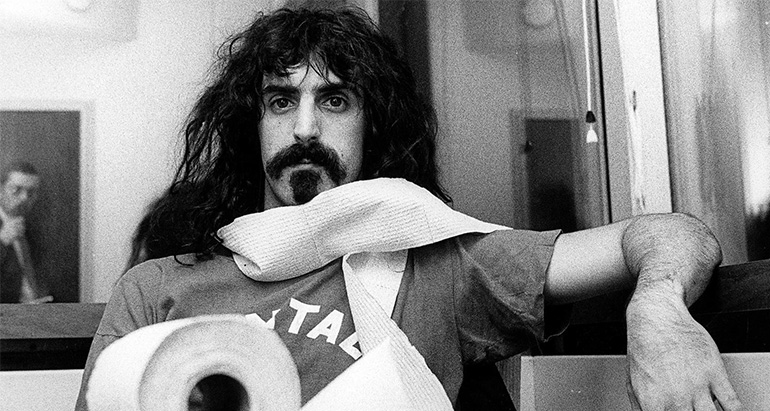
Frank Vincent Zappa (Listen?/i) (* December 21, 1940, in Baltimore, Maryland; † December 4, 1993, in Laurel Canyon, California) was an American composer and musician. He released 62 musical albums during his lifetime. Zappa was inducted into the Rock and Roll Hall of Fame and received two Grammy Awards.
Influence
Zappa has significantly influenced rock music, both thru his compositions marked by stylistic borrowings and rhythmic diversity, and thru his lyrics. These referenced pop culture and current events and were often satirical or even dadaistically absurd. Zappa also worked as a music producer and film director and composed orchestral pieces. His main instrument was the electric guitar, but he was also often heard as a singer and played drums, electric bass, and keyboards. Characteristic of Zappa were his stage shows, which were sometimes designed within larger dramatic contexts, his (music) films, which can be seen as a model for the visual esthetics of music television, as well as his work as an independent music producer who controlled and influenced all steps of product creation.
Life
Frank Zappa was the eldest child of Sicilian immigrant Francis Zappa and his wife Rose Marie; she came from a Neapolitan immigrant family. Zappa had three siblings, brothers Bobby and Carl, and sister Patrice. His father worked in the U.S. states of Maryland and Florida at various locations for the American Department of Defense. That’s why the family had to move often. During the years on the East Coast, Frank repeatedly suffered from severe colds and asthma. This prompted the parents to move to the more climatically favorable West Coast in December 1951.
By the time of his high school graduation in 1958, Zappa’s family had moved a total of eight times. Zappa’s schooling was at three high schools and three other colleges. The repeated moves and constant illnesses in Zappa’s early years influenced his personality development. He is described as someone who had difficulty making friends. Zappa was considered a loner and a workaholic. The young Zappa withdrew primarily into himself and pursued his artistic inclinations. The graphically talented student won two design awards, and his first compositions were created during this time. At high school, Zappa was allowed to conduct the school orchestra, and as a college student, he wrote the music for a Hollywood film.
After Zappa dropped out of music studies after one semester, he initially engaged in graphic design and music. At college, he met Kay Sherman; the couple married on December 28, 1960, and lived east of Los Angeles in Ontario. Both were working, she as a bank secretary, he, among other things, as a designer of greeting cards, a sales representative for encyclopedias and jewelry, or as an employe of an advertising agency. Then Zappa turned more and more to music. From 1961 onward, he worked at the Pal Recording Studio in Cucamonga and also played in various bands. The marriage to Kay did not last long and remained childless. The couple divorced in early 1964.
For understanding some of his lyrics, an incident that occurred in the spring of 1965 at Studio Z, the former Pal Recording Studio where Zappa was now living, is significant. He was to produce a tape of sexual activity sounds for the acoustic accompaniment of a “gentleman’s evening.” Zappa and his then-girlfriend sat down in front of the studio microphones and completed the assignment. Both were arrested a few days later when they delivered the tape – the client turned out to be a detective sergeant of the district police. Zappa was sentenced to six months in prison for “conspiracy to commit pornography.” He had to serve ten days in jail, the rest of the sentence was suspended for three years. Rock journalist Barry Miles describes the episode, which was significant for Zappa, in detail and concludes: “Cell C was a trauma for life, and in many ways he spent the rest of his career trying to shove his pornographic tape America down the throat of America, over and over again. He would show Americans what their country was really like.”
In the summer of 1966, Zappa met Adelaide Gail Sloatman, who worked as an assistant to Elmer Valentine, the owner of the Whiskey a Go-Go and Trip clubs in Los Angeles. In September 1967 – just days before the first European tour of his band Mothers of Invention – Zappa married his heavily pregnant girlfriend. While the band was still on tour in Scandinavia, daughter Moon was born. They were followed by sons Dweezil (1969), Ahmet (1974), and daughter Diva (1979).
Apart from short stays in New York (March 1967 to May 1968) and London (December 1970 to April 1971), Frank Zappa lived in the northern districts of Los Angeles from mid-1965. In the late 1970s, he decided to build the Utility Muffin Research Kitchen recording studio next to his house, which began operations on September 1, 1979. This meant that the release of his music – including production and distribution – was almost entirely under his control.
In November 1991, it became known that Zappa had prostate cancer, with the disease already being in an advanced stage at the time of diagnosis. Zappa died on December 4, 1993, and was buried in an unmarked grave at Westwood Village Memorial Park Cemetery in Los Angeles, directly to the right of Lew Ayres and just a few feet from Roy Orbison.
Musical Development
Influence
Zappa received his first record as a gift for his seventh birthday: “All I Want for Christmas Is My Two Front Teeth” by Spike Jones and his City Slickers. His way of combining humor with music had a lasting influence not only on Zappa’s compositions, but also on how he designed his live concerts. Among Zappa’s early musical influences was also Arabic music. He said: “I heard it somewhere and was immediately fascinated.” At 13, he heard the Crows’ Gee and the Velvets’ I on the radio. The first record Zappa bought for himself was the 1954 78rpm Riot in Cell Block Number 9 by the Robins. Zappa himself called early rhythm and blues “a major influence – and perhaps what really opened my ears.” The affection for doo-wop music of the early 1950s can be found throughout his entire career in numerous compositions.
An important encounter with orchestral music for Zappa occurred when he bought his first LP used in the early 1950s. He had become aware of it thru a newspaper article and had been looking for it for some time: The Complete Works of Edgar Varèse, Vol. 1, recorded by the New York Wind Ensemble and the Juilliard Percussion Quartet. He was particularly taken with Ionization – a piece for 13 percussionists and a pianist. He was so enthusiastic about the compositions that he wished for a long-distance call with Varèse for his 15th birthday. The footnotes on the Varèse record sleeve also mentioned the composers Béla Bartók, Igor Stravinsky, and Anton Webern. Zappa immediately began to look for recordings of works by these representatives of new music. Varèse’s textural layering and collages, his experiments with sounds, voices, tape recordings, electronics, and percussion, as well as the provocative potential of his music, deeply impressed Zappa, according to musicologist Hans-Jürgen Schaal.
The young Zappa was fascinated by the representation of music in the form of notes. This was an important impetus for him to compose himself, but also an explanation for the style of some of his compositions. His biographer Barry Miles quotes him as saying, “I just like the way notes look on paper,” and adds that Zappa said of his early compositions, “I didn’t have the faintest fucking idea what it was going to sound like.”
As a guitarist, Zappa was influenced by rhythm-and-blues guitarists such as Johnny “Guitar” Watson, Clarence “Gatemouth” Brown, Eddie Jones, and Matt Murphy. In the liner notes to his first album, Freak Out!, he also mentioned, among others, Howlin’ Wolf and John Lee Hooker.
First Steps
Education
At school, Zappa learned drums starting in 1951 – initially on “boards.” Later, he played the drums in the school orchestra. During a competition at the CA Keith McKillop’s Monterey Summer Percussion School, his first composition, “Mice” – a solo for snare drum – was created in 1953. From 1956, he attended Antelope Valley High School in Lancaster. Among the earliest Zappa compositions to be performed were the pieces A Pound for a Brown (On the Bus) and Sleeping in a Jar, both parts of a string quartet that Zappa had performed in 1958 when his music teacher allowed him to conduct the Antelope Valley High School Big Band.
In October 1958, Zappa transferred to Antelope Valley College in Lancaster, where he met Donald Vliet, also known as Captain Beefheart. Around this time, he taught himself to play guitar. The piece “Lost in a Whirlpool” (first released in 1996 on the album “The Lost Episodes”) was recorded in the winter of 1958/59 in an empty college classroom and is the earliest recording featuring Zappa as a guitarist. To study harmony and composition, Zappa enrolled at Chaffee Junior College in Alta Loma in the spring of 1960. After a little more than a semester, he dropped out again, because, according to Barry Miles, he had achieved his goal: “He now understood the basics of music.” Zappa took composition classes at Pomona College in Claremont again in 1961.
Early Bands and Projects
In 1955, Zappa joined the R&B band The Ramblers as a drummer at high school in San Diego, after which his parents bought him his first drum kit. After two relocations of his family, Zappa founded the R&B group The Black-Outs in 1957 in Lancaster, in which, among others, Jim “Motorhead” Sherwood played. After Zappa left in 1958, the group renamed themselves The Omens. In addition, he played in the Antelope Valley High School Big Band. In the spring of 1961, Zappa formed the quartet The Boogie Men, but disbanded it shortly thereafter. In the summer of 1961, Zappa breathed new life into the Black-Outs, only this time he played guitar instead of drums. To make money, he was also a member of the dance band Joe Perrino & The Mellotones.
From 1962 onward, Zappa focused primarily on studio projects. With Ray Collins, he performed several shows in 1963 as the Sin City Boys and as Loeb & Leopold. He also founded the short-lived group The Soots, in which, among others, Captain Beefheart played. The studio work did not yield the hoped-for returns, so Zappa founded the dance band The Muthers in 1964. In addition, he was a member of the house band at the Village Inn club.
In the early years, Zappa worked not only as a musician but also pursued other projects: in 1959, he wrote the music for the low-budget film Run Home, Slow (1965, directed by Ted Brenner). However, the music was not recorded until 1963. The film itself had its premiere in cinemas on December 15, 1965. Another film music project for which Zappa was hired in June 1961 was the B-movie The World’s Greatest Sinner (1962, directed by Timothy Carey).
In November 1961, Zappa began working for Paul Buff at his Pal Recording Studio. There he worked as a session musician, composer, sound engineer, and producer with several artists of local significance, recording a number of singles. When Buff was commissioned to work for another recording studio in the summer of 1964, Zappa bought the Pal Studio and renamed it Studio Z. As a percussionist and with his own film contributions, Zappa was involved in a multimedia experimental project by Don Preston in May 1962, who had gathered Bunk and Buzz Gardner among others for this project.
Zappa’s ambition to become known in the music business is illustrated by two events in 1963. In March, he appeared as a guest on the famous Steve Allen Show on television and presented his Concerto for Two Bicycles there. The fact that Zappa was not given the opportunity to be taken seriously as a young composer by Allen, a well-known jazz musician, but instead was only able to perform because he was offering a Dadaist avant-garde performance, is described by music journalist Hans-Jürgen Schaal as “superior social satire, but also first resignation.” About two months later, the concert The Experimental Music of Frank Zappa took place at Mount St. Mary’s College in Los Angeles, where several of Zappa’s scores were played by students of the college orchestra.
In 1964, the group The Soul Giants was looking for a new guitarist. Zappa joined and quickly became the bandleader. The group – at that time, it included the two founders Roy Estrada as bassist and drummer Jimmy Carl Black, as well as Ray Collins as singer and David Coronado as saxophonist – changed its name several times. Initially as Captain Glasspack & His Magic Mufflers, then on Mother’s Day 1964 as The Mothers. The guitarist Henry Vestine, who had joined in the meantime, was replaced by Elliot Ingber in the spring of 1966. On March 1, 1966, the Mothers received a record deal and shortly thereafter went into the studio to record their first album, Freak Out! Before it could be released, the group had to change their name to The Mothers of Invention under pressure from the record company.
Die Mothers of Invention
The Mothers of Invention existed for a period of about ten years. During this time, the group toured in 18 different line-ups. Taking into account the Hot Rats Band and the two different Wazoo orchestras, there were 21 line-ups, all of which only lasted for a few concerts. Even the original five-piece line-up was supported by dozens of other musicians during the studio recordings for the debut album. Moreover, Zappa changed the formation after only a few concerts: guitarist Elliot Ingber had to go, and Don Preston, Bunk Gardner, Ian Underwood, Billy Mundi and Jim “Motorhead” Sherwood came on board. In the multitude of ensembles, however, five basic formations crystallize. Apart from Zappa, the performance ability of the live bands always depended on the skills of the rhythm section, which was important for Zappa’s music, and especially on the drummer.
Jimmy Carl Black was the drummer of the first five Mothers formations until the autumn of 1969. His playing provided the foundation on which, among others, Don Preston, Ian Underwood, Bunk Gardner, and Zappa could build their musical experiments and extensive improvisations. The extended, free musical and musical theater parts typical of this Mothers era were held together by the loosely set compositional framework by Zappa. Characteristic of this phase are the Mothers’ performances at the Garrick Theater in New York, where the band performed the rock musical “Pigs & Repugnant” (Schweine und Widerlinge) twice on weekdays and three times on weekends from March 23 to September 5, 1967, with short breaks. The theater performance in the style of a happening offered all kinds of horrors, coarse humor, social criticism, musical parodies and much more – including a guest appearance by Jimi Hendrix in July 1967. For some critics, the shows were nothing but “hot air,” while for others they were “brilliant to fantastic.”
Freak Out!, the first album released by the Mothers of Invention in 1966, was an elaborate double album with extensive liner notes. The music critic Mike Fish describes it as “one of the most dazzling debuts”: The album contains satire and political criticism as well as references to doo-wop and rhythm and blues, as well as autobiographical references. Zappa devoted an entire side of the album to a percussive improvisation, mixed with text collages and inarticulate sounds. The 1968 album We’re Only in It for the Money was described as “a mercilessly dark, angry and grim response to Sergeant Pepper” and clearly shows Zappa’s role as part of the counterculture. False hippies are parodied, and the shooting of protesting youths by the police is also a theme. In September 1968, Zappa and the Mothers of Invention performed for the first time in front of a German audience at the International Essener Songtagen.
After jazz-rock passages had already appeared on the Mothers album Uncle Meat in April 1969, Zappa disbanded the Mothers in August and released the album Hot Rats in October without them (except for Ian Underwood). It is considered one of the first jazz rock albums ever.
With 200 Motels, Zappa assembled a four-movement work for orchestra and rock band as a contribution to the Contempo ’70 music festival at the University of California. It premiered on May 15, 1970, at the Pauley Pavilion. The performers were the Mothers and the Los Angeles Philharmonic Orchestra, conducted by Zubin Mehta. For cost reasons, only the first, third and fourth movements of this work were played, with which Zappa wanted to try out “what the music I wrote in motels [during the tours of the previous years] sounds like.” The British drummer Aynsley Dunbar, who came from rock music, was involved in this project. Subsequently, he was part of the Mothers formations six to nine. The music became overall tighter and rockier. When former Turtles lead singers Mark Volman and Howard Kaylan joined the Mothers for Band Version No. 7, the Mothers’ vaudeville era began. The stage shows until the end of 1971 were tailored to the acting and satirical talents of these two seasoned frontmen.
Two incidents ended this Mothers phase: On December 4, 1971, a fire broke out during a concert by the band at the Casino Barrière in Montreux, destroying the band’s entire sound system – the Deep Purple song “Smoke on the Water” tells the story. A few days later, on December 10, Zappa was pushed off the stage into the orchestra pit by a visitor during a concert at the Rainbow Theater in London. He was so badly injured that he had to spend nine months in a wheelchair. As a result, one of his legs was shortened (the song Dancing Fool from the album Sheik Yerbouti contains a reference to this fact), and his voice also sounded a third lower. Zappa had to cancel the concert tour and disband the group.
In 1972, Zappa realized two more solo projects, initially still sitting in a wheelchair: Waka/Jawaka and The Grand Wazoo. He once again turned to jazz, of which he once said, “Jazz is not dead, it just smells funny.” (Jazz is not dead, it just smells funny). Zappa introduced this extended jazz-rock project, featuring 20 musicians on stage, during a two-week tour of the USA and Europe. The tour was then continued for a further six weeks in America with a smaller band (“Petit Wazoo”).
From February 1973, Ralph Humphrey (Band No. 10 to 14) was the drummer for the Mothers, and from October 1973, Chester Thompson (Band No. 12 to 16) also joined as the drummer. At that time, several versatile musicians were involved in the group, including violinist Jean-Luc Ponty, keyboardist George Duke, percussionist Ruth Underwood, and trumpeter Sal Marquez. This enabled Zappa to approach music in a completely different way than before. In an accessible tone, but not without Zappa’s typical ingredients, he skillfully fused complex jazz-rock arrangements, funk, and other musical styles into compact songs lasting only three to six minutes: The album Over-Nite Sensation features a “virtuosic, extraordinary band,” which, in the eyes of one critic, is contrasted by “scabrous, pornographic lyrics.” The following album, Apostrophe (’), a nonsensical concept album about an Eskimo, reached No. 10 on the Billboard charts in June 1974 and was released by DiscReet Records, a label co-founded by Zappa.
The last drummer of the Mothers (No. 17 and 18) was Terry Bozzio, who joined during the US tour in the spring of 1975. For the world tour, which began in the autumn of 1975 and lasted until the spring of 1976, Zappa restructured the Mothers one last time: The ensemble, which had shrunk to a quintet, included, in addition to Zappa and Bozzio, the singer and saxophonist Napoleon Murphy Brock, the keyboardist André Lewis, and, with the bassist Roy Estrada, a member of the first Mothers formation.
The Zappa Bands
After the dissolution of the Mothers, there were disputes between Zappa and Herb Cohen. Zappa had fired the longtime manager, who then delayed the release of the album Zoot Allures. To avoid further difficulties with Cohen, Zappa gave up the group name The Mothers of Invention and performed only under his own name from then on.
Except for drummer Terry Bozzio, Zappa completely changed the lineup for his first band after the Mothers era. The lineup for the US and Canadian tour in the fall of 1976 included guitarist and singer Ray White, singer and keyboardist Lady Bianca (also known as Bianca Odin, also known as Bianca Thornton), keyboardist and violinist Eddie Jobson, and bassist Patrick O’Hearn. The European tour that followed in the spring of 1977 took place without Lady Bianca. Eddie Jobson no longer participated in the North American tour at the end of 1977 and the European tour in the spring of 1978; instead, keyboardists Tommy Mars and Peter Wolf, as well as guitarist and singer Adrian Belew and percussionist Ed Mann, had joined.
Vinnie Colaiuta was the drummer for Zappa’s fourth band, which performed on stages in Europe and North America in the fall of 1978. Terry Bozzio, Ray White and Adrian Belew had left. Newly joining were singer and guitarist Ike Willis, slide guitarist Denny Walley, and bassist Arthur Barrow. Warren Cuccurullo joined the group for the European tour in the spring of 1979. A year later, Peter Wolf was no longer part of the group, and Vinnie Colaiuta took a break from touring. Zappa replaced the latter in his sixth band for the USA-Europe tour in the spring of 1980 with the drummer David Logeman. In addition, Ray White was back.
In 1980, Zappa also achieved a top-ten hit with “Bobby Brown Goes Down” (album “Sheik Yerbouti”), which made him known to a broader audience not only in Germany. This piece reached number 32 again in 1995.
For the winter tour in 1980, Colaiuta had returned, and Band Number Seven also included guitarist Steve Vai as well as keyboardist, trumpeter, and singer Bob Harris.
The foundation for the last three Zappa bands was formed by drummer Chad Wackerman and bassist Scott Thunes, who replaced Vinnie Colaiuta and Arthur Barrow since the autumn tour of 1981 thru America. In Band Number 8, keyboardist, saxophonist and singer Bobby Martin replaced Bob Harris. The ninth band hardly changed during the tour of North America and Europe from summer to winter 1984. With Napoleon Murphy Brock, a former Mothers member, there was a guest appearance lasting just two weeks. The keyboardist Allan Zavod replaced Tommy Mars. In February 1988, a Zappa band went on tour for the last time, which lasted until June of that year, covering North America and Europe. Zappa had significantly expanded his tenth ensemble and developed it into a rock group with big band qualities. In addition to Zappa, Willis, Thunes, Wackerman, and Martin, the twelve-member band also included guitarist, keyboardist, and singer Mike Keneally, percussionist Ed Mann, trumpeter Walt Fowler, trombonist Bruce Fowler, and saxophonists Paul Carman, Albert Wing, and Kurt McGettrick.
Orchestral music
Even before his rock career, Zappa had written pieces for symphony orchestra. The first performance took place in 1963 at St. Mary’s College, Los Angeles, and was broadcast by the radio station KPFK. In 1967, in addition to recordings with the Mothers, he recorded the album Lumpy Gravy, composed for a 40-piece orchestra, and released it in 1968 as his first solo album, according to the cover with the “Abnuceals Emuukha Electric Symphony Orchestra & Chorus.” After Zappa collaborated with the Royal Philharmonic Orchestra for the album and the film 200 Motels in 1971, he released the purely orchestral album Orchestral Favorites in 1979; again, the orchestra involved here is called the “Abnuceals Emuukha Electric Symphony Orchestra” – but it is partly made up of different musicians than in 1967. Recordings with the London Symphony Orchestra (conductor: Kent Nagano) were released in 1983 and 1987. What was new about these recordings was that the instruments were recorded separately with their own microphones, which allowed Zappa to mix them afterward and make limited corrections. In the accompanying text to the second album, Zappa lamented the “human quirks” of the recording infected with “wrong notes and out-of-tune passages.” Even collaborations with Pierre Boulez did not lead to great success. Shortly before his death, Frank Zappa found in the Ensemble Modern a musical body that successfully performed his orchestral compositions with great technical precision. Frank Zappa’s orchestral work The Yellow Shark was premiered in September 1992 by the Ensemble Modern in Frankfurt am Main in the presence of the composer and partly under his musical direction. However, he had to cancel the tour due to his advancing prostate cancer.
Work with the Synclavier
Zappa acquired a Synclavier, a synthesizer with a sampling module, in 1982. It allowed him to comfortably input even complex scores via keyboard or piano. These entered pieces could then be edited, saved, and finally played back or printed as sheet music. Zappa appreciated the high precision of playback on the Synclavier without the fatigue that sometimes occurs with musicians. Zappa saw the high effort required to program musical expression and, compared to working with musicians, the lack of improvisation and spontaneity as disadvantages. Zappa directly used the electronic input options; his compositions were created directly on the device.
Zappa noted regarding the cost of the device that the Synclavier was only half as expensive as the recordings with the London Symphony Orchestra, and that he greatly appreciated the ability to play his compositions at any time while they were still in progress, without having to maintain and pay for permanently employed musicians. In the 1980s, Zappa worked simultaneously on 250 to 300 compositions and revised them as the capabilities of his Synclavier expanded due to technical advancements. On the album Boulez Conducts Zappa: The Perfect Stranger from August 1984, the Synclavier was heard for the first time on a CD, together with orchestral music conducted by Pierre Boulez. According to Barry Miles, the pieces produced electronically on the Synclavier sound “mechanical” compared to those performed by the Ensemble InterContemporain, and the album is “strangely unbalanced” overall. The Synclavier recording Francesco Zappa, released by Zappa three months later, consisted of several historical pieces by the Baroque musician Francesco Zappa and was purely electronically orchestrated.
The album Jazz from Hell, released in November 1986, mainly consisted of pieces recorded with the Synclavier. Barry Miles notes that the drums repeat mechanically, the long notes do not fade out, and the vibrato of the notes is unsuccessful. Ben Watson, on the other hand, sees the album as a “wonderful demonstration of Zappa’s continuing ability to compose melodies.” Zappa’s “surrealist ear for sonority” made a melody less a sequence of notes on paper than a way to recognize the “social-satirical energies” bound up in the, as Zappa called them, flavors of the instruments. The album won a Grammy Award for Best Rock Instrumental Performance (Orchestra Group or Solist). For the project The Yellow Shark, Zappa also used the Synclavier to generate the scores.
Music
Zappa’s compositions are unmistakable due to a number of different characteristics. The collage-like and often highly complex compositional technique, the rhythmic diversity of the compositions, the stylistic borrowings from many areas of both popular and classical music, the recurring musical quotations, the ironic and satirical extent in music and lyrics, the sophisticated arrangements – all of this goes “beyond the narrow scope of forms typically defined as rock.” In doing so, Zappa assembled the various elements into a context typical for him. Zappa’s musical concept is broader than what is usually offered in the rock genre. He composed and arranged not only for the rock band (even tho these works make up the largest part of his overall oeuvre), but also for the jazz-oriented big band and for variously assembled orchestras of different sizes, from chamber orchestras to symphony orchestras.
Zappa was open to influences of all kinds, borrowing from the “most diverse forms and materials,” and naturally using elements from a wide range of styles and genres. Despite all the differences in the works of, for example, Edgar Varèse on the one hand and the songs of R&B groups like the Robins on the other, Zappa considered both to be good music; for him, “the soul seemed to come from the same universal source.” Whether Doo-Wop hits or Stravinsky severity, down-to-earth rhythm & blues or exuberant Spike Jones tomfoolery, whether Hungarian folklore or crashing hard rock, minimalist John Cage sounds or wild free jazz – Zappa combined all this and much more with humor and irony into compositions whose aim, Volker Rebell sees, is to “attack and unsettle entrenched listening habits.” Zappa had many advocates for his working methods – in the pop music sector, of course, but also in the field of contemporary music, as evidenced by his joint projects with Zubin Mehta, Pierre Boulez or Kent Nagano. Compositions were created on behalf of the Kronos Quartet and the Aspen Woodwind Quintet, and shortly before his death he rehearsed 19 compositions with the Ensemble Modern to performance readiness as part of the project The Yellow Shark. The posthumously published compilation Strictly Genteel introduces Zappa’s orchestral oeuvre. The German music critic Hans-Jürgen Schaal commented on this excerpt from the work as follows: “Here we meet the father of punk and postmodernism in one person.”
Influences of Classical Modernism
Barry Miles points to the influences of Edgar Varèse in Zappa’s works: “The use of sound blocks, the primacy of timbre over pitch, and varying time signatures, all of these are hallmarks of Varèse’s oeuvre.” Hans-Jürgen Schaal also refers to the role model of modern composers: “What [Zappa] was inspired by in Varèse and Stravinsky – blocks of sound and electronics, complex time signatures and metric shifts, sound colors and strange harmonic progressions – he also demanded of his rock band and the audience.” Schaal attributes Zappa’s characteristic “rhythmic capers,” his “bizarre march themes,” and abrupt tempo changes to the clear influence of Stravinsky, which is already evident in the early works of the Mothers of Invention and can sometimes be traced as direct musical quotations in individual pieces, such as in “Duke of Prunes” (album “Absolutely Free”). The sociologist Ronald Hitzler generally sees Zappa’s composing as an “implementation of Stravinsky’s anti-purist, material-rich, and ‘constructive’ conception on the current overall musical scene.”
Collage, quotation, and parody
Zappa’s collage-like compositional technique is striking, in which he interspersed his pieces with musical snippets, sounds, or interview material thru weeks of detailed work. Rushed, composed passages dissolve into fragile, wistful melodic harmony, which is replaced by several rhythms played simultaneously and counterpoint melodies, which are torn apart by electronically or tape-recorded sound fragments, only to dissolve into derisive band laughter at the end. “Absurd – but funny” is what the music journalist Volker Rebell calls this compositional technique, which can be found in many examples throughout Zappa’s entire creative period.
The sociologist Ronald Hitzler speaks of a high degree of disrespect in the handling of materials, noting a contextual deconstruction of canonized musical styles and values. In Zappa’s montages, which Hitzler describes as “time-critical-satirical,” the arbitrary separation between genres and their limitations dissolves. In this process, the elements in Zappa’s compositions interlock and parody each other. Zappa skillfully uses musical quotes as “exotic pieces in the mosaic of rhythms and (dis-)harmonies.” This can be seen, for example, in the jazz borrowings in “The Eric Dolphy Memorial Barbecue” (album “Weasels Ripped My Flesh”) and “Be-Bop Tango (of the Old Jazzmen’s Church)” (album “Roxy and Elsewhere”), in the Bob Dylan parody in “Flakes” (album “Sheik Yerbouti”), or in the country-and-western parody in “Harder Than Your Husband” (album “You Are What You Is”). Even his own pieces and compositions are quoted and reinterpreted again and again. Esthetically, the quote underscores intended statements and thus serves as an additional comment, either ironically or parodically, as a reference to “knowledge sediments.”
Arrangement
Intricate architecture, refinement, and attention to detail are characteristic of the arrangements. These often include 15 or more staff lines on the sheet music. Notable is the often unconventional and frequently atypical instrumentation for rock bands. Particularly characteristic is the multitude of percussion instruments: vibraphone, marimba, and xylophone dominate, alongside bells, slap tubes, jingles, triangle, and other idiophones. Keyboard instruments appear in practically all of Zappa’s recordings, usually utilizing the entire sound spectrum. Zappa also enjoys using newly available developments, such as the Minimoog on the album Fillmore East, June 1971. In addition to the electric guitar, which, apart from Zappa, is also played by other band musicians as a rhythm, lead, or “stunt” guitar, acoustic guitars are also used. Wind instruments are also frequently heard, including those less common for rock bands, such as the sarrusophone, the contrabass clarinet, or the bass saxophone.
Zappa maintains full control over his arrangements, with precise planning and specification of introductions and transitions. Characteristic of Zappa’s work are the frenzied unison runs of multiple instruments, often with contrasting use of instruments or even the human voice.
Meter, measure, and rhythm
Zappa-typical is the rhythmic diversity found in individual compositions as well as in the entirety of his work. According to Volker Rebell, “there is hardly a time signature – no matter how bizarre – that has not already been drummed out by Zappa.” Even the first known Zappa composition – at the age of twelve he wrote the piece Mice, a solo for drums – reveals his pronounced interest in rhythm. This is also visually evident in the piece The Black Page, also a piece for percussion instruments, whose name comes from the many notes on the sheet music.
Zappa’s metric uses different time signatures, which often change even within a piece. In addition to the 4/4 time signature, which mainly appears in rock-oriented pieces and solos, Zappa frequently uses triple meters such as 3/4, 6/8, and 12/8. For example, the piece What’s the Ugliest Part of Your Body (album We’re Only in It for the Money) is in 6/8 time and The Illinois Enema Bandit (album Zappa in New York) is in 12/8 time. The 3/4 time signature is more common, for example in King Kong (album Uncle Meat), Sofa (album One Size Fits All) or Overture to a Holiday in Berlin (album Burned Weeny Sandwich). Zappa often uses the 2/4 time signature where echoes of marching music are to be made clear, for example in Who Needs the Peace Corps (album We’re Only in It for the Money).
But even in Western Europe, less common odd time signatures are characteristic of Zappa. These include 5/4, 5/8, 7/4 and 7/8 time signatures, as well as ternary, that is, played in shuffle rhythm. For example, some lines of the song “What’s the Ugliest Part of Your Body” (album “We’re Only in It for the Money”) are written in 7/8 time.
The main motif of Big Swifty (album Waka/Jawaka) is played in parallel tenths and switches twice from a 7/8 to a 3/4 time signature, until after several repetitions and variations in the chorus, a 4/4 time signature is finally reached. Generally, odd meters are often coupled with basic patterns that repeat. But also different meters with repeated patterns, or constant meters with changing basic patterns occur. In some cases, Zappa also uses polyrhythms: In the piece “Rubber Shirt,” for example, a bass track in 4/4 time and a drum track in 11/4 time overlap. The two tracks were recorded on different occasions and only later combined in the studio.
Meter changes often mark content or melodic transitions and are used, for example, in motif changes as well as in shaping phrases and themes. In some pieces, such as “The Dangerous Kitchen” (album “The Man from Utopia”), the meter is adapted to the underlying spoken text. This leads to constant changes of meter. Zappa himself admitted, “My particular interest is in unusual time signatures.”
The rhythm in Zappa’s music is pioneering and very complex, often taking center stage. The note and rest values exhibit a wide range. Often, triplets or quintuplets are used. Triplets, quartoles, or quintoles are also played over two or more beats. These so-called note-length conflicts, as well as rhythmic accent shifts (hemiolas) and shifts in the beat’s focal point (syncopations), are typical of Zappa. This often results in unexpected effects.
For example, in “The Eric Dolphy Memorial Barbecue” (album “Weasels Ripped My Flesh”), hemiolas are used to achieve a noticeable acceleration by shortening the note lengths across the bar lines. However, the tempo, that is, the number of basic beats per minute, remains the same.
The musicologist Wolfgang Ludwig compares the asymmetrical arrangement of uniform note values caused by accentuation in some pieces with Igor Fyodorovich Stravinsky. This technique, which is also characteristic of jazz music, can be found, for example, in Igor’s Boogie on the album Burned Weeny Sandwich.
Rhythmic-metric permutations and polymeter are also stylistic elements frequently encountered in Zappa’s work. The latter can be found, for example, in “The Little House I Used to Live In” (album Burned Weeny Sandwich): the initial bass riff (11/8) is joined by a melody line with a duration of 12/8 beats. With each repetition, the beginning of the melody shifts by 1/8 note value, giving the piece a special dynamic of its own.
A typical rhythmic variation of motifs and phrases for Zappa is used, for example, in Big Swifty from the album Waka/Jawaka.
Zappa frequently used augmentation and diminution. In this process, the relationship between the note values within a theme remains the same, but the speed changes, as in Big Swifty.
Deviations from rhythmic basic patterns can be found in almost all of Zappa’s pieces. With the exception of riff formations and accompaniment voices during solos, there are rarely phases in his pieces where a specific rhythm is maintained for a longer period.
Melody
Zappa himself placed great importance on the creation of melodies: “I’m interested in melodies and it’s the one thing I find lacking in most of the music today.” […] Es ist eine große Herausforderung, eine Melodie zu schreiben. (“I am interested in melodies, and that is what most music today lacks.”) It is a great challenge to write a good melody.”
The frequency analysis of the intervals occurring in Zappa’s melodies shows a difference from the distributions typical in rock music. The interval most frequently used in Zappa’s melodies is the fourth, which accounts for about a third of all pitch changes, followed by the minor third with 23 percent and the major third with 13 percent. Also striking are the minor and major seventh leaps, which account for 15 percent.
The frequent leaps of fourths are quite unusual, while seconds and thirds “are generally the most common in melodic construction.” In a classification of intervals inspired by jazz, the third is attributed a special consonance as a primary consonance, while the major seventh is considered a dissonance. The fourth is described as having a differing effect. The use of the aforementioned intervals by Zappa thus shows a wide range and is a characteristic stylistic element of his melodies.
Sequences are often found in Zappa’s work as well. In this process, identical sequences of notes are repeated at different pitches, for example, in the melodic sequence in “King Kong” from the album “Uncle Meat.” Zappa also employs multiple note repetitions, such as in the song “You Didn’t Try to Call Me” on the album Freak Out!
Typical for the melodies are also frequent changes in the direction of movement, where there is a stepwise alternation between pitch increase and decrease, demonstrated here with a short excerpt from the song “Absolutely Free” from the album “We’re Only in It for the Money”: From note to note, the direction in which the pitch changes alternates.
Zappa also employs contrapuntal techniques that are not typically found in rock music. This includes the crab, where the melody is played first forward and then backward again, as in “Zombie Woof” from the album Over-Nite Sensation. Other stylistic elements include the trill, the rapid repetition of two notes that are close together. In particular, these are often used on the vibraphone, for example in “What’s New in Baltimore” from the album Frank Zappa Meets the Mothers of Prevention. Glissandi, rapid continuous pitch changes, are also found in many pieces.
In the vocal parts, it is noticeable that the distribution of sung syllables to melody notes is often deliberately shaped: In certain sections, exactly one note is sung per syllable, a technique also referred to as syllabic, which is used, for example, in the bridge of “The Illinois Enema Bandit” (album “Zappa in New York”). The opposite – the distribution of multiple notes on a single syllable, known as melisma – is also used as a stylistic device, for example in “Advance Romance” from the album “Bongo Fury.”
Harmony
The harmonic systems and connections used by Zappa are generally rather conventional, which does not exclude the presence of tension-generating chord progressions and contrast-creating step jumps in individual cases. When he uses classical harmonic schemes, passing chords, modulations, and dissonant harmonies provide variation. However, many pieces are also atonal. Kelly Fisher Lowe points to the influence of Stravinsky, which can also be found in the album 200 Motels, where orchestral music is not only inserted into other pieces for the first time, but also forms the framework itself. Even on Zappa’s first album, there are atonal passages, such as the second movement of Help, I’m a Rock (album Freak Out!), which is titled 2nd Movement: In Memoriam Edgar Varese, as well as on the album Lumpy Gravy and in the piece The Eric Dolphy Memorial Barbecue from the album Weasels Ripped My Flesh.
The Guitarist
In addition to his qualities as a composer, arranger, and bandleader, Zappa also impressed as an instrumentalist on the electric guitar. He himself saw himself as “a composer whose main instrument is indeed the guitar.” Others counted him among the most talented and gifted guitarists of his time, among the “real guitar heroes of the Sixties” or “among the most idiosyncratic and competent guitarists of the scene.” His idiosyncratic playing style was admired, “for example in the title The Orange County Lumber Truck (album Weasels Ripped My Flesh), a piece that culminates in one of the most swinging guitar solos in pop music.”
Typical of his playing style is the great experimentalism with which Zappa worked. Another characteristic is the unusual length of his solos for rock music. On the two double CDs Shut Up ‘N Play Yer Guitar and Guitar – both of which contain only solos – the shortest contributions are 1:39 and 2:12 minutes long, while the longest are 10:12 and 6:58 minutes long. Zappa differed from many other guitarists in that he incorporated all positions of the fretboard into his playing. His playing technique, which is characterized by sometimes breathtaking speed, he himself did not consider outstanding: “I am not a virtuoso guitarist. A virtuoso can play everything, I can’t do that.” However, he sees himself as quite capable of playing what he knows and has developed sufficiently fast manual dexterity for it. “When I strike a note with my right hand, I play five with my left.” I don’t hit all the notes I play. I do things where I use the pick on the fretboard, push it down and hit it at the same time. It sounds a bit like a Bulgarian bagpipe sound.”
Essential influences for guitarist Zappa were Guitar Slim and Johnny Watson. In his autobiography, Zappa wrote: “Although I can’t claim that I am able to play a Guitar Slim lick today, his ‘torture them and choke them’ attitude had a strong esthetic influence on the style I eventually developed.” He first became aware of Watson in 1955 thru his first hit, Those Lonely Lonely Nights: “Watson is the original minimalist among guitarists. The solo on ‘Lonely Nights’ – the ‘one-note guitar solo’: that says it all. To the point.” Musically, Zappa oriented his solo playing, according to his own statement, on “rhythms and harmonies influenced by language; they are both either based on the pentatonic scale or on many others.” The basis of his improvisations often included songs in D minor. Zappa: “In fact, about 80 percent of our pieces that contain solos are in this key and have the same time changes. I just love D minor improvisations; D minor with a preceding major chord gives a nice modal effect.”
The result of his “meaningful, inspiration-rich” and “high-risk, highly experimental” playing style, which “also leaves room for mocking phrasing,” were solos that made the audience “gasp in surprise” at the end – for rock journalist Volker Rebell, simply “beyond categories.”
Zappa worked with a variety of guitar sounds. Contributions on acoustic guitar (mostly played on an Ovation with an electric guitar neck) can be found, as well as the entire range of electric guitar sounds, from clean to slightly distorted to extremely overdriven bombastic sounds like those on the album Tinsel Town Rebellion. The timbre influenced Zappa primarily with the wah-wah pedal, which he mainly used statically. Also heard, tho not too often, are phasing, flanging, or chorus effects; he used an echo device less frequently.
For the wide range of Zappa’s playing ability, there are contributions of such different character as the rock-and-wild solos in Rat Tomago (album Sheik Yerbouti) or Willie the Pimp (album Hot Rats), the somber, acoustic guitar duet Sleep Dirt (album Sleep Dirt), the swinging solo in The Orange County Lumber Truck (partial version on the album Weasels Ripped My Flesh; full version on Ahead of Their Time), the jazzy solo in Grand Wazoo (album The Grand Wazoo), the guitar instrumental Theme from the 3rd Movement of Sinister Footwear (album You Are What You Is) with an oriental touch, and the opening solo in Filthy Habits (album Sleep Dirt), the somber, equally splattered tones of the instrumental piece Pink Napkins (album Shut Up ’N Play Yer Guitar), melodically floating solos like in Inca Roads (album One Size Fits All) or Any Kind of Pain (album Broadway The Hard Way), the solo in Son of Orange County (album Roxy & Elsewhere) or Zoot Allures (album Zoot Allures), a guitar instrumental with a lot of feedback.
The Lyricist
As funny as they can be in detail, as much controversy as they have often caused – Zappa’s lyrics play a rather subordinate role in the entirety of his work. Considering them as an inevitable accessory, he said: “I do not claim to be a poet. My texts are intended solely for entertainment and are not meant for internal application.” Viewed in this way, they have indeed fulfilled their function. Zappa’s approach as a lyricist was, as with his compositions, a nuanced one.
Following the attitude of several satirists of his time, Zappa also did not concern himself with the big lines of politics in his contributions, but this did not prevent him from harshly criticizing societal grievances he identified in individual cases. Thus, in “Trouble Every Day” (album “Freak Out!”), he denounced the race riots in Los Angeles in the mid-1960s and the way the media exploited the misfortunes of others; he commented on his stance in the piece itself with the words: “I’m not black.” But there’s a whole lots a times, I wish I could say, I’m not white” (“I’m not Black, but very often I wish I could say that I’m not White”). In the piece “I’m the Slime” from the album “Over-Nite Sensation,” he contemplated the seductive omnipotence of television, which for him oozes like slime from the TV sets. He not only described the medium’s mechanisms of action with the words “I may be vile and pernicious, but you can’t look away,” but also named its beneficiaries: “I am the tool of the government and industry too, for I am destined to rule and regulate you.” In “Dumb All Over” and “Heavenly Bank Account” (both on the album “You Are What You Is”), he condemned the greed of American television evangelists, their entanglements with politics, and their influence on society. Zappa’s conclusion: “Religious fanatics can make it be all gone.”
Zappa also saw himself as a journalist reporting on life as he observed it. In doing so, he shared his observations ruthlessly and without regard for taboos, refraining from any categorization or evaluation of what was said. Barry Miles describes Zappa’s view of things as “uncompromisingly satirical.” His lyrics are ironic, often cynical. Zappa was shaped by the emerging sexual revolution and also addressed the American society’s handling of sexuality in his lyrics. In doing so, he generally portrayed them in a clichéd and simplistic manner. Not only in his well-known appearance on the CNN television show Crossfire did Zappa vehemently insist on the right to free speech granted to everyone in the 1st Amendment to the Constitution of the United States. His appearance at the congressional hearing on 19 September 1985 on the planned ban on pornographic lyrics on records should also be seen in this context – it was not even about Zappa’s contributions, but among other things about the piece Darling Nikki by Prince.
Zappa said, “America is nothing but that: twisted sexual desires and extreme drug use.” Zappa did not impose any restrictions on himself when it came to sexual themes. For example, in “Catholic Girls” (album Joe’s Garage), he sang about the sexual experiences of teenagers during puberty, or in “Penis Dimension” (album Frank Zappa’s 200 Motels), he addressed men’s and women’s attitudes toward their penises and breasts, respectively. In Dinah-Moe Humm (album Over-Nite Sensation) it was about group sex and voyeurism, in Brown Shoes Don’t Make It (album Absolutely Free) about a politician’s fantasies about incestuous sex with his underage daughter, and in Crew Slut (album Joe’s Garage) about the relationships between band members and groupies. In Bobby Brown Goes Down (Album Sheik Yerbouti) he made sex toys (the “Tower of Power”) and urophilic sexual practices (“golden shower”) the subject of his songs, as well as stereotypes about homosexuals. Zappa also sings about sexually transmitted diseases in Why Does It Hurt When I Pee? (album Joe’s Garage). Zappa saw and described all this without commenting on it, he did not distance himself from it either. He was often accused of sexism and misogyny because of this attitude, and was therefore controversial among music critics. Barry Miles, for example, criticized the piece Fine Girl (album Tinsel Town Rebellion) for being an “insult to the black population” and saw Zappa’s extreme aversion to the women’s movement as the basis for the piece. Kelly Fisher Lowe, on the other hand, considers the piece so exaggerated that he assumes it is a parody. The writer Carl-Ludwig Reichert notes that Zappa’s “sexual satires,” which would be based on empirical evidence and observation of reality, have often been confused with pornography. The piece Easy Meat from the same album, in which a woman is described as “easy meat,” in German something like “easy prey/fresh meat,” also divides opinion. While Miles sees a derogatory attack on women in the song and notes a deeply rooted double standard in Zappa, Lowe sees the piece as the “Rosetta Stone” for Zappa criticism. He points out that the woman described also exercises control over her sexuality and expresses her own desires, and that different critics interpret the piece in completely different ways. Anyone can read into the piece whatever they want. Zappa always defended himself against accusations that he saw his role as “social documentation,” and he is supported in this by Ben Watson, for whom Zappa’s portrayal of “people and places that the ‘educated person’ doesn’t want to know about” also justifies his “humorless, sexist junk.”
Zappa also approached other topics by describing them – rather amusedly. In “Cosmik Debris” (album Apostrophe (‘)), he addressed the emerging boom in esotericism by describing a conversation with one of the fraudulent “gurus,” in which the guru unsuccessfully tries to sell the first-person narrator esoteric “mumbo jumbo.” The piece Valley Girl (album Ship Arriving Too Late to Save a Drowning Witch), to which Zappa’s daughter Moon contributed the lyrics, described the self-loving scene jargon of immature upper-class teenagers and reached number 32 on the Billboard charts. Zappa often also dedicated himself to contemporary phenomena, such as the hippie culture (Flower Punk, album We’re Only in It for the Money), the disko scene (Disco Boy, album Zoot Allures), or the yuppies (Yo Cats, album Frank Zappa Meets The Mothers Of Prevention).
Zappa had a pronounced fondness for Dadaism and the absurd, which was also reflected in his lyrics. For example, in “Montana” (from the album “Over-Nite Sensation”), he described the desire to harvest dental floss as a farmer riding thru the vast landscape with a large rhinestone-studded tweezers. In the Eskimo Suite (Apostrophe (‘)), he tells the story of a young Eskimo, Nanook, who avenges himself on a seal hunter by blinding him with snow laced with husky urine. The song The Dangerous Kitchen from the album The Man from Utopia deals with absurd threats that can lurk in the drain of a kitchen sink. “He takes the commonplace, exaggerates it, loads it with meaning, and makes it a symbol of humanity itself,” describes Barry Miles of this piece Zappa’s approach as one known from artists in the field of pop art.
Especially in the first half of his creative phase, Zappa often worked within larger dramatic contexts. Musically elaborated sketches were repeatedly components of his stage shows. Examples were the rock musical Pigs & Repugnant, which was performed live at the Garrick Theater for several months in 1967, the almost 25-minute-long dramolett Billy the Mountain (album Just Another Band from L.A.), and the already mentioned Yellow Snow Suite, which is just under eleven minutes long and consists of four pieces, about the Eskimo Nanook on the album Apostrophe (‘). The piece “What Kind of Girl Do You Think We Are?” (album “Fillmore East, June 1971”) is referred to by Ben Watson as a true rock opera, whose technical achievements other rock operas, such as “Tommy,” could not match.
Frank Zappa’s 200 Motels, a full-length film and double album, dealt with even greater dramatic contexts, in which Zappa describes the tour life of a rock band. On the triple album Joe’s Garage, Zappa tells of the guitarist Joe’s fight against censorship and a total ban on music, and mocks the Scientologists in the character of L. Ron Hoover. The cycle Thing Fish, which was also released as a triple album/double CD, was originally conceived as a Broadway musical. The story tells of the evil prince Thing Fish, who wants to restore the good old Broadway musicals to their place on stage.
Some of his contributions fall into the category of “sappy love songs.” They stemmed from Zappa’s fondness for rhythm and blues and doo-wop, two pop music styles of the 1950s that had a major influence on Zappa’s compositions. Examples of such banal, non-satirical lyrics can be found in songs such as “Love of My Life” and “Fountain of Love” (both on the album “Cruising with Ruben & The Jets”) and “Sharleena” (album “Chunga’s Revenge”). A song like Big Leg Emma (album Zappa in New York), for example, shows that Zappa sometimes acknowledged this genre with a wink.
“Touring can make you crazy”: Many of Zappa’s lyrics deal with the rock music business and its protagonists. He dedicated not only a whole album and a feature-length film (Frank Zappa’s 200 Motels) to his wealth of experience in this area. Again and again, his albums featured songs that dealt with various processes in rock. For example, “Stevie’s Spanking” (album Them or Us) describes a night-time adventure of his guitarist Steve Vai with a concert-goer, while “Punky’s Whips” (album Zappa in New York) tells of a fictitious romance between drummer Terry Bozzio and a PR photo of Angel guitarist Punky Meadows. In Yo’ Mama (from the album Sheik Yerbouti), keyboardist Tommy Mars was given the line “Maybe you should stay with yo’ mama” after he forgot the sequence of a Zappa piece during a rehearsal. The treadmill aspiring musicians have to go thru if they want to make a career was described by Zappa in the title song of his album Tinsel Town Rebellion.
Zappa attacked taboos and brought repressed things to light. He exposed hollowness and self-love, clichés and old wives’ tales, and subjected them to ridicule. Satire and mockery are conveyed not only thru word choice and tone but are “an essential part of composition and arrangement.” This view of rock journalist Volker Rebell is confirmed by a statement from Zappa: “Partly, it’s not just about the content for me, but I also write based on sonic aspects.” As a result, text and music enter into a relationship and are inseparably connected, with the music commenting on the text content while the vocal contribution interprets the musical events. These montages of text and music typical of Zappa are influenced by the aforementioned Spike Jones. Volker Rebell judged: “Like hardly any other rock composer, Zappa masters the oeuvre of musical satire.”
As vast as the field of topics Zappa explored, so extensive is the range of forms he employed in doing so. There are contributions in the classical structure with verse, chorus, and hook line, as well as text contributions in a free narrative style. In rhymed contributions, one can find couplets, alternate rhymes, enclosed rhymes, or even tail rhymes; both perfect and imperfect rhymes occur, and in some texts, rhyme is completely omitted.
Most of Zappa’s lyrics are sung, but there is also spoken word in his pieces. Zappa thus took up a form of recitation originating in African American culture, which appeared in the blues as “Talking Blues” from around the 1920s, and made it known to a larger audience in the realm of pop culture, long before rap and hip-hop gained mass appeal. Examples of this spoken word can be found in the pieces “Trouble Every Day,” “I’m the Slime,” “Dinah-Moe Humm,” “Dumb All Over,” and “The Dangerous Kitchen.”
Attitudes
Freak
Even tho Zappa distinguished himself as a freak from bourgeois ideals thru his appearance and clothing in his early years, he quickly distanced himself from the hippie movement that was emerging in the 1960s. He often took the “flower children” in his songs and concert statements in a satirical way. An attempt to become their spokesperson was only temporarily successful. In his songs, in interviews, as well as in radio and television spots, he repeatedly spoke out against drug use – he also tried to dissuade his band members from using.
Hippie movement
In the early 1960s, a new youth culture developed in America, with distinctly different regional expressions. The San Francisco scene was shaped by the hippies, who, however, were referred to as freaks in Los Angeles, where Zappa also lived. Zappa initially saw their way of life as an adequate “means against America’s ruthless consumer culture.” He was in complete agreement with the youth’s demand for an expansion of consciousness in the sense of free thinking. Free love, open marriages – these aspects of a different way of life, also propagated by the scene, corresponded to his feelings about life.
During the brief heyday of this subculture in Los Angeles, the Mothers of Invention became known. Zappa used the band’s popularity in the scene and the promotional materials available after the release of the album Freak Out! to publish his own ideas of a counterculture in partly multi-page ads and in supplements of the Los Angeles Free Press newspaper. Zappa wanted society to change, and he tried to enlist his fans to achieve this goal. As a result, Zappa and the Mothers were seen by many as the voice of the scene. Many others, on the other hand, rubbed against Zappa’s declarations, finding them, as Barry Miles writes, “simply inflated and patriarchal.” Even Mothers singer Ray Collins publicly took a stand against Zappa in a letter to the editor.
Initially, Zappa had mildly mocked the flower children: “In San Francisco, they approached the matter in a somewhat hickish manner.” Soon, however, he noticed how the scene was also being co-opted by other sides: “When the counterculture began to be noticed by the American media, it was already firmly in the hands of the corporations.” He himself began to comment satirically on some manifestations of freak existence. The part of Laurel Canyon where many dropouts lived at the time (he himself lived there too) was for him the “freak reserve” or a “hallucinogenic wasteland.” In some of his songs, he mocked the hungry freaks (album Freak Out!). On the album Burned Weeny Sandwich, the live song The Little House I Used To Live In, recorded in the summer of 1969, features Zappa telling an interjector: “Everybody in this room is wearing a uniform, and don’t kid yourself.” Zappa’s criticism became increasingly harsh over time, culminating in 1985 with the song “We’re Turning Again,” released on Frank Zappa Meets the Mothers of Prevention. In it, Zappa dismissed the hippie movement as “folklore,” whose adherents “had no sense of humor,” were too lazy to worry, believed “they were never wrong,” were therefore “totally empty,” and plastered their beliefs on “posters to hang on the wall of their bedroom.”
In her autobiography, Jefferson Airplane singer Grace Slick describes how Zappa “made fun of the whole counterculture” “bluntly,” “which he was keeping going.” Zappa biographer Barry Miles concludes that Zappa was never a hippie, rather a late beatnik – a loner and a “fellow traveler who was on a parallel course: alone.”
Drugs
Zappa smoked a lot, he also drank plenty of coffee – and he made fun of both habits: “To me, a cigaret is food.” Ich lebe mein Leben, indem ich diese Dinge esse und das “schwarze Wasser” in dieser Tasse hier trinke. (“For me, a cigaret is a food. “I spend my life eating these things and drinking the ‘black water’ in this cup here,” he said during a reading in San Francisco in front of a running television camera. However, he always rejected the consumption of other types of drugs – especially for himself.
In his autobiography I Am the American Dream, he described how, between 1962 and 1968, he explored the “joys of passing around marijuana joints” on perhaps ten occasions: “I got a dry throat and it made me sleepy. I couldn’t understand why others liked it so much. […] If I had liked it, I might even still take it today – I do like smoking itself.”
Grace Slick wrote in her autobiography: “Drugs were never Frank’s thing.” Barry Miles even claims that Zappa didn’t know the difference between hashish and heroin for a while. He tells an anecdote that took place after a Pink Floyd concert at the UFO Club in London. At the door of the club, someone shook Frank’s hand and slipped him a piece of hashish. Frank would have cast a puzzled glance at it and asked, to the astonishment of the hippies around him: “What is this?” His experience of prison in 1965 and the fear of a repeat not of his own making may have led him to ban visitors from taking drugs in his house. “It also seems to me an impractical pastime, as you can go to prison for it.”
Another reason for Zappa’s negative attitude toward drugs is seen by Barry Miles in a character trait of the artist: Zappa was considered a “control freak” who absolutely wanted to keep the reins of action in his hands. He suspected a conspiracy by the American government behind drug use. “The drugs are part of the strategy the government uses to keep us all under control.” When it came to work – whether rehearsing, recording in the studio, or touring – Zappa insisted that his musicians not take drugs. Many of his musicians, however, were by no means abstinent, at least not when the work was done. Jimmy Carl Black: “He didn’t like it at all and kept his distance.” For us, that was fine – because we were definitely having more fun than he was.” Instead, Zappa observed the drug use of his fellow musicians and incorporated it into his work. For example, in the film 200 Motels, keyboardist Don Preston plays the role of the monster Biff Debris, who experiments with hallucinogenic substances in a laboratory.
In the 20th year after the founding of the Mothers, drug consumption had consequences for a Zappa musician: Napoleon Murphy Brock had to leave the group after a few performances of the 1984 US tour due to drug use.
Otherwise, Zappa’s attitude toward drugs was between tolerance and distance. This was confirmed, for example, by Zappa’s daughter Moon, who was quoted by Miles as saying: “I didn’t take drugs because they weren’t available at home.” But no one would have stopped me.” Rosemarie Heinikel, who socialized a lot with musicians in the Munich scene during the 1960s and 1970s, described in her autobiography the nite she spent with the band and Zappa after a Mothers concert. There are several mentions of passing joints: “Frank put the ashtray on my bed […] Frank didn’t take a puff on the joint.” Although Zappa recorded several anti-drug spots for radio and television throughout his career, he also took a stand against American drug laws. In March 1986, Zappa appeared in the well-known television series Miami Vise in the role of drug dealer Mario Fuente in the episode Payback. Zappa’s ambiguous attitude toward drugs was summed up by ex-GTO Pamela Des Barres. He had wanted to convince her in the mid-1960s that drugs were pointless.
Political Engagement
Music critic Ben Watson describes Zappa’s Mothers of Invention as “the most politically effective musical force since Bertolt Brecht and Kurt Weill” because of their radical, topical references to the negative aspects of mass society. His music attracted the attention of the New Left.
On October 16, 1968, Zappa played with the Mothers of Invention at the Berlin Sportpalast and was urged by students to call for a demonstration against the American government during the concert. Zappa refused – protesters stormed the stage and called the band “Mothers of Reaction.” In a lecture Zappa gave at the London School of Economics in 1969, he condemned demonstrations as “useless” – men should instead infiltrate the establishment with neat hairstyles and women should marry influential men. That this statement can indeed be understood as ironic, or at least multi-layered, is evident in the lyrics of “Brown Shoes Don’t Make It” (album “Absolutely Free”), in which the conformist protagonist is told: “Smile at every ugly shine on your shoes and cut your hair.” Be a jerk and go to work” (“Smile at every ugly shine of your shoes and cut your hair. Be a fool and go to work.
Later, however, Zappa became directly politically active. Since the album Fillmore East, June 1971, Zappa repeatedly urged his American fans in concerts and on album covers with the reminder “Don’t forget to register to vote” to exercise their right to vote and register on the voter rolls.
A campaign launched in 1985 by the wives of then American senators (notably Tipper Gore) thru the Parents Music Resource Center (PMRC) demanded that offensive lyrics should be banned or at least marked with a sticker on the records. Zappa was not on the list of artists to be censored, but musicians such as Bruce Springsteen for “I’m on Fire” and Prince for “Darling Nikki” from the album “Purple Rain.” Frank Zappa, in the discussion he called the Porn Wars, defended free speech at the Congress Hearing on September 19, 1985, among others with John Denver. He used parts of the hearing in the album Frank Zappa Meets the Mothers of Prevention. Zappa believed that music could not incite people to forbidden actions: “There are more love songs than other songs.” If music could make people do certain things, we would all be making love.”
Zappa, however, acted quite provocatively, for example with “Jewish Princess” and by referencing the freedoms of the hippie generation. There are clear political references, for example, in the song “Son of Orange County,” the home of Richard Nixon, whom Zappa quotes with the words “I am not a crook.” Chorus text: “I just can’t believe you are such a fool.” Zappa was sued by B’nai B’rith over the song Jewish Princess, but the lawsuit was unsuccessful.
Under Václav Havel, Zappa was the cultural attaché of Czechoslovakia. In his 1989 autobiography, in which he described himself as a “practical conservative,” Zappa developed ideas on tax law, defense and other political issues. Zappa announced his plans to run for the presidency in a 1991 interview, but he abandoned the idea when he was diagnosed with prostate cancer.
Reception
During his lifetime
The jazz magazine Down Beat named Frank Zappa as Pop Musician of the Year 1970 in December 1970. In 1988, Zappa’s album Jazz from Hell won a Grammy Award in the category Best Rock Instrumental Performance. The album had been mostly recorded on the Synclavier, and Zappa speculated that the nomination was an accident or based on a “perverse sense of humor” of many. Zappa had his first encounter with the National Academy of Recording Arts and Sciences, which awards the prize, 20 years earlier. In 1968, the Mothers were to provide “entertainment” at one of the official Grammy dinners. The band did it their way – and was booed. As rock journalist Barry Miles reports, Zappa’s name appeared in the Grammy program again in 1979: for the album Sheik Yerbouti, he received two nominations (Best Rock Vocal Performance – male for Dancin’ Fool and Best Rock Instrument Performance for Rat Tomago). In 1982, the Academy nominated Zappa and his daughter Moon for the album Ship Arriving Too Late to Save a Drowning Witch in the category Best Rock Performance by a Duo or Group with Vocal for the piece Valley Girl.
Posthumously
The comprehensive recognition began after Zappa’s death. Posthumously, Zappa received the last two Grammys: Zappa and his widow Gail were awarded in 1995 for the packaging of the album Civilization Phaze III in the category Best Recording Package – Boxed; in 1997, Zappa’s life’s work was honored with the Lifetime Achievement Award.
Frank Zappa was inducted into the Rock and Roll Hall of Fame in 1995. The song “Brown Shoes Don’t Make It” performed by the Mothers was included in the list “500 Songs That Shaped Rock and Roll” by the board of the Rock and Roll Hall of Fame.
The American music magazine Rolling Stone honored Zappa’s work several times. He ranks 71st among the 100 greatest musicians of all time. In the list of the 100 greatest guitarists of all time from 2015, he is ranked 22nd. In the list of the 500 greatest albums of all time, the Mothers albums Freak Out! appear at number 243 and We’re Only In It For the Money at number 296. The album Freak Out! is also mentioned in the 1997 list The Essential Rock Collection.
The musicologist Hans-Jürgen Schaal attributes to Zappa the invention of the “underground,” the concept album, the rock double album, jazz rock, and “pop music as social satire and surrealist world theater.” Zappa was the first to introduce the electronically amplified big band, electronically manipulated woodwind instruments, the wah-wah pedal, and other effect devices.
Since 1990, the Zappanale has been taking place in Bad Doberan, the largest Zappa festival in the world. In addition to former Zappa musicians such as Mike Keneally, Ike Willis, Napoleon Murphy Brock, Jimmy Carl Black, and others, Zappa cover bands and musicians influenced or impressed by Zappa perform.
In the Berlin district of Marzahn-Hellersdorf, on July 28, 2007, the 400-meter-long “Street 13” was named after Zappa (Frank-Zappa-Straße) at the initiative of the ORWOhaus association and at the request of the Left Party. In the street there is a building that was formerly used by the film manufacturer ORWO and in which more than 150 bands have their rehearsal rooms today. The North Rhine-Westphalia state capital Düsseldorf followed suit in 2016: on 4 June, the mayor opened the new Frank Zappa Street in the Flingern-Nord district.
The city of Baltimore, where Zappa was born, also paid tribute to the artist: In 2007, Mayor Sheila Dixon declared August 9th “Frank Zappa Day.” In May 2008, the Baltimore Arts Committee voted in favor of erecting a replica of the bronze Zappa bust in the city, which has been in the Lithuanian capital Vilnius since 1995.
The influential Czech underground band Plastic People of the Universe named themselves after one of his songs. There are many groups around the world that have been influenced by Zappa’s work in various ways. These include the Grandmothers, Klaus König Orchestra (Germany), Sammlas Mammas Manna (Sweden), Omnibus Wind Ensemble (Sweden), Ensemble Modern, Steve Vai, Mike Keneally, Sheik Yerbouti (Germany), Le Concert Impromptu & Bossini (France), and last but not least, Zappa’s son Dweezil Zappa, who toured Europe in 2006, 2007, and 2009 with the project Zappa Plays Zappa and continues to interpret his father’s compositions.
Even in the natural sciences, the name Frank Zappa has made its mark. Named after him are
- the gene “ZapA Proteus mirabilis”,
- the fish “Zappa confluentus”,
- the jellyfish “Phialella zappai”,
- the mollusk “Amauratoma zappa”,
- the spider “Pachygnatha zappa”,
- the asteroid “(3834) Zappafrank,” which orbits the sun between Mars and Jupiter in the middle main belt, and
- the bacterium “Propionibacterium acnes type Zappae.”
A Boeing 737-800 of Lauda Air with the registration OE-LNR and the serial number 33833 was delivered in April 2005 and named “Frank Zappa.”
The Hamburg comic artist Wittek adapted the Zappa album Joe’s Garage in 1994 into a six-page comic, which was published in the magazine Unangenehm. Following the example of Cal Schenkel, nothing was drawn; the entire comic consists of collages.
On the Red Hot Chili Peppers’ 2011 album I’m with You, lead singer Anthony Kiedis pays tribute to the Mothers of Invention by singing in the song Happiness Loves Company: “The Mothers of Invention are the best.” In a later interview, Kiedis emphasized that the band’s former guitarist, John Frusciante, is a big admirer of Frank Zappa’s music.
