
Part 1:
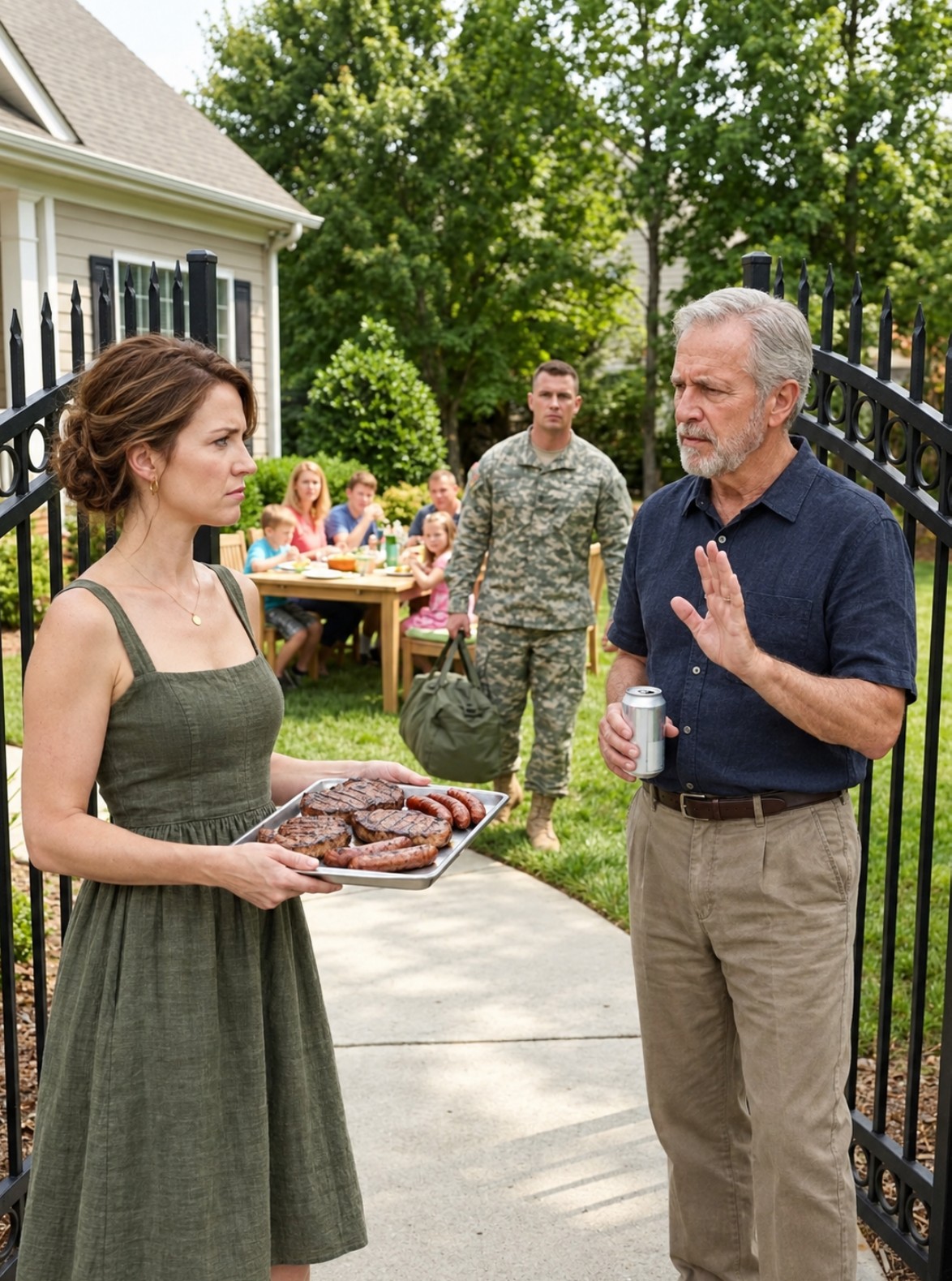
“People who only come here to make others feel sorry for them are not welcome in this house,” Charles Dalton said, standing right in front of the gate with a cold beer in his hand. A crooked smile spread across his face, as if he enjoyed knowing that everyone was watching.
I stood frozen on the sidewalk, holding a heavy tray of slow-roasted barbecue pork. I had been preparing the meal since early that morning, hoping to bring something special to the family gathering.
The hot Phoenix sun beat down on my back, but the heat was nothing compared to the burning shame I felt inside.
Under the large canopy in the backyard, my sisters-in-law, cousins, and aunts sat around the tables. They all suddenly seemed fascinated by their phones. Not one of them looked up to defend me or tell Charles that he had gone too far.
My name is Valerie Dalton, and for sixteen long years, I had been the devoted wife of his son, Luke. I had loved my husband and done my best to become part of his family.
But to the wealthy Daltons, I had never been more than an outsider who had somehow managed to marry into their world.
What they never understood was that before I became Valerie Dalton, I had served in military intelligence as an analytical specialist.
It was not the kind of career I could discuss casually at a dinner party. I could not tell interesting stories about my work or share exciting details on social media. Much of what I had done was confidential, and I had learned to keep my professional life separate from my personal one.
My work involved listening to intercepted communications, comparing enormous amounts of data, identifying hidden patterns, and making decisions under extreme pressure. Sometimes, a single mistake could cost human lives.
My father had been a soldier for most of his life. He had taught me the importance of discipline, patience, and knowing when to speak.
“My dear daughter, the truth does not need to shout,” he used to tell me. “It can wait quietly until the exact right moment to reveal itself.”
I had taken his advice to heart. Perhaps I had taken it too seriously.
When I first met Luke, I believed I had finally found the peaceful, loving family I had always wanted. He was affectionate, kind, and hardworking. During the early years of our relationship, he made me feel safe and appreciated.
Unfortunately, his father was a completely different story.
Charles Dalton was a wealthy businessman who rented heavy machinery to construction companies, including contractors working near major military bases. His business had made him rich, and his money had convinced him that he was more important than almost everyone around him.
He loved talking about the powerful people he knew and the influence he believed he had.
“I know more high-ranking soldiers than you ever will, so you would be wise to remember that,” he once told me at dinner, laughing loudly at his own words. “You were just a simple girl sitting comfortably in front of a computer while other people did the real work.”
From that day forward, he began calling me the simple Army clerk whenever we were around other people.
At family baptisms, birthday parties, holiday dinners, and weekend gatherings, he repeated the same insulting joke.
Sometimes, he would introduce me to guests by saying, “And this is Valerie, our little Army clerk. She used to sit behind a desk while the important people handled the real business.”
The guests would laugh awkwardly, and the relatives would join in with polite chuckles.
I would force myself to smile, too, even though every joke left another small wound inside me.
Luke always asked me to be patient with his father.
“That’s just how Dad is, Valerie,” he would whisper whenever we were alone. “He doesn’t know when to stop joking. Please don’t take everything he says so personally.”
“But he isn’t joking when he humiliates me in front of everyone,” I once told him.
“He doesn’t mean any harm. Just ignore him, and eventually he’ll move on to something else.”
But Charles never moved on. His behavior became worse with every passing year.
Whenever I tried to contribute to a conversation, he interrupted me before I could finish speaking. If someone asked about my military career, he quickly changed the subject to his business.
And whenever I brought homemade food to a family gathering, he would smile and say, “Well, at least we know Valerie is useful in the kitchen.”
The family would laugh, and I would pretend it didn’t bother me.
I told myself that keeping the peace was part of being a good wife. I convinced myself that if I remained patient long enough, Charles might eventually accept me.
Sixteen years of marriage taught me how wrong I had been.
That Sunday afternoon, my in-laws were celebrating a major wedding anniversary. The entire extended family had been invited, and the spacious backyard was filled with tables, chairs, decorations, and food.
Luke had arrived early that morning to help set everything up. I arrived about half an hour later, carrying my tray of barbecue pork and wearing a beautiful blue dress I had bought especially for the occasion.
As I walked toward the house, I felt a little excitement.
Perhaps, I thought, this gathering would finally be different. Maybe Charles would be too busy celebrating to make another cruel remark. Maybe his relatives would treat me like a member of the family instead of an unwanted guest.
I should have known better.
Before I could even step through the gate, Charles moved into my path and deliberately shut the heavy metal entrance.
The gate slammed closed between us.
“Today is strictly a Dalton family reunion,” he announced coldly. “And after all these years, you still haven’t learned where you belong.”
For a moment, I could hardly believe what I was hearing.
The heavy tray felt as though it weighed twice as much as before. Sweat trickled down my back, and the hot metal handles pressed painfully into my palms.
I looked at him, trying to understand how a man could be so cruel to the woman who had been married to his son for sixteen years.
“I’m your son’s legal wife, Charles,” I replied, doing my best to keep my voice steady. “I have every right to be here with my husband.”
He threw back his head and laughed.
“Being legally married to my son doesn’t magically make you one of us,” he sneered. “It just means you’re his wife. That doesn’t mean you belong in this family.”
His words carried across the yard.
I looked past him, hoping someone would finally speak up.
My mother-in-law, Miriam, stood near the refreshments table. She had heard everything, but she lowered her eyes and pretended to be busy arranging the drinks.
My sisters-in-law remained seated beneath the canopy.
Even my uncles, who had asked me for help with military-related contacts and government paperwork on several occasions, suddenly found the ground much more interesting than my face.
Nobody defended me.
Not one person.
That was when something inside me finally became still.
For years, I had swallowed my anger, hidden my hurt, and told myself that family peace was worth the price of my silence.
But standing outside that gate, holding the food I had prepared for people who didn’t even want me near their table, I finally understood something.
They had never mistaken my patience for kindness.
They had mistaken it for weakness.
I carefully placed the hot tray of barbecue pork on a plastic chair outside the fence. Then I looked directly at Charles.
“You’re right,” I said quietly. “I finally understand my place here.”
I turned toward the street, fighting back the tears that threatened to spill down my cheeks.
I had barely taken a step when a large white van pulled up in front of the house.
The side door slid open, and Wyatt, my younger brother-in-law, stepped out.
He leaned heavily on his walking cane, moving slowly as he carefully placed his injured leg on the pavement.
The moment he saw me standing alone outside the gate, his face changed.
And I had no idea that his arrival was about to expose a secret that would turn the entire Dalton family upside down.
Part 2:
Wyatt had never been a man who enjoyed making a scene.
Before his military service, he had been cheerful and outgoing. He loved joking with his brothers, spending time outdoors, and making everyone around him laugh.
But after returning home severely wounded from a dangerous military operation in Kandahar Province, he had become a much quieter person.
His leg had been badly injured, leaving him with lasting mobility problems. He used a cane to walk and often needed to sit down after standing for too long.
Loud parties made him uncomfortable, so he usually stayed away from the center of family gatherings. He would find a quiet corner and sit there, looking as though his thoughts were somewhere far away.
That afternoon, however, he barely seemed to notice the decorations or the people in the backyard.
His attention was fixed entirely on the closed gate.
Then he looked at me.
My eyes were still wet, and I was standing beside the chair where I had left the food tray.
Finally, he turned toward his father.
“Why exactly is Valerie standing outside on the sidewalk?” he asked.
His voice was low, but there was something in it that made the people nearest to him stop talking.
Charles rolled his eyes.
“Oh, don’t start an argument today, Wyatt,” he replied dismissively. “I’m simply reminding her that this is an exclusive family gathering.”
Wyatt tightened his grip on his walking cane. His knuckles turned white.
“Family?” he repeated.
He stared at his father as though he had just heard something unbelievable.
“Are you seriously talking about family right now?”
The atmosphere changed immediately.
The children stopped running across the grass. The relatives beneath the canopy fell silent, and even the music coming from the outdoor speaker seemed suddenly too loud.
At that moment, Luke came around the side of the house carrying a large bag of ice for the drinks.
He stopped when he saw me standing outside the gate and his younger brother gripping his cane with barely controlled anger.
“What happened out here?” Luke asked.
He looked from Wyatt to his father, then back at me.
Nobody answered him.
Wyatt began walking toward the gate.
His injured leg made every step difficult, but he kept moving until he reached the entrance. He took hold of the metal handle and pulled the gate open himself.
The sharp clang of metal against the gatepost echoed through the quiet neighborhood.
Then he turned toward me.
“Please come inside, Valerie,” he said.
There was no mockery in his voice. No pity. No attempt to make me feel small.
For the first time that afternoon, someone in the Dalton family looked at me with genuine respect.
I remained where I was, uncertain whether I should step through the entrance after the humiliation I had just endured.
Charles was furious.
“Nobody gives me orders in my own home!” he shouted. “You seem to have forgotten who built this place and who pays for everything here.”
Wyatt slowly turned to face him.
His injured leg trembled slightly as he straightened his back.
“Then you need to listen carefully to what I’m about to say,” he replied. “Because I should have said it years ago.”
Miriam hurried forward, pressing one hand against her chest.
“Wyatt, please,” she begged. “Don’t do this during our anniversary celebration. Whatever the problem is, we can discuss it later.”
“No, Mom,” Wyatt answered firmly. “I’m done keeping quiet.”
He reached into his jacket pocket and pulled out a folded manila folder. The folder was old and badly worn, with creases along the edges and marks suggesting it had been opened many times.
He walked to the nearest table and placed it down with a heavy thud.
Inside were photocopies of military documents, official stamps, dates, and several lines of text containing names and references to a classified operation.
Everyone watched him.
Even Charles seemed uncertain now.
Wyatt opened the folder and carefully removed the first document.
“Two years ago, I formally requested the release of the records related to the ambush that destroyed my leg,” he explained. “I wanted to understand what had happened that night and why our entire convoy hadn’t been wiped out.”
He paused, looking at the relatives gathered around him.
“For years, we were told that our survival was a matter of luck. That our commanders had made the right decisions at the last minute and that we were fortunate to have escaped.”
He shook his head.
“But after I received the declassified records, I learned that there was much more to the story.”
Charles frowned.
“What does an old military operation have to do with Valerie?” he demanded.
Wyatt slowly turned his head toward me.
His eyes were filled with sorrow, but beneath that sorrow was something else.
Gratitude.
“Everything,” he answered.
The yard became completely silent.
Wyatt continued.
“In the early hours of that operation, someone in military intelligence intercepted an enemy communication. The message revealed that insurgents were waiting along our main route with heavy explosives. They were preparing to attack our convoy.”
He lifted the document.
“The intelligence specialist who intercepted that message realized what it meant. She recognized the danger before the information had been fully confirmed through the normal channels.”
He swallowed hard.
“Because she understood how much time we had left, she sent an urgent warning to headquarters. The commanders then changed the primary route for most of the convoy.”
He paused, and his voice grew quieter.
“But one unit remained ahead on the original route. The warning didn’t reach us in time.”
Wyatt looked down at his injured leg.
“That unit was mine.”
Luke’s hand suddenly opened, and the bag of ice he had been holding fell to the ground. Ice cubes scattered across the grass.
He didn’t even notice.
I stood motionless beside the gate, feeling as though someone had opened a door to a part of my past I had spent years trying to keep closed.
The memories returned with frightening clarity.
I remembered the smell of warm radio equipment and stale coffee. I remembered the cold, windowless basement where I had worked, surrounded by computer screens and communication equipment.
I remembered the broken voices coming through the speakers, the complicated encryption codes, and the tension that filled the room.
Most of all, I remembered the clock.
It had been exactly 4:17 a.m.
I had been analyzing an intercepted communication that suggested an enemy force was preparing an ambush. One piece of intelligence still needed official confirmation, and I knew that sending an alert before receiving that confirmation could have serious professional consequences.
But waiting could have cost lives.
I had reviewed the available information, checked the patterns, and made the decision.
I sent the warning.
At the time, I had no way of knowing exactly how many people it would save.
I had simply done what I believed was necessary.
Wyatt placed another sheet of paper on the table and pointed to a specific line.
“This document identifies the intelligence specialist who initiated the emergency warning,” he announced.
He took a breath.
“The name recorded here is Lieutenant Valerie Cross.”
My maiden name.
Nobody spoke.
For several seconds, the relatives simply stared at the document, trying to understand what they had heard.
Then they looked at me.
Charles’s face went pale.
He forced a nervous laugh, desperately trying to dismiss what was happening.
“Valerie Cross is hardly an unusual name,” he muttered. “This could easily be someone else.”
Wyatt slammed his palm against the table.
The plates rattled.
“It was not someone else, Father!” he roared.
His voice shook with anger.
“That woman you have humiliated for sixteen years is the reason I came home alive from that war zone!”
Charles opened his mouth, but Wyatt didn’t give him a chance to interrupt.
“She is the reason Mom didn’t receive a folded American flag and a coffin instead of her son. She is the reason I am standing here today, able to speak to you, even if I have to lean on this cane to do it.”
He pointed toward the table where the family had planned to eat.
“Without her warning, I might never have come home. You might never have seen me sit at this table again.”
Miriam covered her mouth with both hands and began to cry.
Luke stared at me, his face filled with disbelief.
“Valerie,” he whispered, “is this true?”
I couldn’t bring myself to answer immediately.
I had never wanted praise for what I had done. I had not saved those men because I expected a reward, a medal, or the gratitude of a wealthy family.
I had made a decision because lives were at stake.
And afterward, I had returned to my work and carried on with my life.
There were also details of the operation I could not discuss, even years later. Some parts of military intelligence remained sensitive, and I had learned to protect that boundary.
But Wyatt had not finished.
He reached into the folder and pulled out an old photograph.
The picture showed his unit shortly before deployment. The young men stood shoulder to shoulder in their uniforms, their faces bright with hope and confidence.
Wyatt held it up for everyone to see.
“There were twenty-eight of us in that platoon,” he said quietly. “Twenty-seven came home.”
His eyes filled with tears.
“If Valerie hadn’t recognized that faint transmission and sent the warning when she did, the attack could have killed every one of us.”
He lowered the photograph.
“Twenty-seven families would have lost their sons, husbands, brothers, or fathers. And my family would have lost me.”
He looked directly at Charles.
“But that’s not even the worst part of this story, Dad.”
Charles sat rigidly in his chair.
Wyatt’s next words changed everything.
“You already knew that someone in military intelligence had helped save our lives. You knew long before I requested these records.”
A murmur spread through the backyard.
Charles shook his head, but Wyatt continued.
“You knew there was an intelligence officer whose actions had helped prevent an even greater disaster. You had information connecting that officer to Valerie, but instead of acknowledging what she had done, you chose to keep mocking her.”
Wyatt’s voice hardened.
“You spent more than a decade making her feel worthless because admitting the truth would have meant accepting that she had done something extraordinary.”
He stared at his father with open disappointment.
“You couldn’t stand the thought that the woman you treated as inferior might have accomplished something you could never have done yourself.”
Charles’s face drained of color.
For the first time since I had known him, he looked genuinely afraid.
And as I watched him struggle to respond, I realized that Wyatt’s revelation was only the beginning.
The most painful part of our family’s history had not yet been exposed.
Part 3:
Charles slowly lowered himself into his chair.
For a moment, he looked as though his legs could no longer support him.
Nobody spoke.
The expensive food prepared for the anniversary celebration sat on the tables. Fresh dinner rolls were cooling in their baskets, and the drinks were waiting beside the ice that Luke had dropped onto the grass.
Soft country music continued playing from a nearby speaker.
Everything looked exactly as it had a few minutes earlier, yet nothing felt the same.
The family gathering had become something else entirely.
A secret had been exposed, and every person present was beginning to understand how much damage had been done to someone they had all taken for granted.
Luke finally walked toward me.
His expression had changed. The shock in his eyes had given way to sadness, confusion, and something that looked painfully close to shame.
“Why didn’t you ever tell me?” he asked quietly. “Why didn’t you tell me what you did?”
I looked at my husband.
For sixteen years, I had loved him. I had stood beside him through difficult times, supported him, and tried to build a peaceful life with him.
I had also spent sixteen years waiting for him to stand beside me when his father attacked my dignity.
He had rarely done so.
I took a slow breath.
“Because every time your father humiliated me in front of the family, you told me not to make a big deal out of it,” I replied.
Luke’s eyes filled with tears.
“You told me to be patient. You told me to ignore him. You told me that keeping the peace was more important than arguing with him.”
I looked directly at him.
“Eventually, I started believing that my peace mattered less than everyone else’s comfort.”
Luke lowered his head.
My words seemed to hurt him more deeply than any angry accusation could have.
For years, he had convinced himself that staying out of the conflict was the same as being fair. He had believed that if he asked me to remain quiet, the family would eventually settle down.
But he had never considered what his silence was costing me.
He had wanted peace without having to confront the person causing the pain.
And I had been the one paying for it.
Wyatt cleared his throat and returned his attention to the documents.
“When I requested the complete file from the military archives, I discovered another important piece of evidence,” he explained.
He removed another paper from the folder.
“After the operation, military command sent a formal letter of appreciation to several prominent local families who had supported logistics and other activities connected to the deployment.”
He looked at Charles.
“Our family received a copy because Dad’s company worked with defense contractors.”
Miriam raised her tear-stained face.
“What are you saying?” she asked.
Wyatt answered without hesitation.
“I’m saying that Dad received a letter mentioning Valerie’s contribution. He kept it in his office.”
Miriam slowly turned toward her husband.
“Charles, did you receive that letter?”
Charles stared at the table.
He said nothing.
Wyatt continued reading.
“The letter did not reveal Valerie’s complete identity or the operational details. It referred to an officer by the name of Cross and identified the officer as a member of the Military Intelligence Division.”
He pointed toward his father.
“I found the letter locked away inside Dad’s old desk in the study.”
Luke turned to Charles.
His expression was no longer confused.
It was filled with disgust.
“Did you know?” he asked. “Did you really know that Valerie had been involved?”
Charles clenched his jaw.
“I wasn’t entirely certain that it was her,” he muttered. “It was a long time ago, and there could have been other officers with the same name.”
His answer was weak, and everyone could hear it.
Before Wyatt could respond, I stepped forward.
“That is a lie, Charles.”
The words came out more firmly than I expected.
Every head in the yard turned toward me.
For sixteen years, I had carefully chosen my words around this man. I had avoided confrontation because I wanted my marriage to work and hoped that patience would eventually earn me respect.
But I no longer felt the need to protect his feelings.
I walked toward the table and picked up the photocopy of the military appreciation letter.
My hands were perfectly steady.
“You may not have known every detail of the operation,” I said. “And you may not have known exactly what happened to every soldier that night. But you knew enough to understand that I wasn’t the useless woman you kept pretending I was.”
Charles looked up at me.
I continued.
“You knew I had worked in military intelligence. You knew that someone with my surname had been recognized for important work. And instead of asking me about it or treating me with even a little respect, you continued humiliating me.”
I paused, making sure he was listening.
“Why? Because it was easier to laugh at me than to admit that you might have been wrong about me.”
Charles opened his mouth, but no words came out.
I could see him searching for an excuse, some explanation that would allow him to escape responsibility without admitting what he had done.
But there was no excuse that could erase sixteen years of cruelty.
“You didn’t need to know about my military service to treat me like a human being,” I told him. “You didn’t need a document or an official letter to understand that I deserved basic respect.”
My voice grew stronger.
“You could have treated me with kindness from the very first day you met me. You chose not to.”
For once, Charles had nothing to say.
Then Miriam stood up.
For most of her life, she had been a quiet woman who preferred to stay out of arguments. At family gatherings, she was usually the one clearing plates, refilling glasses, and making sure everyone had what they needed.
She had watched her husband insult me countless times.
She had heard his cruel jokes and seen the hurt they caused.
And for years, she had remained silent.
But now, she stood in front of him with tears on her cheeks and a determination I had rarely seen.
“Charles,” she said, “you are going to apologize to Valerie right now.”
He stared at her in disbelief.
“Miriam, please,” he whispered. “Not in front of everyone.”
“No,” she replied firmly. “You will do it now.”
She took a breath, and her voice trembled.
“I kept quiet, too. I watched you humiliate her, and I told myself it wasn’t my place to interfere. I convinced myself that staying silent would keep the family together.”
She wiped her cheeks.
“But I was wrong. I should have defended her years ago, and I am ashamed that I didn’t.”
For a moment, I couldn’t speak.
I had spent so many years hoping someone in that family would finally acknowledge what was happening that hearing Miriam admit her own failure was almost as painful as Charles’s original insults.
My sisters-in-law began crying.
One of them stepped toward me.
“Valerie, I’m so sorry,” she said. “I should have said something. I knew his comments hurt you, but I kept pretending they were harmless.”
Another relative reached for my hand.
“We all should have done more,” she whispered.
An older uncle shook his head.
“This should never have been allowed to continue,” he muttered. “We were wrong to sit there and laugh.”
Their apologies came one after another.
Some sounded sincere. Others seemed to come from people who had only just realized how terrible the situation looked now that the truth was out.
I listened, but I did not immediately reassure them or tell them that everything was fine.
It wasn’t fine.
Not yet.
Luke gently reached for my hand.
I allowed him to hold it, but I did not squeeze it back.
I needed him to understand that love alone could not instantly repair the damage caused by years of silence.
Forgiveness was not a switch that could be turned on the moment someone finally admitted the truth.
It would take time.
And even then, forgiveness would not necessarily mean returning to the way things had been before.
Part 4:
Charles slowly stood up.
The man who had once seemed so powerful and intimidating now looked old and uncertain. His shoulders were slumped, and he avoided looking at the relatives gathered around him.
For years, he had used his wealth, his business connections, and his position as the head of the family to control the people around him.
He had acted as though his money gave him the right to decide who belonged and who did not.
But standing in front of everyone that afternoon, he seemed to have finally understood that money could not protect him from the consequences of his own behavior.
He looked down at the grass.
“Valerie,” he began.
His voice was quieter than I had ever heard it.
“I treated you unfairly for a very long time. I was cruel to you, and I know that I hurt you.”
He swallowed nervously.
“I mocked what I didn’t understand. And when I learned enough to realize that you deserved more respect than I had given you, I still refused to change my behavior.”
He paused, struggling to continue.
“I think I allowed my pride to become more important than doing what was right. I wanted to believe that I knew better than everyone else, and I didn’t want to admit that I had judged you wrongly.”
For the first time, he looked directly at me.
“I’m sorry, Valerie. I know that saying those words doesn’t erase what I did. But I am asking you to forgive me.”
Nobody moved.
I could hear the faint sound of traffic from the street beyond the property.
Charles waited for my answer.
I could have told him that I forgave him. I could have accepted his apology and allowed the family to return to its celebration, pretending that the worst was finally behind us.
But that would have been dishonest.
I had spent too many years pretending that his behavior didn’t hurt me.
I would not begin pretending again simply because he had finally apologized.
So I let the silence continue.
For a few moments, I said nothing at all.
Charles shifted uncomfortably, but I did not rush to make him feel better.
He had forced me to carry the weight of his cruelty for sixteen years. Now, for the first time, he had to sit with the discomfort of knowing that he had hurt someone who did not owe him immediate forgiveness.
Finally, I spoke.
“I honestly don’t know if I can forgive you today, Charles.”
His face fell slightly, but I continued.
“I hear your apology, and I appreciate that you’re finally admitting what you did. But I need you to understand something.”
I held his gaze.
“I will never again walk into a place where I have to make myself smaller so that someone else can feel bigger.”
My voice was calm, but every word carried the weight of sixteen years.
“I won’t accept being humiliated just to keep a family gathering peaceful. I won’t pretend that cruel jokes are harmless. And I won’t keep sacrificing my dignity so that everyone else can avoid an uncomfortable conversation.”
I took a breath.
“If we are going to have a relationship in the future, it will have to be different. I cannot promise you forgiveness today, and I cannot promise that things will ever be the way they were before.”
Luke began crying quietly beside me.
He finally seemed to understand that his father’s behavior had damaged more than my relationship with the extended family.
It had also changed the way I felt about my marriage.
Wyatt approached me carefully.
He leaned on his cane and wrapped his arms around me in a gentle hug.
“I should have looked into the records years ago,” he whispered. “I should have asked more questions instead of accepting the explanation we were given.”
He pulled back slightly and looked into my eyes.
“Thank you for saving my life, Valerie. I don’t think I will ever be able to explain how much that means to me.”
I felt tears rising in my eyes again, but this time they were different.
“I was doing my job, Wyatt,” I told him softly.
He shook his head.
“You were doing your job, yes. But that doesn’t mean what you did was ordinary. You made a difficult decision under pressure, and that decision helped give us a chance to survive.”
He glanced toward the old photograph on the table.
“You gave twenty-seven men the chance to return to their families. I know that nothing I say can repay you for that, but I want you to know that I will never forget it.”
I looked at him and smiled sadly.
“I never expected you to repay me.”
“I know,” he replied. “That’s part of why you deserve so much respect.”
His words touched me more deeply than any public praise ever could have.
For years, I had been treated as though my worth depended on whether I could impress the Daltons. My career had been dismissed because Charles did not understand it. My opinions had been ignored because they did not fit the image he had created of me.
Now, suddenly, everyone wanted to celebrate what I had done.
But I understood something that they were only beginning to learn.
My worth had not changed that afternoon.
It had been there all along.
The only thing that had changed was their understanding of it.
I looked at the tray of barbecue pork sitting outside the gate.
The food I had prepared that morning was still there, untouched.
I walked over, picked it up carefully, and turned toward my car.
Luke followed me.
“Valerie, please,” he said. “Can we go home and talk about this?”
I looked at him.
“We can talk,” I answered. “But not here. And not because your father finally admitted what he did.”
He nodded, wiping his eyes.
“I understand.”
I wasn’t sure that he truly did, but I was willing to give him the chance to prove it.
He walked beside me as we left the property.
Behind us, the family remained gathered in the backyard, surrounded by the decorations, the food, and the evidence of everything that had just been exposed.
I did not leave because I wanted revenge.
I did not leave because I wanted to punish Charles or make the family feel guilty.
I left because I finally understood that I had a choice.
I could continue trying to earn acceptance from people who had spent years making me feel unwanted, or I could protect the peace I had spent so long sacrificing.
For the first time in sixteen years, I chose myself.
Part 5:
The months that followed were not easy.
Luke and I had many difficult conversations about our marriage, his father’s behavior, and the years I had spent swallowing my feelings to avoid conflict.
He apologized more than once for asking me to remain silent whenever Charles humiliated me.
“I thought I was keeping the peace,” he admitted during one of our conversations. “I didn’t understand that I was asking you to suffer so that I wouldn’t have to confront my father.”
I appreciated his honesty, but I also told him that understanding the problem was only the beginning.
“I need you to stand beside me when something is wrong,” I explained. “Not after the damage has been done. Not when everyone else finally agrees with me. I need to know that my feelings matter to you even when standing up for me makes things uncomfortable.”
Luke listened.
For the first time, he did not tell me that I was being too sensitive or that I should simply ignore his father’s behavior.
He began to understand that being a good husband did not mean avoiding every argument. Sometimes, it meant being willing to have the difficult conversation.
As for Charles, he did not become a different man overnight.
One apology could not erase sixteen years of insults, and one afternoon of embarrassment could not undo the habits he had spent decades building.
But something had changed.
Several months later, Charles asked the entire extended family to gather at his house again.
This time, the occasion was different.
Before anyone arrived, he made sure the large metal gate was standing wide open.
There were tables in the backyard, food waiting to be served, and chairs arranged beneath the canopy.
But there were no cruel jokes about my past. Nobody referred to me as the simple Army clerk, and nobody laughed when I spoke.
When I arrived, Charles came forward to greet me.
He looked nervous, and for once, he seemed to understand that he could not demand anything from me simply because I had married his son.
“Valerie,” he said, “thank you for coming.”
I nodded.
He took a breath.
“I want to apologize to you again, in front of everyone. What I did was wrong. I treated you as though you had to prove that you deserved to be part of this family, when I should have treated you with respect from the beginning.”
He looked around at the relatives standing nearby.
“I made cruel jokes, and I encouraged everyone else to laugh along with me. I also allowed my pride to stop me from admitting that I was wrong. None of that was your fault.”
He turned back toward me.
“I cannot undo those years, but I can choose how I treat you from now on. I am sorry for what I did, and I will do my best to make sure it never happens again.”
I listened carefully.
Then I thanked him for apologizing.
I did not promise that everything was forgiven, and I did not pretend that the past no longer mattered.
But I was willing to see whether his actions would finally match his words.
Over time, I began to notice small changes.
Charles became more careful about the way he spoke to me. When I offered an opinion, he let me finish. When relatives asked about my career, he no longer interrupted or turned the conversation toward his business.
Most importantly, he stopped treating my presence as something he had the right to approve or reject.
The family also began to understand that respect was not something they should offer only after discovering that a person had done something extraordinary.
I had never needed them to know about the military operation to treat me decently.
I had never needed a document, a photograph, or an official letter to prove that I deserved a place at their table.
I had been Luke’s wife for sixteen years. I had been part of their family long before Wyatt opened that folder.
And I had deserved respect from the very beginning.
Looking back, I sometimes think about that hot Sunday afternoon in Phoenix.
I remember the heavy tray of barbecue pork in my hands. I remember Charles standing behind the closed gate with a beer and a cruel smile. I remember the relatives who looked away because they were too afraid or too comfortable to speak up.
And I remember the moment Wyatt opened the gate.
He did more than allow me to enter a backyard.
He exposed a truth that the family had spent years refusing to see.
But the greatest lesson I learned that day had nothing to do with military intelligence, hidden documents, or the lives I had helped save.
It was about human worth.
For years, I had allowed myself to believe that if I stayed patient enough, worked hard enough, and made everyone else comfortable enough, I would eventually earn the respect I deserved.
I had been wrong.
Respect should never depend on someone’s wealth, job title, family connections, or secret achievements.
It should not take a dramatic revelation to convince people that another human being deserves kindness.
And it should never require a woman to prove that she is extraordinary before others stop treating her as though she is insignificant.
The truth is that I had been worthy of respect before Charles knew anything about my military career.
I had been worthy of respect when he called me a simple Army clerk.
I had been worthy of respect when he interrupted me at dinner, mocked the food I prepared, and shut the gate in my face.
I had been worthy of respect even when I stood alone on the sidewalk, with tears in my eyes and nobody willing to defend me.
That day taught me that the truth can change the way people see you, but it cannot change your actual worth.
Sometimes, the most painful thing about a family is not the secret that finally comes to light. It is the web of lies, excuses, and silence that everyone has used to keep the family looking perfect.
Charles’s secret had not destroyed our family.
His pride, his cruelty, and everyone’s willingness to tolerate them had caused the damage long before Wyatt arrived.
The revelation simply made it impossible to keep pretending otherwise.
And as for me, I finally stopped measuring my worth by the way other people treated me.
I no longer needed Charles’s approval to feel proud of the woman I had become. I no longer needed the family’s acceptance to know that my life had meaning.
I had spent years waiting for someone to open the gate for me.
Now I understood that I could walk away from any gate that was closed against me.
Because the most important lesson I ever learned was this:
A woman’s worth does not depend on someone discovering her hidden achievements. She deserves to be respected simply because she is a human being.
And no one—not even the wealthiest, loudest, or most powerful person in the room—has the right to make her believe otherwise.
THE END.
