
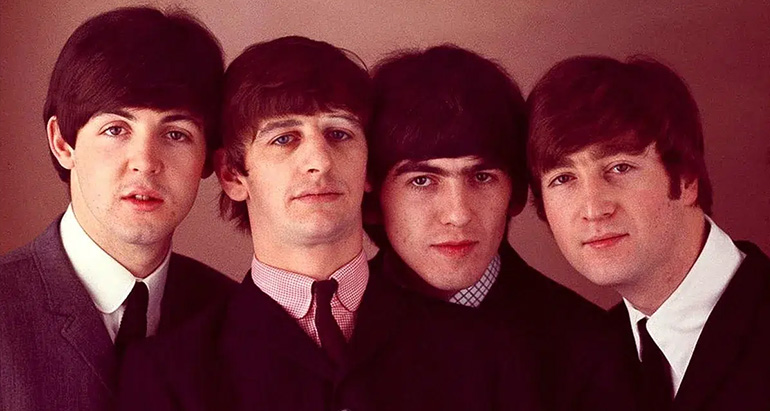
The Beatles were undoubtedly the most influential band of the 20th century. In just eight years, they changed not just rock ‘n’ roll, but all music that followed.
Without Liverpool, the city where John, Paul, George and Ringo grew up on the rock ‘n’ roll records of the 50s, brought in by American sailors, there would have been no Beatles. And they might not have been so successful if record shop owner Brian Epstein hadn’t seen them play at the Cavern Club in Liverpool in 1961 and, from the first moment, knew they would be much bigger than Elvis.
- John Lennon (John Winston Lennon) – born on October 9, 1940, Liverpool, England – died on December 8, 1980, New York City, New York, USA
- Paul McCartney (James Paul McCartney) – born on June 18, 1942, Liverpool, England
- George Harrison – born on February 25, 1943, Liverpool, England – died on November 29, 2001, Los Angeles, California, USA
- Ringo Starr (Richard Starkey) – born on July 7, 1940, Dingle, Liverpool, England
1957
On July 6, 1957, John Lennon, the frontman of a band called “Quarry Men,” was introduced to Paul McCartney by their mutual friend Ivan Vaughan. Both McCartney and Lennon had a performance at the Woolton Parish Church. Impressed by McCartney’s ability to play and tune the guitar, Lennon soon asked him if he wanted to join the Quarry Men. McCartney agreed, and shortly after joining the group, Paul McCartney recommended school friend George Harrison to frontman Lennon. But Lennon refused to listen to the boy because he was only 14. Eventually, Lennon relented and on 6 February 1958, 19 days before his 15th birthday, Harrison was auditioned. After he played Raunchy, he was made the newest member of the group.
The band had several names such as “Johnny and the Moondogs,” “The Silver Beetles,” “The Beatals,” “The Silver Beatles,” and finally “The Beatles.” Just as there were many changes in the band’s name, there were also many changes in the band members. The most important one to mention here was the bassist and closest friend of John Lennon, Stuart (“Stu”) Sutcliffe, born on June 23, 1940, in Edinburgh, Scotland. He died on April 10, 1962, in Hamburg. Another important band member was the drummer Pete Best, born in 1941 in Liverpool.
1960
In 1960, the Beatles went to Germany to play in Hamburg. But instead of becoming rich and famous as hoped, they found only dirty clubs and easy girls. They played all nite and slept behind the screen in a cinema. During their stay in Germany, they gained a lot of experience for performances, but that was also the only thing. The money they were promised was rare. Their time in Germany ended abruptly when it was discovered that George, then 17, was still a minor and therefore was deported.
1961
Toward the end of 1961, Brian Epstein, whose family owned the furniture and record store NEMS, began to hear about the Beatles and their recording of “My Bonnie.” The record had been recorded by the Beatles together with the English musician Tony Sheridan. Epstein listened to the record and ordered some to sell in his shop. To his surprise, the records sold like hotcakes.
Finally, he decided to check out the group for himself and when he visited a club known as “The Cavern,” he was impressed by what he saw. Liverpool was full of such types at the time, but the Beatles had more – charisma.
1962
Since January 1962, Brian Epstein had been the Beatles’ official manager, and he persuaded them to smarten up and wear suits. Epstein gave the Beatles a look that set them apart from all the other groups in the area.
On April 10, 1962, the Beatles heard sad news: Stuart Sutcliffe died in Hamburg from a brain hemorrhage. The very next day, they flew to Germany and played for seven days at the Hamburg Star-Club. These performances had already been scheduled before Stu’s death. The Beatles did not attend his funeral, but they did express their condolences to his German girlfriend Astrid. All in all, Stuart Sutcliffe’s early death was quite a shock for the Beatles. He had left the group after their first stay in Hamburg to devote himself to painting and his girlfriend, but he was a close friend of John’s, who had gone to art school with him.
After several failed attempts in various recording studios, the Beatles got the opportunity for a recording session at EMI’s Parlophone label. There was only one problem, the group’s drummer, Pete Best, had to go, according to producer George Martin. Since the Beatles did not want to fire their good friend, Brian Epstein had to do it for them. Some called them cowards, others thot they were jealous of his good looks, but the real reason for the decision was that Pete simply didn’t have the necessary talent and perhaps was a bit slow on the uptake.
Therefore, the Beatles asked Ringo Starr, drummer of the Liverpool group Rory Storm And The Hurricanes, if he wanted to join the group. But their producer George Martin, who did not yet know Ringo, initially turned him down and hired session drummer Andy White. Andy’s career with the Beatles was rather short-lived, as the group decided to use Ringo Starr for all further recordings and performances. With Ringo by their side, the Beatles now conquered Britain. The excitement they generated was unparalleled with anything that had been experienced in Britain up to that point.
Toward the end of 1962, the Beatles stormed the UK charts with their debut single “Love Me Do” and played for the last time at the Hamburg Star Club. Their debut was significant in that their music moved away from the traditional “beat combo sound” and Lennon’s harmonica made the song stand out. At this time, Brian Epstein signed a contract with music publisher Dick James; this contract led to the formation of Northern Songs.
1963
On February 13, 1963, the Beatles appeared on the British television show Thank Your Lucky Stars to introduce their new single Please Please Me. They had around six million viewers. This was a pivotal moment in their career at the start of a year in which they were to lead a musical and fashion revolution for the working class. Please Please Me, with its unique harmonies and the group’s infectious beat, soon topped the UK charts. From now on, the Beatles developed artistically and commercially with each subsequent record. After From Me To You spent seven weeks at the top, they released She Loves You, a song with the catchphrase Yeah, Yeah, Yeah, which then kept appearing in newspaper headlines. The number one hit She Loves You fell in the UK charts and returned to number one seven weeks later as Beatlemania gripped the nation. By this time, the Beatles were everyplace and She Loves You was replaced by the song I Want to Hold Your Hand, which sold over a million copies in the UK and went straight to number one.
In November 1963, “I Want to Hold Your Hand” became a number-one hit in the USA. For American teenagers, the Beatles’ long hair, collarless suits, and typical shoes were irresistible. And the press liked their charm and their jokes, which were often quoted. All in all, the Beatles took America by storm.
1964
The Beatles made their first appearance on US television on February 9, 1964, on the Ed Sullivan Show. At the time, it was the highest-rated show in television history. During the performance, not a single crime was reported in the USA.
Until 1964, America was a barren land for up-and-coming British pop bands; there were only occasional exceptions, such as the Tornados’ record Telstar. But the Beatles changed that abruptly and decisively. Even with the help of their appearance on the Ed Sullivan Show, the sales of “I Want To Hold Your Hand” soon surpassed those in their home country of Britain. The Beatles had achieved a popularity that even overshadowed their standing in the United Kingdom. In the Hot 100 sales charts, the Beatles held the top five positions in April, and in Canada, they even had nine records in the top 10! The chart statistics are not only fascinating, they also reflect the importance of the group. They made Liverpool the pop capital of the world, and the Beat Boom soon spread across North America. Along with Bob Dylan, the Beatles taught the world that pop music could be intelligent and serious, despite the hordes of screaming teenagers.
Beatles stickers, dolls, chewing gum, and even canisters of Beatles breath showed for the first time that a lot of money could be made with merchandising products. But perhaps the most important factor in their commercial success was that they broke the Tin Pan Alley monopoly on pop music by writing their own songs. From the moment they turned down Mitch Murray’s How Do You Do It? and opted instead for their own Please Please Me, Lennon and McCartney set in motion a revolution in the music industry. They had so much of their own material that they were able to offer it to fellow artists, such as Billy J. Kramer, Cilla Black, the Fourmost and Peter and Gordon. They also gave the Rolling Stones the song for their second single, I Wanna Be Your Man. The Beatles then encouraged the Stones to write their own songs to earn royalties as composers themselves.
1965
By 1965, Lennon and McCartney’s songwriting ability had matured to such an astonishing degree that they were hardly reliant on third-party material. Before that they had recorded songs by Chuck Berry, Buddy Holly, Carl Perkins, Bacharach and David, Leiber and Stoller and Goffin and King, but with each new song the group was leaving their earlier influences further behind and moving into uncharted pop territory. They swept their audience along and even when they played traditional pop numbers, they always brought their own originality to them. Their first two films, A Hard Day’s Nite and Help!, were not the usual commercially-oriented pop celluloid, but were witty and inventive. They received critical acclaim and were also box office hits. The national affection that the Fab Four enjoyed was most clearly demonstrated in 1965 when the Beatles were awarded the MBE (Members of the British Empire) for their services to British industry. The year ended with the release of their first double A-side number one single, We Can Work It Out / Day Tripper. The coupling showed how hard it was to distinguish between A-side and B-side.
At Christmas 1965, the Beatles released Rubber Soul, an album that was not just a collection of potential hits or popular cover versions, as previous albums had been, but a surprisingly versatile record of satirical songs like Nowhere Man to the reflective In My Life. The album also hinted at the Beatles’ future musical development, with George Harrison using the sitar on Norwegian Wood, which alluded to Lennon’s infidelity. In the same year, the Byrds, Yardbirds and Rolling Stones incorporated Eastern sounds into their works, and the music press reported hesitantly on the little that sounded like pop music, Ravi Shankar. Significantly, Shankar’s master student, George Harrison, was allowed to contribute two songs to Rubber Soul: Think For Yourself and If I Needed Someone (also a hit for the Hollies).
1966
During the year 1966, the Beatles continued to perform their increasingly complex arrangements in front of screaming fans, but this new form of adoration wore off frustratingly quickly.
In Tokyo, the group drew the ire of militant students who had attended their performance at Budokan. There were several death threats and the Beatles left Japan feeling sad, unaware that worse was to come. A visit to Manila almost ended in a riot when the Beatles refused to attend a party arranged by President Ferdinand Marcos. As a result, they were attacked by angry patriots before leaving the country. A few weeks later, Beatles records were burned in the southern redneck states of America after Lennon made the off-the-cuff, tongue-in-cheek remark in an interview that “we’re more popular than Jesus now.” While his words went unnoticed in Britain, their publication in an American magazine led to assassination attempts on the Beatles and a campaign by Ku Klux Klan members to stamp out the “Beatles threat.” By the summer of 1966, the group was exhausted and dispirited, and played their last official US concert at San Francisco’s Candlestick Park on August 29.
The controversies that accompanied their live performances, however, did not negatively impact the quality of their recordings. “Paperback Writer” was another step forward, with its glorious harmonies and delightfully prosaic subject matter.
It was soon followed by the double-sided chart-topper Yellow Submarine/Eleanor Rigby, with Yellow Submarine a homemade nursery rhyme sung by Ringo Starr, complete with mechanical sounds, and Eleanor Rigby a brilliantly orchestrated depiction of loneliness, untainted by excessive sentimentality. The accompanying album, Revolver, was equally diverse, with Harrison’s acerbic Taxman, McCartney’s elegiac For No One and Here, There and Everyplace, and Lennon’s drug-influenced I’m Only Sleeping, She Said She Said and the mystical Tomorrow Never Knows. The latter song has also been described as the most effective evocation of an LSD experience ever recorded.
1967
After 1966, the Beatles went back into the studio, free from the burden of live performances. Their image as pin-up pop stars was transformed, with the new photos showing them with beards and Lennon proudly wearing glasses, having previously hidden his short-sightedness behind contact lenses. The first release they put out after more than six months was Penny Lane/Strawberry Fields Forever, which, astonishingly, failed to continue their long run of number ones, as Engelbert Humperdinck’s schmalzy Release Me was released at the same time and attracted more buyers. Nevertheless, this single brilliantly showcased the talents of Lennon and McCartney and is often regarded as the best single pairing ever.
But during this time, the lives of the group members began to develop in different directions. Lennon met artist Yoko Ono, George sought enlightenment with Ravi Shankar and Paul fell in love with photographer Linda Eastman. The style of their songs also became more and more opposed, although there were significant similarities in the songs that dealt with the Liverpool of their childhood. Lennon’s lyrics in Strawberry Fields Forever, however, dramatize a far more complex inner dialog, characterized by simple qualifications in the lyrics (That is, I think, I disagree). Musically, the songs are equally interesting; Penny Lane, which features a piccolo trumpet and a shimmering rhythmic fade-out, and Strawberry Fields Forever, which combines two different versions of the same song and features backward cellos to create a haunting effect.
Originally intended to be the jewel in the crown of their next album, by the summer of 1967 the Beatles had enough material to release 13 new recordings on the album Sgt. Pepper’s Lonely Hearts Club Band. Sgt. Pepper was to be released not as a mere pop album but as a cultural icon, embodying the defining elements of 1960s youth culture: pop art, psychedelic clothing, drugs, instant mysticism, and liberation from parental authority.
Although the Beatles had previously experimented with collages for Beatles for Sale and Revolver, they adopted the idea for the cover of Sgt. Pepper, which was to include a staged group photo with cardboard cutouts of all the people who had influenced the Beatles. It was also the first pop album to include the lyrics printed on the sleeve. The music was also extraordinary and refreshing; instead of the traditional pauses between tracks, some songs flowed into each other, connected by studio chatter, laughter, electronic sounds, and animal voices.
Constantly chaotic sounds were enlivened by the genius and inventiveness of the Beatles’ ideas man, George Martin. The songs were essays in innovation and variety, with the cartoon psychedelia of Lucy In The Sky With Diamonds, the music hall pastiche of When I’m 64, the circus atmosphere of Being for the Benefit of Mr Kite, the far eastern philosophizing of Within You, Without You and even a modern morality tale with She’s Leaving Home. With steam organs, orchestral backing, sitars and even some foxhounds howling and other animal voices at the end of Good Morning, Good Morning, the album is full of audio tricks and surprises. Sgt. Pepper closes with the epic A Day in the Life, the Beatles’ most ambitious work to date, which, according to Lennon, builds up like a sound building from nothing to the end of the world.
As a final gag, the orchestra was recorded at a frequency above 20 kHz, so that it can only be heard by dogs. The turntable was also unable to resist the record’s final gimmick, which saw one of the record’s tracks cut so that it repeated a section of tape played backward over and over again.
While Sgt. Pepper’s Lonely Hearts Club Band was storming the album charts, the Beatles were already playing a new song in a worldwide TV live broadcast that was to become their anthem of the decade: All You Need Is Love. The following week, the song entered the charts at number one in many countries around the world, harking back to the old days of Beatlemania.
But this summer was not only of a cheerful nature, as Brian Epstein was found dead on August 27, 1967. The autopsy revealed an overdose of the drug Carbitrol and indications of a homosexual background. With the spiritual help of Maharishi Mahesh Yogi, with whom they were seeking enlightenment in Bangor, India, the Beatles were able to cope with the death and decided to do without a manager in the future.
The first fruit of their labors after Epstein’s death was the film Magical Mystery Tour. It was first broadcast on Boxing Day in 1967 on national television. Although the phantasmagorical film received mixed reviews, no one could complain about the music, which was first released as a double EP containing six powerful songs. The EP reached number two in the UK and made chart history the following week. Ironically, the Beatles’ Hello Goodbye, their traditional annual Christmas single, kept the single chart’s top spot.
1968
In 1968, the Beatles were increasingly busy with the affairs of their company, Apple. A badly run boutique on Baker Street in London came and went. Musically, however, they continued to be successful. In August 1968, the first Apple single, Hey Jude, was released. A heartwarming ballad (of course by McCartney), which built up to a rousing singalong finale over its seven minutes.
Their next film, Yellow Submarine, was an animated work whose animated landscape graphics were celebrated by critics. The accompanying soundtrack album was half instrumental. George Martin was responsible for some interesting orchestral interludes. The album, however, contained only four real new Beatles songs, of which Lennon’s biting Hey Bulldog should be mentioned first. George Harrison’s swirling Only a Northern Song featured some brilliant brass and trumpets. Although It’s All Too Much was well received by the film’s powerful animation, it was not a particularly good song.
Thru their prolific output, the Beatles were able to squeeze some of their latest unreleased pieces (it was just “all too much”) onto the new album. A double album in naked white with the simple title The Beatles, which is now known mainly as The White Album. George Martin said many years later that it could have made an excellent single album. It contained some brilliant musical moments that reflected the Beatles’ great surge of talent: Back In The USSR, a loving tribute to Chuck Berry and the Beach Boys, Julia, Lennon’s homage to his late mother, and McCartney’s excellent Blackbird. George Harrison contributed the magnificent While My Guitar Gently Weeps, featuring Eric Clapton on guitar. Ob-la-di, Ob-la-da hit number one in the UK singles chart, while Paul McCartney’s wild Helter Skelter found meaning as a song misinterpreted by Charles Manson. Manson misinterpreted the song to mean that the Beatles were the four horsemen of the apocalypse and decided to become a mass murderer, which he did. In addition, the album contained a number of rather average songs and some heavily drug-influenced works such as Revolution No. 9 and Goodnight.
The Beatles also showed with this album that the four musicians were already working in isolated neutrality, even if today this work is one of the favorites among music critics. Meanwhile, the Beatles’ lack of business acumen was also revealed by the precarious state of Apple, which Allen Klein tried to sort out.
The new realism that now appeared in their music was also represented by other contemporary artists such as Bob Dylan and the Byrds. They wanted to end the 60s with a return to less complex musical forms. This “back to basics” minimalism was particularly aptly led by the single “Get Back,” on which Billy Preston plays the organ.
At the Beatles’ next recording session, where they played dozens of their songs for the first time since Hamburg, cameras were present. When the session was over, the result was an endless number of recorded tapes, which were not looked at again until the following year. In the meantime, only a few were unwitting eyewitnesses and earwitnesses to the Beatles’ last public performance. They played on the roof of their Apple headquarters in London’s Savile Row. Amid the chaos of 1969, the Beatles then had their last UK number one hit with the single Ballad of John and Yoko, which featured only John Lennon and Paul McCartney.
1969
In a constant attempt to cover up the rifts that increasingly became visible in the personal and musical relationships within the group, the Beatles came together again to record Abbey Road. The album Get Back, which had already been started, was put on hold due to the ongoing differences and was later released under the title Let It Be. For Abbey Road, the four of them wanted to pull themselves together one last time to produce a good album. Abbey Road is dominated by the album’s second side, which consists of a sequence of interlocking songs: fragmentary compositions such as Mean Mr. Mustard, Polyethylene Pam, She Came in Thru the Bathroom Window and Golden Slumbers / Carry That Weight, which coalesce into a compelling whole. The accompanying single featured Lennon’s Come Together and Harrison’s Something. The latter song gave George Harrison the credit he deserved, and was not inappropriately the most covered Beatles song after Yesterday. However, the single only reached number 4 in the UK charts, the worst chart position since 1962 with Love Me Do.
Such setbacks were insignificant compared to the fate that befell the other Beatles songs. The band had to helplessly watch as Dick James, who held the rights to all Beatles songs and was Managing Director at Northern Songs, secretly sold Northern Songs – and thus all Beatles songs – to ATV in March 1969. The rights changed hands several times in the years that followed. Not even the combined financial power of Paul McCartney and Yoko Ono could wrest the rights from the current owner, Michael Jackson.
1970
With various planned solo projects, the Beatles stumbled thru 1970. The group’s internal strife was laid bare for the world to see in the depressing film Let It Be. It was clear that Lennon and Harrison were extremely unhappy and annoyed with McCartney’s attitude toward the group. The subsequent, eponymous album, which was patched together by Phil Spector, was a controversial and cobbled-together affair. Originally, the album was released in a cardboard box with a generous booklet, which significantly increased the purchase price. Musically, the work was a retrospective of the Beatles in better times. It included the mediocre “Two of Us” and the primitive “The One After 909,” a song they played more often in their Quarry Men days, and the lavishly orchestrated “Long and Winding Road,” which was the Beatles’ last number one single in the U.S., although song writer McCartney preferred the non-orchestrated version for the film. In addition, the album contained the last official Beatles single, Let It Be, which entered the UK charts at number 2, only to fall to number 3 the following week. For many, this album was the last low point, perhaps not necessarily in musical terms, but at least for the group as such. Another indication of the poor internal state was that the cover, for the first time, did not show all the Beatles in one photo, but only separately.
On April 10, 1970, Paul McCartney announced that he was leaving the group due to “personal, business, and musical differences.” The split, which was a surprise to the public at the time, was probably inevitable. The subsequent bitter dissolution of the Beatles symbolized, like no other group before or since, the end of an era that they themselves had dominated and helped create. It is almost impossible to imagine any group in the future shaping and influencing a generation in the way these four did. More than 30 years later, their songs have not lost any quality, both lyrically and musically.
After the dissolution
On December 8, 1980, John Lennon is murdered by a crazed fan in front of his New York apartment. The then 25-year-old murderer, Mark D. Chapman, lay in wait for Lennon outside the Dakota Building, asked him for an autograph and then shot him dead in the street with five revolver shots.
After the official dissolution of the group, there were still some important publications for Beatles fans. In March 1988, the two Past Masters CDs were released, which contained the songs that had not yet appeared on the CD editions of their original albums. The first volume, covering the period from 1962 to 1965, contains 18 tracks; the second, 15 tracks from the following years. The double CD Live At The BBC, released in 1994, consists of 56 songs that the Beatles had played live at the beginning of their career as part of various shows in the “BBC Light” program. Most of these pieces are cover versions of typical 1950s R&B songs, including nine by Chuck Berry.
In November 1995, the first volume of the three-part Anthology series was released just in time for the Christmas shopping season. Anthology 1 contained 52 previously unreleased recordings and demo versions from the period of 1958 to 1964. In addition, the double CD contained eight excerpts from interviews with the Beatles and other important people in their environment. The Anthology series was also accompanied by an excellent six-part television series in which the complete story of the group was told with the support of the three surviving Beatles. In addition, the song Free As a Bird, which was included in Anthology 1, was released as a single. The first song the Beatles recorded after their breakup. The template for this was made by John Lennon, who recorded the unfinished song with a cassette recorder in 1977. In 1995, the song was reworked vocally and instrumentally by the three surviving Beatles and produced by Jeff Lynne. It narrowly missed number one on both sides of the Atlantic, as did the rather weak Real Love from Anthology 2 in March 1996.
The reaction to Anthology 2 was ecstatic. While it was expected that older journalists would be the ones to write about the music of their generation, it was encouraging to see younger journalists enthusing about the album too. David Quantick of the New Musical Express wrote one of the best comments: “The Beatles only made music – they could only make music – that pointed to the future. And that is the difference between them and all other pop groups or singers since.”
Anthology 3 may not have surpassed its predecessor, but it certainly contained some gems. George Harrison’s acoustic While My Guitar Gently Weeps is impressive, and Because, an unjustly neglected piece on Abbey Road, appears in an a cappella version. The McCartney demo of Come and Get It for Badfinger raises the question of why the Beatles didn’t release this classic pop song themselves.
On November 29, 2001, George Harrison succumbed to a long battle with cancer in Los Angeles. His last years were marked by a number of strokes of fate. In December 1999, he was seriously injured by a burglar with a knife in his London home. Harrison was already seriously ill at the time and had already undergone several cancer operations on his larynx and lung. In the spring of 2001, he had to be treated for a brain tumor at a specialized clinic in Switzerland. In November, he underwent radiotherapy at a cancer clinic in New York. The death of the “quiet” Beatle has caused great dismay worldwide.
Throughout history, the Rolling Stones and countless other groups have been loved, but the Beatles were and are universally and unreservedly revered. After releasing album after album and film after film, they were indeed “on top of the world.” But in August 1969, Lennon announced he wanted to leave the group. The group was over. However, he wanted the separation to happen quietly, so it only became public on April 10, 1970, when McCartney decided to formally dissolve the group. Many blamed Linda McCartney and especially Yoko Ono for the split in the group. Others felt the Beatles had done their job and it was time. Whatever the final straw was for their split, it ended an era and left a legacy that will never be forgotten.
