
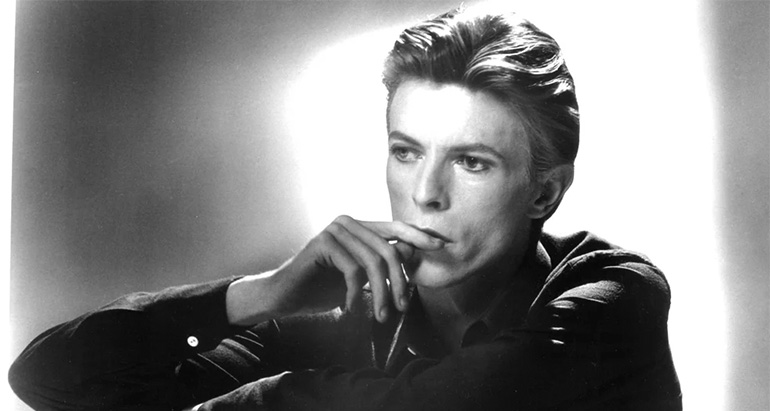
David Bowie (born January 8, 1947, as David Robert Jones in London; died January 10, 2016, in New York City) was a British musician, singer, producer, and actor. In his career spanning more than 40 years, with 26 studio albums, he was one of the most influential musicians in rock and pop music and, with around 140 million records sold, also commercially very successful.
Biography
Childhood and Youth
He was born in 1947 as the son of Haywood Stenton “John” Jones (1912–1969) and Margaret Mary “Peggy” Burns (1913–2001) in the London district of Brixton and grew up in modest but secure circumstances. His father was a marketing manager for the children’s charity Barnardos, and his mother worked as a waitress. The family atmosphere was characterized by silence, which Bowie described in an interview in 1993 as follows: “My childhood was not happy.” Not that it was brutal, but I had a very British kind of parent: they were quite cool, and we didn’t hug much.” David was considered a shy, polite child.
In the early 1950s, the family’s social ascent began. In the winter of 1953, they moved to the middle-class suburb of Bromley in London, and David became a showcase for his parents’ pursuit of status, who placed great importance on neat clothing and a well-groomed appearance. David developed a particularly close bond with his half-brother Terry, who also lived in the house as the mother’s son. He loved his little brother, and David admired the older, emotional, and rebellious Terry. They were treated very differently by their parents; while they spoiled David, they mostly treated Terry with cool correctness, but sometimes they ignored him altogether.
First musical steps
At the age of nine, David Bowie was introduced to rock ‘n’ roll thru his father, who gave him his first singles. About the first record, Little Richard’s Tutti Frutti, he later said: “I had heard God.” In addition to his parents, David’s brother Terry also encouraged his interest in music, introducing him to US beat poets and jazz, and taking the then 13-year-old to concerts in London’s entertainment district, Soho. In 1962, at the age of 15, Bowie sang under the stage name Dave Jay in the group The Kon-Rads, in which he also played the saxophone. The band recorded a song titled I Never Dreamed, co-written by Bowie, in August 1963. In 2018, the only known recording of this session was found in an old bread bin. The demo tape recorded for Decca was rediscovered by David Hadfield, the band’s former drummer. When success failed to materialize, Bowie left the group. The recording was auctioned off in 2018 at the Omega auction house in northwest England for just under £40,000.
In 1964, he recorded his first solo single, “Liza Jane,” which also flopped. In the 1960s, he gained experience as a singer and musician in other bands like the Manish Boys and the Lower Third, all of which did not become well-known. In 1967, he worked with the British mime artist Lindsay Kemp, whose influence was evident in Bowie’s stage shows in the following years. Thru these experiences, the shy young Bowie gradually began to develop very versatile artistic expressions. However, as an aspiring rock star, he feared that his name was too similar to that of Davy Jones, a member of the well-known band The Monkees. Therefore, he gave himself an artist name; in reference to Jim Bowie, he called himself David Bowie from then on.
His debut album, David Bowie, released in 1967, included some songs inspired by musicals, as well as folk songs and ballads, including the title “Please Mr. Gravedigger.” The lack of success prompted him to change his concept. He received a boost from his later producer Tony Visconti, whom he met in late 1967 and who also worked for his friend Marc Bolan. At the beginning of 1969, a half-hour promotional film titled “Love You Till Tuesday” was made. Some songs from the first album and some new compositions were staged. One of these was the space ballad Space Oddity, which was added to the set most recently. Bowie, who was inspired by the Stanley Kubrick film 2001: A Space Odyssey, described the rocket launch of the fictional astronaut Major Tom and his feelings alone in space, as well as the communication with the ground station, which suddenly cuts off at the end of the piece. Ten years later, Bowie explained the space trip in the song Ashes to Ashes as a drug trip of a junkie.
In November 1969, the second album was released, in the United States under the title Man of Words, Man of Music, in the United Kingdom, as with the first album, again under the title David Bowie. In 1972, it was reissued by RCA Records with a new cover under the title Space Oddity. The album includes a re-recording of the title track, which was also released as a single and became Bowie’s first commercial success. Bowie was awarded the Ivor Novello Award for this composition in 1969, and it is one of his best-known works. The single reached number six in the UK sales charts and remained in the top ten for four weeks, and when it was re-released in 1975, the title reached number one. The song, produced by Gus Dudgeon, stood out from the rest of the album with its novelty song character. The rest of the album, with its mix of folk music, Bowie’s voice and his twelve-string guitar, was not a commercial success.
At the beginning of 1970, Bowie recorded two new songs with Marc Bolan: “The Prettiest Star,” which was also released as a single, and “London Bye Ta Ta.” In May, a re-recording of Memory of a Free Festival was released as a single. Although this too was unsuccessful, it is of historical interest as it features the first studio recording of guitarist Mick Ronson, who would remain Bowie’s musical collaborator until 1973. Bowie, Ronson, Visconti on bass and John Cambridge on drums briefly performed under the band name The Hype from early 1970. With this band, Bowie experimented with a new stage concept, where all four performed in costumes and used theatrical techniques. Thus, Bowie dressed up as “Rainbow Man,” Visconti as “Hype Man,” Ronson as “Gangsterman,” and Cambridge as “Pirate Man.”
In 1971, another unsuccessful single (Holy Holy) and Bowie’s third album titled The Man Who Sold the World were released, both produced by Visconti. Stylistically, it leaned toward hard rock, and instrumentally, Ronson’s guitar playing dominated. In the lyrics, Bowie referred to science fiction, Buddhism, and mysticism. On the cover, he appeared in a dress, consciously adopting an androgynous image that characterized his performances in the early 1970s. In 1972, the album was reissued by RCA with a new and less controversial cover. This album also met with little success. The title track was covered several times in later years, by Lulu and Nirvana, among others.
Breakthrough
In 1971, the album Hunky Dory followed. On it, Rick Wakeman can be heard on keyboards, who later became known with the band Yes. In addition, all the members of his alter ego Ziggy Stardust’s later backing band, The Spiders from Mars, played on it: Mick Ronson (guitar), Mick (Woody) Woodmansey (drums) and Trevor Bolder (bass). It was Bowie’s first album for the record company RCA Records, to which his new manager Tony DeFries had introduced him. Among other things, it contains one of Bowie’s best-known songs, Changes, and the ballad Life on Mars?, after which a television series was named in 2006. Bowie’s engagement with the US music and art scene of the time is reflected on the album in nods to Bob Dylan, The Velvet Underground and Andy Warhol. Bowie said that he had experienced widespread artistic recognition for this album for the first time, before he became an icon of glam rock with the next albums.
In 1972, he achieved commercial success. With the album The Rise and Fall of Ziggy Stardust and the Spiders from Mars and the subsequent world tour lasting until 1973, he became widely known. The tour was only briefly interrupted when, on June 10, 1972, he spontaneously boarded a plane from England to New York to attend an Elvis Presley concert at Madison Square Garden, and then immediately flew back to England to continue his tour. One reason was the “creation” of his flamboyant alter ego Ziggy Stardust, whose rise and fall in a doomed world is told. Another was his theatrical stage show with its provocatively homoerotic features. He further fueled this scandalous play with homosexuality at the time by pretending to be gay in an interview. At that time, he had been married to Angela Barnett for two years and had a son, Duncan Jones, born in 1971, whom he later raised alone.
At the end of 1972, Bowie had a top-ten hit in his home country with “The Jean Genie.” During the work on his album Aladdin Sane, the pianist Mike Garson was there for the first time, who became a longtime companion of Bowie’s. The album received over 100,000 pre-orders in England, a number that had only been reached by the Beatles until then. On July 3, 1973, Bowie let Ziggy Stardust “die” (My Death – Jacques Brel) at the last concert of his world tour at the London Hammersmith Odeon, before singing Rock ‘n’ Roll Suicide with his band for the last time.
During this time, Bowie also worked as a producer and promoter for other musicians. He produced, together with Ronson, among other things, Lou Reed’s second solo album Transformer, released in 1972, featuring the hit Walk on the Wild Side, wrote the successful song All the Young Dudes (1972) for the band Mott the Hoople, and produced their eponymous album. He was responsible for the mixing of the Stooges’ album Raw Power (1973). In 1973, Bowie also recorded the album Pin Ups, which contains cover versions from the 1960s. The concept album Diamond Dogs (1974), which is largely based on George Orwell’s dystopia 1984, was recorded by Bowie without his previous backing band The Spiders from Mars and his longtime companion, lead guitarist Mick Ronson. Bowie fell out with his manager DeFries during the US tour and was left with a mountain of debt.
Influenced by his move to New York, the album Young Americans was created in the Sigma Sound Studios in 1975, marking a musical new beginning in which Bowie engaged with the music that had shaped him as a young man, namely rhythm and blues and soul; he himself ironically called his music Plastic Soul. At that time, Bowie appeared in a tailored suit – another image change for the artist. The album features his first number one hit in the United States, Fame. This song, which Bowie recorded with John Lennon in a session at the Electric Lady Studios in New York, was originally not intended for release.
Following the album production, Bowie took on the lead role in the science fiction film The Man Who Fell to Earth by Nicolas Roeg. Afterward, he produced the album Station to Station in Los Angeles, which was released in early 1976. After the Isolar tour in 1976, the musician moved back to Europe. He first went to Switzerland and, after recording tracks for the album Low in France with Brian Eno and Tony Visconti, to West Berlin.
The Berlin Period
Bowie lived for a time with Edgar Froese of Tangerine Dream in Berlin’s Bavarian Quarter, where he went thru a cold turkey withdrawal from hard drugs. Bowie described Froese’s album Epsilon in Malaysian Pale as “an incredibly beautiful, enchanting, apt work… That was the soundtrack to my life when I was living in Berlin.” From 1976 to 1978, he lived in a seven-room apartment in the main street 155 in the West Berlin district of Schöneberg. In later interviews, such as in a report by Arte, he referred to West Berlin as the then “world capital of heroin.”
In the Berlin Hansa Studios, he completed the album Low, the first part of the so-called Berlin Trilogy. Bowie was influenced by German bands such as Tangerine Dream, Kraftwerk, Cluster, Can, or Neu!, but also by Steve Reich. He actually considered the albums, which were not supposed to be about sales figures, as an experiment. But the single Sound and Vision was a big hit; it reached number 6 in Germany and even number 3 in England. While the first side of the LP “Low” consists mainly of song fragments, the second side surprises by containing almost exclusively instrumental pieces, just like its successor “Heroes,” which was also recorded in Berlin a few months later.
“Heroes” features one of Bowie’s most famous songs of the same name, which was recorded in multiple languages, including French/English and German/English. The lyrics are about two lovers who kiss at the Berlin Wall while border guards shoot at them. In this song, Bowie processed not only his own observations in Berlin, but also impressions of 1920s expressionism, such as Otto Mueller’s painting “Liebespaar zwischen Gartenmauern” (Lovers between Garden Walls) from 1916.
With Iggy Pop, who had come to Berlin with Bowie and had moved into a neighboring apartment in the same building, Bowie recorded the albums The Idiot and Lust for Life, most of whose music was written by him. In addition, he went on tour as a keyboard player with Iggy Pop. During his Berlin years, he also played the lead role in Schöner Gigolo, armer Gigolo, Marlene Dietrich’s last film. In 1978, Bowie went on tour again and recorded, among other things, the children’s story Peter and the Wolf with the Philadelphia Orchestra. In the same year, the live album “Stage” was released, and Bowie moved to Switzerland. In 1979, Bowie and Brian Eno recorded their third so-called “Berlin album,” Lodger, at the Mountain Studio near Bowie’s then-residence in Montreux. It was mixed in New York and delivered minor chart successes with the singles “Boys Keep Swinging” and “DJ,” especially in the UK.
Reinvention
After the commercial and artistic failure of the 1987 album Never Let Me Down, Bowie reappeared two years later with the Tin Machine project. Tin Machine was the band around Reeves Gabrels and the brothers Hunt and Tony Sales, with whom Bowie had recorded the Iggy Pop album Lust for Life in 1977 as producer and co-writer. Bowie insisted on being “just one band member among many” and rejected any special role. In 1991, Tin Machine II followed, along with the moderately successful single “You Belong in Rock ‘n’ Roll.”
In 1992, Bowie married Iman Abdulmajid, a world-renowned model and actress from Somalia. That same year, he moved into a 1,900-square-foot apartment in the Essex House on New York’s Central Park, 160 Central Park South, with her. During this time, his album for the film adaptation of Hanif Kureishi’s The Buddha of Suburbia, which was misleadingly referred to and distributed as a soundtrack, was released. The Tin Machine project came to an end in 1993 with the solo album Black Tie, White Noise – again produced by Nile Rodgers. Artistically overall not very innovative, and commercially and due to distribution problems especially in the USA failed, it marked in Bowie’s opinion the overcoming of his creative crisis of the 1980s.
The album 1. Outside, released in September 1995 and once again produced with Brian Eno, was very multifaceted and experimental, but despite some positive and many irritated reviews, it was also not a commercial success. During the subsequent, world-spanning Outside tour with 100 concerts, well-known bands such as “Placebo” in Europe and “Nine Inch Nails” in the United States were available as support acts for Bowie. With Earthling, released in 1997, a work followed that once again confirmed Bowie’s creative drive and exhibited strong influences of drum and bass. Artistically and commercially, the follow-up album Hours… (1999) attracted little attention, in which Bowie returned to simpler song structures. In August 2000, Bowie’s daughter was born.
The year 2002 brought the continuation of the collaboration with Tony Visconti with Heathen. Artistically and commercially (especially in Germany), the album was seen by some fans as a continuation of classic Bowie works and was partly regarded by critics and fans as a comeback. In 2003, the album Reality, produced again by Visconti, was released with the singles New Killer Star and Never Get Old. In the run-up to its release on September 8, 2003, Bowie made music and technology history: on that day, his new studio album was presented live and interactively in cinemas around the world. A live show produced specifically for the occasion was broadcast via satellite to all participating European cinemas simultaneously and – due to the time difference – a day later in Asia, Japan, and Australia as well as North America, Canada, and South America. The show was filmed in digital widescreen format, the sound recorded in DTS-5.1 surround sound and transmitted to the cinemas completely digitally. This made the process the most comprehensive and innovative use of digital technology in cinemas to date.
With A Reality Tour starting in October 2003, Bowie went on one of the longest world tours of his career. Shortly before its end, however, he had to cancel the tour on June 25, 2004, at the Hurricane Festival in Scheeßel due to a heart attack – after his last song Ziggy Stardust. At the time, Bowie was fitted with a stent at the Hamburg General Hospital St. Georg. After his recovery, he appeared, in addition to guest appearances at concerts by “Arcade Fire” and David Gilmour, as curator of the Highline Music Festival in New York in May 2007.
On January 8, 2013 – his 66th birthday – he released a new single titled “Where Are We Now” for the first time in ten years, along with a video by Tony Oursler, a tribute to his time in Berlin from 1976 to 1979. Subsequently, the album The Next Day was released on March 8, 2013. It became one of his most successful albums, reaching number 1 on the charts in Germany as the first Bowie album and topping the charts in 40 countries simultaneously. A variation of the Heroes cover was used as the cover; a white square in the center with the title of the current work obscures the singer’s face.
On November 18, 2015, Bowie’s musical Lazarus, starring Michael C. Hall, was performed for the first time; the official premiere in the presence of Bowie was on December 7, 2015, in New York. The musical is an adaptation of the 1976 film The Man Who Fell to Earth, in which Bowie starred. The title song was released as a single.
For the series The Last Panthers, which aired from October 2015 on various European pay-TV channels, Bowie contributed the title song “Blackstar.” Blackstar was released as a single on 20 November and was the title track of Bowie’s 26th studio album, released on 8 January 2016, his 69th birthday. Blackstar became the first Bowie album to reach the top of the American Billboard 200 and, after The Next Day, Bowie’s second number-one album in Germany. On October 21, 2016, the sampler Lazarus Cast Album was released, featuring Bowie songs from the musical Lazarus sung by the musical’s cast. The album also contains the three previously unreleased Bowie studio recordings No Plan, Killing a Little Time and When I Met You. These pieces are considered to be Bowie’s last recordings, sung shortly before his death. Recorded with the Blackstar musicians, the songs were once again produced by Bowie’s longtime companion Visconti.
Death
Together with his wife Iman and their daughter, David Bowie lived relatively reclusively in two penthouse apartments in SoHo, 285 Lafayette Street, between Prince Street and Houston Street, since 1999. On January 10, 2016, two days after his 69th birthday and the release of the album Blackstar, Bowie died there of liver cancer. He had not told the public about the illness, which had been diagnosed 18 months before his death. In his 2004 will, Bowie had decreed that his body should be cremated. In accordance with his last will, his ashes were scattered on the Indonesian island of Bali in a Buddhist ritual.
Reappraisal
In 2019, the production of a biopic about the life of David Bowie was confirmed. Accordingly, Neil Gaiman is working on the screenplay, Peter Ramsey is set to direct, and Johnny Flynn will take on the lead role in Starman. In August 2019, David Bowie’s son Duncan Jones explained that the film would have to do without the music rights to David Bowie’s records.
Style
David Bowie was inspired by a variety of influences from both Western and non-Western cultures, both in terms of image and music. At the beginning of his career, he was primarily influenced by the contemporary beat music of the time, but also by the British tradition of novelty songs. In addition, he was interested in the American avant-garde band “The Velvet Underground” and the proto-punk band “The Stooges” from Detroit.
Thru Lindsay Kemp, he became known for a particular school of pantomime, which also had references to Japanese Kabuki theater, among other things. He repeatedly used elements from this in his stage show throughout the 1970s. He was also fascinated by the esthetics of transvestites and the homosexual avant-garde, especially in the New York subculture. Initially, he oriented himself to the esthetics of figures from the Andy Warhol circle, from which he shaped his character “Ziggy Stardust.”
With his move to the United States in 1973, he began to develop a stronger interest in soul music, particularly the style that came from Philadelphia and is known as the Philly sound. This influence was first audible on the album Diamond Dogs and shaped the album Young Americans (1975). At the latest since 1974, he also developed a strong interest in German electronic music from “Kraftwerk” and “Neu!” as well as the music of Steve Reich. This was initially reflected in the album “Station to Station” and came fully to fruition in the so-called Berlin Trilogy, which, in collaboration with Brian Eno, became groundbreaking for the further development of electronic music. In the 1980s, he was primarily influenced by contemporary pop music, and in the 1990s, he incorporated influences from drum and bass, among others.
His versatility earned Bowie the nickname “the chameleon of pop.” He countered this by stating that a chameleon adapts to its surroundings, while he had mostly done the opposite. He was often accused of plagiarism. Well-meaning critics, however, give him credit for combining the various influences into a whole of his own, and for helping to make lesser-known, subcultural art and cultural forms known to a wider audience. In addition, numerous younger artists refer to him and his influence on their music and image.
Impact
Music
David Bowie is considered one of the most influential artists of his time – and until the early 1980s, also a pioneer – in the field of contemporary popular music. This is due to his decades-long creative output with a wide musical range: rock with Ziggy Stardust and Diamond Dogs, jazz elements with Aladdin Sane, soul with Young Americans and Black Tie, White Noise, electronic concert music with Low – like Heroes symphonically arranged by Philip Glass – and 1. Outside.
Image
Bowie had the strongest cultural impact with his artistic persona “Ziggy Stardust.” Its image influenced punk, indie and new romantic musicians from Steve Strange to Morrissey. Madonna has said that a Ziggy Stardust concert she attended at the age of 14 changed her life. The character David Bowie was in constant transformation. This creativity alone was absolutely innovative in the music scene until the end, in this ever-contradictory form of thematic self-presentation.
In connection with the album “Station to Station,” Bowie transformed into another persona in 1976 called the Thin White Duke, a name that refers to the line “The return of the Thin White Duke” in the title track. His wardrobe now consisted of a white shirt with black trousers and waistcoat, his hair was slicked back, and his demeanor appeared distant and aloof. Not only because of his self-chosen title of Duke, he was suspected of being fascist in his views. At a live performance, a compromising gesture was then observed, and in interviews he made statements that could be interpreted in this direction. This led to some fans turning away from him. Later, Bowie distanced himself from this phase; the ambiguous statements were probably due to his significant cocaine consumption. An investigation into the events of the time also concluded that Bowie was not a fascist.
His play with sexual identity and gender roles in the 1970s, which he developed from the image of Andy Warhol’s bizarre entourage from the late 1960s and early 70s, was initially a driving force in the development of glam rock; it was also adopted by subsequent artists. Bowie was thus instrumental in making sexual ambiguity acceptable in the mainstream. Brian Slade, the main character in the film Velvet Goldmine (1998) about the glam rock era, is an allusion to David Bowie and modeled after him; however, he is not explicitly referenced in the film.
Almost simultaneously with his musical comeback with The Next Day, the exhibition David Bowie Is took place in 2013 at the Victoria and Albert Museum in London. The museum showcased private pieces from the David Bowie archive for the first time in the international exhibition. The exhibition included around 300 exhibits, including handwritten texts, photographs, films and music videos, set designs, musical instruments, personal collections, 60 stage costumes, self-written song lyrics, drawings, and personal diary entries. A preview in March 2013 opened the museum’s most successful exhibition to date, with a total of 312,000 visitors in five months. It was on tour until March 2016, visiting cities such as Chicago, Paris, and Berlin.
Bowie as an Actor
Since the mid-1970s, Bowie also regularly worked as an actor in feature films and television series. He generally received recognition for it, but not to the same extent as with his musical work. He himself primarily saw himself as a musician, as he stated in interviews. He gained his first experiences as an actor in the late 1960s in the experimental short film The Image and in small promo clips as a mime for his then-mentor Lindsay Kemp.
In 1975, Nicolas Roeg cast him in the lead role of the film The Man Who Fell to Earth, even tho Bowie had no notable acting experience. This film is still considered his best acting performance to this day. However, Bowie later remarked self-critically that he had actually just played himself. At that time, he was heavily addicted to cocaine. Less successful was his portrayal of Paul in 1979’s Just a Gigolo. The film and his performance were both panned by critics and later dismissed by Bowie himself.
In 1981, he had a brief appearance in Christiane F. – We Children from Bahnhof Zoo. He can be seen there in a concert he gave in Berlin. These scenes were filmed especially for the movie and mixed with archive footage. In 1983, he achieved a notable success in the film Furyo – Merry Christmas, Mr. Lawrence, directed by the highly regarded Nagisa Ōshima. In the same year, the film “Desire” was released, in which he starred alongside Catherine Deneuve, and “The Last Emperor,” in which he played a British ensign.
In 1985, Bowie had a minor role in the film “Into the Night,” a thriller by John Landis. In 1986, he was introduced to a younger audience as the Goblin King Jareth in Jim Henson’s film Labyrinth, which fell far short of the expected commercial success. He had a cameo in Martin Scorsese’s 1988 film The Last Temptation of Christ alongside Willem Dafoe and Harvey Keitel as Pontius Pilate.
His lead role in the film Houdini & Company – The Spirit of the Magician (The Linguini Incident) from 1991 alongside Rosanna Arquette has remained relatively unknown. In Twin Peaks – The Movie, the prequel to the cult series Twin Peaks by David Lynch, Bowie played the “long-lost” FBI agent Phillip Jeffries in a short sequence in 1992. Bowie’s performance in the 1996 film Basquiat in a supporting role as Andy Warhol also received attention.
In 2006, he appeared in a supporting role as Nikola Tesla in the film “The Prestige.” In 2007, he lent his voice to Lord Royal Highness in the English original of SpongeBob’s Atlantis Adventure.
Honors
In 1996, Bowie was inducted into the Rock and Roll Hall of Fame. In 1999, he was appointed Commandeur de l’ordre des Arts et des Lettres by the then French Minister of Culture Caroline Trautmann, having already been appointed Officier of this order in 1997.
However, Bowie rejected both the appointment as CBE (Commander of the Order of the British Empire) in 2000 and the even higher honor of KBE (Knight Commander of the Order of the British Empire) in 2003, which would have been associated with the title “Sir.”
In 2000, the New Musical Express named Bowie the “most influential pop musician of all time.” In 2007, he was awarded a lifetime achievement award at the 11th Webby Awards, among other things in connection with his role as a pioneer of the internet music scene.
The giant crab spider species Heteropoda davidbowie, discovered in 2009 by Peter Jäger from the Arachnology Section at the Senckenberg Research Institute in Frankfurt am Main, is named after David Bowie. In 2017, another newly discovered spider species was named after him: Spintharus davidbowiei.
In February 2014, Bowie, at 67 years old, became the oldest musician to receive a Brit Award, his first since 1984. He did not travel from his adopted home in New York to attend the award ceremony, but sent his friend, model Kate Moss, to accept the award in an outfit reminiscent of Bowie’s famous character “Ziggy Stardust.”
In January 2015, the asteroid (342843) Davidbowie was named after him.
On August 22, 2016, Berlin’s Governing Mayor Michael Müller unveiled a Berlin memorial plaque at the building Hauptstraße 155, David Bowie’s former residence in Berlin-Schöneberg. The plaque was violently removed from the building wall under unclear circumstances on September 17, 2016, necessitating the installation of a new plaque on October 5, 2016.
In the Warsaw district of Żoliborz, the Polish artist Dawid Celek created a mural on a residential building on Maria Kazimiera Street (Polish: ulica Marii Kazimiery) at the beginning of 2016. It covers six floors and shows half of the musician’s face, with the Palace of Culture and Science tower placed over the eye. The image is in the Ziggy Stardust style. The occasion was a short stay by David Bowie in the Polish capital in 1976. He had taken a walk near the so-called Danzig station, bought a record in a music shop, and later composed the song Warszawa.
Rolling Stone ranked Bowie 39th among the 100 greatest musicians, 39th among the 100 greatest songwriters, and 23rd among the 100 greatest singers of all time.
In 2013, Bowie was inducted into the Science Fiction Hall of Fame.
On February 6, 2018, during the live broadcast of the maiden launch of SpaceX’s Falcon Heavy rocket, the refrain of Life On Mars? was played in honor of David Bowie. The rocket carried a Tesla Roadster from Elon Musk’s personal collection into space, with a mannequin named Starman sitting in it, named after Bowie’s song of the same name. It was also announced that the vehicle itself would play the song Space Oddity, which, however, is not audible due to the lack of atmosphere in space.
Musical collaboration with other artists
Bowie collaborated with many prominent colleagues throughout his long career, including his former partner Romy Haag, as well as Marc Bolan (Prettiest Star, Madman, Standing Next to You), Brian Eno (Heroes, Low, Lodger, 1. Outside), Mick Jagger (Dancing in the Street), John Lennon (Fame), Marianne Faithfull (I Got You Babe), Bing Crosby (Little Drummer Boy), Tina Turner (Tonight), with whom he made a guest appearance on her European tour in 1985, Pat Metheny (This Is Not America), Philip Glass (Low and Heroes Symphony), Luther Vandross, Quincy Jones, Queen (Under Pressure), Meshell Ndegeocello, Klaus Nomi, Frank Black, Pet Shop Boys (Hello Spaceboy), Lou Reed, and Iggy Pop. In the mid-1990s, he toured with Nine Inch Nails (Trent Reznor), worked with Placebo (Without You I’m Nothing), Moby, British DJ Goldie (Truth) and Kashmir, American singer Kristeen Young (The Cynic), Denmark, TV on the Radio, Canadian band Arcade Fire and Scarlett Johansson. In 1979, he helped to launch the career of Klaus Nomi by appearing with the singer, who was known only in insider circles until then, on a major US television show.
For his 50th birthday, Bowie gave a concert at Madison Square Garden in New York on January 9, 1997, in front of 20,000 spectators, where, in addition to Lou Reed, well-known representatives of the “new alternative” music scene also participated, such as Frank Black (Pixies), Billy Corgan (The Smashing Pumpkins), Robert Smith (The Cure), Sonic Youth, Brian Molko from Placebo, and the Foo Fighters. Lou Reed (Transformer), Iggy Pop (The Idiot) and Mott the Hoople (All the Young Dudes) in particular benefited from Bowie’s production qualities. In 2006, Bowie and David Gilmour re-recorded the Pink Floyd song Arnold Layne, and placed in the British charts.
Personal
Wealth
David Bowie was considered one of the richest artists in the world. There are different figures regarding the amount of his fortune. Forbes estimated Bowie’s fortune at 230 million dollars. It was divided by Bowie in his will between his wife, his children, an assistant, and a nanny.
Bowie Bonds and the Internet
In February 1997, Bowie took a new approach to making money with his music: he issued a bond (Bowie Bonds) backed by the future earnings of 287 of his songs, which brought him a whopping 55 million US dollars all at once. The ten-year bond was initially rated “A3” by the agency Moody’s, which is a very good credit rating. After a significant drop in sales of Bowie’s records, the bond was downgraded to “Baa3” in 2004, which is one level above junk status.
Bowie is also considered a pioneer in self-marketing on the internet. His website has been online since 1996. The majority of the content could only be viewed by members. There was the possibility to create your own blogs and participate in special member-only raffles, including for concerts and meet and greets.
Eye color
In a fight in 1962 with his friend George Underwood, which was about a girl, the pupil muscles of his left eye were injured. This resulted in a dilated, fixed pupil (traumatic mydriasis) and the left eye appeared darker as a result. Bowie and Underwood remained good friends despite the incident. As a painter, Underwood later even contributed to the design of some album covers, such as the album cover of Bowie’s Hunky Dory (1971).
Sexual orientation
There was often speculation about Bowie’s possible bisexuality. Headlines like “David Bowie loves a man” during his relationship with the transsexual entertainer Romy Haag were the order of the day in the 1970s. Bowie himself had created this image with his androgynous, sometimes almost feminine appearance, and had declared to the Melody Maker, mainly for publicity reasons, “I am gay,” a sensational revelation at the time. Affairs with Bowie’s occasional roommate Iggy Pop and with Mick Jagger were reported in the press, and the Rolling Stones song Angie is said to be based on a love triangle between Jagger, Bowie and his ex-wife Angela Barnett, which was later denied. Bowie’s public announcement that he was “no longer gay” coincided with his image change from avant-garde artist to pop star in the early 1980s.
