
Part 1:
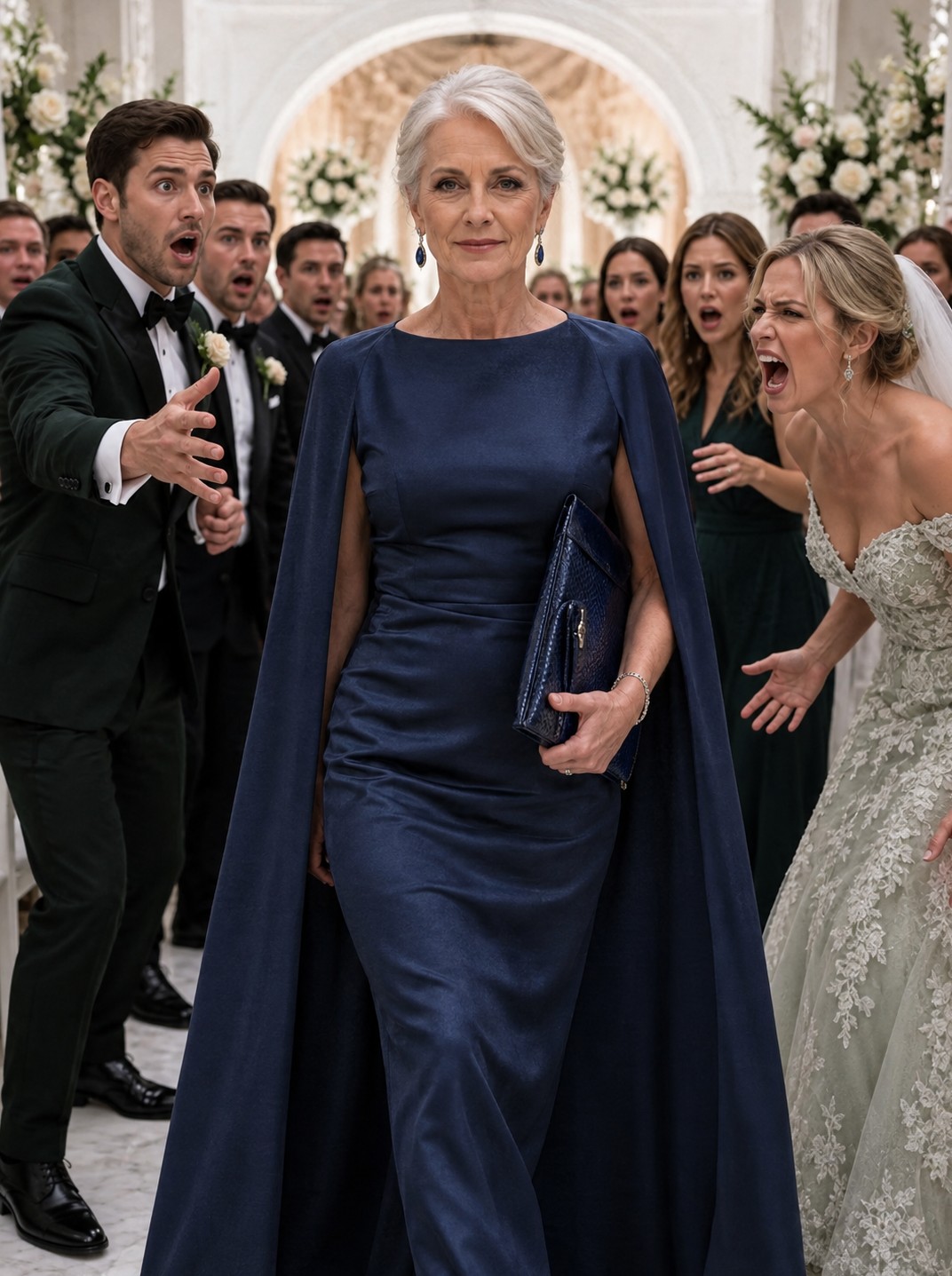
I arrived at my son’s wedding wearing the blue dress I had saved for two years.
I had imagined that day so many times.
I imagined hugging my son. I imagined telling him how proud I was. I imagined watching him dance with his new wife and maybe shedding a few tears when he thanked everyone who had helped him get there.
Instead, the first thing I heard was:
“I’m sorry, ma’am. Your name isn’t on the guest list.”
For a moment, I honestly thought I had heard her wrong.
The young woman standing at the entrance held a tablet in both hands. Behind her, the Napa Valley estate looked like something from a magazine. White roses covered the stone walls. Soft violin music floated through the courtyard. Women in designer dresses posed beside a stone fountain while photographers moved around them.
I looked down at myself.
My blue dress was simple but beautiful. I had bought it two years earlier and saved it specifically for Ivan’s wedding. I wore comfortable shoes because my feet were no longer as young as they used to be. In my purse was a small envelope containing a letter I had written the night before.
A letter for my son.
Because a mother always believes there is still something beautiful left to say to her child on his wedding day.
“Please check again,” I said softly. “I’m the groom’s mother.”
The young woman looked down at the tablet again.
She scrolled.
Then she looked back at me.
Her expression changed.
It was pity.
“I’m sorry, ma’am. You are not authorized to enter.”
That word hurt more than I expected.
Authorized.
As if I were a stranger trying to enter a place where I had no right to be.
I stared at her for a few seconds.
Then I looked past her.
And I saw him.
Ivan.
My son stood near the main garden in a black tuxedo, smiling perfectly for photographs. He looked confident, handsome, and completely at ease.
I started walking toward him before anyone could stop me.
When he saw me, his smile disappeared.
He did not look surprised.
He did not look happy.
He looked annoyed.
“What are you doing here?” he asked through clenched teeth.
I stared at him.
“I came to your wedding, son. My name isn’t on the list.”
He glanced around quickly, as if he was more worried about who might see us than about what he had just said.
Then he rolled his eyes.
“Did you really think you were invited?”
For a second, I forgot how to breathe.
Behind him, Brenda appeared.
She looked beautiful in her white silk wedding gown. Tiny pearls were sewn into the sleeves, and her diamond earrings caught the afternoon light.
She wore a small smile.
I knew that smile.
It was the kind of smile that could hurt someone without ever raising its voice.
“Ivan, honey,” she said, “don’t make this longer than it needs to be. The family pictures are about to start.”
I looked at my son.
The little boy I had adopted when he was three years old.
The child I had first met in a foster care office in Sacramento.
I still remembered that day.
He had been sitting alone, holding a stuffed dinosaur with one missing eye.
When I walked into the room, he watched me carefully.
I knelt beside him.
He grabbed my skirt.
Then he looked up at me with frightened eyes.
“Are you going to leave too?” he asked.
I had promised him I wouldn’t.
And I had kept that promise.
For thirty-one years.
I gave Ivan my last name.
My home.
My youth.
My time.
My money.
My heart.
I worked as a school secretary during the day and sewed uniforms at night so I could afford better schools for him. When he needed surgery, I sold my mother’s wedding necklace.
When he needed a laptop, I stopped buying new shoes.
When he needed tutoring, I worked extra hours.
I paid for summer programs, school trips, college application fees, and things he probably never even knew I had sacrificed to afford.
“Ivan,” I whispered, my voice shaking, “I’m your mother.”
His expression hardened.
“My mother would respect my life,” he said.
I stared at him.
He continued.
“Brenda is right. You always make everything emotional. You always want people to feel sorry for you. You always act like everything revolves around what you sacrificed.”
Brenda sighed.
“Clara, please don’t take this personally,” she said. “We just wanted an elegant wedding with people who fit the image.”
People who fit.
I looked around.
The expensive flowers.
The luxury cars.
The designer clothes.
The photographers.
And suddenly I understood.
I did not fit.
Not because I had done anything wrong.
But because I reminded Ivan of the life he wanted to hide.
The life before the expensive clothes.
Before the wealthy friends.
Before Brenda’s family.
Before he could pretend he had built everything alone.
I remembered the first time Brenda insulted me in my own kitchen.
She had tasted my chicken stew, wrinkled her nose, and said she couldn’t understand how Ivan had grown up eating food that tasted like a church basement fundraiser.
I had waited for Ivan to defend me.
He hadn’t.
He had simply kept eating.
After that, the comments became more frequent.
My clothes.
My age.
My small house.
My phone calls.
My visits.
My old car.
Even the way I hugged my own son.
“Your mom is too needy,” Brenda would tell Ivan.
“A woman in her seventies should have her own life instead of clinging to her grown son.”
And Ivan would nod.
When they got engaged, I was the last person to know.
I had arrived at a dinner believing we were celebrating Ivan’s birthday.
Instead, Brenda suddenly held up a diamond ring.
Everyone shouted, “Surprise!”
I smiled.
I even hugged them.
But something inside me already understood.
They had started removing me from the picture.
A few weeks later, Ivan called me.
“It’s going to be a small wedding, Mom,” he said. “Only close family.”
I believed a mother counted as close family.
I was wrong.
Now I stood outside the Napa estate while my son prepared to marry the woman he had chosen.
And I finally understood what I had been to him.
I was useful when I paid.
Useful when I babysat.
Useful when I solved problems.
Useful when I signed documents.
Useful when I gave him money.
Useful when I stayed quiet.
And useful when I disappeared before important people arrived.
I could have cried.
I could have begged.
I could have reminded him of every fever I sat beside.
Every tuition payment.
Every hospital night.
Every birthday cake I baked after working twelve hours.
Every time I went without something so he could have something better.
But something inside me became still.
Very still.
Then I smiled.
“I understand perfectly,” I said.
Brenda blinked.
Ivan frowned.
“Don’t make a scene, Mom.”
“I won’t,” I replied. “Have a beautiful wedding.”
Then I turned around.
Nobody followed me.
Nobody stopped me.
Nobody said, “Wait. She belongs here.”
I walked back through the entrance, past the white roses and the fountain, and toward the parking area.
A taxi was waiting near the gate.
I climbed inside.
Only after the door closed did I allow myself to look down at the envelope in my lap.
The letter.
The letter I had written for my son.
I had written about love.
Forgiveness.
Memories.
Pride.
And the little boy who had once been afraid that everyone would leave him.
He would never read it.
I took out my phone.
Then I called Samuel Price, my attorney of more than twenty years.
“Clara?” he answered. “What happened?”
I looked through the window at the estate where my son was getting married without me.
“No,” I said quietly. “Everything is not all right.”
Samuel became silent.
“What happened?”
“Ivan just showed me exactly what I’m worth to him.”
There was a pause.
Then I said the words I had never imagined I would say.
“Execute everything we discussed.”
Samuel did not answer immediately.
“Are you sure?” he finally asked. “Once we start, there is no going back.”
I looked down at the letter.
“I’m sure.”
Then I took a breath.
“If I am not his mother in public, I will no longer be his safety net in secret.”
Samuel exhaled slowly.
“Then I’ll begin tonight.”
I leaned back against the taxi seat.
Through the window, the wedding lights were beginning to glow.
Ivan had no idea what was about to happen.
He did not know that the luxury condominium he lived in was still owned through a trust I controlled.
He did not know that I had personally funded most of the down payment.
He did not know that I had been making the mortgage payments for three years.
He did not know that his business loans were backed by assets connected to me.
He did not know that the expensive car he drove was still being paid through an account I controlled.
He did not know that his credit card, investor dinners, and several other expenses were still being quietly covered by me.
He thought he had built his life alone.
I had simply allowed him to believe it.
By the time he lifted his champagne glass at the reception, the first financial instructions would already be moving.
By the next morning, his comfortable life would begin to change.
Not because I wanted revenge.
Because I was finally removing myself from a life where I was useful in private and unwanted in public.
Ivan had forgotten one important thing.
A mother can forgive almost anything.
But she does not have to keep funding her own humiliation.
Part 2:
While Ivan and Brenda celebrated their wedding beneath strings of golden lights, I sat at my kitchen table in Oakland, still wearing the blue dress.
I had taken off my earrings.
The letter remained unopened beside my cup of tea.
For the first time in thirty-one years, I was not thinking about what Ivan needed.
I was thinking about what I needed.
At 8:47 that evening, my phone rang.
It was the property management company that handled the condominium Ivan and Brenda lived in.
“Mrs. Whitmore,” the manager said, “we received instructions from your attorney regarding the Lake Street condominium.”
“Yes.”
“We’ll begin changing the billing arrangements immediately. Mr. Whitmore will need to assume responsibility for all future payments.”
“Thank you,” I said.
That condo was one of the biggest secrets in Ivan’s life.
His friends believed he had bought it himself.
Brenda believed her new husband owned a beautiful luxury home because he was successful.
The truth was different.
I had provided the down payment.
My trust still held the ownership interest.
And for the previous three years, I had quietly covered the mortgage because Ivan kept telling me his startup was about to take off.
I had never complained.
I had never told his friends.
I had never asked him to thank me.
I simply helped.
Until that day.
The second call came from my bank.
“Yes,” I told the representative. “Please remove Ivan Whitmore as an authorized user from all accounts.”
I paused.
“Close the credit card ending in 4421. Cancel the automatic payments to Stanford Capital Loans, Everline Auto Finance, and Westbridge Membership Club.”
The representative hesitated.
“Mrs. Whitmore, some of those payments are scheduled within the next forty-eight hours.”
“I know.”
“Would you like us to notify Mr. Whitmore?”
“No,” I said. “He can read his own statements.”
The third call came from Samuel.
“It’s done,” he said.
I closed my eyes.
“The trust amendment has been filed. Ivan is no longer a beneficiary under the terms we changed. The business loan guarantee has been withdrawn where legally permitted under the agreement. The condo payment transfer is underway, and the vehicle payments will become his responsibility after the current billing cycle. I also sent the formal notice ending the monthly support arrangement.”
I sat quietly.
For years, I had been the invisible foundation underneath Ivan’s beautiful life.
The condo.
The car.
Some of his student loan payments.
Investor dinners.
His gym membership.
The health insurance gap when he left his job.
Even the expensive suit he wore to his wedding rehearsal dinner.
Brenda believed Ivan was successful.
Polished.
Independent.
But she had married a lifestyle that I had quietly helped finance.
“Clara?” Samuel asked.
“I’m here.”
“Are you all right?”
I looked at the blue dress hanging over the back of the chair.
“No,” I said honestly. “But I’m awake.”
At the wedding, Ivan noticed nothing at first.
He danced with Brenda.
He smiled for photographs beside her wealthy parents.
He gave a speech about hard work and vision.
“Everything I have,” he said, raising his glass, “I earned by refusing to settle.”
The guests applauded.
Brenda squeezed his hand.
At 10:13 p.m., Ivan’s phone buzzed.
He ignored it.
At 10:21, it buzzed again.
At 10:29, Brenda noticed.
“Who keeps calling you?” she whispered while smiling at the guests.
Ivan checked his phone.
His expression changed.
There were missed calls from the property management company, his bank, Everline Auto Finance, and Samuel.
His stomach tightened.
“What is it?” Brenda asked.
“Nothing,” he said. “Probably paperwork.”
But by midnight, the paperwork had become a storm.
Ivan’s credit card was declined when he tried to pay the remaining balance for the after-party bar.
The hotel asked for another card for the suite deposit because the original payment had been reversed.
His car account showed a payment failure.
Then a notice appeared from the condominium management system informing him that ownership and billing records were being reviewed and that his access credentials could be affected if the new arrangements were not completed.
Then he received an email from Samuel.
He opened it in the hotel bathroom while Brenda removed her veil in the bedroom.
The message was formal and direct.
All voluntary financial support from Clara Whitmore was ending.
Housing assistance.
Loan support.
Vehicle payment support.
Personal credit authorization.
Business-related guarantees.
And trust benefits.
From that point forward, financial obligations in Ivan’s name were his responsibility.
Ivan read the message three times.
His face went cold.
He called me.
I did not answer.
He called again.
Still nothing.
Then he sent a text.
Mom, what the hell is this?
I saw it.
I did not reply.
For the first time in thirty-one years, I let Ivan experience the silence he had given me.
The next morning, Brenda woke to find Ivan pacing across their hotel room.
He was still wearing yesterday’s dress shirt.
His hair was messy.
His face was pale.
His phone was pressed against his ear.
“No, there has to be a mistake,” he snapped. “My mother doesn’t make decisions like this. She’s emotional. She’ll fix it.”
Brenda sat up.
“Fix what?”
Ivan turned away.
“Ivan.”
He ended the call.
“What happened?” she demanded.
He rubbed both hands over his face.
“My mom is upset.”
Brenda rolled her eyes.
“Because of yesterday? She’ll get over it. Women like her always do. Just call her and act sweet.”
“She cut everything off.”
Brenda stared at him.
“What do you mean, everything?”
“The condo payment. The car. The credit card. The loan guarantees. The monthly transfers.”
Brenda slowly got out of bed.
“The condo?”
Ivan said nothing.
She stared at him.
“Ivan, you told me you bought that condo.”
“I did, basically.”
“Basically?”
“My mom helped with the down payment.”
“How much?”
He looked away.
Her voice became sharper.
“How much?”
“She owns the property through her trust.”
The silence that followed was worse than shouting.
Brenda laughed once.
It was a cold, empty laugh.
“So the home you brought me to, the home you told everyone proved you were established, belongs to the woman you let stand outside our wedding?”
Ivan flinched.
“Don’t say it like that.”
“How should I say it?”
She stared at him.
“Your mother has been paying for our lifestyle while you allowed me to call her embarrassing?”
“You called her embarrassing because she is embarrassing!”
Brenda’s face hardened.
“No. She was useful.”
Ivan looked at her.
“And you were stupid enough to humiliate her before you made sure you could replace what she provided.”
For one painful second, Ivan saw something behind Brenda’s beauty.
Calculation.
Fear.
Not love.
At my house, the morning was quiet.
I made coffee.
I watered my plants.
Then I took the blue dress off the chair and placed it back in the closet.
After that, I returned to the kitchen table.
The letter was still there.
I opened it.
The first line read:
My dear Ivan, no matter how old you become, a part of me will always see the little boy who held my hand and asked me not to leave.
My fingers trembled.
I folded the letter again.
Then I placed it in a drawer.
Around noon, Samuel arrived carrying a folder and a box of pastries.
He had known me for more than twenty years.
He had been there when I first came to him about adoption paperwork.
He had watched me fight for Ivan.
Protect Ivan.
Support Ivan.
Build my life around a child the world had nearly forgotten.
“You don’t have to pretend with me,” Samuel said, putting the pastries on the counter.
I gave him a tired smile.
“Good. I don’t have enough energy left to pretend.”
We sat at the kitchen table.
Samuel opened the folder.
“There is something else.”
I looked up.
“Ivan called my office six times this morning. Brenda called twice. Then Brenda’s father called.”
I sighed.
“Of course he did.”
“Her father implied that if you don’t reverse your decisions, they may claim you used financial control to emotionally manipulate Ivan.”
I almost laughed.
“I paid his bills for thirty years, and now I’m abusive because I stopped?”
Samuel nodded.
“That’s usually how entitled people describe boundaries.”
I looked toward the window.
“I don’t want revenge, Samuel.”
“I know.”
“I just want to stop being the floor people wipe their shoes on.”
Samuel closed the folder.
“Then don’t open the door until they learn to knock.”
But Ivan did not knock.
That evening, he arrived at my house pounding on the front door.
Brenda stood behind him in oversized sunglasses and a white designer coat.
Her diamond ring flashed under the porch light.
I opened the door but kept the chain attached.
Ivan’s face was red.
“What did you do?”
I looked at him calmly.
“Good evening, Ivan.”
“Don’t good evening me! You’re ruining my life!”
“No,” I said. “I stopped funding it.”
Brenda stepped forward.
“Clara, this is ridiculous. Yesterday was stressful. Weddings are stressful. Maybe mistakes were made.”
I looked at her.
“Mistakes?”
She forced a smile.
“You know what I mean.”
“No,” I said. “I don’t think I do.”
Ivan slammed his palm against the doorframe.
“Mom, open the door.”
“When you speak respectfully.”
His mouth fell open.
“Are you serious?”
“Yes.”
Brenda crossed her arms.
“Do you understand how this looks? We just got married. People know where we live. We have responsibilities.”
I nodded.
“Then you should handle them.”
Ivan leaned toward the opening.
“You can’t just take the condo. That’s my home.”
“It is my property.”
“You gave it to me!”
“I let you live there.”
“You said you wanted me to be secure.”
“I did.”
My voice became quieter.
“And you used that security to pretend I didn’t exist.”
Ivan’s anger flickered.
Underneath it was fear.
“Mom, come on,” he said more softly. “You’re hurt. I understand. But this is too much.”
I studied his face.
I searched for the little boy I had loved.
The teenager who once brought me a wilted grocery-store rose on Mother’s Day.
The college student who called me crying after his first heartbreak.
I wanted to find that boy.
I wanted desperately to find him.
But all I saw was a grown man frightened by consequences.
“Do you know what hurt me most?” I asked.
Ivan looked down.
“The guest list thing was Brenda’s idea.”
Brenda’s head snapped toward him.
I smiled sadly.
“No, Ivan. What hurt me most was not that Brenda pushed me out.”
I looked directly into his eyes.
“It was that you let her.”
Brenda crossed her arms.
“We wanted a certain image.”
“And now you have one,” I said. “A beautiful image. No mother in the frame.”
Ivan’s jaw tightened.
“So that’s it? You’re going to throw me away because of one mistake?”
My eyes filled with tears.
But my voice remained steady.
“I did not throw you away when you screamed that I wasn’t your real mother at thirteen.”
Ivan froze.
“I did not throw you away when you wrecked my car at seventeen. I did not throw you away when you failed your first semester of college and lied about it. I did not throw you away when you borrowed money and forgot to pay it back.”
I took a breath.
“I did not throw you away when you stopped calling unless you needed something.”
Ivan said nothing.
“But yesterday,” I continued, “you looked me in the eye and asked if I really thought I deserved to be invited to your wedding.”
My voice broke slightly.
“That was not a mistake.”
I looked at him.
“That was a confession.”
For once, Ivan had no answer.
Brenda did.
“This is emotional blackmail.”
I looked at her through the narrow opening.
“No, Brenda.”
My voice was calm.
“Emotional blackmail is letting an older woman pay your mortgage, cover your husband’s loans, buy your groceries, and support your lifestyle while telling her she doesn’t fit your image.”
Brenda’s face went pale.
Ivan whispered, “Mom, please.”
That word almost broke me.
Please.
I remembered how often he had said it as a child.
Please don’t go.
Please stay until I fall asleep.
Please come to school with me.
Please make the bad dream stop.
I had answered every one of those pleas with my whole life.
But this time, I stepped back.
“You have thirty days to refinance the condo or move out,” I said. “Samuel will send the documents.”
Then I closed the door.
Ivan stood silently on the porch.
For the first time, Brenda did not take his hand.
Part 3:
The following week was ugly.
Ivan called.
He texted.
He emailed.
He left voicemails that moved between rage, blame, and desperation.
One message accused me of betraying him.
Another accused me of trying to destroy his marriage.
Another said I was punishing him simply because he had grown up.
I saved every message.
I answered none of them.
Then Brenda began calling.
Her messages were different.
Smoother.
She said they should talk like adults.
She said families made mistakes.
She said I was “still welcome” to join them for a private dinner once everyone had calmed down.
She said there was no reason to involve lawyers over “misunderstandings.”
I listened to one message.
Then I deleted the rest.
Five days later, the condo notice arrived.
Ivan now had thirty days to refinance the property or move out.
The car lender contacted him directly.
His business partners also discovered that I had withdrawn my personal guarantee from their expansion financing where the agreement allowed it.
That was when Ivan’s polished world began to crack in public.
His startup was not profitable.
His salary depended heavily on performance.
The expensive dinners he hosted had often gone onto the credit card I had been paying.
His investor confidence depended partly on the impression that he came from money and stability.
Without my financial support, the illusion disappeared quickly.
He was not a wealthy young founder.
He was a man in an expensive suit standing on borrowed ground.
Brenda’s parents learned the truth during brunch.
Her father, Richard Voss, was a successful real estate developer with a voice that could make a room go quiet.
He looked at Ivan.
“How much of your lifestyle was actually yours?”
Ivan tried to explain.
He talked about growth phases.
Temporary family support.
Liquidity.
Future projections.
Business expansion.
Richard listened for several minutes.
Then he said:
“So none of it.”
Ivan had no answer.
Brenda cried in the bathroom.
Not because she suddenly understood how much Clara had suffered.
She cried because her wedding photographs had barely been printed before her new life had become embarrassing.
Two weeks later, Ivan came to my house alone.
This time, he knocked.
I saw him through the window.
He looked thinner.
His hair was uncombed.
He wore jeans and the old gray hoodie I had bought him in college.
For several seconds, I almost did not open the door.
Then I did.
There was no chain this time.
But I did not invite him in immediately.
“Hi, Mom,” he said.
The word landed softly.
But I had learned that soft words could still hide sharp intentions.
“What do you need, Ivan?”
He winced.
“Can I come in?”
I hesitated.
Then I stepped aside.
He walked into the house where he had grown up.
Nothing was grand.
There were family photographs on the walls.
A bookshelf full of old paperbacks.
A quilt over the couch.
The faint smell of cinnamon tea.
Ivan slowly looked at the photographs.
There he was at four, missing two front teeth.
At seven, dressed as a firefighter.
At twelve, holding a science fair ribbon.
At eighteen, standing beside me at graduation while I cried harder than he did.
His face changed.
“You kept all of these,” he whispered.
“Of course.”
He turned toward me.
“Brenda said you kept them to make me feel guilty.”
I looked at him.
“And what do you think?”
Ivan stared at the wall.
“I don’t know anymore.”
It was the first honest thing he had said in a long time.
He sat down on the couch.
His elbows rested on his knees.
“Everything is falling apart.”
“I know.”
He looked up.
“You know?”
“People talk.”
He gave a bitter laugh.
“Brenda moved into her parents’ guesthouse.”
I said nothing.
“She said she needs space. Her father wants a postnuptial agreement. Her mother told her she married beneath her.”
I watched him carefully.
“And what do you want from me?”
He rubbed his hands together.
“I don’t know.”
“You do know.”
His eyes filled with tears.
“I want my mom.”
My throat tightened.
His face crumpled.
“I thought if I became important, nobody would see where I came from. I thought if Brenda’s family accepted me, I’d finally be safe from being that little unwanted kid.”
I closed my eyes for a moment.
He continued.
“And you reminded me of everything I was trying to hide. Not because you did anything wrong. Because you knew me before I could pretend.”
Tears ran silently down my cheeks.
“I was ashamed,” he whispered. “Not of you. Of me.”
He took a shaky breath.
“Of being adopted. Of being poor. Of needing you.”
He looked at me.
“Brenda made it sound like I had to choose between the life I wanted and the woman who raised me.”
His voice broke.
“And I chose wrong.”
I wanted to run to him.
Every instinct in me wanted to hold him.
But love without boundaries had already helped create the man sitting in front of me.
So I stayed where I was.
“Ivan,” I said softly, “I believe that pain is real.”
He nodded.
“But pain explains cruelty. It does not excuse it.”
He wiped his eyes.
“I know.”
“Do you?”
I leaned forward.
“You didn’t just hurt me. You used me. You let me pay for a life where I wasn’t welcome. You allowed your wife to humiliate me. You allowed strangers to turn me away from your wedding while you stood there protecting your image.”
“I know,” he said again.
This time, his voice was smaller.
I looked at him.
“I need you to understand something.”
He waited.
“I will always be the woman who adopted you.”
His eyes filled again.
“I will always love you.”
He swallowed.
“But I am done being your emergency exit.”
He looked down.
“Can we fix this?”
“We can try.”
His shoulders lifted slightly.
“But not with money,” I added.
They dropped again.
“I will not restore your credit cards. I will not pay your condo. I will not guarantee your loans. And I will not put you back into my trust simply because you cried in my living room.”
He nodded.
“If you want a relationship with me, it starts with accountability.”
“What do I have to do?”
I looked directly at him.
“For once, live the truth.”
The next month tested him.
Ivan moved out of the condo before the thirty-day deadline.
He rented a small one-bedroom apartment in Sacramento near his office.
He sold the Tesla.
He bought a used Toyota with a dented bumper.
He canceled the country club membership Brenda loved posting about.
He met with a financial adviser who gave him a brutal but necessary assessment.
His income did not match his lifestyle.
It never had.
He also wrote me a letter.
Not a text.
Not a message copied from the internet.
A real letter.
It was nine pages long.
He apologized for the wedding.
For years of taking.
For hiding me.
For allowing Brenda to insult me.
For pretending that adoption made me less of his mother.
He wrote that the truth was the opposite.
Adoption meant I had chosen him.
I read the letter three times.
I cried every time.
But I did not call him immediately.
Healing, I knew, was not a performance.
Brenda did not seem interested in healing.
One afternoon, she arrived at my house in a black SUV driven by her father’s assistant.
This time there was no fake smile.
She stood on my porch with perfect makeup and angry eyes.
“You must be very proud,” she said.
I held the door halfway open.
“Of what?”
“You destroyed my marriage.”
“No,” I said. “I stopped financing the lie inside it.”
Her mouth tightened.
“Ivan was doing fine before you interfered.”
“Ivan was doing fine because I was quietly holding up the roof.”
“You made him weak.”
I studied her.
“No, Brenda. I made him loved.”
She stared at me.
“You made him ashamed of it.”
She stepped closer.
“He had potential.”
“He still does.”
“Not like this. Not broke. Not living in some sad little apartment. Not driving a used car.”
My eyes hardened.
“Then you never wanted Ivan.”
She said nothing.
“You wanted the packaging.”
Brenda gave a cold laugh.
“And what did you want? A son who worshipped you forever because you adopted him?”
My face became still.
For a moment, she thought she had won.
Then I said:
“I wanted a son who remembered that love is not something you throw away when richer people are watching.”
Brenda looked away first.
Part 4:
Two months later, Ivan filed for an annulment.
The marriage had lasted sixty-three days.
Brenda’s family tried to keep everything quiet.
But Napa weddings, broken engagements, canceled financial arrangements, and sudden separations do not stay private among people who care deeply about appearances.
Rumors spread.
Some people said Clara had destroyed the marriage.
Others said Brenda had married a man without understanding what was underneath the expensive lifestyle.
A few said Ivan deserved everything that happened.
I ignored all of them.
I had spent too many years worrying about what other people thought.
I was finished.
Instead, I began volunteering twice a week at a foster youth center in Oakland.
Samuel had suggested it.
“You spent so many years giving everything to one child,” he told me. “Maybe your heart needs somewhere safe to put all that love.”
I resisted at first.
Then I met Jonah.
He was seventeen.
Tall.
Quiet.
Guarded.
He was aging out of the foster system with two garbage bags filled with his belongings.
Nobody was coming to his graduation.
Something about him reminded me of Ivan.
That hurt.
But it also made me want to help.
I helped Jonah fill out community college applications.
I taught him how to make soup.
I bought him a winter coat and pretended not to notice when he cried into the sleeve.
One evening, Ivan unexpectedly arrived at the center.
I was in the kitchen helping prepare dinner when I saw him standing in the doorway.
My face softened.
But I did not rush toward him.
I had learned not to rush.
“What are you doing here?” I asked.
He held up a cardboard box.
“You told me to live the truth.”
I looked at the box.
“I thought maybe I could start by giving away some of the things that came from the lie.”
Inside were designer shoes, watches, unopened cologne, and expensive wedding gifts he no longer wanted.
I looked at him.
“These kids don’t need cologne.”
He almost smiled.
“No. But the center has a fundraising auction next month. I called ahead.”
I nodded.
“That was thoughtful.”
The word seemed to mean more to him than praise ever had.
After that, he began coming every Thursday.
At first, the teenagers didn’t trust him.
They could smell guilt before he even opened his mouth.
But Ivan didn’t give speeches.
He served food.
He carried boxes.
He repaired a broken printer.
He helped with resumes.
He listened.
One evening, a boy named Marcus snapped at him.
“You don’t know what it’s like to be unwanted.”
Ivan became completely still.
Then he said:
“Actually, I do.”
Marcus looked at him.
“And I also know what it’s like to hurt the person who chose you because you’re still angry at the people who didn’t.”
Marcus said nothing.
I had heard the entire exchange from the hallway.
For the first time in months, I allowed myself to hope.
The following spring, the foster center held a small fundraiser in a church hall.
There were no white roses.
No violins.
No vineyard.
No champagne tower.
Just folding tables, donated food, paper plates, and a handmade banner.
EVERY CHILD DESERVES SOMEONE WHO STAYS.
I stood near the back helping serve coffee.
Then Ivan walked toward the microphone.
He looked nervous.
Not polished nervous.
Real nervous.
“My name is Ivan Whitmore,” he began.
The room became quiet.
“Some of you know my mother, Clara. Some of you know she adopted me when I was three years old.”
My hand froze around the coffee pot.
“What most people don’t know is that last year, I made her stand outside my wedding because I was ashamed of the life that saved me.”
The room became completely silent.
Ivan swallowed.
“I thought success meant cutting away anything that made me look poor, wounded, or dependent.”
He looked down.
“I thought love was something I could outgrow once I had nicer clothes and richer people around me.”
He looked toward me.
“I was wrong.”
My eyes filled with tears.
“My mother gave me everything.”
His voice shook.
“And when I treated her like nothing, she did the hardest and most loving thing she could have done.”
He took a breath.
“She stopped saving me from myself.”
I covered my mouth.
Ivan continued.
“I’m not here to ask her to forget what I did.”
He looked directly at me.
“I’m here to say publicly what I should have said publicly before.”
His voice became stronger.
“Clara Whitmore is my mother.”
Tears rolled down my face.
“Not because of blood. Because of every choice she made when she could have walked away and didn’t.”
The room blurred through my tears.
Ivan stepped away from the microphone.
Then he walked toward me.
He stopped several feet away.
He did not assume he had the right to hug me.
He waited.
“I’m sorry, Mom,” he said.
His voice broke.
“Not because I lost the condo.”
He swallowed.
“Not because Brenda left.”
Another breath.
“Not because my life became hard.”
His eyes filled.
“I’m sorry because I forgot who loved me before I had anything to offer.”
I stared at him for a long moment.
Then I put down the coffee pot.
And I opened my arms.
Ivan broke.
He stepped into my embrace like the three-year-old boy who had once asked me if I would leave too.
I held him.
But I did not hold him the way I used to.
This time, I wasn’t holding him as a shield against every pain in the world.
I was holding him as a mother holding a grown son who had finally begun to stand on his own.
Our relationship did not become perfect overnight.
Real forgiveness rarely looks like a movie ending.
There were awkward dinners.
Difficult conversations.
Days when I remembered the wedding entrance and had to sit quietly until the pain passed.
There were moments when Ivan slipped into old habits and I had to remind him that love did not mean automatic rescue.
There were months when he worked two jobs to pay down debts he had once pretended did not exist.
But there was something we had never truly had before.
Truth.
Ivan learned to visit without asking for money.
I learned to answer his calls without immediately expecting a crisis.
We spent Sundays cooking together.
Sometimes he called simply to tell me about his day.
Sometimes I let the phone ring twice before answering, smiling because for once, he wasn’t calling because he needed something.
He was calling because he wanted his mother.
Two years after the wedding that had broken us, Ivan invited me to dinner.
Not at a vineyard.
Not at a private club.
Not anywhere with a guest list.
He brought me to a small neighborhood restaurant in Oakland.
The lights were warm.
The tables were wooden.
The waitress called everyone “sweetheart.”
Jonah came too.
So did Marcus and two other young people from the center.
Samuel joined us later, carrying a folder he insisted was not work, even though it obviously was.
When I arrived, Ivan stood.
This time, he didn’t look around to see who was watching.
He pulled out my chair.
“My mother is here,” he said.
The words were simple.
But they healed something deep inside me.
During dinner, Ivan handed me a small envelope.
For a second, my breath caught.
I remembered the letter I had carried to his wedding.
The letter I had never given him.
“What is this?” I asked.
“Not money,” he said quickly. “I know better now.”
I smiled.
Then I opened it.
Inside was a photograph from the fundraiser.
It showed the moment Ivan had held me and cried in my arms.
I turned it over.
On the back, he had written:
To the woman who chose me, raised me, lost me, corrected me, and still left the porch light on.
I pressed the photograph against my chest.
Ivan looked nervous.
“Is it okay?”
I nodded.
I couldn’t speak.
Later that night, after everyone had gone home, I returned to my quiet house.
I opened the drawer where I had kept the wedding letter for two years.
The envelope was still there.
The edges had turned slightly yellow.
I took it out and sat at the kitchen table.
For a long time, I simply held it.
Then I opened it.
I read every word.
It was full of the mother I had been before the vineyard.
Before the guest list.
Before the sentence that had broken my heart.
But the letter wasn’t foolish.
It wasn’t weak.
It was proof that I had loved completely.
I folded it again.
But this time, I didn’t hide it.
I placed it in a new envelope with Ivan’s photograph.
Then I wrote one sentence across the front:
For the day we both learned what love is not.
I placed it in a box with our family photographs, his adoption papers, and the little stuffed dinosaur he had carried home from foster care all those years ago.
I never gave Ivan back the condo.
I never restored him to the center of my financial life.
I never again became the secret engine behind someone else’s image.
But one Sunday afternoon, Ivan came over to repair my porch railing.
I made his favorite chicken stew.
When he walked into the kitchen and smelled it, he stopped.
“I haven’t had that in years,” he said.
I stirred the pot.
“I know.”
He smiled sadly.
“Brenda hated it.”
I raised an eyebrow.
“Brenda hated a lot of things that had flavor.”
Ivan laughed.
It was a real laugh.
The kind that did not hide shame.
We ate together at the small kitchen table where I had once signed adoption papers, school forms, loan documents, and checks I could barely afford.
This time, there were no contracts between us.
No rescue plan.
No performance.
Just a mother.
A son.
And a humble meal that had once embarrassed him until he understood what it really was.
Love in a bowl.
When Ivan left that evening, he kissed me on the forehead.
“See you Thursday, Mom.”
I smiled.
“Drive safe.”
I watched his used Toyota pull away from the curb.
Its dented bumper caught the light of the setting sun.
It was not the glamorous life Brenda had wanted.
It was not the image Ivan had once tried so hard to sell.
It was something better.
It was honest.
And I finally understood something.
Taking everything back had not destroyed my son’s life.
It had given him his first real chance to build one.
And sometimes, loving someone means refusing to carry them any further until they learn how to stand.
The End.
