
Part 1:
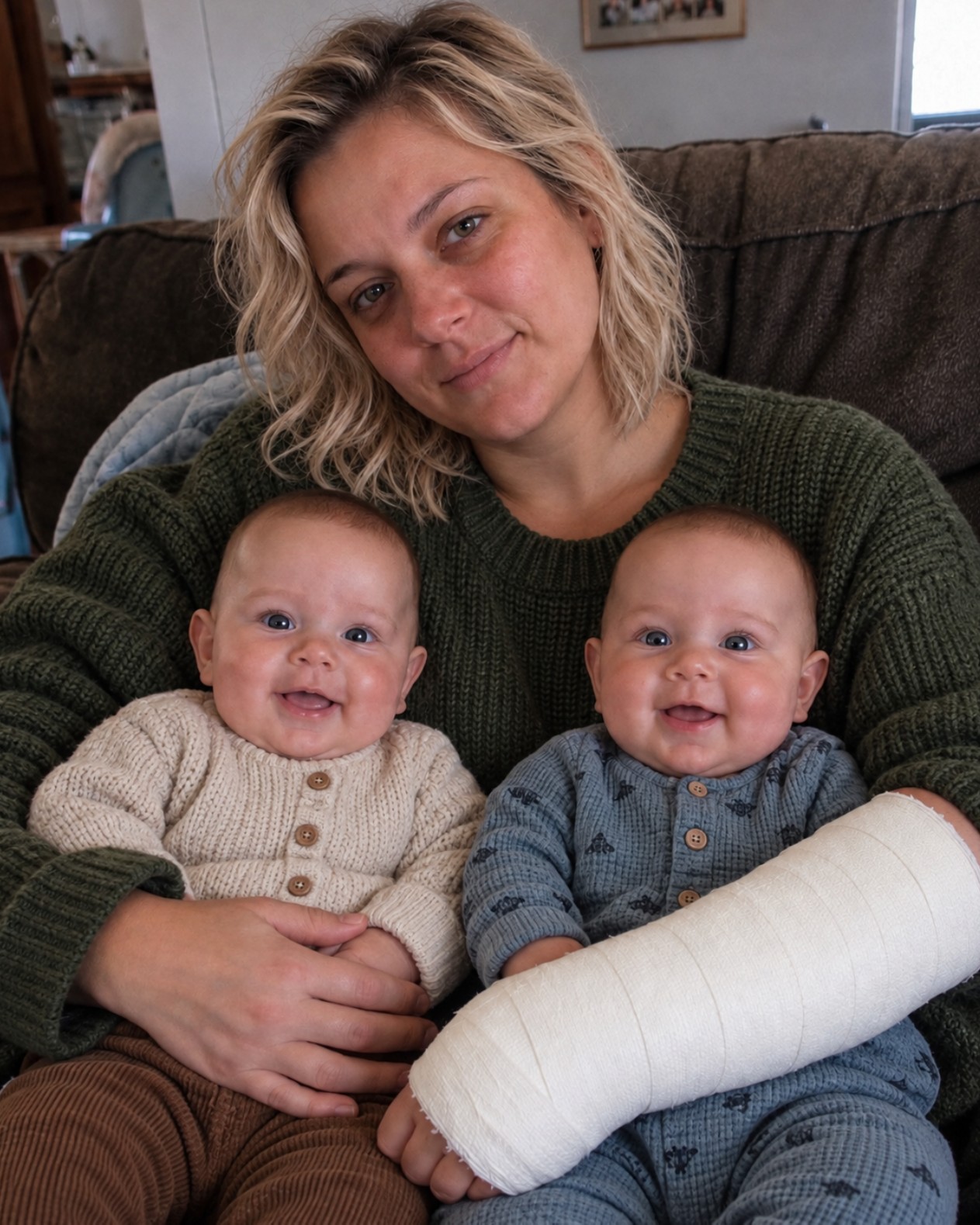
When I broke my arm, I thought the hardest part would be taking care of my five-month-old twins while I recovered. I was wrong. The real pain came from realizing how little my husband understood everything I did for our family every single day. And what hurt even more was discovering how far I would have to go before he finally understood that I couldn’t carry the entire burden alone.
“Brianna?”
I didn’t answer immediately.
Mason stood in the doorway of my mother’s living room, staring at Liam in her arms, Noah beside me, and the diaper bag I had packed with enough supplies for more than one night. His expression changed as he took in the scene.
“Brianna?” he asked again, his voice becoming sharper. “Why are the boys staying here?”
I looked directly at him, making no effort to hide what I was feeling.
“Because my arm is broken, Mason.”
“I know that,” he replied quickly.
“Apparently, you don’t,” I said, keeping my voice steady. “You don’t even understand that I need help.”
Mason blinked and glanced around the room before returning to his original question.
“Why are the boys staying here?”
His eyes suddenly landed on the folded sheet of paper lying on the coffee table. It was the schedule I had prepared the night before, the same schedule he had refused to follow.
He looked back at me, his eyebrows drawing together in disbelief.
“You took my kids and left?”
“Our kids,” I corrected quietly.
“Bring them home,” he demanded.
“No.”
His expression darkened.
“You took my kids and left?” he repeated, his anger rising.
He stepped closer.
“Brianna.”
“No,” I said again, this time more firmly.
For five months, I had spent every single day anticipating problems before Mason even realized they existed. I remembered appointments, prepared bottles, changed diapers, washed clothes, soothed crying babies, and somehow managed to keep our home running.
I had always found a way to do his share, too, because it seemed easier than arguing with him.
Then I broke my arm.
Suddenly, I couldn’t do everything anymore. For the first time, Mason had to face the responsibilities I had been carrying alone.
And he had made it clear that he wasn’t willing to help.
Two days before I went to my mother’s house, I was sitting on the nursery floor, struggling to fasten Liam’s sleeper with my left hand.
My right arm was trapped inside a heavy white cast. The doctor had warned me not to lift either baby with that arm while the fracture healed.
Behind me, Noah was lying on his play mat, kicking his little legs and beginning to fuss. My cup of tea sat untouched and completely cold on the changing table.
I was trying to fasten the tiny metal snaps on Liam’s sleeper when Mason walked into the nursery.
He stepped neatly around a basket of clean laundry, loosened his necktie, and looked at me.
“What’s for dinner, Brianna?”
I stopped struggling with the snaps and stared at him.
“My arm is broken.”
He glanced at the cast for a second.
“I know.”
I waited.
Surely, he would offer to make something. Perhaps he would suggest ordering takeout. Maybe he would at least ask how I was managing.
Instead, he simply stood there.
“What’s for dinner, Brianna?” he asked again.
“So?” I replied.
He frowned.
“So what?”
I looked up at him from the floor.
“I was hoping you’d remember what kitchens are for, or at least know how takeout works.”
He didn’t smile at my sarcasm.
“I worked ten hours today.”
“So what?” I asked. “I fell down the stairs yesterday.”
The accident had left me with a fractured arm and a cast that made even the simplest tasks difficult. My doctor had been very clear that I needed to protect the injury and avoid lifting the twins.
I turned toward Noah, who was now crying louder.
“Mason, can you get him?”
He checked his phone without moving.
“I haven’t even changed yet.”
“I fell down the stairs yesterday,” I reminded him.
“He doesn’t care what you’re wearing,” Mason snapped.
“Mason, please.”
“What?” he demanded. “I just got home.”
I stared at him in disbelief.
“So did you stop being their father in the driveway?”
His mouth tightened into a thin line.
“I just got home. I pay the bills.”
“And?”
“And I’m not coming home to start another shift.”
The word *shift* hung between us.
Another shift.
As though being a father was nothing more than unpaid overtime. As though spending time with his own children was an unreasonable demand instead of a basic part of family life.
“I pay the bills,” he repeated, apparently believing that settled the entire argument.
I took a slow breath.
“I need help for a few weeks, Mason. That’s all. Until my arm heals properly. Come home an hour earlier when you can. Take a day off if you have one. Ask your boss if you can work from home sometimes.”
“I have a job,” he said defensively.
“So did I before maternity leave.”
“Exactly!” he replied immediately. “You’re home now.”
“With two babies,” I reminded him.
“You’re better at this anyway,” he said, waving a hand toward the nursery.
I stared at him.
“I’m better at it because I’m the one doing it all the time. That’s how people learn.”
Noah’s cries grew louder.
Mason let out a heavy sigh, as if the noise itself were an insult.
“Can’t you just handle him?”
“With one arm?”
“You have another one,” he blurted out.
For a moment, I couldn’t speak.
I simply stared at him, trying to understand how the man I had married could look at my cast and say something so thoughtless.
Then he shrugged.
“You’re the one who wanted kids,” he muttered.
My head snapped up.
“We wanted them! You were the one showing me nursery ideas before I was even pregnant.”
“You know what I mean,” he grumbled.
“No, I don’t, Mason.”
My eyes began to burn with tears.
“I don’t even know who you are right now.”
He rubbed his forehead with his palm.
“I’m exhausted, Brianna. Moms don’t get sick days.”
I looked down at the thick white cast covering my arm.
“I’m injured.”
“That’s not my problem,” he replied flatly.
His words hit harder than I expected.
I had spent months telling myself that marriage meant supporting each other through difficult times. I had believed that when one of us struggled, the other would step in.
But Mason seemed to believe that because I was the mother, every responsibility belonged to me, no matter what happened.
I looked up at him again.
“I’m asking you to help me a little.”
“You take care of them because that’s your job,” he said.
Then he turned around and walked straight out of the nursery.
Noah continued crying.
Liam reached for the plastic edge of my cast and grabbed it with both of his tiny hands.
I gently freed my arm from his grip and leaned closer to him.
“Okay, sweetheart. I’ve got you.”
But as I sat there on the nursery floor, trying to comfort one baby while the other cried, I realized something painful.
I had been telling myself I was fine for far too long.
And I wasn’t fine at all.
The following afternoon, my mother, Nora, came to visit.
She found me in the kitchen, wiping spilled formula off the counter with my good hand. Liam was kicking happily in his bouncy seat nearby.
“Brianna,” she said gently from the doorway.
“I’m almost done,” I muttered, scrubbing the counter harder.
Mom walked over and took the wet cloth out of my left hand.
“Sit down.”
“Mom, it’s sticky.”
“It’ll still be sticky in five minutes,” she replied firmly.
I finally gave in and lowered myself into a chair at the kitchen table.
Mom opened the microwave and found my cup of tea.
“You reheated this already?” she asked, examining the lukewarm liquid.
“Twice,” I admitted.
She shook her head.
My mother knew me well enough to recognize that whenever I felt overwhelmed, I started cleaning everything around me. If I could make the kitchen spotless, perhaps I could convince myself that the rest of my life was under control, too.
She emptied the cup, made me a fresh one, and placed it in front of me.
“Where’s Mason?” she asked casually.
“At work.”
“And when he gets home?”
“He’ll be tired, of course.”
Mom turned and gave me a long, knowing look.
I took a careful sip of the hot tea.
“I’m fine,” I added quickly.
“There it is,” she said.
I frowned.
“What?”
“That voice you use when you’re lying to me, Brianna.”
I looked away.
Mom didn’t lecture me or demand that I explain myself. Instead, she stepped in and helped with the boys. She washed all the dirty bottles, prepared a proper dinner, and made sure I had eaten before she finally left.
For the first time in days, I felt as though someone had noticed how much I was struggling.
That night, Noah woke up crying first.
A few minutes later, Liam joined him.
I nudged Mason with my knee.
“Can you take Liam?”
He rolled onto his stomach and buried his face in the pillow.
“I have work.”
“So?”
“I have to be up in four hours,” he mumbled into the sheets.
Liam’s cries grew louder down the hallway.
“So do I,” I said.
“No, you don’t,” he replied instantly.
I froze.
“What does that mean?”
“You can sleep when they sleep.”
For a moment, I almost laughed at the absurdity of his answer.
Sleep when the babies slept?
What about the bottles that needed washing? The laundry piling up? The meals that needed preparing? The endless cleaning, feeding, changing, and comforting that continued long after the boys closed their eyes?
And how exactly was I supposed to sleep when both babies woke up at different times throughout the night?
Instead of arguing, I swung my legs over the edge of the bed and stood up.
Liam was still crying loudly when I left the bedroom.
Behind me, Mason pulled the blanket tightly over his shoulder and went straight back to sleep.
Three nights later, my mother called.
“My car won’t start, Brianna. I can’t make it over tonight.”
I looked at the twins, who both desperately needed baths.
“It’s okay, Mom.”
“Don’t even think about bathing them alone,” she warned.
“I won’t.”
“Promise me?”
I glanced at my cast.
“I’ll wait for Mason to get home. I promise.”
When Mason finally walked through the front door that evening, I met him near the kitchen entrance.
“I need you to bathe the boys tonight.”
He dropped his keys into the metal bowl on the entryway table. They landed with a loud clatter.
“I just walked in, Brianna. Don’t you think you’re being a bit ridiculous right now?”
“They need a bath.”
“Skip it.”
“They really need one, Mason.”
“Use a washcloth and warm water,” he instructed casually as he started walking away. “That’s what tired mothers do.”
“Mason, please.”
He let out another exaggerated sigh.
“I’ve been working all day.”
“So have I,” I replied.
He turned around and looked at me as though I had said something completely ridiculous.
“Why should I have to come home and take care of the kids, too?”
I stopped moving.
“Too?”
“What?”
“You said ‘too.’ You think taking care of our children is something I do after my actual day is over?”
“You stay home,” he said simply. “You stay home with Liam and Noah, doing nothing all day.”
For once, I didn’t defend myself.
I didn’t list the hundreds of things I had done since waking up that morning. I didn’t remind him about the feeding schedules, the dirty bottles, the laundry, the crying, or the hours I spent soothing two babies while trying not to injure myself further.
I just looked at him.
“Okay.”
Mason frowned.
“Okay what?”
“Nothing.”
He studied my face, suddenly looking uneasy.
“Don’t do that calm thing.”
“What calm thing?”
“The thing where you stop talking.”
He knew me well enough to recognize the difference.
Usually, I hated conflict. I would keep explaining myself until everyone felt better, especially Mason. I would find the right words, offer another compromise, and somehow end up comforting the person who had hurt me.
But this time, I had nothing left to say.
That night, after the twins finally fell asleep, I sat alone at the kitchen table with my injured arm resting on a folded towel.
Earlier, Liam had reached up toward me, wanting me to hold him. I had been forced to ask Mason to lift his own son because I couldn’t safely do it myself.
That moment had hurt more than I wanted to admit.
I opened a small paper notebook with my good hand and began writing a list.
Baths.
Evening bottles.
Carrying the boys upstairs.
One nighttime waking.
I stared at the words.
These weren’t favors. They weren’t special requests. They were things I physically couldn’t manage safely while my arm healed.
The next evening, I placed the handwritten page on the dining table and slid it toward Mason.
He glanced down at it.
“What’s this?”
“What needs to change while my arm heals.”
He read the first few lines before pushing the paper away.
“You made me a schedule?”
“I made us a plan,” I corrected.
“I’m not doing shifts in my own house.”
I looked him directly in the eye.
“Then tell me what you will do.”
His expression tightened with frustration.
“Brianna, I work all day.”
“I know. I’m asking what happens when you come home.”
He didn’t answer.
I tapped the paper with my index finger.
“I can’t carry both boys. I can’t bathe them alone. Last night, I tried to settle Liam by myself because you wouldn’t get up.”
That finally got his attention.
“You shouldn’t have done that.”
“I shouldn’t have needed to, Mason, but you gave me no choice.”
He looked away toward the window.
I waited a moment before asking the question that would change everything.
“Will you take these things over until the doctor clears me?”
“No,” he said flatly.
There it was.
For days, I had tried to convince myself that Mason simply didn’t understand how much help I needed. I had thought that if I explained things clearly enough, he would finally see the situation from my perspective.
But he understood perfectly well.
He simply didn’t want to take responsibility.
“All right,” I said quietly.
He frowned at my immediate acceptance.
“What does that mean?”
“It means I heard you.”
I folded the paper neatly in half and stood up.
In the nursery, Liam stirred slightly when I reached for the diaper bag. I froze, waiting until his breathing returned to a steady rhythm.
Then I stepped into the hallway and called my mother.
“Can the boys and I stay with you for a few days?”
She went completely silent.
“Did something happen?” she finally asked.
“Nothing new,” I admitted. “That’s the problem.”
“Brianna…”
Her voice was filled with worry.
“I can’t keep risking my arm because Mason won’t pick them up. I need my arm to heal properly, Mom. My boys need me.”
Her voice softened immediately.
“Do you want me to come and get you? The car is working again.”
“Yes,” I said. “I’ll pack what we need.”
She hesitated before asking the question I knew was coming.
“Are you leaving him?”
I glanced toward the living room, where Mason was sitting comfortably in front of the television as though nothing had happened.
“No,” I answered clearly. “I’m trying to heal.”
For the first time, I had stated a boundary without apologizing for it.
I wasn’t threatening to leave my marriage. I wasn’t trying to punish my husband. I simply needed a safe place where I could recover without being forced to do things my doctor had told me not to do.
An hour later, Mom was waiting in her living room with the boys while I finished packing the car.
Mason came out of the garage just as I zipped the main diaper bag shut.
“Where are you going?” he asked, looking surprised.
“Mom’s.”
“With Liam and Noah?”
“Yes.”
His expression changed immediately.
“For how long?”
“I don’t know.”
“Brianna, you can’t just walk out.”
I looked at him calmly.
“I asked you to help me stay.”
He stared at me, completely speechless.
I didn’t wait for another pointless argument.
I got into the driver’s seat, fastened my seat belt, and started the car.
As I drove away, my heart pounded so hard that I could feel it in my throat. I didn’t know what would happen to my marriage. I didn’t know whether Mason would finally understand or whether he would simply become angrier.
But I knew one thing.
I couldn’t continue risking my recovery just to prove that I was a good wife.
At my mother’s house, Liam fell asleep against her chest while Noah kicked his legs happily beside me on the soft couch.
For the first time in days, I wasn’t trying to do everything with one good arm.
Then my phone began ringing inside my purse.
It was Mason.
I answered.
“Bring them home,” he demanded immediately.
“No.”
“I’m their father,” he stated firmly.
“Then start acting like one.”
He went completely silent.
Then his voice sharpened.
“Do you know what this makes me look like?”
There it was.
Not a single question about my health. Not one concern about whether my arm was hurting or whether I had managed to rest.
His first concern was what other people might think of him.
“Tell people the truth,” I replied calmly.
“NO!” he shouted through the speaker. “How dare you make me look like some deadbeat?”
Part 2: My Husband Finally Had to Face the Truth
“I didn’t make you look like anything, Mason,” I said into the phone.
“What am I supposed to tell my mother?” he snapped.
“Tell her the truth.”
“The truth?” he scoffed. “And what’s that?”
I took a slow breath.
“Tell her I broke my arm. Tell her I asked you to help me. And tell her you said mothers don’t get sick days.”
Silence filled the line.
For once, Mason had no immediate answer.
Then he spoke again, his voice dropping into a desperate hiss.
“You’re humiliating me.”
That was the moment I finally understood how he saw the entire situation.
He hadn’t been embarrassed when I begged him to help me with our crying babies. He hadn’t been embarrassed when he watched me struggle to fasten their clothes with one hand. He hadn’t been embarrassed when I told him I was injured and needed him to take over some of the responsibilities.
He was embarrassed now because someone else might discover what he had been doing.
“You weren’t embarrassed when you said it,” I reminded him.
“What?”
“You weren’t embarrassed when I was begging you for help. You’re just embarrassed that someone else might find out.”
My hand was trembling so badly that I had to end the call.
Mom noticed my tense posture immediately.
She reached gently toward Noah, who was sitting beside me.
“Give him here,” she said.
“I can hold him,” I replied automatically.
“I know,” she said quietly.
Those two words nearly brought me to tears.
She hadn’t told me I couldn’t do something. She hadn’t made me feel weak or useless. She had simply offered to help.
I let out a long breath and allowed her to take Noah.
For the first time in days, I didn’t feel as though I had to prove anything to anyone.
Mason arrived at my mother’s front door the following evening.
His face was red with anger, and his jaw was clenched so tightly that I could see the muscles moving beneath his skin.
I stepped onto the porch and closed the door behind me so the twins could continue resting inside.
“My mother called me,” he announced.
I folded my good arm across my body.
“Okay.”
“She wanted to see you and the boys, so I had to tell her you weren’t home.”
“And?”
“She asked why.”
“What did you tell her?”
He rubbed the back of his neck.
“The truth, apparently.”
His answer surprised me.
I had expected him to make excuses or blame me for leaving without permission. Instead, he seemed genuinely uncomfortable.
He glanced past my shoulder toward the living room.
“She asked whether I’d been helping since you broke your arm.”
I waited.
“What did you tell her?”
“I told her you’re home with the boys and I’m at work all day.”
I continued watching him, waiting for him to explain what had happened next.
Mason rubbed the back of his neck again and looked down at the porch floor.
“Then she asked why you had to leave the house just to get someone to help you.”
I felt something shift inside me.
“What did you say?”
“Nothing,” he whispered.
“Why not?”
His jaw tightened.
“Because I knew how it sounded.”
For the first time, he seemed to understand that the problem wasn’t simply my broken arm. It was the fact that I had been asking for help from my own husband and had been treated as though I were asking for something unreasonable.
Before I could respond, Noah began crying inside the house.
Mason immediately turned toward the sound.
His eyes widened with panic.
“Brianna?”
I stayed where I was.
“You’ve got him.”
“I don’t know what he wants,” Mason protested.
“Neither do I yet.”
“You usually know,” he said.
“I usually find out.”
He hesitated for a long moment.
Then he stepped inside and walked toward the nursery.
I followed him at a distance, but I didn’t rush ahead to take over.
Mason carefully lifted Noah from the crib.
The crying immediately grew louder and sharper.
“See?” he called out in frustration. “I’m making it worse!”
“You’ve held him for ten seconds,” I replied, walking into the room.
“What do I do?”
A dozen possible answers came to mind.
I could have told him to check the baby’s diaper, see whether he was hungry, adjust his position, or walk slowly while gently rocking him.
I had spent five months learning these things through experience. Explaining them would have been easy.
But I also knew that if I gave Mason instructions for every little thing, he would continue relying on me to manage everything, even when he was the one holding the baby.
So I simply said, “Start paying attention.”
He looked at me helplessly before turning back toward Noah.
At first, he paced across the carpet far too quickly. Noah cried even harder against his chest.
Mason stopped.
He looked down at the baby, adjusted his hold, and began swaying more gently.
Within a minute, Noah’s cries softened into quiet sniffling.
Mason stared at him in amazement.
“He’s stopping.”
“Yeah,” I said softly.
Mason looked down at the tiny baby in his arms.
“You make this look so easy.”
I couldn’t help the bitter little laugh that escaped me.
“You told me I do nothing.”
His expression changed.
“I know.”
“Why?” I asked.
He swallowed hard, and his shoulders dropped.
“Because every time I came home, you already knew what they needed, and I didn’t.”
“You could’ve learned.”
“I know.”
“Then why didn’t you?”
He looked down at Noah, who had curled a tiny fist into the fabric of his button-down shirt.
For several seconds, Mason said nothing.
Finally, he whispered, “Because I felt useless. Every time you asked me for help, it reminded me that I didn’t know what to do.”
I stared at him.
“So you wanted me to stop asking.”
He nodded slowly.
The admission explained some of his behavior, but it didn’t excuse any of it.
“Being scared doesn’t excuse what you said to me,” I told him firmly.
“I know,” he repeated.
For five long months, I had wanted to see Mason hold one of our sons with care and patience instead of treating fatherhood like an inconvenience.
Now he was finally doing it.
But I wasn’t going to pretend that one quiet moment had fixed everything.
A few days later, Mason sent me a photograph of our kitchen at home.
The counters were sparkling clean. Every dish appeared to be in its proper place, and the kitchen looked better than it had in weeks.
His message read:
“Cleaned everything. Come home?”
I stared at the glowing screen for a long moment.
Then I typed back a simple question.
“What time does Noah usually take his last bottle?”
The little typing dots appeared.
They disappeared.
Then they appeared again.
Finally, they vanished completely.
No answer came.
I put my phone down and looked toward the twins, who were resting comfortably nearby.
Cleaning the kitchen was helpful, of course. I appreciated that he had taken the time to do it.
But I needed more than a spotless counter.
I needed a husband who knew his children. I needed someone who could recognize their needs without expecting me to explain every detail. I needed a partner who understood that caring for our family was not a job I had been assigned alone.
That evening, Mason drove to my mother’s house.
He walked through the front door looking tired and frustrated.
“What do you want me to do, Brianna?” he asked immediately.
I looked at him calmly.
“I want you to stop waiting for instructions.”
“I’m trying.”
“Then try without making me your manager.”
He sat down across from me in the armchair.
“I cleaned the whole house, Brianna. I really thought you’d be happy about that.”
“I appreciate that you cleaned,” I replied. “But I’d be much happier if you knew why Noah cries differently from Liam.”
Mason looked down at his hands.
“Then teach me.”
For a moment, I almost gave in.
The old version of me would have grabbed a pen and started writing another detailed list. I would have explained their feeding times, sleeping habits, favorite positions, and every little sign that told me what they needed.
I would have made it so easy for him that he wouldn’t have to figure out anything on his own.
Instead, I shook my head.
“No.”
He looked up, surprised.
“Watch them. Learn them. Be here long enough to actually know them.”
His expression tightened, and for the first time, I saw genuine vulnerability in his eyes.
“And if I mess up?”
“You will,” I answered honestly.
He stared at me, clearly not expecting that response.
“So will I,” I added gently.
He seemed surprised by that, too.
I glanced down at the hard plaster cast covering my forearm.
“I’ve spent weeks feeling like I’m failing because I can’t even lift my own sons. I’ve felt helpless, angry, and ashamed because I can’t do the things I used to do.”
“Brianna…”
“Let me finish.”
He fell silent.
“When this cast comes off, I’ll get another chance to feel like their mother again. I’ll be able to hold them properly, bathe them, and do all those little things I’ve been missing. But you have a chance right now to become the father they deserve.”
Mason leaned forward.
“And what about us?”
I held his gaze.
“You can have a second chance, too. But I’m not dragging you there.”
He looked as though he wanted to say something, but I continued before he could interrupt.
“I can’t spend the rest of our marriage begging you to notice when I need help. I can’t be responsible for the babies and responsible for teaching you how to care for them every single day. I need a partner, Mason, not another person to manage.”
He lowered his eyes.
“I understand.”
I wanted to believe him.
But this time, I knew that his actions would have to prove it.
Over the next few weeks, Mason began showing up consistently without waiting for me to ask.
Twice a week, he left his office on time instead of staying late unnecessarily. He added the boys’ pediatric appointments directly to his personal work calendar. He started checking what supplies we needed before the diaper bag was empty and learned to prepare their bottles without asking me where everything was.
Most importantly, he began paying attention to the boys themselves.
He discovered through trial and error that Liam settled much faster against his chest. Noah, on the other hand, usually needed a steady rhythm before he could fall asleep.
Sometimes Mason got things wrong.
Sometimes he became frustrated when the boys cried for longer than he expected.
But I stopped jumping in to rescue him every time he struggled.
If he was holding Noah safely and trying to soothe him, I allowed him to work it out. If he forgot something, I gave him the opportunity to remember it next time.
I was still his wife, but I wasn’t going to be his manager.
And slowly, things began to change.
Three weeks after I had moved in with Mom, my doctor examined my arm and confirmed that the fracture was healing well. I still needed to be careful, but I could begin gradually returning to more of my usual activities as the doctor allowed.
That was when I finally brought a few of our personal belongings back to the house.
I didn’t bring everything.
Some of my clothes and a few things the boys needed remained at Mom’s place.
Mason noticed the bags immediately.
“You’re keeping clothes at your mom’s house?” he asked carefully.
“Yes,” I replied honestly.
“Because you don’t trust me?”
There was a hint of hurt in his voice.
I took a moment before answering.
“Because I’m learning to trust myself.”
He looked at me in confusion.
“If this ever falls apart again, I won’t wait until I’m completely broken before doing something about it,” I explained. “I’m not going to ignore my own needs just to keep everything looking normal.”
Mason swallowed.
“I don’t want that to happen again.”
“Then don’t let it happen again,” I replied.
I wasn’t trying to frighten him or threaten our marriage. I was simply making it clear that the way things had been could not continue.
Trust wasn’t something he could demand because he had finally started doing the work he should have been doing all along.
It would have to be rebuilt.
Slowly.
One day at a time.
That night, we went to bed in our own room for the first time since I had left.
I was still getting used to being home again. Part of me wanted to believe that everything would be fine now, but another part remained cautious.
Then, late that night, Noah began crying loudly from the nursery down the hallway.
I immediately started to sit up, instinctively holding my recovering arm close to my body.
But Mason was already moving.
“I’ve got him,” he said, throwing off his covers.
He paused at the bedroom door and glanced back at me.
“That’s his tired cry.”
Before I could answer, he disappeared down the dimly lit hallway.
I listened as he lifted Noah from the crib and began moving around the nursery.
For a moment, the crying grew louder.
Then Mason started speaking softly to our son.
“Come on, little man. I know you’re tired. Let’s get you settled.”
I heard the familiar sound of his footsteps moving slowly across the floor.
A minute later, Noah’s cries softened.
Then they stopped completely.
I lay back against my pillow and reached for the cup of herbal tea on my nightstand.
It was still perfectly warm.
For months, I had believed that being a good mother meant carrying every burden alone, no matter how exhausted or overwhelmed I became.
I had convinced myself that if I could just do a little more, complain a little less, and ask for a little less help, everything would work out.
Breaking my arm forced me to face the truth.
I couldn’t do everything, and I shouldn’t have had to.
Being a good mother didn’t mean proving how much pain I could survive. It didn’t mean sacrificing my health or pretending I was fine when I desperately needed support.
And being a good husband and father didn’t mean simply bringing home a paycheck.
It meant showing up.
It meant noticing when the people you loved were struggling.
It meant taking responsibility without waiting to be asked.
Mason still had a lot to learn, and I knew that one good night wouldn’t erase everything that had happened. But for the first time, he was beginning to understand that caring for our children was not a favor he did for me.
They were his children, too.
And I was his partner, not the person responsible for making his life easier at the expense of my own.
As I closed my eyes, I listened to the quiet house and felt something I hadn’t felt in a long time.
Relief.
Not because everything was perfect, but because I had finally stopped pretending that I could carry everything alone.
And I had finally made it clear that I would never again accept a marriage in which I had to beg my own husband to be a father.
THE END.
