
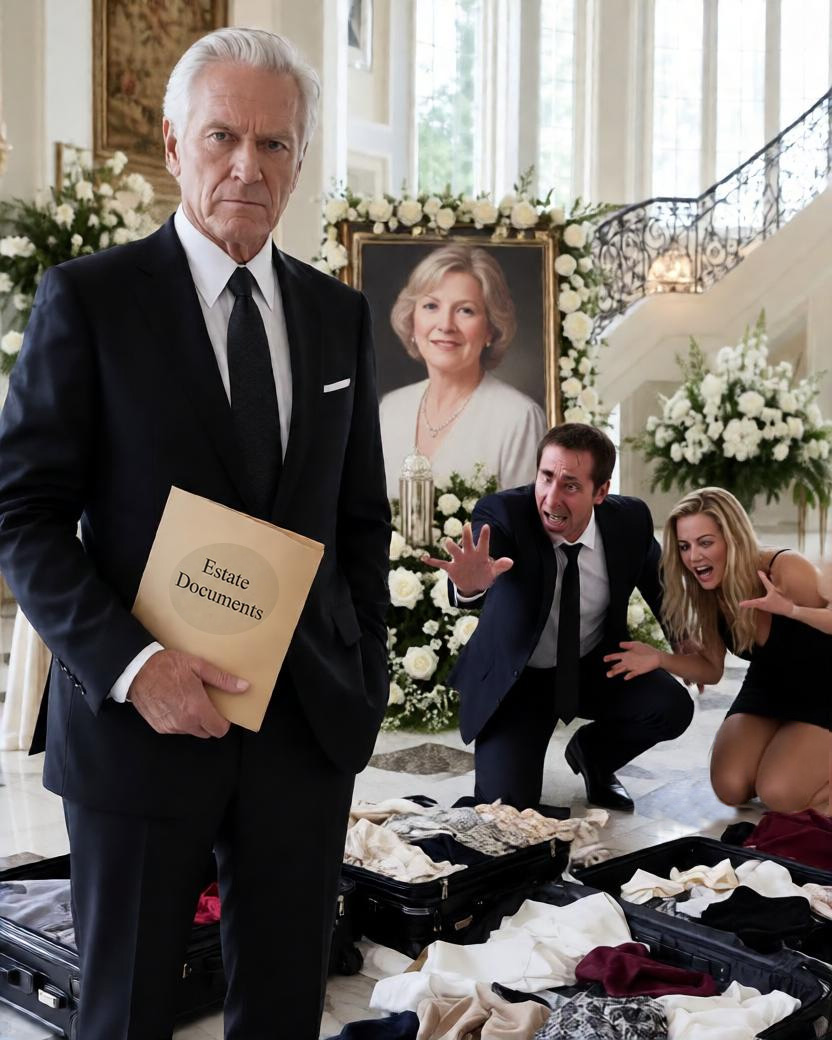
Part 1:
I called my son from our kitchen in Cleveland to tell him that his mother had died.
The first thing I heard from him was not a cry.
Not a shocked gasp.
Not the sound of a son breaking down after losing the woman who raised him.
Instead, I heard a tired, annoyed sigh.
It was a Tuesday morning in November.
Outside our small house on Maplecrest Lane, the cold had already taken over. The kind of cold that comes every year in the Midwest and feels like it has no intention of leaving. The air was wet and sharp, cutting through coats and settling deep into your bones.
Inside the house, everything had changed.
For weeks, the sound of the oxygen machine had filled every corner of our home. That machine had become part of our daily life. It was always there in the background, humming quietly while I cooked, cleaned, and sat beside my wife, Linda.
But that morning, the machine had stopped.
Not because she was getting better.
Because Linda was gone.
The hospice nurse, a gentle woman named Nora, had finished what she came to do. She packed her bag slowly, as if she understood that moving too quickly would make the moment even more painful.
Before leaving, she placed her hand on my shoulder.
“Walter,” she said softly, “I’m so sorry.”
I nodded because I could not find words.
Then Nora walked out the front door.
And I was alone.
For the first time in forty years, I was inside that house without my wife.
The same house where we had cooked together, argued over small things, laughed until our stomachs hurt, celebrated birthdays, and watched seasons change through the kitchen window.
Suddenly, it felt empty.
Not quiet.
Empty.
Like someone had taken the heart out of it.
I stood in the kitchen with one hand holding onto the edge of the old Formica counter. My legs felt weak, and I was afraid they would stop holding me up.
Everything around me was still.
Too still.
Linda’s coffee mug was sitting beside the sink.
The same mug she had used every morning.
It had a faded red cardinal printed on the side, and there was a tiny crack running through the ceramic near the handle.
She loved that mug.
She always said cardinals meant hope.
“Red birds look like hope refusing to freeze,” she once told me.
Her reading glasses were lying beside a half-finished crossword puzzle.
The puzzle was filled with her familiar green ink.
Linda always used green ink.
Never black.
“Black feels too final,” she would say.
And she hated blue.
“Blue is too ordinary.”
Those little things used to make me smile.
That morning, they nearly destroyed me.
My chest felt heavy, like someone had filled it with wet sand.
Only a few hours had passed since Linda took her final breath, but already I could feel my life changing shape around her absence.
I picked up my phone.
My fingers were shaking.
I stared at the screen for several seconds before dialing the international number.
My son, Marcus, was thirty-one years old.
My little boy.
The child who used to run into Linda’s arms whenever she came home from work.
The boy who cried when she was five minutes late because he thought something terrible had happened.
I needed to hear his voice.
I needed my son.
The phone rang.
Once.
Twice.
Three times.
Four times.
Finally, he answered.
“Dad?”
His voice sounded far away.
And immediately, I heard something behind him.
Music.
A deep bass sound.
The clinking of expensive glasses.
People laughing.
A party.
Another world.
A world where my wife’s death did not seem to exist.
Marcus and his wife, Allison, were in Barcelona.
They had been traveling there for what Allison called a “creative sabbatical.”
She had posted pictures online every day.
Beautiful restaurants.
Luxury hotels.
Wine glasses overlooking old streets.
Smiling faces.
A perfect life.
At least that was what everyone saw.
“Marcus,” I whispered.
My throat tightened around his name.
“Your mother passed away this morning.”
For one second, everything went silent.
No music.
No laughter.
Nothing.
I waited.
I waited for my son to understand.
I waited for the pain to reach him.
I waited for the little boy who loved his mother to come back.
Then I heard Allison’s voice in the background.
“Who is it?”
Her voice was muffled but impatient.
“We need to leave soon. They won’t hold the reservation.”
My heart sank.
Marcus lowered his voice.
But I could still hear the frustration.
“Dad, please.”
A pause.
“Don’t make this more dramatic than it needs to be.”
I closed my eyes.
“Marcus…”
“Mom has bad days,” he continued. “You’re making it sound worse than it is.”
For a moment, I thought I had misunderstood him.
Then I realized.
He thought I was exaggerating.
I gripped the phone tighter.
“Marcus,” I said slowly, “she’s gone.”
Silence.
“Your mother died.”
The silence that followed felt endless.
Then Marcus finally spoke.
“I’m sorry, Dad.”
But his voice did not sound broken.
It sounded annoyed.
“I really am sorry. But what do you want me to do?”
I said nothing.
He continued.
“We leave for the next part of the trip in a few days. The tickets are non-refundable.”
Then he said the words that would stay with me forever.
“Mom would understand.”
Mom would understand.
People say things like that when they want forgiveness without having to change.
They say the person who died would understand because the person who died cannot argue back.
Linda had spent her entire life putting others first.
Marcus knew that.
He knew exactly how kind his mother was.
And somehow, he used that kindness against her.
Before I could answer, the call ended.
He hung up.
I stood there with the phone still pressed against my ear.
All I heard was the empty sound of the disconnected line.
Outside, a garbage truck drove down the street.
The world kept moving.
Cars drove by.
People went to work.
Neighbors walked their dogs.
The sun continued rising.
But my world had stopped.
My wife was gone.
And my son had chosen a vacation.
I did what people do when tragedy comes.
I made the necessary calls.
I called the funeral home on Briar Avenue.
I called the church where Linda had volunteered during holiday food drives for ten years.
I called our neighbor, Mrs. Harper.
She arrived thirty minutes later.
She did not ask questions.
She did not offer meaningless words.
She simply walked through the door carrying a warm casserole dish and wrapped her arms around me.
She held me in the hallway while I cried.
Every conversation after that felt strange.
Too normal.
People said things like:
“I’m so sorry.”
“We’ll make arrangements.”
“Let us know if you need anything.”
But no words could match the size of what I had lost.
Words felt too small.
By Thursday, I buried my wife.
I wore the charcoal suit Linda had chosen for me two Christmases earlier.
She had held it up in the store and smiled.
“That one,” she said. “You look handsome in that one.”
I had laughed.
“I look the same in every suit.”
“No,” she replied. “You look like my husband in that one.”
I wore it because she picked it.
Because she always knew me better than anyone.
The funeral was held in the small, dark chapel.
I stood at the front and looked out at the seats.
There were only five people there.
Five.
Mrs. Harper and her husband sat in the second row.
Linda’s oldest friend, Elaine, sat near the aisle. She wore the same strong lavender perfume she had worn at our wedding decades earlier.
At the back stood Andre, our mail carrier.
He wore his blue uniform and held his cap against his chest.
Linda loved Andre.
Every summer, she left a glass of ice water on the porch for him.
Every winter, she placed a thermos of hot coffee behind the storm door.
“He works hard,” she always said.
“He deserves to know someone appreciates him.”
The fifth person was a man I did not recognize.
He sat quietly in the back row.
He wore an expensive navy suit and watched everything with respect.
At first, I assumed he was someone from Linda’s old job.
An old coworker.
Someone I had forgotten.
But I would later learn he was much more important than that.
The seat in the front row that belonged to Marcus remained empty.
I walked to the podium.
I looked down at my notes.
Then I looked at the people who came to say goodbye to my wife.
And I began.
I talked about Linda’s apple cake.
I talked about her laugh.
I talked about how she remembered every birthday without ever needing a calendar.
I talked about the way she could walk into a room and make people feel like they mattered.
But I did not talk about Marcus.
I did not tell strangers that my son chose Europe over his mother’s funeral.
Some truths are too painful to place in front of people who came only to mourn.
Part 2:
Ten days passed after Linda’s funeral.
Ten days of waking up and forgetting for a few seconds that she was gone.
Ten days of opening my eyes in the morning, reaching across the bed out of habit, and expecting to feel her beside me.
Ten days of waiting to hear the sounds that had filled our home for forty years.
The soft opening of a kitchen cabinet.
The scrape of a spoon against the inside of her coffee cup.
The little cough she always made before saying my name.
“Walter?”
That tiny sound.
That little piece of her.
Gone.
The house felt different without her.
Not because anything had moved.
Because everything had stayed exactly the same.
Her sweater was still hanging over the chair in our bedroom.
Her favorite books were still stacked beside the bed.
Her perfume still lingered faintly in the bathroom.
It was like the house was waiting for her to come back.
But she never did.
And during those ten days, there was still no word from Marcus.
Not one phone call.
Not one message.
Nothing from Barcelona.
My own son had not checked on me after his mother’s funeral.
The silence hurt almost as much as losing Linda.
Almost.
On the eleventh morning, something inside me finally broke.
I walked into our bedroom and opened Linda’s dresser.
I needed to start doing something.
Anything.
I told myself I would collect some of her clothes and donate them.
I told myself it was practical.
That it was what people did after someone died.
But the truth was different.
I think I wanted to feel close to her again.
I pulled open the heavy oak drawers.
Inside were her clothes, folded exactly the way she always folded them.
Linda believed everything had a proper place.
Under a stack of winter sweaters, my hand touched something hard.
I stopped.
I moved the sweaters aside.
There was a small wooden box underneath.
A cedar box.
Smooth.
Polished.
Beautiful.
And completely unfamiliar.
I stared at it.
I had lived with Linda for forty years.
I knew every corner of our house.
Every drawer.
Every cabinet.
Every hiding place.
But I had never seen this box before.
I carried it to the bed.
My hands felt strangely nervous as I opened it.
The hinges made a quiet creaking sound.
Inside was the faint smell of cedar wood mixed with Linda’s vanilla lotion.
And inside that box were letters.
Dozens of them.
Every envelope had the same handwriting.
Linda’s handwriting.
My heart began beating faster.
Every letter had my name written on the front.
Every single one was addressed to me.
I picked up the first envelope.
The paper felt smooth beneath my fingers.
I opened it carefully.
The first words stopped me cold.
“My darling Walter,”
I swallowed hard.
Then I read the next sentence.
“If you are reading this, I am gone. And Thomas has told you about the money.”
I froze.
The letter shook slightly in my hand.
Thomas?
The money?
I read the sentence again.
And again.
I looked around the bedroom as if Linda might somehow appear and explain what I was reading.
But she was gone.
My wife had left me a message.
And somehow, she had known there was something I did not know.
I placed the letter beside me and looked deeper into the cedar box.
Underneath the envelopes was a thick leather-bound photo album.
I opened it.
But these were not the photographs we kept around the house.
Not the polished family pictures displayed on the shelves.
These were different.
These were real.
The moments nobody else saw.
The first picture showed Marcus when he was five years old.
He was standing in the backyard, completely covered in mud.
His face was dirty.
His clothes were ruined.
And he had the biggest smile I had ever seen.
Linda had written a note underneath the picture:
“My little explorer.”
I turned the page.
There was Marcus sleeping on the living room floor beside our old golden retriever.
His small hand was resting on the dog’s fur.
Another page.
Marcus at sixteen years old.
He was dressed for prom.
He was pretending to look annoyed while Linda fixed his jacket and pinned a boutonniere onto his suit.
But I could see the truth.
He loved that moment.
He loved his mother.
I ran my fingers over the pictures.
I looked at my son growing up year by year.
And one question kept coming back.
When did he change?
When did my little boy become someone who could ignore his mother’s death?
I knew the answer.
It started when he met Allison.
Allison entered our lives four years earlier.
At first glance, she seemed perfect.
She was beautiful.
Well dressed.
Confident.
She wore expensive coats and carried herself like someone who belonged anywhere.
But there was something about her.
Something I could never explain.
She smiled often.
But her eyes never smiled with her.
She was always polite.
Always careful.
Always saying the right thing.
But somehow, every conversation with her left me feeling like I had been measured.
Judged.
Evaluated.
Like she was silently deciding what things in our home were valuable.
And what things were not.
The first time she came to our house for dinner, I remember watching her walk through the living room.
Her eyes moved slowly.
The furniture.
The paintings.
The old china cabinet.
The decorations Linda had collected over decades.
She looked at everything.
Not like a guest.
Like someone inspecting property.
After dinner, Marcus and Allison left.
Linda and I stood in the kitchen washing dishes.
She handed me a wet plate.
Then she said quietly:
“I hope she makes him happy.”
That was all.
Not:
“I like her.”
Not:
“She seems wonderful.”
Just:
“I hope she makes him happy.”
Looking back, I realize Linda saw something I refused to see.
But I was a father.
And fathers want to believe their children are happy.
Sometimes hope makes people ignore things right in front of them.
I returned to the letters.
They were not love letters.
They were not memories of our marriage.
They were something else.
A record.
A warning.
Linda had been documenting everything.
The slow disappearance of our son.
The missed holidays.
The forgotten birthdays.
The phone calls that only came when Marcus needed something.
Especially money.
Letter after letter described the same pattern.
Marcus would suddenly become warm.
He would call more often.
He would ask about us.
He would say things like:
“Dad, Mom, I’ve been thinking about you.”
Then, a few minutes later:
“Could you help us out with something?”
The amount was always thousands of dollars.
The excuses were always different.
A business opportunity.
A problem with bills.
An emergency.
Linda wrote everything down.
She remembered everything.
Then I found the letter dated three years earlier.
My hands started trembling before I even finished reading the first line.
“Walter, I have to write this down because I still cannot say it out loud without breaking.”
I continued.
“Marcus called today asking for four thousand dollars. When I told him we didn’t have that kind of money available, he became angry.”
I stopped.
I already knew I would not like what came next.
Then I read the words my son had said to his mother.
The words that changed everything.
“Mom, when you and Dad can’t take care of yourselves anymore, Allison and I will have to make those financial decisions for you anyway. Think of it as an advance.”
I stared at the page.
An advance.
That was how he saw us.
Not as his parents.
Not as the people who raised him.
As something valuable waiting to be collected.
I continued reading.
“Walter, our son is already looking at us like a problem to manage. Like an estate to liquidate.”
A cold feeling moved through my body.
I put the letter down.
My hands were shaking.
For years, I thought Marcus was simply distant.
Busy.
Caught up in his own life.
But Linda had seen the truth.
And she had been afraid.
I picked up the first letter again.
The one that mentioned Thomas.
The one that mentioned money.
The final pages explained that after her death, I needed to wait for a call from an estate attorney.
Then, as if the timing had been planned perfectly…
The phone rang.
I jumped.
The sound filled the quiet bedroom.
I looked at the screen.
Unknown number.
I answered.
“Mr. Walter Brooks?”
A deep, professional voice spoke.
“Yes?”
“My name is Thomas Ellery. I am an estate attorney.”
I sat down slowly on the bed.
“I believe you saw me at your wife’s funeral.”
The man from the back row.
The stranger in the navy suit.
The man I thought was just an old coworker.
“I did,” I said.
“Linda asked me to contact you after a short period of mourning.”
A pause.
“We need to talk.”
I looked down at the cedar box.
At the letters.
At my wife’s handwriting.
“What is this about?” I asked.
Thomas’s voice became serious.
“It is about what your wife spent years building.”
Another pause.
“And what she wanted to protect you from.”
Part 3:
Two days after Thomas Ellery called me, I drove downtown.
The drive felt strange.
I had taken that road hundreds of times before, but that morning everything looked different.
The buildings.
The traffic lights.
The people walking on the sidewalks.
My whole life had been turned upside down, and yet the world outside my car window continued as if nothing had happened.
I parked my old sedan on Lakeside Avenue.
My car looked out of place between two expensive black Mercedes parked outside a tall glass office building.
I looked at my vehicle and almost laughed.
It was the same car I had driven for years.
The same car with the small noises and rattles.
The same car Linda and I kept because it still worked.
We were not people who chased luxury.
We fixed things.
We saved money.
We lived simply.
That was who we were.
Or at least, that was who I thought we were.
I walked into the building and was greeted by a receptionist who already knew my name.
“Mr. Brooks? Mr. Ellery is expecting you.”
I nodded.
The elevator carried me high above the city.
When the doors opened, I stepped into a quiet hallway with polished floors and expensive artwork hanging on the walls.
A few minutes later, I was sitting inside Thomas Ellery’s corner office.
The view stretched across the river.
The room was large, with a massive mahogany desk in the center.
Behind it sat Thomas.
He was a silver-haired man in his late sixties.
His face was calm.
His eyes were intelligent.
But there was something else there too.
Respect.
He stood and shook my hand warmly.
“Mr. Brooks,” he said.
Then he smiled gently.
“Linda spoke about you often.”
Those words almost broke me.
Because for ten days, I had heard almost nothing about Linda except that she was gone.
Now, this stranger was telling me she had been talking about me.
“Please,” Thomas said. “Have a seat.”
I sat down.
He placed a thick folder on the desk between us.
“This belongs to you.”
I looked at it.
The folder was filled with documents.
Legal papers.
Financial statements.
Property records.
Names of companies I did not recognize.
Numbers I did not understand.
I opened the first page.
Then the second.
Then the third.
My confusion only grew.
“I don’t understand,” I said.
I pointed to a page listing several properties.
“There must be some mistake.”
Thomas tilted his head.
“What makes you think that?”
I gave a small, tired laugh.
“Because Linda and I were not rich people.”
I looked back at the papers.
“She was a part-time bookkeeper. We clipped coupons. We watched every dollar. We lived in a two-bedroom house with old floors.”
I looked up at him.
“Mr. Ellery, we drove old cars. We worried about heating bills.”
Thomas smiled softly.
“Walter…”
He leaned forward.
“Linda was not just a part-time bookkeeper.”
I stared at him.
“What?”
“She was the assistant manager at her accounting firm for twelve years.”
I felt my eyebrows rise.
“An assistant manager?”
Thomas nodded.
“She also handled private accounting work for several small businesses. Quietly. She had clients who trusted her completely.”
He opened another document.
“Your wife had a rare talent. She understood money. Not just how to earn it, but how to make it grow.”
I sat there silently.
The woman I thought I knew completely suddenly had parts of her life I had never seen.
Thomas continued.
“Fifteen years ago, Linda inherited a property from her aunt.”
I listened carefully.
“At the time, the property was almost worthless. It was damaged. Many people believed it should simply be demolished.”
He turned a page.
“But Linda saw something others did not.”
“She repaired it.”
“She borrowed money to rebuild it.”
“She rented it out.”
“She reinvested the income.”
“One property became two.”
“Two became three.”
“She created an LLC. She invested in municipal bonds. She built portfolios. She created a blind trust.”
My mind struggled to keep up.
All these years…
While I was worrying about grocery bills and car repairs…
My wife had been quietly building something enormous.
Thomas folded his hands.
“She never wanted attention, Walter.”
“That was Linda.”
I looked down.
A thousand memories rushed through my mind.
Linda sitting at the kitchen table late at night.
Linda working on papers.
Linda saying she was “just finishing something.”
I thought she was doing bookkeeping.
I thought she was organizing bills.
I never imagined she was building a future.
I swallowed.
“How much?”
The question came out almost as a whisper.
Thomas was quiet for a moment.
Then he answered.
“Including the properties, liquid assets, investments, and the life insurance policy…”
He paused.
“Your estate is worth approximately nine point two million dollars.”
The room became silent.
Nine point two million dollars.
I stared at him.
I thought I had heard wrong.
“Nine million?”
Thomas nodded.
“Yes.”
I leaned back in my chair.
The world felt unreal.
Nine million dollars.
My entire life, I had worried about money.
Every heating bill.
Every repair.
Every unexpected expense.
And all this time…
My wife had been protecting us.
Not because we were desperate.
Because she wanted us to be safe.
My voice cracked.
“Why didn’t she tell me?”
Thomas looked down at the papers.
Then back at me.
“Because she wanted to surprise you.”
I said nothing.
“She planned to reveal everything on your sixty-seventh birthday.”
My eyes burned.
“She wanted you to retire comfortably.”
Thomas paused.
“She wanted you to enjoy the rest of your life without ever needing to ask Marcus for help.”
That sentence hurt.
Because suddenly, I understood.
Linda had not hidden the money because she did not trust me.
She had hidden it because she knew exactly who might try to take it.
Thomas’s expression became more serious.
“There is something else.”
I looked at him.
“Linda left specific instructions regarding Marcus.”
My stomach tightened.
“What instructions?”
Thomas opened another drawer.
He removed a manila envelope.
“Linda believed that after her death, certain people might become interested in her finances.”
He placed the envelope on the desk.
“She used a word in her notes.”
I waited.
“Vultures.”
The word hung in the air.
Thomas continued.
“She hired a private investigator.”
“A man named Grant Miller.”
My fingers tightened around the edge of my chair.
“Why?”
Thomas pushed the envelope toward me.
“Because Linda was concerned about your daughter-in-law.”
I looked at the envelope.
“What did he find?”
Thomas did not answer immediately.
Instead, he let me open it myself.
Inside were copies of documents.
Marriage certificates.
Court records.
Death certificates.
At first, they looked like ordinary papers.
Then I saw the names.
And the dates.
And everything changed.
Three different states.
Three different marriages.
Three older men.
All wealthy.
All widowers.
All with money.
The papers showed the same pattern.
Allison had married them.
Then, after their health declined, she had gained control over their finances.
Their estates had eventually transferred into her hands.
I stared at the documents.
My mind refused to accept what I was seeing.
Three husbands.
Three fortunes.
Three dead men.
Before I could even process the truth, my phone started ringing.
I looked down.
The screen showed one name.
Marcus.
My son.
After almost three weeks of silence.
I answered.
“Hello?”
His voice came through immediately.
But something about it was different.
Sweet.
Careful.
Almost rehearsed.
“Dad!”
A pause.
“How are you holding up?”
I looked at the documents spread across Thomas’s desk.
I looked at Allison’s smiling face in one of the photographs.
“I’m managing,” I said.
Marcus sighed.
“Listen, Dad, Allison and I feel terrible about missing the funeral.”
Missing.
That word.
Like it was a meeting.
A dinner.
Something that could simply be rescheduled.
“We really do,” he continued.
“We’ve been talking, and we’re worried about you being alone in that big house.”
I said nothing.
“We’re cutting the trip short.”
Another pause.
“We’ll be there Saturday.”
My hand tightened around the phone.
“To help you sort through whatever Mom left behind.”
Whatever Mom left behind.
The words landed like a knife.
I looked at Thomas.
He was watching me carefully.
I lowered my voice.
“How did you know there was anything to sort through?”
Silence.
Not normal silence.
A guilty silence.
Then Marcus answered.
“I just assumed.”
A lie.
A terrible one.
“There’s always paperwork with a house.”
His voice became nervous.
“We’ll see you Saturday, Dad.”
Then he ended the call.
I stared at the phone.
My own son had not come to his mother’s funeral.
But he was coming now.
Not to comfort me.
Not to grieve.
To find out what Linda left behind.
Thomas looked at me.
And for the first time, I understood why my wife had prepared for this moment.
She knew.
She had known.
And she had been waiting for me to finally see it too.
Part 4:
Saturday afternoon arrived with a gray sky hanging over Cleveland.
The kind of sky that made everything look colder.
I stood inside my living room and watched through the thin curtains as a vehicle slowly turned onto Maplecrest Lane.
It was not Marcus’s car.
It was a rented luxury SUV.
A large one.
Expensive.
The kind of vehicle people use when they want others to notice they have money.
The SUV stopped in front of my house.
But they did not get out.
Not immediately.
For almost ten minutes, Marcus and Allison stayed inside.
I watched them through the curtain.
They leaned toward each other, talking quietly.
Their faces were serious.
Their hands moved quickly as they spoke.
They did not look like a couple arriving to comfort a grieving father.
They looked like two people preparing for a business meeting.
Or a mission.
Like someone was giving instructions before a difficult job.
I thought about Linda.
About the letters.
About everything she had discovered.
She had known this day might come.
And now it was here.
Finally, the car doors opened.
They walked up the path toward the house.
I waited.
Then, before they could knock, I opened the door.
Allison stopped for half a second.
A look of surprise crossed her face.
Then it disappeared.
She quickly replaced it with sadness.
A performance.
That was the only way I could describe it.
She stepped forward.
A cloud of expensive jasmine perfume entered the house before she did.
She wore a black cashmere coat.
Her hair was perfect.
Her face carried exactly the right amount of sadness.
Not too much.
Not too little.
Just enough.
Then something happened that shocked me.
She hugged me.
Allison had known me for four years.
Four years.
And she had never once hugged me.
Not once.
But now, standing in my doorway after ignoring her mother-in-law’s funeral, she wrapped her arms around me.
“Walter,” she said softly.
Her voice was full of fake warmth.
“We are so deeply sorry for your loss.”
She squeezed my shoulders.
“Linda was…”
She paused dramatically.
“One of a kind.”
I stepped back.
“She was,” I replied.
The smile on Allison’s face stayed in place.
But I noticed something.
Her eyes were already moving.
Looking around.
Studying.
Marcus stood behind her.
He looked uncomfortable.
He avoided my eyes.
“Hey, Dad,” he said quietly.
That was all.
No apology.
No explanation.
Just:
“Hey, Dad.”
They walked into the living room.
And almost immediately, the atmosphere changed.
The sadness disappeared.
The concern disappeared.
The performance faded.
Allison looked around the room.
Not like someone remembering Linda.
Like someone evaluating a property.
Her eyes moved across the furniture.
The antique clock above the fireplace.
The silver tea set inside the china cabinet.
The wooden floors.
The paintings.
The things Linda had collected over forty years.
She was not seeing memories.
She was seeing value.
She was taking inventory.
I sat down in Linda’s favorite reading chair.
The chair where she had spent countless evenings with a book in her hands.
Allison sat across from me on the sofa.
She crossed her legs elegantly.
“Walter,” she began, “we are just so worried about you.”
I said nothing.
“This is a lot for one person to handle.”
She looked around.
“A house this old requires so much work.”
Her voice became softer.
“There is no shame in needing support after a tragedy.”
I looked at her.
“I am perfectly capable of taking care of my own home.”
A small smile appeared on her face.
But it did not reach her eyes.
“Of course you are.”
The way she said it made the words feel like an insult.
Marcus shifted in his seat.
“Dad,” he said, leaning forward.
“We’ve been talking.”
He looked at his hands.
“Our condo in Chicago has a spare room.”
I waited.
“It’s all one level. No stairs.”
He glanced around the house.
“The winters here in Cleveland can be dangerous.”
Then came the sentence I knew was coming.
“We just want to make sure you’re safe.”
Safe.
That word.
People often use “safe” when they really mean “controlled.”
Marcus continued.
“And, you know, there are medical decisions.”
A pause.
“Paperwork.”
Another pause.
“Estate matters.”
There it was.
The real reason they came.
I kept my expression calm.
“Estate matters?”
Marcus immediately looked uncomfortable.
“Well…”
He swallowed.
“Mom handled most of the bills, right?”
I said nothing.
“We just want to make sure everything is organized.”
He leaned forward.
“The mortgage gets paid. Utilities. Important documents.”
His voice became more concerned.
“We don’t want you accidentally forgetting something because you’re grieving.”
I stared at my son.
Every sentence was carefully chosen.
Every word was designed to create a picture.
An old man.
A confused widower.
Someone who could no longer manage his own life.
Then Allison opened her handbag.
Slowly.
Carefully.
She pulled out a business card.
She placed it on the coffee table.
Right beside Linda’s favorite wooden coaster.
I looked down.
The card read:
Dr. Nolan Pierce
Geriatric Evaluation & Psychiatry
My stomach tightened.
“We already made you an appointment,” Allison said.
“Tuesday.”
I picked up the card.
“A psychiatric evaluation?”
She smiled.
“Oh, Walter, don’t make it sound so serious.”
She laughed softly.
“It’s just a formality.”
She leaned forward.
“Grief affects people differently.”
Then she added:
“And sometimes older people don’t realize how much their judgment has changed after a loss.”
Older people.
Not me.
Older people.
The message was clear.
They were trying to make me seem incapable.
They wanted someone to say I was not mentally fit.
Because if they succeeded…
They could take control.
Power of attorney.
Financial decisions.
The house.
The accounts.
Everything.
And eventually…
The money Linda had spent years protecting.
The nine million dollars.
I slowly placed the card back on the table.
Then I looked directly at Marcus.
“You mean…”
My voice stayed calm.
“You think an old man like me might not be legally capable of managing his own money?”
Marcus’s face changed.
Only slightly.
But I saw it.
He knew exactly what I was saying.
“Dad, that’s not what we mean.”
But he could not look me in the eye.
The boy from Linda’s photo album was gone.
The child covered in mud.
The teenager smiling while his mother fixed his prom suit.
That person was buried somewhere deep inside him.
But the man sitting in front of me was different.
I stood up slowly.
“I need to make a phone call.”
Immediately, Allison’s expression changed.
Just for a second.
The kindness disappeared.
The mask slipped.
“Walter, please.”
She stood too quickly.
“There’s no reason to get defensive.”
Her voice became sharper.
“We are family.”
Family.
That word again.
A word she used like a chain.
Like something she could wrap around me.
“We can handle this privately,” she said.
I walked into the kitchen.
I picked up the wall phone.
The old one Linda loved because she said it was reliable.
Then I dialed Thomas Ellery’s number.
He answered after the first ring.
“Mr. Brooks?”
I looked through the doorway.
Allison was whispering to Marcus.
Her face was no longer sweet.
It was angry.
“They’re here,” I said.
There was a pause.
Then Thomas replied:
“I understand.”
I hung up.
Three days later, they came back.
But this time…
They brought reinforcements.
Part 5:
Three days after Marcus and Allison’s first visit, they returned to Maplecrest Lane.
But this time, they were not alone.
It was a cold Friday morning.
The kind of morning where the sky looked heavy and gray, like rain could fall at any moment.
I was standing near the living room window when I saw them walking toward my house.
Four people.
Allison was in front.
She walked confidently, almost proudly.
Marcus followed a few steps behind her.
He looked different.
Not confident.
Not angry.
Just uncomfortable.
Like he already knew something was wrong but did not want to admit it.
Behind them was a man wearing a sharp pinstriped suit.
He carried a leather briefcase.
Next to him was a woman with a serious expression, a clipboard in her hands, and a professional look that immediately told me who she was.
A doctor.
I understood what was happening before they even reached the door.
They were not here to help me.
They were here to take control of me.
I unlocked the door and opened it before they could knock.
Allison smiled.
But this time, the smile looked different.
It looked confident.
Almost victorious.
“Walter,” she said smoothly.
“We brought Dr. Pierce to you. We thought it would be less stressful than making you travel.”
Then she turned slightly.
“And this is Mr. Carter, our family attorney.”
The man in the pinstriped suit stepped forward.
He gave me a small smile.
Not a friendly one.
A professional one.
The kind of smile people give when they believe they already have the advantage.
“Mr. Brooks,” he said.
“I understand this is a difficult time.”
I said nothing.
He continued.
“We have a court order for a preliminary mental competency evaluation.”
The words entered the room like a cold wind.
Then he added:
“Your son has expressed serious concerns about your ability to live independently and manage your finances following your wife’s passing.”
I looked at Marcus.
He looked away.
That hurt more than I expected.
Not because I was surprised.
Because some part of me was still hoping.
Some part of me was still waiting for my son to step forward and say:
“This has gone too far.”
But he didn’t.
He stayed silent.
I stepped aside.
“Come in.”
They entered.
For the next two hours, my home stopped feeling like my home.
It became an interrogation room.
Dr. Nolan Pierce sat across from me in the living room.
Her clipboard rested on her lap.
Her pen was ready.
She asked questions.
Not normal questions.
Questions designed to find weakness.
“Mr. Brooks,” she said, “can you tell me what day of the week it is?”
“Friday.”
She wrote something down.
“Can you tell me the current president?”
I answered.
She wrote again.
“If you smelled smoke inside your home, what steps would you take?”
I answered that too.
They asked about Linda.
They asked about her illness.
They asked about her death.
They watched my face carefully.
They wanted to see if grief would break me.
They wanted anger.
Confusion.
Panic.
Anything they could use.
But Linda had taught me something through those letters.
She had taught me that details mattered.
Records mattered.
And sometimes, staying calm was the strongest answer you could give.
So I remained steady.
I answered every question.
Clearly.
Carefully.
While they questioned me, I watched Allison.
She thought I was not paying attention.
But I was.
She walked around the house.
Slowly.
Quietly.
Her fingers touched things.
The furniture.
The shelves.
The decorations.
She opened the hallway closet.
She looked inside.
She touched the piano keys.
She examined every room like she was already imagining ownership.
She was not grieving Linda.
She was planning what came next.
She was already spending money she had never earned.
Finally, after two hours, Dr. Pierce lowered her clipboard.
The room became quiet.
Mr. Carter leaned forward.
He opened his leather briefcase.
Slowly.
Carefully.
Like he was presenting something important.
He removed a stack of papers.
Then he placed them on my coffee table.
Right beside Linda’s favorite coasters.
“Mr. Brooks,” he said.
“Given your son’s concerns about your financial ability, we believe it would be in your best interest to sign a temporary power of attorney.”
I looked down.
A temporary power of attorney.
The words sounded harmless.
They were not.
He continued.
“This would allow Marcus and Allison to manage your bills and financial matters while the evaluation process is completed.”
I looked at the document.
Then I looked at Marcus.
“Is this what you want, son?”
The room became silent.
Marcus opened his mouth.
But no words came out.
Before he could answer, Allison spoke.
“It’s what you need, Walter.”
Her voice was different now.
Less sweet.
More impatient.
“Please.”
She leaned forward.
“Just sign it.”
A pause.
“Don’t make this ugly.”
There it was.
The threat.
Hidden behind polite words.
I folded my hands in my lap.
I leaned back in Linda’s chair.
The chair where she had sat countless nights reading books.
The chair where she had written those letters.
And suddenly, I felt her strength.
Her planning.
Her love.
Moving through me.
“I think,” I said quietly, “it’s time to make that phone call.”
Allison’s expression changed.
“Walter…”
Her voice became sharper.
“There is no one you can call who can override a court-ordered—”
The doorbell rang.
She stopped.
Everyone turned.
The sound echoed through the house.
Not a polite little ring.
A long, sharp buzz.
I stood.
Walked toward the door.
And opened it.
Thomas Ellery stood there.
But he was not alone.
Behind him was a tall man with broad shoulders wearing a leather jacket.
Grant Miller.
The private investigator.
And behind Grant stood a woman wearing a navy windbreaker.
A gold badge was clipped to her belt.
Detective Maria Coleman.
Cleveland Police Department.
Financial Crimes Unit.
The moment Allison saw them…
Everything changed.
It was only a small reaction.
Most people would have missed it.
But I saw it.
The color drained from her face.
Her confident expression disappeared.
For the first time, she looked afraid.
Not annoyed.
Not angry.
Afraid.
Because the plan she thought was perfect had just collided with reality.
Mr. Carter stood up.
“What is the meaning of this?”
His voice was suddenly less confident.
“I represent Marcus Brooks, and we are conducting a court-ordered—”
Thomas walked past him.
Calmly.
“You can take your court order and put it away.”
His voice filled the room.
He walked to the coffee table.
Then he dropped a thick file onto it.
The sound was heavy.
Final.
Grant opened the folder.
Inside were photographs.
Documents.
Court records.
Evidence.
He spread them across the table.
Like he was laying out a map.
A map showing exactly who Allison was.
“Allison Reed,” Grant said.
His voice was flat.
“Also known as Allison Grant.”
He placed another document down.
“Also known as Allison Monroe.”
Marcus looked confused.
“What?”
Grant continued.
He pointed to the photographs.
Pictures of Allison smiling beside older men.
Men in their seventies and eighties.
“Allison has been married three times before.”
The room went silent.
“Three different states.”
“Oregon.”
“Nevada.”
“Georgia.”
Grant looked directly at Allison.
“Three older husbands.”
“Three widowers.”
“Three cases where guardianship was requested after claims of sudden mental decline.”
He placed another paper down.
“Three estates transferred into accounts controlled by Allison.”
Marcus stared at the documents.
His face changed.
Confusion.
Then disbelief.
Then fear.
He looked at Allison.
“Allison…”
His voice cracked.
“What is this?”
She said nothing.
“Tell them it’s fake.”
Still nothing.
For the first time, Marcus was seeing what Linda had seen.
The woman he married.
The woman he trusted.
The woman who had slowly pulled him away from his family.
He was finally seeing the truth.
And the truth was much darker than he imagined.
Part 6:
The living room became completely silent.
Not the normal kind of silence.
Not the peaceful silence that comes after a conversation ends.
This was the kind of silence that arrives when people realize their entire world is changing.
The papers were spread across the coffee table.
Marriage certificates.
Court documents.
Financial records.
Photographs.
Proof.
Allison stood frozen.
For the first time since I had known her, she did not look perfectly controlled.
Her confidence was gone.
Her carefully created image was cracking.
Marcus stared at the documents in front of him.
His eyes moved from one page to another.
Then to Allison.
Then back to the papers.
He looked like someone trying to wake himself from a nightmare.
“Allison…”
His voice was barely a whisper.
“What is this?”
She did not answer.
“Tell them it’s fake.”
His voice became louder.
“Tell me it’s fake.”
Still, she remained silent.
Her eyes stayed fixed on Thomas.
Not on her husband.
Not on Marcus.
On the person who had just destroyed her plan.
The man who had brought the truth into my home.
Then Allison finally spoke.
“These documents prove nothing.”
Her voice tried to sound confident.
But I could hear the fear underneath.
“These are old records. My past is my past.”
Grant Miller looked at her calmly.
“Your past becomes important when it shows a pattern.”
Allison’s face tightened.
“You can’t prove intent.”
Thomas smiled slightly.
Not kindly.
Not warmly.
A cold smile.
The kind of smile someone gives when they know they have one final card to play.
“That is exactly why Linda prepared for this.”
Everyone looked at him.
I felt my heartbeat increase.
Linda.
Even after she was gone…
She was still protecting me.
Thomas reached into his pocket.
He pulled out a small digital recorder.
The room changed.
Even Allison looked nervous now.
“This,” Thomas said, holding the recorder up, “was provided by Linda Brooks.”
Marcus looked confused.
“What is that?”
Thomas looked at him.
“Your mother recorded a conversation three months before she passed away.”
My breath caught.
A recording.
Linda knew.
She knew something like this might happen.
She had prepared.
Thomas pressed a button.
For a second, there was only static.
Then…
Linda’s voice filled the room.
My wife.
My heart stopped.
I had not heard her voice since the morning she died.
And suddenly, there she was.
Calm.
Clear.
Strong.
“Allison, I know what you’re planning.”
The room froze.
I closed my eyes for a moment.
Hearing Linda again was painful.
But it was also the most comforting sound I had heard in weeks.
The recording continued.
“I found the court records from Nevada. I know about the other families.”
Allison’s face changed.
Her lips parted slightly.
Marcus looked at her.
“What other families?”
No one answered.
The recording continued.
Then Allison’s voice came through.
But it was not the voice she used with us.
Not the sweet, polite voice.
Not the gentle voice.
This voice was different.
Cold.
Cruel.
“You can’t prove anything, Linda.”
A chill moved through me.
“You’re just a paranoid old woman.”
Marcus looked like he had been punched.
He stared at the recorder.
The voice of his wife.
The woman he loved.
The woman he defended.
The woman he chose over his parents.
The recording continued.
“And when you’re dead and gone, Walter will need someone to handle things for him.”
Nobody moved.
Then Linda answered.
Her voice remained calm.
Strong.
“Someone who will handle him into a locked facility while she strips his home down to the copper wire?”
The room became even colder.
I looked at Allison.
She looked away.
For the first time, she looked small.
The recording continued.
A laugh.
A quiet laugh.
Allison’s laugh.
Not nervous.
Not embarrassed.
Cruel.
“Someone who understands that sentiment doesn’t manage assets, Linda.”
A pause.
Then:
“Don’t worry.”
“I’ll make sure he gets a room with a window.”
Click.
The recording stopped.
Nobody spoke.
The silence afterward felt heavier than anything I had ever experienced.
No one needed to explain.
No one needed to argue.
The truth was sitting right there.
I looked at Marcus.
And I watched him break.
Not physically.
Something deeper.
Something inside him.
For years, he had believed whatever Allison told him.
He had chosen her words over his parents’ warnings.
He had ignored every sign.
But now he could not look away.
Five years of lies.
Five years of excuses.
Five years of carefully built illusions.
All collapsed in a single moment.
Marcus stepped backward.
His hand touched the wall behind him.
He looked at Allison like he was seeing her for the first time.
“What did you do?”
His voice shook.
“Allison…”
She looked at him.
And for a second, I thought she might apologize.
I thought maybe she would finally show some regret.
But I was wrong.
Her eyes were not filled with guilt.
They were filled with anger.
She was angry that she had been caught.
Not that she had hurt people.
Detective Maria Coleman stepped forward.
The sound of her shoes against the floor broke the silence.
She reached for her handcuffs.
“Allison Brooks,” she said firmly.
The room went still.
“You are under arrest on suspicion of elder financial exploitation and felony fraud.”
Allison’s face turned pale.
Detective Coleman continued.
“We are also opening investigations into three suspicious deaths connected to your previous marriages.”
The words hung in the air.
Three deaths.
Three families.
Three men whose stories had never been believed.
Until now.
Allison turned toward Marcus.
Suddenly, she was desperate.
“Marcus.”
Her voice cracked.
“Marcus, do something.”
He did not move.
“Tell them to stop.”
She stepped toward him.
“Don’t let them do this.”
Marcus looked at her.
Then he looked at the handcuffs.
Then at the evidence spread across the table.
He said nothing.
Not one word.
And that silence was the loudest thing I had ever heard from my son.
After Allison was taken away, the room slowly emptied.
Mr. Carter left quickly.
The confidence he had walked in with was gone.
Dr. Pierce followed.
She did not say much.
She simply gathered her things and left.
The people who came into my home believing they had power over me were gone.
The house became quiet again.
But this time, the silence was different.
Marcus and I were alone.
He sat on the sofa.
His elbows rested on his knees.
His face was buried in his hands.
His shoulders shook.
He was crying.
For years, if my son cried, I would have rushed to him.
I would have crossed the room.
I would have put my hand on his shoulder.
I would have told him everything would be okay.
That was who I had always been.
I was his father.
But grief changes people.
Pain teaches lessons that love alone cannot teach.
I still loved Marcus.
That never disappeared.
A parent does not stop loving their child because they are hurt.
But love does not mean pretending everything is fine.
Love does not mean allowing someone to destroy you.
Linda had taught me that.
Sometimes love needs a locked door.
Not because you hate someone.
Because you need to protect what remains.
So I stayed where I was.
And I let my son cry.
After a long time, Marcus finally looked up.
His eyes were red.
His face looked exhausted.
“Dad…”
His voice broke.
“I don’t even know where to begin.”
I looked at him.
“You don’t have to begin tonight.”
He looked around the room.
At the place where Allison had stood.
At the empty space she left behind.
At the home she had tried to take.
“I missed her funeral.”
Three words.
Simple words.
But full of pain.
“I missed Mom’s funeral.”
I nodded.
“I know.”
He covered his face again.
“She must have hated me.”
“No.”
The answer came immediately.
He looked up.
“She didn’t hate you.”
I leaned forward.
“Your mother knew you might not come.”
His eyes filled with tears.
“She forgave you before it even happened.”
He looked down.
“That was who your mother was.”
Marcus wiped his face.
“I don’t deserve that.”
For a moment, I said nothing.
Then I answered honestly.
“No.”
He looked surprised.
Maybe he expected me to comfort him.
Maybe he expected me to make the pain disappear.
“But she gave it to you anyway.”
I continued.
“That does not erase what you did.”
“It does not erase choosing Allison over her.”
“It does not erase ignoring your father after she died.”
Marcus looked down.
“But it gives you something.”
I paused.
“Something to spend the rest of your life trying to become worthy of.”
For the first time in years…
My son did not argue.
Part 7: Final
The months after Allison’s arrest passed in a blur.
There were meetings.
Interviews.
Court hearings.
Boxes filled with documents.
Pages and pages of evidence.
It felt like the story would never end.
But slowly, the truth began to come out.
And when it did, we discovered something even worse than we first imagined.
Allison’s crimes were bigger than anyone knew.
The three marriages that Grant had uncovered were only the beginning.
The investigation found more victims.
More families.
More people who had spent years wondering what happened to the people they loved.
Families who had tried to warn others.
Families who had gone to authorities.
Families who had been ignored.
They had watched their fathers.
Their uncles.
Their elderly relatives.
Slowly lose control of their own lives.
And every time, the same pattern appeared.
A charming woman.
A quick marriage.
A sudden concern about health.
Claims that someone was becoming unable to manage their own affairs.
Then control.
Money.
And silence.
For years, people had been trying to make others listen.
But without enough evidence, their stories were dismissed.
Some were called greedy.
Some were called bitter.
Some were told they were simply unhappy about losing an inheritance.
But Linda changed that.
She had done what Linda always did.
She paid attention.
She noticed details.
She kept records.
She saved proof.
The recordings.
The financial documents.
The notes she had written.
The information she collected piece by piece.
All of it created something powerful.
A pattern.
A pattern nobody could ignore.
The same woman.
The same methods.
The same destruction.
Eight months later, Allison accepted a plea deal.
Facing serious federal charges in multiple states, she finally admitted enough wrongdoing to avoid a longer trial.
The sentence came down on a cold morning.
Twelve years in federal prison.
When I heard the judge announce the sentence, I felt many things.
Anger.
Relief.
Sadness.
But not happiness.
Because prison could punish Allison.
It could hold her responsible.
But it could not bring back what she had taken.
Not the money.
Not the years.
Not the trust she destroyed.
Some things cannot be returned.
A court can recover dollars.
It cannot recover time.
It cannot repair broken families.
It cannot erase the moment someone realizes they trusted the wrong person.
Marcus moved back to Cleveland.
But he did not move into my house.
That was one boundary I needed to make clear.
I loved my son.
But love without boundaries had almost destroyed our family once already.
Marcus understood.
He did not argue.
He rented a small apartment near the market district.
Nothing fancy.
Nothing impressive.
Just a simple place of his own.
He found an entry-level job at a local credit union.
At first, he struggled.
Not financially.
Emotionally.
He had spent years believing a false story.
A story where Allison was the person protecting him.
A story where his parents were obstacles.
Now he had to face the truth.
And the truth was painful.
He had not just been fooled.
He had participated.
Maybe not knowingly.
Maybe not intentionally.
But he had hurt the people who loved him most.
That was something he had to live with.
And he knew it.
He came by on Sundays.
But only when I invited him.
That was another boundary.
At first, our conversations were difficult.
Sometimes we talked about baseball.
Sometimes we talked about the weather.
Sometimes we sat at the kitchen table and said almost nothing.
But slowly…
Very slowly…
Things began changing.
I started seeing pieces of the old Marcus again.
Not the man Allison created.
The boy Linda raised.
But healing does not erase the past.
That is something I learned.
Sometimes two truths can exist at the same time.
Marcus was once the child who loved his mother.
And Marcus was also the man who abandoned her when she needed him most.
Both were true.
That is the hardest thing about family.
The people we love are rarely only one thing.
One Sunday evening, Marcus came over carrying something in his hands.
He walked into the kitchen quietly.
I was sitting at the table.
The same table where Linda had written her letters.
The same table where she had planned everything.
Marcus looked nervous.
“I brought something,” he said.
I looked up.
In his hands was a small basil plant.
A bright green plant inside a simple terracotta pot.
He walked to the kitchen window.
The exact spot where Linda used to keep her herbs.
“I thought this place needed something alive,” he said quietly.
He placed the plant there.
Then he adjusted it slightly so it would catch the sunlight.
I watched him.
For a moment, I could not speak.
Because Linda would have loved that.
She always loved small acts of care.
Small signs that someone was trying.
Finally, I said:
“Your mother would have liked that.”
Marcus looked down.
His eyes filled with tears.
But he did not cry.
He simply nodded.
Then he washed his hands.
And helped me set the table.
A small thing.
An ordinary thing.
But after everything that happened…
It felt important.
I still live on Maplecrest Lane.
I never spent the nine million dollars.
Not one dollar.
Thomas continues managing the money through a trust Linda created.
She had planned everything carefully.
When I die, the money will go mostly to charities she selected.
Organizations that helped families.
Children.
Elderly people.
People who needed someone to protect them.
She also left Marcus a modest amount.
But only under certain conditions.
He receives support only if he continues living honestly.
Only if he keeps working.
Only if he proves that he has changed.
Linda loved him.
That was never in question.
But she also understood something important.
Love without accountability can become another form of harm.
Linda’s crossword puzzle is still on the kitchen table.
Her reading glasses are still beside the bed.
I have not moved them.
I know some people would tell me I should.
That it is time.
That I need to move forward.
But I do not believe grief works that way.
People talk about “moving on” like grief is a room you eventually leave.
Like one day you wake up and everything is normal again.
I do not believe that.
I think grief becomes part of the house you live in.
You learn where it creaks.
You learn where the memories are stored.
You learn which corners still hurt.
And you learn how to live there.
Every morning, I wake up in a home my wife protected.
Not just financially.
Emotionally.
She built walls around me that I did not even know existed.
She protected me from someone who looked at me and saw only weakness.
Allison saw an old man.
Someone who could be controlled.
Someone who could be pushed aside.
Someone who could be convinced that “help” meant giving away his independence.
For a while…
Even my own son saw me that way.
But Linda never did.
She saw me clearly.
Her husband.
A person.
A man who still mattered.
A man worth protecting.
Even after she was gone.
People often think the strongest love is loud.
Big speeches.
Grand gestures.
Public displays.
But Linda was never like that.
She never needed attention.
She simply worked quietly.
She built.
She planned.
She protected.
She loved through action.
Every night, when the house becomes quiet and the old clock in the living room ticks louder than it should, I go into the bedroom.
I open the cedar box.
I take out her final letter.
The one she wrote knowing I would eventually read it.
And I read the last words she left for me.
“Live, Walter.
Not just safely. Fully.
Take your time.
Let people earn their way close to you.
And when you miss me, look at what I built around you.
Know that every single brick of it was love.”
Every time I finish reading those words, I fold the paper carefully.
I follow the creases made by her hands.
Then I place it back inside the envelope.
I turn off the kitchen light.
And I walk slowly through the quiet house she saved for me.
My grief is still heavy.
Maybe it always will be.
But now I know what exists beneath that grief.
Not only pain.
Not only loss.
Love.
Quiet love.
Patient love.
A love that worked in silence.
A love strong enough to keep protecting me…
Long after the voice that carried it had gone quiet.
The End.
