
PART 1:
I came home from a grueling three-day business trip to Omaha, Nebraska, expecting nothing more than a quiet evening with my family.
Instead, the moment I opened the front door, my heart nearly stopped.
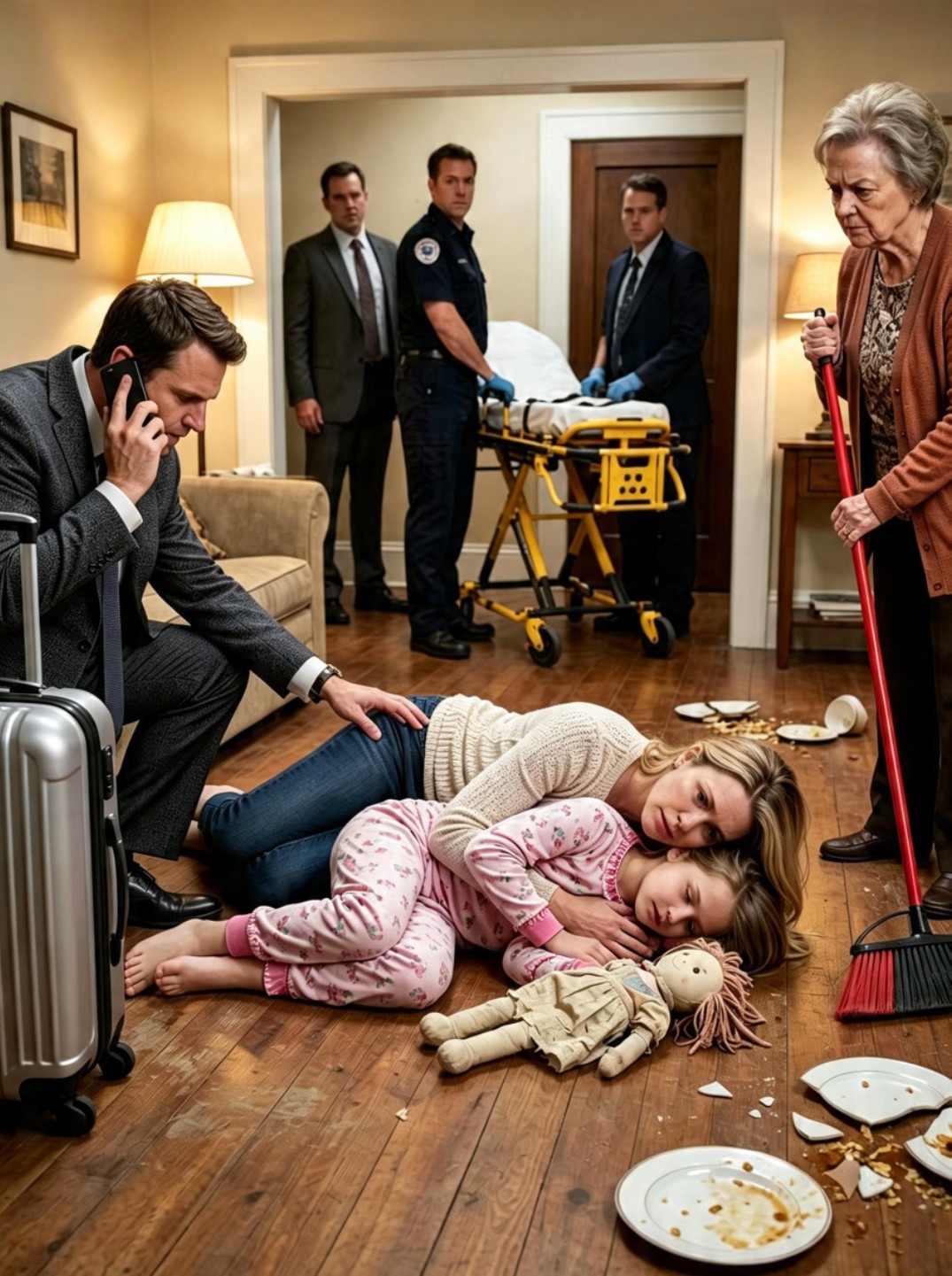
My wife, Maya, and our six-year-old daughter, Chloe, were lying barely conscious on the cold kitchen floor.
And standing over them was my mother, Florence, casually holding a wet mop.
She looked down at my wife and daughter without the slightest sign of panic.
Then she muttered, almost as if she were annoyed by the mess, “Your wife is just lazy.”
I stared at her in disbelief.
The kitchen looked nothing like the home I had left three days earlier.
Broken glass covered part of the floor. Spilled soup was spread across the white porcelain tiles. A heavy metal padlock hung from the pantry door.
And Chloe’s favorite stuffed bunny, Mister Buttons, was trapped beneath Maya’s weak hand.
Its little white fabric dress was covered in a dark, oily stain.
Florence seemed completely certain that all of this would disappear before anyone started asking questions.
She had no idea what was hidden inside that little doll.
“What did you do?” I gasped.
I dropped my heavy suitcase onto the entryway tile and immediately reached for my phone to call emergency services.
Maya was curled tightly beside the gas stove.
One arm was wrapped protectively around Chloe, as if she had used every last bit of strength she had to shield our little girl.
Her face was a frightening ash-gray color.
Chloe’s tiny lips were already turning blue.
I rushed toward them.
Florence leaned against the wooden mop handle and rolled her eyes.
“Don’t make a dramatic scene, Aaron,” she said smoothly. “Maya has been lying around doing nothing for days. She just wanted attention the exact moment you left town.”
I looked at her in horror.
“Step away from them. Right now.”
I dropped to my knees beside my family.
That was when I noticed everything else.
Dirty dishes were piled high in the sink.
The decorative fruit bowl was completely empty.
And the pantry door was secured with a massive metal padlock.
My eyes locked onto it.
“Where is the key?” I demanded.
Florence’s expression hardened.
“What key?”
“The key to the pantry.”
I pointed toward the locked door.
Then I saw the dark bruises wrapped around Maya’s thin wrist.
My stomach tightened.
Florence’s mouth became a bitter line.
“I locked the pantry because your spoiled wife wastes good food.”
I looked at Chloe.
Her tiny ribs were clearly visible beneath her cotton pajama shirt.
“How long has that door been locked, Florence?”
“Stop interrogating me like I’m a criminal in my own son’s house!” she snapped defensively.
But it wasn’t her house.
Florence had only moved in two weeks earlier.
She had claimed that the main plumbing pipes in her apartment in Lincoln had burst and that the repairs would take several weeks.
I had believed her.
I had even thought her staying with us would help.
I had left for my business trip believing Maya would have another pair of hands around the house.
Instead, I had left my wife and daughter alone with a woman who apparently controlled whether they were allowed to eat.
A faint rattling sound suddenly came from Maya’s dry throat.
I leaned closer.
Her pale eyelids moved.
For just a second, she opened them.
“Aaron,” she whispered.
Her voice was barely more than air.
Her breath smelled strangely metallic.
Then she whispered two words.
“The doll.”
Her eyes rolled backward.
Her body went completely limp.
“Maya!”
I reached for her, terrified.
Before I could say anything else, movement caught my attention in the hallway.
My younger brother, Lucas, stepped out from the back hallway.
He was wearing a brand-new luxury gold watch.
I had never seen that watch before.
He looked down at Maya and Chloe.
He didn’t kneel.
He didn’t look frightened.
He didn’t even seem surprised.
“Mother called me an hour ago,” Lucas said casually. “She told me Maya was having another one of her emotional fits.”
I slowly turned toward him.
“Another fit?”
My blood ran cold.
Lucas gave me a patronizing smile.
“You really married fragile goods, didn’t you?”
I stared at my own brother.
Then the sound of sirens filled the quiet suburban street.
An emergency vehicle pulled into our driveway.
Two paramedics rushed through the front door.
One immediately checked Chloe’s faint pulse while the other placed an oxygen mask over Maya’s face.
Florence immediately began talking.
She talked over the medical crew as if she needed to make sure they heard her version first.
“Maya has refused to eat properly for days,” she insisted.
“She refuses to clean.”
“She has been acting unstable.”
“And she’s been filling Chloe’s head with crazy stories.”
One of the first responders looked toward her.
Florence leaned closer and said, “Honestly, officer, you should start documenting this unstable behavior for the upcoming custody hearing.”
The paramedic paused.
Then he glanced toward the locked pantry.
His expression changed.
He looked at me suspiciously.
I said nothing.
Instead, I pulled out my smartphone.
I began photographing everything.
The padlock.
The spilled soup.
The broken glass.
The bruises on Maya’s wrist.
The mop bucket.
The murky water inside it.
Lucas’s new gold watch.
Everything.
I didn’t know exactly what had happened yet.
But I knew something was terribly wrong.
Then one of the female paramedics reached down to move Mister Buttons out of the way.
Florence suddenly flinched.
“Leave that filthy rag right where it is!” she barked.
I immediately looked at her.
Why was she so afraid of someone touching a stuffed toy?
I grabbed a clean plastic freezer bag from the counter and held it open.
“The doll goes directly with my daughter,” I said firmly.
I carefully placed Mister Buttons inside and sealed the bag.
For the first time since I had walked through the front door, my mother looked genuinely terrified.
At the regional hospital in Des Moines, Maya and Chloe were rushed into separate trauma rooms.
I paced through the bright hospital hallway while Florence sat in the lobby.
She continued telling every nurse who passed that Maya was mentally unstable.
Lucas sat beside her.
His fingers kept tapping against the glass face of his expensive new watch.
Then he leaned toward me.
“Don’t try to make this situation ugly,” he whispered.
I turned toward him.
Lucas lowered his voice even further.
“Mother already spoke with a family lawyer this morning. If Maya is officially declared unfit, temporary legal custody of Chloe can easily be arranged.”
I stared at him.
“You contacted a child custody lawyer before the paramedics even arrived at the house?”
For the first time, Lucas’s confident expression slipped.
He looked away.
“We were just planning ahead for the family.”
I didn’t answer.
My phone suddenly vibrated inside my jacket.
Then it vibrated again.
And again.
I pulled it out.
Multiple financial alerts were waiting.
Three separate wire transfers had just been approved from our family savings account.
I opened the notifications.
My heart sank.
$84,000 was gone.
The primary authorization had come directly from the secondary security card I kept hidden inside my locked desk.
Only two people knew where I kept the spare desk key.
Maya.
And Florence.
I turned my phone facedown.
I didn’t shout.
I didn’t confront anyone.
Instead, I quietly sent a message to my personal attorney.
“Freeze every single account immediately. Preserve all digital access logs. Do not inform my family.”
Then I waited.
A few minutes later, Dr. Miller stepped into the hallway.
He was holding Mister Buttons inside a clear plastic evidence container.
His face was pale and serious.
“Mr. Vance,” he said, “where did your daughter originally get this toy?”
“She carries it everywhere,” I answered.
“Why?”
Dr. Miller looked down at the doll.
“There is a heavy chemical residue on the fabric.”
My stomach dropped.
He continued.
“It matches the symptoms we’re seeing in your wife. We found evidence of concentrated industrial pesticide exposure in her bloodstream.”
Florence let out a sharp laugh from her chair.
“Getting sick from a plush toy? That’s completely absurd.”
Dr. Miller slowly turned toward her.
“This level of toxic chemical concentration did not come from normal household exposure, ma’am.”
Lucas immediately stood.
“You cannot throw around wild accusations without hard proof!”
Dr. Miller remained calm.
“I haven’t accused anyone yet.”
He paused.
“And that’s precisely why I have already alerted the local police department.”
A tall hospital security officer stepped into the hallway.
He positioned himself between Lucas and the exit doors.
Lucas stopped moving.
Dr. Miller placed Mister Buttons carefully onto a clean stainless-steel medical tray.
He pressed gently against the soft stuffing.
Then he stopped.
His fingers had felt something hard near the center seam.
I suddenly remembered something I had done years earlier.
When Chloe was still a baby, I had custom-stitched a compact, motion-activated voice recorder inside Mister Buttons.
I had installed it because I traveled frequently for work.
Whenever Chloe missed me, she could press the doll and hear my recorded bedtime stories.
The recorder could also capture up to twelve continuous hours of clear audio.
Dr. Miller looked at me.
“You put a recorder inside this?”
“Yes,” I said.
He carefully picked up a small scalpel.
Then he snipped a single thread along the doll’s center seam.
A tiny black micro SD card slid out onto the stainless-steel tray.
Nobody spoke.
I looked toward my mother.
Florence was staring directly at the memory card.
All the color drained from her face.
She knew.
She knew exactly what was on that card.
PART 2:
The black memory card sat motionless on the stainless-steel tray.
But suddenly, everything that had happened in my kitchen seemed to carry a completely different meaning.
Mister Buttons had not simply been forgotten on the floor during some accident.
Maya had used the last of her strength to keep that doll beneath her body.
And when she had barely been able to speak, she hadn’t asked for water.
She hadn’t begged for help.
She hadn’t even spoken about her own pain.
She had looked at me and whispered:
“The doll.”
Now I understood why.
The recording module inside the plush lining had been designed to capture hours of sound without making a noticeable noise.
Up to twelve hours of audio were stored on that tiny memory card.
I looked across the hospital hallway at Florence.
Her hands were trembling uncontrollably in her lap.
For hours, she had been building a story.
Maya was lazy.
Maya was unstable.
Maya couldn’t take care of Chloe.
Maya was supposedly having emotional episodes.
Lucas had already mentioned taking custody of my daughter.
And now eighty-four thousand dollars had mysteriously disappeared from our savings.
The pantry had been locked.
Maya had painful bruises around her wrist.
Chloe was severely sick and fighting for her life.
And the moment anyone had tried to touch Mister Buttons, Florence had panicked.
She had demanded that the doll stay exactly where it was.
Now the same toy she had tried to keep away from everyone had produced evidence.
Evidence that could tell us exactly what had happened inside my home.
I didn’t know what conversations were stored on that tiny card.
But one thing was suddenly clear.
My mother knew.
The terror in her eyes told me that much.
I stopped asking myself whether Maya had somehow misunderstood what was happening.
Instead, I began asking a much darker question.
Just how much had that little toy heard?
PART 3:
Meanwhile, down the hallway in the pediatric emergency wing, another examination room had become completely quiet.
I turned toward the little boy sitting on the edge of the examination table.
His name was Mason.
He was waiting for me to ask another question.
His small, bruised fingers kept twisting a loose gray thread on his faded hoodie.
That tiny movement told me everything.
Mason wasn’t trying to remember what had happened.
He remembered.
He was trying to decide whether it was safe to tell a stranger the truth.
I kept my voice soft.
“What really happened out in the backyard shed, Mason?”
The boy stared down at the tile floor.
He refused to look at me.
Then, after several seconds, he whispered:
“Mr. Vance said I was way too expensive to keep around.”
My stomach twisted.
Mason swallowed.
“He told me my mom was spending all her hard-earned money on me instead of him.”
His voice cracked.
“Then he said if I got hurt out there, nobody would ever care anyway.”
Nurse Jennifer stood beside the heart monitor.
Her eyes widened in shock.
She looked at the boy.
“Mason, how many nights have you been sleeping in that cold shed?”
Mason swallowed again.
“Three whole nights.”
Three nights.
A nine-year-old child had been locked inside an unheated outdoor shed while the adults around him continued with their normal lives.
I immediately stepped into the hallway.
I called child protective services and requested an urgent dispatch team.
But before the social workers could arrive, Mason’s condition became more serious.
The swelling along the side of his jaw had grown worse.
Doctors ordered an emergency CT scan.
What they found shocked everyone.
This wasn’t a simple bug bite.
It wasn’t a small scrape from playing outside.
A sharp piece of treated wood was deeply embedded beneath Mason’s facial tissue.
The filthy conditions inside the shed had caused a severe bacterial infection.
The attending surgeon pulled me aside after the procedure.
His expression was grave.
“If this boy had arrived twenty-four hours later,” he told me, “the infection could have spread into his bloodstream and become fatal.”
I stood there silently for a moment.
Then I walked back into Mason’s room.
The surgery was over.
For the first time that evening, Mason wasn’t wearing his oversized hoodie to hide his face.
He was wrapped in a clean hospital blanket.
He held a small paper cup of apple juice with both hands.
He looked so young.
Too young to have gone through any of this.
After a long silence, he looked at me.
“Did I cause a lot of trouble by speaking up?”
His question hurt more than any physical injury I had seen that night.
I pulled a chair beside his bed.
“No, Mason,” I told him. “You didn’t cause trouble.”
He looked at me.
“You did something incredibly brave tonight.”
His eyebrows pulled together.
“But Mr. Vance always told me grown-ups never believe kids like me.”
I shook my head.
“Some people say cruel things because they want children to feel small and powerless.”
Mason stayed quiet.
I continued.
“But the truth doesn’t disappear just because someone tells you to hide it.”
I gave him a gentle smile.
“Sometimes the truth takes a while to come out. But eventually, it finds a way to stand up.”
Two days later, local law enforcement investigators officially confirmed everything Mason had been too frightened to tell us.
The backyard shed had been used as an abusive punishment system for several months.
Neighbors provided security camera footage.
The footage showed Mason being forced into the shed during severe rainstorms.
School attendance records revealed sudden changes in his behavior.
There were dozens of missed school lunches.
There were also unexplained physical injuries that Mason had repeatedly tried to hide.
The evidence told a story that Mason had been too afraid to tell himself.
His mother, Rachel, completely broke down when investigators finally told her what had happened.
She had been working double shifts at the factory.
She had trusted her boyfriend to care for Mason.
She had believed his lies.
She never imagined that the person she trusted with her son was hurting him.
When she saw Mason lying in a hospital bed with IV lines attached to his arms, the truth finally became impossible to ignore.
“I should have paid closer attention to the signs,” Rachel sobbed.
She covered her face with both hands.
“I should have known something was wrong.”
I didn’t judge her for the mistakes she had made.
I looked at her and spoke quietly.
“What matters most right now is that you’re here.”
Rachel looked up.
I continued.
“You’re here to protect him moving forward.”
She nodded through her tears.
Several months passed before I saw Mason again.
He returned to the outpatient clinic for his final follow-up appointment.
But the boy who walked through the waiting room doors was different.
He wasn’t hiding inside a dark hoodie anymore.
Instead, he wore a bright blue winter jacket.
And when he saw Nurse Jennifer behind the reception desk, he smiled.
“You still use those exact same colorful pens,” Mason said cheerfully.
Jennifer laughed.
“I certainly do, Mason.”
Mason carefully touched the small mark on his cheek.
His surgical scar had faded into a thin line.
It was almost invisible.
But everyone in that room knew what that little mark meant.
It was proof that he had survived.
Proof that cruelty had not won.
Proof that a frightened child had found the courage to speak.
Later that afternoon, I noticed Mason sitting near the window.
He was quietly working on a colorful drawing.
When he finished, he walked over and handed the paper to me.
I looked down.
The picture showed a small yellow house beside a large oak tree.
Above them was a huge, bright sun.
Standing outside the front door was a little boy holding hands with a tall doctor.
I smiled.
“Is this a picture of us?”
Mason nodded proudly.
“That is the day you found me.”
I shook my head gently.
“No, Mason.”
I pointed to the little boy in the drawing.
“You found your own way out of the darkness.”
Mason looked at me.
“I just happened to unlock the door.”
He smiled.
Years have passed since that stormy night in the emergency room.
But I still think about Mason.
I think about the little boy who entered my hospital believing that his voice meant nothing.
I think about how easily the world can overlook the quiet suffering of vulnerable children.
And I think about what can happen when someone finally stops.
Someone finally listens.
Someone finally believes them.
Because sometimes a child’s voice is barely louder than a whisper.
But even the softest whisper can change an entire life when someone is willing to hear it.
Sometimes the most powerful medicine we can give a patient isn’t found inside a prescription bottle.
Sometimes it is simply this:
Believing a child who has spent far too long waiting to be heard.
And sometimes, that one act of believing can completely change their future.
THE END.
