
PART 1:
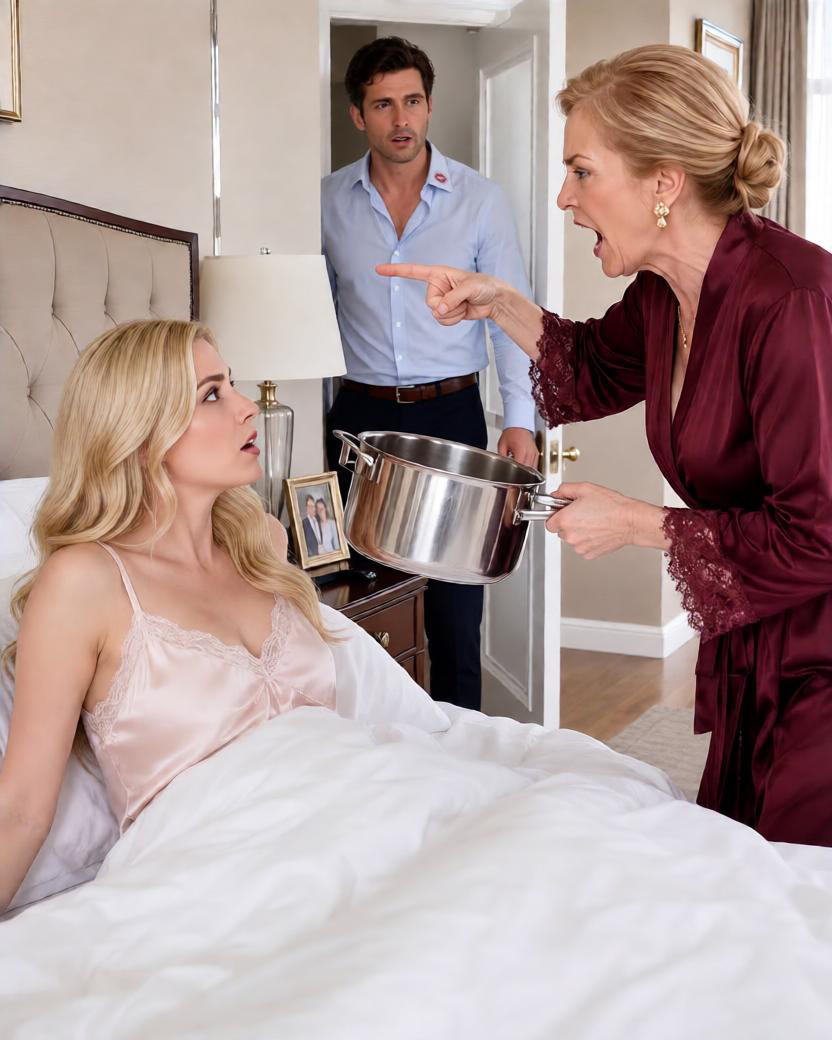
“I could care less that today is your birthday! Get up and cook breakfast for my son!”
The heavy cast-iron skillet crashed against the wooden headboard, missing my temple by only a few inches.
The loud bang shook the windowpanes, but I didn’t scream.
I simply lay there, staring at the small crack in the ceiling.
Mitchell had promised to fix that crack six months ago.
He never did.
Standing beside my bed was my mother-in-law, Theresa. Her face was red with anger, and her eyes were filled with the same cold irritation I had grown used to seeing every day.
“Mitchell is coming home starving from his weekend trip to the lake house,” she snapped. “And you’re lying here acting like royalty!”
Today was my thirty-second birthday.
And somehow, I wasn’t surprised.
For five years, I had worked as a paramedic on an ambulance rig before eventually taking a job at a local health clinic in suburban Chicago. During those years, I had seen almost everything.
Multi-car accidents.
Cardiac arrests.
Emergency deliveries.
People screaming in fear.
People fighting for their lives.
I had learned how to stay calm when everyone around me was panicking.
But for two long years, I had allowed Theresa to take control of my home and my life.
She criticized the clothes I wore.
She rearranged my rooms without asking.
She judged everything I cooked.
She humiliated me in front of the neighbors.
She acted as if my own house belonged to her.
And every time I complained to Mitchell, he gave me the same passive-aggressive answer.
“My mom doesn’t mean any harm, Danielle. You’re just overreacting.”
Those words had become his favorite excuse.
That morning, I slowly got out of bed.
I washed my face and went into the kitchen.
Instead of making the huge breakfast Theresa demanded, I made myself a simple plate of scrambled eggs.
Theresa stared at me as though I had committed some terrible crime.
“A devoted wife would have been awake at six in the morning,” she said. “She would have prepared a full breakfast to celebrate her husband.”
I didn’t argue.
I sat down and calmly picked up my fork.
“I’m eating my breakfast,” I said. “I’ll decide what to do with the rest of my day later.”
Theresa went silent.
My calmness bothered her more than shouting ever could.
She wanted me to cry.
She wanted me to defend myself.
She wanted another argument she could use against me.
Instead, I simply ate my eggs.
Mitchell had left the afternoon before, claiming he needed to fix a plumbing leak at the small vacation home we had purchased together near Lake Geneva.
He hadn’t called me to wish me a happy birthday.
At seven that morning, I had sent him a text.
Happy birthday to me. I wish you were here.
He had read the message.
He hadn’t replied.
As I washed my breakfast plate, a fact I had spent a long time trying to ignore suddenly became impossible to avoid.
The suburban townhouse where we lived was not some generous gift from Mitchell.
I had paid a huge part of it myself.
When my grandmother died, she left me a house. After selling it, I had contributed $145,000 toward the purchase of our townhouse.
The bank transfer was fully documented.
The deed was in both of our names.
And I had a signed letter from Mitchell clearly acknowledging that the money had come from my inheritance.
I dried my hands and went to my desk.
Then I pulled out a green folder.
Inside were my financial documents, property records, and other papers I had carefully kept over the years.
I packed my personal documents into a bag.
Then I grabbed my phone and texted my friend Megan, a family law attorney.
I need an urgent consultation. I think I’m ending my marriage today.
I was just about to call her when the doorbell rang.
I frowned.
Theresa looked toward the front door.
“I’m not expecting anyone,” she muttered.
I opened it.
A woman in her mid-forties stood on the porch. She was holding a manila envelope.
She looked nervous.
“My name is Patricia,” she said gently. “I live next door to your cabin near Lake Geneva.”
I stared at her.
“I’m sorry to bother you today,” she continued, “but you deserve to know the truth.”
She held out the envelope.
I took it.
Inside were several crisp photographs.
I pulled out the first one.
My stomach dropped.
Mitchell was standing on the back deck of our Lake Geneva cabin.
His arm was wrapped around a blonde woman’s waist.
I looked at the second photograph.
They were kissing.
Then I pulled out the third.
The blonde woman was standing in the kitchen, cooking.
She was wearing an embroidered apron.
My apron.
The same apron I had thought was lost months ago.
For a moment, I couldn’t speak.
Patricia lowered her voice.
“I saw them there several times,” she said. “I didn’t know what was happening between them, but I thought you had the right to know.”
Before I could answer, Theresa stepped behind me and looked over my shoulder.
She saw the photographs.
And instead of looking shocked, she simply sighed.
Then she said the words that destroyed the last remaining piece of my marriage.
“Of course I knew about her.”
I slowly turned toward her.
Theresa didn’t even look ashamed.
“He’s my son,” she continued. “If he looked for another woman, you must have given him a reason.”
Something inside me went completely still.
For the first time, Theresa seemed to realize that she was no longer standing in front of the quiet woman who had spent two years swallowing every insult.
I looked at her.
And this time, I wasn’t afraid.
PART 2:
I closed the front door after thanking Patricia.
Then I immediately called Megan.
I told her everything.
The photographs.
The Lake Geneva cabin.
The two years of mistreatment.
Theresa’s behavior.
And the $145,000 I had contributed toward the townhouse.
Megan listened carefully.
“The deed is in both of your names, right?” she finally asked.
“Yes.”
“And you have proof that the $145,000 came from your inheritance?”
“I have the wire transfers and a signed statement from Mitchell acknowledging where the money came from.”
“Then you’re in a strong position,” Megan assured me. “Theresa isn’t an owner. She has no lease agreement, and she has no legal right to stay there.”
I took a deep breath.
“What should I do?”
“Don’t sign anything Mitchell gives you,” Megan said. “And don’t let anyone pressure you into making a decision without legal advice.”
“I want you to represent me,” I said. “File the divorce and property division papers.”
“Okay,” Megan replied. “I’ll start preparing everything.”
At 12:30 p.m., Mitchell finally walked through the front door.
The moment he entered, I noticed something.
He smelled of woodsmoke.
And underneath it was the sweet scent of a perfume that definitely wasn’t mine.
Theresa immediately rushed to greet him.
“There you are!” she exclaimed.
Mitchell barely acknowledged her.
He walked into the kitchen and avoided looking directly at me.
“We need to talk,” he said awkwardly.
I looked at him.
“Go ahead.”
He swallowed.
“I wasn’t alone at the cabin.”
I waited.
“Her name is Courtney,” he continued. “It started a few months ago, but it doesn’t mean I don’t love you.”
I stared at him.
“It’s been going on for seven months,” I said calmly.
His face changed.
“Patricia brought me the photographs,” I continued. “And your mother just admitted that she knew all about it.”
Mitchell went pale.
He had probably expected tears.
Maybe screaming.
Maybe dishes being thrown across the kitchen.
Instead, I simply reached over and turned off the stove.
“Eat your lunch,” I said.
He looked confused.
“At five o’clock,” I continued, “we’re talking about the house.”
I walked away.
Later that afternoon, Mitchell tried to explain himself.
He claimed he had felt ignored.
He said Courtney listened to him.
He said he felt understood by her.
Then he tried to shift some of the blame onto Theresa and me.
“Both of you have difficult personalities,” he said.
I almost laughed.
Instead, I walked to the coffee table and placed the green folder in front of him.
“My attorney is drafting an agreement tomorrow,” I said. “It will recognize my $145,000 inheritance contribution. The remaining equity will be divided fifty-fifty according to the deed.”
Mitchell stared at me.
“You can buy out my share,” I continued, “or we put the house on the market.”
He looked stunned.
“And I’m filing for divorce.”
His jaw tightened.
“And what if I refuse?”
“Then my lawyer files a formal petition and requests a forensic financial audit of all your accounts.”
He stared at me.
“That will take longer,” I said. “And it will cost you twice as much in legal fees. But I won’t back down.”
Before Mitchell could respond, Theresa stormed into the room.
She was furious.
“You’re trying to steal my son’s livelihood!” she shouted.
I calmly opened the deed.
“This is Mitchell’s home!” Theresa continued. “You moved in here with a single suitcase!”
I pointed directly at my name on the document.
“I moved in here with an inheritance, a full-time career, and receipts.”
Theresa stared at me.
“You’ve been living here without paying a single dollar toward the mortgage, utilities, or groceries,” I continued. “And meanwhile, you’ve been collecting $1,200 a month by renting out your own condo downtown.”
Her face hardened.
“As of today, I am revoking my consent for you to live under this roof.”
Theresa turned toward her son.
“Tell her!” she demanded. “I’m your mother!”
Mitchell looked at the floor.
For the first time, he didn’t defend her.
Not one word.
That night, Mitchell and Theresa argued behind closed doors.
I stayed out of it.
Instead, I focused on protecting myself.
I backed up our financial statements.
I saved the text messages.
I uploaded the photographs to secure cloud storage.
I copied important documents.
I made sure I had records of everything.
At 3:00 a.m., Mitchell stepped outside onto the patio.
I was sitting there alone.
He stood a few feet away from me.
“I’ll sign the agreement,” he muttered.
I looked up.
“I’ll apply for a refinancing loan to buy out your share.”
The next day, we signed the preliminary paperwork at Megan’s attorney’s office.
For the first time, everything felt real.
My marriage was ending.
My life was changing.
But when I returned home from my shift at the clinic, I found Theresa standing near the front door.
She was wearing her coat.
A suitcase stood beside her.
She looked different.
There was no anger in her face.
No shouting.
No insults.
She looked tired.
“Before I leave,” Theresa said quietly, “you should know the real reason I moved into this house.”
PART 3:
Theresa didn’t raise her voice.
Instead, she walked to the kitchen table and sat down.
She clutched the handle of her purse tightly with both hands.
“My condo has been empty since February,” she confessed.
I stood near the counter.
“The tenants moved out, and I never listed it again.”
I frowned.
“Why?”
Theresa looked down.
“Because I was terrified of being alone.”
The answer surprised me.
For two years, Theresa had told everyone she moved in because of her back pain and because she needed help.
She had constantly talked about the money she earned from renting her condo.
Yet she had never contributed a single dollar toward our household expenses.
Now, for the first time, she was telling me something different.
“After Mitchell’s father passed away,” she said softly, “I started having severe panic attacks at night.”
She took a shaky breath.
“Every little noise made me think someone was breaking in. I was too proud to admit that I was scared.”
She looked at me.
“When Mitchell married you, I saw an opportunity to make sure I would never have to be alone in an empty house.”
I stared at her.
“You could have just told us that.”
Theresa gave a bitter little laugh.
“I don’t know how to ask for help,” she admitted. “I’ve spent my whole life bossing people around. It was easier to criticize you than to admit that I was terrified.”
I understood something in that moment.
An explanation was not the same thing as an excuse.
Theresa’s fear explained why she wanted to stay in our house.
But it did not excuse what she had done.
It did not excuse throwing a heavy skillet at my head.
It did not excuse humiliating me in front of the neighbors.
It did not excuse controlling my home.
And it certainly did not excuse protecting her son after he cheated on me.
“Being afraid didn’t give you the right to destroy my peace,” I said.
Theresa lowered her eyes.
“I know.”
It was the first time she had ever admitted she was wrong without fighting back.
“I’m moving back to my condo tomorrow,” she said, slowly standing. “My friend’s son is helping me move my boxes.”
She picked up her purse.
“And…” She paused. “You were a good wife to my son. I just chose not to see it.”
The words were two years late.
But they still carried weight.
“If you ever need a medical referral for your anxiety, you can call me,” I told her. “But we will never live under the same roof again.”
“I understand.”
Theresa reached the door.
Then she stopped.
“Happy birthday, Danielle,” she said quietly. “I didn’t say it yesterday.”
The door clicked shut.
I stood there for a moment.
Then I opened the windows.
A fresh afternoon breeze moved through the townhouse.
I didn’t feel victorious.
I didn’t feel like celebrating.
I simply felt like I could breathe again.
Mitchell came home late that evening.
We ate dinner in silence.
We washed our own dishes.
And eventually, Mitchell finally admitted something he had avoided for years.
“I knew my mom was cruel to you,” he said.
I looked at him.
“I called it ‘personality clashes’ because standing up to her felt too uncomfortable.”
I shook my head.
“A personality clash is disagreeing about how to fold towels,” I replied. “What happened here was emotional abuse, and you enabled it.”
Mitchell had no answer.
Over the next two weeks, I packed my belongings.
I found a bright, sunlit one-bedroom apartment only fifteen minutes from the health clinic.
The rent wasn’t cheap.
But my salary covered it easily.
On moving day, I took only what belonged to me.
My clothes.
My books.
My coffee maker.
My linens.
My favorite mug.
And a small entry rug.
Theresa had once thrown that rug into the trash because she said it looked cheap.
I had rescued it from the bin back then.
Now, I placed it proudly at the entrance of my new apartment.
Mitchell helped me load my boxes into the moving truck.
He didn’t try to stop me.
When the truck finally pulled away, I stood alone in my quiet living room.
There was no dramatic music.
No grand applause.
No crowd cheering for me.
There was only warm afternoon sunlight coming through the south-facing windows.
For the first time in years, the quiet didn’t feel like isolation.
It felt like freedom.
A few days later, Mitchell called me.
“The bank approved my refinancing loan,” he said. “As soon as the appraisal clears, your $145,000 plus your share of the equity will be wired to your account.”
“Good.”
There was a pause.
“Courtney and I—”
“I don’t need to know,” I interrupted gently. “That’s your life now. It’s no longer my story.”
The uncontested divorce went smoothly.
A few weeks later, we stood outside the courthouse after receiving the final paperwork.
Mitchell lit a cigarette.
He looked exhausted.
“I should have stopped my mother from day one,” he said. “And I shouldn’t have cheated. I thought things would just work themselves out.”
I looked at him.
“Things don’t just work themselves out, Mitchell. People have to make choices.”
He nodded.
“I’m sorry, Danielle.”
For the first time, I looked at him without anger.
I no longer saw the man I had once fallen in love with.
But I also didn’t see a villain I needed to hate.
I saw a weak man who had made cowardly choices and now had to live with the consequences.
“I forgive you,” I said. “Not because what you did was okay, but because I refuse to carry the weight of it anymore.”
My forgiveness wasn’t reconciliation.
It was closure.
By the middle of summer, the $145,000 inheritance contribution plus my share of the equity had been deposited into my bank account.
Mitchell fulfilled every term of our settlement.
We collected our final decree.
We wished each other well.
Then we walked away in opposite directions.
A month later, Mitchell unexpectedly appeared near the entrance of my clinic.
He looked thinner.
There were dark circles beneath his eyes.
I stepped outside to speak with him on the sidewalk.
“Courtney left,” he said plainly.
I said nothing.
“When she realized I had taken on a large mortgage to buy you out and that my mother wasn’t living with me anymore, she said it was too much baggage.”
I felt neither satisfaction nor pity.
“I’m sorry to hear that.”
“I didn’t come here to make you feel bad for me,” Mitchell said.
His eyes filled with tears.
“I came because I finally realize she wasn’t the main problem.”
I stayed silent.
“I wanted a life where I never had to make hard decisions,” he continued. “I let my mother mistreat you. I let you handle all the heavy lifting in our marriage. And then I ran to another woman who only knew my side of the story.”
He wiped his eyes.
“Now that the dust has settled, I’m entirely alone.”
“You’re not entirely alone, Mitchell,” I said. “You have your mother, your career, and the opportunity to grow up.”
He looked at me.
“But you don’t have me anymore.”
He slowly nodded.
“Did you ever think about coming back?”
“No.”
My answer was gentle.
But it was final.
“I didn’t leave because Courtney showed up,” I added. “I left because I disappeared inside our marriage. The affair just turned on the light.”
A few weeks later, the clinic director called me into her office.
She had an offer for me.
“You handle high-stress situations remarkably well,” she said. “And lately, you carry yourself with a real sense of quiet confidence.”
She offered me a promotion to Nurse Coordinator.
I accepted.
The raise allowed me to furnish my apartment, increase my savings, and buy a colorful watercolor print.
It showed an open window overlooking a blooming garden.
I hung it above my desk.
By late autumn, I found a small rescue dog at a local shelter.
He was a mixed breed with warm caramel-colored fur and attentive eyes.
I named him Copper.
Walking him in the evenings became part of my new routine.
Having his warm presence in my apartment brought me a quiet kind of happiness.
Copper didn’t yell.
He didn’t demand praise.
He didn’t expect me to sacrifice my peace.
That winter, I spent Christmas Eve with my parents.
We sat around the dinner table together.
My father raised his glass.
“What are we drinking to?” he asked.
I looked at my parents.
Then I looked down at Copper, who was resting peacefully beside my feet.
“To new beginnings,” I said with a smile. “Not the kind we hope for someday, but the kind we build for ourselves.”
I looked out the window.
Soft snow was falling outside.
And I thought back to the morning of my thirty-second birthday.
The heavy skillet crashing against my headboard.
The crack in the ceiling.
Theresa standing beside my bed.
And the woman I had been for so long.
A woman who had believed that keeping a family together meant enduring anything.
But I finally understood the truth.
A relationship without respect is just a cage with pretty decorations.
My real victory was never Mitchell’s financial settlement.
It wasn’t Theresa moving out.
It wasn’t even the divorce.
My real victory was the moment I stopped asking other people for permission to value myself.
And that was the beginning of my real life.
The end.
