
PART 1:
I discovered that I was probably the father of five-year-old twin boys while standing on the cold marble floor of Terminal 4 at O’Hare International Airport.
Thirty-five minutes earlier, I had been cursing an unexpected flight delay, convinced that it was going to destroy the most important business deal of my career.
I was forty-four years old, and I had built my entire life around being on time.
Some people treated punctuality like a simple habit.
I treated it almost like a religion.
I owned a boutique hotel chain with properties in Miami, Charleston, Savannah, and Key West. That morning, I was supposed to fly to Boston to close a deal involving the acquisition of a historic estate.
It was the biggest deal I had ever attempted.
I had arrived at O’Hare two hours early, just as I always did.
I had checked everything twice.
My documents were organized.
My schedule was packed.
My laptop was fully charged.
My presentation was ready.
Everything was supposed to happen exactly according to plan.
Then the departure monitor suddenly flashed red.
MECHANICAL DELAY.
I stared at the screen.
Of course.
The one morning when I absolutely could not afford a delay, something had gone wrong with the aircraft.
I immediately called my chief financial officer.
“Start the board meeting without me if you have to,” I told him. “I’ll get there as soon as they clear the aircraft.”
“Marcus, we can hold for a while,” he replied.
“No. Don’t risk the deal. Keep everyone moving.”
I ended the call and looked around the crowded terminal.
Families dragged suitcases behind them.
Business travelers stared at their phones.
Children cried.
Announcements echoed from the speakers overhead.
I needed somewhere quiet.
So I walked toward the floor-to-ceiling windows, found an open area away from the gate, and opened my laptop.
I had barely read two lines of my financial summary when something caught my attention.
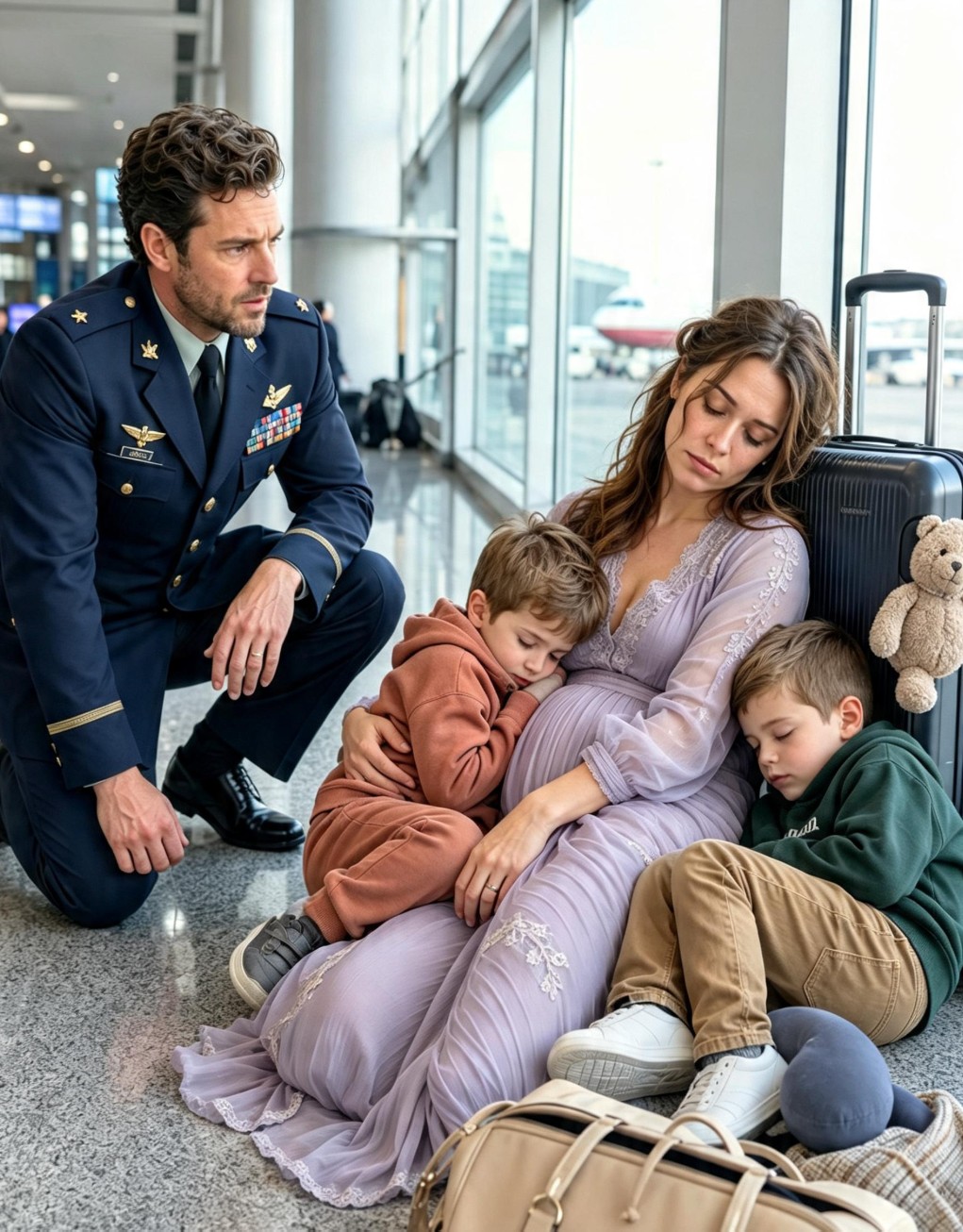
A few yards away, a woman was sleeping upright against the wall.
Beside her sat a badly scuffed blue suitcase.
Two little boys were sleeping next to her.
One had his head resting against the woman’s leg.
The other had both tiny hands wrapped tightly around the suitcase handle.
He held it as if letting go meant losing everything.
I would have kept walking.
I would have returned to my laptop.
I would have forgotten they were even there.
Then the woman moved.
She slowly brushed her hair behind her ear.
And I recognized the exact, delicate way she did it.
My entire body froze.
Evelyn.
The woman who had vanished from my life six years earlier.
For several seconds, I couldn’t breathe.
I simply stood there.
Evelyn was thinner now.
Her face carried deep lines of exhaustion that had never been there before. She wore plain clothes, and there was nothing glamorous about the woman sitting beside that battered suitcase.
But I knew her.
I could have recognized her anywhere.
For six years, I had tried to bury every memory of her beneath grand hotel openings, investor contracts, endless flights, business dinners, and one deal after another.
My mother, Eleanor Vance, had given me an explanation so many times that eventually I had convinced myself it was the truth.
“Evelyn realized she didn’t belong in our world, Marcus,” my mother had told me. “Let her walk away with her dignity.”
I wanted to believe her.
I needed to believe her.
Because the alternative hurt too much.
The alternative was that the woman I had loved had simply abandoned me.
I had met Evelyn when she was coordinating charity galas for my family’s foundation in Chicago.
I was thirty-five.
She was thirty-one.
From the very beginning, she was different from the people who usually surrounded my family.
She wasn’t intimidated by the Vance name.
She challenged me when she thought I was wrong.
And she openly laughed at the stiff, formal traditions my family treated like sacred law.
My mother hated her almost immediately.
One evening, Eleanor warned me over dinner.
“Enjoying someone’s company is one thing, Marcus,” she said. “Building a family legacy with someone is quite another.”
I didn’t back down.
“Evelyn is the only woman I’ve ever wanted to build a family with.”
My mother had stared at me across the table.
“You’ll regret letting emotions interfere with the family business.”
“I’d regret letting the family business decide who I love.”
That conversation became one of the last serious arguments we had about Evelyn.
A few months later, I had to leave the country for three weeks to oversee a hotel opening.
I expected to come home to Evelyn.
Instead, when I returned to Chicago, her apartment was completely empty.
Every trace of her was gone.
Her phone had been disconnected.
My text messages went undelivered.
The letters I mailed came back unopened.
I was devastated.
I was furious.
And I was confused.
My mother told me Evelyn had explicitly begged us not to track her down.
Wounded, angry, and far too proud to admit how badly I was hurting, I eventually stopped searching.
I told myself she had made her choice.
I told myself I had to move on.
Now, six years later, she was sitting only a few yards away from me.
And she wasn’t alone.
One of the boys suddenly stirred.
He shifted against the wall.
Then he slowly sat up.
I looked at him.
My mouth went completely dry.
The boy had my dark, wavy hair.
He had the exact square jawline my late father had.
And then I saw it.
A tiny notch in his left eyebrow.
The same little notch I saw every morning when I looked into the mirror while shaving.
I couldn’t move.
I couldn’t speak.
As if she had sensed something, Evelyn opened her eyes.
She looked directly at me.
The moment our eyes met, every drop of color disappeared from her face.
She immediately pulled both boys toward her chest.
I took one slow, uncertain step toward her.
“Evelyn.”
She stared at me as if I were a ghost.
Her lips parted.
“It can’t be…”
“I’ve been asking myself the same thing for six years,” I managed to say.
Evelyn pressed her lips tightly together.
She looked down at the boys.
Then she looked back at me.
Her eyes were filled with something I couldn’t understand at first.
Grief.
Fear.
Caution.
And perhaps something else.
“Marcus…” she whispered.
Her voice trembled.
“Your mother never told you, did she?”
PART 2: THE TRUTH ABOUT THE BOYS
For several agonizing seconds, I couldn’t find my voice.
“Told me what?”
Evelyn looked down at the children.
One of the boys opened his eyes and stared at me.
There was something about his expression that felt so familiar it physically hurt.
Evelyn swallowed.
“Their names are Leo and Toby,” she said softly.
I looked from one boy to the other.
“How old are they?”
“Five.”
My knees suddenly gave out.
I dropped onto the cold airport floor.
“Are they mine?”
Evelyn nodded once.
That single movement changed my entire life.
She reached into her worn tote bag and pulled out a thick stack of papers held together by a rubber band.
She placed them in front of me.
There were unopened letters addressed to my office in Chicago.
Every one of them had been stamped:
RETURN TO SENDER.
There were copies of emails she had sent to an old email account I had eventually stopped using.
And then there was a cashier’s check.
Sixty thousand dollars.
I recognized the elegant handwriting immediately.
My mother’s handwriting.
“Your mother offered me this check to disappear,” Evelyn said.
Her voice had become cold and quiet.
“I refused it.”
I stared at her.
“Three days later, she told me you already knew about the pregnancy and that you wanted nothing to do with us.”
I felt all the blood drain from my face.
“That… I never knew, Evelyn.”
I shook my head.
“I swear to God, I never knew.”
Evelyn watched me carefully.
Then she whispered, “I see that now.”
She took a breath.
“Three days after that conversation, my apartment lease was suddenly canceled by my landlord.”
I stared at her.
She continued.
“And your family’s corporate attorney formally served me with a notice.”
“What kind of notice?”
“A warning.”
She looked directly into my eyes.
“They said any further attempt to contact you would be treated as harassment and extortion.”
My heart hammered against my ribs.
“Why didn’t you fight it?”
“I was pregnant.”
Her voice cracked.
“I was alone. I had no money for a major legal battle, and your family’s attorney made it clear they could bury me in paperwork.”
She looked down at Leo and Toby.
“I thought you had chosen them over us.”
I closed my eyes for a moment.
“I never chose this.”
“I know.”
“Why are you back in Chicago?”
Evelyn pointed toward the departure monitor.
“Because your mother found us again.”
Before I could respond, my phone suddenly vibrated violently in my hand.
MOTHER CALLING…
My stomach tightened.
I slid the screen to answer.
Eleanor didn’t even say hello.
“Marcus, do not believe a single word that woman says to you.”
I slowly stood.
“How do you know I’m standing with her?”
There was silence on the other end.
Then my mother said, “Come home. We can discuss this privately.”
I looked around the terminal.
Evelyn was staring over my shoulder.
Her eyes had gone wide with terror.
I turned around.
Fifty yards away, standing across the concourse, was my mother.
Eleanor Vance.
Beside her stood Raymond Vance, our family’s senior corporate counsel.
Raymond was holding a thick gray legal folder.
I could see the names printed across the front.
Two names.
Two children’s names.
LEO VANCE MONTGOMERY
TOBY VANCE MONTGOMERY
I stared at the folder.
Then I looked at my mother.
And suddenly, I understood.
This wasn’t some strange coincidence.
My mother had known.
She had known about the boys.
She had known about Evelyn.
And she had come to the airport prepared.
PART 3: THE FORGED SIGNATURE
I marched across the concourse toward my mother before she could take another step in Evelyn’s direction.
“Hand me that folder, Raymond.”
I stepped directly into my lawyer’s path.
Raymond tightened his grip on the gray cardboard folder.
“Marcus, this is completely inappropriate. This is not the place to discuss private estate matters.”
“Then it certainly wasn’t the place to hunt down a mother and two five-year-old boys,” I snapped.
My mother stood behind him.
At sixty-eight, Eleanor still had an incredible ability to issue a ruthless command without ever raising her voice.
She held her chin high.
Her expression remained calm.
“You’re emotional, Marcus,” she said. “That woman has staged this encounter with precise timing.”
Evelyn stood behind me.
She immediately pulled Leo and Toby closer, positioning herself between them and my mother.
“I didn’t stage anything,” Evelyn said. “I was trying to leave.”
My mother didn’t even look at her.
“Marcus, you have a multimillion-dollar closing in Boston that affects hundreds of our employees. Do not throw away years of corporate growth for an unverified story.”
I pointed toward Evelyn’s open bag lying on the floor.
“I just saw the returned letters, Mother.”
I held her gaze.
“I saw the cashier’s check with your signature on it.”
“Letters prove nothing regarding paternity,” Eleanor replied coldly.
“No.”
My voice was low now.
“They prove someone actively intercepted my mail for six years.”
Raymond tried to speak.
“Marcus, perhaps—”
I cut him off.
“What is in that folder, Raymond?”
He said nothing.
“Hand it to me right now,” I ordered, “or you are no longer corporate counsel when I leave this terminal.”
Raymond looked at my mother.
He hesitated.
That tiny hesitation told me everything.
I reached forward, grabbed the folder from his hands, and tore open the clasp.
Inside was a private investigator’s report.
There were detailed surveillance photographs of Evelyn walking the boys to preschool.
There were copies of their daily schedules.
There were photographs of the building where they lived.
There was even a drafted legal settlement.
My mother was offering Evelyn two hundred thousand dollars.
In exchange, Evelyn would have to agree to absolute non-disclosure, surrender all correspondence, and sign an irrevocable agreement stating that every future attempt to contact the Vance family would have to go through Raymond’s law firm.
I felt violently sick.
“You hired a private investigator to stalk my children?”
My mother didn’t even flinch.
“To investigate children whose legal status is completely unverified,” she corrected.
Evelyn reached into a hidden interior pocket inside her worn blue suitcase.
“Show him this one too, Marcus.”
She pulled out a single sheet of paper.
It had been folded into quarters.
She unfolded it.
My hotel company’s corporate letterhead was at the top.
The date was six years old.
I began reading.
The words were brief.
Brutal.
The letter stated that I was fully aware of Evelyn’s pregnancy.
It said I had no desire to establish a relationship with Evelyn or the children.
It directed all future legal communications to Raymond’s law firm.
And at the bottom was my signature.
I stared at it.
For two seconds, I couldn’t understand what I was seeing.
Then I looked up.
“I never signed this document.”
Evelyn closed her eyes.
Tears slipped down her cheeks.
For six years, she had hated that piece of paper.
She had read it during late-night fevers.
She had read it on fatherless birthdays.
She had read it while filling out school medical forms.
And she had seen it in her mind every time one of her sons asked why other fathers came to school plays.
Raymond suddenly looked pale.
My mother didn’t blink.
“It was the best decision for everyone involved, Marcus.”
The silence that followed seemed to swallow the entire terminal.
“You forged my signature?”
My voice sounded strange even to me.
Eleanor remained calm.
“I prevented you from making a permanent, life-altering mistake.”
“They are my sons!”
For the first time, my mother looked directly at Leo and Toby.
There was no warmth in her expression.
No grandmotherly affection.
Only cold calculation.
“Those children didn’t need a father, Marcus,” Eleanor said smoothly.
“Their mother simply needed to understand her place.”
Evelyn flinched as though my mother had physically slapped her.
Something inside me went completely still.
I didn’t shout.
Instead, I reached into my pocket and pulled out my phone.
I called my CFO.
“I need you to stop the Boston acquisition.”
There was silence on the other end.
“Marcus, what?”
“Cancel the closing. All of it. I’ll explain later.”
“Are you sure?”
“Yes.”
I ended the call.
Then I contacted my company’s IT and legal departments.
I ordered them to immediately lock down and preserve every historic email, server backup, corporate mail log, and document connected to Eleanor and Raymond.
I wanted everything preserved exactly as it existed.
Nothing deleted.
Nothing altered.
Nothing conveniently missing.
After that, I flagged down nearby airport security officers.
I requested that they escort my mother and Raymond away from my family.
Eleanor stared at me in disbelief.
“You are destroying your own family, Marcus!”
I looked directly into her eyes.
“No.”
My voice was calm.
“I’m finally uncovering who destroyed it six years ago.”
Raymond dropped his briefcase onto a chair.
His face was completely drained of color.
“Eleanor…”
He swallowed.
“I cannot participate in this any longer.”
That sentence finally broke my mother’s composure.
Raymond asked to speak with me privately.
I refused.
“If you have something to explain,” I told him, “you can explain it in front of Evelyn.”
Raymond looked at the floor.
Then he admitted what had happened six years earlier.
My mother had instructed his firm that I wanted all contact with Evelyn completely severed.
Raymond said he had never personally watched me sign the letter Evelyn had been given.
He had assumed the signature had been authorized through my corporate power of attorney.
Then he admitted something even worse.
When Evelyn rejected the sixty-thousand-dollar cashier’s check and continued trying to contact me, my mother ordered him to increase the legal pressure.
She wanted to make certain Evelyn fled Chicago.
“I should have verified it directly with you, Marcus,” Raymond stammered.
“Yes,” I replied quietly.
“You should have.”
My mother turned and walked toward the terminal exit.
No one followed her.
No one stopped her.
And no one said goodbye.
PART 4: MEETING MY SONS
What I did next was far more important.
I dropped down until I was at eye level with my sons.
Leo was staring at his shoes.
Toby still had both hands wrapped around the handle of the worn blue suitcase.
I didn’t know what to say.
There were six years of missing memories between us.
Six years of birthdays.
Christmas mornings.
School events.
Illnesses.
First steps.
First words.
Everything I should have known.
Everything I had missed without even knowing it existed.
Then Leo looked up at me.
“Are you really our dad?” he asked quietly.
I felt Evelyn catch her breath beside me.
“I am,” I answered gently.
“And we’re going to figure everything out together.”
I looked at both boys.
“But there’s one thing I need you to know right now. Your mother tried everything in her power to find me. I never knew.”
Toby frowned.
His little eyebrows pulled together.
“So… you weren’t mad at us?”
That question shattered something deep inside my chest.
I shook my head.
“I could never be mad at you, buddy.”
I paused.
“I didn’t even know you existed.”
Then I smiled at him.
“But I’m here now.”
I didn’t force them to hug me.
I didn’t make huge promises.
I didn’t tell them I could magically repair six years in one afternoon.
Instead, I asked the simplest question I could think of.
“Are you hungry?”
An hour later, the four of us sat together in a quiet airport café.
There were sandwiches on the table.
Juice boxes.
And a cup of coffee that I completely forgot about until it had gone cold.
Evelyn answered my questions carefully.
She spoke like someone who had spent six years learning that information could be turned into a weapon.
Slowly, I began learning who my sons were.
Leo was obsessed with geography.
He knew almost every state capital.
Toby loved taking plastic toys apart to see how they worked.
He wasn’t always able to put them back together afterward.
The boys had shared a bedroom since they were babies.
Evelyn had worked as an administrative assistant at a medical clinic.
During the hardest years, she had raised the boys with help from her sister, Victoria.
Eight months earlier, Evelyn and the boys had moved back to Chicago because Evelyn had received a job offer.
That was when my mother’s private investigator found them.
First came a legal letter from Raymond’s firm.
Then came a phone call.
Then Evelyn noticed the same black sedan parked near the boys’ preschool for three consecutive days.
She realized they were being watched.
She took several days off work and bought bus tickets so she could take the boys away while she searched for a legal-aid lawyer.
Our meeting in Terminal 4 hadn’t been planned.
Nobody had arranged it.
Nobody had timed it.
It happened because of one thing.
A thirty-five-minute mechanical delay.
That evening, I booked two adjoining suites for Evelyn and the boys at one of my boutique hotels in downtown Chicago.
She refused at first.
“I don’t want your money, Marcus.”
“I know.”
“Then why are you doing this?”
“Because you’re my children’s mother, and because you need somewhere safe tonight.”
She still hesitated.
I placed the reservation entirely under her name.
“My mother will have absolutely no access to the building,” I told her. “No room information. No guest information. Nothing.”
Only then did Evelyn agree.
She also agreed to a court-admissible DNA test.
She chose an independent laboratory.
Her own attorney would be present.
Five days later, the results arrived.
I opened the report.
There it was.
Probability of Paternity: 99.99%.
I read the sentence again.
Then again.
I sat alone in my office.
For ten full minutes, I didn’t move.
Finally, I locked the door.
And for the first time since my father’s funeral, I cried.
I wasn’t crying because of the number.
I wasn’t crying because the test had confirmed what I already knew in my heart.
I was crying because I suddenly understood what six years meant.
Five birthdays.
Five Christmases.
Their first steps.
Their first words.
Late-night fevers.
Scraped knees.
School plays.
Thousands of ordinary moments.
Thousands of precious moments I could never get back.
The next day, I met Evelyn.
I didn’t give her some hollow apology for something I hadn’t known about.
Instead, I apologized for something I had done.
I had accepted my mother’s convenient explanation six years earlier without digging deeper.
“I should have searched for you harder,” I said.
Evelyn remained silent for a long moment.
“And I should have questioned that forged letter,” she finally said.
Her voice was quiet.
“But I was pregnant with twins, completely alone in Chicago, and an entire law firm was threatening to destroy me.”
She looked at me.
“We both believed a lie because it was engineered to look like the truth.”
That conversation became the beginning of our real story.
Not an instant romance.
Not some magical reunion where everything immediately returned to the way it had been.
It was something much harder.
A slow, deliberate rebuilding.
PART 5: THE EVIDENCE
Over the next few months, I completely restructured my executive schedule.
I needed to spend time with Leo and Toby.
But more importantly, I needed to spend time with them in places where they felt safe.
I walked them to preschool with Evelyn.
I learned that Leo hated crushed tomatoes.
I learned that Toby couldn’t sleep if the closet door was even slightly open.
I learned that both boys were fiercely competitive whenever we played board games.
Little by little, I began learning the ordinary details of their lives.
The details I had missed.
Then, one afternoon, something happened that I would remember for the rest of my life.
Toby and I were sitting at the living room table, building a plastic model airplane.
A tiny plastic wheel fell onto the rug.
Without looking up, Toby mumbled,
“Dad, can you pass me that wheel?”
Everything stopped.
All three of us froze.
Toby’s face immediately turned bright red.
He realized what he had said.
I picked up the tiny wheel.
Then I gently handed it to him.
“Here you go, buddy.”
I didn’t make a big deal out of it.
I didn’t want to embarrass him.
But that night, I put that tiny spare plastic wheel inside my bedside drawer.
I kept it there.
Meanwhile, the corporate IT investigation into my mother’s actions uncovered the full scope of her deception.
Our systems engineers recovered archived emails from my mother’s personal account.
In those emails, she had instructed a former executive secretary to scan my signature onto corporate documents for what she called “urgent estate matters.”
Another email thread revealed that Eleanor had explicitly ordered that any personal mail or packages addressed to me from Evelyn be redirected directly to Raymond’s law office.
The retired secretary later confirmed everything in a sworn affidavit.
She said she had followed my mother’s instructions because she believed Eleanor had my full authorization.
Then the phone records revealed something even more disturbing.
Seventeen incoming calls had been made by Evelyn to my office immediately after she discovered she was pregnant.
Every single one had been blocked or diverted under my mother’s instructions.
Seventeen calls.
Seventeen chances for me to learn that I had become a father.
And I had never heard a single one.
When I saw that phone log, I had to put the paper down.
I stared at those seventeen entries for several minutes.
Then I whispered to myself,
“She called me seventeen times.”
Evelyn looked at me.
“I know.”
“And I never answered.”
“You didn’t know.”
“No.”
I swallowed.
“But I should have.”
Armed with those records, Evelyn filed formal complaints concerning the forged document and the harassment she had experienced.
I voluntarily turned over every relevant corporate archive to the authorities.
Raymond Vance faced formal ethics proceedings before the Illinois legal authorities.
Eventually, he surrendered his license to practice law.
My mother tried to defend herself before the board of our family foundation.
She claimed she had only been protecting the family estate from an outsider.
I placed the certified DNA paternity report on the boardroom table in front of her.
“You didn’t protect the estate, Mother.”
I looked directly at her.
“You simply refused to see the truth.”
Then I revoked every power of attorney, corporate proxy, and administrative access my mother held throughout my hotel group.
I didn’t give interviews.
I didn’t release public statements.
I didn’t drag our family name through the tabloids.
I simply removed her ability to make another decision about my life.
Months later, Eleanor asked to see the boys.
I agreed to meet her.
But I met her alone at a quiet restaurant.
“They are my grandsons, Marcus,” she said.
For the first time, I could hear cracks in her voice.
“They were your grandsons six years ago,” I replied calmly, “when you paid to make them disappear.”
She looked down.
“I made mistakes.”
“No.”
I shook my head.
“You made calculated choices for six years.”
She stared at the table.
“I thought I was protecting you.”
“You were protecting your idea of the family.”
I paused.
“Forgiveness and access are not the same thing.”
I told her that if she wanted any possibility of having a relationship with the boys someday, she would have to complete family counseling.
She would also have to formally acknowledge what she had done in writing.
And she would have no contact with the boys until Evelyn and qualified child specialists believed it was appropriate.
I wasn’t going to allow my children to become victims of her decisions a second time.
PART 6: WHAT IT MEANS TO SHOW UP
My relationship with Evelyn moved at its own pace.
I still loved her deeply.
But Evelyn was far too intelligent to mistake trauma for romance.
She had spent six years building a life without me.
She had survived pregnancy, motherhood, legal threats, financial pressure, and years of believing that the man she loved had chosen to abandon her.
I couldn’t simply walk back into her life with money, love, and regret and assume that gave me the right to reclaim my place.
So I started with the simplest thing.
I showed up.
I attended the boys’ Little League games.
I sat through parent-teacher conferences.
I learned which cough medicine Toby took.
I learned where Leo kept his favorite trading cards.
Whenever I traveled for business, I called at exactly the same time every night.
When I promised I would be home by Friday afternoon, I walked through the door on Friday afternoon.
I wanted the boys to learn something very simple.
My word meant something.
Six months later, Evelyn and the boys moved into a spacious, light-filled condo ten minutes from my home in Chicago.
It wasn’t a Vance family gift.
The lease was strictly in Evelyn’s name.
She continued paying her share of the rent from her own salary.
I legally covered my official child-support obligations.
Everything was clear.
Everything was on paper.
I wanted Evelyn to know that I wasn’t trying to buy my way into her life.
One evening, while we were unpacking boxes in their new living room, Toby found the old, scuffed blue suitcase in the back of a closet.
Inside were the returned, unopened letters.
He pulled one out.
My name was printed across the yellowed envelope.
“Why did you save these, Mom?” he asked.
Evelyn looked over at me.
I knelt beside my son.
“Because some people tried very hard to make sure those letters never reached me.”
Leo thought about that.
For a moment, he said nothing.
Then he looked at me.
“But you finally got here, Dad.”
I looked at the old suitcase.
I looked at its frayed corners.
I looked at the stack of envelopes that had spent six years blocked from their destination.
Then I smiled.
“Yeah, buddy.”
I wrapped my arm around his shoulders.
“I got here.”
Suddenly, Toby came running down the hallway.
He jumped onto my back, laughing.
“Thirty-five minutes late!”
Evelyn laughed.
It was soft.
Genuine.
And it was the first time in six years that I heard her laugh in exactly the same way she used to.
The way the woman I had fallen in love with used to laugh.
I had built my entire life around never keeping anyone waiting.
Every meeting had a schedule.
Every flight had a plan.
Every business deal had a deadline.
I had spent forty-four years believing that being late meant something had gone wrong.
But the most important chapter of my life began because I was thirty-five minutes late.
And ever since that day, I have kept one unopened returned letter sitting on my office desk.
Not as a reminder of everything my mother took from us.
But as proof of something I will never forget.
Sometimes silence doesn’t mean you were abandoned.
Sometimes someone built a wall between two people.
Sometimes the person you thought had left you never left at all.
And sometimes, no matter how long that wall has been standing, breaking it down is worth every single second it takes.
The End.

What a heart warming story. I loved it. Thank u