
Part 1:
Julian was eighteen years old when he disappeared.
It happened on an ordinary January morning, the kind of morning I had lived through hundreds of times before. Nothing about it seemed unusual. I had no idea that it would become the last morning I would see my son for three long years.
He ate breakfast at the kitchen counter, complained that he was running late, and grabbed his backpack.
As he headed toward the door, I called after him, “Zip your coat. It’s freezing outside!”
He rolled his eyes, laughed, and leaned over to kiss me on the cheek.
“Okay, Mom. I know!”
Then he walked out.
The dark green winter coat he wore that morning would become the most painful reminder of the son I had lost.
Julian never came home that night.
At first, I thought he had stayed with a friend. He was eighteen, after all. We had argued the night before, and I assumed he might need some time to cool down.
But when morning came and there was still no sign of him, my worry turned into fear.
I called his friends. I checked the places he usually visited. I sent messages to his phone, hoping he would answer with something as simple as, *I’m fine, Mom. I’ll be home soon.*
He never answered.
Two days later, police found his car in a parking lot several miles away from our home.
His phone was missing.
There was no note, no message, and no clear sign that he had planned to disappear.
The police questioned his friends and searched the surrounding area. They tried to find out whether he had been seen getting into another car or boarding a bus. I gave them every piece of information I could think of.
I put up missing-person flyers, contacted anyone who might have known where he was, and followed every lead that came my way.
For months, I lived with my phone beside me, terrified that I might miss the one call that would bring my son home.
Every time someone knocked on my door, my heart jumped.
Every time a car slowed down outside, I looked through the window.
And every night, I lay awake wondering whether Julian was safe, whether he was hungry, whether he had somewhere warm to sleep, and whether he ever thought about coming home.
Three years passed.
I was forty-six years old when my life changed again.
I never threw away Julian’s belongings. His room remained almost exactly as he had left it. His old backpack was still in the closet, some of his clothes were still in the drawers, and the memories of our last conversation remained painfully clear.
I had learned how to get through the days, but I had never learned how to stop missing my son.
Then, one cold morning, shortly before six o’clock, my doorbell rang.
I was barely awake when I reached the front door.
I expected a delivery or perhaps a neighbor who needed help.
Instead, I opened the door and found an empty porch.
No person stood outside. No car was pulling away. The street was quiet.
But something had been left on my doorstep.
A baby carrier.
I stared at it, confused.
Then I looked inside.
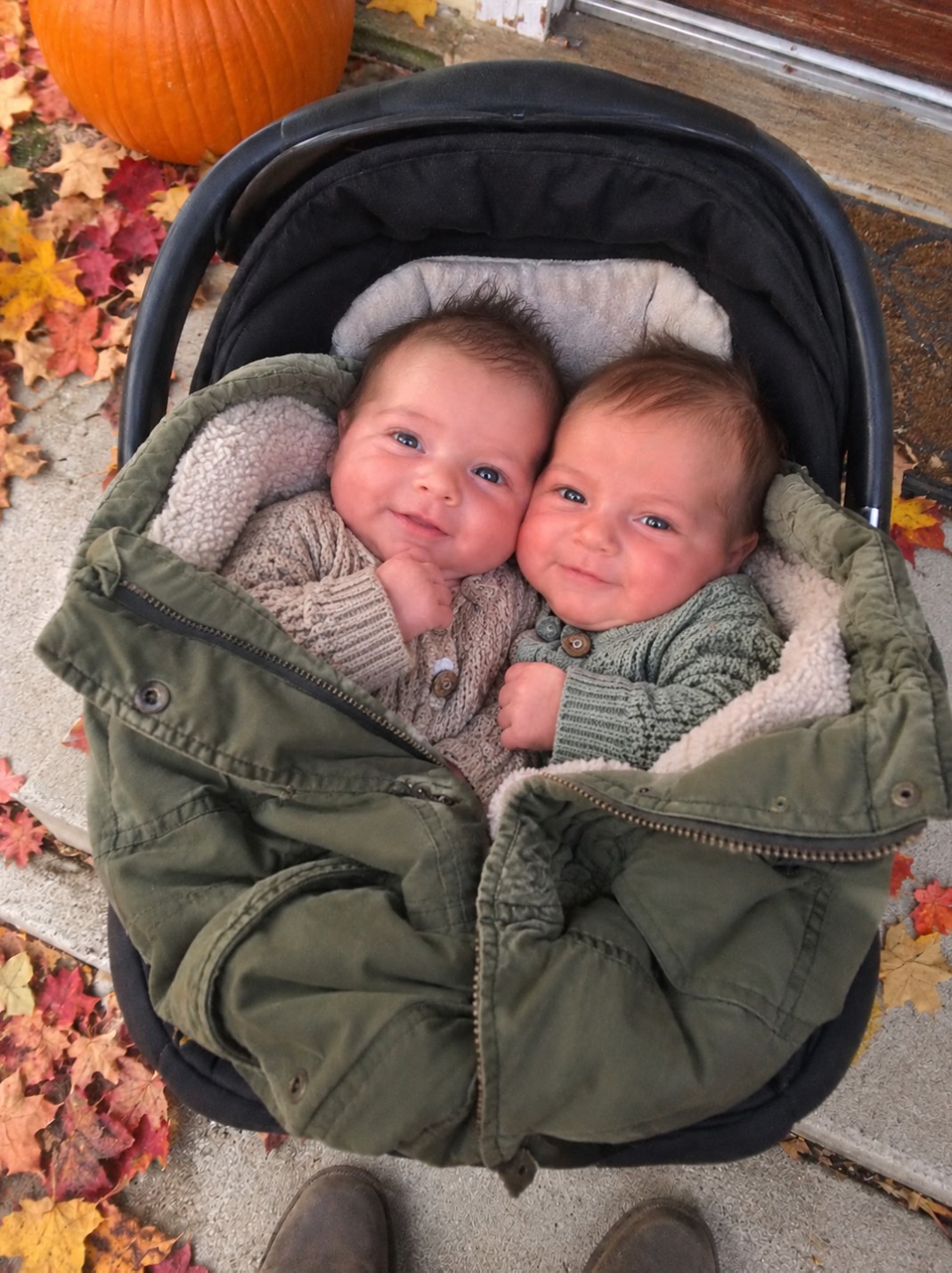
Two tiny newborn girls lay bundled together, their little faces peaceful and their bodies covered with warm clothing. A dark green winter coat had been carefully draped around them.
For several seconds, I couldn’t move.
Then I noticed a small tear near the coat’s pocket.
I knew that tear.
I had sewn it myself during the winter before Julian disappeared. He had complained that the stitching looked crooked, but he had worn the coat anyway.
My knees nearly gave out.
I grabbed the doorframe and whispered the only name that came to mind.
“Julian…”
I looked up and down the street again, hoping he might be standing somewhere nearby.
There was nobody.
I quickly carried the babies inside, placed the carrier in a safe spot, and wrapped them in warm blankets. My hands were shaking so badly that I had to stop for a moment and take a deep breath.
The girls were so small. Their tiny fingers curled and uncurled as they slept.
I couldn’t understand what was happening.
Why had someone left two newborn babies at my house?
And why were they wrapped in my missing son’s coat?
Then I felt something inside the coat’s pocket.
A folded letter.
My name was written across the front.
I recognized the handwriting immediately.
It was Julian’s.
My heart began pounding so hard that I could hear it in my ears.
I opened the letter with trembling fingers.
I managed to read the first few sentences before tears blurred the words.
My son was alive.
But the letter revealed something else, something I had never imagined during those three terrible years.
Julian had become a father.
And he had two daughters I had never met.
Part 2:
For three years, I had searched for my only son without knowing whether I would ever see him again.
I had blamed myself for our last argument. I had replayed every word, every angry sentence, and every moment when I might have handled things differently.
Some nights, I convinced myself that Julian had left because I had pushed him away.
Other nights, I feared something terrible had happened to him and that I would never learn the truth.
Now, standing in my living room with two newborn babies, I finally had an answer to the question that had haunted me for more than a thousand days.
I unfolded the letter completely.
It read:
“Mom,
You always told me I could come to you when I needed help.
I didn’t forget that. I just stopped believing I deserved to.
These are my daughters, Emma and Chloe. They’re two weeks old. Their mother’s name is Maya.
They’re healthy, and they’re loved.
You deserve to know I’m alive. They deserve to know their grandmother.
I’m sorry I made you wait three years.
Julian.”
I read the letter once.
Then I read it again.
By the third time, I could no longer hold myself together.
I sank into a chair and pressed the paper against my chest.
“Julian,” I sobbed. “You’re alive! Oh, thank God, you’re alive!”
My son was alive.
He had survived whatever had happened during those missing years. He had found a place to live, met someone he loved, and started a family of his own.
And all that time, I had been sitting at home wondering whether I would ever see him again.
I looked at the babies.
Emma and Chloe.
My granddaughters.
They were two weeks old, which meant Julian had known about their arrival long before that morning. He had watched their mother carry them, prepared for their birth, and held them in his arms.
I had missed all of it.
I had missed the moment he learned he was going to be a father. I had missed the excitement of preparing for the babies, the birth itself, and those first precious days when everything in a family’s life changes.
The realization hurt, even through my overwhelming relief.
Then another thought struck me.
If Julian had sent this letter, where was he?
Before I could decide what to do, someone knocked on my front door.
I hurried to answer it.
A young woman stood outside with a diaper bag over her shoulder. She looked tired, as though she hadn’t slept properly in days, but there was a gentle expression on her face.
“I’m Maya,” she said quietly. “I’m so sorry. I just went to the car to get their bag. I could see them the whole time.”
I looked at her, then at the diaper bag.
“You’re their mother? You’re Maya?”
She nodded.
“Yes.”
I stepped aside immediately.
“Please, come inside. I’m Clara.”
Maya walked straight toward the babies, checking that they were comfortable and adjusting the blankets around them.
I watched her for a moment, trying to process everything.
Then I asked the question that mattered most.
“Where’s Julian?”
“Nearby,” she answered.
“Nearby where? Is he all right?”
“Yes. He’s safe.”
I closed my eyes briefly, letting out a breath I felt as though I had been holding for three years.
“Then why isn’t he here?”
Maya hesitated.
“He’s afraid you’ll turn him away.”
I stared at her.
For a moment, I couldn’t believe what I had heard.
My son had been missing for three years. I had searched for him, cried for him, and spent countless nights wondering whether he was alive.
And now he was afraid that I wouldn’t want to see him?
“Tell him something for me,” I said, struggling to keep my voice steady. “Tell him I’ve spent three years looking for him. Then ask him what he thinks I’m afraid of.”
Maya lowered her eyes.
“I will.”
I returned to the living room and sat across from her.
I wanted to ask a hundred questions, but I forced myself to begin with the most important ones.
“How long have you known Julian?”
“About two and a half years.”
That answer made my stomach tighten.
Two and a half years.
Julian had been missing for three years. That meant he had spent only about six months away from home before meeting Maya.
“Did he tell you about me?”
“Yes. He told me that you’d stopped speaking after an argument.”
I looked down at the letter in my hands.
“Did he tell you I reported him missing?”
Maya didn’t answer immediately.
That hesitation told me more than I wanted to know.
“Yes,” she finally admitted. “But I didn’t know the whole story at first.”
“When did you find out?”
“Last year. I came across an old missing-person post about him. That’s when I realized you were still looking for him.”
I stared at her.
“You knew last year that I was searching for my son?”
“Yes.”
“And nobody contacted me?”
Maya looked deeply uncomfortable.
“I asked Julian to call you. More than once. He kept saying he would, but he was scared.”
I pressed my fingers against my forehead.
I wasn’t angry with Maya for the choices Julian had made, but I needed to understand how this had happened.
“We’ll talk about that,” I said. “But first, I want to hear his voice.”
Maya took out her phone and handed it to me.
“His number is saved here.”
I stared at the screen for a moment before pressing the call button.
The phone rang once.
Twice.
On the third ring, someone answered.
“Maya?”
I stopped breathing.
Then I whispered, “Julian, it’s Mom.”
Silence filled the line.
For several seconds, neither of us spoke.
Then I heard a shaky breath.
“Mom?”
His voice sounded older than I remembered. There was a roughness to it, and I could hear the fear in the single word.
“Yes, sweetheart. It’s me.”
“I’m sorry.”
I closed my eyes.
“Are you safe?”
“Yes.”
“Are you healthy? Are you somewhere warm? Do you have a place to live?”
“I’m okay, Mom. I promise.”
I wanted to ask why he had stayed away for so long. I wanted to tell him about the nights I had cried myself to sleep and the endless hours I had spent searching for him.
But I knew this was not the moment to say everything.
“Then come here this afternoon,” I told him. “I need to hear what happened from you. I need answers, but I won’t send you away.”
His voice cracked.
“You won’t?”
“No, Julian. You’re my son.”
I heard him start to cry.
“I’ll be there.”
When the call ended, I sat quietly for a moment.
Maya reached over and touched my arm.
“Thank you for answering.”
I looked at her.
“Those babies are my grandchildren. Of course I answered.”
For the first time that morning, I smiled.
Then I looked at Emma and Chloe again.
I had spent three years wondering whether my family would ever be whole again.
Now I had two new members of that family sleeping in my living room.
But before I could begin building a relationship with them, I needed to understand why their father had disappeared.
And I needed to know whether he was finally ready to stop running.
Part 3:
While Maya settled the babies, I sat beside them and tried to understand the strange turn my life had taken.
Only a few hours earlier, I had been a mother who believed her son might never return.
Now I was a grandmother holding the hands of two newborn girls.
Emma had a tiny nose that reminded me of Julian’s when he was a baby. Chloe kept turning her head toward her sister whenever she made a sound, as though she already knew that she wasn’t alone in the world.
I felt love for them almost immediately.
But underneath that love was a deep sadness.
I had missed so much.
I had missed three birthdays that never came, three years of ordinary conversations, and the chance to be there when Julian needed his mother.
I didn’t want to waste another moment, but I also knew that pretending nothing had happened would not fix anything.
After Maya finished feeding one of the babies, she showed me how to hold them properly.
“Support her head like this,” she explained. “And keep her close to your chest.”
I followed her instructions carefully.
Chloe opened her eyes for a moment before closing them again.
“She’s beautiful,” I whispered.
“They both are,” Maya said with a tired smile.
“Have they been sleeping?”
“Not much. They usually take turns waking us up.”
I laughed softly.
“That sounds familiar. Julian never wanted to sleep when he was a baby, either.”
For a few minutes, we talked about the girls instead of the painful past.
Then I looked at the clock.
It was almost noon.
“Has Julian told you what happened the night before he left?”
Maya shook her head.
“Not everything. He said you argued about his future.”
I nodded slowly.
“That is where it began.”
The night before Julian disappeared, he had told me that he didn’t want to go to college.
Instead, he wanted to enroll in a mechanic training program.
I had spent years saving money for his education. I had worked hard because I wanted him to have opportunities I had never had. In my mind, college would give him security and open doors that might otherwise remain closed.
When he told me he wanted to take a different path, I panicked.
I thought he was throwing away everything he had worked for.
Instead of listening, I argued.
I told him he needed a better plan. I reminded him how much money I had saved. I asked him whether he understood how difficult life could be without a degree.
He tried to explain that he had researched the training program, that he wanted to learn a practical skill, and that he believed he could build a good future as a mechanic.
But I was too frightened to hear him properly.
The argument grew worse.
At one point, I told him he was making a selfish decision.
He told me I never listened to him.
I accused him of being ungrateful.
Then I said the words that had haunted me for three years.
“If you walk away from this, don’t expect me to fix everything for you.”
At the time, I meant that he needed to take responsibility for his education and his future.
But Julian had heard something very different.
He had heard that if he chose his own path, he would no longer have a home with me.
The next morning, he left.
And I never saw him again until the day those two babies arrived on my doorstep.
When I finished telling Maya what I remembered, she looked down at Emma.
“Julian told me he thought you didn’t want him anymore.”
My throat tightened.
“I wanted him to have a good life. I was scared he would struggle, and I let that fear turn into anger.”
Maya nodded.
“I think he knows that now.”
“Knowing something and believing it are two different things.”
She looked at me.
“I agree.”
We sat in silence for a moment.
Then I asked, “What happened after he left?”
Maya took a deep breath.
“He drove away that morning. He told me he left his car in a parking lot and caught a bus to a friend’s house. He planned to stay there for a few days.”
“And then?”
“He kept telling himself that he would call you once things had settled down. But he was ashamed and frightened. Every day he waited made the next day harder.”
I looked toward the window.
“Did he know I had reported him missing?”
“Yes. He found out after he had been away for a while.”
My heart sank.
“Then he knew I was looking for him.”
Maya nodded.
“He did.”
“And he still didn’t call?”
“No.”
I closed my eyes.
For three years, I had imagined all kinds of explanations. I had wondered whether he had been injured, whether someone had taken him, or whether he was living somewhere without access to a phone.
I had never imagined that he might have known I was searching for him and still chosen to remain silent.
“Where did he go after his friend’s house?”
“He and his friend went to another state. His friend’s brother gave them a room, and Julian found work. Eventually, he got his own place.”
“And his phone?”
“It stopped working. He replaced it, but he never gave you the new number.”
I shook my head.
“I searched everywhere for him.”
“I know,” Maya said softly. “I’m sorry.”
I looked at her.
“You don’t have to apologize for every decision Julian made. But I need the truth from now on.”
“You have it.”
I hoped she meant that.
Then I heard a car pull into the driveway.
My heart began racing.
Maya stood up.
“That’s him.”
I looked toward the front door.
For three years, I had imagined what I would say if I ever saw my son again.
I had rehearsed angry speeches. I had imagined crying, shouting, and demanding answers.
Now that he was finally here, I couldn’t remember a single one of those speeches.
All I could think was that I was about to see my child again.
And I had no idea what would happen when we stood face-to-face.
Part 4:
I heard footsteps on the porch.
Then came a knock.
I walked to the door slowly and opened it.
For a moment, I barely recognized the young man standing outside.
Julian was broader than he had been at eighteen. He had grown a beard, and his face looked more tired than I remembered. There were lines around his eyes that hadn’t been there before.
But I knew his walk.
I knew the way he held his shoulders and the way he looked at the floor when he was nervous.
It was my son.
“Hi, Mom,” he said.
His voice was quiet.
I stepped aside.
“Come inside, Julian.”
He walked into the house and stopped near the living room.
His eyes moved toward the babies.
Then he looked at me.
We stood facing each other, neither of us knowing how to begin.
Finally, I asked the question I had been carrying for three years.
“Did you leave because of our argument?”
He nodded.
“Yes.”
I swallowed.
“You thought I didn’t want you to come home?”
“You told me not to expect you to fix everything for me.”
“I was talking about college and money. I was angry, and I chose the wrong words.”
“You said I was throwing my future away. You said I would end up begging you for money. You made me feel like everything I’d done was a disappointment.”
His words hurt because I remembered enough of the argument to know he wasn’t making it up.
“I was frightened,” I admitted. “I had worked for years to save for your education. I thought you were making a decision without understanding the risks.”
“I tried to explain the training program.”
“I know.”
“No, Mom. You wouldn’t even let me finish. Every time I tried to tell you what I wanted, you interrupted me.”
I lowered my head.
He was right.
I had been so focused on protecting him from what I feared might happen that I had failed to listen to what he was actually telling me.
“I should have listened,” I said. “I should have asked you why you wanted to become a mechanic. I should have tried to understand your plan instead of assuming you were making a mistake.”
Julian looked at me, but he didn’t answer.
“I was wrong to speak to you that way,” I continued. “But I need you to understand something, too. I never stopped wanting you in my life.”
He glanced toward the door.
“That’s not how it felt.”
“I know.”
For a moment, the room was silent.
Then I asked, “Why didn’t you call me after you left?”
He rubbed his hands together.
“At first, I thought I’d be gone for a few days. I was angry, and I wanted to prove that I could manage on my own.”
“And after a few days?”
“I was embarrassed. I knew you’d be angry. I kept thinking that if I waited until I had a job and a place to live, I could call you and show you that I was doing fine.”
“But you never did.”
“No.”
He took a deep breath.
“When I found out you’d reported me missing, I knew you were looking for me. I told myself I’d call once I had everything figured out. But the longer I waited, the harder it became.”
“Did you ever think about how I felt?”
His eyes filled with tears.
“Yes. I thought about it a lot. That’s part of why I was scared.”
“Scared of what?”
“Scared that you’d hate me. Scared that you’d ask me why I’d put you through all that pain. Scared that you’d tell me I couldn’t come home.”
I stared at him.
“Julian, I would have answered your call every single time.”
He pressed his lips together.
“I know that now.”
I shook my head.
“No, sweetheart. You know it because you’re standing here. But I need you to understand that I would have answered even if you had called the day after you left. Even if you had called a month later. Even if you had called a year later.”
He began to cry.
“I am so sorry, Mom.”
I wanted to be angry. I wanted him to understand the full weight of what he had done.
But when I saw his tears, I remembered the little boy who used to run to me whenever he hurt himself.
I stepped forward and wrapped my arms around him.
For a moment, he stood still.
Then he held me tightly.
We cried together in the middle of my living room.
I had imagined that hug for three years. I had pictured him walking through the door so many times that I sometimes felt I had already lived the moment.
But the real thing was different.
It was warmer. More painful. More precious.
When we finally pulled apart, I wiped my cheeks.
“There is something we need to do,” I said.
He looked worried.
“What?”
“We need to update the missing-person report. The police spent months looking for you. People deserve to know you’re safe.”
He nodded.
“I understand.”
We contacted the investigator who had handled the case and arranged for Julian to confirm his identity and explain that he had left voluntarily and was now safe. Julian also agreed to contact the friend who had sheltered him.
When he called his friend, I could hear his side of the conversation.
“I need to tell you something,” Julian said. “I lied when I told you I’d spoken to my mother. I hadn’t. I’m with her now, and I’m trying to make things right.”
After he ended the call, I sat down beside him.
“Why did you come back now?”
He looked toward Maya and the babies.
“Maya’s grandmother died recently. She left Maya an apartment here, so we moved in last month.”
“That explains why you’re nearby. But why come to me now?”
He hesitated.
“We’ve been struggling financially. I thought about asking you for help.”
I felt a small knot form in my stomach.
“Is that the reason you contacted me?”
“No. I know how that sounds, but it isn’t the whole reason.”
“Then tell me the whole reason.”
He looked down at his hands.
“I missed you. I missed home. I wanted you to meet the girls. But I also knew we were going to need help, and I didn’t know how to ask.”
Maya spoke from the other side of the room.
“I told him we shouldn’t ask you for anything until we’d explained what happened. You deserved the truth first.”
I looked at her.
“She was right.”
Julian nodded.
“I know.”
I took his hand.
“We’ll talk about money another time. Right now, I want us to understand each other.”
He looked at the babies.
“When I held Emma and Chloe, I started thinking about what it would feel like if one of them disappeared from my life without telling me where she was. I imagined spending years wondering whether my daughter was alive.”
He swallowed.
“That’s when I really understood what I’d done to you.”
I squeezed his hand.
“Then don’t make the same choice again.”
He nodded.
“I won’t.”
I wanted to believe him.
But three years of silence had taught me that promises were not enough.
If Julian wanted to rebuild our relationship, he would have to show me, one day at a time, that he was ready to stay.
Part 5:
The following Sunday, my sister came over for a visit.
She had helped me search for Julian during those terrible months. She had driven me to police stations, helped distribute missing-person flyers, and sat beside me when I couldn’t stop crying.
She had been there for the worst of it.
So when she walked into my living room and found Julian sitting beside Maya, with Emma and Chloe sleeping nearby, she stopped in the doorway.
For several seconds, she simply stared at him.
Then she put down her handbag.
“Julian?”
He stood up.
“Hi.”
My sister’s expression changed from shock to anger.
“Do you have any idea what your mother went through?”
Julian lowered his eyes.
“I know I hurt her.”
“No, I don’t think you do. We searched everywhere for you. Your mother thought you might be dead. She spent months calling hospitals and police stations, hoping someone would tell her you were alive.”
“I know,” he said quietly.
“Then why didn’t you call?”
He looked toward the door.
“Maybe I should leave.”
“No,” I said immediately.
He stopped.
I turned to my sister.
“You have every right to be angry. I am angry, too. But I won’t have him shamed in my living room.”
“He needs to understand what he did!”
“He does. And he knows that he has a lot to make up for. But rebuilding our relationship is between Julian and me.”
My sister looked at me, then at him.
“I just don’t want you to get hurt again,” she said.
I understood that.
She had watched me suffer, and she was afraid that I would forgive him too quickly and end up heartbroken all over again.
“I don’t want that either,” I told her. “But I can’t repair this family by pretending my son doesn’t exist.”
She took a deep breath.
Then she looked at Julian.
“You owe your mother more than an apology.”
“I know,” he replied. “I’m trying to show her that.”
My sister didn’t look convinced, but she sat down.
For the rest of the afternoon, we talked about the babies, Julian’s job, and the apartment where he and Maya were living.
It wasn’t an easy visit.
There were moments when my sister’s anger returned, and moments when Julian seemed ready to retreat into himself.
But he stayed.
And that mattered.
Later, after my sister had gone home, Julian showed me photographs of Maya’s pregnancy.
There were pictures of Maya standing in front of a mirror with one hand on her growing belly. There were pictures from a doctor’s appointment and others taken at home, where Julian had his arms around her.
In one photograph, he was smiling so widely that I could hardly look at it.
I imagined how excited he must have been when he first heard the babies’ heartbeats.
I imagined him waiting outside the hospital room, holding Maya’s hand, and learning that he had two daughters.
I should have been there to share those moments.
Instead, I had been sitting at home, wondering whether he was alive.
“I’m sorry you missed all of it,” Julian said quietly.
I handed the phone back.
“I wish I could have been there.”
“Me too.”
I looked at him for a long moment.
“Show me I can trust you to be here now, Jules.”
He nodded.
“I will.”
A few weeks later, Julian arrived at my house carrying three envelopes.
He placed them on the kitchen table.
“What are those?” I asked.
“Letters.”
I looked at the envelopes.
“Letters to me?”
He nodded.
“I wrote them over the years. I never sent them.”
I stared at him.
“How many?”
“Three that I kept. There were others I wrote and threw away.”
I picked up the first envelope.
It described his new job and the small room he had rented after leaving his friend’s place. He had written about working long hours and trying to save enough money to get his own apartment.
The second letter mentioned Maya. He wrote about meeting her at work, how they had started spending time together, and how he had slowly begun to feel that he might have a future with someone.
The third letter had been written after he learned Maya was pregnant.
I looked at the date.
It was from months before the twins were born.
My fingers tightened around the paper.
“You knew you were going to be a father, and you still didn’t call me.”
Julian lowered his head.
“Yes.”
I opened the letter and began to read.
He had written about the shock of learning there were two babies on the way. He had described how frightened he was and how he had started thinking about the kind of father he wanted to become.
He had written about wanting his daughters to grow up knowing they were loved.
And he had written about me.
He said he wondered whether I would be happy to hear that he was going to be a father. He imagined telling me the news and hearing my excited voice.
But he had never made the call.
I set the letter down.
“You heard your daughters’ heartbeats while I was still wondering whether you were alive.”
He closed his eyes.
“I know.”
“Every time you wrote one of these letters, you had a chance to tell me you were safe. You could have mailed it. You could have called. You could have sent a message through someone else.”
“I was afraid.”
“I understand that you were afraid. But your fear doesn’t erase what happened to me.”
He nodded, tears gathering in his eyes.
“I know it doesn’t.”
I pushed the envelopes toward him.
“Take them home, Julian.”
He looked surprised.
“You don’t want to keep them?”
“No. If you want me to know you, come here and talk to me. Tell me what’s happening in your life while it’s happening. Don’t bring me another three years of things you almost did.”
He stared at the envelopes.
Then he picked them up.
“I understand.”
I hoped he did.
Because I didn’t need letters about a life he had lived without me.
I needed a son who was willing to share his life with me now.
Part 6:
The following Saturday, Maya came over with Emma and Chloe while Julian was at work.
She had brought a diaper bag, a bottle, and a small blanket for each girl.
We spent the morning talking about the babies. Maya told me which sounds meant they were hungry, which cries usually meant they were tired, and how Emma often woke up just as Chloe was falling asleep.
After feeding Chloe, Maya settled into the chair beside me and held the baby against her chest.
For a while, neither of us spoke.
Then I asked the question that had been troubling me since the day I found the letter.
“You said you discovered the missing-person post last year?”
Maya nodded.
“Yes.”
“And until then, Julian had told you that we weren’t speaking?”
“That’s right. He said you’d had a terrible argument and that he didn’t think you wanted to hear from him.”
I looked down at Chloe.
“Did you believe him?”
“At first, yes. I thought it was a painful family situation and that he needed time. I didn’t know you’d been searching for him.”
“What made you look for information about him?”
“I was trying to find some old details about his family. I wanted to know more about his childhood. I came across a post that included his photograph and said he had been missing for months.”
Maya’s expression tightened.
“I recognized him immediately. I asked him about it, and he finally admitted that you had reported him missing.”
“What did you say to him?”
“I asked how he could let you believe he might be dead. I told him he had to contact you.”
“And what did he say?”
“He promised he would. He said he needed a little more time to prepare himself.”
I let out a tired breath.
“Did he ever explain why he kept waiting?”
“He said he was ashamed. He thought that if he called, you’d ask him why he hadn’t contacted you sooner, and he wouldn’t know how to answer.”
I shook my head.
“He could have started by saying he was alive.”
“I know.”
Maya looked down at her daughter.
“I argued with him about it. I didn’t want our children to grow up in a family where people disappeared whenever they were frightened or ashamed. But he kept putting it off.”
“And then the babies were born.”
She nodded.
“When they arrived, everything changed. Julian was holding Emma one night while Chloe slept beside him. He kept looking at them and saying he wanted them to have a close family.”
Maya’s eyes filled with tears.
“I told him that he couldn’t teach them the importance of family while refusing to speak to his own mother.”
I looked at her.
“Then why did you bring the girls here that morning instead of coming with him?”
She took a deep breath.
“He was supposed to come with me. We had planned to arrive together. But when we reached your street, he panicked. He said he needed a little more time.”
I stared at her.
“So he stayed in the car while you brought my grandchildren to the door?”
“Yes. He was nearby, but he couldn’t make himself walk up to the house.”
I remembered how Maya had explained that she could see the babies while she went to the car for their bag. I had assumed Julian had been waiting somewhere close, but I hadn’t understood how frightened he had been.
“Why did you agree to do it?”
“Because I wanted you to know the girls existed. And because I believed that once you read the letter, you’d want to meet them.”
She paused.
“I also knew that Julian needed to face what he’d done. But I couldn’t force him to walk through your door.”
I looked at her for a long moment.
“You understand that I can’t simply forget the three years I spent searching for him.”
“Of course.”
“And I won’t let him use the babies to avoid answering for his choices.”
“I wouldn’t want you to.”
I studied her face.
She looked exhausted, but she was being honest with me.
“I want to be part of Emma and Chloe’s lives,” I said. “I want to watch them grow up. I want to hear about their first words, their first steps, and everything else I missed with Julian.”
Maya smiled.
“They would be lucky to have you.”
“But I need you to understand something. I won’t pay for Julian’s silence. I won’t pretend that everything is fine just because I love those girls.”
Maya nodded.
“I’m not asking you to. If we need help, we’ll ask you directly. And Julian needs to speak for himself.”
“That is exactly what I want.”
She reached over and squeezed my hand.
“I’m sorry you were left alone for so long.”
I looked at her.
“Thank you. I appreciate that.”
For the first time, our conversation felt less like an investigation and more like the beginning of a relationship.
Maya wasn’t responsible for the choices Julian had made before he met her. She couldn’t undo the years I had lost.
But she could help build a healthier future for the girls.
And I wanted that future more than I wanted to remain angry.
Part 7:
The following week, Julian came to see me alone.
He had called the night before to ask whether he could stop by after work. I told him he was welcome, and when he arrived, I made coffee for both of us.
We sat at the kitchen table where he had eaten breakfast on the morning he disappeared.
For a moment, I couldn’t stop thinking about that day.
He had been eighteen. He had been angry with me, and he had walked out believing that he had nowhere to return.
Now he was a father of two, and we were trying to learn how to speak to each other again.
We began by discussing Maya and the babies.
Then Julian became quiet.
“Mom, I need to ask you something.”
I put down my cup.
“All right. What is it?”
He rubbed his hands together.
“I know you said we’d talk about money another time.”
“We can talk about it now.”
He took a breath.
“We don’t pay rent because of Maya’s grandmother’s apartment, but moving cost us most of our savings. We still have building fees, utilities, and hospital bills from the birth. Things have been harder than we expected.”
I listened without interrupting.
“We could use some help,” he continued. “Just until we get back on our feet.”
“What kind of help do you need?”
“Groceries, baby supplies, things like that. Maybe enough to get us through the next couple of months.”
“Have you worked out exactly how much you’re short?”
He looked uncomfortable.
“Not exactly.”
“Then that is where you need to start.”
His expression changed.
“Mom, I wouldn’t ask if things weren’t difficult.”
“I believe you, Julian.”
“Then why does it feel like you’re making this harder than it needs to be?”
I folded my hands on the table.
“Because I need you to understand where I stand.”
He waited.
“I love you. I love Emma and Chloe. I want to help you give them a good life. But I am still trying to understand how you could live for three years without telling me you were alive.”
His face tightened.
“I’ve apologized, Mom. What else can I do?”
“I need time. You spent three years making decisions without me. You can’t expect me to rebuild my trust in a few weeks.”
He looked away.
“I thought you’d be happy to help me.”
“I am happy to help. But helping you doesn’t mean pretending that nothing happened.”
I took a breath before continuing.
“I will buy what Emma and Chloe need. If they need diapers, formula, clothes, or other supplies, I’ll help with those things. But I won’t hand over money without knowing what it is supposed to cover.”
He leaned back in his chair.
“You think I’d waste it?”
“No. I’m not accusing you of wasting anything. I’m saying that you have two daughters now, and you need a plan for supporting them.”
He rubbed his face.
“I know that.”
“Then show me the plan.”
For several seconds, he didn’t speak.
Finally, he stood up and reached for his coat.
I felt my heart tighten.
For a moment, I was back in that January morning, watching him leave the house with his backpack.
I forced myself to stay calm.
“Are you leaving because you’re angry?”
He paused.
“I need some time to think.”
“All right. Take the time you need. But Julian, if we’re going to have a relationship, you can’t disappear whenever things get difficult.”
He looked at me.
“I won’t disappear.”
“Then tell me when you need space. Don’t leave me wondering whether I’ll ever hear from you again.”
He nodded slowly.
“I’ll call tomorrow.”
“All right.”
I watched him walk to the door.
Every part of me wanted to ask him to stay. I wanted to make sure he understood that I loved him and that I wasn’t trying to push him away.
But I knew I couldn’t rebuild our relationship by chasing after him every time a difficult conversation frightened him.
He needed to learn that we could disagree without losing each other.
So I let him go.
That evening, at eight o’clock, my phone buzzed.
It was a message from Julian.
“I’m home. I’m okay. I just need some time to think.”
I stared at the words for several seconds.
Then I replied.
“Thank you for telling me. I appreciate it.”
It was a small message, but it meant more to me than he probably realized.
Three years earlier, he had vanished without a word.
Now, even though he was upset, he had told me he was safe.
The next morning, as promised, he called.
We spoke for a few minutes about the babies and his plans for work. He didn’t bring up the argument, and neither did I.
Three days later, he returned with Maya and a written breakdown of their expenses.
He placed the paper on the table.
“I should have done this before asking you for help,” he said.
I read through the figures carefully.
They had listed the hospital bills, utility costs, food expenses, and the amount they needed for the babies’ everyday supplies.
It wasn’t a perfect budget, but it was a beginning.
“We can start with the girls’ supplies,” I said. “I’ll go shopping with you and Maya this weekend.”
Maya’s face brightened.
“That would help us so much. Thank you.”
Julian nodded.
“I’ll work out the rest. I’ve asked my supervisor about taking extra shifts.”
“Good,” I said. “Your daughters need you to be dependable.”
He looked at me for a moment.
Then he said something I hadn’t expected.
“I kept thinking that once I came home, you’d be so relieved to see me that everything else wouldn’t matter anymore.”
I leaned back.
“I am relieved, Julian. More than I can explain. But I also spent three years blaming myself for losing you.”
He swallowed.
“I made the choice to stay away.”
“Yes, you did.”
“I was selfish. I kept putting off the call because I was scared of what you’d say.”
“And I would have answered, no matter how angry I was.”
His eyes filled with tears.
“I wish I’d believed that.”
“So do I, sweetheart.”
I reached across the table and took his hand.
“I’m not shutting you out. I’m asking you to give me a reason to trust you again.”
He squeezed my fingers.
“I want to do that.”
“Then keep showing up.”
He nodded.
And this time, he didn’t make a promise about the rest of his life.
He promised something smaller.
He promised to keep showing up.
For now, that was enough.
Part 8:
Several months passed.
Julian and Maya began settling into their new life. Julian picked up extra shifts at work, and they started paying down the hospital bills. They became more careful with their spending and learned how to plan for the girls’ needs.
I helped with baby supplies when they needed them, but I didn’t take over their responsibilities.
That was important to me.
I wanted to be a grandmother, not the person who had to solve every problem in my son’s life.
More importantly, I wanted Julian to understand that being part of a family meant more than coming home when he needed something.
It meant being honest, staying in contact, and learning how to handle difficult conversations without running away.
He began calling regularly.
Sometimes he called to tell me that Emma had smiled at him. Other times, he wanted advice about feeding schedules, work problems, or how to handle two crying babies at once.
Our conversations were not always easy, but they became more natural.
One afternoon, Julian called to ask whether Maya and the girls could visit that weekend.
“Of course,” I said. “What time?”
“We’ll come after lunch.”
“I’ll make something for everyone.”
When Saturday arrived, I prepared the living room and put fresh blankets on the couch.
Maya arrived first with the babies, and Julian followed a few minutes later.
Emma and Chloe wore matching sweaters. Maya held Emma while I cradled Chloe.
My sister joined us later, and for the first time since Julian returned, we took a family photograph with everyone together.
It wasn’t a perfect picture.
Chloe began crying just as the camera went off, and Emma had one hand covering part of her face. Julian was laughing, Maya was trying to settle the girls, and I was looking at my granddaughter instead of the camera.
But when I saw the photograph afterward, I loved it.
It showed a family that had been hurt, separated, and brought back together in a way none of us had expected.
After the photograph, Julian walked toward the front door.
His eyes stopped on the dark green coat hanging near the entrance.
I had kept it after the babies arrived.
At first, I couldn’t bear to put it away. It was the coat he had worn on the last morning I saw him, and it had returned to me with a letter that changed everything.
Julian reached out and touched the stitching near the pocket.
“You still remember fixing this?”
I smiled faintly.
“Of course. You complained that my stitches were crooked.”
He laughed.
“I wore it anyway.”
“You did.”
For a moment, he stood quietly, looking at the old coat.
Then his expression softened.
“I should have come home sooner.”
I looked at him.
“Yes, Julian. You should have.”
He nodded.
“I know.”
I didn’t tell him that everything was forgiven. I didn’t tell him that the pain had disappeared.
Because it hadn’t.
There were still days when I thought about the years we had lost. There were still moments when I wondered how many things might have been different if he had simply picked up the phone.
But I no longer needed to pretend that the past could be changed.
All we could do was decide what happened next.
Julian stepped forward and hugged me.
This time, the hug felt different from the one we had shared on the afternoon he returned.
There was still sadness between us, but there was also something new.
Trust, perhaps.
Not complete trust, and not trust that had appeared overnight.
But the beginning of it.
Before leaving, Julian helped Maya secure the girls in their car seats.
He checked Emma’s straps, then carefully adjusted Chloe’s blanket.
When he was finished, he turned toward me.
“I’ll call tonight.”
I smiled.
“I’d like that.”
They drove away, and I stood in the doorway watching the car disappear down the street.
For the first time, I didn’t feel the old panic rising in my chest.
I knew where my son lived. I knew he was safe. I knew that if something happened, he could call me.
At seven o’clock that evening, my phone rang.
“Hi, Mom.”
I smiled before I even answered.
“Hi, sweetheart. How are the girls?”
“Good. Well, Emma is sleeping, and Chloe is being difficult.”
I laughed.
“She’s two weeks old all over again, is she?”
“Feels like it.”
Then Chloe began fussing in the background.
“Give me a minute, Mom. She needs me.”
I listened as Julian spoke softly to his daughter.
“It’s okay, sweetheart. Daddy’s here. I’ve got you.”
His voice was gentle and patient.
After a few moments, Chloe settled down.
Julian returned to the phone.
“Sorry about that.”
“Don’t apologize. Take care of your daughter.”
We talked about their day, the family photograph, and the extra shifts he had arranged for the coming week.
Nothing dramatic happened during that conversation.
There were no grand promises and no sudden revelations.
It was just a mother talking to her son.
But to me, that ordinary phone call meant everything.
For three years, I had wondered whether Julian was alive. Then I had learned that he was alive but had chosen not to contact me. The truth had hurt in ways I was still learning to understand.
Now, little by little, he was showing me that he wanted to be part of my life again.
I still had questions.
Some days, I was angry about everything we had lost. Other days, I felt grateful that we had been given another chance.
Both feelings could exist together.
I could love my son and still be hurt by what he had done.
I could welcome him home without pretending that the years apart hadn’t mattered.
And I could forgive him gradually, without demanding that either of us forget the past.
When the call ended, I looked at the dark green coat hanging beside the door.
For three years, I had thought of it as the last thing my son wore before he disappeared.
Then it returned to me with two newborn babies and a letter that told me he was alive.
I used to believe that losing Julian was the worst thing that could ever happen to me.
But I had learned something during those long years of waiting.
Sometimes, the people we love make choices that hurt us deeply. Sometimes, fear keeps them away long after they want to return. And sometimes, finding your way back to each other takes more than an apology.
It takes honesty.
It takes patience.
And it takes showing up, again and again, even when the conversations are uncomfortable and the past still hurts.
Julian had finally come home.
And this time, when he left my house, I no longer wondered whether I would ever see him again.
I knew he would call.
And when he did, I would answer.
The End.
