
Part 1:
A week after my wife’s funeral, her attorney placed a dusty cardboard box in front of me.
Then he said something that made my blood run cold.
“Before we discuss Florence’s will, she wanted you to see this.”
I stared at the box.
It was old, stained, and tied with a piece of faded string. Nothing about it looked valuable.
But Paul, Florence’s attorney, wasn’t looking at the box.
He was looking directly at me.
“You need to understand something,” he said quietly. “Florence knew why you first came into her life.”
My stomach tightened.
“What do you mean?”
He leaned back in his chair.
“You walked into a trap you didn’t even know existed. Florence arranged it that way because she wanted you to discover the truth for yourself.”
I couldn’t speak.
Paul pushed the box a few inches closer.
“She left these things behind because she wanted you to understand what she knew about you, what she suspected about you, and what eventually changed her mind.”
My hands began to shake.
“What was she thinking?”
Paul’s expression softened.
“You should open the box.”
I didn’t know it yet, but everything inside that box would force me to face the ugliest truth about myself.
And it would also show me why Florence had loved me anyway.
To understand that, I have to go back five years.
I was twenty-nine years old when I first met Florence outside a local market in Burlington.
She was struggling with her manual wheelchair while trying to control three overflowing grocery bags.
One of the bags was threatening to split open.
Another was filled with vegetables.
And somehow, a carton of whole milk had become the center of her anger.
“Stupid milk,” she muttered. “You couldn’t stay upright for five minutes?”
I stopped beside her.
“Do you need a hand with those?”
She immediately turned her sharp eyes toward me.
“Do I look helpless to you, young man?”
“Not helpless,” I said with a small smile. “Just completely outnumbered.”
For a second, she stared at me.
Then she burst out laughing.
She laughed so hard that she nearly dropped the loaf of sourdough sticking out of one of her bags.
“Fine,” she said. “You can carry the heavy bags. But don’t touch this wheelchair without my permission.”
She pointed a finger at me.
“If you do, I’ll run over your foot.”
I smiled.
“Understood.”
I picked up the bags and walked beside her.
It took us nearly twenty minutes to travel the six blocks to her home.
When we finally reached her property, I stopped walking.
I couldn’t hide my reaction.
Her house was enormous.
Tall stone walls surrounded the property. The windows were spotless. The hedges were perfectly trimmed, and a wide gravel driveway led toward a huge front porch.
It wasn’t simply a large house.
It was the kind of estate people associated with old money.
Florence caught me staring.
“Don’t worry,” she said. “The ghosts in the parlor are surprisingly polite.”
I laughed.
“Do you really live here alone?”
“Ever since my husband Douglas died.”
She shrugged.
“No children. So yes. It’s just me.”
And that was when I had my first ugly thought.
My father had recently suffered a massive stroke.
My mother was struggling to keep up with his medical expenses.
I had already spent every dollar of my savings helping them.
Every time my phone rang, I worried that another medical bill was waiting.
And now I was standing outside an enormous estate belonging to an elderly woman who lived alone.
I looked at the house and wondered how wealthy she really was.
The thought disgusted me.
But I couldn’t make it disappear.
Two days later, I returned to Florence’s front door with two cups of coffee.
I told myself I was simply being a good neighbor.
She opened the door and looked at the cups.
“You didn’t ask how I take my coffee.”
“I guessed.”
“You guessed wrong.”
“I’ll remember next time.”
“You’d better.”
Then she stepped aside.
“Come in.”
That became a habit.
I visited Florence again and again.
I replaced lightbulbs.
I carried boxes from the basement.
I fixed loose cabinet hinges.
I repaired small things around the house.
But I also sat with her.
She had a remarkable talent for insulting daytime television hosts.
She could spend ten minutes explaining exactly why some talk-show guest was an idiot.
And every time I brought her coffee, she complained about it.
Yet she always finished the entire cup.
Eventually, she started asking questions about my family.
One afternoon, while we played cards, she looked at me.
“Is your father getting better?”
“Slowly.”
“Are the medical bills becoming too much?”
I forced a smile.
“Everything is under control.”
She looked at me for several seconds.
She knew I was lying.
But she didn’t challenge me.
Instead, I began taking her out for dinner.
We went to comfortable diners around Burlington where she wouldn’t have to eat alone.
People stared at us.
They couldn’t help it.
The age difference between us was enormous.
One evening, a young waiter looked at us, smiled, and called me Florence’s grandson.
Florence leaned toward me.
“Should I kiss you on the lips just to ruin his evening?”
I nearly choked on my water.
I laughed until my stomach hurt.
That was the first time I realized something dangerous.
I genuinely enjoyed being around her.
I loved her humor.
I admired her intelligence.
I liked the fact that she never treated me like a child.
But the other part of me was still there.
I still noticed the mansion.
I still wondered about her money.
I still imagined what my life might look like if I somehow inherited everything.
I hated myself for those thoughts.
Yet I kept coming back.
Even when Florence didn’t need my help, I found excuses to visit.
Then, one winter night, everything changed.
A terrible blizzard swept through Burlington.
Sometime after midnight, Florence called me.
“The furnace stopped working,” she said.
“I’ll come over.”
“You don’t need to.”
“Yes, I do.”
“I have blankets.”
“Florence, it’s below freezing outside.”
“I’ll be fine.”
“No, you won’t.”
I grabbed my coat and drove through the storm.
I found an emergency repair technician and stayed with Florence until morning.
When the furnace finally started working again, warm air began filling the house.
I stood near the front door, preparing to leave.
Florence watched me silently.
There was something strange in her expression.
Something I couldn’t understand.
I walked home through the snow.
I didn’t know it then, but Florence had already started asking herself a question.
Was I staying because I cared about her—or because I wanted what she owned?
And soon, she would find out.
Part 2: The Woman Who Started Testing Me
Six months after we met, Florence offered to help my family.
We were sitting at her dining table when she placed a thick white envelope in front of me.
“You look exhausted,” she said. “Take this.”
I immediately pushed it back.
“No.”
Her eyebrows rose.
“No?”
“I can’t accept your money.”
“Why not?”
“Because he’s my father. His health is my responsibility.”
Florence stared at me.
For several seconds, neither of us spoke.
Then her expression softened.
“You are unbelievably stubborn.”
“So are you.”
A small smile appeared.
“Fair enough.”
She put the envelope away.
But I noticed that familiar look in her eyes again.
She was watching me.
Studying me.
At the time, I didn’t understand why.
I only knew that something inside me had changed.
When I first met Florence, I had seen her as a wealthy older woman who might someday solve my financial problems.
Now I was beginning to see her as a person I couldn’t imagine losing.
Two years after we first met, Florence surprised me again.
We were having breakfast.
She put down her teacup.
“Marry me.”
I nearly dropped mine.
“What?”
“Marry me.”
I stared at her.
“You’re serious?”
“Unfortunately.”
I laughed.
Then I looked at her carefully.
She wasn’t joking.
“People are going to talk,” I said.
“People already talk.”
“Are you certain?”
She smiled.
“Not completely. But I have a remarkably good feeling about it.”
I took her hand.
“Yes.”
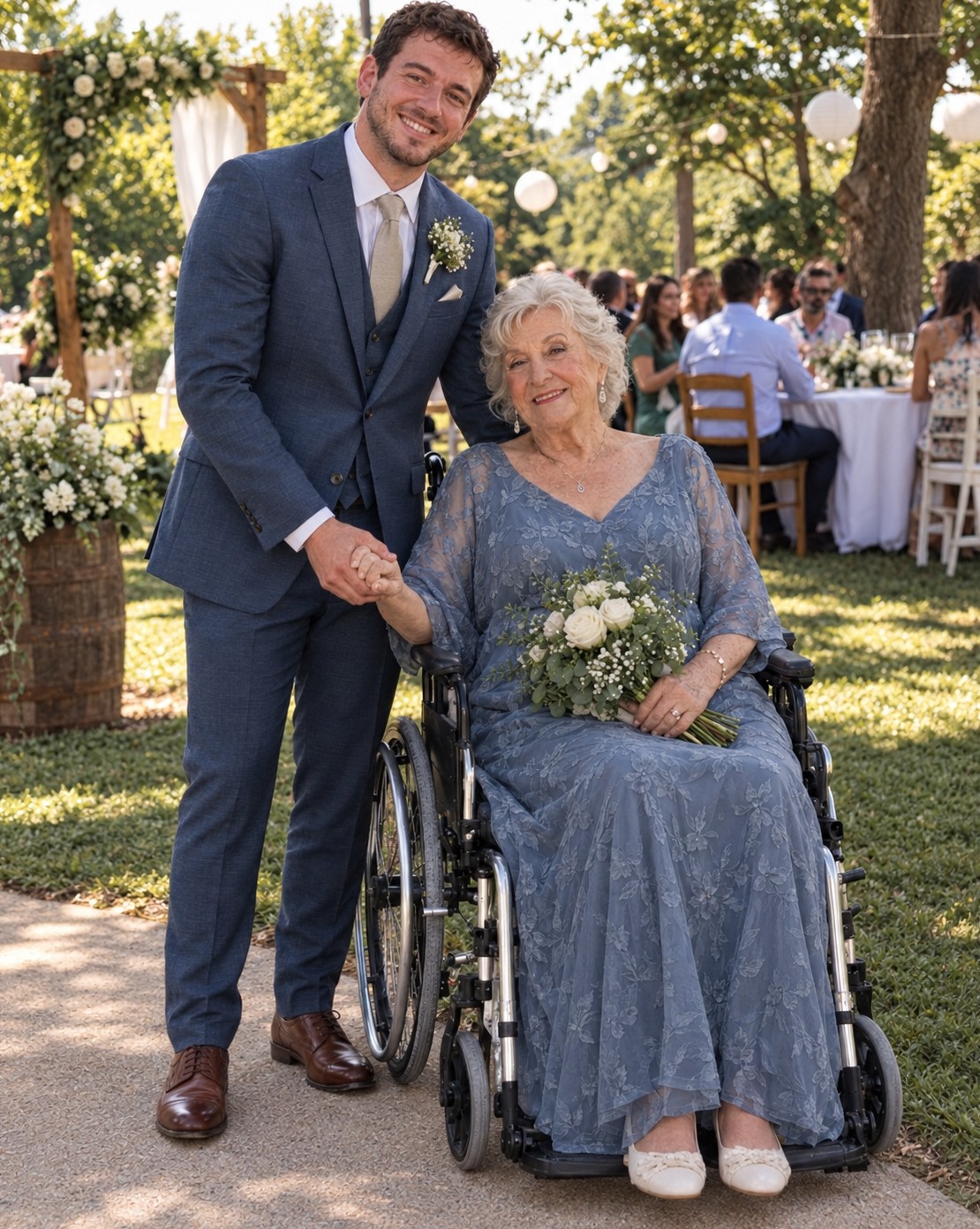
We married in a small ceremony.
My parents attended.
My father, still recovering from his stroke, walked with his wooden cane and thanked Florence for bringing happiness back into my life.
Florence wore a simple navy-blue dress.
When someone asked why she hadn’t worn white, she said a traditional wedding gown would make her look like “a haunted lampshade.”
Everyone laughed.
For a while, I believed I had finally escaped my old motives.
I loved Florence.
That was real.
But every once in a while, I still looked around the mansion.
I noticed the grand staircase.
The paintings.
The polished floors.
The expensive furniture.
And I wondered what would happen to all of it one day.
I never asked Florence how much money she had.
I never asked who would inherit the house.
She never volunteered the information.
That silence remained between us.
Our marriage settled into an ordinary rhythm.
Coffee at seven.
Medication at eight.
Arguments over the thermostat.
Crossword puzzles on Sunday mornings.
Florence always won.
I accused her of cheating.
She always denied it.
We had wonderful days.
We had difficult days.
And there were days when I completely forgot about the enormous difference in our ages.
Then Florence became sick.
Almost three years into our marriage, she began losing weight quickly.
At first, she blamed her hospital stay.
“The kitchen staff couldn’t even season chicken soup properly,” she complained.
I laughed.
But the laughter became harder as her health worsened.
She became tired after short walks.
Her doctors started speaking more carefully.
I drove her to appointments.
I sat beside her hospital bed.
I brought her favorite food.
I did everything I could.
I kept telling myself she would recover.
Then one evening, I found her sitting alone in the dark kitchen.
“You should sit with me,” she said.
“You should be in bed.”
“So should you.”
I pulled a chair beside her.
She reached for my hand.
Her fingers felt so thin.
“Are you afraid?” I asked.
“Of dying?”
I nodded.
She thought for a moment.
“Much less than you think.”
I swallowed.
“Are you afraid of leaving me?”
Her fingers tightened around mine.
“Far more than you could ever understand.”
One week later, Florence died peacefully in our bed.
I was holding her hand.
Her final coherent words were:
“Don’t make that miserable face. I had a fantastic run.”
I forced myself to laugh.
She wanted me to.
Then I cried until morning.
But beneath my grief was another thought.
A thought I hated.
What happens to the house now?
I tried to push it away.
I couldn’t.
A week after the funeral, Paul called.
And that was when Florence’s final secret began to unfold.
Part 3: The House Was Never Hers
Paul asked me to come to his office at nine the next morning.
When I arrived, I expected to discuss Florence’s will.
Instead, he placed a heavy cardboard box on his desk.
“This is what Florence wanted you to see first.”
I looked at the box.
“What is it?”
“Open it.”
I lifted the lid.
Inside were photographs, handwritten letters, a black leather journal, a property deed, and an old legal agreement.
Paul pointed toward the documents.
“Start with the deed.”
I picked it up.
The legal language was complicated.
I read it once.
Then twice.
My confusion only grew.
“What am I looking at?”
Paul pulled his chair closer.
“I want to make the ownership situation completely clear.”
I nodded.
“Please.”
“Florence lived in that estate for decades, but she never owned the property outright.”
I stared at him.
“What?”
“After Douglas died, his family kept ownership of the estate within the family. Florence was granted a lifetime right to live there. Legally, that meant she could live in the house for the rest of her life, but she could not sell the property because she wasn’t the owner.”
I looked down at the deed again.
“So Florence owned the right to live there, but not the house itself?”
“Exactly.”
“And who actually owned it?”
“Douglas’s family retained ownership. Under the legal arrangement, after Florence’s lifetime right ended, the property was to belong to Douglas’s nephew, Raymond.”
My heart sank.
“So after Florence died…”
“Her lifetime right to live there ended,” Paul said. “Raymond’s ownership became effective, and he will take full possession.”
I stared at the document.
For five years, I had imagined that mansion as part of my future.
But Florence had never been able to leave it to me.
She had never actually owned it.
I had been dreaming about inheriting something she legally could never have given me.
“How long has Raymond owned it?”
“His family’s interest in the property existed all along. Florence simply had the legal right to occupy it during her lifetime.”
I sat back.
It was almost impossible to process.
Paul watched me carefully.
“There is more.”
He handed me a folded letter.
I recognized Florence’s handwriting immediately.
My hands started shaking.
I opened it.
The first sentence stopped me cold.
I knew exactly why you kept coming back to my door.
I looked up.
“What does she mean?”
Paul’s voice was quiet.
“Keep reading.”
I did.
Florence explained that during the first months after we met, she had overheard a conversation between me and my old friend Sam.
My father’s medical bills had been overwhelming us.
I had been angry.
Desperate.
And I had joked that staying close to the wealthy old woman might eventually solve my problems.
I had no idea Florence was standing near the open garden window.
She had heard every word.
Then I read the next sentence.
He is only standing on my porch because of this mansion.
I stopped.
A tear rolled down my cheek.
“If she knew that,” I whispered, “why didn’t she throw me out?”
Paul pointed toward the black journal.
“She almost did.”
I opened it.
The first entries were brutal.
He is only here because of the house.
Another entry said:
He smiles too quickly whenever money is mentioned.
I felt my face burn.
Then the entries changed.
He drove across town through a freezing snowstorm because my furnace stopped working.
I turned the page.
He canceled his plans because I wasn’t feeling well.
Another page.
He refused to accept money for his father’s medical care.
I stared at those words.
Florence had been watching me.
She had seen the selfish man I had been.
But she had also seen something else.
I kept reading.
He stays long after his chores are finished.
Then:
He laughs whenever I insult people on television.
And:
He thinks I don’t notice him checking to make sure I’m still breathing when I sleep.
My eyes filled with tears.
I turned another page.
Near our wedding anniversary, Florence had written:
Perhaps people begin their journeys for all the wrong reasons, but choose to stay out of genuine love.
I closed my eyes.
Beneath that sentence was one final thought.
I am no longer suspicious of his heart. People truly can change their minds about loving someone.
I lowered the journal.
Florence had known everything.
She knew I had first approached her because I saw money.
She knew I had looked at her house and imagined my future.
She knew I had wondered what would happen after she died.
But she had also watched me change.
And somehow, she had decided that the man I became mattered more than the man I had been.
Part 4: What Florence Really Left Me
Paul reached into his desk drawer.
“There is one final thing.”
He placed an envelope in front of me.
“Florence left this specifically for you.”
I looked at it.
“How much is it?”
The words came out automatically.
The moment I heard myself ask, I felt ashamed.
Paul didn’t react.
“It is enough to pay off your parents’ mortgage completely and cover several years of your father’s specialized medical care.”
I opened the envelope.
Inside was a check.
It wasn’t the fortune I had once imagined.
It wasn’t enough to make me wealthy.
But it was enough to save my family from the financial nightmare that had haunted us for years.
I looked at Paul.
“And the estate?”
“Raymond will take full possession in thirty days.”
I nodded.
I left the office feeling grief, shame, and relief all at once.
I was ashamed that even after reading Florence’s journal, a small part of me still felt disappointed about losing the mansion.
It had never been mine.
It had never even been Florence’s to give away.
Yet I had spent years imagining it as my future.
When I returned to the estate, everything felt different.
The grand rooms no longer looked like financial assets.
They looked like rooms.
Rooms where Florence had laughed.
Rooms where we had argued.
Rooms where we had shared coffee.
Rooms where we had lived.
Three days later, a dark sedan came up the gravel driveway.
A tall man in his late fifties stepped out.
I knew immediately who he was.
“Raymond?”
He nodded.
“I can come back later if you need more time.”
“No.”
I stepped aside.
“This is your house now.”
Raymond gave me a sympathetic smile.
“Florence would hate hearing you say that.”
I frowned.
“Why?”
“She wrote to me often during the last few years.”
My throat tightened.
“What did she say?”
Raymond looked around the hallway.
“She told me that after Douglas died, everyone treated her like a fragile old woman who couldn’t do anything for herself.”
He paused.
“But you didn’t.”
I listened.
“You argued with her. You teased her. You took her out to dinner. You got angry when she cheated at cards.”
A small laugh escaped me.
“She really did cheat.”
Raymond laughed.
“I know.”
Then he became serious.
“She told me you made her final years feel ordinary again.”
Ordinary.
That word stayed with me.
Coffee at seven.
Medication at eight.
Crossword puzzles.
Thermostat arguments.
Late-night furnace repairs.
Simple dinners.
Laughter.
That was what Florence had valued.
Not the mansion.
Not the money.
The life we had built inside it.
Raymond offered to let me stay several more months.
I shook my head.
“I’ll start packing tomorrow.”
“You don’t need to rush.”
“I’ve spent enough time here.”
I looked around the room.
“It is time for me to remember her somewhere else.”
The next morning, I began packing.
For years, I had thought the mansion was the prize.
Now I finally understood.
It had only been the setting.
While cleaning the kitchen cabinets, I found an old reusable grocery bag.
The same faded green bag from the day I met Florence.
It had a torn handle and an old store logo.
I sat on the kitchen floor and held it against my chest.
Suddenly, I remembered everything.
The market.
Her wheelchair.
The grocery bags.
The milk she had cursed at.
The first joke.
The first time she laughed with me.
The mansion had never been the beginning of our story.
That little green grocery bag was.
When the moving truck arrived, I took almost nothing.
My clothes.
My documents.
A few photographs.
The green grocery bag.
And the simple wooden chair where Florence and I had drunk coffee every morning.
Raymond watched the movers carry the chair outside.
“That’s all?”
I nodded.
“That’s all I need.”
He looked at the chair.
“I think that chair belongs to the house.”
I smiled.
“Florence would approve.”
Raymond smiled back.
“Yes. She would.”
Months passed.
My family’s life changed.
My parents’ mortgage was completely paid off.
My father received the medical treatment he needed.
My mother finally stopped crying over unpaid bills.
One evening, my father and I sat on the porch of my new apartment.
He looked at me.
“Did Florence know why you approached her in the beginning?”
I didn’t hesitate.
“Yes.”
“Did she forgive you?”
I thought about the journal.
The letters.
The green grocery bag.
The woman who had discovered the worst part of me and somehow believed there was still something good underneath it.
“She gave me the time to become a better man,” I said.
The faded green grocery bag is still folded inside my kitchen drawer.
Whenever I feel lost, I take it out.
I remember the mansion.
I remember the money I once imagined.
I remember the selfish calculations I made.
And I remember Florence.
I entered her life for selfish reasons.
She knew.
She knew almost from the beginning.
But somewhere along the way, the reason I stayed changed.
The mansion didn’t save me.
The inheritance didn’t save me.
Florence did something far more important.
She gave me time.
Time to prove that I could become someone different.
Time to learn that love can grow from a deeply flawed beginning.
Time to understand that a person’s worth is not measured by property, money, or inheritance.
And time to become the man she already believed I could be.
Florence knew exactly why I walked up to her that sunny afternoon.
She knew why I kept returning.
She knew what I had once hoped to inherit.
But when she closed her eyes for the last time, she knew something else too.
She knew why I stayed.
THE END.
