
Part 1:
I’m an orphan who grew up in foster care, so I know exactly what it feels like to be passed from one family to another, always wondering when they will decide they no longer want you.
Eventually, I learned the hardest truth of all.
Sometimes, no matter how hard you try, people can still send you away like an unwanted stray kitten.
But that all changed when I met Julian.
He was an orphan too, and perhaps that was one of the reasons we understood each other so well. We both knew what it was like to grow up without a real family. We knew what loneliness felt like.
And somehow, despite everything we had been through, we fell deeply in love.
Neither of us had an impressive career. I worked as a store clerk, while Julian worked as a mechanic. We didn’t have much money, but we didn’t need much to be happy.
We got married, rented a decent apartment, and eventually welcomed our daughter, Nora, into the world.
For the first time in our lives, we felt like we truly belonged somewhere.
We were a family.
We were happy.
Until Julian was diagnosed with cancer.
Our entire world changed overnight.
We fought for his life as hard as we could. We followed every treatment the doctors recommended. We spent every bit of money we had. We borrowed money when our savings ran out and kept hoping the next treatment would finally work.
But nothing stopped the disease.
After a year of fighting, Julian died.
I was devastated.
I was also drowning in debt, grieving the man I loved, and left alone to raise our one-year-old daughter.
I had no family to turn to.
No savings.
No husband.
No safety net.
So I took the first job I could find.
I became a housekeeper for Arthur Vance, a wealthy seventy-two-year-old widower who lived alone on a large estate outside the city.
Arthur was nothing like the wealthy people I had imagined.
He was quiet, polite, and surprisingly kind.
But kindness didn’t pay my bills.
The money I earned from housekeeping didn’t even cover half of what I owed. I was still struggling to pay Julian’s medical debts, and after rent and food, there was almost nothing left.
Then Nora became seriously ill.
The doctor prescribed medication she needed, but I could barely afford groceries. Paying for her medicine felt impossible.
And just when I thought things couldn’t get any worse, my landlord gave me one month to leave.
“You’re behind on the rent again,” he told me. “I’m sorry, Evelyn, but I can’t keep waiting. You have thirty days to move out.”
I begged him.
“Please. Just give me a little more time. My daughter is sick. I’m trying to catch up.”
But he shook his head.
“I’ve already given you extra time. I’m sorry.”
When I walked away from his office that day, my hands were shaking.
I had thirty days.
After that, Nora and I could be homeless.
I was depressed, exhausted, overwhelmed, and terrified. Every night, after putting Nora to sleep, I sat alone in our tiny apartment and stared at the bills spread across the table.
I couldn’t see a way out.
But during those terrible weeks, Arthur continued treating me with extraordinary kindness.
He never mocked my situation.
He never made me feel poor.
He never treated me like someone beneath him.
And then, one morning, everything changed.
I was setting down his morning tea when Arthur looked up at me.
His expression was unusually serious.
“Evelyn,” he said quietly.
I turned toward him.
“I know I’m much older than you,” he continued. “And maybe you’ll laugh in my face when I say this. But I don’t want to waste time pretending.”
He took a slow breath.
“I’ve fallen in love with you. I don’t want to spend the rest of my life hiding that from you. So I’m asking you to marry me.”
For several seconds, I couldn’t speak.
My mind immediately went to Nora.
To the unpaid bills.
To the eviction notice.
To the medicine I couldn’t afford.
To the terrifying possibility that my little girl and I would soon have nowhere to live.
And suddenly, I saw a lifeline.
I knew how strange the situation was.
I was thirty-five.
Arthur was seventy-two.
He was my employer.
He was also a man I cared about.
But I was desperate.
What else was I supposed to do?
So I said yes.
I married Arthur.
Over the next five years, something happened that I never expected.
Our marriage became more than an arrangement.
Arthur became part of Nora’s life.
He taught her how to play chess, patiently showing her how each piece moved across the board. Sometimes he would spend an entire afternoon sitting with her while she proudly announced every move she thought would defeat him.
He became the grandfather she had never known.
And he became someone I genuinely loved—not in the same way I had loved Julian, but with deep affection, gratitude, and respect.
When Nora became sick with a high fever, Arthur stayed awake with me through the night.
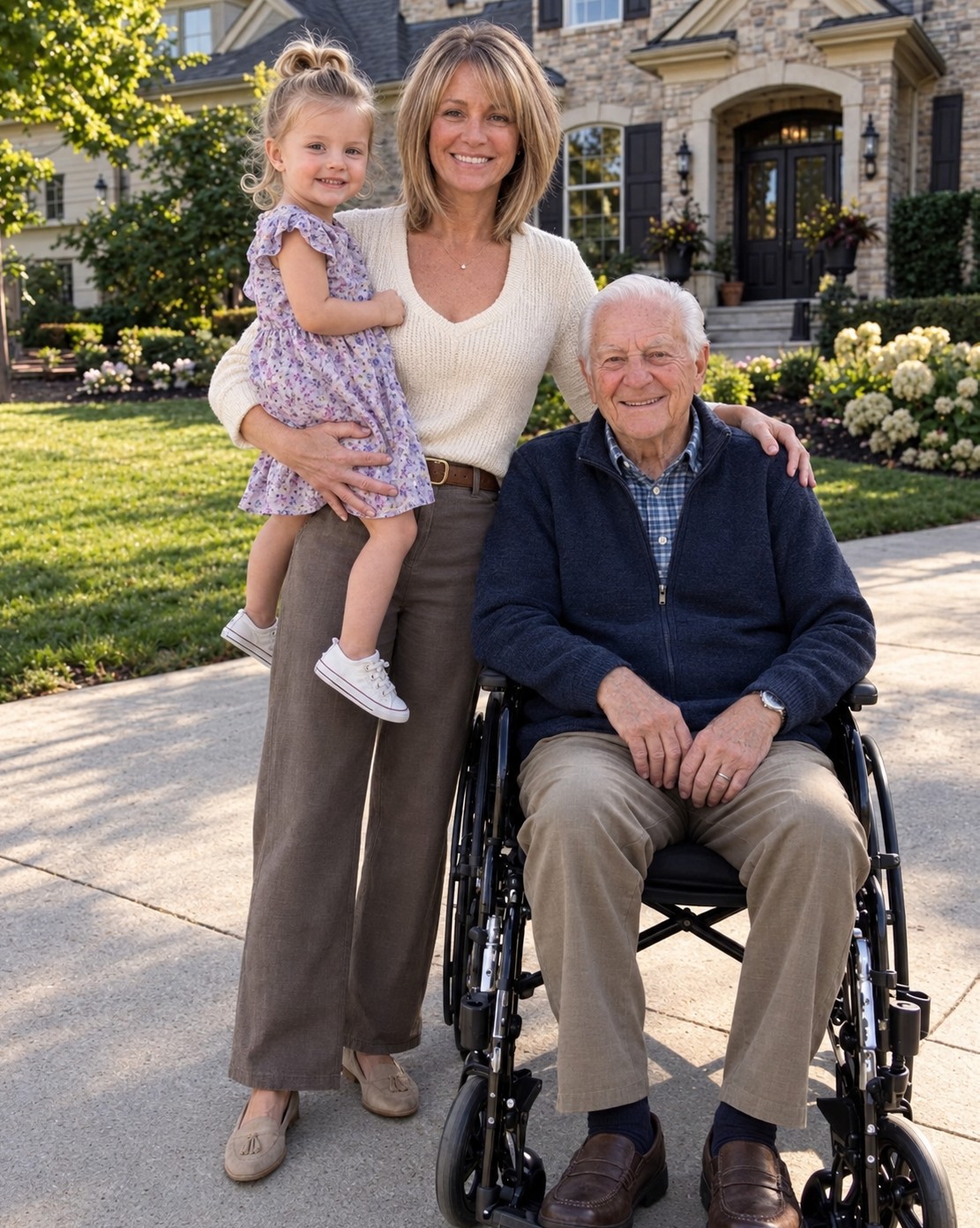
When his health began to decline and he could no longer walk without assistance, I helped him into his wheelchair and took him through the gardens every afternoon.
I made his coffee exactly the way he liked it.
He complained if I put too much sugar in it.
I complained when he refused to wear a coat on cold mornings.
We developed our own little routines.
Arthur didn’t just give us a roof.
He gave us warmth.
Protection.
Respect.
And, most importantly, a home.
For five years, the three of us lived together.
Then, one quiet morning, Arthur passed away peacefully in his sleep.
I was heartbroken.
By then, I had grown deeply attached to him.
I also believed I understood what would happen next.
Arthur had no surviving children that I knew of, and I had never heard him mention any close relatives.
So I assumed that whatever he owned would legally pass to me and Nora.
I thought we would be able to remain in the home we had built our lives around.
But the day after Arthur’s funeral, someone knocked on my door.
It was Arthur’s estate lawyer, Mr. Hayes.
He asked to speak with me privately.
We sat across from each other in the study where Arthur had spent so many evenings playing chess with Nora.
Mr. Hayes looked at me with a serious expression.
Then he said something that made my stomach drop.
“Evelyn, Arthur knew you would fall for all of this and agree to marry him. But unfortunately, the will leaves you nothing from his primary estate.”
My entire body went cold.
“What?”
My voice shook.
“Sir, what are you talking about?”
Mr. Hayes sighed.
Then he placed a heavy, wax-sealed manila envelope on the mahogany table between us.
“You never knew who Arthur Vance really was,” he said. “But he did leave you something very special.”
He pushed the envelope toward me.
“Open it, Evelyn. Then you’ll understand everything.”
Part 2:
My hands trembled so badly that I could barely break the red wax seal.
For a moment, I couldn’t even bring myself to open the envelope.
I had expected many things.
A cruel joke.
A legal eviction notice.
A final humiliation.
Maybe Arthur had simply used me as a caregiver during the last five years of his life, and now that he was gone, I was about to discover that the entire marriage had been nothing more than an arrangement.
Finally, I opened the envelope.
Inside were three things.
The first was a yellowed, faded photograph.
It showed a much younger Arthur standing beside a young boy wearing a mechanic’s uniform. The photograph appeared to have been taken roughly thirty years earlier.
The second item was a certified DNA paternity report.
And the third was a handwritten letter.
I recognized Arthur’s handwriting immediately.
My hands shook as I unfolded the paper.
My eyes filled with tears before I had even finished reading the first few lines.
The letter began:
“My dearest Evelyn,
If you are reading this, then I am gone, and Mr. Hayes has delivered my final play.
Forgive me for the theatrical wording he used. I asked him to say those exact words because I knew your practical, resilient heart would brace itself for the worst before discovering the truth.
When you first walked into my home five years ago to apply for the housekeeping position, you introduced yourself as Evelyn.
But the moment you mentioned your late husband’s name—Julian—my heart nearly stopped.
Thirty-five years ago, I was a foolish and ambitious corporate man.
I abandoned my young, unmarried wife and our infant son because I wanted wealth, power, and status.
At the time, I convinced myself that I was building a better future.
Instead, I destroyed my family.
By the time I finally understood what I had done, it was too late.
My son’s mother had died, and my son had been placed into the state foster system.
I spent years trying to find him.
I searched records.
I hired investigators.
I followed every lead I could find.
Eventually, I discovered that my son had grown into a good man. He had married a wonderful woman named Evelyn, had a daughter named Nora, and built the family I had been too selfish to give him.
Then I discovered something that nearly destroyed me.
My son had died from cancer before I ever had the chance to ask him for forgiveness.
Julian was my son, Evelyn.
You married my biological son.
And Nora is my granddaughter.
When I discovered that my son’s widow and my granddaughter were drowning in medical debt and facing eviction, I knew I couldn’t simply hand you millions of dollars.
I knew you.
I had watched you work.
I had seen how fiercely independent you were.
You would have rejected a stranger’s charity.
So I offered you a marriage of protection instead.
I gave my granddaughter a home.
I taught her chess.
I paid off Julian’s remaining medical debts anonymously through my firm.
And most importantly, I spent five glorious years getting to know the incredible family my late son had built.
You don’t inherit my ‘primary estate,’ Evelyn, because three years ago I dissolved Vance Corporate Holdings entirely.
I did it to prevent corrupt distant executives from ever taking control of my legacy.
Instead, everything I own—the two-hundred-acre estate, the fifteen-million-dollar liquid trust, my investment accounts, and the Vance family name—was legally transferred into an irrevocable trust for my granddaughter, Nora Vance.
You are her exclusive legal guardian and trustee.
Everything was arranged so that no one could take her home away from her.
Thank you for taking care of an old man who didn’t deserve the second chance God gave him.
Thank you for making my coffee exactly the way I liked it.
Thank you for sitting beside me when I was sick.
And thank you for allowing me to become a grandfather.
With all my love and eternal gratitude,
Arthur Vance.”
I stopped reading.
For several seconds, I couldn’t breathe.
I slowly lowered the letter onto the desk.
My eyes moved toward the old photograph again.
There, standing beside a much younger Arthur inside a garage, was a ten-year-old boy.
His dark hair.
His gentle smile.
The shape of his eyes.
I knew that face.
It was Julian.
My late husband.
My daughter’s father.
Arthur’s son.
My hands covered my mouth as the truth finally sank in.
The man I had believed was simply a wealthy old widower had been Julian’s biological father all along.
And he had known who I was from the very first day I walked into his house.
Mr. Hayes quietly pushed a box of tissues toward me.
His professional expression had softened.
“Arthur spent the last five years of his life in complete peace, Evelyn,” he said gently.
I looked at him through my tears.
“He knew you married him because you were desperate to save your daughter. He never blamed you for that. In fact, he understood it better than anyone.”
Mr. Hayes paused.
“But he also watched you care for him with genuine tenderness, dignity, and respect every single day.”
He gave me a small smile.
“You gave a lonely, regretful old man the greatest gift he could have asked for.”
He glanced at the photograph.
“You gave him his family back.”
Before I could answer, the study door slowly opened.
Six-year-old Nora stepped inside.
She was holding a wooden chess piece in one hand.
“Mommy?”
I quickly wiped my cheeks.
Nora looked at me with confusion.
“Why are you crying?”
Then she glanced toward the empty chair where Arthur used to sit.
“Is Grandpa Arthur coming back down for tea?”
My heart broke.
I walked across the room and knelt in front of her.
Then I pulled my daughter tightly into my arms.
“No, sweetie,” I whispered.
I held her against my heart.
“Grandpa Arthur isn’t coming back down.”
Nora’s little arms tightened around my neck.
“But he made sure that you and I will never, ever be homeless again.”
She didn’t fully understand what I meant.
Not yet.
But she looked past my shoulder toward the sunny gardens outside the window.
Those were the gardens where Arthur had pushed her on the swing.
The gardens where he had taught her chess.
The gardens where he had spent his final years getting to know the granddaughter he had lost decades before he even knew she existed.
We were no longer two people with nowhere to go.
We were no longer lost orphans passed from house to house.
We were safe.
We were loved.
And for the first time in our lives, we were finally home.
Part 3:
Three months after Arthur’s death, autumn had settled over the estate.
The morning was clear and crisp, with soft golden sunlight falling across the brick pathways and carefully maintained lawns.
A gentle breeze moved through the ancient maple trees surrounding the property, scattering amber leaves across the grass and rustling the quiet garden beds.
Evelyn stood at the floor-to-ceiling windows of the sunroom with a warm ceramic mug between her hands.
Outside, the morning fog slowly lifted from the rolling hills, revealing a pale blue sky.
For five years, this house had been a refuge born from absolute desperation.
She had first entered it as a grieving widow who was terrified of losing her home, with a sick one-year-old daughter depending entirely on her.
Now, three months after Arthur’s death, the silence inside the estate no longer felt heavy or uncertain.
It felt protective.
It felt peaceful.
It felt like home.
Behind her, the click of leather shoes against the polished hardwood announced the arrival of Mr. Hayes.
The attorney carried a sleek leather portfolio and placed it carefully on the glass coffee table beside a bouquet of fresh white roses.
“Good morning, Evelyn,” he said warmly.
He removed his reading glasses.
“I’ve just finalized the tax filings and probate transfers with the county clerk. Every piece of property, every investment portfolio, and the primary liquid accounts are now officially registered under the Nora Vance Irrevocable Trust, with you as the sole designated trustee.”
Evelyn turned away from the window.
She gave him a soft smile.
“And the distant relatives who tried to challenge the trust last month?”
Mr. Hayes let out a quiet, dry chuckle.
“Arthur anticipated them years ago.”
He opened his portfolio.
“The moment their attorneys saw the certified DNA records proving Julian was Arthur’s biological son—and Nora was his sole living descendant—they quietly withdrew their claims.”
He looked directly at Evelyn.
“Arthur built a legal fortress around you and Nora. No one can simply walk in and take this home away from you.”
Evelyn walked over to the desk near the window.
Her hand rested gently on a silver-framed photograph.
The picture had been taken two years earlier, when Nora was still a young child.
Arthur was sitting in his wheelchair beneath the shade of the garden arbor, with Nora sitting happily on his lap as they studied a wooden chessboard between them.
Beside that photograph sat the old, yellowed picture of ten-year-old Julian standing beside Arthur in the garage.
The two photographs seemed to connect two completely different generations.
One showed the little boy Arthur had lost.
The other showed the granddaughter he had finally found.
For years, Evelyn had carried a quiet, painful guilt.
She had believed that she had taken advantage of a lonely old man’s affection simply to secure a roof over her daughter’s head.
She had buried her grief over Julian.
She had worked herself to exhaustion.
And she had cared for Arthur through his declining health because she believed it was the price she had to pay for survival.
But learning the truth had changed everything.
Arthur hadn’t been tricked.
He hadn’t been manipulated.
He had known exactly who she was from the very first day she applied for the housekeeping job.
He had discovered that his late son’s widow and granddaughter were drowning in debt and facing eviction.
And instead of offering cold charity that he knew Evelyn would probably reject, he had offered them something different.
A home.
Protection.
A family.
And his love.
He had spent his final five years trying to redeem a terrible mistake he had made thirty-five years earlier.
He had surrounded his secret family with love while quietly dismantling his corporate empire to make sure no one could take that future away from Nora.
Suddenly, a familiar voice came from the garden.
“Mommy! Look what I found!”
The sunroom doors burst open.
Six-year-old Nora came running inside, her cheeks rosy from the cool morning air.
She wore a warm wool sweater, and her dark hair bounced as she hurried toward her mother.
In her hands was a brilliant red maple leaf.
She ran to the desk and carefully placed it beside the framed photograph of Arthur.
“Grandpa Arthur told me that if you catch a red leaf before it hits the ground, it brings you good luck for the whole winter,” Nora announced proudly.
Her dark eyes were shining.
Evelyn dropped to her knees and pulled her daughter into a warm embrace.
She kissed Nora gently on the temple.
“He was right, sweetie,” she whispered.
Her voice trembled.
“He was always right.”
Nora looked toward the small wooden chessboard sitting on a nearby table.
The pieces were still arranged in the exact middle-game position where Arthur had left them during their final match.
Nora walked over and touched the polished wooden knight.
“Can we leave the chess pieces just like that, Mom?”
Evelyn looked at her daughter.
“So I can practice the move Grandpa was trying to teach me?”
Evelyn smiled through the tears gathering in her eyes.
“Of course we can, sweetie.”
She gently touched Nora’s hair.
“We won’t move a single piece.”
Mr. Hayes gathered his documents and placed them carefully back into his briefcase.
He looked at the mother and daughter with genuine warmth.
“If you ever need anything, Evelyn—whether it’s about the trust or the estate—you have my private number.”
He paused.
“Arthur made sure I would look after you both for as long as I practice law.”
Evelyn stood and shook his hand.
“Thank you, Mr. Hayes.”
Her voice was quiet.
“For everything.”
A short time later, the attorney’s car disappeared down the long driveway and passed through the estate gates.
Once again, peaceful silence settled over the house.
Evelyn took Nora’s small hand.
Together, they walked outside onto the broad stone patio overlooking the gardens.
The morning frost was already melting from the clover.
High above the estate, the sun shone brightly against the clear autumn sky.
Evelyn looked across the enormous property.
The land no longer represented wealth to her.
It represented security.
It represented the promise Arthur had made to his granddaughter.
It represented a future that could no longer be stolen from them.
She took a deep breath of the crisp morning air.
The long years of poverty, fear, debt, and grief were finally behind them.
They were no longer lost orphans searching for somewhere to belong.
They were no longer being passed from one place to another by a world that had never seemed to want them.
Julian’s memory had been honored.
Arthur’s debt had been repaid with love.
And Nora was growing up safe, cherished, and free.
Evelyn squeezed her daughter’s hand.
Nora looked up at her and smiled.
For the first time, Evelyn knew without a doubt that the little girl beside her would never have to experience the childhood she had known.
Nora would grow up knowing exactly where she belonged.
She would have a home.
She would have memories of a grandfather who had loved her more than anything.
And she would always know that, even after Arthur was gone, his love had remained behind.
Evelyn looked toward the garden.
The wooden chess pieces were waiting inside.
The red maple leaf rested beside Arthur’s photograph.
And somewhere in the quiet autumn breeze, she could almost imagine hearing his familiar voice telling Nora to think carefully before making her next move.
Evelyn smiled.
Then she squeezed her daughter’s hand once more.
They had lost Julian.
They had lost Arthur.
They had endured grief, poverty, fear, and years of uncertainty.
But they had found something neither of them had ever truly had before.
A family.
A home.
And a future.
They were finally, truly home.
The End.
