
PART 1:
“That useless woman doesn’t even deserve to sit at my table!”
Those were the first words I heard from my son after eight long years without seeing his face.
My name is Henrietta Radford. I am sixty years old.
I had returned to the quiet countryside outside Columbus, Ohio, after spending years in Madrid, Spain. I thought the hardest part of the trip would be facing the painful memories of my late husband.
I was terribly wrong.
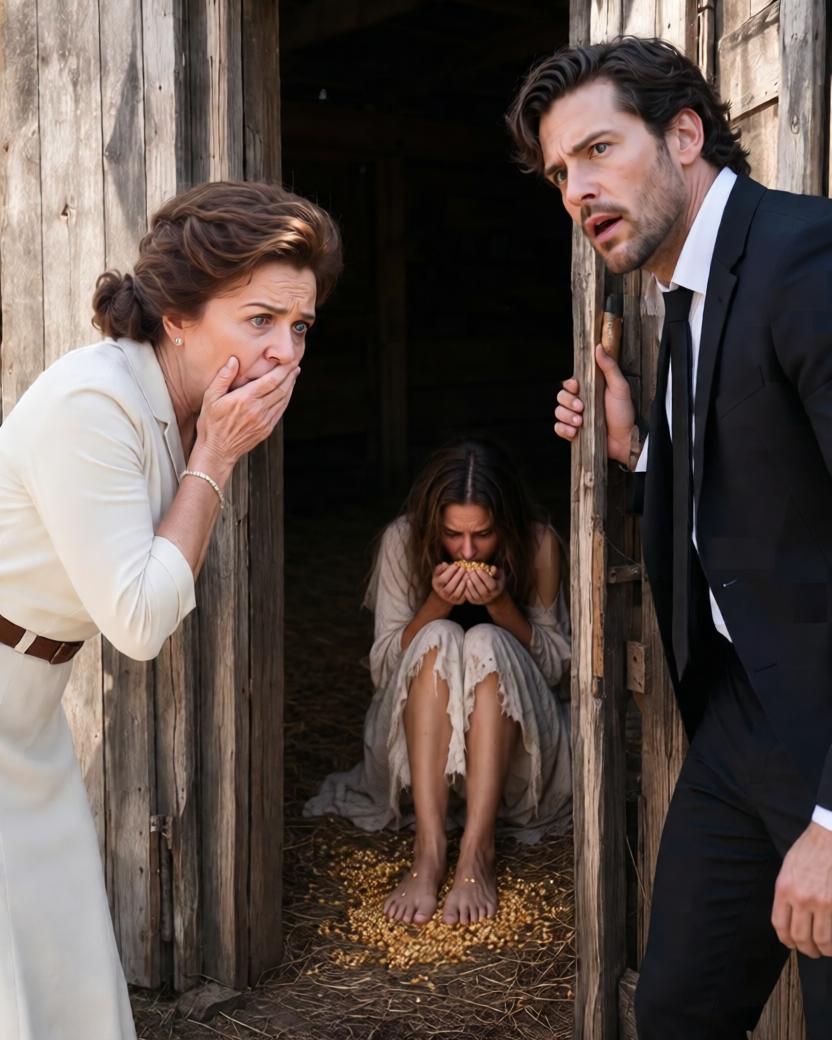
The hardest part was waiting for me behind the family farmhouse, locked inside a filthy wooden chicken coop.
I had returned without telling anyone. I wanted to see the old ranch where my husband and I had raised Brock, our only son. But when the yellow taxi finally dropped me beside the rusted iron gate, something immediately felt wrong.
The white paint was peeling from the farmhouse. The garden had withered beneath thick weeds. The dirt corrals were empty.
And there was no sign of a single farm worker.
The entire property was eerily silent.
Then—
BANG!
A loud noise exploded from behind the main house.
I quickly walked around the building.
What I saw made my stomach tighten.
Brock was standing outside a locked chicken coop.
He was dressed like a wealthy businessman, wearing an expensive button-down shirt, brand-new leather boots, and a shiny gold watch.
He kicked the thin wooden door with his boot.
“I explicitly told you to finish cleaning before dark!” he shouted. “If you don’t, you’re staying in there all night!”
From inside the dark shed came a weak female voice.
“I’m almost finished, Brock,” the woman whimpered.
I froze.
“Who is inside there?” I called firmly.
Brock spun around.
For one brief second, pure fear flashed across his face.
Then it disappeared.
He forced a warm smile.
“Mom… what on earth are you doing here?”
“I asked you a clear question, Brock. Who is inside that coop?”
He casually waved one hand.
“It’s just Natasha. She’s cleaning the shed, but she always leaves everything half-finished.”
Natasha.
His wife.
Eight years earlier, she had been a soft-spoken young woman studying nursing. She had loved talking about her family in Omaha, Nebraska, and she had once seemed excited about building a future with my son.
Something inside me immediately told me that the woman behind that door was not simply “cleaning.”
I reached for the metal latch.
Brock stepped directly in front of me.
“Please don’t make a dramatic scene right now, Mom,” he said coldly.
I pushed his arm aside.
Then I slid the heavy iron bolt open.
The smell hit me first.
Dirt.
Animal feed.
Moisture.
Rot.
Natasha was sitting on the filthy ground, surrounded by loose chicken feathers and damp animal feed.
Her blouse was torn and faded. Her brown hair was tangled and covered with dust. Her bare arms were marked with dark bruises.
But what shocked me most was what she was holding.
Several raw kernels of dried corn.
She was eating them.
She was eating chicken feed because she had nothing else.
“Mrs. Henrietta…” she whispered.
Her voice trembled.
She tried to stand.
Her legs gave out.
I dropped to my knees beside her.
“How long have you been locked in this horrible place, my dear?”
Natasha looked toward Brock.
The terror in her eyes was unmistakable.
“I’m completely fine, Mrs. Henrietta,” she whispered.
She was lying to protect herself.
Behind us, Brock gave a harsh laugh.
“She always exaggerates everything. She loves playing the helpless victim.”
Then I noticed her wrist.
A dark, raw mark circled the thin skin.
It looked exactly like the deep imprint left by a tight rope.
My blood ran cold.
“You’re coming home with me right now,” I said.
I wrapped my arm around her fragile shoulders.
Natasha began trembling violently.
“I can’t go with you,” she whispered.
“Yes, you can,” I said firmly. “And you will.”
Brock suddenly grabbed my forearm.
His fingers dug into my skin.
“She is my legal wife. Stay out of our personal business!”
I stared into his eyes.
I searched desperately for the sweet little boy I had raised.
I found nothing.
Only emptiness.
“Precisely because she is your wife,” I told him, “you should have been protecting her all along.”
I helped Natasha toward my old sedan.
Brock followed us.
When I started the engine, he slammed both fists against the side window.
“If you take her away today, you’re going to destroy this entire family!” he screamed through the glass.
I drove away.
Twenty minutes later, we were sitting inside a quiet diner in downtown Columbus.
Natasha was hungrily eating a warm bowl of chicken noodle soup.
She finished it almost too quickly.
I waited until she had slowed down before asking the question that frightened me most.
“When was the last time you ate a proper meal?”
She lowered her head.
“It’s been almost two entire weeks,” she admitted weakly.
My heart broke.
“And your family back home?”
Her eyes filled with tears.
“Brock always told me they moved away. He said they didn’t want to hear from me anymore.”
“When was the last time you actually spoke to your mother?”
Natasha wiped a tear from her cheek.
“Six years ago.”
Six years.
My hands began shaking.
I immediately called a private local hospital.
Then I called Mr. Montgomery, a highly respected defense attorney in the state.
A few hours later, a doctor carefully examined Natasha.
The medical report was devastating.
She had extensive old bruises, severe malnutrition, and two cracked ribs that had healed badly and crookedly over time.
While Natasha finally slept beneath a warm hospital blanket, my phone rang.
It was Brock.
His angry voice came through the speaker.
“Mom, please tell me you are not actually doing what I think you’re doing.”
“I’m simply doing what I should have done many years ago,” I answered.
Silence followed.
Heavy.
Suffocating.
Then Brock spoke again.
His next words chilled me to the bone.
“If you report this to the police, Natasha is going to lose everything she has left, too.”
It was a threat.
And at that moment, I had no idea how many dark secrets I was about to uncover.
PART 2:
The official medical report confirmed my worst fears.
Natasha was suffering from extreme malnutrition. She had fresh physical injuries, old scars, and badly healed fractures.
The primary physician estimated that the physical abuse had been happening consistently for several years.
That same night, I walked straight into the local police station and filed a formal criminal complaint against my own son.
Attorney Montgomery pulled me aside.
“Are you absolutely certain you’re ready to move forward against your own biological son?” he asked.
I reached into my leather purse and pulled out an old photograph.
It showed Brock when he was five years old, gently hugging a stray puppy in our backyard.
I looked at the picture through tear-filled eyes.
“That sweet boy was my true son,” I said. “I am not going to cover up crimes for the monster I saw standing at the farm today.”
Around midnight, local deputies arrested Brock.
Shortly afterward, he called me from the detention center.
“How could you do this to me?” he shouted. “I’m your own flesh and blood!”
“And Natasha is a human being,” I answered firmly. “She deserved basic human decency. That should have been more than enough reason for you not to destroy her life.”
“You’re going to regret this decision for the rest of your life!”
The line went dead.
I put the phone down and cried.
But I did not withdraw a single charge.
The next morning, I returned to the hospital.
Natasha was wearing clean clothes. She looked calmer, but every time the heavy hospital door clicked open, she jumped in fear.
I sat beside her bed.
“I need you to tell me everything that happened during all those lost years,” I said gently.
What she told me forced me to face a crushing truth about myself.
Before I left the United States for Spain, I had already noticed warning signs.
After my husband died, Brock took complete control of the family ranch.
He fired loyal workers.
He became possessive.
And he began speaking to Natasha as though she were nothing more than an unpaid servant.
One night, I had even caught him roughly squeezing her arm because she had dared to call her mother.
We argued fiercely.
But I was grieving my husband. I was exhausted, my health was failing, and I convinced myself that distance would help me recover.
So I left the country.
I had no idea what happened after I was gone.
According to Natasha, everything became worse almost immediately.
Brock began checking her phone every day.
He demanded all her passwords.
He forbade her from contacting anyone in Nebraska.
Then, one afternoon, she secretly tried to call her mother.
Brock smashed her phone into pieces.
Then he struck her across the face for the first time.
After that, he banned all outside visitors from the ranch.
Then came the shoving.
Then the brutal physical attacks.
Eventually, he discovered another way to control her.
Food.
“He told me I had to earn every meal through hard labor,” Natasha said, her voice trembling. “If I made even the smallest mistake, he would withhold food from me for days.”
Then came the incident that changed everything.
In the summer of 2021, Natasha accidentally dropped and broke a ceramic dinner plate.
Brock locked her inside the chicken coop for an entire night.
Over time, that filthy shed became her routine prison.
“I was forced to drink water straight from the chickens’ dirty trough,” she told me. “And I chewed raw corn kernels because it was literally the only food available.”
I held her thin hands and cried.
“Did you really never try to escape?”
Natasha looked directly into my eyes.
That was when she told me the darkest part.
“I tried once,” she whispered. “In the spring of 2022.”
She had secretly escaped early one morning.
She walked for miles along a dark highway.
Eventually, a kind long-haul truck driver saw her and stopped.
He offered her a ride to the nearest town.
For the first time, Natasha believed she might actually survive.
Then Brock appeared.
He chased them down in his truck and forced the big rig to pull over.
He calmly told the driver that his young wife suffered from severe psychotic episodes, was deeply confused, and was dangerous to herself.
The driver believed him.
Brock sounded concerned.
He looked convincing.
And while Natasha begged for help, the truck driver accepted Brock’s story.
Brock dragged her back to the ranch.
“He locked me inside the chicken coop for an entire week after that,” Natasha sobbed. “He told me that if I ever tried to run again, he would kill me and bury my body on the farm.”
Three days later, Attorney Montgomery arrived at the hospital with troubling news.
“Brock’s defense team has already finalized their primary strategy,” he warned.
“What strategy?” I asked.
“They intend to claim that Natasha has severe mental disorders, that she fabricated the allegations, and that her injuries were simply tragic domestic accidents.”
I felt rage burning inside my chest.
It was the exact same lie Brock had used on the truck driver.
“There’s one more crucial thing,” Montgomery continued. “For the state prosecutor to secure a conviction, Natasha will have to testify before the judge, directly in front of Brock.”
Natasha went completely pale.
Her breathing became shallow.
“I can’t bear to look at his face again,” she whispered.
I took both of her cold hands.
“You do not have to prove anything to that man. You only have to tell the judge the truth.”
She remained silent.
Seconds passed.
Then she slowly raised her head.
There was something different in her eyes.
Courage.
“I’m going to give my full official statement in court,” she said.
Montgomery nodded.
“Then prepare yourself mentally,” he told her. “Tomorrow, Brock is going to hear every detail of what he did, spoken aloud for the entire world to hear.”
None of us knew what would happen when Natasha finally faced her abuser.
But the next day, she walked into that courtroom anyway.
PART 3:
The courtroom smelled of old wooden benches, official paperwork, and stale cafeteria coffee.
Natasha entered wearing plain black trousers and an ironed white blouse. Her brown hair was neatly pulled back into a simple ponytail.
She had regained some color in her face.
But her slender hands still shook.
Just before we passed through the double doors, she turned toward me.
“If my mind goes completely blank on the witness stand, please don’t leave me alone in there,” she pleaded.
“You are never going to be alone again,” I promised, squeezing her hand.
Brock was already seated at the defense table beside his expensive lawyer.
The moment he saw Natasha, he stared at her.
He wanted her to look at him.
He wanted her to remember who had controlled her for all those years.
Natasha lowered her eyes for a few seconds.
Then she took a slow breath.
She lifted her head.
For the first time in eight years, she refused to surrender to his control.
The judge asked her to tell the court everything that had happened from the beginning of her marriage.
Natasha spoke clearly.
She described the first violent slap.
The smashed phone.
The forbidden calls to her family.
The letters from her mother that Brock had burned in the living room fireplace.
She explained how he had fired every farmhand until there were no potential witnesses left on the property.
She described waking before five every morning.
She scrubbed floors.
She cared for livestock.
She did heavy laundry.
She maintained the outdoor corrals.
And every day, Brock alone decided whether she had worked enough to deserve food.
Brock shook his head furiously.
“She’s making up complete lies!” he shouted.
The judge slammed the gavel.
“Silence in this courtroom, sir!”
Natasha continued.
She described her first night inside the chicken coop.
Then the countless freezing nights she spent shivering on the dirt floor.
She told the court about drinking filthy water from the trough.
Eating hard, dry corn kernels.
Going weeks without a proper shower.
And living in constant terror whenever she heard Brock’s heavy work boots approaching the wooden door.
When she reached the failed escape attempt, her voice cracked.
“I genuinely thought that kind truck driver was going to save my life that morning,” she said through tears. “But my husband calmly convinced him that I was insane. Brock smiled warmly and acted like a deeply concerned husband. The driver believed him while I was screaming for help.”
Brock suddenly interrupted again.
“Because you were acting completely out of control!” he shouted.
Then Natasha did something nobody expected.
She slowly turned toward him.
She looked directly into his eyes.
“I was never insane, Brock,” she said clearly. “I was simply terrified of you.”
The courtroom became completely silent.
“For years, you convinced me that nobody in the world would ever believe my story,” she continued. “So look at me carefully today, Brock. I survived everything you did to me.”
Brock lowered his head.
For the first time, he could not hold her gaze.
Then it was my turn to testify.
I told the judge everything I had witnessed when I returned unexpectedly.
The locked padlock.
The bruises.
The raw corn in Natasha’s hands.
Her inability to walk properly.
But I also had to admit something painful.
“I saw the warning signs before I left for Spain,” I confessed. “I saw my son controlling, humiliating, and isolating his young wife. I convinced myself it was not my place to interfere. So I walked away. I was terribly wrong.”
Brock’s attorney immediately began his cross-examination.
“Isn’t it true that you had frequent, bitter arguments with your son over his financial management of the ranch?”
“Yes,” I answered honestly.
“And isn’t it true that you left the country feeling deeply resentful toward him?”
“Yes. I was upset with him.”
“Then you clearly have a personal motive to harm my client’s reputation today, don’t you?”
I turned toward Brock.
“If I wanted to harm him, I could have invented a lie,” I said firmly. “But what he actually did to that poor girl is far worse than anything I could ever make up.”
Several long weeks later, the trial finally ended.
The judge delivered the verdict.
Brock was found guilty on all counts, including aggravated domestic assault and unlawful imprisonment.
He received eighteen years in prison without the possibility of immediate parole.
When the sentence was announced, I felt no joy.
No triumph.
He was still my biological son.
He was the little boy who had once run through our green yard with scraped knees.
The gentle child who had fallen asleep beside his favorite golden retriever.
The boy who had once promised to buy me a beautiful house when he grew up so I would never have to worry again.
I sat in the back of the courtroom and cried.
But I never apologized for turning him in.
Loving your child is a natural instinct.
Protecting them from the consequences of destroying another person’s life is something entirely different.
In early December, Natasha and I returned to the ranch.
The moment her feet crossed the old iron gate, she froze.
Painful memories seemed to rush over her all at once.
“We can leave right now if you want,” I told her. “You never have to enter this house again.”
She looked at the empty corrals.
The weathered farmhouse.
The overgrown yard.
Then she shook her head.
“No. If I run away because I’m afraid, he will still control my life from prison. I want to stay here and turn this place into something beautiful.”
We began with her room.
We chose a spacious bedroom in the quiet north wing, far from the master bedroom.
We painted the walls soft sage green.
We hung bright white cotton curtains.
We placed freshly cut wildflowers beside the sunny window.
Then came the chicken coop.
One bright morning, Natasha entered the kitchen with a calm, determined expression.
“I’m ready to tear that terrible place down.”
Instead of burning it in anger, we hired an elderly neighbor named Don Callahan to help us dismantle the wooden building carefully, piece by piece.
We moved the chickens into a spacious, modern coop across the yard.
The old pine boards were chopped into winter firewood.
The ground beneath the coop was scrubbed clean.
Over the next several months, Natasha planted purple bougainvillea, sweet lavender, and colorful wildflowers across the exact spot where her prison had once stood.
“I never want to look out my window and see a prison,” she told me softly. “I want to see vibrant life growing.”
Her recovery was not quick.
And it was not easy.
Some nights, she woke screaming from nightmares, convinced Brock was standing outside her bedroom door.
If a male stranger raised his voice too loudly at the farmers’ market, she would freeze in terror.
Sometimes, without even realizing what she was doing, she hid extra bread rolls inside paper napkins and tucked them into her nightstand.
She was still afraid she might be starved again.
One afternoon, she found me sitting alone at the kitchen table, crying into my hands.
“What’s bothering you today, Mrs. Henrietta?” she asked gently.
“I failed as a mother,” I sobbed. “I raised a monster.”
Natasha sat beside me and took my trembling hands.
“Brock is in prison because of the terrible choices he made as a grown man,” she said softly. “You did not make those choices for him. But you saved my life when you had the power to do so. That choice shows who you truly are.”
Her words changed something inside me.
I began professional therapy in downtown Columbus.
During one session, a wise psychologist named Dr. Miller asked me a question that stayed with me for months.
“If you had stayed at the ranch all those years ago,” she asked gently, “can you honestly say with absolute certainty that you would have stopped his abuse?”
I could not.
Through therapy, I slowly understood that accepting my mistakes did not mean accepting responsibility for every criminal action my adult son had chosen to commit.
While I learned how to forgive myself, Natasha began rebuilding her own life.
Then came one of the most frightening steps of her recovery.
Calling her family in Nebraska.
She had not heard her parents’ voices in six painful years.
One quiet Sunday morning, she dialed the number while I sat beside her.
“Hello?”
A familiar woman’s voice answered.
Natasha closed her eyes.
Tears rolled down her cheeks.
“Mom… it’s really me.”
Silence.
Then came a sudden gasp.
“Natasha! Oh, my sweet girl!”
It was her mother, Laura.
For six terrible years, Laura had believed her daughter had willingly abandoned the family.
Brock had answered their calls and told them Natasha wanted nothing to do with them.
He had blocked their numbers.
He had intercepted their letters.
He had created a false story in which he was the suffering husband trapped with an ungrateful wife.
Two weeks after that phone call, Natasha’s parents drove all the way from Omaha to the ranch.
Her father, Joseph, stepped from the truck.
He crossed the yard without saying a word.
Then he wrapped his daughter in his arms.
They held each other for several minutes, both crying uncontrollably.
“Please forgive me for not searching harder for you, my sweet girl,” he whispered into her hair.
Laura gently held Natasha’s face and kissed her cheeks again and again.
“You have absolutely nothing to apologize for, sweetheart,” she whispered.
That evening, our home felt completely different.
We cooked a huge pot of beef stew together.
For the first time since I had returned from Spain, the dining table was filled with warm bread, lively conversation, and genuine laughter.
There was no fear underneath it.
Only love.
A few months later, Natasha told us she wanted to finish her nursing degree.
She had been forced to abandon college shortly after marrying Brock, with only a few semesters left.
Now she re-enrolled at the state university in Columbus.
She worked tirelessly to catch up.
At first, I drove her to campus every morning.
But slowly, she became confident enough to drive herself.
She made wonderful new friends.
Eventually, she secured a prestigious internship at the regional hospital.
One evening, she came home with sadness and determination written across her face.
“I treated a woman in the emergency room today,” she told me as we made tea. “She was covered in terrible bruises. She told me she had simply fallen down the stairs.”
“What did you do?” I asked.
“I took her into a private room and quietly asked if she felt safe at home. I didn’t pressure her or make her uncomfortable. I just wanted her to know that whenever she was ready to seek help, safe options were waiting for her.”
“Did seeing her remind you of yourself?”
Natasha nodded.
“It reminded me completely of who I used to be.”
That was the moment she discovered a new purpose in her life.
When graduation day finally arrived, her parents and I sat together in the very front row.
When her name was announced, I jumped to my feet first.
I clapped until my hands hurt.
Tears streamed down my face.
The fragile young woman I had found eating raw animal feed inside a filthy chicken coop was now a licensed registered nurse.
That evening, we raised our glasses at the farmhouse table.
“To Natasha,” I said proudly. “Surviving that dark prison was not the end of your story. It was the beginning of your real life.”
She raised her glass.
“And to you, Mrs. Henrietta,” she replied warmly. “You courageously chose to do the right thing even though it broke your motherly heart into a thousand pieces.”
I did not answer.
I simply pulled her into my arms.
Over the following months, we heard very little about Brock.
At first, he sent letters filled with excuses and bitter accusations.
But after he entered court-mandated anger management therapy inside the correctional facility, a very different letter arrived.
“Dear Mom, I’m not writing this letter to make pathetic excuses or claim that Natasha provoked me,” the handwritten letter said. “I committed terrible, unspeakable acts, and there is absolutely no justification for what I did. Now that I am locked behind bars every day, I am finally beginning to understand what it means to live in constant fear without freedom. I am not asking you to pull strings to get me released early, and I am not begging for forgiveness. I simply wanted to tell the truth for once in my life.”
I carried the letter into the living room.
“Would you like to read what he wrote?” I asked Natasha.
She slowly shook her head.
A peaceful smile appeared on her face.
“No, thank you. I no longer need him to understand the damage he caused in order to move forward with my life.”
That simple sentence taught me something more powerful than all my therapy sessions.
I read Brock’s letter several times.
I still did not know whether he was truly changing or simply accepting the reality of his long sentence.
But eventually, I understood something.
His redemption was his responsibility.
Natasha did not have to join him on that journey.
And I did not have to rescue him from the destruction he had created himself.
A full year after my sudden return from Spain, the old ranch looked like a completely different place.
We rehired honest local farmhands and paid them fair wages.
We restored the fruit orchards.
We painted the farmhouse white again.
The front yard filled with green plants.
And where the chicken coop had once stood, colorful flowers now covered the ground.
One sunny afternoon, Natasha stood beside the flower garden, looking at the lavender.
“Exactly one year ago today,” she said quietly, “I genuinely believed I was going to die alone in this exact place.”
I stood beside her.
“And how do you feel today, my dear?”
She turned toward me with a radiant smile.
“Now I know with absolute certainty that I want to live a long, beautiful life.”
Eventually, Natasha found a permanent nursing position at the medical center.
Her patients adored her.
They loved her gentle bedside manner and the way she listened without judgment.
She also began spending her free weekends volunteering at community workshops for women escaping domestic abuse.
She never forced anyone to talk about the past.
But she always shared one simple truth.
“Being afraid does not mean you are weak,” she would tell them. “And taking a long time to ask for help does not mean it is too late to rebuild your life.”
I often sat in the back row and watched her speak.
I would remember the first time I saw her covered in dirt, clutching raw corn in her trembling hands.
It felt like another lifetime.
Two years later, Natasha officially purchased a portion of the ranch using her own hard-earned savings.
She refused to accept the land as a gift.
“I don’t want anyone to hand me a life,” she said proudly as we signed the paperwork. “I want the pride of building it with my own hands.”
We signed the real estate documents at the same dining room table where Brock had once arrogantly decided who deserved a basic meal.
Outside the window, purple flowers covered the old stone wall.
That evening, I sat quietly on the back porch while Natasha prepared dinner.
I no longer heard shouting.
No threats.
No violent footsteps.
Instead, I heard soft music, the gentle clinking of plates, and confident footsteps moving through the house.
I thought about my son sitting in his distant prison cell.
He would always be my biological child.
But he could never again be part of our daily lives.
I finally understood that I could grieve the innocent boy he once was without denying the terrible crimes he had committed.
I could hope that he might one day change without expecting Natasha to forgive him.
And most importantly, I realized that his imprisonment was not my betrayal of my duty as a mother.
It was the natural consequence of his own terrible choices.
That was the hardest lesson I had ever learned in sixty years.
Being family does not give anyone permission to remain silent when evil is happening.
Love does not require you to endure endless abuse or hide terrible crimes.
And forgiveness, if it ever comes, does not mean reopening a door that took years of pain and courage to close.
Natasha stepped onto the porch carrying two warm plates of food.
“What are you thinking about so deeply, Mrs. Henrietta?” she asked, handing me one.
I looked across the yard.
The flowers were moving gently in the evening breeze where the dark chicken coop had once stood.
“I was thinking about how I came back here to recover an old house,” I said softly, “only to discover that a human life needed to be rescued.”
Natasha placed her plate on the table.
Then she wrapped her arms around my neck.
“We actually rescued two lives,” she whispered.
She was right.
That afternoon, I pulled Natasha out of a physical prison behind the farmhouse.
But in the end, she also freed me from a prison inside my own mind—the toxic belief that a mother must protect her child at any cost, even when that child becomes a monster to someone else.
Ever since that day, people have sometimes asked me the same question:
Would I still report my own son if I knew he would receive eighteen years in prison?
My answer has never changed.
Yes.
I would do it again.
I would slide that rusty iron bolt open again.
I would take Natasha’s trembling hand and lead her to safety again.
And I would choose human justice every single time, even if my own son stood on the wrong side of the law.
Because some silences pretend to keep families together while secretly destroying them from the inside.
And sometimes, the most painful act of true love is being the first person brave enough to break that silence.
THE END.
