
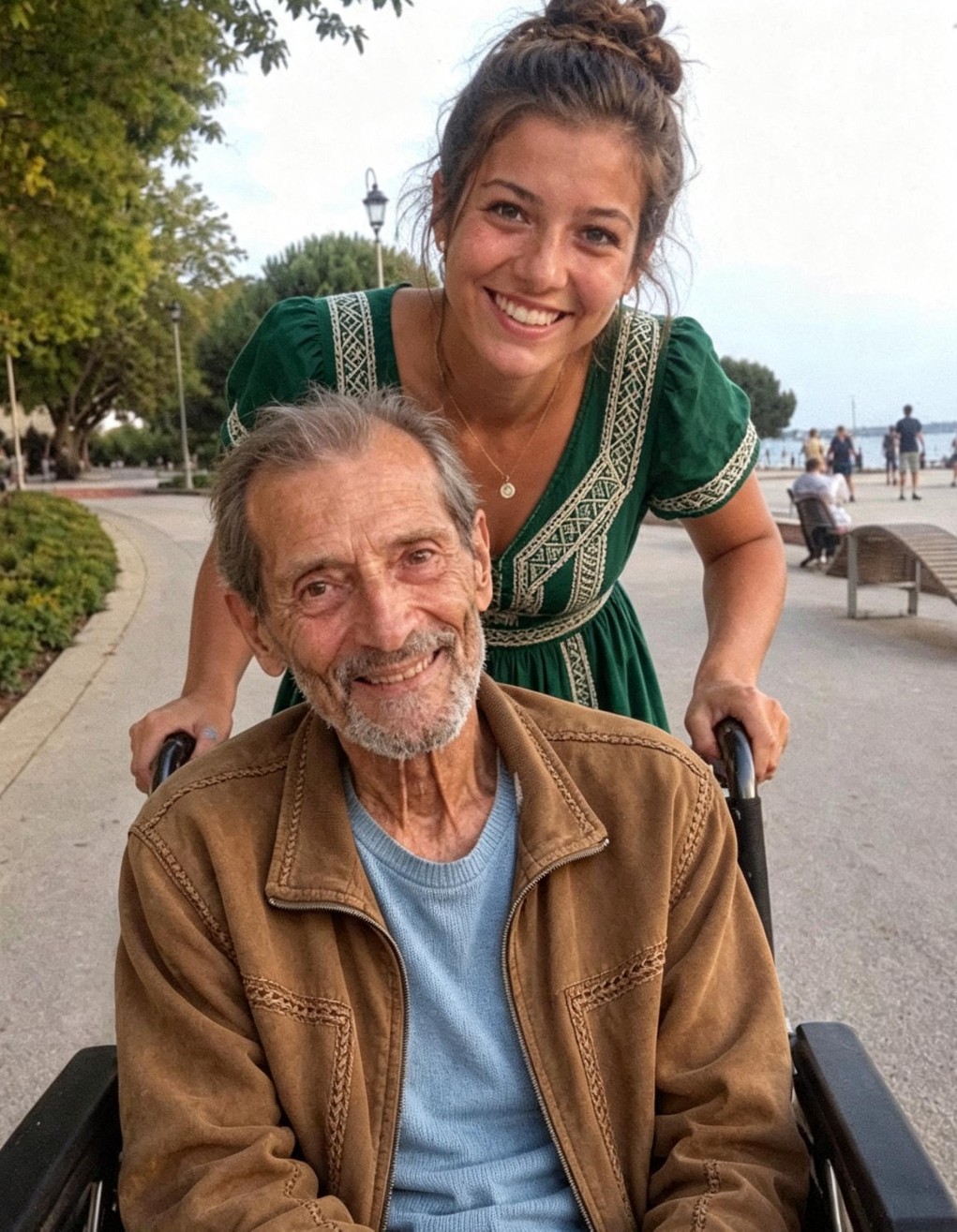
Part 1:
Two years ago, after my mother died, I started volunteering at a small hospice in Boston.
I had never planned to work there. I simply needed something to keep me busy after losing her. The apartment felt painfully empty without my mother, and I couldn’t stand spending every evening alone with my thoughts.
That was where I met Julian.
He was fifty-nine years old, thin and tired-looking, with silver hair and gentle eyes that seemed much younger than the rest of him.
Most of the patients at the hospice had family members who came to visit.
Some had children who sat beside their beds for hours. Others had spouses who brought photographs, homemade food, or clean clothes. There were always people coming and going.
But Julian had no one.
No wife.
No children.
No friends who visited.
At least, that was what I believed.
So I started stopping by his room whenever I had a few extra minutes.
At first, I only brought him coffee.
He liked it black, with no sugar.
Then I started staying a little longer.
He told me stories about his childhood, the places he had traveled, and the mistakes he wished he could undo.
He had once been a successful engineer, he told me. He had built things, designed things, and spent years believing that money and success would make him happy.
Instead, he said, he had spent too much of his life chasing things that didn’t matter.
“I wasted so many years,” he told me one evening as rain tapped against the window. “You don’t realize how precious time is until you know exactly how much of it you have left.”
I didn’t know what to say, so I simply sat beside him.
Eventually, our visits became a routine.
I brought his coffee.
He told me stories.
I listened.
Sometimes we laughed.
Sometimes we sat in silence.
And slowly, something strange happened.
I became the person Julian waited for.
If I was late, he would look toward the hallway every few minutes.
If another volunteer came into his room, he would politely ask, “Has Evelyn come in yet?”
I began pushing his wheelchair through the hospice gardens.
On warmer days, I took him outside and sat with him beneath the trees.
One Saturday, I drove him to his favorite little diner. He ordered pancakes even though the nurses had warned him not to eat too much.
When I raised an eyebrow at the enormous plate in front of him, he laughed.
“I’ve spent my whole life being told what I shouldn’t eat,” he said. “At this point, I’m ordering the pancakes.”
I laughed so hard that the waitress smiled at us.
Another weekend, I drove him to the ocean.
He had asked me several times if I could take him there.
So I borrowed a wheelchair from the hospice, helped him into my car, and drove north along the coast.
When we reached the water, I pushed him as close to the beach as I could.
Then, with my help, he stood for a few seconds.
His legs were weak, but he insisted.
He took off his shoes and let his bare feet touch the sand.
He closed his eyes.
For several seconds, he said nothing.
Then he whispered, “I remember this place.”
I thought he meant the ocean.
I didn’t realize until much later that he meant something much more important.
Six weeks before he died, something happened that changed both our lives.
We were sitting together in his room after dinner.
Julian reached across the armrest and took my hand.
His fingers were cold.
“Evelyn,” he said quietly.
“Yes?”
“I have one last wish.”
I smiled. “What is it?”
He looked nervous.
“Would you pretend to be my daughter until I’m gone?”
I stared at him.
For a moment, I thought I had misunderstood.
“Your daughter?”
He nodded.
“I know it sounds strange.”
“It does,” I admitted.
He gave a weak laugh.
“My life separated me from my little girl before she was even born. I never got to hold her. I never heard her say ‘Dad.’ I never watched her grow up.”
His voice broke.
“I just want to know what it feels like.”
His words hit me harder than I expected.
My own father had left before I was born.
I had never known his name.
My mother had raised me alone and had almost never spoken about him.
For most of my life, I had wondered what kind of man could walk away from his own unborn child.
I knew what it felt like to grow up believing you had been abandoned.
So when Julian looked at me with tears in his eyes, I couldn’t bring myself to say no.
I squeezed his hand.
“Well then,” I said with a smile, “hello, Dad.”
Julian stared at me.
Then he laughed.
It was one of the happiest sounds I had ever heard.
“Hello, sweetheart,” he whispered.
From that day on, we played along.
Whenever a nurse came into the room, Julian would introduce me.
“This is my daughter, Evelyn.”
Whenever someone asked how we knew each other, I smiled and said, “He’s my dad.”
Everyone believed us.
And somehow, after a few days, I stopped feeling like I was pretending.
For six weeks, we were inseparable.
I pushed his wheelchair through the gardens.
I took him back to the diner.
I drove him to the ocean.
We drank coffee together in the mornings.
He told me stories about his childhood.
I told him about my mother.
Sometimes he asked questions about her that seemed strangely personal.
“What kind of music did she like?”
“What did she do when she was nervous?”
“Did she ever talk about me?”
I thought he was simply curious.
I didn’t know that he already knew the answers to many of those questions.
Whenever strangers saw us together, Julian smiled proudly.
“This is my daughter.”
And I would smile back.
I knew most people would never understand what was happening between us.
But I didn’t care.
For the first time in years, I felt as though I belonged to someone.
For the first time, I had someone who looked at me as if I mattered more than anything else in the world.
Then, last week, Julian died quietly in his sleep.
I was there earlier that evening.
We had talked about the ocean.
He had fallen asleep while holding my hand.
I kissed his forehead before leaving.
“I’ll see you tomorrow, Dad,” I whispered.
He never woke up.
The next morning, I stood beside his bed and cried harder than I had cried since my mother died.
I thought the strange little father-daughter relationship we had created was over.
I thought those six weeks were simply a beautiful gift we had given each other at the end of his life.
I was wrong.
The day after his funeral, a man in a dark suit arrived at the hospice.
He introduced himself as Daniel Mercer, Julian’s longtime attorney.
I had never seen him before.
He didn’t smile.
He didn’t offer small talk.
Instead, he looked directly at me and said:
“You walked straight into his trap.”
I froze.
“What?”
He placed a smooth wooden box into my hands.
My fingers immediately began to tremble.
“Julian chose this hospice because you volunteered here,” he said.
I stared at him.
“He searched for you for twenty years.”
My heart stopped.
“Who are you talking about?”
Daniel took a slow breath.
“Your father.”
Then he looked at me and added:
“You’d better sit down.”
Part 2:
My knees nearly gave out.
I sank into the nearest wooden chair in the empty hospice lobby, clutching the box against my chest.
“What are you talking about?” I whispered.
Daniel Mercer sat across from me.
“Julian didn’t choose this hospice by accident.”
I shook my head.
“Julian was a lonely old man. He asked me to pretend to be his daughter. That’s all.”
Daniel’s expression softened.
“Julian Mercer was many things. He was a brilliant engineer, a deeply flawed man, and a man who spent more than two decades trying to protect you.”
I stared at him.
“Protect me from what?”
“The people who destroyed his life.”
He nodded toward the wooden box.
“Open it.”
My hands were shaking as I lifted the lid.
Inside were several yellowed photographs, a thick leather journal, a certified copy of a birth certificate, and a small brass key.
I reached for the birth certificate first.
My eyes moved slowly across the page.
Then they stopped.
Father’s Name:
Julian Edward Vance.
I couldn’t breathe.
I read it again.
Then a third time.
Julian Edward Vance.
My father’s name.
The man I had spent my entire life believing had abandoned me was the same man who had held my hand while I cried in a hospice room.
The same man who had laughed with me at the diner.
The same man who had stood barefoot on the beach.
The same man I had called Dad.
Tears blurred the page.
“No,” I whispered.
Daniel leaned forward.
“Your mother never told you his name.”
“She said he left.”
“She believed he had no choice.”
I looked at him.
“Why?”
Daniel reached for one of the photographs.
He handed it to me.
It showed my mother when she was young.
She was standing on a sunny pier beside a much younger Julian.
Her hands rested protectively over her pregnant belly.
They were smiling.
Not politely.
Not awkwardly.
They were completely in love.
I pressed the photograph against my chest.
“He didn’t abandon you or your mother,” Daniel said quietly.
“Then why did he disappear?”
“Because twenty-two years ago, Julian’s former business partners framed him in a massive corporate fraud scheme.”
I looked up.
“What kind of scheme?”
“They wanted his patents.”
Daniel explained that Julian had developed several valuable engineering and architectural systems. His business partners wanted control of those patents and the company built around them.
When Julian refused to give them up, they began looking for another way.
“They created false financial records, moved money through accounts Julian didn’t control, and made it appear as if he was responsible for the fraud.”
“And the authorities believed them?”
“For a time, yes.”
Julian was arrested.
Then the threats began.
“They didn’t just want Julian in prison,” Daniel said. “They wanted your mother frightened enough to disappear.”
My fingers tightened around the photograph.
“She was pregnant.”
“With you.”
Daniel nodded.
“Julian knew that if his enemies discovered your mother and the baby, they could use you to control him.”
“So he told her to hide?”
“Yes.”
“And then?”
“He made a choice.”
Daniel looked directly into my eyes.
“He took the fall.”
I stared at him.
“Julian accepted a ten-year prison sentence rather than reveal where your mother had gone.”
My mouth went dry.
“He could have fought?”
“He could have tried. But every legal move he made increased the chance that his enemies would discover your mother’s location.”
“So he disappeared.”
“Completely.”
My eyes filled with tears again.
“But why didn’t he come back after prison?”
Daniel lowered his voice.
“Because the people who framed him were still watching.”
He explained that even after Julian’s release, his former partners continued trying to locate his remaining assets and discover whether he had hidden anything from them.
“They knew Julian had a daughter,” Daniel said. “But they didn’t know where you were.”
I stared at him.
“They knew I existed?”
“They knew there was a child. They didn’t know your name, your exact location, or what you looked like.”
“So Julian stayed away.”
“Yes.”
“For twenty years?”
Daniel nodded.
“Twenty years.”
I looked down at the journal.
“Did he watch me?”
Daniel smiled sadly.
“From a distance.”
My stomach twisted.
“What does that mean?”
“He monitored your life through people he trusted. He knew where you went to school. He knew when you started college. He knew about your mother’s illness. He knew when she died.”
I covered my mouth.
“Why?”
“Because he was your father.”
Those words broke something inside me.
I had spent my entire life thinking my father hadn’t cared enough to stay.
And all those years, he had been somewhere nearby, watching from a distance because he believed coming closer could put me in danger.
“Why didn’t he just tell me?” I asked.
Daniel’s eyes softened.
“Because he knew you.”
I looked at him.
“He knew how much anger you carried toward your father. He knew you believed you had been abandoned. If he walked up to you one day and said, ‘I’m your father,’ you might have rejected him.”
I swallowed hard.
“He was afraid.”
“Yes.”
Daniel glanced at the box.
“He didn’t want your first reaction to be anger. He wanted you to know him first.”
I thought about those six weeks.
The coffee.
The jokes.
The diner.
The ocean.
His hand holding mine.
“He knew I’d volunteer here?”
“He knew you had been volunteering at the hospice after your mother died.”
I stared at him.
“So he chose this place.”
“Yes.”
“On purpose.”
“Every part of it was planned.”
I shook my head.
“But what was the trap?”
Daniel pointed to the brass key.
“The trap wasn’t designed to hurt you.”
He paused.
“It was designed to protect you.”
He explained that Julian had spent years creating a legal plan that would allow his estate and intellectual property to pass to me without exposing me to unnecessary danger while he was alive.
“He couldn’t simply put everything in your name while his former partners were still watching his finances.”
“So what did he do?”
“He created a series of trusts and legal documents that would take effect after his death.”
I looked at him.
“And the six weeks?”
“Those mattered too.”
Daniel explained that Julian had intentionally allowed hospice staff, nurses, volunteers, and visitors to see the relationship between us.
“You weren’t legally made his daughter by pretending for six weeks,” Daniel said. “But the witnesses established something important: that you had a genuine, continuous relationship with Julian before his death. Combined with your birth certificate, the DNA evidence, his journal, and his other legal documents, there could be no credible argument that you were some stranger suddenly appearing to claim his estate.”
I stared at the box.
“Why was he so careful?”
“Because his enemies had spent years trying to trace his estate.”
Daniel pointed to the key.
“This key leads to a safe-deposit box. Inside is the evidence that finally exposes what they did.”
My heart pounded.
“Did Julian know he was dying?”
“Yes.”
“How long did he know?”
“He had known for months that his cancer was no longer responding to treatment.”
I closed my eyes.
Suddenly, every moment from those six weeks looked different.
Every question.
Every smile.
Every trip.
Every time he held my hand.
He hadn’t been pretending to be my father.
He had been trying to experience fatherhood before he died.
And he had already known exactly who I was.
Part 3:
Daniel reached into the wooden box and pulled out a cream-colored envelope.
It had been sealed with red wax.
My name was written across the front.
Evelyn.
I stared at it.
“Julian left this for you.”
My fingers trembled as I broke the seal.
Inside was a handwritten letter.
I recognized the elegant handwriting immediately.
I began to read.
“My dearest Evelyn,
If you are reading this, then I have finally crossed over, and Daniel has given you the key.
I know you are probably confused.
You may even be angry.
I hope, with everything in me, that one day you will forgive me.
I spent twenty years living in the shadows and watching you grow into the kindest and bravest woman I could ever have dreamed of calling my daughter.
I know I tricked you into that first ‘Hello, Dad.’
Forgive an old man’s cowardice.
I was terrified that if I told you the truth, I would see anger in your eyes instead of the warmth you gave me every day.
Those six weeks were not a lie.
Pushing me through the gardens, sitting beside the ocean, sharing coffee, laughing at the diner—those were the only real weeks of fatherhood I was ever allowed to have.
You didn’t just play a role, Evelyn.
You saved my soul.
The safe-deposit box contains the restored patents, the records proving what happened to my company, and the estate I spent years protecting.
Everything has been legally secured for you.
You never have to wonder who your father was again.
You never have to believe that I left because I didn’t love you.
I loved you every day.
Even when you never knew my name.
Live your life boldly, my sweet girl.
Live in the sunlight.
I have spent twenty years in the shadows so that you wouldn’t have to.
Love always,
Dad.”
I couldn’t read the last few lines.
The tears came too quickly.
I pressed the letter against my chest and closed my eyes.
The hospice lobby was silent.
Outside, sunlight streamed through the tall glass windows.
For six weeks, I had believed I was giving a lonely dying man one last wish.
But now I understood.
He had been giving me something too.
He had given me a father.
I looked down at the photograph of my mother and Julian standing together on that sunny pier.
I had walked straight into his trap.
But it wasn’t a trap made of lies.
It was a trap made of love.
Twenty years of love.
Twenty years of silence.
Twenty years of sacrifice.
And now, for the first time in my life, I knew the truth.
My father hadn’t abandoned me.
He had been protecting me.
Part 4:
Two months later, I returned to the Maine coast.
The crisp October wind carried the smell of salt, pine, and coming rain.
I stood at the edge of a stone bluff overlooking the Atlantic, wrapped in a long wool coat.
Below me, gray-green waves crashed against jagged granite rocks, exploding into white spray before pulling back into the sea.
This was the exact place where I had brought Julian shortly before his death.
I remembered that afternoon clearly.
He had sat beside me in his wheelchair with a fleece blanket wrapped around his thin shoulders.
His eyes had been fixed on the horizon.
At the time, I thought he was simply trying to enjoy the ocean one last time.
Now I understood.
He had known exactly where he was.
He had known that he was standing at the edge of the world with his daughter.
And he had known that the twenty-year storm he had endured was finally coming to an end.
I held his leather journal against my chest.
A car door closed behind me.
I turned.
Daniel Mercer was walking toward me along the gravel road.
He carried a slim leather briefcase beneath one arm.
“I thought I might find you here,” he said.
I looked back toward the ocean.
“He loved this place.”
“He did.”
Daniel stopped beside me.
“This was the last place Julian visited with your mother before everything fell apart.”
I swallowed.
“He told me he wanted to feel the sand beneath his feet one last time.”
Daniel nodded.
“You thought you were fulfilling a dying man’s bucket list.”
I smiled sadly.
“But he was bringing me home.”
“He was,” Daniel said.
For a moment, neither of us spoke.
Then Daniel opened his briefcase.
“The final probate orders were entered this morning.”
He handed me a blue leather folder.
I opened it.
“The court has formally recognized the evidence establishing your relationship with Julian,” he explained. “The DNA evidence, the original birth records, the handwritten codicil, and the documents from the safe-deposit box all held up.”
I looked at him.
“And the patents?”
“They have been restored to the estate.”
“And the people who stole them?”
“The surviving former partners have been indicted.”
My breath caught.
“For what?”
“Fraud, conspiracy, and illegal seizure of company assets.”
Daniel gave me a cold smile.
“Julian spent years preparing for the day they would finally be exposed.”
I looked down at the folder.
“And the money?”
“Everything has been consolidated into the trust Julian created for you.”
“Everything?”
“Everything.”
Daniel paused.
“The original escrow accounts, back royalties from the stolen patents, and the estate properties.”
I stared at him.
“How much?”
He gave me the number.
“Approximately seventy-four million dollars.”
I couldn’t speak.
Seventy-four million dollars.
I thought about the tiny one-bedroom apartment I had lived in after my mother died.
I thought about counting coins before buying groceries.
I thought about my modest clothes and my old car.
Then I thought about Julian.
He had lived in a tiny hospice room with two shirts and an old radio.
“He had seventy-four million dollars?”
“Not in a form he could safely spend.”
“Why?”
“Because if he suddenly bought a mansion, a new car, or began living like a wealthy man, his former partners would have noticed.”
Daniel looked at me.
“They monitored his finances. They watched for unexplained transfers. They would have followed the money.”
I understood.
“He stayed poor.”
“He stayed invisible.”
“For me.”
Daniel nodded.
“He traded twenty years of comfort for your safety.”
Tears filled my eyes.
I turned toward the ocean so he wouldn’t see them.
For twenty years, my father had lived like a ghost.
And I had thought he didn’t care.
Daniel’s voice became softer.
“He wanted you to live in the sunlight.”
I wiped my eyes.
“What happens now?”
“Now you live.”
Part 5:
By mid-afternoon, rain began falling as a soft mist.
I drove my modest sedan down the winding coastal highway toward a quiet cemetery behind an old stone church in Rockport.
The graveyard was almost empty.
Rain tapped against the autumn leaves.
Near the top of a small hill, beneath the wide branches of an old sugar maple, stood two simple granite headstones.
One carried my mother’s name.
CLAIRE VANCE — 1978–2024
Beside it was my father’s newly carved stone.
JULIAN EDWARD VANCE — 1967–2026
Beneath his name, I had asked them to carve five simple words:
HE BROUGHT HIS DAUGHTER HOME.
I walked across the wet grass carrying a small bouquet of white lilies.
Then I knelt beside the two graves.
For a long time, I simply stared at their names.
My parents.
Together again.
I reached into my coat pocket and pulled out Julian’s leather journal.
I had spent the previous seventy-two hours reading every page.
It wasn’t a business diary.
It wasn’t a record of patents.
It wasn’t a collection of legal strategies.
It was the story of a father who had spent twenty years loving his daughter from a distance.
One entry was dated June 14, 2008.
I read it again.
“Evelyn turned ten today. Claire sent a photograph through the secure mail drop in Chicago. Evelyn has her mother’s smile, but she holds her pencil with her left hand, just like my father did. She won the district spelling bee.
I sat in the back row of the auditorium behind the light booth so she wouldn’t see me.
She was wearing a yellow dress.
I had to leave before the award ceremony because the private investigators following my credit cards might spot the rental car.
I wanted to hug her.
I couldn’t.”
I closed my eyes.
He had been there.
He had watched me win that spelling bee.
I had never known.
Another entry was dated October 3, 2017.
“Evelyn started college today.
She’s studying literature and ethics.
She had to take out a student loan because Claire couldn’t cover the full tuition without triggering another financial review of her accounts.
It broke my heart not to pay it myself.
But Vance’s lawyers checked Claire’s tax filings again last month.
I must remain a deadbeat in their eyes.
Just a few more years, my sweet girl.
Just a few more years.”
My hands shook.
I turned another page.
November 20, 2024.
The day my mother died.
“Claire passed away this morning.
I couldn’t go to the funeral.
Standing at the back of the cemetery in the rain and watching my daughter stand alone beside her mother’s casket was the hardest thing I have ever done.
She doesn’t know me.
She doesn’t know I am here.
But I know her.
The hospice near her apartment has an opening for weekend volunteers.
I have checked myself into the facility under my legal name.
The cancer has spread to my lungs.
The clock is running out.
But the final stage of the plan is ready.
Soon, I will get to hear her voice.
Soon, my daughter will call me Dad.”
I couldn’t continue.
I pressed the journal against my chest and cried.
Suddenly, I remembered the first day I had met him.
I had walked into his room carrying a tray with ice water and a fresh cup of black coffee.
He had been sitting in his chair, looking out the window.
His hands were trembling slightly.
When he turned and looked at me, something had happened in his eyes.
They had filled with an overwhelming tenderness.
At the time, I had thought he was simply touched by a volunteer’s kindness.
Now I knew better.
He had looked at his daughter for the first time in twenty years.
I remembered his laugh.
The way his face brightened whenever I entered the room.
The way he held my hand while we watched rain slide down the window.
The way he proudly introduced me to everyone.
“This is my daughter.”
He hadn’t been pretending.
Not really.
He had finally been living the fatherhood that had been stolen from him.
I touched his headstone.
“I’m not angry, Dad,” I whispered.
The wind moved through the branches above me.
“I understand now.”
My voice broke.
“You didn’t leave me.”
I wiped my cheeks.
“You were standing at the back of the room the whole time.”
Part 6:
Four months later, early spring sunlight finally broke through the gray winter clouds over Boston.
On a quiet, tree-lined street in the historic district stood a beautifully restored three-story brick townhouse.
Beside the heavy oak front door was a simple brass plaque.
THE JULIAN & CLAIRE VANCE FOUNDATION FOR PROTECTED FAMILIES
Inside, the rooms were filled with sunlight, soft rugs, bookshelves, and the quiet sound of people working.
The foundation had been created from the restored assets of Julian’s estate.
Its mission was simple.
It would provide immediate legal protection, secure housing, and financial independence for mothers and children escaping domestic violence, financial control, and other forms of dangerous harassment.
I sat behind a large mahogany desk reviewing grant applications.
There were dozens of them.
Families who needed lawyers.
Women who needed safe homes.
Children who needed a place where no one could find them.
People who had spent years being controlled because they had no money and nowhere else to go.
I understood their fear.
I understood what it meant to believe you had no one protecting you.
Daniel Mercer walked into my office carrying a cup of coffee.
He placed it on my desk.
“The first three safe houses in western Massachusetts passed their licensing inspections this morning,” he said.
I smiled.
“How many families?”
“Forty scheduled for intake by the end of the month.”
I took a sip of coffee.
“Are the records secure?”
“Completely.”
“No shared financial databases?”
“None.”
“No public addresses?”
“None.”
I smiled.
“Good.”
Daniel sat across from me.
“Your father spent twenty years building walls around your identity.”
I looked at him.
“We’ve built those same walls around these women.”
He nodded.
“No one can use their financial weakness against them.”
I turned toward the window.
Outside, people were walking along the busy sidewalk.
Then I saw a young mother holding her little girl’s hand.
The little girl was laughing.
She jumped over a crack in the pavement.
Her mother laughed too.
They looked safe.
They looked free.
I watched them until they disappeared around the corner.
Then I opened my desk drawer.
Inside was the small silver-framed photograph I had taken from Julian’s wooden box.
My mother and father stood together on that sunlit pier.
They were young.
They were smiling.
They had no idea what was coming.
I placed the photograph on my desk beside two things.
My mother’s favorite pen.
And my father’s brass pocket watch.
Daniel looked at the picture.
“You kept it.”
“I’ll always keep it.”
He stood.
“I’ll leave you to your work.”
After he left, I reached for the photograph.
My thumb moved gently across the glass.
The lawyer had told me I had walked straight into a trap.
He had been right.
But it was a trap forged from twenty years of silence.
It was built with careful legal planning.
It was protected by secrets.
And it was sealed by the sacrifice of a father who had chosen to live like a ghost so his daughter could live in the sunlight.
I looked at Julian’s young, smiling face.
For most of my life, I had wondered what it would feel like to know my father.
Now I knew.
I knew what his laugh sounded like.
I knew how he took his coffee.
I knew his favorite place by the ocean.
I knew that he loved pancakes.
I knew he liked watching rain against the window.
I knew he had spent twenty years watching over me.
And I knew one thing most of all.
He had never abandoned me.
I lifted the photograph and whispered the words I had first spoken as part of a pretend game in a hospice room.
“Hello, Dad.”
I smiled through my tears.
This time, there was no pretending.
For the first time in my life, those words were not a game.
They were not a dying man’s final wish.
They were not a role I was playing.
They were the absolute, unshakable truth.
He was my father.
And he had loved me all along.
The end.
