
PART 1:
“My wife left because she refused to cook for your brother, and if she comes back, I will kick her out myself.”
Those were the first words my mother said when I came home early from a business trip and asked where Kristin, my pregnant wife, was.
She was four months pregnant.
My name is Elias Minton. I am thirty-one years old, and I supervise construction projects in Phoenix. For years, I believed that being a good son meant avoiding arguments with my mother, Georgia, even when that meant allowing my wife to swallow humiliation just to keep the peace.
Kristin was an elementary school teacher. She was quiet, kind, and incredibly patient. After we got married, we moved into the house I had bought in the Sun Valley neighborhood. My mother lived there with us, along with my younger brother, Zachary, who was twenty-five.
My father had died when we were teenagers, and Georgia never stopped talking about everything he had sacrificed for our family.
Whenever I criticized Kristin’s cooking or allowed Zachary to throw his dirty clothes at her as if she were his personal servant, I always repeated the same cowardly sentence.
“Be patient, my love. You already know how my mother is.”
I thought I was keeping the peace.
I did not understand that I was slowly destroying my marriage.
That Thursday, I was supposed to remain in Salt Lake City for another day. But the construction inspection finished much earlier than expected, so I changed my flight and headed home.
I arrived around six in the evening, right in the middle of a powerful rainstorm.
Before leaving the airport, I had bought a box of saltine crackers because Kristin had been struggling with severe morning sickness. They were one of the few things she could eat without immediately throwing up.
When I stepped inside the house, everything felt strangely quiet.
The lights were mostly off.
My mother was lying comfortably on the sofa, watching a soap opera and eating sunflower seeds as if she did not have a single problem in the world.
I dropped my bag near the door.
“Where is Kristin?” I asked immediately.
Georgia jumped slightly, then slowly lifted her chin.
“She left on Tuesday.”
I stared at her.
“Left? Where did she go?”
My mother rolled her eyes.
“She left after I asked her to make beef stew for Zachary. He had come home tired from playing soccer.”
My stomach tightened.
“What do you mean she left?”
“The young woman said the smell of the food made her nauseous,” Georgia replied. “So I told her off. Then she grabbed her bag and left to play the victim with her parents.”
Nothing about that explanation made sense.
Kristin was considered high-risk for a miscarriage. Her doctor had specifically warned her to avoid strenuous activity.
And she would never simply disappear without telling me.
Not like that.
I rushed upstairs to our bedroom.
The moment I entered, my heart dropped.
Her phone was lying dead on the nightstand.
Beside it were her wallet, driver’s license, prenatal care card, and cash.
All of them were still there.
I looked around frantically.
Then I noticed her shoes.
Her favorite shoes were sitting in the entryway.
Her sandals were there too.
And hanging near the door was her yellow raincoat.
She had not left.
I hurried back downstairs.
My heart was pounding so hard that I could barely breathe.
“She never left this house,” I said. “So what did you two do to her?”
My mother immediately exploded.
“You are a terrible son!”
She accused Kristin of deliberately leaving her belongings behind to manipulate me.
I did not argue.
I searched the kitchen.
Then the bathroom.
Then the entire upstairs floor.
Nothing.
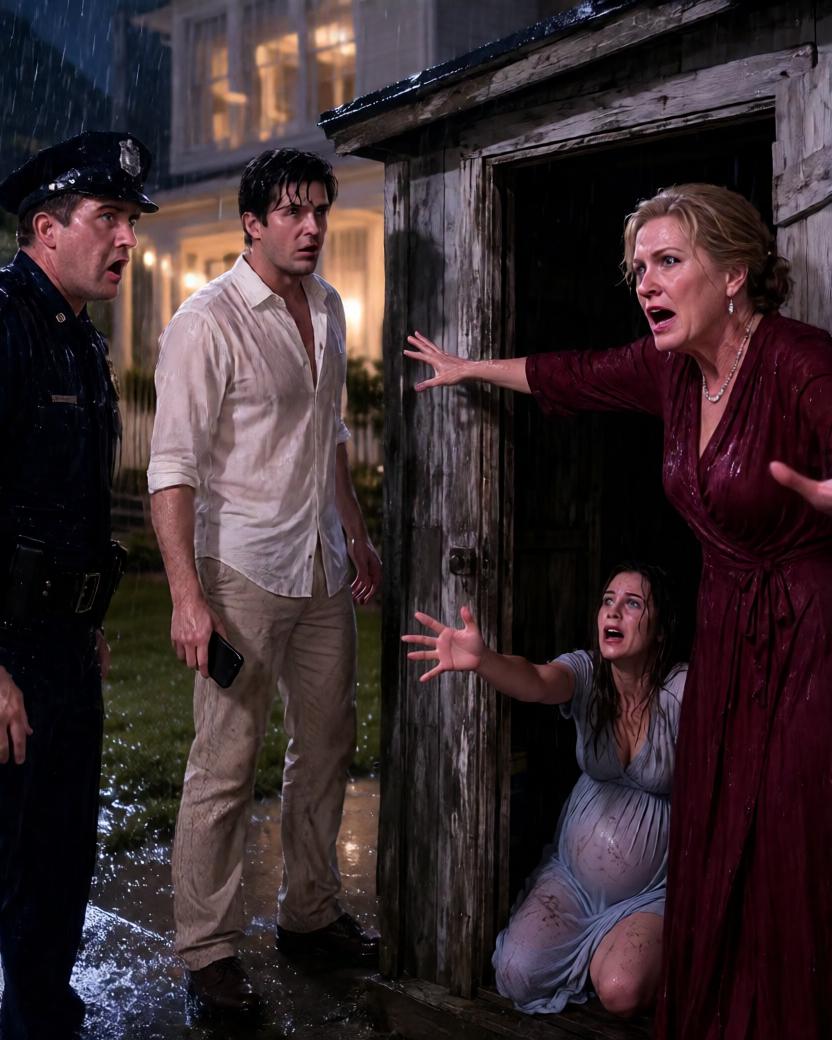
But suddenly, I remembered the old storage room in the backyard.
It was a damp, forgotten structure where we kept rusty tools, broken furniture, and old cardboard boxes.
I turned toward the back door.
The moment I reached for it, Georgia ran after me.
“Do not go near that shed!” she screamed.
I froze.
Then I looked outside.
A brand-new brass padlock hung from the storage door.
My eyes moved down to the bottom of the door.
Something blue was sticking out from underneath the heavy wooden door.
A small piece of fabric.
I knew it immediately.
It was from the maternity dress Kristin had worn the morning I left for my business trip.
My entire body went cold.
I ran outside through the rain and dropped to my knees in front of the door.
I slammed both fists against the wood.
“Kristin! It’s Elias! Can you hear me?”
For several agonizing seconds, there was nothing.
Only the rain pounding against the metal roof.
Then I heard it.
A faint scraping sound.
It sounded like fingernails weakly dragging across the wood from inside.
My blood ran cold.
I spun around.
“Give me the key!”
Georgia stood directly behind me.
She shook her head.
“I don’t have it.”
“Give me the key, Mom!”
She suddenly began talking about a spiritual cleansing.
“The shed contains things from a spiritual cleansing. The woman who performed it said nobody can touch anything for forty-nine days.”
I stared at her in disbelief.
“My pregnant wife is in there.”
Georgia continued insisting that opening the door would unleash dangerous spiritual energy.
I stopped listening.
I pulled out my phone and immediately called emergency services.
“My pregnant wife has been missing for three days,” I said, forcing the words out through my panic. “I believe she is locked inside a storage room at my house, and her life is in grave danger.”
My mother suddenly lunged for my phone.
She tried to rip it from my hand.
I pulled away.
When she failed to take it, she dropped onto her knees in the wet grass.
Then she began screaming.
“Opening that door will bring tragedy to this entire family!”
But the tragedy was already there.
It was barely breathing behind that wooden door.
And I still had no idea what we were going to find when the lock finally came off.
PART 2:
The police cruiser arrived at our driveway about fifteen minutes later.
By then, my mother’s angry screaming had turned into loud, dramatic crying.
She immediately began telling the officers that Kristin had a secret phone.
Then she claimed my wife had a hidden lover.
Then she accused Kristin of constantly inventing stories to separate me from my family.
The officers did not appear convinced.
They searched our bedroom carefully.
Within minutes, they confirmed what I had already found.
Kristin’s wallet was there.
Her medical documents were there.
Her phone was there.
Her cash and personal belongings were all still inside the house.
Then the officers went into the backyard.
They approached the storage shed.
Underneath the patio sink, one of them found a single pink sandal.
It was covered in thick mud.
The strap was broken.
I immediately recognized it.
I had bought that exact pair for Kristin because the soles were designed to prevent slipping.
Looking at the broken strap made my stomach turn.
It looked as if the sandal had been ripped from her foot while someone was dragging her across the dirt.
The senior officer turned toward my mother.
“Where is the key to the shed?”
Georgia swallowed.
“I don’t have it with me.”
“Then where is it?”
“The woman who performed the spiritual cleansing took it.”
The officer stared at her.
Georgia continued quickly.
“If you break that lock, you will unleash very dangerous energies into this house.”
The younger officer ignored her and picked up a pair of heavy bolt cutters.
My mother immediately sat down in front of the door.
“No!”
She kicked wildly at the ground.
“You want to kill the woman who gave you life!”
The officers had to physically pull her away from the door.
Then the younger officer placed the bolt cutters around the brass lock.
With one powerful squeeze—
CRACK.
The padlock snapped.
It fell onto the muddy ground with a heavy thud.
The wooden door slowly swung open.
A horrible smell rushed into the air.
Dampness.
Urine.
And dried blood.
I covered my mouth.
Then I saw her.
Kristin was curled tightly among dusty cardboard boxes.
Her light-blue dress was completely covered in dirt and filth.
Her hands were raw and bloody.
Her lips were split.
And beneath her body, a dark stain spread across the cold floor.
“Kristin!”
I dropped to my knees beside her.
“My love, please open your eyes. I’m right here. I’m here with you.”
Her skin was ice-cold.
She was barely breathing.
Then I looked around the shed.
On the dusty floor was a single hard tortilla.
An empty glass.
And a small plastic bucket.
That was all my mother and brother had given her during three terrible days of confinement.
The emergency medical team rushed Kristin to Saint Anthony Hospital in downtown Phoenix.
I spent nearly two hours pacing the hospital hallway while doctors fought to save her.
Finally, the surgeon came out.
His face was solemn.
“We managed to stabilize her,” he said carefully. “But she has suffered severe dehydration, a concussion from a heavy blow to the head, and a complete placental abruption.”
I could barely process his words.
Then came the sentence that destroyed me.
“Our baby boy did not survive the trauma.”
The hallway seemed to tilt beneath my feet.
Our son.
The baby we had already named Carson.
He had died before taking his first breath.
And I had failed to protect him from my own family.
The guilt was unbearable.
For years, I had forced Kristin to tolerate my mother’s cruelty because I was too afraid to confront Georgia.
Now my cowardice had helped create something that could never be undone.
Early the next morning, Zachary appeared in the hospital waiting area.
He did not ask how Kristin was doing.
He did not ask about his unborn nephew.
He did not even ask whether she was alive.
Instead, he looked at me angrily.
“You need to get Mom out of this legal mess right now.”
I stared at him.
“What?”
“Kristin is exaggerating everything,” he said. “It was just a quick punishment. It wasn’t kidnapping.”
Before I could throw him out of the hospital, I heard screaming from Kristin’s room.
She had awakened.
She was thrashing violently in her bed.
“Please don’t kick me again!” she screamed. “I promise I’ll cook whatever you want! Just don’t lock me in the dark!”
I ran into the room.
I grabbed her hand.
“Kristin. It’s me.”
She looked at my face.
For a moment, she seemed confused.
Then she recognized me.
She grabbed my shirt and began sobbing uncontrollably.
Between broken breaths, she finally told me everything.
Zachary had slapped her across the face because she was too sick to cook.
Then Georgia grabbed her by the hair.
Kristin tried to protect her pregnant stomach.
But Zachary kicked her hard enough to knock her to the ground.
Then the two of them dragged her outside.
They took her to the dark storage shed.
They locked her inside.
But the worst part had not even been revealed yet.
Zachary had returned to the backyard twice during those three days.
He had heard Kristin screaming.
He had heard her begging for help.
He knew exactly where she was.
And both times, he simply walked away.
I needed proof.
Not just because I wanted justice.
I needed proof because I knew they would lie.
I left Kristin under the care of a dedicated nurse and drove to Mrs. Moffitt’s corner store.
Her security camera pointed directly toward the only exit from our residential street.
The high-definition footage showed something extremely important.
Kristin had never left our house that Tuesday.
Not once.
From there, I returned home and went straight into Zachary’s bedroom.
His computer was still running.
His main messaging app was open on the screen.
I began reading.
There were weeks of conversations between Zachary and my mother.
They had been discussing ways to force Kristin out of the house.
They wanted complete control over my monthly salary.
They wanted the house.
They wanted Kristin gone.
Then I found the final message.
It had been sent while my wife was trapped inside that shed.
It said:
“Leave her in there until she learns her place, and if she loses that baby, it will be even better for everyone involved.”
PART 3:
I immediately copied every message.
I saved the security footage from Mrs. Moffitt’s store onto several USB drives.
I took clear screenshots of everything.
Then I drove back toward the hospital.
But I felt different now.
My mind was clearer than it had ever been.
This was no longer a simple family argument.
This was a calculated plan to destroy my wife through violence.
Just before I reached the hospital entrance, my phone rang.
It was Zachary.
I answered.
“Mom is extremely sick because of all the stress you’re causing her,” he said coldly. “Withdraw the police complaint immediately and send us money for her medical care, or I’ll post online that you’re a terrible son who is trying to imprison an elderly woman.”
I quietly pressed the recording button.
Then I asked the question that had been burning inside me.
“What about Kristin?”
He said nothing.
“What about the unborn baby that you two murdered?”
He scoffed.
“Don’t start with that dramatic nonsense. She was being completely stubborn. Besides, a pregnancy can easily be replaced, but a mother cannot.”
My hands tightened around the phone.
I told him exactly what I had.
“I have the neighborhood security footage. I have the complete chat logs. And I have Kristin’s sworn testimony.”
There was silence.
I could hear his breathing becoming harsh and uneven.
Then he hung up.
The next morning, I took everything to the Maricopa County Prosecutor’s Office.
The investigators carefully compared the evidence.
They matched the timestamps from the messages with the street security footage.
They compared them with Kristin’s medical report.
They examined the drag marks in the yard.
They reviewed my mother’s original statement.
Every lie began collapsing under the weight of physical evidence.
Georgia had claimed Kristin had left the property on the back of a motorcycle.
The security footage proved the main gate had remained locked the entire day.
Then she claimed the storage shed had not been opened for months.
But the lock was brand new.
Investigators even found the store receipt for the padlock inside Zachary’s coat pocket.
Then Georgia swore under oath that she had no idea Kristin was inside.
But the investigators had her own words.
In the chat with Zachary, she had written:
“Do not give her any water yet, and let her learn who really runs this house.”
The prosecutor’s office issued immediate arrest warrants for both of them.
My mother and brother had fled to an aunt’s house in the nearby town of Mesa.
When the police tactical team arrived, the two of them immediately turned against each other.
Zachary shouted that Georgia was the one who had locked the padlock.
My mother cried that Zachary had forbidden her from opening it because he was afraid I would notice the forced entry.
They blamed each other.
They screamed at each other.
But neither of them could escape what they had done.
Both were handcuffed and taken into custody.
News of the arrest spread quickly through our neighborhood.
For years, my mother had proudly told everyone that we were a respectable, loving family.
Now people began speaking.
Neighbors who had heard years of verbal abuse finally felt safe enough to contact the authorities.
One neighbor remembered hearing frantic banging from our house on Tuesday afternoon.
Another said he had heard a woman crying for help during the night.
But because the storm had been so loud, he assumed the sound was coming from another street.
Still, not every relative supported me.
Several family members called again and again.
“A person only gets one mother in this life,” they told me.
“Family problems should stay inside the family.”
One uncle went even further.
“A real man would have broken the lock quietly,” he told me. “He would have taken his wife to a private clinic and created a fake story to protect the family’s reputation.”
I listened quietly.
Then I gave him my answer.
“The family name did not bleed out on that cold storage floor,” I said. “But my wife did.”
After that, they knew I would not back down.
So they attacked us publicly.
They posted old pictures of my mother online.
They called me an ungrateful son.
They claimed I was trying to steal her home because my ambitious wife had manipulated me.
Then they created an even crueler rumor.
They claimed Kristin’s pregnancy had already been failing before the incident.
They said she had intentionally caused the miscarriage out of spite.
For several painful hours, hundreds of strangers believed them.
People online called me a heartless monster.
But the truth was already backed by evidence.
The Prosecutor’s Office authorized a formal public statement about the criminal case.
The statement explained the verified emergency rescue, Kristin’s documented physical injuries, the felony unlawful confinement, and the extensive digital evidence recovered from the suspects’ devices.
Saint Anthony Hospital also released a medical summary confirming that the placental abruption was directly caused by severe physical trauma and prolonged medical neglect.
Mrs. Moffitt voluntarily provided a signed statement confirming that Kristin had never left the property.
The lies collapsed almost overnight.
But while the legal battle continued outside the hospital, Kristin was fighting a completely different battle inside.
She spent nearly a month receiving intensive treatment.
Whenever she woke during the night, she curled into a tiny ball and begged the nurses not to turn off the lights.
Whenever she heard the heavy metallic sound of a door locking somewhere in the hallway, she immediately began hyperventilating.
Even the smell of food could trigger her.
One afternoon, a food service worker brought a hot bowl of beef broth into the room.
The smell instantly sent Kristin into a panic attack.
Her parents drove down from their small farm near Flagstaff.
I deliberately did not tell them about Carson’s death while they were driving because I could not bear the thought of them trying to process that kind of heartbreak behind the wheel.
When they finally entered Kristin’s room and saw their daughter lying there broken and injured, her mother collapsed onto the floor crying.
Her father was a hardened man who had never cried in his life.
Even he had to lean against the wall to keep himself standing.
I took them into the waiting room.
Then I told them everything.
I did not hide my own failures.
When I finished, I dropped to my knees in front of them.
“I wasn’t the person who physically attacked her,” I said through tears. “But for years, I left her completely unprotected from emotional abuse. I kept begging her to tolerate the mistreatment because I was too afraid to confront my own mother. My cowardice prepared that storage shed long before Georgia ever bought the lock.”
Kristin’s father stood up.
Then he slapped me hard across the face.
I did not move.
I did not try to stop him.
“My daughter asked you to build a loving home with her,” he said, his voice shaking. “She didn’t ask you to give her a life sentence of total submission. If you ever choose your own comfort over her physical safety again, I will make sure you never see her face again.”
I nodded.
“You’re absolutely right. I’m not asking for your forgiveness today. I’m only begging for the chance to prove through my future actions that I have finally learned my lesson.”
Kristin had heard everything through the open door of her hospital room.
A few days later, when we were finally alone, she motioned for me to sit beside her bed.
She reached for my hand.
“When I was trapped inside that pitch-black room,” she whispered, “it wasn’t the hunger or the thirst that terrified me the most.”
I looked at her.
She continued.
“I was terrified that you would come home, find me in there, and ask me to forgive your mother because you didn’t want to destroy the family.”
I lowered my head.
Because I knew she was right.
That really could have happened during the early years of our marriage.
“I will never ask you to sacrifice your safety or dignity again,” I promised. “Our family was destroyed the moment they decided to treat you like property. Filing those police charges was the first real step I took to protect whatever was left of us.”
Kristin quietly cried into her pillow.
Later that evening, she told me something she had been too traumatized to reveal during the first police interview.
While she had been lying on the cold dirt inside the shed, bleeding heavily and begging through the door for water, my mother had answered her from the patio.
“If that baby is lost, Elias can easily have another child with a woman who actually knows how to obey her elders.”
Zachary had laughed.
Then he walked back into the air-conditioned house.
When I heard that, something inside me finally broke.
Every remaining emotional connection I had to my biological family disappeared.
The criminal investigation continued for seven long months.
Forensic experts recovered deleted messages.
They analyzed Zachary’s laptop search history.
They discovered explicit searches about how long a human body could survive without drinking water.
They also found recorded voice notes.
In them, Zachary complained that my marriage had caused me to contribute less money toward his personal expenses.
My mother responded in one recording that Kristin was trying to steal the property.
But the deed had been solely in my name long before I had even met Kristin.
That was the real reason behind everything.
It had never truly been about the food.
It had never been about respecting my mother.
It had never been about pregnancy.
Kristin represented a threat to the easy life they had built.
I had been financing my brother’s lifestyle while blindly obeying my mother.
And they were terrified of losing that control.
PART 4:
The day of the final sentencing trial arrived beneath a sky filled with heavy gray clouds over Phoenix.
Kristin walked into the courtroom holding my hand tightly.
She wore a simple black blouse and a delicate silver necklace.
Attached to it was a small charm bearing the name of our lost son.
Carson.
The moment my mother saw us, she began crying hysterically.
“My dearest son!” she cried from behind the defense table. “I made a terrible mistake! Please save me from this place. Don’t let them destroy your younger brother’s bright future!”
I looked at her.
For years, I had been afraid of disappointing that woman.
Now I could barely recognize the person I had once tried so desperately to please.
Zachary refused to look at anyone.
He was no longer the arrogant young man who demanded money and screamed at my wife.
Now he was a terrified prisoner trembling uncontrollably as the prosecutor described what had happened.
The physical assault.
The dragging across the yard.
The brand-new padlock.
The seventy horrifying hours of confinement.
The defense attorney stood and asked for maximum leniency for my mother.
He pointed to her advanced age.
He mentioned her lack of a previous criminal record.
Then he repeatedly described everything as an unfortunate domestic dispute between a mother-in-law and daughter-in-law that had simply gone too far.
The judge looked directly at me.
“Do you wish to make a statement regarding a possible reduction in their sentences?”
I stood.
The courtroom became completely silent.
“I am Georgia’s biological son,” I began. “And I am Zachary’s older brother.”
I paused.
“But I am also the victim’s husband. And I am the father of a child who died before taking his first breath.”
I looked toward the judge.
“For far too many years, I confused basic respect for a parent with complete submission. If I stand here today and ask for leniency, I would be sending my wife a terrible message—that her life and safety are worth less than my family’s reputation.”
I took a breath.
“We are not asking for vengeance. We are asking for complete legal justice.”
My mother began screaming.
She slammed her fists against the wooden railing.
“You ungrateful monster!”
Zachary began openly sobbing.
He turned toward Kristin.
“Please forgive me.”
For the first time since that terrible night, Kristin looked directly at him.
Her voice was calm.
“You didn’t lose your future today in this courtroom.”
Zachary stared at her.
“You threw your future away the moment you heard me begging for a glass of water through that wooden door and chose to laugh at my pain.”
The court found both defendants guilty on all counts.
They were convicted of felony unlawful imprisonment, aggravated domestic battery, and severe personal injuries resulting in the termination of a pregnancy.
Georgia received a mandatory six-year sentence in state prison.
Zachary received eight years without the possibility of immediate parole because he had directly participated in the assault and actively maintained Kristin’s confinement.
When the bailiffs led them away in handcuffs, I felt no happiness.
There was no victory inside me.
Justice could never bring Carson back.
But for the first time in her life, Kristin walked out of that building without lowering her head for anyone.
I immediately put our Sun Valley house on the market.
We sold it shortly afterward.
A small portion of the money was placed under my aunt’s legal supervision so my mother could have her basic commissary needs covered during her prison sentence.
But I made one decision for myself.
I would never visit her again.
Doing what was morally necessary did not mean allowing toxic people back into our lives.
Kristin and I moved to a quiet residential area near her parents’ farm in Flagstaff.
She began weekly therapy sessions to deal with everything she had survived.
Several months later, she achieved a dream she had carried for years.
She opened a small local preschool.
During the first few months in our new home, she could not stand being in a room with the door completely closed.
So she worked on it slowly.
Five minutes.
Then ten.
Then longer.
Until one day, she realized she was no longer counting the minutes.
I also began intensive therapy.
I had to face the truth about myself.
I realized that I had used the word “peace” as a weapon.
I called it peace when what I really meant was silence.
I had demanded silence from the most vulnerable person in my life because it was easier than confronting the people who were hurting her.
I had never asked my brother to be patient when he insulted me.
I had never demanded understanding from my mother when she crossed my boundaries.
But I had demanded endless patience from Kristin.
Why?
Because I knew her gentle nature would stop her from screaming back at me.
Three years later, on a bright spring morning, our beautiful daughter Lisa was born.
When the delivery-room nurse placed our healthy baby girl into my arms, Kristin burst into tears of pure relief.
For a brief moment, my mind returned to Carson.
The damp storage shed.
The wooden door.
The sound of the bolt cutters snapping the brass lock.
And every moment when I could have established firm boundaries years earlier.
Lisa grew up in a bright home filled with love and laughter.
There were no toxic demands disguised as family affection.
There were no fake portraits pretending everything was perfect.
Instead, there were open doors.
Doors nobody ever felt afraid to close.
Doors nobody ever had to lock because they were terrified of someone on the other side.
Sometimes people who hear parts of our story ask me the same question.
“Do you regret sending your own mother and brother to prison?”
My answer has never changed.
I deeply regret not defending my wife sooner.
I regret every time I told her to be patient.
I regret every time I chose my mother’s feelings over Kristin’s dignity.
But I have never regretted calling emergency services that rainy evening.
Biological blood may make someone a relative.
But genuine respect, unconditional protection, and true love are what make someone family.
Patience will never save a home when it exists only to make an abuser feel untouchable.
Silence does not prevent a public scandal.
It only delays the explosion until an innocent person gets badly hurt.
And no debt of childhood gratitude can ever force someone to sacrifice their spouse or children on the altar of family pride.
That rainy Thursday afternoon, we physically broke a brass padlock off a dark storage shed.
But the much harder thing to break was the belief that a mother has the right to cause endless harm simply because she gave birth to you.
No person has the right to destroy your life just because they helped create your past.
I made a conscious decision to make sure my daughter understood that truth throughout her entire life.
If Lisa ever asks me about her paternal grandmother when she is older, I will tell her the truth.
I will not fill the story with hatred.
I will not exaggerate anything.
I will tell her that her grandmother was once a woman I loved very deeply.
But she eventually crossed a line of cruelty that could never be forgiven or ignored.
I will teach Lisa that loving someone does not mean protecting them from the natural consequences of their own destructive choices.
A dignified family is not one that hides its darkest wounds beneath a rug just to keep the neighbors from gossiping.
A real family is one that stops the hand that strikes.
It breaks open the door that traps an innocent person.
And it stands firmly beside the person who needs protection, without making excuses.
Sometimes I still ask myself the question.
Did I do wrong by allowing my mother and brother to go to prison?
For many sleepless nights, that question kept me awake.
But today, when I sit back and watch Kristin laughing with our daughter beneath the bright morning sunlight, I know the answer.
The correct answer was waiting behind that storage door all along.
I finally understood that protecting the people you love sometimes means standing against the people who share your blood.
And sometimes, the bravest thing a person can do is stop calling silence “peace.”
THE END.
