
PART 1:
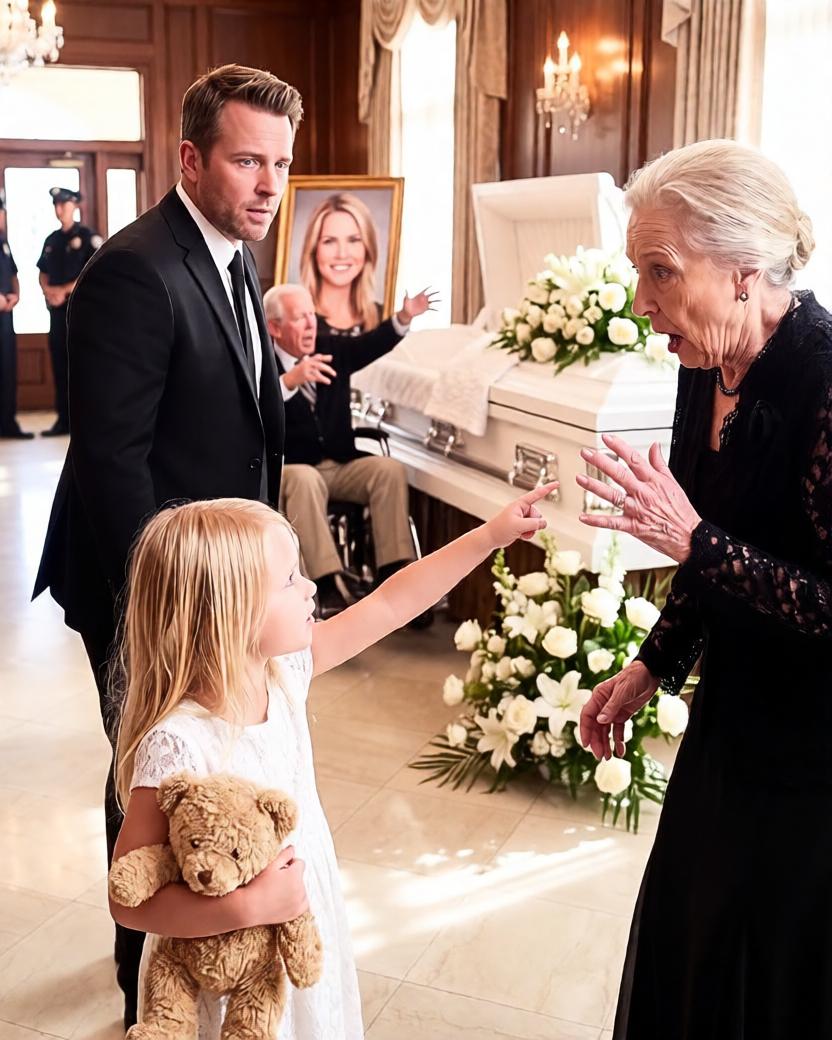
“My grandmother is lying! My mom didn’t die because she wanted to!”
My six-year-old daughter screamed those words in front of her mother’s coffin, and the entire room went silent.
It was the kind of silence that made it feel as if even the air had stopped moving.
I had just returned to Cedar Falls, Iowa, after spending three days completely unreachable during a high-security operation for the armored transport company where I worked.
In my backpack, I carried two things I had been looking forward to giving my family.
A green scarf for my wife, Rachel.
And a new doll for our daughter, Emma.
During the entire drive home, I imagined them waiting for me at the front door. I pictured Rachel wearing that tired little smile of hers.
But now, looking back, I realized that smile had been hiding more than I wanted to admit.
I had no idea what I was about to find.
Instead of my wife running into my arms, I saw funeral wreaths.
Folding chairs stood beneath a white canopy.
A black ribbon was tied around the front gate.
Then I saw the poster beside the entrance.
It carried my wife’s name.
My heart stopped.
My mother, Lorraine, came rushing outside. Her eyes were swollen from crying, and she wrapped her arms around me so tightly that something immediately felt wrong.
“You’re too late, David,” she whispered. “Rachel took her own life almost three days ago.”
For a moment, I couldn’t understand the words.
Then the meaning hit me.
The ground seemed to disappear beneath my feet.
“What?”
Lorraine pulled back and looked at me.
“Why didn’t anyone tell me?” I demanded.
“Your phone couldn’t be reached,” she replied, quickly looking away. “Your boss, Mr. Whitaker, said you were on a special assignment. He told everyone that nobody was allowed to interrupt you.”
I didn’t listen to anything else.
I rushed inside.
Rachel’s coffin stood in the middle of the living room, surrounded by candles, white flowers, and relatives.
The moment they saw me, several of them suddenly became very interested in staring at the floor.
My aunt Beverly, my mother’s sister, stood near the coffin.
She owned a funeral home in nearby Waverly, and she had already taken control of everything.
She kept insisting that we needed to leave for the cemetery before sunset.
“David, we shouldn’t drag this out,” she said softly. “Rachel had been depressed for months. We need to let her rest and protect her memory.”
I stared at her.
“Protect it from what?”
Nobody answered.
Then I noticed my father.
Arthur sat in his wheelchair beside the staircase.
Since his stroke, he could barely move the right side of his body. Speaking was also extremely difficult for him.
But his eyes were still sharp.
And they were furious.
The second he saw me, he struck the armrest three times with his left hand.
Bang.
Bang.
Bang.
Then he pointed upstairs.
Toward the second floor.
Toward my bedroom.
Toward Emma’s room.
My mother suddenly dropped to her knees beside the coffin and began sobbing even louder.
“Rachel, sweetheart, why did you do this to us?” she cried. “Everyone in this house loved you!”
That was when Emma pulled away from her maternal grandmother.
She pointed directly at Lorraine.
“That’s not true!” Emma screamed. “Uncle Brandon broke the door! He hurt Mommy! Grandma took her phone and locked us in!”
My thirty-five-year-old younger brother, Brandon, stood near the kitchen entrance.
His face suddenly went completely white.
Lorraine froze.
Then she stammered, “She’s confused. She’s traumatized. She doesn’t know what she’s saying.”
I dropped to my knees in front of my daughter.
“Emma, look at me.”
Her eyes filled with tears.
“Tell me what you saw.”
She immediately wrapped her little arms around my neck.
Her whole body was shaking.
“Mommy kept yelling your name,” she whispered. “Uncle Brandon wouldn’t let her leave. Then Grandma locked the door from the outside. Mommy cried all night.”
I slowly looked toward my father.
He slammed his hand against the wheelchair again.
This time, he pointed underneath the cushion.
Aunt Beverly immediately raised her voice.
“David, don’t create a scene. We bury your wife first. Then we can talk about family problems.”
I didn’t answer her.
Instead, I grabbed a cousin’s phone.
Then I dialed 911.
My mother lunged toward me.
“Give me that!”
She tried to take the phone from my hand.
“Family matters stay inside the family!” she screamed.
I stared at her.
For the first time in my life, I looked at my mother and felt like I was looking at a stranger.
“A suspicious death is not a family matter,” I said.
Nobody spoke.
Then, in the distance, I heard sirens.
They were getting closer.
Beverly suddenly stepped backward toward the hallway.
She pulled out her phone and began typing a message.
I watched her carefully.
She noticed me looking.
She quickly turned the screen away.
But I had already seen four words.
He’s starting to suspect.
My stomach tightened.
Before I could say anything, the police arrived.
As officers entered the house, I saw Brandon trying to slip toward the back staircase.
I stepped directly into his path.
“Nobody goes upstairs,” I said. “Nobody touches anything.”
Brandon lowered his head.
That was when I noticed something on his face.
A deep red handprint stretched across his left cheek.
It was fresh.
Sharp.
The kind of mark someone leaves when they slap another person with every bit of strength they have left.
I stared at it.
And suddenly, one terrible thought entered my mind.
Someone had been fighting in my house.
And I still had no idea what the police were about to find inside my bedroom.
The funeral procession never made it to the end of the street.
Police stopped everything.
They sealed the house and treated the entire second floor as a possible crime scene.
Forensic technicians began examining every inch of the upstairs area.
They found screws ripped from the bedroom doorframe.
Splintered wood behind the nightstand.
Broken glass beneath the vanity.
And deep damage around the lock.
Someone had tried to clean the room.
But they had done it too quickly.
And far too badly.
Then investigators spoke privately with Emma.
A child forensic psychologist asked her questions without anyone from the family being present.
I waited outside, terrified of what my daughter might say.
When the interview ended, the psychologist told the investigators that Emma had repeated the same story without anyone feeding her answers.
Uncle Brandon had forced his way inside.
Mommy had screamed.
Grandma had taken the phone.
And then the bedroom door had been locked from the outside.
My mother continued denying everything.
“Rachel wasn’t well,” Lorraine insisted. “She was taking medication. Emma probably mixed up a nightmare with what really happened.”
But the first forensic findings destroyed that explanation.
Rachel had defensive injuries.
The injuries were not consistent with a woman quietly choosing to end her own life.
My father then asked for his communication board.
It took him nearly an hour to form the words with his trembling left hand.
One word at a time.
BRANDON.
DOOR.
SCREAMS.
LORRAINE.
PHONE.
BEVERLY.
BLACK BAG.
Then he pointed beneath his wheelchair cushion again.
A technician carefully reached underneath.
His hand came back holding a small SD card.
It had been taped to the metal frame beneath the cushion.
My father had hidden it there.
The investigators inserted it into a computer.
What they found changed everything.
There were photographs of Brandon trying to open the safe in my home office.
There were recordings of him arguing with a lender.
And then there was a voice message from a man.
A man who said:
“Get the black notebook and the access card before David gets back. If Rachel knows anything, take her phone.”
I recognized the voice immediately.
My blood ran cold.
It belonged to my boss.
Gordon Whitaker.
The black notebook contained routes, schedules, and security codes connected to a shipment worth more than twelve million dollars.
The access card gave someone master entry into the company’s tracking system.
Whitaker had ordered me to keep both items inside my home safe during the three-day assignment.
Suddenly, the reason behind everything became much clearer.
Brandon owed almost twenty-five thousand dollars in online gambling debts.
A private lender known as Preacher had offered to erase that debt if Brandon stole the credentials.
And my mother had already gone far beyond helping him.
She had pawned jewelry.
She had taken money meant for my father’s medication.
And she had even pledged part of the family home as collateral to keep Brandon out of trouble.
Rachel discovered everything.
She photographed messages.
She recorded arguments.
And secretly rented a small house near the elementary school where she worked.
She had planned to leave.
She planned to take Emma with her.
But she also planned to take my father.
Because he was the only person in that house who consistently believed her.
Then Rachel’s friend Megan arrived at the district attorney’s office.
She was carrying an envelope Rachel had given her two days earlier.
Inside were a lease agreement.
Copies of messages.
And a letter addressed to me.
I opened it with trembling hands.
It said:
“David, I don’t want to destroy your family. I want to get our daughter and your father out of a house where we are no longer safe. Last night I told you I was afraid. You asked me to wait. I hope you get home before they find out what I know.”
The guilt hit me so hard I could barely breathe.
I remembered our last phone call.
Rachel had told me the same thing.
“I’m afraid.”
And what had I done?
I had told her she was overreacting.
I had told her to talk to my mother.
I had told her to wait until I got home.
I had believed I was giving her advice.
I didn’t know I was sending her back into danger.
Then the lead detective received a call from the lab.
Investigators had recovered audio from a small recorder hidden behind the bathroom mirror.
The final voice recorded on it was not Brandon’s.
It was Lorraine’s.
“If you report my son, I’ll say you provoked him,” she said. “People believe family first.”
Then came a sound.
A door locking from the outside.
After that, Rachel’s voice.
She was begging for medical help.
The detective stopped the recording.
He looked directly at me.
“Mr. Miller,” he said quietly, “this did not end with your brother. Someone began covering this up that same night and tried to bury your wife before you got back.”
Then an officer rushed into the room.
“Aunt Beverly fled,” he reported. “She took one of the funeral home vans. We believe she has two black bags taken from the bedroom.”
My heart sank.
The detective turned toward the other officers.
“Find that van.”
Whatever was inside those bags, I realized, could destroy every lie my family had built.
And the truth was only beginning to come out.
PART 2:
Police found Beverly’s van behind her funeral home, parked beside the crematory building.
When I arrived with the detectives, the scene looked unreal.
Two black bags had been opened on the ground.
Inside and around them were burned pieces of fabric.
Metal fasteners from clothing.
A broken silver necklace.
And several hinge screws.
The screws were identical to the ones investigators had found missing from the bedroom door.
Beverly had tried to destroy the evidence.
But she had not been careful enough.
Security footage showed her arriving shortly after four in the morning.
Brandon was standing near the entrance, watching the parking lot like a trapped animal.
One of Beverly’s employees eventually broke down and confessed.
He told police that Beverly had ordered him to burn Rachel’s torn clothes.
She had also ordered him to burn the bedsheets.
And the shirt Brandon had been wearing that night.
But that wasn’t all.
Beverly had erased surveillance footage.
She had contacted a cemetery employee and told him to prepare a grave before all the required documents were complete.
She had also rushed the funeral arrangements using altered paperwork.
They had been trying to bury Rachel before I could come home and ask questions.
But they had not destroyed everything.
The recorder Rachel had hidden behind the bathroom mirror had preserved the timeline of her final hours.
That recording finally revealed what had happened that night.
Brandon had gone upstairs drunk.
He was carrying a duplicate key and lock-picking tools.
His first goal was my home office.
He wanted to steal the black notebook and the access card.
Rachel caught him before he could get into the safe.
She knew exactly what he was trying to do.
She also knew she was in danger.
Brandon tried to take her phone because she had already photographed messages between him and the lender.
Rachel refused to give it to him.
Then she locked herself inside the bedroom with Emma.
Brandon began kicking the door.
Again.
And again.
Until the doorframe finally broke.
Emma was awake.
She saw everything.
My wife immediately put herself between our daughter and my brother.
Rachel told Brandon that he could still stop.
He could hand over the card.
He could report Whitaker.
He could save himself before he destroyed his entire life.
But Brandon was buried under debt and rage.
He attacked her.
The worst details were preserved in the court file.
I refused to let them appear in the newspapers.
Rachel had already suffered enough.
I would not allow her dignity to become entertainment just so strangers could feel that the case was more dramatic.
During the struggle, Brandon destroyed Rachel’s phone.
But Rachel managed to turn on an old backup phone.
Then my mother entered the room.
She saw the broken door.
She saw Rachel’s torn clothes.
She saw Emma crying in the corner.
And she saw Rachel injured.
At that moment, Lorraine understood exactly what had happened.
Rachel begged her.
“Please, call an ambulance.”
My mother had a choice.
She could have saved Rachel.
Instead, she chose Brandon.
She grabbed the phone.
Turned it off.
And told Rachel that the situation would be handled “without bringing the police into it.”
Rachel refused to stay quiet.
She shouted that she would report Brandon.
Lorraine threatened her.
She told Rachel that she would claim Rachel had caused the entire incident.
Then Lorraine and Brandon locked the bedroom door from the outside.
My wife was trapped inside with our daughter.
Injured.
Without a phone.
Unable to call for help.
The windows had security bars.
I had personally installed those bars years earlier because I believed they would keep Emma safe.
That night, they became a cage.
Rachel knew she might not survive.
So she wrote down what had happened in a notebook.
She hid the recorder.
Then she tried to send a message from an old tablet.
The tablet had no cellular service, but Rachel tried anyway.
Investigators later recovered the unsent draft.
It said:
“David, help us. Brandon got in. Your mother took my phone. I can’t get out.”
The message never went anywhere.
Before dawn, Rachel died.
She died because of the violence.
Because she had been trapped.
And because the people around her deliberately refused to get her medical help.
It was not the quiet death caused by depression that my family had invented.
It was a chain of cowardly choices.
One cruel decision after another.
At 5:30 in the morning, Lorraine finally opened the bedroom door.
But she still didn’t call 911.
She called Beverly instead.
“Is she still breathing?” Beverly asked.
“No,” Lorraine answered.
There was a pause.
Then Beverly said, “Then close the room. I’m coming.”
Beverly arrived before six.
And she turned Rachel’s bedroom into a lie.
She placed prescription sedatives on the nightstand.
She fabricated a promissory note claiming Rachel owed forty thousand dollars.
Then she forced Brandon to imitate Rachel’s signature.
They already had their story.
Rachel had supposedly been deeply in debt.
She had supposedly become depressed because her husband was always working away from home.
And she had supposedly made an irreversible choice.
My mother called Rachel’s parents.
She told them there was nothing an ambulance could have done.
Then she used Rachel’s phone to answer Megan’s messages.
She pretended everything was under control.
She kept doing it until the funeral.
But there was another person involved.
Gordon Whitaker.
When Lorraine told him Rachel was dead, he didn’t ask how it happened.
He didn’t sound shocked.
He didn’t even ask whether Emma was safe.
He asked only one question.
“Did Brandon get the notebook and the access card?”
Then Whitaker ordered company staff not to tell me anything while I was still on the operation.
A dispatcher had actually received a call reporting an emergency at my address.
He could have contacted me.
He wanted to.
But Whitaker threatened to fire him if he did.
While my yard was filling with funeral flowers, Whitaker was doing something much worse.
He was using my credentials to enter the company’s tracking system.
He altered routes.
Changed schedules.
And prepared an armed theft of the shipment worth more than twelve million dollars.
His plan was simple.
He would make me look like the inside source.
Brandon would be the desperate thief.
Preacher would be the buyer.
And I would become the grieving employee who had supposedly sold confidential information after his wife died.
The SD card my father had hidden beneath his wheelchair destroyed that entire plan.
That same night, state police raided a warehouse outside Waterloo.
They found the black notebook.
The access card.
Weapons.
Fake license plates.
And a signed document proving that my mother had used the family home as collateral for Brandon’s gambling debt.
Preacher realized the entire operation was collapsing.
Feeling betrayed by Whitaker, he decided to cooperate.
He handed investigators recordings, dates, and meeting locations.
Whitaker was arrested at a roadside motel outside Marshalltown.
Investigators found route maps.
Cash.
Forged internal orders.
And copies of my signature.
Whitaker tried to deny knowing Brandon.
But there was nowhere left to hide.
Toll-camera footage connected them.
Cell tower data placed them together.
Recovered messages showed exactly what they had been planning.
Once they were cornered, everyone began blaming everyone else.
Brandon claimed Lorraine had promised he would never go to prison.
Lorraine claimed Beverly had shown her how to clean the bedroom.
Beverly said she had only been trying to prevent “public humiliation.”
Whitaker claimed Brandon had acted alone.
Preacher insisted he had only been collecting a debt.
Not one of them spoke about Rachel as a person.
To them, she had been a problem.
A witness.
A woman who didn’t share their last name.
Someone they could sacrifice so that “the family” could continue looking respectable.
Then my father insisted on giving a formal statement.
Using his communication board, he explained something I had never known.
Months earlier, he had seen Brandon watching Rachel.
Following her through the hallways.
Stealing a spare key.
Standing too close whenever he believed nobody was looking.
My father had also heard Rachel asking Lorraine for help weeks before she died.
He had tried to warn me.
But Lorraine had hidden his communication board.
She told everyone that his stroke had left him confused.
When I heard that, I broke down.
I looked at my father.
“Why didn’t you try harder?”
It took him almost twenty minutes to form his reply.
Then he finally showed me the words.
I WAS AFRAID OF BREAKING THE FAMILY. I WANTED TO PROTECT MY YOUNGER SON. MY SILENCE PROTECTED THE MONSTER.
I stared at him.
I wanted to tell him that none of it was his fault.
But I couldn’t.
There were different levels of guilt.
He had not attacked Rachel.
He had not locked her in that room.
He had not taken her phone.
But his silence had helped build that prison too.
Before the trial began, I visited my mother in jail.
I had spent days wondering what she would say when she finally saw me.
I thought maybe she would apologize.
Maybe she would finally admit what she had done.
Instead, the first words out of her mouth were:
“You have to help your brother, David. Rachel is already gone. Sending Brandon to prison isn’t going to bring her back.”
I slowly stood.
I looked at her through the glass.
“You still believe he was the only person worth saving.”
“He’s your blood!” she cried.
I shook my head.
“Rachel was someone’s daughter too. She was my wife. She was the mother of your granddaughter. She begged you to get her a doctor, and you took away her phone.”
Lorraine began sobbing.
But even then, I knew those tears weren’t for Rachel.
They were for Brandon.
“I loved her like a daughter,” she whispered.
“No,” I said.
My voice was quiet, but I meant every word.
“You do not lock a daughter inside a room to protect the man who destroyed her.”
Six months later, the trials ended.
Brandon received the maximum sentence allowed under the charges for assault, aggravated manslaughter, theft, unlawful entry, and destruction of evidence.
Lorraine was convicted of unlawful confinement, failure to render aid, threats, and obstruction.
Beverly lost her funeral business.
She was convicted of tampering with a crime scene, falsifying documents, destroying evidence, and illegally manipulating funeral procedures.
Whitaker and Preacher received long sentences for extortion, corporate theft, conspiracy, and planning an armed robbery.
Justice had finally come.
But justice did not bring Rachel back.
It did not erase Emma’s nightmares either.
My company cleared me of deliberately selling route information.
But I still accepted responsibility for bringing sensitive credentials into my home.
I had obeyed a fraudulent order without questioning it.
I had ignored warning signs.
So I resigned.
Being innocent of the crime did not mean I was innocent of ignoring the things that should have made me suspicious.
Emma, my father, and I moved into the small house Rachel had rented near the elementary school.
It had three bedrooms.
A small backyard.
And a flowering dogwood beside the front steps.
It was the place Rachel had imagined as a new beginning.
Now it would have to become ours.
Emma began therapy.
For months, every closing door frightened her.
So whenever I needed to close a door, I would tell her:
“Em, Daddy is going to close the door now. You can open it whenever you want.”
Little by little, she began to feel safe again.
Eventually, she stopped sleeping with her shoes on.
Then, one afternoon, she drew a picture.
It showed three people standing together in a field of sunflowers.
The woman in the picture wore a green scarf.
I looked at it carefully.
“Who’s that?” I asked.
Emma smiled sadly.
“That’s Mommy.”
I swallowed hard.
“She’s somewhere nobody can lock her in.”
I had to walk outside into the backyard so Emma wouldn’t see me fall apart.
My father continued physical and speech therapy.
For months, he struggled to speak.
Then one day, he managed his first full sentence.
It was my wife’s name.
“Rachel…”
He paused.
Then whispered:
“Forgive me.”
On the anniversary of Rachel’s death, we went to the cemetery.
Emma carried a letter with both hands.
She placed it carefully against her mother’s headstone.
“Mommy, we live in the new house now. Grandpa lives with us, and Daddy comes home early every day.”
I reached into my backpack.
Inside was the green scarf I had bought for Rachel before I left for my assignment.
The scarf I had never gotten the chance to give her.
I placed it beside the flowers.
Then I touched the headstone.
“I’m home now, Rachel,” I whispered.
My voice broke.
“But I came home when you couldn’t wait for me anymore.”
For years, I had believed that being a good husband meant working hard.
Providing money.
Solving problems from far away.
I thought if I kept my family financially safe, I was doing my job.
But Rachel didn’t only need a provider.
She needed a husband who believed her when she said she was afraid.
I should have listened.
I should have come home.
And I should have understood that some dangers cannot be solved from a distance.
Blood does not make abuse a private family matter.
Protecting an abuser is not love.
It teaches them that they can destroy someone and still expect the family to protect them.
And a house does not become a home just because everyone inside shares a last name.
It becomes a home when nobody has to beg to be believed.
The end.
