
PART 1:
I woke up to the sharp smell of disinfectant and a deep, aching pressure beneath my ribs.
I was missing a kidney.
My mouth was painfully dry, my arms felt far too heavy to lift, and the monitor beside my bed kept making small, steady sounds. The calm beeping seemed completely wrong for what had just happened to my body.
Then I heard something hit the floor.
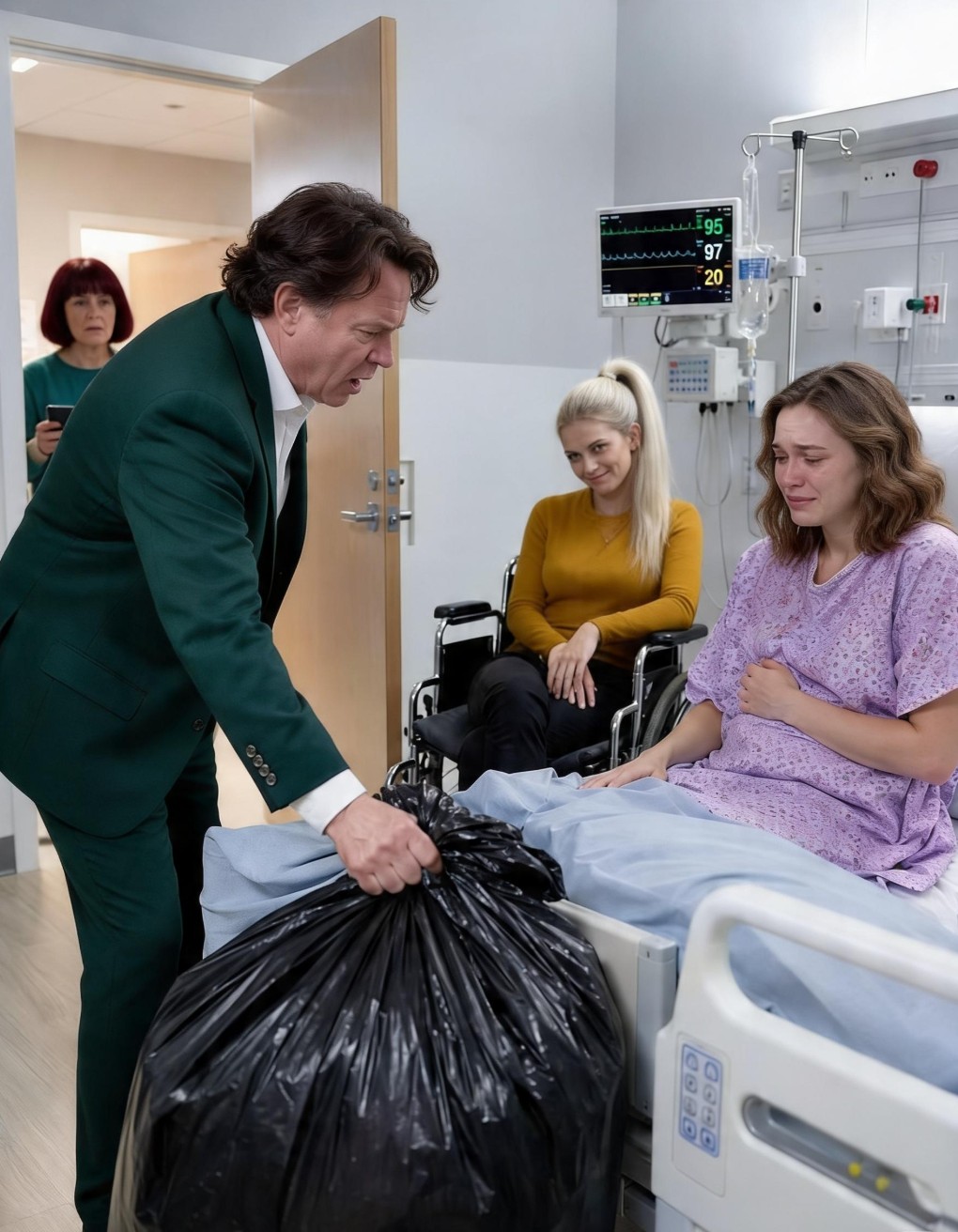
My father had dropped a black garbage bag beside my hospital bed. The heavy thud made the plastic brush against the blanket covering my legs.
“Don’t come home,” he said, his face twisted with disgust. “You are useless now.”
I did not argue.
I did not cry.
Because a clinical recording camera had already captured every word he said.
And only moments later, when a police officer blocked the doorway, my father’s face turned completely pale.
When I first saw Charles Montgomery standing at the foot of my bed, I had foolishly thought he had come because he was worried about me.
For one naive second, I believed that donating my kidney had finally made me his real daughter.
I was wrong.
Charles Montgomery had never been cheap with anyone except me. He wore tailored suits, drove polished luxury cars, and lived in a huge mansion in Denver, Colorado. Every room looked like it belonged in an expensive real estate advertisement.
My stepmother, Brenda, stood behind him. She always had that same expression on her face, as if she were constantly forgiving people simply for existing near her expensive furniture.
Their daughter, Alyssa, had received everything.
The soft bedroom.
The family jokes.
The attention.
And the diamond bracelet sparkling around her wrist as she sat in a wheelchair, waiting for the kidney I had just given her.
I had signed the donor forms because my father held my hand tightly and promised me something I had wanted for years.
A real family.
Alyssa desperately needed the transplant. Brenda suddenly had a long list of medical reasons why she could not donate. Charles claimed his high blood pressure made surgery too dangerous.
Then the final lab results came back.
“You are the perfect match,” Dr. Miller had told us.
My father actually cried when he begged me to save Alyssa’s life.
I mistook those tears for love.
Only three hours after the operation, he walked into my recovery room carrying my clothes in a black trash bag.
“You have done your part,” Charles sneered.
Brenda nodded behind him.
“You are still completely useless to this family.”
Brenda stood there with one hand wrapped tightly around her phone, looking completely unbothered by his cruelty.
I swallowed painfully.
“Where was I supposed to go after surgery?” I asked.
My voice was barely more than a whisper.
Brenda looked at me with cold eyes.
“We were already clearing out your bedroom anyway,” she said. “A home gym will fit the space much better than you ever did.”
I tried to take a deeper breath, but the fresh incision pulled sharply beneath my ribs.
The edges of the room began to blur.
The nurse call button was beneath my trembling fingers.
I could have pressed it.
Normally, I would have begged my father for mercy. I would have asked what I had done wrong. I would have apologized for something that was never my fault.
But this time, I simply stared at the black bag on the floor.
And I finally understood.
Spare parts did not need bedrooms after the surgery was over.
Then the door suddenly swung open.
Brenda flinched.
Dr. Miller stepped inside with his white coat hanging open. Two hospital security guards followed him, with a police officer standing directly behind them in the doorway.
“Nobody leaves this room,” Dr. Miller said.
His voice was cold and firm.
Charles immediately changed his expression.
He put on the smooth, friendly smile he normally used with bankers, business partners, and charity board members.
“Is there some kind of problem, Doctor?” he asked.
He sounded as though he had not just thrown his recovering daughter out of his home.
Dr. Miller pointed toward the small camera mounted above my monitor.
“This suite has a clinical recording camera,” he explained calmly. “Your visit has been streaming directly to our legal department since the moment you walked in.”
My father’s eyes slowly moved toward the camera.
His face turned gray.
Brenda grabbed his sleeve to steady him.
“She has not been medically cleared to leave,” Dr. Miller continued. “The recording captured you attempting to evict a critical donor during postoperative recovery.”
“That is ridiculous,” Charles sputtered, taking a step forward. “This is a private family matter.”
“She was never going to be homeless,” Brenda quickly added. “She is just emotional because of the medication.”
I looked past Brenda.
My black garbage bag was still sitting on the floor.
“Tell me where I was supposed to sleep tonight,” I said, looking directly at her.
Brenda opened her mouth.
Nothing came out.
Charles quickly stepped in.
“We would have figured something out eventually,” he said.
His voice suddenly sounded much more reasonable.
The police officer stepped closer to the bed and looked at the bag.
“Did you pack her belongings before she even woke up from surgery?” he asked.
Charles straightened.
“Those are only her basic essentials.”
The officer looked at him.
“Then why did you explicitly tell her not to come home?”
Charles turned toward me.
His entire expression softened.
He was trying to become the loving father he had pretended to be before my surgery.
“You are confused right now,” he said gently. “Tell them this is just a minor family disagreement.”
His words echoed inside my head.
He always wanted me to tell the lies that protected his reputation.
Not anymore.
“I want them removed from my room right now,” I said clearly.
Charles stared at me as though he could not believe those words had come from me.
“You do not mean that,” he insisted.
He took a step toward my bed.
“I do mean it,” I replied.
The words hurt more than the incision.
The police officer immediately stepped between us.
“You need to step outside right now, sir.”
“I am her father!” Charles shouted. “You cannot remove me from my daughter’s room!”
“Being her father does not give you control over her medical space,” Dr. Miller replied without raising his voice.
Brenda tightened her grip on her phone.
“You are humiliating a family that has already been through a massive trauma today!” she snapped as the security guards guided her toward the door.
Alyssa was still sitting near the wall.
Her hands were trembling as she stopped playing with her diamond bracelet.
Then she looked at her parents.
“Are you really clearing out her room?” she asked.
Her voice was small and shaky.
I turned toward my stepsister.
“Your mother just said they were turning it into a gym.”
Alyssa’s face changed.
She looked at Brenda with genuine confusion.
“You told me she had already found a new apartment in Phoenix,” Alyssa said.
Brenda’s expression hardened.
“This is not the time or place for this.”
“You said she wanted to move out right after the surgery was over,” Alyssa insisted.
Her voice grew louder.
“Alyssa, keep quiet,” Charles ordered.
Alyssa looked at me.
“Did she know about this?”
Nobody answered.
The silence that followed told her everything.
For the first time, Alyssa seemed to look at me as a human being instead of a convenient source for an organ.
Charles suddenly grabbed the handles of her wheelchair.
“We are leaving right now.”
Alyssa pulled away from him.
“I am not medically cleared to leave either,” she said. “I am staying here.”
“Your mother will handle your discharge paperwork,” Charles snapped.
“No.”
The single word stopped him.
Alyssa turned toward the transplant coordinator.
“I want my parents removed from my approved visitor list until I can speak with my care team alone.”
Charles stared at her in disbelief.
“After everything we have paid for?” he shouted. “After everything we did for you?”
He had not asked whether Alyssa was scared.
He had not asked whether I was in pain.
He only cared about the money he had spent.
Security escorted Charles and Brenda into the hallway while the officer began taking separate formal statements.
The hospital staff preserved the clinical recording.
My family could not force me out of my hospital bed.
A few minutes later, a kind nurse named Claire entered the room.
She carefully began taking an inventory of my belongings.
She lifted the black garbage bag from the floor and placed it gently on a clean chair.
Inside were two pairs of jeans, three plain shirts, an old hoodie, worn sneakers, a toothbrush, and a cheap phone charger.
They had packed enough to prove I no longer belonged in their house.
But not enough to help me start a real life.
At the bottom of the bag, Claire found my house key.
It had been removed from my key ring.
She held it up.
“Do you want me to put this key with your personal valuables?” she asked gently.
I looked at the small brass key.
It had once meant home.
Now it meant something completely different.
“Please seal it with the official recording paperwork,” I said softly.
Claire placed the key inside a clear hospital envelope.
She labeled it carefully and locked it in the drawer beside my bed.
For the first time in my life, I understood that the door to my old life had already closed.
And I was finally going to choose what came next.
PART 2:
The next morning, a hospital social worker named Sarah sat beside my bed with a cup of warm coffee in her hands.
She spoke gently, as if she understood how frightening everything had become.
“Your discharge will be delayed until the medical team is certain you can recover safely,” Sarah explained. “We can arrange temporary medically appropriate housing while you look for a permanent home.”
“Thank you,” I said.
A wave of relief washed over me.
“I was terrified I would have nowhere to go.”
Sarah gave me a reassuring smile.
“Is there anyone you trust that we can call for you?”
I stared at my phone for a long time.
That simple question made me realize just how isolated my father had made me over the years.
I had learned to hide every family problem behind a polite smile.
Whenever coworkers asked how things were at home, I always said the same thing.
“Everything is perfectly fine.”
It had never been fine.
Finally, I called my work supervisor, Karen.
My hands shook as I explained what had happened.
“I donated a kidney to my stepsister,” I told her through tears. “My family has revoked my housing, and I need help protecting my job while I recover.”
Karen did not ask me why I had stayed.
She did not judge me.
She simply asked the question I needed to hear.
“What paperwork do you need from us to make sure your leave is approved?”
Her kindness almost broke me.
Later that afternoon, Alyssa requested a supervised conversation with me.
I asked Dr. Miller to stay in the room while she came in.
When Alyssa entered, she was no longer wearing her diamond bracelet.
A pale strip of skin showed where it had been.
She stood beside my bed and looked down at the floor.
“Mom told me you demanded money in exchange for the kidney,” Alyssa admitted. “She said you planned to move into a new apartment as soon as the operation was over.”
I stared at her pale face.
“Did you honestly believe her?”
Alyssa swallowed.
“I wanted to believe her,” she confessed quietly. “It was easier than facing the truth.”
“She lied to you,” I said firmly. “They packed my clothes in a trash bag while I was still under anesthesia.”
Alyssa’s eyes filled with tears.
“I knew about the home gym,” she whispered. “Mom told me you chose to give up the room because you were leaving us.”
“I never agreed to leave.”
My voice was steady.
“They treated me like a spare parts bin.”
Alyssa covered her mouth.
“I am so sorry,” she sobbed. “I thought you hated me all these years.”
I looked at her for a long moment.
“I did not know you well enough to hate you.”
The truth was painful.
Our parents had kept us on opposite sides of every story.
They told Alyssa I was jealous of her.
They told me Alyssa was too fragile to be held responsible for anything.
She received protection.
I received responsibility.
“What do you want from me now?” Alyssa asked softly.
I knew exactly what I wanted.
“I want you to tell the truth when the care team asks what happened,” I said. “And I want you to stop letting them make me responsible for your recovery.”
Alyssa nodded through her tears.
“I will tell them everything. You will not have to take care of me ever again.”
That afternoon, Alyssa met privately with the transplant team.
Charles and Brenda were not allowed in the room.
She confirmed that she had been lied to about my housing situation.
She also formally requested an independent recovery plan that did not require me to become her caregiver.
Charles did not accept losing control quietly.
He called the hospital repeatedly.
He demanded meetings with senior administrators and insisted that the recording was simply a misunderstanding.
Then his corporate lawyer sent a formal message.
The offer sounded generous at first.
But it was not.
Dr. Miller stood beside my bed and read the letter aloud.
“He says you can stay in the guest room,” he explained. “However, you must sign a statement saying the eviction was a misunderstanding caused by your medication.”
I stared at him.
“What else does it say?”
Dr. Miller frowned.
“He wants you to drop the police report and assist with Alyssa’s daily care once you can walk.”
I felt anger rise inside me.
He had turned shelter into another contract.
A contract requiring my total obedience.
“What would you like us to tell him?” Dr. Miller asked gently.
I asked for a pen and paper.
Then I wrote one sentence beneath his offer.
I will not return to a home where my safety depends on denying the truth.
I signed my name firmly.
Then I handed the paper back to Dr. Miller.
Three days later, I was strong enough to walk down the hallway with a physical therapist.
Every step hurt.
But every step also felt like mine.
Near the nurse station, I saw Alyssa coming from the other end of the floor with her own care team.
We stopped when we reached each other.
“I told the hospital lawyers everything they needed to know,” Alyssa said.
“Thank you,” I replied.
She nodded.
Neither of us knew what else to say.
But for the first time, we were standing on the same side.
Two weeks after the surgery, I was finally discharged.
I did not leave with my father.
A hospital transport vehicle took me to a quiet temporary recovery facility that Sarah had arranged.
Claire placed my black garbage bag into the trunk with delicate care.
The temporary room was simple and clean.
There was a small bed and a kitchenette where I could safely heat soup.
It was not a mansion.
It was not luxurious.
But nobody could take it away from me because nobody else controlled it.
During my first few weeks there, Karen sent messages asking how my healing was going.
She never asked for family drama.
She never demanded explanations.
She simply cared whether I was getting better.
Alyssa sent two letters.
In them, she apologized for years of believing lies and told me she had moved into her own apartment away from our parents.
Brenda sent one harsh text message.
She claimed I had destroyed the family during Alyssa’s most vulnerable moment.
I saved the message for my lawyer.
I never replied.
Charles sent nothing at all.
For years, his silence had felt like punishment.
Now it simply felt empty.
After nine weeks of resting and rehabilitating, I signed a lease on a modest apartment in downtown Denver.
It had large windows that filled the room with warm afternoon light.
The front door was sturdy and locked securely from the inside.
It was the first home I had ever chosen for myself.
Months later, Alyssa and I met at a quiet coffee shop.
She looked healthier.
More independent.
Less afraid.
“I am continuing my therapy and making my own decisions now,” she told me softly. “I know you might never want a real relationship with me, and I understand why.”
I looked at her.
“The kidney belongs to you now,” I said calmly.
Then I smiled faintly.
“My future belongs to me.”
That night, I returned to my apartment.
I opened the drawer beside my bed and took out the old brass house key.
It had been sealed inside the hospital envelope for months.
I placed it into a padded mailer.
I sent it back to Charles without a note.
Without an explanation.
Without asking for anything in return.
Then I hung my new silver apartment key on the hook beside my front door.
I stood there for a moment, looking at it.
The key was small.
But it represented everything I had finally gained.
Freedom.
Safety.
A home that was mine.
I looked down at the black garbage bag sitting open on my living room floor.
For months, that bag had represented the moment my family decided I was worthless.
But now I was the one filling it.
I placed old clothes inside it.
Clothes I no longer wanted.
Things I had chosen to give away.
Nobody was throwing me out.
Nobody was deciding what I deserved.
This time, I was letting go on my own terms.
And as I closed the front door behind me that night, I realized something I should have understood years earlier.
I had given away a kidney to save someone else’s life.
But losing that kidney was not what destroyed my life.
It was the moment I finally stopped begging people who did not love me to act like they did.
For the first time, I was not somebody’s daughter.
Not somebody’s stepdaughter.
Not somebody’s donor.
Not somebody’s spare part.
I was simply myself.
And I was finally home.
THE END.
