
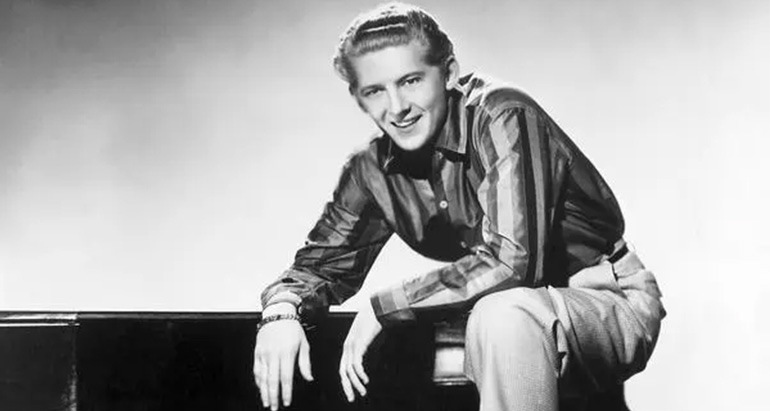
Jerry Lee Lewis (born September 29, 1935, in Ferriday, Louisiana) is an American rock and roll and country musician. He is best known for his aggressive piano playing and his legendary stage presence.
In the 1950s, he had some major hits in the rock and roll genre with Whole Lotta Shakin’ Goin’ On, Great Balls of Fire and Breathless. After a scandal toward the end of the decade, he focused increasingly on country music, with which he worked his way to the top of the country charts in the 1960s and 1970s.
Life
Childhood and Youth
Jerry Lee Lewis was born in 1935 in the small town of Ferriday, Louisiana, and grew up in impoverished conditions. Nevertheless, Elmo and Mamie Lewis were able to buy a piano for their son. Along with his cousins Jimmy Lee Swaggart and Mickey Gilley, both of whom later also began careers in the music business, Lewis took piano lessons and soon showed a special talent for the instrument. During this time, Lewis was influenced by boogie woogie, rhythm and blues, gospel and country music, all of which he incorporated into his piano playing. At just 14, he had the style he would later apply to his recordings: with his left hand, he created a strong boogie-woogie background, while with his right, he played fast, gospel-infused melodies.
Rock ‘n’ Roll star of the 1950s
Lewis’ mother had other plans for her son. She sent him to a Bible school, but he was expelled for his behavior. The 21-year-old pianist then moved to Memphis, Tennessee. Memphis was known for the development of rockabilly and its vibrant music scene. Lewis quickly got a job as a musician in a bar. There he met the musician Roy Hall, who began to promote him. Hall was also a pianist and had already recorded some records. Hall, together with Dave Williams, also wrote Lewis’ later hit “Whole Lotta Shakin’ Goin’ On.” In 1956, Lewis auditioned for Sun Records, which had already signed rockabilly artists such as Elvis Presley, Carl Perkins, Johnny Cash and Roy Orbison. Owner Sam Phillips was away on holiday, but his employe Jack Clement listened to Lewis and decided to set up a trial recording.
Clement brought in guitarist Roland Janes and drummer Jimmy Van Eaton, whom he had met at Fernwood Records, and put them together with Lewis on November 4, 1956. During a break, Clement had forgotten to turn off the recording equipment. During the break, Sun artist Billy Lee Riley came into the studio and began playing Lewis Ralph Mooney’s Crazy Arms on the guitar. Roland Janes joined in and picked up an old stand-up bass. Janes later recalled the recording:
“I came out of the washroom about halfway thru the song and picked up an old upright bass and started playing it – and I don’t play upright bass.” He was lucky he wasn’t close to a microphone. En esa canción, técnicamente solo hay dos instrumentos, batería y piano.”
“About halfway thru the song, I came out of the bathroom, picked up an old double bass, and started playing it – and I don’t play the double bass.” Luckily, I wasn’t near a microphone. On this song, there are technically only two instruments, drums and piano.”
– Roland Janes
When Clement played the tapes for Sam Phillips, he exclaimed:
“Just get him [Jerry Lee Lewis] in here as fast as you can!”
“Bring him [Jerry Lee Lewis] in here as fast as you can!”
Phillips had Lewis record Crazy Arms again with Lewis’s own boogie version of the jug band song End of the Road. Although Crazy Arms did not become a national hit, Sam Phillips decided to keep Lewis on the label due to the strong regional sales. He sensed that Lewis had star potential and got him work wherever he could. In early 1957, he replaced the unreliable pianist Smokey Joe Baugh with the Snearly Ranch Boys, played piano on sessions for Carl Perkins, Billy Lee Riley, Johnny Cash, Ray Harris, Jimmy Wages, and many others, and got some small gigs in Arkansas dancehalls. On February 23, 1957, Lewis made his first major appearance on the Big D Jamboree, a live country show from Dallas, Texas, and on March 31, he began his first tour with Cash, Perkins, and Onie Wheeler. During this time, he developed his strong stage presence. Lewis was unhappy because he was “chained” to the piano on stage and could not dance on stage with the guitar like Carl Perkins, for example. Perkins advised him to just kick the stool away.
Phillips thot he could make Lewis a true rock ‘n’ roll star, so he put all his financial resources into the next single, Whole Lotta Shakin’ Goin’ On, contrary to his usual practice. Lewis had heard the song in a Roy Hall club, and by the summer of 1957 it was number one in the Memphis charts. On June 12, the single also reached the country charts, and two weeks later it entered the national Billboard Top 100 at No. 70. But after that, requests for Whole Lotta Shakin’ Goin’ On began to dwindle; the explicit lyrics and Lewis’ wild performances apparently did not help his reputation. Sam Phillips then arranged for him to appear on the popular Steve Allen Show, and after his performance on the evening of July 28, the single climbed to No. 1 on the country and R&B charts and No. 2 on the Top 100.
In December 1956, Lewis was present as a pianist at a session for Carl Perkins, during which, among other things, Matchbox and Your True Love were recorded. At the end of this recording session, the music-historical event began that would later go down in history as the “Sun Session” or Million Dollar Quartet. Lewis played a few old songs in the studio with Cash, Presley, Perkins, and some other musicians, which Phillips had recorded.
This was followed by further hits such as “Great Balls of Fire,” which featured vocals, piano, and drums, and “Breathless.” Lewis’s stage performances became ever more legendary. He now played the piano with his hands and feet, kicked the stool away and danced around the piano or even set it on fire. He was a regular on American Bandstand and made other appearances on national television. He also appeared in the film Jamboree.
Jerry Lee Lewis also led a restless life in private. After it became known during a tour of England in 1958 that he had married the thirteen-year-old Myra Gale Brown, daughter of his bassist and cousin J. W. Brown, his career seemed to be over. He had to cancel the tour because of the scandal, but the American public was also horrified. He was called a “cradle snatcher” and his records were taken off the air. Lewis had no choice but to play in small clubs. Only in the early 1960s did he gradually work his way back up. He had a few hits and was gradually accepted by the public again. The heyday of rock ‘n’ roll was over, however, and so the big success eluded him.
Career as a country musician
In 1963, Lewis switched to the record label Smash Records. A year later, his legendary performances at the Star-Club in Hamburg took place. The album Live at the Star-Club, Hamburg, which was recorded during one of these performances, set new standards at the time in terms of sound and artistic presentation and is still considered one of the best live albums in rock history. From the mid-1960s onward, Jerry Lee Lewis increasingly devoted himself to country music and achieved great success in this genre in the late 1960s and early 1970s. Some of his major hits from this period included “What’s Made Milwaukee Famous (Has Made a Fool out of Me)” (No. 2; June 1968), “Me and Bobby McGee” (No. 1; November 1971), and “Chantilly Lace” (No. 1; March 1972). However, during live performances, Lewis continued to play wild rock ‘n’ roll. With the rise of the rock revival, he was rediscovered by the general public in 1969 at the Rock ‘n’ Roll Revival in Canada. His last chart placement was in 1983 with “Why You Been So Long,” which reached number 69 on the country charts.
Present day
Due to his advanced age and his excessive lifestyle – he took drugs for a long time – Jerry Lee Lewis is now physically badly marked. Despite this, he still performs regularly and even tours with other rock legends like Little Richard. In 1985, he was a member of the Class of ’55, an Elvis Presley tribute featuring him, Johnny Cash, Roy Orbison and Carl Perkins.
In 1989, his life was adapted into a film titled Great Balls of Fire! with Dennis Quaid and Winona Ryder in the lead roles. The book that the screenplay is based on was written by Myra Lewis and Murrey Silver Jr., and the film was released in German cinemas on September 21, 1989. Lewis re-recorded his songs for the soundtrack, but was unhappy with the portrayal of his character in the film. In 2005, Lewis was portrayed by Waylon Malloy Payne in the Johnny Cash biopic Walk the Line.
As the last surviving member of the famous so-called “Million Dollar Quartet” (besides him, Elvis Presley, Johnny Cash, and Carl Perkins), he released the album Last Man Standing in 2006 with 22 guest stars, including Jimmy Page, the Rolling Stones, Bruce Springsteen, Ringo Starr, Tom Jones, and Rod Stewart. In 2010, Lewis released the follow-up album Mean Old Man, which also featured a number of high-profile guest stars. In October 2014, his new album Rock & Roll Time was released.
In many interviews, he states that, beside his own God-given talent, he only accepts three other musicians as stylists: Al Jolson, Jimmie Rodgers, and Hank Williams.
Rolling Stone ranked Lewis 24th on its list of the 100 Greatest Artists of All Time and 67th on its list of the 100 Greatest Singers of All Time.
Private life
Jerry Lee Lewis’ parents, Elmo and Mamie Ethel Lewis, were poor farmers. His brother Elmo Jr. died when Jerry was three years old. His sister Frankie Jean Lewis Terrell (* 1944; † 2016) was the curator of the Jerry Lee Lewis Museum. With his other sister Linda Gail Lewis (*1947), who remained active as a singer until the late 2010s, he recorded several singles between 1963 and 1971 and also an album (Together) in 1969. Despite their ultra-religious stance, which condemned dance music as “devil’s music,” Mamie and Elmo Sr. mortgaged their farm to buy eight-year-old Jerry Lee a piano. Lewis was not a good student and dropped out of high school; the Texas Southwestern Assemblies of God University, a college Bible school, expelled the rebellious boy.
Lewis is married for the seventh time and has six children. His two sons, Jerry Lee Lewis Jr. and Steven Allen Lewis, died at the ages of 19 and 3, respectively. In 2001, Bonnie Lee Bakley claimed that Lewis was the biological father of her daughter Jeri Lee Lewis (born 1993). A subsequent DNA test, however, could not prove this.
His first marriage lasted approximately 20 months, although it cannot be said with certainty today when the marriage took place. Lewis said of his marriage to Dorothy Barton: “I was 14 when I first got married. My wife was too old for me, she was 17.” Ich war 14, als ich zum ersten Mal heiratete. My wife was too old for me; she was 17.” According to the officially known date (February 21, 1952), Lewis was 16 years old at the time.
After that, the musician was married to Jane Mitchum from 1953 to 1957. With her, he had two sons: Jerry Lee Lewis Jr. (1954–1973) and Ronnie Guy Lewis (* 1956). Curiously, the wedding took place 23 days before the divorce from Barton. Lewis Jr. died in a car accident a few days after his 19th birthday, in a Jeep that his father had given him for his birthday.
For 13 years (1957–1970), Lewis was married to his second cousin Myra Gale Brown: Again, the marriage took place before the divorce of the previous relationship; in this case, however, the ceremony had to be repeated. In addition, Myra stated her age as 20 on the marriage documents, but in reality she was only 13 at the time of the marriage. Myra and Jerry had two children: Steve Allen Lewis (1959–1962) and Phoebe Lewis (born 1963), who worked as her father’s manager for a time. Son Steve drowned at the age of three in a swimming pool.
Jaren Elizabeth Gunn Pate was Jerry Lee Lewis’s wife from 1971 to 1982. She drowned in a swimming pool while they were separated. Their child is daughter Lori Lee Lewis (* 1972).
Shawn Stephens died in August 1983, less than three months after her wedding to Lewis, from a methadone overdose.
In 2005, Lewis and Kerrie McCarver divorced. They had married in 1984 and had a son together, Jerry Lee Lewis III (*1987), called Lee.
Lewis lives with his daughter Phoebe on his ranch in Nesbit, Mississippi. On March 9, 2012, he celebrated his seventh wedding with Judith Brown, the ex-wife of his cousin Rusty.
