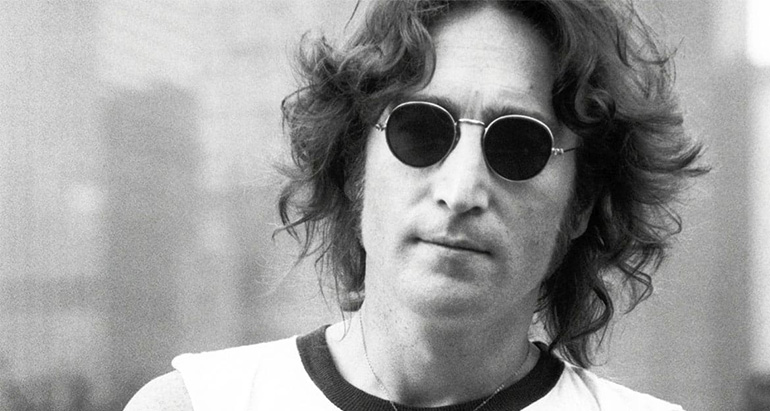
John Winston Lennon, MBE (later: John Winston Ono Lennon; * October 9, 1940 in Liverpool; † December 8, 1980 in New York) was a British musician, composer, author, film actor, peace activist, Oscar winner, and multiple Grammy Award winner. He became world-famous as the co-founder, singer, and guitarist of the British rock band The Beatles, for whom he wrote most of the songs, alongside Paul McCartney. The songwriting partnership of Lennon/McCartney is one of the most famous and successful in the history of pop music.
During the dissolution phase of the Beatles, Lennon, together with his second wife Yoko Ono, organized several high-profile happenings (cf. Fluxus) for world peace starting in the late 1960s and turned to new artistic fields. After the breakup of the Beatles, Lennon launched a successful solo career with albums such as John Lennon/Plastic Ono Band (1970) and Imagine (1971).
Lennon was shot in 1980 in New York in an assassination attempt by Mark David Chapman.
Life
Childhood and youth
Early Years
John Winston Lennon was born on October 9, 1940, in Liverpool. His parents were sailor Alfred Lennon (1912–1976) and his wife Julia (née Stanley; 1914–1958). Born during World War II, he was given the middle name “Winston,” after the then British Prime Minister Winston Churchill. The first years of John Lennon’s life were spent mainly with his mother and her family in Liverpool, as his father was often at sea during that time. Because Julia Lennon had a child by another man in 1945, his parents separated. After 1946, he had no contact with his father until his time as a Beatle.
John Lennon now lived permanently with Julia’s sister Mary Smith (1906–1991), known as “Mimi,” and her husband George (1903–1955) in Mendips in the Liverpool suburb of Woolton and initially had little contact with his mother. Soon, his musical talent became apparent when he began playing the harmonica and developed an interest in other musical instruments. After transferring to Quarry Bank High School, he impressed his classmates with parodies, little nonsense texts, and caricatures of his teachers. However, his academic performance was below average. From 1955 onward, John Lennon’s contact with his mother improved again. As a lover of early pop music, Julia taught him to play the banjo, and thru that, she also introduced him to the music of Buddy Holly and other rock ‘n’ roll musicians. Julia Lennon died in a car accident in 1958 – at a time when John Lennon had developed a closer relationship with her.
The Quarrymen
The emerging rock ‘n’ roll had an increasing influence on the young John Lennon, and in particular, the appearance of Elvis Presley fueled his desire to become a rock ‘n’ roll musician himself.
At the end of 1956, John Lennon (vocals and guitar) founded his first band, The Quarrymen, with his best friend Pete Shotton (washboard), named after the school they attended. The band started as a skiffle group, but also played rock ‘n’ roll classics by Buddy Holly, Little Richard and Gene Vincent. On 6 July 1957, Ivan Vaughan, who occasionally played with the Quarrymen, brought his school friend Paul McCartney to a performance. Lennon was so impressed by his skills that he invited him to join the group. In the same year, John Lennon began studying at the Liverpool College of Art. However, during this time he also increasingly devoted himself to music and regularly met with the younger McCartney, who attended the Liverpool Institute nearby. During this time, the first compositions of the later famous partnership Lennon/McCartney were created, who regularly met in the living room of the McCartney family at 20 Forthlin Road. After McCartney (vocals and guitar), his school friend George Harrison (vocals and guitar) joined the group in February 1958. In November 1959, Lennon was able to persuade his friend Stuart Sutcliffe, with whom he attended art school, to invest the money he had earned from selling a painting in a Höfner President bass guitar. With Sutcliffe, Lennon came up with the idea of naming the group “Beatals” at first, later “The Beatles.” In early 1960, Sutcliffe became the group’s bassist, despite never having played an instrument. Drummer Pete Best completed the original Beatles that same year.
The Beatles
Rise
From 1960 to 1962, the Beatles had several engagements in Hamburg at the Indra, the Kaiserkeller, the Top Ten Club, and the Star Club. Lennon later claimed to have grown up in Hamburg rather than Liverpool. Lennon mostly acted as the bandleader and entertained the German audience with small comedic interludes. After Paul McCartney and Pete Best were deported from Hamburg to England, Lennon initially played with another group. When Sutcliffe decided to stay in Hamburg with his fiancée Astrid Kirchherr in 1960, McCartney took over the bass guitar. After returning to Liverpool, the group’s popularity grew. From 1961 onward, the Beatles had numerous performances at the Cavern Club.
In April, the Beatles returned to Hamburg. There, in June, they accompanied the British musician Tony Sheridan in the recording of his album My Bonnie. During this session, the Beatles recorded two pieces: the cover version “Ain’t She Sweet,” sung by Lennon, and the instrumental piece “Cry for a Shadow,” composed by Harrison and Lennon.
In December, Brian Epstein became the manager of the Beatles. He managed to arrange for the Beatles to have a studio audition with music producer George Martin. During his third stay in Hamburg in 1962, Lennon received the news of the sudden death of his friend Stuart Sutcliffe. Despite the bereavement, the third stay in Hamburg was also very successful; in the summer, the Beatles received their first record contract with Parlophone, a subsidiary of EMI.
Under pressure from George Martin, Ringo Starr replaced the previous drummer Pete Best; from then on, the Beatles were in their final lineup.
In the same year, 1962, Cynthia Powell, Lennon’s girlfriend since art school, became pregnant by him. They married on 23 August 1962, with manager Brian Epstein as witness. On April 8, 1963, Lennon’s first son, Julian, was born.
Beatlemania
The first single by the Beatles, the Lennon/McCartney composition “Love Me Do,” was released in September 1962. The second single, Please Please Me, mainly written by Lennon, reached the top of the British charts. The eponymous album from 1963 was equally successful.
With “I Want to Hold Your Hand” (January 1964), the Beatles managed to musically “conquer” the USA as well. On February 7, 1964, they traveled to the USA for the first time and were received enthusiastically in New York.
After the success of the film A Hard Day’s Nite and the soundtrack of the same name in the summer of 1964, Lennon increasingly devoted himself to the lyrics of his songs. Encouraged by Bob Dylan, he tried to establish himself as a serious songwriter. Thus, the album Beatles for Sale (December 1964) increasingly features more contemplative pieces by Lennon, such as I’m a Loser or No Reply.
The Beatles also continued to develop artistically. Rubber Soul features outstanding Lennon tracks such as Norwegian Wood (This Bird Has Flown), Nowhere Man, and Girl. The piece In My Life was chosen by the British music magazine Mojo as the best song of all time. Lennon’s contact with the psychedelic drug LSD was reflected in the follow-up album Revolver (August 1966). It features psychedelic pieces such as Tomorrow Never Knows and is considered one of the group’s strongest.
A new world tour by the Beatles began in June 1966 with three concerts in Germany. In the Philippines, the group was attacked by an angry mob on their departure after they had refused an invitation from Imelda Marcos. In the US, an interview given by Lennon in March to British journalist Maureen Cleave for the Evening Standard caused a stir. In it, Lennon commented on Christianity, among other things:
“Christianity will go.” Elle va disparaître et se réduire. […] We’re more popular than Jesus now – I don’t know which will go first, rock and roll or Christianity.”
“Christianity will pass away.” It will disappear and fade away. […] We are more popular than Jesus now – I don’t know which will go first, rock ‘n’ roll or Christianity.
In Great Britain, these statements received little attention. However, when the interview was published in the United States four months later, the statement that the Beatles were more popular than Jesus caused a wave of outrage. Several radio stations boycotted Beatles songs, and there were even organized bonfires of their records. On the advice of Brian Epstein, John Lennon made a lengthy apology at a press conference in Chicago. Nevertheless, the Beatles’ performances were overshadowed by Ku Klux Klan marches, and Lennon feared for his life. On August 29, the Beatles gave their last concert in San Francisco and decided not to tour anymore.
First own projects
John Lennon had been writing poems and short stories since his childhood. In 1964 and 1965, two collections of Lennon’s quirky short stories were published, which he also illustrated. On March 23, 1964, In His Own Write (German title: In seiner eigenen Schreibe) was published. A year later, A Spaniard in the Works (German title: Ein Spanier macht noch keinen Sommer) followed.
In 1966, Lennon took on a supporting role in the anti-war film “How I Won the War” by Richard Lester. This role gave Lennon the opportunity to change his appearance and shed the “Beatles look.” The mop-top was trimmed and Lennon, who had been nearsighted since childhood, began wearing glasses in public. He opted for a pair of nickel-rimmed glasses with round lenses.
Musical highlight with the Beatles
After the end of the tours, the Beatles devoted themselves entirely to working in the studio. Lennon composed the piece “Strawberry Fields Forever,” which was released as a single in February 1967 along with McCartney’s “Penny Lane.” With its thoughtful lyrics, elaborate studio effects, and complex musical arrangement, the piece is considered one of Lennon’s masterpieces and marks the Beatles’ transition from pop to art. Lennon contributed significantly to the success of the concept album Sgt. Pepper’s Lonely Hearts Club Band with pieces such as Lucy in the Sky with Diamonds and A Day in the Life. For the first television broadcast worldwide, Our World, Lennon wrote All You Need Is Love, the “anthem of the Summer of Love” in 1967.
The sudden death of Brian Epstein on August 27, 1967, hit Lennon hard after the death of his mother and Stuart Sutcliffe. The group decided to carry on regardless. He then traveled to India with the other Beatles to meditate with the guru Maharishi Mahesh Yogi. There, Lennon wrote numerous new pieces, which were released on November 22, 1968, on the Beatles’ new album simply titled The Beatles, also known as the White Album due to its cover design.
John and Yoko
John Lennon had met the Japanese avant-garde artist Yoko Ono in 1966 at her exhibition in the London Indica Gallery. In May 1968, the two became a couple. In July 1968, Lennon and Ono presented their first joint exhibition at Robert Fraser’s gallery under the motto “You Are Here.” On 18 October 1968, Lennon and Ono were arrested for possession of marijuana, which caused a significant media stir (reporters from the Daily Mail and Daily Express were already on the scene before the police arrived) and ultimately meant a lifelong criminal record for Lennon. On 8 November 1968, John and Cynthia Lennon were divorced.
On November 29, 1968, Lennon released the album Unfinished Music No.1: Two Virgins with Yoko Ono. The couple’s first joint work caused a stir, but less because of the avant-garde sound collages, and more because of the cover – it showed Lennon and Ono naked. 30,000 copies were seized by police at Newark Liberty International Airport on January 3, 1969, with a further 22,000 copies following on January 25 in Union County. In addition, sales were banned in some places, dealers were threatened, and record stores were closed, as in Chicago, for example. On 11 December 1968, John Lennon performed live for the first time outside the Beatles. The group, consisting of Lennon, Eric Clapton, Keith Richards, and Mitch Mitchell, called themselves The Dirty Mac and performed the songs “Yer Blues” and “Her Blues” sung by Yoko Ono for the television special “Rock and Roll Circus,” the title of which was later changed to “Whole Lotta Yoko.”
Ono’s artistic influence also made its mark on the Beatles’ White Album. For example, the experimental sound collage Revolution 9 can be found there. With Revolution 1, Lennon also took a political stance and referred to the Paris May riots. In May 1969, the second album by the couple Lennon and Ono was released under the title Unfinished Music No. 2: Life with the Lions.
On March 20, 1969, John Lennon and Yoko Ono got married in Gibraltar. On March 31, 1969, the couple ended their week-long “Bed-In” in the Apollobuurt in Amsterdam. Lennon and Ono had been giving daily interviews from their bed at the Hilton Hotel starting March 26, to make a visible statement for peace. Later, Lennon commented on this:
“When we got married, we knew our honeymoon would be public anyway, so we decided to make the most of it.” Our life is our art. That was the bed-in. We were in bed talking to the reporters. It was hilarious. In the end, we made a commercial for peace […].”
Another week followed in Montreal, while the third Bed-In failed due to a lack of entry permit for the Bahamas. As part of their peace campaign, Lennon and Ono also gave an interview in a sack in Vienna, calling the action “Bagism.” The song The Ballad of John and Yoko is about the events of their honeymoon. The third and final part of the Unfinished Music series documenting the life of John Lennon and Yoko Ono together was released under the name Wedding Album in October 1969.
New Paths and the End of the Beatles
The couple founded the Plastic Ono Band in 1969, whose first single – Give Peace a Chance, recorded during the Bed-In in Montreal – made it into the top 20 of the charts worldwide in July of that year. In October, the single Cold Turkey followed, but it did not sell as well. Cold Turkey describes the suffering during heroin withdrawal. Lennon struggled with his drug addiction for the next five years. The chart failure of “Cold Turkey” was cited by Lennon as an additional reason for returning the Member of the British Empire (MBE) medal he had received in 1965 with the other Beatles. The main reason he gave in the written justification was Britain’s involvement in the two wars in Biafra and Vietnam.
In December 1969, Lennon and Ono organized the War Is Over poster and billboard campaign to promote peace. The posters were seen in several major cities worldwide, including New York, Los Angeles, Toronto, Tokyo, Rome, and Berlin. The inscription read:
WAR IS OVER!
IF YOU WANT IT Happy Christmas from John & Yoko
On December 23, 1969, John Lennon and Yoko Ono met with Canadian Prime Minister Pierre Trudeau for a 50-minute conversation.
In the course of these projects with Yoko Ono, Lennon distanced himself more and more from the Beatles. The project of a documentary film about the Beatles titled Get Back was marked by increasing conflicts within the group and was only released in 1970 under the title Let It Be. The Beatles’ last joint project was their album Abbey Road, which was released in September 1969. Lennon later often criticized the album in interviews. Nevertheless, it became one of the group’s most successful albums.
Solo career
1970–1971: Plastic Ono Band and Imagine
On February 6, 1970, John Lennon recorded his new single “Instant Karma!” with American music producer Phil Spector. Lennon said in an interview: “I wrote it for breakfast, recorded it for lunch and we’re putting it out for dinner.” (German: “I wrote it for breakfast, recorded it for lunch and we’re putting it out for dinner.”) Instant Karma became an international top-ten hit.
On April 10, 1970, Paul McCartney announced the official dissolution of the Beatles, preempting Lennon, who had claimed it for himself, as John Lennon had announced during a meeting with the other Beatles members on September 20, 1969, that he wanted a “divorce” from the Beatles.
From the beginning of 1970, Lennon heard about the “primal scream” therapy developed by American psychologist Arthur Janov. Lennon and Ono invited Janov to their Tittenhurst Park estate in Ascot in April 1970 and underwent the treatment. This was followed by four more months in Los Angeles, California. During this time, Lennon wrote several songs that reflected his personal situation, anger, fears, and problems. The result was Lennon’s first solo album, John Lennon/Plastic Ono Band (December 1970), on which Lennon openly described his personal feelings. It was produced by him, Yoko Ono, and Phil Spector. In the song “God,” he sings at the end, “I don’t believe in Beatles; I just believe in me.” Yoko and me. Und das ist die Realität.” (English: “I don’t believe in the Beatles, I only believe in myself.”) Yoko and me. And this is the reality.”) The attached part of the song begins with the statement that the dream is over, but that one must now move on.
In March 1971, the successful single “Power to the People” followed, which was politically motivated; John Lennon wrote the song after an interview conducted by Tariq Ali, the editor of the politically left-leaning British magazine Red Mole. The single “God Save Us” / “Do the Oz” was recorded in May 1971, with the A-side sung by Bill Elliot and the B-side by Lennon. The release was under the pseudonym Elastic Oz Band.
His second album, Imagine (September 1971), was recorded by Lennon with old companions like George Harrison and Klaus Voormann in May 1971 at Lennon’s own studio, the Ascot Sound Studios in Tittenhurst Park. It was the only album by John Lennon that was created there. In contrast to the album John Lennon/Plastic Ono Band, the musical influence of Phil Spector was clearly recognizable. John Lennon said of the album Imagine in comparison to the previous album: “… it’s a bit cleaner looking, but the basic message is the same, just more acceptable to people.” Imagine was commercially very successful and reached top positions in the charts worldwide. The title track is considered Lennon’s most famous solo piece and describes the vision of a better and fairer world. With his statements regarding religion in the song Imagine, Lennon allegedly hurt the religious feelings of his later murderer, which probably mainly led to the assassination. In 2012, Imagine was played as one of the songs at the closing ceremony of the London Summer Olympics, with a video that had never been seen before. The song “Imagine” reached the UK Singles Chart in 1975 (No. 6), 1980 (No. 1), and 1999 (No. 3).
In 1971, the relationship with Paul McCartney had reached a low point, so the song “How Do You Sleep?” is a reckoning with McCartney and a reaction to his Ram album from May 1971. The McCartney song “Too Many People” is one of three songs on the album that John Lennon felt were directed at him. The line from “How Do You Sleep?” “…those freaks was right when they said you was dead” is a reference to the Paul is dead conspiracy theory. The song contains further claims, including that Paul McCartney surrounded himself with “yes men,” and that his music was inferior in John Lennon’s opinion and that his career would last only a year or two. George Harrison played guitar on the song How Do You Sleep?. As a response from Paul McCartney, the song Dear Friend from his Wild Life album was considered.
The cover of the McCartney album Ram shows Paul McCartney on the front holding a ram by its horns. As a parody of the cover, John Lennon had a photo taken of himself holding a pig in a similar pose, and included it with the Imagine album.
1971–1973: New York
In September 1971, John Lennon and Yoko Ono left the United Kingdom, flew to New York, and checked into the St. Regis Hotel, from where they began several artistic projects. By November 1971, they had moved to Greenwich Village, to 105 Bank Street.
As their first musical project, they recorded the Christmas single “Happy Xmas (War Is Over)” in October 1971, which was released in December in the USA and in November 1972 in the UK. The song established itself in the following years as one of the most played Christmas songs.
The album Some Time in New York City (June 1972), recorded with the Elephant’s Memory Band, was filled with political protest songs as John Lennon and Yoko Ono faced various political issues in the USA. As a result, the couple engaged intensively with it and processed these influences in their lyrics. During this time, the Lennons were politically influenced by Jerry Rubin and David Peel, among others. During this time, John Lennon had problems with his residence permit in the USA, he was threatened with deportation, due to the growing fears of the Richard Nixon administration of a “radicalizing” artist John Lennon. During this time, Lennon was monitored by the FBI.
Lennon and Ono addressed in the songs the uprising at the Attica Correctional Facility, the Northern Ireland conflict, and the poet and anarchist John Sinclair, who was sentenced to ten years in prison in the USA in 1969 for possessing two marijuana cigarets. For Sinclair, Lennon and Ono had already participated in a benefit concert on December 10, 1971. With the single release “Woman Is the Nigger of the World,” Lennon protested against the role of women in society at the time and addressed feminist ideologies. In addition, the album also contains the live recording of a joint performance on June 6, 1971, by John Lennon, Yoko Ono, and Frank Zappa’s Mothers of Invention at the Fillmore East in New York, as well as another concert recording by the Plastic Ono Band at the Lyceum Ballroom in London on December 15, 1969, which was under the motto “peace for Christmas” (Benefit for UNICEF). Some Time in New York City was John Lennon’s least commercially successful studio album during his lifetime.
On August 30, 1972, Lennon and Ono performed at the “One to One” benefit concert at Madison Square Garden in support of children with disabilities. A recording of the concert was released posthumously in 1986 as John Lennon: Live in New York City. The performance was Lennon’s last major concert.
At the end of 1972, John Lennon ended his collaboration with the Elephant’s Memory Band.
On March 13, 1973, the recording of the Lennon composition “I’m the Greatest” took place, with John Lennon playing the piano and providing background vocals, George Harrison on guitar, and Ringo Starr singing and playing the drums. This was the only time Paul McCartney was missing from a Beatles reunion. The bass was played by Klaus Voormann, the organ by Billy Preston, and the song was released on the Ringo Starr album Ringo. A version of the song with John Lennon singing was released in 1998 on the album John Lennon Anthology.
In February 1973, Lennon and Ono began moving into a luxury apartment in the Dakota Building on 72nd Street in New York, and their former residence in the UK, the 29-acre estate Tittenhurst Park, was sold to Ringo Starr on September 15, 1973. On April 1, Lennon and Ono declared the fictional state of “NUTOPIA,” a country without borders or passports. The national anthem of “NUTOPIA” consisted of three seconds of silence and was released on the album Mind Games in November. The album was produced by Lennon himself for the first time, and overall it is more commercially oriented both musically and lyrically than the previous album. John Lennon also did not continue the political path of 1972, political engagements and contact with Jerry Rubin and David Peel were discontinued.
1973–1975: Lost Weekend
During the recording of the album Mind Games in July/August 1973, Lennon temporarily separated from Yoko Ono due to marital problems. Yoko Ono then asked May Pang, her secretary and press agent, to accompany John Lennon. John Lennon and May Pang had an affair during the so-called “Lost Weekend,” which was to last 18 months. In September 1973, John Lennon and May Pang left New York and went to Los Angeles. This period was marked by self-destructive alcohol binges that Lennon undertook, among others, with Harry Nilsson and Keith Moon.
Lennon began working on the album Rock ‘n’ Roll with Phil Spector from October to December 1973. However, work on the album stagnated due to the lack of commitment from those involved. Eventually, the situation escalated when Spector fired his revolver in the studio. The recordings were then eventually canceled.
In March 1974, John Lennon and Harry Nilsson were ejected from the Troubadour Club for drunkenly heckling the Smothers Brothers; this incident and his relationship with May Pang were made public by the press. Afterward, John Lennon decided to become musically active again by producing Harry Nilsson’s new album, Pussy Cats. The recordings extended from the end of March 1974 into April 1974. During these recordings, on March 28, 1974, the only known musical collaboration with Paul McCartney after the breakup of the Beatles took place. McCartney, who was visiting Los Angeles with his wife Linda, was invited by Lennon to a day-long jam session, which was also attended by Stevie Wonder, among others. During the recording, Lennon sang the lead vocals and played guitar. McCartney sang the backing vocals and played the drums. A further musical collaboration with Paul McCartney, which John Lennon had in mind, was never realized.
John Lennon returned to New York for the recordings of Walls and Bridges (October 1974), which took place in July/August 1974, and like with Mind Games, John Lennon produced the album himself again. In Los Angeles, Lennon had met the British musician Elton John, who supported Lennon on the album with the songs “Whatever Gets You Thru the Nite” and “Surprise, Surprise (Sweet Bird of Paradox).” In addition to the single “Whatever Gets You Thru the Night,” the album also reached the number one position on the U.S. Billboard charts, making it the second and final number one solo album during John Lennon’s lifetime. Due to a lost bet with Elton John (Lennon did not believe that Whatever Gets You Thru the Nite would reach the top of the charts), he appeared as a surprise guest at a John concert at Madison Square Garden on November 28, 1974. In addition to Whatever Gets You Thru the Nite, Lennon and John played the Beatles songs Lucy in the Sky with Diamonds and I Saw Her Standing There. At the end of August 1974, Elton John recorded the song “Lucy in the Sky with Diamonds” with John Lennon at the Caribou Ranch Studios in Colorado. John Lennon sang the backing vocals on the chorus, and also played guitar. “Lucy in the Sky with Diamonds” was released in November 1974 as an Elton John single and reached number one on the US charts. Also in August 1974, following the sessions for the album Walls and Bridges, John Lennon recorded the song Only You (And You Alone) during the sessions for Ringo Starr’s album Goodnight Vienna, in April the Lennon composition (It’s All Da-Da-Down To) Goodnight Vienna was already recorded as a demo, both songs were also released in November 1998 on the compilation album John Lennon Anthology.
In October 1974, John Lennon decided to return to the studio with the session musicians from the recordings for Walls and Bridges to complete the album Rock ‘n’ Roll, which he had started with Phil Spector, and which was released in February 1975. The album contained cover versions of well-known pieces from Lennon’s youth.
In January 1975, Lennon participated in the recordings for David Bowie’s album Young Americans at the Sigma Sound Studios in New York, playing guitar and singing on two songs. The single Fame is a collaboration between the two and reached number one in the US charts.
At the end of January/beginning of February 1975, John Lennon moved back in with Yoko Ono in the apartment in the Dakota Building. On April 8, 1975, John Lennon was interviewed by Tom Snyder on his television show Tomorrow, which aired on television in the USA on April 28, 1975. In later years, the interview was released on VHS in May 1981 and on DVD in April 2008. On April 18, 1975, John Lennon made his last live appearance during the television show Salute to Sir Lew – The Master Showman, where he sang the songs Slippin’ and Slidin’, Stand by Me, and Imagine, which was broadcast on television in the USA on June 13, 1975.
1975–1980: Withdrawal from Public Life and Comeback
On October 9, 1975, Lennon’s 35th birthday, Lennon and Ono became parents to their son Sean Taro Ono Lennon. On the same day, John Lennon received the Green Card after a four-year battle against the US authorities. Ono took care of the family’s business affairs, while Lennon stayed home to take care of his son. Lennon increasingly distanced himself from his role as a “rockstar” and placed his son at the center of his life. While Lennon primarily took care of the household, Yoko Ono took over Lennon’s management, which, due to the lack of new releases, mainly managed the rights to old songs.
On October 24, 1975, John Lennon’s first compilation album titled Shaved Fish was released.
On April 24, 1976, Paul McCartney visited John Lennon in New York; it was the last meeting of the two former Beatles. John Lennon’s last studio session for the time being was during the recordings for the Ringo Starr album Ringo’s Rotogravure on 12 June 1976. Lennon contributed the yet unreleased self-composition Cookin’ (In the Kitchen Of Love) along with piano accompaniment.
The couple gave an interview at the Hotel Okura in Tokyo on October 4, 1977, in which they stated that their current priorities were family life and raising their child, and that they would therefore withdraw from the music business until their son Sean turned five. According to George Harrison, he visited John Lennon at the Dakota Building (in the late 1970s), it was their last meeting. (According to Keith Badman’s book The Beatles Diary Volume 2: After the Break-Up 1970–2001, their last meeting was on September 28, 1980, in Los Angeles)
Between 1975 and 1980, John Lennon recorded several demos of his new compositions at home, some of which are available on bootlegs or were legally released. According to his own statements, it was in Bermuda where Lennon decided to record an album again. The trigger was the song “Rock Lobster” by the American band The B-52s, which he heard during a visit to a dance club and reminded him of Ono’s music. The time seemed ripe to become active again – or as Lennon put it in an interview with Rolling Stone: “It’s time to get out the old ax and wake the wife up!” Starting in August 1980, recordings by John Lennon and Yoko Ono for their last joint album, Double Fantasy, followed, which was released on November 17, 1980. On November 15, 1980, John Lennon met Ringo Starr for the last time at the Plaza Hotel in New York, where he handed Starr a cassette tape with four songs. They planned to record together in January 1981 for the Ringo Starr album Stop and Smell the Roses. John Lennon continued to plan a tour with the Double Fantasy studio musicians after the completion of the next album, Milk and Honey, which was not completed until 1983 by Yoko Ono. The tour was to begin in Japan in the spring of 1981, followed by Europe and the USA.
Assassination and Death
On the evening of December 8, 1980, John Lennon and Yoko were working on the final mix of Ono’s composition “Walking on Thin Ice” at Record Plant-East. They returned to the Dakota Building at 10:48 p.m. Contrary to his habit, Lennon instructed his driver not to drive into the building’s courtyard, but to let him and Yoko Ono out in front of the house. After they passed thru the Dakota’s archway, the mentally disturbed gunman Mark David Chapman shot John Lennon with a revolver from about six meters away. Lennon was still conscious when he was taken to Roosevelt General Hospital, but succumbed to his injuries at 11:07 p.m.
When John Lennon left the Dakota Building a few hours before the murder, Chapman had a record signed by him and was photographed at that moment by photographer Paul Goresh together with Lennon. Chapman is therefore pictured with him in the last photo that shows the artist alive. Lennon’s murder triggered a wave of horror. Even on the nite of the murder, several thousand people gathered in front of the Dakota Building to sing Lennon’s songs together. Numerous expressions of condolence reached Yoko Ono in the following days. Lennon’s music reached top positions in the charts worldwide. The album Double Fantasy rose from number 11 to number 1 in the USA and stayed there for eight weeks, with the single (Just Like) Starting Over becoming a number-one hit. The following single, “Woman,” also reached number one in the UK and number two in the US. In the UK, Imagine from 1971 posthumously became the first single to reach number one, and Happy Xmas (War Is Over) reached number two. “Watching the Wheels,” as the third single from the album “Double Fantasy,” also reached the top ten in the U.S. charts, while “Give Peace a Chance” was once again noted at number nine in the German charts.
Chapman pled “guilty” to the murder charge, against his lawyer’s advice and despite six out of nine psychiatric experts diagnosing him with psychosis. He was finally sentenced to 20 years to life in 1981. Since the year 2000, Yoko Ono has called on the parole commission every two years to never release Chapman, because she feels endangered, the perpetrator does not deserve a normal life, and violence begets violence. In August 2018, Chapman’s tenth application for release was rejected.
Impact and Legacy
Posthumous Publications
Since Lennon’s death, Yoko Ono has dedicated herself to preserving and disseminating his artistic work by continuously releasing more material from the ex-Beatle. At the beginning of 1984, Milk and Honey was released, which had already been planned during Lennon’s lifetime as a follow-up album to Double Fantasy. In 1986, the live album Live in New York City and Menlove Ave., which contains outtakes from earlier albums, followed. The single “Nobody Told Me” from the album “Milk and Honey” became the last top-ten hit in the USA and the UK.
In November 1985, the 60-minute video film Imagine was released on VHS cassette, containing all the tracks from Imagine, the single Power to the People, as well as the two Yoko Ono tracks Don’t Count the Waves and Mrs. Lennon.
In 1988, the German Federal Post issued a John Lennon stamp. In October 1988, the documentary film about John Lennon titled “Imagine: John Lennon” premiered at the Canon Cinema in London in the presence of Yoko Ono, Sean Lennon, and Cynthia Lennon. The director of the 100-minute film was Andrew Solt, who also co-wrote the screenplay with Sam Egan. Andrew Solt was able to compile this career-spanning documentary on John Lennon from over 200 hours of footage. Audio commentary by John Lennon, mostly from interviews, accompanies the film. At the same time, the soundtrack album Imagine: John Lennon (Music from the Motion Picture) was released.
Between January 1988 and March 1992, 218 broadcasts under the title “The Lost Lennon Tapes” were aired on US radio. The broadcasts contained outtakes, demos, and live performances by John Lennon.
Starting in May 1992, the song Instant Karma! was used for a Nike commercial, which brought the single back into the top ten of the German charts. In October 1992, the 80-minute video collection The John Lennon Video Collection was released, containing 19 music videos by John Lennon. In October 2003, a 100-minute video collection titled “Lennon Legend: The Very Best of John Lennon” was released, containing 20 music videos by John Lennon.
Fifteen years after Lennon’s death, the Beatles Anthology sparked a revival of Beatlemania. To this end, the three Beatles still alive in 1995 worked on two demo recordings by Lennon. In 1995, the single Free as a Bird was released, and the following year Real Love. What was special about these singles was that Lennon’s voice came from tape recordings he had made in his apartment in New York in the late 1970s.
After the great success of the Beatles Anthology, the John Lennon Anthology was released in 1998, which, similar to the Beatles’ version, contains alternative versions of well-known Lennon pieces. In 2004, the album Acoustic followed, which includes further partially unreleased versions of Lennon songs.
Between the years 2000 and 2005, John Lennon’s studio albums were remastered, and some albums were also remixed and contain bonus material.
In April 2000, the DVD John Lennon – Gimme Some Truth: Making of the Album “Imagine” was released, documenting the creation of the 1971 album Imagine. Other documentaries about John Lennon albums or performances have been released as follows: John Lennon and The Plastic Ono Band: Sweet Toronto (April 1989), John & Yoko the Bed-in All We Are Saying Is Give Peace a Chance (December 1990), How I Won the War (feature film, April 1995), John & Yoko’s Year of Peace (September 2002), The Dick Cavett Show – John & Yoko Collection (November 2005), John & Yoko – Give Peace a Song (October 2006), and John Lennon/Plastic Ono Band…the Definitive Authorized Story of the Album (May 2008).
In 2005, Yoko Ono granted Amnesty International the editing rights for all of John Lennon’s solo tracks. “John’s music was always about making change, and so is ‘Make Some Noise.’ If we stand up for human rights, we can change the world for the better,” Ono said.
In September 2006, the film about John Lennon titled The U.S. vs. John Lennon premiered at the Venice International Film Festival. The 96-minute film was directed by David Leaf and John Scheinfeld. The film deals with the political activities and peace actions of John Lennon and Yoko Ono. The soundtrack album of the same name, The U.S. vs. John Lennon, was also released in September. In September 2010, another documentary titled LENNONYC was released, showcasing Lennon’s life between 1971 and 1980. The 115-minute film was directed by Michael Epstein. Another film by director Epstein was released in September 2019 titled Above Us Only Sky, which reflects the creation story of the album Imagine and the artistic collaboration of the Lennon couple.
By October 2010, four more “best-of” compilation albums by John Lennon were released internationally by EMI: The John Lennon Collection (November 1982), Lennon Legend: The Very Best of John Lennon (October 1997), Working Class Hero: The Definitive Lennon (October 2005), and Power to the People: The Hits (October 2010). In October 2010, two CD box sets were released, Gimme Some Truth, which contains four thematically arranged CDs; the Signature Box contains the eight original studio albums as well as two bonus CDs, which were merely remastered again in 2010 based on the respective original mixes. This time, the bonus tracks from the first reissues were omitted, restoring the original album track listings. Other compilation albums were released only regionally: Instant Karma: All-Time Greatest Hits (February 2002), Peace, Love & Truth (August 2005), Remember (November 2006), John Lennon Collector’s Edition (November 2008), and ICON (September 2014), or were intended for specific consumers: Lennon (4-CD box set, October 1990) and Wonsaponatime (1998 songs from the album John Lennon Anthology, November 1998).
In October 2010, the double CD Double Fantasy Stripped Down was released. While the second CD contains the remastered version of the album, Stripped Down is a complete remix by Jack Douglas and Yoko Ono. The main musical difference from the original mix is that the voices of John Lennon and Yoko Ono are more prominent and various instrumental accompaniments and choirs have been omitted.
In 2010, John Lennon appeared in television commercials for a new compact car by the automobile manufacturer Citroën, which led to criticism, especially from fans, who saw it as a sellout by John Lennon. Sean Lennon defended Yoko Ono’s decision to make the material available for the advertisement.
On June 4, 2014, 89 manuscripts and drawings by John Lennon were sold for a total of 2,899,000 US dollars. The auction house Sotheby’s released a video of the collection on their website. On October 5, 2018, the most comprehensive re-release of the Imagine recordings to date was released.
Honors and Tributes
- Double Fantasy received the Grammy for “Album of the Year” in 1982. In 1987, Lennon was inducted into the Songwriters Hall of Fame. Seven years later, he was inducted into the Rock and Roll Hall of Fame.
- In 2002, John Lennon was voted one of the ten greatest Britons by BBC viewers as part of the television show 100 Greatest Britons. He thus landed ahead of icons such as Horatio Nelson and Oliver Cromwell.
- The music magazine Rolling Stone ranked Lennon fifth in its 2008 list of the 100 greatest singers of all time. The same magazine listed him at number 38 on its list of the 100 greatest musicians, number 55 on its list of the 100 greatest guitarists, and number three on its list of the 100 greatest songwriters of all time (one position behind Paul McCartney).
- Imagine reached number three in the “500 Greatest Songs of All Time.”
On the Hollywood Walk of Fame, Lennon received a star. - Forty years after the release of the Beatles’ White Album, the Vatican officially forgave John Lennon on November 22, 2008. His statement “The Beatles are more famous than Jesus Christ” had angered some representatives of the Catholic Church in the year of its release.
- Since John Lennon often preferred Gibson western guitars when playing acoustic guitar during his lifetime, this American manufacturer has released signature guitars in his honor several times. The two most recently released models are the 70th Anniversary John Lennon J-160E and the John Lennon J-160E Peace.
- In 2014, the tarantula species Bumba lennoni was named after Lennon.
- The unveiling of the John Lennon monument in Verden took place in April 2008. The idea for this came about during the special exhibition “John Lennon – a Beatle in Verden,” which was on display in 2006 at the German Horse Museum. The exhibition was held to mark the 40th anniversary of the filming of the anti-war film How I Won the War with John Lennon. Under the direction of Richard Lester, it was filmed over several days in 1966 in Verden, in the district of Verden, in the Lüneburg Heath and in Spain. A notable point is the Mühlentor in the old town. The row of houses seen in the film still exists, and residents who experienced the filming back then still fondly remember it today. It is in this very street (Mühlentor) with the side path to the Aller that the monument now stands, commemorating this significant event for Verden. Years ago, many enthusiastic visitors to the special exhibition, private individuals, and companies who feel connected to John Lennon donated for the monument.
Memorabilia
There is no grave for John Lennon. His body was cremated and the ashes were given to his widow. The further whereabouts of Lennon’s mortal remains were not made public.
In 1985, an area in Central Park opposite the Dakota Building was named Strawberry Fields after one of Lennon’s songs. The round mosaic with the inscription “Imagine” has since served as a memorial to Lennon. In 2002, Liverpool’s Speke Airport was renamed Liverpool John Lennon Airport. The airport’s motto is a quote from the song Imagine: “Above Us Only Sky.” Today there are numerous monuments in memory of Lennon around the world (including in Liverpool, Havana and Almeria).
There are also memorials to Lennon in Germany: In 1994, the former August-Bebel Secondary School in the Mitte district of Berlin was renamed John Lennon Gymnasium under the motto “Beatle instead of Bebel.” In Oberhausen (North Rhine-Westphalia) there is a John Lennon Square and in Essen and Steinheim an der Murr there is a John Lennon Street. The first John Lennon memorial in Germany was unveiled in 2008 in Verden (Aller), exactly at the spot where he had filmed a scene in the film “How I Won the War” in 1966. Another was erected in 2012 in Liverpool’s partner city of Cologne.
On the island of Viðey near the Icelandic capital Reykjavík, the Imagine Peace Tower, donated by Yoko Ono, was inaugurated on October 9, 2007, among others in the presence of Ringo Starr. The monument consists essentially of 15 spotlights, which – powered by geothermal energy – can create a column of light up to 4,000 meters high. At the base of the monument, “Imagine Peace” is written in 24 languages.
Musical Remembrance
After Lennon’s death, a multitude of tribute songs followed: In 1981, Roxy Music released the single Jealous Guy, a cover of the Lennon classic. The single reached number 1 in the UK. Also in 1981, the homage “He, John” by the Puhdys became number 1 on the GDR annual hit parade.
In March 1982, Lennon’s friend Elton John released the piece “Empty Garden (Hey Hey Johnny).” In the same year, Paul McCartney remembered his former musical partner with Here Today. This piece is to be understood as an imaginary conversation between the two friends. Together with Ringo Starr, McCartney was also involved in George Harrison’s tribute song All Those Years Ago. With George Martin as producer, this led to a small Beatles reunion in 1981. Paul Simon’s The Late Great Johnny Ace deals with the murder of Lennon, as does the piece Life Is Real by Queen. Pink Floyd guitarist David Gilmour addressed the assassination in the song Murder, which appeared on his second solo album, About Face, in March 1984.
In July 2005, the musical Lennon opened on Broadway in New York. It tells the story of John Lennon thru quotes and songs by the ex-Beatle. The piece was created in collaboration with Yoko Ono and contains three of Lennon’s unpublished compositions, India, India, I Don’t Want to Lose You and Cookin’ (in the Kitchen of Love). The musical, in which the life stages of John Lennon are documented by three different actors of different ages, was already taken off the schedule in October 2005 due to lack of response.
Numerous other musicians, such as Bono from U2, Liam Gallagher from Oasis, and Billie Joe Armstrong from Green Day, count Lennon among their role models. Lennon’s sons Julian and Sean also work as musicians to this day.
