
Part 1: The Girl Beside My Mother
I came home early on a Wednesday afternoon expecting the mansion to be completely silent.
Instead, I heard my mother laughing from upstairs.
The sound stopped me in my tracks.
For eight long months, Florence Delacroix had been slowly losing her battle with illness. Nobody in our family dared to use the word dying around her because it felt too final.
The doctors called it “rapid progression.” The nurses preferred phrases like “declining response.” The expensive specialists I had flown in from Toronto and Geneva used gentler expressions such as “limited options” and “quality of life.”
But death had never cared what wealthy people chose to call it.
Stage-four ovarian cancer had already taken twenty pounds from my mother. Then it took her appetite and the strength in her legs.
It had not taken her sharp temper.
“You are hovering over me again, Christopher,” she said one morning with a scowl.
“I am simply standing here,” I replied, adjusting my jacket.
“You stand there looking exactly like an undertaker.”
“Mother, please behave,” I muttered with a heavy sigh.
“See what I mean?” she asked with a slight grin.
Even while gravely ill, she had an uncanny ability to make me feel twelve years old again.
I had spent most of my adult life believing every problem could be calculated and solved.
If someone owed money to my firm, my agents collected every cent.
If a corporate rival threatened one of my companies, I neutralized the threat before sunrise.
If a local politician wanted leverage against us, I made sure we found stronger leverage first.
If one of our subsidiaries failed, I simply authorized enough money to acquire a stronger competitor.
My father had taught me early that real power meant forcing reality to cooperate with your demands.
Then cancer entered our private estate.
Suddenly, reality stopped listening to me.
So I used the only strategy I had ever trusted.
Money.
I secured the most prestigious medical experts available. I placed a clinical bed beneath imported silk sheets. I hired private nurses around the clock, along with nutritionists, physical therapists, and a medical consultant whose hourly fee was almost absurd.
I even installed a private elevator beside the grand marble staircase because Mother refused to move downstairs.
I arranged for specialists to travel directly to our estate in Baltimore rather than forcing her to make exhausting trips. Whenever she mentioned even the slightest increase in pain, a doctor could be at our front gate within an hour.
Whatever she needed, I paid for immediately.
I genuinely believed that spending all that money made me a devoted son.
Then, on that Wednesday afternoon, I came home early.
And I heard her laugh.
It was not the polite chuckle she gave the home nurses.
It was not the dry laugh she offered optimistic doctors.
It was warm.
Bright.
Real.
The sound floated down the corridor from her bedroom.
I followed it until I reached the heavy wooden door.
It was half open.
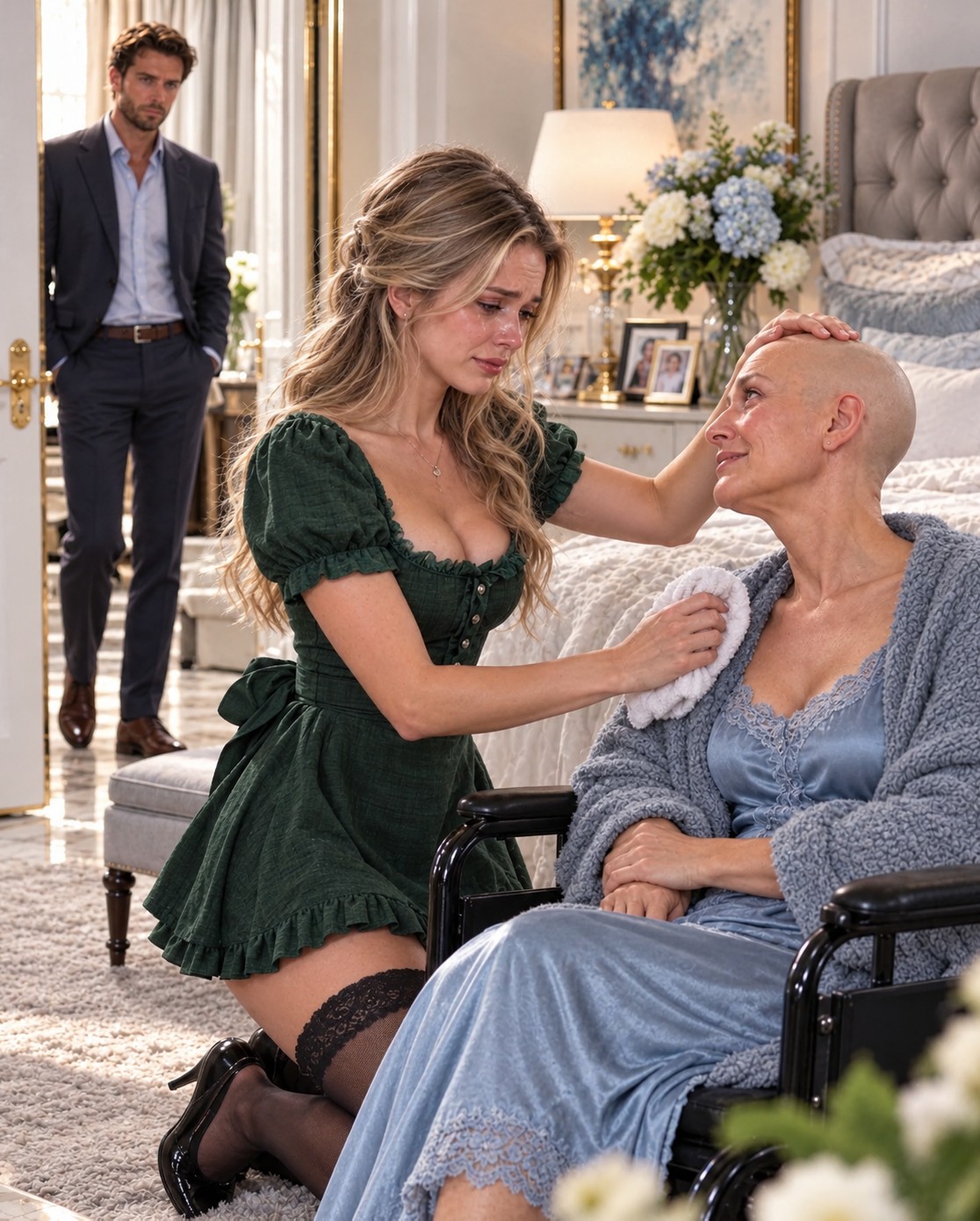
Through the narrow opening, I saw a young woman kneeling beside my mother’s wheelchair.
Her name was Hannah Miller.
She had worked in our household for almost six months as a quiet domestic employee. She was around twenty-seven, with brown hair tied neatly into a knot and a plain gray maid’s uniform.
She was the kind of person who moved so quietly through the mansion that you barely noticed she was there.
I certainly had not noticed her much during those busy months.
Now she was crying.
In her right hand was a small electric shaver.
A clean white towel covered my mother’s shoulders, and soft strands of silver hair lay scattered across it.
My mother’s head was almost completely shaved beneath the bright bedroom light.
My first reaction was anger.
Nobody had asked my permission.
That possessive thought appeared automatically, and I immediately felt ashamed of it.
Then Hannah wiped a tear from her cheek with the back of her wrist.
“I am almost finished with the shave,” she whispered.
“Stop talking to me as if I were five years old,” Mother complained.
“You are being terribly difficult today,” Hannah said, laughing softly through her tears.
“I have stage-four cancer. That gives me special privileges.”
“It gives you severe nausea. It does not give you permission to insult my haircutting technique.”
“Well, you left a patch on the side,” Mother said, pointing toward her head.
“I was getting to that area.”
“I look like a terribly peeled potato.”
Hannah covered her mouth to stop herself from laughing.
Mother smiled.
It was a brilliant, genuine smile.
And that smile changed her entire face.
For one sharp moment, I saw the woman from my childhood again.
I saw my mother standing barefoot in our summer kitchen, wiping flour from her cheek while loud music played in the background. My father had been complaining from the nearby library, but Mother had kept laughing because she knew he secretly enjoyed the song.
That woman had been disappearing by inches for eight months.
Yet somehow, this young housekeeper had brought her back.
I stayed hidden outside the door.
Hannah gently passed the shaver over the last remaining silver hairs and switched it off.
Silence settled over the room.
Mother raised one hand and touched her smooth scalp.
Her smile disappeared.
Hannah immediately lowered the shaver into her lap.
Neither woman spoke.
Mother stared at herself in the oval mirror.
Something in her expression collapsed.
She did not cry or make a dramatic scene. Her thin mouth simply tightened as she stared at the unfamiliar woman in the reflection.
Hannah noticed immediately.
She moved closer to the wheelchair.
“You are still incredibly beautiful,” Hannah said softly.
“You are an atrocious liar,” Mother snorted.
“No. I am telling you the absolute truth.”
“You look like someone who is still very much here with us,” Hannah added gently.
Mother closed her eyes.
Then she reached down and squeezed Hannah’s small hand.
That was when I quietly walked away.
I still do not completely understand why.
The moment felt private.
Maybe it was because I suddenly realized that my enormous fortune and our family name were useless in that room.
A young housekeeper earning twenty-two dollars an hour had accomplished something all my money could not buy.
She had made my mother feel less alone.
The next morning at nine o’clock, I summoned Hannah to my private study.
She knocked twice before entering.
“Did you ask to see me, Mr. Delacroix?” she asked quietly.
“Close the door behind you.”
Her fingers paused on the polished brass handle before she obeyed.
My study occupied the large southeast corner of the mansion. Dark wood covered the walls, and a black marble fireplace dominated one side of the room.
Through the enormous windows, I could see the twenty acres my father had purchased because he did not want neighbors.
Hannah stood in front of my mahogany desk with her hands folded neatly over her gray uniform.
I studied her for a moment.
“You were originally hired to clean this estate,” I said.
“Yes, sir.”
“Then why have you been spending your shifts providing personal care for my mother?”
She hesitated for only a second.
“Because she was frightened.”
Her simple answer irritated me.
Not because it was disrespectful.
Because it was true.
“She has expensive full-time nurses,” I reminded her.
“The nurses are here to monitor her physical condition,” Hannah replied. “That is not the same thing as sitting beside someone when they are afraid they might die.”
My jaw tightened.
“Do you honestly believe I fail to sit with my own mother?”
“I did not say that, Mr. Delacroix.”
“You certainly implied it.”
“No, sir. I did not.”
Her voice was calm.
Not defiant.
Not rude.
She simply refused to be intimidated.
I stood and walked around the desk.
“What exactly have you been doing for her?”
“I make her fresh tea.”
“We have an entire kitchen staff.”
“The medical staff prepares what she is supposed to drink. But she prefers fresh ginger with extra honey.”
I said nothing.
“She has also been struggling with severe insomnia,” Hannah continued.
“I am aware of her sleep problems.”
“She sleeps much better when someone reads to her.”
I frowned.
“My mother has always hated audiobooks.”
“I do not use audiobooks.”
“What do you read?”
“Agatha Christie novels.”
I stared at her.
“My mother has claimed to hate mystery novels her entire life.”
“She claims that to me too,” Hannah said with a faint smile.
“What else have you been doing without my knowledge?”
Hannah looked down at her hands.
“Her hair started falling out in large clumps about three weeks ago.”
I knew her hair loss had become worse recently, but I had not known it had been happening for three weeks.
“She started sleeping with thick towels over her pillows so nobody would see the hair in the morning.”
My chest tightened.
“She also hides her stronger pain medication when it makes her mind feel cloudy.”
I stopped pacing.
“What did you just say?”
“She dislikes feeling as though the doctors and family are speaking around her.”
“Why was I not informed?”
Hannah looked directly into my eyes.
“Because she specifically asked the staff not to tell you.”
“Why?”
She hesitated.
“Hannah. Answer me.”
“She told me you already looked far too frightened whenever you visited her.”
Her words hit harder than any business criticism ever had.
I turned toward the window.
Outside, the February frost covered the estate beneath a dull gray sky.
Behind me, Hannah continued.
“Some nights she wakes around two in the morning.”
“You are not scheduled to work overnight.”
“No, sir.”
“Then why are you in her room at those hours?”
“I chose to stay with her a few times.”
“Who authorized those extra hours?”
“Nobody.”
I turned around.
“Are you telling me you work sixteen-hour days without claiming overtime?”
“I clock out at the normal end of my shift.”
“That was not my question.”
“She did not want another complete stranger standing over her bed.”
The words struck me.
My mother’s room had become a revolving door of expensive professionals.
Every one of them was highly qualified.
Every one of them was temporary.
“How did this arrangement begin?”
Hannah folded her hands together.
“She simply could not sleep one evening.”
“And what did you do?”
“I sat beside her chair.”
“That was all?”
“Yes.”
I almost laughed.
It was absurd.
Men in my world spent entire days arguing about territory, loyalty, debt, money, and power.
Yet this young woman had walked into my mother’s room and helped her by doing something so simple.
She had stayed.
Before I could respond, the heavy study door opened without a knock.
My mother rolled into the room in her wheelchair.
She wore a bright silk scarf over her bald head.
Behind her, Nurse Laura looked completely exhausted.
“I specifically instructed Mrs. Delacroix to wait for assistance,” Laura reported.
Mother waved her away.
“Go bother someone who actually respects medical advice.”
Laura sighed and closed the door.
Mother looked from Hannah to me.
Then she pointed at Hannah.
“That young woman has treated me more like real family than anyone else in this mansion.”
My chest tightened.
“Mother, that is unfair.”
“I mean every word of it.”
“I have provided you with the best care money can buy.”
“Exactly, Christopher,” she replied quietly. “You provided me with endless money.”
Silence filled the study.
Mother reached toward Hannah.
Hannah immediately stepped forward and took her hand.
Mother looked at me.
“Hannah gave me her precious time.”
I could not answer.
“You enter my room with world-renowned specialists,” Mother continued. “You stand beside my bed and ask if I need anything.”
She paused.
“And before I can even answer, you are already looking at your phone.”
“That is not a fair description of my visits.”
“No, darling. It really isn’t fair.”
Her gentle tone hurt more than anger would have.
“You are terrified,” she said.
“I am not terrified.”
I knew I was lying.
“You have been terrified ever since the oncologist told you it was stage four.”
My throat tightened.
Mother squeezed Hannah’s hand.
“If my son fires you today, I am leaving this estate with you.”
Hannah’s eyes widened.
“Mrs. Delacroix, please don’t say that.”
“Nobody is being fired,” I said quickly.
“I expected you might terminate her.”
“I was not planning to fire anyone.”
Mother raised an eyebrow.
“You certainly had your firing face on when I came in.”
“I do not have a firing face.”
Both women looked at me.
Their silence said everything.
Mother smiled faintly.
Then her expression became serious.
“There is something important you need to know about Hannah.”
Hannah’s face immediately lost its color.
“Mrs. Delacroix, please do not do this.”
“No, my dear. It is time.”
“Not like this,” Hannah whispered.
“He should have known this truth decades ago,” Mother said firmly.
I slowly stood.
“Known what?”
Hannah looked sick.
“Florence, please reconsider.”
Mother looked directly at me.
“There was someone else in my life long before I met your father.”
I waited.
“His name was Caleb Ross.”
She swallowed.
“He was nineteen years old and worked in my family’s stables during the summer when I was seventeen.”
I stared at her.
“Mother, what does a stable boy have to do with Hannah?”
Mother’s eyes filled with tears.
“I became pregnant that summer.”
The room seemed to tilt.
I looked at Hannah.
Then back at my mother.
“No.”
It was the only word I could manage.
“My parents sent me away to an isolated facility for six months,” Mother continued. “They told everyone I had gone to Switzerland to study.”
My heartbeat thundered in my ears.
“I gave birth to a healthy baby girl.”
I already knew what was coming.
“My father arranged everything to cover up the scandal. Caleb was dismissed immediately, and the baby was placed with an adoptive family.”
Mother touched the silk scarf covering her head.
“I was allowed to hold my baby for exactly eleven minutes before they took her away.”
Her voice broke.
“What did you name her?”
Mother began crying.
“Chloe.”
I looked at Hannah.
Slowly, she raised her head.
And suddenly I saw it.
My mother’s eyes.
Her chin.
The same delicate shape around her mouth.
How had I failed to notice it for six months?
Hannah spoke quietly.
“Chloe Ross was my biological mother.”
I stopped breathing.
Mother’s tears ran down her cheeks.
“She was my lost daughter,” she sobbed.
Hannah looked directly at me.
“Which makes me your biological niece, Christopher.”
For perhaps the first time in my entire adult life, I had absolutely no idea what to say.
Part 2: The Daughter Our Family Erased
I walked out of my study without saying another word.
I was not angry.
I simply could not breathe.
I moved down the grand west hallway, passing rows of framed family portraits.
My grandfather.
My father.
My great-uncles.
All of them stared down at me with the same stern expressions.
These were the men who had built our fortune through shipping, real estate, and private investments.
I had grown up beneath those portraits.
They had taught me that family came first.
That blood was everything.
That loyalty mattered more than law.
Yet behind those expensive frames was the story of a seventeen-year-old girl whose newborn daughter had been taken away because the family considered her inconvenient.
Family came first.
Apparently, only when the family member obeyed the rules.
I heard footsteps behind me.
“Mr. Delacroix,” Hannah called softly.
I kept walking.
“Christopher.”
I stopped.
She had never called me by my first name during her entire time working in our house.
I turned around.
She stood about twenty feet away beneath the enormous vaulted ceiling.
She had removed her white apron and was now wearing a plain sweater.
“Did you know about the connection when you applied for the job?” I asked.
“Yes.”
There was no hesitation.
“So you lied on your application.”
“I applied for an open housekeeping position through normal channels.”
“Knowing who owned this house?”
“Yes.”
“Knowing that my mother was your biological grandmother?”
“Yes.”
“You entered my private home under false pretenses.”
Her jaw tightened.
“I cleaned your bathrooms for six months, Mr. Delacroix. I assure you those pretenses felt very real every single day.”
“That is not funny.”
“I know.”
“Were you looking for money from our family?”
Her expression changed.
I instantly regretted the question.
But I did not take it back.
That was the man I had been trained to be.
Suspect first.
Regret later.
Hannah reached into the pocket of her cardigan.
She removed a faded black-and-white photograph.
She walked toward me and held it out.
I hesitated before taking it.
The photograph showed a woman in her mid-forties standing beside an old green station wagon.
She was laughing beneath the sunlight, one arm around a teenage Hannah.
The woman’s eyes were unmistakable.
They were my mother’s eyes.
“This was my mother, Chloe,” Hannah said.
My biological sister.
A sister I had never known existed.
“When did she die?” I asked.
“Four years ago.”
“How?”
Hannah’s voice dropped.
“Cancer.”
My fingers tightened around the photograph.
“What kind?”
“Ovarian cancer.”
The hallway seemed to disappear around me.
Suddenly, I was back in Mother’s bedroom.
The razor.
The white towel.
The silver hair falling onto the fabric.
“You had already done this before,” I whispered.
Hannah nodded.
“When my mother’s hair started falling out, she asked me to shave her head.”
I finally understood her tears.
They had not simply been for an employer.
She had stood beside two women from the same bloodline and performed the same act of love for both.
“How old were you when Chloe died?”
“Twenty-two.”
“Did you have to handle everything alone?”
“For the most part.”
“Where was her husband?”
“My father died when I was fourteen.”
I carefully returned the photograph.
“How did Chloe discover the truth about my mother?”
“She didn’t know most of her life.”
“Then when?”
“Near the end of her illness.”
Hannah walked to a wide window seat and sat down.
“She had been adopted by David and Margaret Miller.”
“They were good people,” she continued. “Hardworking. Kind. They weren’t wealthy or powerful, but they loved her.”
I understood the comparison.
After Margaret died, Chloe began cleaning out the attic.
“She found a hidden box,” Hannah explained.
“What was inside?”
“Letters.”
She reached into her cardigan again.
This time she removed an old envelope.
The paper had yellowed with age.
Across the front, in my mother’s delicate handwriting, was a single word.
Chloe.
“She wrote a letter every year on her birthday,” Hannah said.
“Florence wrote them?”
“Yes. Every year from Chloe’s first birthday until her twenty-first.”
“Why weren’t they mailed?”
“A few of the first ones were.”
“What happened?”
“The adoption had been finalized as a closed adoption. Chloe’s adoptive parents returned the first three because they were afraid Florence might try to reclaim her legally.”
“And after that?”
Hannah looked toward my grandfather’s portrait.
“Your grandfather intercepted every letter before they could leave the estate.”
I stared at his photograph.
The same man who had preached that family came first.
“Mother kept writing?”
“Every year.”
“Why?”
Hannah looked at me as though the answer should have been obvious.
“Because she was her biological mother.”
I sat on the wooden bench across from her.
“What happened when Chloe found the letters?”
“She desperately wanted answers.”
“Did she contact Florence?”
“No.”
“Why?”
“She was already very sick.”
Hannah looked toward my mother’s private wing.
“She assumed Florence had willingly chosen the wealthy Delacroix family over her.”
My chest tightened.
“Did she hate my mother?”
“No.”
Hannah gave me a sad smile.
“In some ways, hating her would have been easier.”
I understood that.
Sometimes the people who hurt us most are the people we desperately want to love.
“She asked me once if I thought Florence remembered her birthday,” Hannah continued.
“What did you tell her?”
“That I didn’t know.”
Hannah looked down at her hands.
“After my mother died, I read every letter.”
Her voice cracked.
“And I realized Florence had remembered every single birthday.”
I pictured my mother at thirty.
Forty.
Fifty.
Sitting somewhere inside this enormous mansion while my father conducted business downstairs.
Writing letters to the daughter nobody was allowed to mention.
“Why did you come here?” I asked.
“I wanted to return the letters to her personally.”
“To Mother?”
“Yes.”
“Why didn’t you simply come to the front door?”
Hannah gave a quiet, sad laugh.
“I tried.”
“When?”
“About seven months ago.”
A memory surfaced.
A security report.
A young woman had arrived at the north gate claiming she had personal business with Florence Delacroix.
Security had refused her entry.
I had initialed the report without reading the details.
“You were turned away.”
“Yes.”
“Because of my standing instructions.”
“Because of your rules,” she corrected gently.
It was the same result.
“So you applied for the housekeeping job.”
“I saw the public listing.”
“Did Mother recognize you immediately?”
“No.”
“What happened?”
“During my third week, I was dusting furniture in her dressing room.”
Hannah paused.
“She asked why I was staring at a small blue jewelry box on her dresser.”
I knew the box.
It had been there my entire childhood.
“My mother owned one that looked exactly like it,” Hannah continued.
“What happened next?”
“Florence dropped a crystal perfume bottle.”
I could almost see it.
“She immediately asked for my mother’s full name.”
“And you told her Chloe.”
Hannah nodded.
“She sat down on the floor and cried.”
I felt my eyes burning.
“She couldn’t stand for ten minutes.”
My mother had known her granddaughter for almost six months without telling me.
“Why did she keep it from me?”
Hannah looked uncomfortable.
“You should ask her.”
“I am asking for your opinion.”
“She was afraid.”
“Of my reaction?”
“Yes.”
“Why?”
“Because she thought you would react exactly the way you did ten minutes ago.”
I looked away.
“By asking whether I wanted money?”
“Yes.”
Hannah’s voice remained gentle.
“Your mother spent her life surrounded by men who measured love in inheritance, property, and power.”
She paused.
“She thought you might look at me through the same lens.”
Her words hurt because they were not cruel.
They were simply accurate.
“Did you know Mother had terminal cancer before you applied?”
“Yes.”
“How?”
“It was mentioned in a local news story about her charitable foundation.”
“And you still took a job here?”
“I realized I was running out of time to meet her.”
That ended our argument.
That evening, I ate dinner with Mother in her bedroom.
She had asked for simple tomato soup.
Our executive kitchen prepared an elaborate dish with roasted heirloom tomatoes, basil oil, and fresh cream.
Mother took one spoonful.
“This tastes terrible.”
“You hired the executive chef.”
“Your father hired him.”
“Father has been dead for nine years.”
“And yet his decisions still irritate me every day.”
The bedroom door opened.
Hannah entered carrying a silver tray.
On it was a plain ceramic bowl of tomato soup.
Mother’s face immediately brightened.
I stared at the bowl.
Hannah shrugged.
“It came from a can.”
Mother took a full spoonful.
“This is perfect.”
I nearly laughed.
The difference between the two meals could not have been greater.
Hannah quietly left the room.
I waited until her footsteps disappeared.
“Why didn’t you tell me about Hannah sooner?”
Mother put down her spoon.
“Because I was ashamed.”
“Ashamed of Chloe?”
Her eyes flashed.
“Never of my daughter.”
“Then what?”
“My cowardice.”
She looked toward the window.
“At seventeen, I believed adults had absolute power.”
She swallowed.
“My father told me there was nothing I could do. My mother told me keeping the baby would destroy my future.”
A tear rolled down her cheek.
“Then the nurses put my baby girl in my arms.”
Mother smiled through her tears.
“She had thick black hair.”
Her voice became softer.
“Can you imagine that? All that beautiful black hair.”
I could not speak.
“She opened her tiny eyes once.”
Mother wiped her cheek.
“I spent forty-nine years wondering whether she remembered me.”
“She was a newborn,” I said gently. “She couldn’t have.”
“I know that logically.”
She looked at me.
“Grief is rarely logical, Christopher.”
I hesitated.
“What about Father?”
Her expression hardened immediately.
“Your father knew.”
“He knew about Chloe?”
“He knew everything.”
“Before you married him?”
“Yes.”
“And he still married you?”
Mother gave a bitter laugh.
“You make that sound like an act of generosity.”
I waited.
“He told me the past would remain buried as long as I behaved.”
A chill moved through me.
“What did he mean by behaved?”
“It meant being a proper Delacroix wife.”
She counted the rules on her fingers.
“Smiling beside him at events. Hosting elegant dinners. Never asking where he spent his late nights.”
She looked at me.
“It meant never asking why dangerous men sometimes arrived bleeding at our back entrance.”
My stomach tightened.
“And it meant never searching for Chloe.”
“Did he threaten you?”
“Yes.”
“With what?”
“Losing you.”
My chest tightened.
“He made it clear that if I ever left, I would never see you again.”
I leaned back in the chair.
Mother gave me a sad smile.
“You were only five years old.”
I remembered nothing.
Of course I didn’t.
Children remember school lunches and bedtime stories.
They do not understand why their mothers quietly cry while packing those lunches.
“I stayed for you,” Mother said.
“Please don’t make my existence the reason you suffered.”
“You were not the cause.”
“Mother—”
“He was the cause.”
Her voice was firm.
“Never carry guilt for the cruel choices other people force upon you.”
She reached across the blanket and placed her thin hand over mine.
“Christopher.”
I looked at her.
“I loved you with all my heart.”
She swallowed.
“And I loved Chloe just as deeply.”
She squeezed my hand.
“Those two truths were never enemies.”
She looked toward the window.
“I simply lived among ruthless men who insisted they were.”
The next two months changed our household completely.
Hannah stopped wearing her maid uniform.
Not because I ordered it.
Because Mother demanded it.
“She is my biological granddaughter,” Mother announced to the household staff. “I will not sit here and watch her scrub your marble bathtubs.”
I almost reminded Mother that Hannah was still technically an employee.
One look from her ended that thought.
Hannah no longer had a formal job title.
She simply became family.
At first, I remained suspicious.
Then I began noticing the little things.
Hannah knew Mother wanted the curtains open at sunrise and closed before noon.
She knew which days required ginger tea and which required crushed ice.
She never told Mother to eat.
Instead, she turned food into a game.
“I stole three strawberries from Christopher’s ridiculously expensive refrigerator,” she would say. “We have to destroy the evidence before he notices.”
Mother would laugh.
And then eat two.
Hannah showed me every day that sometimes the smallest acts of presence mattered most.
One night, around one in the morning, I walked past Mother’s room.
An old black-and-white movie was playing.
Mother was asleep in her wheelchair.
Hannah sat quietly in the armchair beside her.
“You should go home and sleep,” I said.
Hannah looked at me.
“You should go to bed too.”
“I live here.”
“That must be exhausting.”
I stepped inside and sat in the empty chair across from her.
For ten minutes, neither of us spoke.
Then I asked the question that had been growing inside me.
“Was Chloe like Mother?”
Hannah smiled.
“In some ways.”
“Did she have Mother’s temper?”
“Worse.”
I smiled.
“Heaven help us.”
“My mother hated being told what to do.”
“That is definitely genetic.”
Hannah looked toward my sleeping mother.
“She had the same laugh.”
Something inside me softened.
“What was her life like?”
Hannah thought for a moment.
“She sang terribly off-key.”
“Mother does that too.”
“She put black pepper on watermelon.”
I frowned.
“That sounds criminal.”
Hannah laughed.
“She worked at the local public library.”
“In the general collection?”
“The children’s department.”
I tried to imagine my unknown sister reading stories to children.
“Did she know about me?”
“Yes.”
“How?”
“The letters.”
“What did Mother write about me?”
“A lot.”
“Like what?”
“She wrote a long letter on the day you were born.”
Hannah smiled.
“She told Chloe that you had the loudest cry she had ever heard in a delivery room.”
“That seems unnecessary.”
“She also wrote that you grabbed her finger with your tiny hand and refused to let go.”
I looked toward Mother.
“She wished Chloe could meet her new baby brother.”
Mother looked so fragile beneath the blanket.
For the first time in my life, I realized that my childhood had contained an invisible third presence.
A sister I had never met.
Someone who had existed in spirit at birthdays, holidays, and family photographs.
Someone my mother had never stopped remembering.
By March, Mother’s health deteriorated rapidly.
One afternoon, her primary physician asked to speak with me in the hallway.
I already knew what he was going to say.
Doctors developed a particular tone when money could no longer change the outcome.
“We are looking at days to a few weeks at most,” he said.
“How many days?”
“It is impossible to know exactly.”
“You just said—”
“Christopher.”
Hannah’s voice came from behind me.
I turned.
She had heard everything.
Her face was pale, but she remained calm.
The doctor nodded politely and walked away.
I immediately turned toward the window.
“We need another medical opinion.”
Hannah said nothing.
“There is an experimental trial in Toronto.”
Silence.
“There is an advanced immunotherapy group in Geneva.”
“Christopher.”
“I can have the private jet ready within forty minutes.”
“Christopher.”
Her voice became firmer.
“Stop this.”
I spun around.
“Do not tell me to stop trying to save my mother.”
“She does not want to get on another airplane.”
“You cannot possibly know what my mother wants better than I do.”
“Yes,” Hannah said quietly. “I actually do.”
“You have known her for six months.”
The moment the words left my mouth, I regretted them.
Hannah flinched.
Her eyes filled with tears.
“You are right about the timeline,” she said softly.
She turned and walked away.
I stepped after her and caught her upper arm.
The moment I realized what I had done, I released her.
“Hannah, I’m sorry.”
She turned back.
“Your mother asked me this morning not to let you put her on another plane.”
My chest felt hollow.
“She asked you directly?”
“Yes.”
“Why didn’t she tell me?”
“Because you don’t listen to the word no when you’re terrified.”
I looked away.
She was right.
Again.
“What am I supposed to do now?” I asked.
The question came out before I could stop it.
I was no longer Christopher Delacroix, the man who solved problems with money.
I was simply a son who was about to lose his mother.
Hannah’s expression softened.
“Sit beside her.”
“That cannot possibly be all I can do.”
“No,” Hannah whispered, wiping a tear from her cheek.
“It is simply all that is left to give her now.”
Part 3: What the Delacroix Name Cost
My mother died sixteen days after that conversation in the hallway.
Those sixteen days became the most meaningful days we had ever shared.
That truth nearly broke my heart.
Yet strangely, it also gave me comfort.
For the first time, we stopped pretending that Mother was going to recover. There was no more false hope, no more discussion about another specialist or another experimental treatment.
And once we stopped pretending, something changed inside the estate.
The atmosphere became lighter.
Mother insisted on eating rich chocolate cake for breakfast.
She ordered me to cancel my executive board meetings so I could stay with her.
She even ordered Hannah to wheel her chair onto the cold stone terrace despite the bitter winter air.
One afternoon, Mother suddenly demanded that we open a bottle of expensive champagne.
Her private nurse immediately objected.
“Mrs. Delacroix, alcohol is not recommended with your medication.”
Mother slowly turned her head toward me.
She had a mischievous look in her eyes.
“You are supposed to be a ruthless corporate figure, Christopher. Make yourself useful.”
I smiled.
Then I opened the bottle.
The cork popped loudly across the room.
I poured three small glasses.
Hannah laughed so hard that she accidentally spilled half of hers down the front of her sweater.
Mother took three tiny sips.
Then she made a terrible face.
“This expensive champagne tastes completely dreadful.”
Hannah started laughing again.
So did I.
For the first time in months, our laughter filled the room instead of medical alarms and whispered conversations.
We spent our afternoons playing simple card games on Mother’s bed.
She cheated shamelessly.
Whenever I caught her, she accused me of cheating.
Hannah eventually caught both of us trying to change the cards when the other wasn’t looking.
“You two are absolutely hopeless,” she declared.
Mother looked offended.
“I am dying. I deserve to cheat.”
“That is not how card games work,” Hannah replied.
“It is now.”
Even then, Mother made us laugh.
One evening, Mother insisted that we eat dinner downstairs in the formal dining room.
“We are having a proper family dinner tonight,” she announced.
That sentence changed the atmosphere instantly.
The enormous dining table could seat twenty-four people.
Only three chairs were occupied.
Mother sat at one end.
Hannah sat beside me.
I sat across from them.
Halfway through the meal, Mother slowly placed her silver fork on the linen napkin.
“Christopher.”
“Yes, Mother?”
“When I am gone, do not make yourself lonely because you think that is somehow loyal to my memory.”
I stared at her.
“Mother, please.”
“I am completely serious.”
She turned toward Hannah.
“And I expect you not to disappear from this family either.”
Hannah’s eyes immediately filled with tears.
“I have no intention of going anywhere.”
“Good.”
Mother pointed her thin finger between the two of us.
“You two have wasted far too many years without knowing each other.”
I swallowed.
“I didn’t even know she existed.”
“And she didn’t know you existed either,” Mother replied softly.
Then she smiled.
“So stop wasting time now that you have finally found each other.”
Hannah looked across the table at me.
For the first time, I said the words aloud.
She was not my employee.
She was not simply Mother’s caregiver.
She was not simply Chloe’s daughter.
She was my family.
“You are my family,” I said.
Hannah’s face crumpled with emotion.
Mother closed her eyes.
A single tear slipped down her cheek.
She smiled peacefully.
At that moment, I believed our story had reached its perfect ending.
It would have made a beautiful ending.
But real life rarely stops when the story seems finished.
Three nights later, at exactly 4:11 in the morning, Mother woke suddenly.
Hannah was asleep in the armchair beside her bed.
I was resting on the sofa nearby.
“Christopher,” Mother whispered into the darkness.
I stood immediately.
“I am right here, Mother.”
She moved her eyes toward Hannah.
“Wake her.”
Before I could touch Hannah’s shoulder, Hannah’s eyes opened.
People who care for terminally ill patients seem to develop an unusual ability to sleep lightly.
She immediately sat upright and moved toward the bed.
Mother reached out and took one of Hannah’s hands.
Then she reached for mine.
Her breathing had changed.
It was slower now.
Uneven.
The night nurse remained quietly near the doorway, giving us privacy.
Mother looked at Hannah.
“You have Chloe’s exact hands.”
Hannah began crying.
“You tell me that every day.”
“Because it remains true every day.”
Mother turned toward me.
“Christopher.”
“Yes, Mother?”
“Do not build cold walls around yourself simply because you are afraid.”
I tried to smile.
“That is remarkably vague advice.”
“You were always an extraordinarily difficult child.”
“You encouraged that behavior.”
“Unfortunately, I suppose I did.”
Her voice became weaker.
Her eyes closed for several seconds.
My heart stopped.
“Mother, please stay with us.”
Her eyes opened again.
“I am not completely gone yet, my boy.”
Hannah laughed through her tears.
Mother smiled faintly.
Then she looked at both of us.
“I spent my entire adult life believing I needed more time.”
Her thumb moved weakly across the back of my hand.
“What I really needed was courage.”
I leaned closer.
“You were incredibly brave.”
“No, I wasn’t.”
She looked at Hannah.
“But this girl was.”
Hannah shook her head.
“Please don’t say that.”
Mother’s breathing suddenly caught.
She looked from Hannah to me.
Her eyes seemed to hold the entire history of our family.
A lost daughter.
A granddaughter who had returned.
A son who had spent his life protecting the wrong things.
We were the surviving pieces of a family that had been broken apart before either of us understood what loss meant.
Then Mother exhaled.
One long, final breath.
Her fingers relaxed inside our hands.
Silence filled the room.
I stood beside the bed, waiting for another breath.
It never came.
Hannah lowered her forehead onto Mother’s hand.
She began sobbing.
A tiny, broken sound escaped her.
“Mama Chloe,” she whispered.
Then she pressed Mother’s hand against her face.
“Grandma Florence.”
I stood beside the bed of the most important woman in my life.
And for the first time, I understood something money had never been able to teach me.
There are losses in life that no fortune can defeat.
Mother’s memorial service filled a historic cathedral almost completely.
Politicians attended.
Federal judges attended.
Corporate executives attended.
People from high society filled the pews.
Men who had once feared my father were there.
Men who now feared my influence were there too.
People I had not spoken to in twenty years shook my hand and told me what an extraordinary woman Florence Delacroix had been.
I wanted to ask them where they had been when she was lying awake at two in the morning, frightened and alone.
But I said nothing.
Hannah sat beside me in the very front pew.
Not behind the household staff.
Not somewhere in the back.
Beside me.
As my equal.
Whenever someone asked who she was, I gave the same answer.
“She is my biological niece.”
Every time I said those words, Hannah looked at me with surprise.
By the end of the day, she no longer looked surprised.
She simply smiled.
After the private burial, everyone returned to the estate for the reception.
Expensive whiskey was poured.
Elegant flowers filled the rooms.
People spoke in quiet voices about Mother.
It was polished grief.
Beautiful grief.
Expensive grief.
At seven that evening, Hannah quietly disappeared from the reception.
I found her upstairs in Mother’s bedroom.
All the medical equipment had already been removed.
The bed had been made with fresh white sheets.
The room looked normal.
That made it worse.
Hannah stood beside the vanity.
In her hands was the small blue jewelry box.
“Mother left that box to you,” I told her.
Hannah nodded.
She did not open it.
Inside were dozens of preserved letters.
Every birthday letter Mother had written to Chloe.
Hannah carefully touched the yellow envelopes.
“There is something else inside this drawer,” she said.
She opened it and handed me a white envelope.
My name was written across the front.
Christopher.
I sat on the edge of Mother’s bed and opened it carefully.
Inside was a small silver key.
There was also one handwritten sentence.
The truth your father forced me to conceal is hidden in his private library behind his portrait. The key opens the safe. Forgive me for waiting until death gave me the courage to tell you.
I read it twice.
Then I looked at Hannah.
She sat beside me.
“What truth is she talking about?” she asked.
“I don’t know.”
And for the first time, I realized how wrong I had been.
I had spent my entire life believing I knew every dark secret hidden inside our family.
I didn’t.
My father’s private library had remained almost untouched since his death nine years earlier.
It still smelled faintly of expensive cigars.
Towering bookshelves covered the walls.
Heavy leather chairs stood beside the fireplace.
Above the stone hearth hung my father’s formal portrait.
He looked exactly as I remembered him.
Powerful.
Cold.
Untouchable.
I walked toward the fireplace.
Then I removed the portrait from the wall.
Behind it was a steel safe.
I inserted the silver key.
It fit perfectly.
The lock clicked.
Inside were financial ledgers, property deeds, personal letters, and a thin legal folder.
A small cassette recorder sat on top of everything.
Hannah stepped beside me.
“What are all these documents?”
I picked up the legal folder.
At first, the numbers meant very little.
Then I saw my mother’s maiden name.
Whitmore.
My mother’s father had built a huge shipping company and owned extensive waterfront property.
I had always known that.
What I had never known was that Mother had not been his only heir.
The documents named another beneficiary.
My hands went cold.
The name was printed clearly.
Chloe Florence Whitmore.
“Hannah.”
She stepped closer.
I handed her the document.
She stared at it.
“That is my mother’s name.”
“Your mother had a legitimate inheritance.”
“But she was adopted.”
“Being adopted did not erase her legal inheritance.”
I turned the page.
The numbers were enormous.
The assets represented tens of millions of dollars in today’s value.
Then I found the transfer agreement.
It had supposedly been signed when Chloe was eleven years old.
The document claimed that she had transferred her entire inheritance into a Delacroix holding company.
I stared at the signature.
Chloe Florence Whitmore.
My stomach turned.
An eleven-year-old child could not have knowingly and legally authorized a complex transfer of millions of dollars in assets.
The document had been forged.
And I knew immediately who had done it.
My father.
He had stolen Chloe’s inheritance and used it to build his business empire.
I turned page after page.
The money had been used to purchase commercial land.
Industrial warehouses.
Corporate holdings.
Investments.
Assets that eventually became part of the fortune I had inherited.
My father’s empire had been built, at least in part, with money stolen from the daughter our family had erased.
I looked around the library.
The mahogany walls.
The expensive furniture.
The artwork.
Everything suddenly looked different.
Everything felt contaminated.
Hannah stepped away from the desk.
“My mother worked two jobs most of her life,” she whispered.
I couldn’t answer.
“She skipped dental appointments because we didn’t have enough money.”
Tears ran down her cheeks.
“She drove the same failing car for sixteen years.”
I closed my eyes.
“When I was eleven, our electricity was shut off for four days because we couldn’t pay the bill.”
“Hannah…”
“My mother owned a fortune?”
Her voice broke.
“While we were heating canned soup on a little camping stove during the winter?”
I had nothing to say.
She wasn’t crying because she wanted money.
She was crying because she finally understood what had been stolen from her mother.
Not only money.
Years.
Opportunities.
Security.
A different life.
Her mother had struggled while the stolen fortune built the life surrounding us.
I reached toward Hannah.
She stepped back.
The rejection hurt.
But I understood.
“You didn’t know about the theft,” she said quietly.
“That doesn’t change where the money ended up.”
“No.”
She wiped her tears.
“It doesn’t.”
I looked back inside the safe.
Then I noticed another envelope.
It was tucked behind the financial records.
My mother’s handwriting was on the front.
For Hannah.
I removed it and handed it to her.
She hesitated before opening it.
Then she began reading.
Her expression changed.
Shock.
Then sadness.
Then something deeper.
She covered her mouth.
“What does it say?” I asked.
She shook her head.
“Read it yourself.”
She handed it to me.
I unfolded the paper.
My darling girl,
There is one final cruelty you deserve to know about this estate.
Your mother discovered the truth about her stolen inheritance six months before she died.
I stopped reading.
I looked at Hannah.
Her face had gone completely pale.
I continued.
Chloe contacted me directly after forty-eight years apart.
My daughter finally called my home.
My vision blurred.
She did not demand an explanation for why I gave her away.
She did not ask for money.
She did not demand property.
She asked me only one question.
“Did you know about the theft?”
I swallowed.
I swore to her that I had known nothing about Victor’s actions.
Your grandfather stole her inheritance without telling me.
I begged Chloe to allow me to return the money.
She refused.
Hannah was crying beside me.
I continued.
She told me, “I don’t want Delacroix money, Florence. I simply wanted my mother.”
I closed my eyes.
Chloe had known she was dying.
And all she wanted was her mother.
I kept reading.
Chloe kept her contact with me secret from Christopher because she knew he would become protective and angry on her behalf.
We spoke eleven times during those final months.
Once, we spoke for three hours.
She told me about Hannah.
She told me about her childhood.
She told me about Christopher.
She told me about his first day of school, his broken wrist, his love of fresh strawberries, and his terrible singing.
Hannah laughed softly through her tears.
I smiled despite myself.
Then I read the next paragraph.
Chloe gave me one final promise to make.
She told me that if Hannah ever came looking for me, I must never try to buy her forgiveness with money.
“If Hannah grows to love you,” Chloe told me, “let her love you because you finally learned how to stay.”
My hands shook as I reached the final paragraph.
There is another reason I kept this truth from Christopher.
I was ashamed that part of everything he inherited came from what Victor stole from Chloe.
Christopher believes financial power protects a family.
Please teach him what you taught me.
Family is not defined by what you can provide.
It is defined by who you choose to stay beside when there is nothing left to give.
I lowered the letter.
Neither of us spoke.
Then Hannah pointed toward the cassette recorder.
“What do you think is on that?”
I picked it up.
I pressed play.
Static filled the room.
Then Mother’s voice came through the small speaker.
“Christopher, if you are hearing this, I am already gone.”
My throat closed.
“You are probably already calculating how to return the stolen assets.”
Despite everything, I almost smiled.
She knew me too well.
“Stop calculating for five minutes and listen to me.”
Hannah covered her mouth as a tearful laugh escaped her.
“You cannot repair fifty years of separation by writing a large check.”
I stared at the financial documents spread across the desk.
“Chloe understood that before any of us did.”
Mother took a slow breath on the recording.
“The stolen money matters. Justice matters too.”
Her voice became softer.
“But guilt can become another kind of selfishness if you spend all your time punishing yourself.”
I listened without moving.
“I know what your father taught you.”
“He taught you that the head of a family protects property above everything else.”
A pause.
“He was wrong.”
“You protect human beings because they are human.”
“Not because they belong to your estate.”
Static filled the room.
Then Mother’s voice returned.
“And if Hannah is still standing beside you in that room…”
There was a faint laugh in her voice.
“…for heaven’s sake, do not make her clean this ridiculous mansion anymore.”
The tape clicked off.
Silence returned.
Hannah laughed and cried at the same time.
I did too.
For the first time since Mother’s death, we laughed together.
The next morning, I called a team of corporate lawyers into my office.
Then forensic accountants.
Then independent auditors.
I opened every financial account, private trust, corporate entity, and investment connected to my father’s old transactions.
Every asset that could possibly be connected to Chloe’s stolen inheritance was investigated.
The senior executives at my company thought I had lost my mind.
Perhaps, by their standards, I had.
I didn’t care.
It took four months to calculate the modern value of everything Chloe’s family had stolen from her.
The final amount was enormous.
I placed the completed legal documents in front of Hannah.
She stared at the number.
“I don’t want this fortune.”
“I know.”
“Then why are you transferring it to me?”
“Because it isn’t mine.”
She pushed the folder toward me.
“I don’t know what to do with this much money.”
I smiled.
“To be honest, neither do I.”
For perhaps the first time in my adult life, admitting that I didn’t know something did not embarrass me.
So we waited.
We did not rush.
Eventually, Hannah found the answer.
She created the Chloe and Florence Foundation.
Its purpose was to build a free residential hospice for women with terminal cancer whose families could not afford proper care.
The first facility would be built inside our own estate.
My father’s old billiard room became a bright communal kitchen.
His private cigar lounge became a colorful playroom for visiting children.
The grand ballroom became a comfortable living area with enormous windows overlooking the gardens.
I kept my private study.
Hannah called it “the unfortunate corporate compromise.”
I pretended to be offended.
Our first patient arrived eight months after Mother’s death.
Her name was June Alvarez.
She was fifty-nine years old and had worked as an elementary school secretary.
She was dying from cancer.
Her three daughters stayed beside her.
They had almost no money.
But they had each other.
Nobody sent them a bill.
Nobody asked them for a deposit.
Nobody asked them how much they could afford.
June received the care she deserved.
Her youngest daughter slept beside her every night.
On the official opening day, Hannah placed two framed photographs beside the main entrance.
One showed Florence.
The other showed Chloe.
Mother and daughter shared the same bright eyes and the same slightly crooked smile.
For the first time, they stood beside each other.
Fifty years too late.
But finally together.
I stood beside Hannah as she adjusted the frames.
“Are you holding up?”
“No,” she admitted.
She looked at the photographs.
“What about you?”
“No.”
She gave me a small smile.
“Good.”
I raised an eyebrow.
“What do you mean, good?”
“I would be worried if you started pretending none of this mattered.”
I looked around.
Nurses moved quietly through the halls.
Someone laughed in the kitchen.
Soft piano music floated from downstairs.
The mansion had changed.
It felt smaller.
Warmer.
Useful.
My father had built it to make powerful people feel small.
We had turned it into a place where frightened people could feel safe.
I had spent my entire life building walls around our family name.
Hannah had walked through the front door and opened every one of them.
One year after Mother’s death, I came home early on another Wednesday afternoon.
I didn’t notice the similarity until I reached the second floor.
Then I heard laughter.
Soft laughter.
A patient’s voice.
Then Hannah’s familiar chuckle.
I followed the sound.
Room Twelve.
The wooden door was half open.
I looked inside.
Hannah was kneeling beside June’s bed.
In her hand was a small electric shaver.
June’s chemotherapy had stopped working several weeks earlier.
Her eldest daughter stood beside the bed holding a clean white towel over her mother’s shoulders.
Soft silver-brown strands of hair covered the towel.
My chest tightened.
I knew this scene.
I had seen it before.
Hannah switched off the shaver.
June reached up and touched her bare scalp.
“Well,” June asked nervously, “how terrible does it look?”
Hannah smiled.
“You look absolutely beautiful.”
June narrowed her eyes.
“You are an atrocious liar, my dear.”
Hannah froze.
So did I.
Those were Mother’s exact words.
For a moment, the room seemed to disappear.
I could almost see my mother sitting in that same wheelchair.
I could hear her voice.
I could see Hannah crying beside her.
Then Hannah smiled through her tears.
“No,” she told June gently. “I am telling you the absolute truth.”
She took June’s hand.
“You look like someone who is still very much here with us.”
I leaned against the door frame.
And finally, I understood why that first afternoon had affected me so deeply.
It had never really been about the haircut.
It had not been about cancer.
It had not even been about Hannah.
It had been about presence.
Real presence.
I had spent forty years confusing financial provision with love.
I had bought grand houses.
World-famous doctors.
Security teams.
Private planes.
Professional loyalty.
Almost everything money could buy.
But none of it had taught me how to sit beside someone who was afraid.
Hannah had taught me.
Mother had taught me.
And Chloe had taught me without ever meeting me.
Later that evening, Hannah found me standing alone in the stone garden.
“You disappeared from the main hall,” she said.
“I was thinking.”
She smiled.
“Thinking is a dangerous habit for you.”
I looked at her.
“Did your mother really sing that badly?”
Hannah laughed.
“Catastrophically out of tune.”
“My mother was terrible too.”
“I know.”
I looked at her.
“How do you know?”
“She sang to me once.”
I stopped.
“When?”
“During the final week before she died.”
My chest tightened.
“What song?”
Hannah looked toward the warm windows of the hospice.
“An old lullaby.”
“Chloe remembered it from childhood.”
I swallowed.
“She remembered?”
“Apparently.”
Hannah’s eyes filled with tears.
“My mother used to sing that same lullaby to me when I was little.”
For one quiet moment, three generations of women seemed to exist together in that garden.
Florence had sung to Chloe.
Chloe had sung to Hannah.
Hannah had stayed beside Florence at the end.
A circle had finally closed.
“What was the name of the song?” I asked.
Hannah shook her head.
“No.”
“Why not?”
“Because you will make fun of it.”
“I promise I won’t.”
“You made fun of the hospice curtains this morning.”
“They are bright yellow.”
“They are cheerful.”
“They look like processed mustard.”
Hannah laughed.
I laughed too.
The evening sun disappeared behind the estate.
But nobody called the property the Delacroix Mansion anymore.
A new brass plaque stood beside the front gate.
It read:
CHLOE & FLORENCE HOUSE
Beneath it were smaller engraved words:
NO ONE SHOULD EVER HAVE TO BE AFRAID ALONE.
I had spent decades making powerful men fear the Delacroix name.
Now vulnerable families entered through those gates because they were frightened.
They came because they needed someone to stay.
I preferred that legacy.
Far more than my father’s.
A dinner bell rang inside the house.
Hannah looked toward the building.
“June needs her evening medication.”
She started walking toward the doors.
“Hannah.”
She stopped.
She looked back.
For the first time, I noticed just how much she resembled the old photograph of Chloe.
Not only her eyes.
Not only her face.
It was the way she stood.
Calm.
Steady.
Like someone who had finally learned she no longer needed to run from her own family.
“Are we still having our family dinner Sunday?” I asked.
She pretended to think.
“Are you cooking?”
“Absolutely not.”
“Then yes.”
“Seven o’clock.”
“Six-thirty.”
“Why?”
“Because you are always late.”
“This is technically my residence.”
“Half of it technically belongs to a nonprofit organization now.”
I stared at her.
She smiled triumphantly.
Then she disappeared through the glass doors.
The lights came on throughout the building.
Room by room.
Warm light from kitchens.
Reading lamps.
Bedside tables.
The kind of light that tells someone standing outside in the darkness that another human being is waiting inside.
I stayed in the garden until the sky became completely dark.
Then I looked toward the second-floor window that had once belonged to my mother.
For one brief moment, memory brought her back.
She had a bare head.
Thin shoulders.
Hannah’s hand in hers.
She was laughing.
She was completely present.
She was still very much here with us.
And I finally understood what my mother had left me.
It was worth more than the Delacroix fortune.
More than the businesses.
More than the houses.
More than every possession my father had spent his life collecting.
She had left me forgiveness.
She had left me Hannah.
But most importantly, she had left me the one truth my father had been too powerful—and too wealthy—to understand.
At the end of everything that truly matters, the richest person in the room is simply the one who stayed.
THE END.
