
Four years after my husband Daniel died, I still could not bring myself to touch his clothes.
I had packed every shirt, jacket, and pair of jeans into boxes, sealed them tightly, and pushed them deep into the back of the closet. Giving them away felt impossible. It felt like losing the last piece of him I still had.
Then one afternoon, my 14-year-old daughter Emily stood in the kitchen doorway and asked quietly, “Mom… are you ever going to do something with Dad’s clothes?”
Her question hit me so hard I could barely breathe.
“I… I don’t know,” I admitted.
Emily nodded slowly, like she had already expected that answer.
“Well,” she said carefully, “I had an idea.”
Something in her voice made me brace myself. I could tell this was important.
“I was thinking about the orphanage where Dad used to volunteer,” she continued. “He loved those kids so much. And I thought maybe… maybe I could turn his clothes into toys for them. I think Dad would really like that.”
I pressed my lips together to stop myself from crying.
“Mom?” Emily asked nervously. “What do you think?”
I took a long breath and looked at her.
“I think,” I said softly, “your dad would absolutely love that idea.”
The very next day, our dining room turned into a workshop.
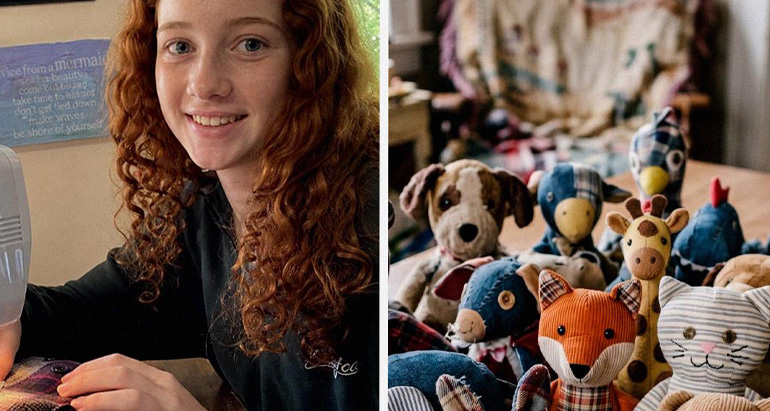
Emily borrowed a sewing machine from our neighbor, Mrs. Carter. Soon the table was covered with fabric pieces, thread, stuffing, paper patterns, scissors, buttons, chalk, and tiny scraps cut from Daniel’s old clothes.
Everywhere I looked, there were pieces of him.
One evening, Emily walked over carrying the first toy she finished.
It was a stuffed rabbit made from one of Daniel’s old plaid shirts.
The second I saw it, tears filled my eyes.
“Mom?” Emily touched my arm gently.
“It’s okay,” I whispered with a shaky smile. “These are happy tears.”
And they truly were.
For weeks, Emily worked every afternoon after school. She stitched rabbits, bears, foxes, and little elephants. She wanted every child at the orphanage to get one, but she also wanted each toy to feel special and different.
She poured all her love into every stitch.
Finally, yesterday, we loaded the toys into boxes and drove to the orphanage.
The children’s room was bright and noisy, with colorful posters on the walls and cartoons playing softly on an old television in the corner.
The moment Emily opened the boxes, children rushed toward her.
A small boy with a runny nose grabbed a stuffed fox and hugged it tightly against his chest like he was afraid someone would take it away.
A little girl rubbed the soft ear of a rabbit against her cheek and smiled.
Another child shouted happily, “Look! Mine has little blue buttons!”
I stood near the doorway watching my daughter, and for a moment, it honestly felt like Daniel was standing beside me again.
“Our girl did something beautiful,” I whispered under my breath. “You’d be so proud of her, Dan.”
I thought that was the end of the story.
I was wrong.
The next morning, everything changed.
A loud knock echoed through the house.
When I opened the front door, two police officers were standing on the porch.
One was older, with gray hair near his temples. The younger officer stood beside him holding a clear evidence bag.
Inside the bag was one of Emily’s stuffed bears.
For a second, my brain could not process what I was seeing.
Then the older officer spoke.
“Ma’am,” he said seriously, “were you the ones who donated toys to the orphanage yesterday?”
“Yes,” I answered slowly. “My daughter made them. Why?”
The officers exchanged a glance.
“Where is your daughter?” the younger officer asked.
A cold chill rushed through me.
“She’s upstairs sleeping,” I said carefully. “What’s going on?”
The younger officer lifted the evidence bag slightly.
“Ma’am,” he said, “don’t you know what your daughter has done?”
My stomach dropped.
“What are you talking about?”
The older officer spoke calmly. “It’s better if we explain once your daughter is here. We need to ask her some questions.”
My heart started pounding.
I called Emily downstairs.
She came down wearing an oversized T-shirt, rubbing sleep from her eyes. But the second she saw the officers, she froze on the staircase.
“Mom?”
The younger officer held up the toy.
“Emily, did you make this bear?”
She looked confused. “Yeah… I made it for one of the kids at the orphanage.”
“What material did you use?”
“My dad’s old clothes,” she answered slowly.
The officer nodded.
“When the toy was cleaned last night,” he explained, “a staff member felt something hidden inside it.”
Emily blinked in surprise.
“Hidden?” I repeated.
The officer opened a folder and carefully pulled out another plastic sleeve.
Inside was a folded handwritten note and an old check.
My knees suddenly felt weak.
“The toy was opened,” the officer explained, “and these were found sewn inside.”
Emily stared at the bag.
“I… I didn’t know,” she whispered. “I didn’t check all the pockets. Sometimes I felt paper in some of the clothes, but…” Her voice cracked. “I thought maybe it was okay to leave them there. Like little pieces of Dad.”
I sat down hard on the stairs because my legs could no longer hold me.
The check was signed by Daniel.
It was dated five years earlier.
It had never been cashed.
And the note… the note was written in Daniel’s handwriting.
Emily stepped closer beside me.
“Mom,” she whispered, “what does it say?”
My hands shook as I read the words out loud.
“For Marcus’s school clothes and supplies. Ask again why last month’s donor box never reached the boys’ room.”
The entire house fell silent.
Emily looked up at me, confused and scared.
“What does that mean?”
The older officer answered carefully.
“That’s exactly what we’re trying to figure out.”
He explained that when the orphanage worker found the note, they reported it immediately because it suggested donations meant for the children may never have reached them.
Then something awful began forming in the back of my mind.
Emily suddenly looked at me.
“Mom… Dad kept records of everything.”
I stared at her.
She was right.
Daniel had always written things down.
Everything.
I stood up slowly and led the officers to the hall closet.
From the back, I pulled out the old boxes filled with Daniel’s notebooks, folders, receipts, and diaries.
I cut open the tape.
Inside were stacks of papers, church bulletins, visitor badges from the orphanage, supply lists, receipts, and finally, buried beneath loose pages, a black notebook with Daniel’s name written across the front.
I opened it carefully.
At first, the pages were exactly what I expected.
Children’s names.
Coat sizes.
Lists of school supplies.
Tiny notes like:
“Maya hates bananas.”
“Jerome likes the red crayons best.”
Daniel had always noticed little things about people.
But then I turned another page.
And my blood ran cold.
“Donation check to orphanage missing — not cashed.”
“Children never received toy shipment from 07/05.”
“Ask Mrs. Caldwell again about missing supplies.”
Emily leaned over my shoulder.
“Oh no,” she whispered. “Was somebody stealing from the orphanage?”
The older officer read quietly over my shoulder and sighed heavily.
“We can’t make accusations yet,” he said, “but we definitely need to speak with the orphanage board.”
Not long later, Emily and I got dressed and drove to the orphanage with the notebook.
The car ride was silent except for the nervous twisting of Emily’s fingers in her lap.
At the orphanage, the director, Mrs. Caldwell, met us in her office.
A board member named Mr. Levin was already there too. He looked tired and irritated, like someone dragged out of bed on his day off.
The second Mrs. Caldwell saw the police officers, the polite smile on her face disappeared.
“I wish this had been handled more discreetly,” she said stiffly.
I stared at her in disbelief.
“Discreetly?”
She folded her hands tightly together.
“These toys were distributed without proper review,” she replied. “There are procedures for outside items, and now undocumented materials have complicated our records.”
Beside me, Emily shrank lower into her chair.
Anger rushed through me so fast it made my face burn.
“A toy contained a hidden note and an uncashed check from a volunteer who worked here for years,” I snapped. “That is not a complication. That is a warning.”
One of the officers placed Daniel’s notebook onto the desk.
Mr. Levin frowned. “What’s this?”
“My husband’s records,” I answered. “Notes about donations that never reached the children.”
Mrs. Caldwell recovered quickly.
“Records from that time period were inconsistent,” she said.
“Inconsistent?” I repeated sharply. “Is that what we’re calling missing donations meant for children?”
Her jaw tightened.
“We were understaffed.”
Then Emily spoke quietly.
“Kids aren’t paperwork.”
The room became completely still.
Mrs. Caldwell looked at her with forced patience.
“I know this is emotional,” she said, “but managing a facility like this is extremely difficult.”
Emily lifted her chin.
“No,” she replied softly but firmly. “I understand enough. My dad was trying to help people, and somebody ignored him.”
At that moment, I saw Daniel in her more clearly than ever before.
Mr. Levin opened the notebook and slowly flipped through the pages.
The more he read, the more serious his face became.
Finally, he looked directly at Mrs. Caldwell.
“Why was this never brought to the board?”
She shifted uncomfortably in her chair.
“I don’t remember the details.”
I leaned forward.
“I do remember Daniel coming home upset sometimes,” I said. “He told me things moved too slowly here. I thought he meant paperwork and bureaucracy. I didn’t realize he was documenting missing donations because nobody else would.”
Mrs. Caldwell’s voice became sharp.
“Your husband was a volunteer, not an auditor.”
“No,” I replied firmly. “He was a man who couldn’t stand seeing children forgotten.”
After that meeting, everything changed.
Mr. Levin ordered a full internal investigation.
The officers copied pages from Daniel’s notebook. Old donation records were pulled. Staff members were questioned.
And little by little, Mrs. Caldwell stopped looking annoyed and started looking trapped.
A week later, Emily and I returned for another meeting with the orphanage board and senior staff.
This time, the atmosphere felt completely different.
Nobody looked defensive anymore.
They looked ashamed.
Mr. Levin spoke first.
“We discovered several serious gaps in donation tracking from that period,” he admitted. “Some donations were mishandled. Others were never properly documented. We are immediately creating a transparent tracking system to make sure this never happens again.”
Emily sat quietly beside me with Daniel’s notebook resting on her lap.
Over the past week, we had read every page together.
Some pages were full of kindness.
Notes about children who needed winter boots.
Lists of kids afraid of thunderstorms.
Reminders about birthdays.
Little details about favorite dinosaurs and favorite colors.
But mixed between all those caring notes were unfinished promises.
I looked around the room and said quietly, “We found more records in Daniel’s boxes. More notes about donations he was still trying to track. I don’t want those boxes sitting in a closet for another four years.”
One staff member wiped tears from her eyes.
Mr. Levin nodded slowly.
“Those records may help us repair the damage that was done.”
Emily looked down at the notebook, then back up again.
“No,” she said softly. “They’ll help us finish what he started.”
I looked at my daughter sitting beside me with tiny needle marks on her fingers and her father’s stubborn, loving heart beating inside her chest.
For years, I had treated grief like a locked room I would never escape from.
Dark.
Silent.
Airless.
But Daniel had already found a way out before I ever did.
He left pieces of himself everywhere.
In kindness.
In promises.
In handwritten notes.
In the children he cared about.
And most of all, in our daughter.
For the first time in years, I took a deep breath.
And it didn’t hurt nearly as much anymore.
